


prEN 12814-6
(Main)Testing of welded joints of thermoplastics semi-finished products - Part 6: Low temperature tensile test
Testing of welded joints of thermoplastics semi-finished products - Part 6: Low temperature tensile test
This document specifies the dimensions, the method of sampling and the preparation of the test specimens, also the conditions for performing the low temperature tensile test perpendicular to the weld in order to determine the low temperature tensile welding factor.
A low temperature tensile test can be used in conjunction with other tests (e.g. bend, tensile creep, macro) to assess the performance of welded assemblies, made from thermoplastics materials.
The low temperature tensile welding factor and the appearance of the fracture surface provide a guide regarding the ductility of the joint and the quality of the work.
The test is applicable to co-axial or co-planar welded assemblies made from thermoplastics materials filled or unfilled, but not reinforced, irrespective of the welding process used.
The test is not applicable for co-axial welded assemblies of an external diameter less than 20 mm.
Prüfen von Schweißverbindungen aus thermoplastischen Kunststoffen - Teil 6: Zugversuch bei tiefen Temperaturen
Dieses Dokument legt die Maße, das Probenahmeverfahren und die Vorbereitung der Proben sowie die Bedingungen für die Durchführung der Zugprüfung bei tiefen Temperaturen senkrecht zur Schweißnaht fest, um den Zug-Schweißfaktor bei tiefen Temperaturen zu bestimmen.
Eine Zugprüfung bei tiefen Temperaturen kann in Verbindung mit weiteren Prüfungen (z. B. Biegeprüfung, Zeitstand-Zugprüfung, makroskopische Untersuchung) angewendet werden, um die Gebrauchstauglichkeit von geschweißten Baugruppen aus thermoplastischen Kunststoffen zu beurteilen.
Der Zug-Schweißfaktor bei tiefen Temperaturen und das Aussehen der Bruchfläche stellen ein Hilfsmittel für die Bewertung der Dehnbarkeit der Verbindung und die Qualität der Schweißung dar.
Die Prüfung ist auf koaxiale oder in einer Ebene liegende Schweißverbindungen anwendbar, die aus gefüllten oder ungefüllten, nicht aber aus verstärkten thermoplastischen Kunststoffen bestehen.
Die Prüfung ist nicht anwendbar für koaxiale Baugruppen mit einem Außendurchmesser < 20 mm.
Essais des assemblages soudés sur produits semi-finis en thermoplastiques - Partie 6 : Essai de traction à basse température
Le présent document spécifie les dimensions, la méthode de prélèvement et de préparation des éprouvettes, ainsi que les conditions d'exécution de l'essai de traction à basse température effectué perpendiculairement à la soudure, afin de déterminer le facteur de soudage en traction à basse température.
Un essai de traction à basse température peut être effectué en combinaison avec d'autres essais (par exemple essai de pliage, essai de fluage en traction, examen macrographique, etc.) afin d'évaluer les performances des assemblages soudés en thermoplastiques.
Le facteur de soudage en traction à basse température et l'aspect de la surface de rupture renseignent sur la ductilité de la soudure et la qualité des travaux de soudage.
Cet essai est applicable aux assemblages soudés dans le même axe ou le même plan, en thermoplastiques chargés ou non chargés, mais non renforcés, quel que soit le procédé de soudage utilisé.
Cet essai n'est pas applicable aux assemblages soudés dans le même axe ayant un diamètre extérieur inférieur à 20 mm.
Preskus zvarjenih spojev plastomernih polizdelkov - 6. del: Trgalni preskus pri nizki temperaturi
General Information
- Status
- Not Published
- Publication Date
- 19-Aug-2026
- Technical Committee
- CEN/TC 249 - Plastics
- Drafting Committee
- CEN/TC 249/WG 16 - Welding of thermoplastics
- Current Stage
- 4599 - Dispatch of FV draft to CMC - Finalization for Vote
- Start Date
- 02-Mar-2026
- Due Date
- 11-May-2026
- Completion Date
- 02-Mar-2026
Relations
- Effective Date
- 07-Aug-2024
Overview
prEN 12814-6:2025, titled Testing of welded joints of thermoplastics semi-finished products - Part 6: Low temperature tensile test, is a European standard developed by CEN Technical Committee TC 249 “Plastics”. This standard specifies procedures for preparing and testing welded joints of thermoplastic materials under low temperature conditions. The main objective is to determine the low temperature tensile welding factor-a critical indicator of joint ductility and weld quality.
Applicable to co-axial or co-planar welded assemblies made from filled or unfilled thermoplastics (excluding reinforced materials), prEN 12814-6 addresses test specimen dimensions, sampling methods, mechanical testing conditions, and reporting requirements. However, it excludes co-axial welded assemblies with external diameters less than 20 mm.
Key Topics
Scope and Application
The standard applies to semi-finished thermoplastic products with welded joints and focuses on the low temperature tensile test performed perpendicular to the weld line.Test Specimen Preparation
Specimens are sampled from the same test piece-both welded and unwelded-and cut at least eight hours after welding. The document details specific dimensions and tolerances, including length, width, and radii for both co-axial and flat specimens.Mechanical Testing Conditions
Tests are conducted at low temperatures with a constant rate of displacement until brittle fracture occurs. Temperature variation during testing must not exceed ±5 °C. The test speed and temperature parameters can be selected according to material, referenced in Annex A (e.g., PVDF tested at –40 °C with 50 mm/min speed).Calculation of Low Temperature Tensile Welding Factor
This welding factor (f_t) is calculated from the ratio of mean fracture stresses of welded specimens (σ_w) to unwelded specimens (σ_r), providing a quantitative measure of weld strength and performance under cold environments.Visual and Fracture Surface Examination
The fracture surface appearance after testing provides qualitative insight into the ductility and quality of the weld. Visual inspection, including compliance with EN 13100-1 standards for weld examination, is compulsory before and after testing.Reporting Requirements
The test report must reference prEN 12814-6 and document detailed specimen descriptions, test conditions, measured forces and stresses, visual assessments, and calculated welding factors, ensuring reproducibility and quality assurance.
Applications
prEN 12814-6 is essential for industries and professionals involved in:
Thermoplastics Fabrication and Welding
Ensuring the mechanical integrity of welded joints in thermoplastic piping, containers, or structural components, particularly those exposed to sub-zero operating conditions.Quality Control and Certification
Quality assurance labs use this standardized test to verify the consistency and reliability of welds, aiding certifying bodies and manufacturers in compliance validation.Material Qualification and Research
Provides a benchmark method for research on weldability and performance of various thermoplastics under low temperature stress, supporting material development and process optimization.Safety and Reliability Assessments
Particularly relevant in sectors such as chemical processing, water supply, and HVAC systems, where thermoplastic welds must maintain strength and ductility despite harsh environments.
Related Standards
prEN 12814-6 complements and references several other relevant standards:
EN 12814 Series
Covers other testing methods related to welded joints of thermoplastics semi-finished products, including bend tests, tensile creep, and macro tests.EN 13100-1
Governs non-destructive visual examination of thermoplastic welded joints, used as a preliminary assessment before mechanical testing.EN ISO 291
Standard atmospheres for conditioning and testing plastics, relevant for ensuring consistent test environments.ISO 5893
Specifies requirements for tensile, flexural, and compression test equipment used in plastics testing, ensuring accurate and standardized mechanical measurements.
Keywords: low temperature tensile test, thermoplastics welded joints, prEN 12814-6, tensile welding factor, thermoplastic semi-finished products, weld quality, mechanical testing, thermoplastic welding standards, brittle fracture test, CEN standards.

Get Certified
Connect with accredited certification bodies for this standard

National Aerospace and Defense Contractors Accreditation Program (NADCAP)
Global cooperative program for special process quality in aerospace.
CARES (UK Certification Authority for Reinforcing Steels)
UK certification for reinforcing steels and construction.
DVS-ZERT GmbH
German welding certification society.
Sponsored listings
Frequently Asked Questions
prEN 12814-6 is a draft published by the European Committee for Standardization (CEN). Its full title is "Testing of welded joints of thermoplastics semi-finished products - Part 6: Low temperature tensile test". This standard covers: This document specifies the dimensions, the method of sampling and the preparation of the test specimens, also the conditions for performing the low temperature tensile test perpendicular to the weld in order to determine the low temperature tensile welding factor. A low temperature tensile test can be used in conjunction with other tests (e.g. bend, tensile creep, macro) to assess the performance of welded assemblies, made from thermoplastics materials. The low temperature tensile welding factor and the appearance of the fracture surface provide a guide regarding the ductility of the joint and the quality of the work. The test is applicable to co-axial or co-planar welded assemblies made from thermoplastics materials filled or unfilled, but not reinforced, irrespective of the welding process used. The test is not applicable for co-axial welded assemblies of an external diameter less than 20 mm.
This document specifies the dimensions, the method of sampling and the preparation of the test specimens, also the conditions for performing the low temperature tensile test perpendicular to the weld in order to determine the low temperature tensile welding factor. A low temperature tensile test can be used in conjunction with other tests (e.g. bend, tensile creep, macro) to assess the performance of welded assemblies, made from thermoplastics materials. The low temperature tensile welding factor and the appearance of the fracture surface provide a guide regarding the ductility of the joint and the quality of the work. The test is applicable to co-axial or co-planar welded assemblies made from thermoplastics materials filled or unfilled, but not reinforced, irrespective of the welding process used. The test is not applicable for co-axial welded assemblies of an external diameter less than 20 mm.
prEN 12814-6 is classified under the following ICS (International Classification for Standards) categories: 25.160.40 - Welded joints and welds. The ICS classification helps identify the subject area and facilitates finding related standards.
prEN 12814-6 has the following relationships with other standards: It is inter standard links to EN 12814-6:2000. Understanding these relationships helps ensure you are using the most current and applicable version of the standard.
prEN 12814-6 is available in PDF format for immediate download after purchase. The document can be added to your cart and obtained through the secure checkout process. Digital delivery ensures instant access to the complete standard document.
Standards Content (Sample)
SLOVENSKI STANDARD
01-julij-2025
Preskus zvarjenih spojev plastomernih polizdelkov - 6. del: Trgalni preskus pri
nizki temperaturi
Testing of welded joints of thermoplastics semi-finished products - Part 6: Low
temperature tensile test
Prüfen von Schweißverbindungen aus thermoplastischen Kunststoffen - Teil 6:
Zugversuch bei tiefen Temperaturen
Essais des assemblages soudés sur produits semi-finis en thermoplastiques - Partie 6 :
Essai de traction à basse température
Ta slovenski standard je istoveten z: prEN 12814-6
ICS:
25.160.40 Varjeni spoji in vari Welded joints and welds
2003-01.Slovenski inštitut za standardizacijo. Razmnoževanje celote ali delov tega standarda ni dovoljeno.
DRAFT
EUROPEAN STANDARD
NORME EUROPÉENNE
EUROPÄISCHE NORM
June 2025
ICS 25.160.40 Will supersede EN 12814-6:2000
English Version
Testing of welded joints of thermoplastics semi-finished
products - Part 6: Low temperature tensile test
Essais des assemblages soudés sur produits semi-finis Prüfen von Schweißverbindungen aus
en thermoplastiques - Partie 6 : Essai de traction à thermoplastischen Kunststoffen - Teil 6: Zugversuch
basse température bei tiefen Temperaturen
This draft European Standard is submitted to CEN members for enquiry. It has been drawn up by the Technical Committee
CEN/TC 249.
If this draft becomes a European Standard, CEN members are bound to comply with the CEN/CENELEC Internal Regulations
which stipulate the conditions for giving this European Standard the status of a national standard without any alteration.
This draft European Standard was established by CEN in three official versions (English, French, German). A version in any other
language made by translation under the responsibility of a CEN member into its own language and notified to the CEN-CENELEC
Management Centre has the same status as the official versions.
CEN members are the national standards bodies of Austria, Belgium, Bulgaria, Croatia, Cyprus, Czech Republic, Denmark, Estonia,
Finland, France, Germany, Greece, Hungary, Iceland, Ireland, Italy, Latvia, Lithuania, Luxembourg, Malta, Netherlands, Norway,
Poland, Portugal, Republic of North Macedonia, Romania, Serbia, Slovakia, Slovenia, Spain, Sweden, Switzerland, Türkiye and
United Kingdom.
Recipients of this draft are invited to submit, with their comments, notification of any relevant patent rights of which they are
aware and to provide supporting documentation.
Warning : This document is not a European Standard. It is distributed for review and comments. It is subject to change without
notice and shall not be referred to as a European Standard.
EUROPEAN COMMITTEE FOR STANDARDIZATION
COMITÉ EUROPÉEN DE NORMALISATION
EUROPÄISCHES KOMITEE FÜR NORMUNG
CEN-CENELEC Management Centre: Rue de la Science 23, B-1040 Brussels
© 2025 CEN All rights of exploitation in any form and by any means reserved Ref. No. prEN 12814-6:2025 E
worldwide for CEN national Members.
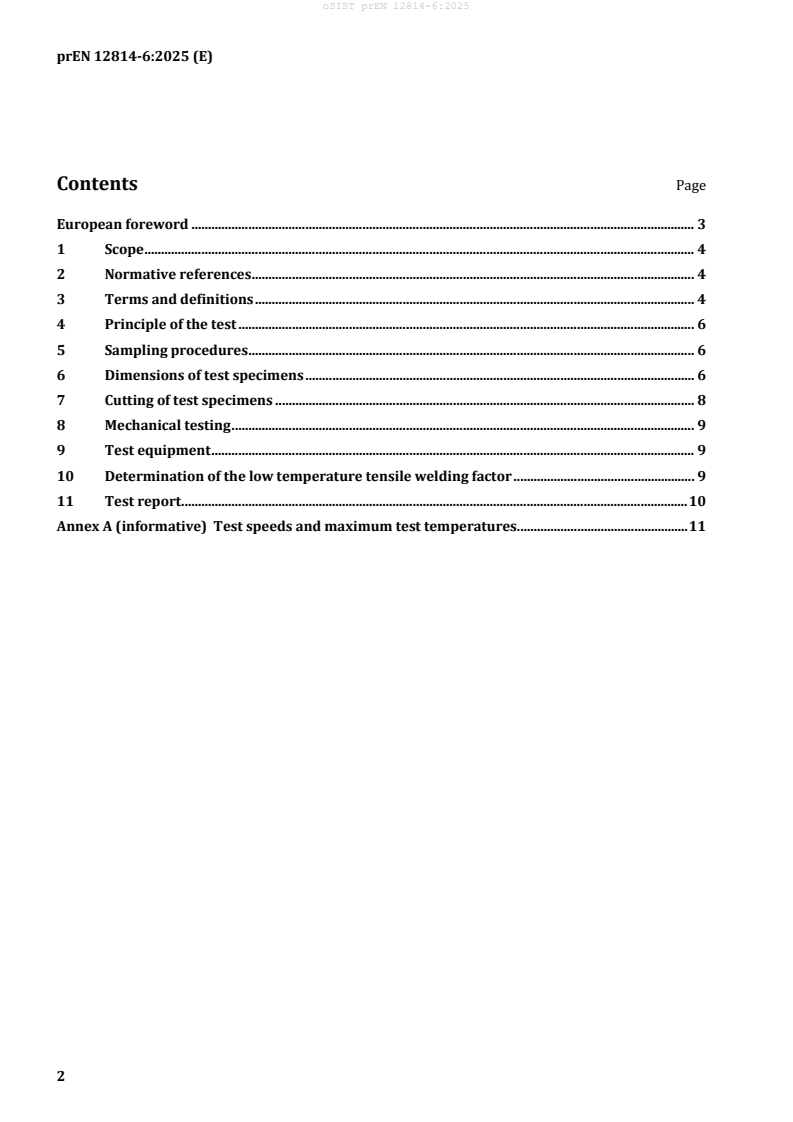
Contents Page
European foreword . 3
1 Scope . 4
2 Normative references . 4
3 Terms and definitions . 4
4 Principle of the test . 6
5 Sampling procedures . 6
6 Dimensions of test specimens . 6
7 Cutting of test specimens . 8
8 Mechanical testing . 9
9 Test equipment . 9
10 Determination of the low temperature tensile welding factor . 9
11 Test report . 10
Annex A (informative) Test speeds and maximum test temperatures . 11
European foreword
This document (prEN 12814-6:2025) has been prepared by Technical Committee CEN/TC 249 “Plastics”,
the secretariat of which is held by SIS.
This document is currently submitted to the CEN Enquiry.
This document will supersede EN 12814-6:2000.
EN 12814-6:2000:
— It has been clarified that if one test specimen yields, all of the test specimens cut from both the welded
and unwelded test piece shall be tested at a temperature/speed that generates brittle fracture, not
just one specimen.
A list of all parts in a series can be found on the CEN website: https://www.cencenelec.eu/
1 Scope
This document specifies the dimensions, the method of sampling and the preparation of the test
specimens, also the conditions for performing the low temperature tensile test perpendicular to the weld
in order to determine the low temperature tensile welding factor.
A low temperature tensile test can be used in conjunction with other tests (e.g. bend, tensile creep, macro)
to assess the performance of welded assemblies, made from thermoplastics materials.
The low temperature tensile welding factor and the appearance of the fracture surface provide a guide
regarding the ductility of the joint and the quality of the work.
The test is applicable to co-axial or co-planar welded assemblies made from thermoplastics materials
filled or unfilled, but not reinforced, irrespective of the welding process used.
The test is not applicable for co-axial welded assemblies of an external diameter less than 20 mm.
2 Normative references
The following documents are referred to in the text in such a way that some or all of their content
constitutes requirements of this document. For dated references, only the edition cited applies. For
undated references, the latest edition of the referenced document (including any amendments) applies.
EN ISO 291, Plastics - Standard atmospheres for conditioning and testing (ISO 291)
EN 13100-1, Non destructive testing of welded joints of thermoplastics semi-finished products - Part 1:
Visual examination
ISO 5893, Rubber and plastics test equipment — Tensile, flexural and compression types (constant rate of
traverse) — Specification
3 Terms and definitions
For the purposes of this document, the following t
...
Questions, Comments and Discussion
Ask us and Technical Secretary will try to provide an answer. You can facilitate discussion about the standard in here.
Loading comments...