


EN 12662-2:2024
(Main)Liquid petroleum products - Determination of total contamination - Part 2: Fatty acid methyl esters
General Information
- Abstract
This document specifies a method for the determination of the content of undissolved substances, referred to as total contamination, in neat fatty acid methyl esters (FAME). The working range is from 5 mg/kg to 27 mg/kg and it was established in an interlaboratory study by applying EN ISO 4259-1 [1].
This document in general is applicable to FAME having a kinematic viscosity not exceeding 8 mm2/s at 20 °C, or 5 mm2/s at 40 °C, e.g. as specified in EN 14214 [2].
This test method can be used for FAME having a kinematic viscosity exceeding 8 mm2/s at 20 °C, or 5 mm2/s at 40 °C, however in such cases the precision of the test method has not been determined.
NOTE For the purposes of this document, the term “% (V/V)” is used to represent the volume fraction, φ, of a material.
WARNING - The use of this document can involve hazardous materials, operations and equipment. This document does not purport to address all of the safety problems associated with its use. It is the responsibility of the user of this document to establish appropriate safety and health practices and determine the applicability of regulatory limitations prior to use.
- Status
- Published
- Publication Date
- 04-Jun-2024
- Technical Committee
- CEN/TC 19 - Petroleum products, lubricants and related products
- Drafting Committee
- CEN/TC 19/WG 31 - Total contamination
- Current Stage
- 6060 - Definitive text made available (DAV) - Publishing
- Start Date
- 05-Jun-2024
- Due Date
- 13-May-2024
- Completion Date
- 05-Jun-2024

Overview
EN 12662-2:2024 - Liquid petroleum products - Determination of total contamination - Part 2: Fatty acid methyl esters (FAME) - is a CEN standard that specifies a vacuum filtration method to determine the total contamination (undissolved substances) in neat FAME. The validated working range is 5 mg/kg to 27 mg/kg, based on an interlaboratory study using EN ISO 4259-1. The method is primarily applicable to FAME with a kinematic viscosity ≤ 8 mm²/s at 20 °C or ≤ 5 mm²/s at 40 °C (for example as specified in EN 14214). Use beyond these viscosity limits is possible, but precision has not been established.
Key topics and technical requirements
- Principle: Weigh a test portion, filter under vacuum through a pre‑weighed glass-fibre filter, wash, dry and reweigh. Calculate contamination as mg/kg.
- Working range & precision: 5–27 mg/kg; precision was determined by an interlaboratory study (EN ISO 4259-1).
- Sample preparation: Heat neat FAME to 60 °C for ≥2 h to re-dissolve separated components, then homogenize by manual shaking (specified strokes and timings).
- Filtration & equipment:
- Glass-fibre filters, 47 mm diameter, ~0.7 μm mean pore size (e.g., Whatman GF‑F noted as suitable).
- Filtration apparatus capable of absolute pressure 2–5 kPa (vacuum source), static oven (110 ± 5 °C), desiccator, analytical balance (0.1 mg).
- Reagents: heptane (≥99.0 % V/V) and propan-2-ol (≥99.0 % V/V).
- Cleaning & contamination control: Strict cleaning of sample containers and apparatus (detergent, water, propan-2-ol, heptane) and handling in a clean environment to avoid artefacts at low contamination levels.
- Sampling: Follow EN ISO 3170 (manual) or EN ISO 3171 (automatic pipeline) sampling procedures; use glass containers, protect from light, fill 80–85 % capacity.
- Safety: The document includes a warning about hazardous materials and operations; users must ensure appropriate safety practices.
Applications
- Routine quality control of biodiesel (neat FAME) production and storage.
- Acceptance testing for supplied FAME batches to prevent premature filter blockage and hardware failure in fuel systems.
- Laboratory testing for compliance, troubleshooting particulate-related engine or filter issues, and monitoring storage stability.
- Useful for fuel producers, independent test laboratories, engine manufacturers, fuel distributors and regulatory bodies.
Who should use this standard
- Fuel testing laboratories and QA/QC teams in biodiesel production
- Petroleum product certifiers and conformity assessors
- Engine and filter manufacturers evaluating fuel cleanliness
- Regulatory authorities and procurement teams specifying fuel quality
Related standards
- EN 14214 (FAME biodiesel specification)
- EN ISO 3170 / EN ISO 3171 (sampling of petroleum liquids)
- EN ISO 4259-1 (statistical analysis/precision evaluation)
- Supersedes EN 12662:2014 (method split into Part 1 and Part 2)
Relations
- Effective Date
- 27-Jul-2022
- Effective Date
- 12-Feb-2026
- Effective Date
- 28-Jan-2026
- Effective Date
- 28-Jan-2026
- Effective Date
- 28-Jan-2026
- Referred By
EN 16734:2022 - Automotive fuels - Automotive B10 diesel fuel - Requirements and test methods - Effective Date
- 28-Jan-2026
- Effective Date
- 28-Jan-2026
- Effective Date
- 28-Jan-2026
Get Certified
Connect with accredited certification bodies for this standard

Element Materials Technology
Materials testing and product certification.

ABS Group Brazil
ABS Group certification services in Brazil.

ABS Quality Evaluations Inc.
American Bureau of Shipping quality certification.
Sponsored listings
Frequently Asked Questions
EN 12662-2:2024 is a standard published by the European Committee for Standardization (CEN). Its full title is "Liquid petroleum products - Determination of total contamination - Part 2: Fatty acid methyl esters". This standard covers: This document specifies a method for the determination of the content of undissolved substances, referred to as total contamination, in neat fatty acid methyl esters (FAME). The working range is from 5 mg/kg to 27 mg/kg and it was established in an interlaboratory study by applying EN ISO 4259-1 [1]. This document in general is applicable to FAME having a kinematic viscosity not exceeding 8 mm2/s at 20 °C, or 5 mm2/s at 40 °C, e.g. as specified in EN 14214 [2]. This test method can be used for FAME having a kinematic viscosity exceeding 8 mm2/s at 20 °C, or 5 mm2/s at 40 °C, however in such cases the precision of the test method has not been determined. NOTE For the purposes of this document, the term “% (V/V)” is used to represent the volume fraction, φ, of a material. WARNING - The use of this document can involve hazardous materials, operations and equipment. This document does not purport to address all of the safety problems associated with its use. It is the responsibility of the user of this document to establish appropriate safety and health practices and determine the applicability of regulatory limitations prior to use.
This document specifies a method for the determination of the content of undissolved substances, referred to as total contamination, in neat fatty acid methyl esters (FAME). The working range is from 5 mg/kg to 27 mg/kg and it was established in an interlaboratory study by applying EN ISO 4259-1 [1]. This document in general is applicable to FAME having a kinematic viscosity not exceeding 8 mm2/s at 20 °C, or 5 mm2/s at 40 °C, e.g. as specified in EN 14214 [2]. This test method can be used for FAME having a kinematic viscosity exceeding 8 mm2/s at 20 °C, or 5 mm2/s at 40 °C, however in such cases the precision of the test method has not been determined. NOTE For the purposes of this document, the term “% (V/V)” is used to represent the volume fraction, φ, of a material. WARNING - The use of this document can involve hazardous materials, operations and equipment. This document does not purport to address all of the safety problems associated with its use. It is the responsibility of the user of this document to establish appropriate safety and health practices and determine the applicability of regulatory limitations prior to use.
EN 12662-2:2024 is classified under the following ICS (International Classification for Standards) categories: 75.160.20 - Liquid fuels; 75.160.40 - Biofuels. The ICS classification helps identify the subject area and facilitates finding related standards.
EN 12662-2:2024 has the following relationships with other standards: It is inter standard links to EN 12662:2014, ISO 32662-2:2025, EN ISO 3170:2025, EN ISO 3171:1999, EN 590:2022, EN 16734:2022, EN 15940:2023, CEN/TS 15940:2012. Understanding these relationships helps ensure you are using the most current and applicable version of the standard.
EN 12662-2:2024 is available in PDF format for immediate download after purchase. The document can be added to your cart and obtained through the secure checkout process. Digital delivery ensures instant access to the complete standard document.
Standards Content (Sample)
SLOVENSKI STANDARD
01-september-2024
Nadomešča:
SIST EN 12662:2014
Tekoči naftni proizvodi - Določanje celokupnih nečistoč - 2. del: Metilni estri
maščobnih kislin
Liquid petroleum products - Determination of total contamination - Part 2: Fatty acid
methyl esters
Flüssige Mineralölerzeugnisse - Bestimmung der Gesamtverschmutzung — Teil 2 :
Fettsäuremethylester
Produits pétroliers liquides - Détermination de la contamination totale — Partie 2 : Esters
méthyliques d’acides gras
Ta slovenski standard je istoveten z: EN 12662-2:2024
ICS:
75.160.20 Tekoča goriva Liquid fuels
2003-01.Slovenski inštitut za standardizacijo. Razmnoževanje celote ali delov tega standarda ni dovoljeno.
EN 12662-2
EUROPEAN STANDARD
NORME EUROPÉENNE
June 2024
EUROPÄISCHE NORM
ICS 75.160.20; 75.160.40 Supersedes EN 12662:2014
English Version
Liquid petroleum products - Determination of total
contamination - Part 2: Fatty acid methyl esters
Produits pétroliers liquides - Détermination de la Flüssige Mineralölerzeugnisse - Bestimmung der
contamination totale - Partie 2 : Esters méthyliques Gesamtverschmutzung - Teil 2: Fettsäure-Methylester
d'acides gras
This European Standard was approved by CEN on 8 April 2024.
CEN members are bound to comply with the CEN/CENELEC Internal Regulations which stipulate the conditions for giving this
European Standard the status of a national standard without any alteration. Up-to-date lists and bibliographical references
concerning such national standards may be obtained on application to the CEN-CENELEC Management Centre or to any CEN
member.
This European Standard exists in three official versions (English, French, German). A version in any other language made by
translation under the responsibility of a CEN member into its own language and notified to the CEN-CENELEC Management
Centre has the same status as the official versions.
CEN members are the national standards bodies of Austria, Belgium, Bulgaria, Croatia, Cyprus, Czech Republic, Denmark, Estonia,
Finland, France, Germany, Greece, Hungary, Iceland, Ireland, Italy, Latvia, Lithuania, Luxembourg, Malta, Netherlands, Norway,
Poland, Portugal, Republic of North Macedonia, Romania, Serbia, Slovakia, Slovenia, Spain, Sweden, Switzerland, Türkiye and
United Kingdom.
EUROPEAN COMMITTEE FOR STANDARDIZATION
COMITÉ EUROPÉEN DE NORMALISATION
EUROPÄISCHES KOMITEE FÜR NORMUNG
CEN-CENELEC Management Centre: Rue de la Science 23, B-1040 Brussels
© 2024 CEN All rights of exploitation in any form and by any means reserved Ref. No. EN 12662-2:2024 E
worldwide for CEN national Members.
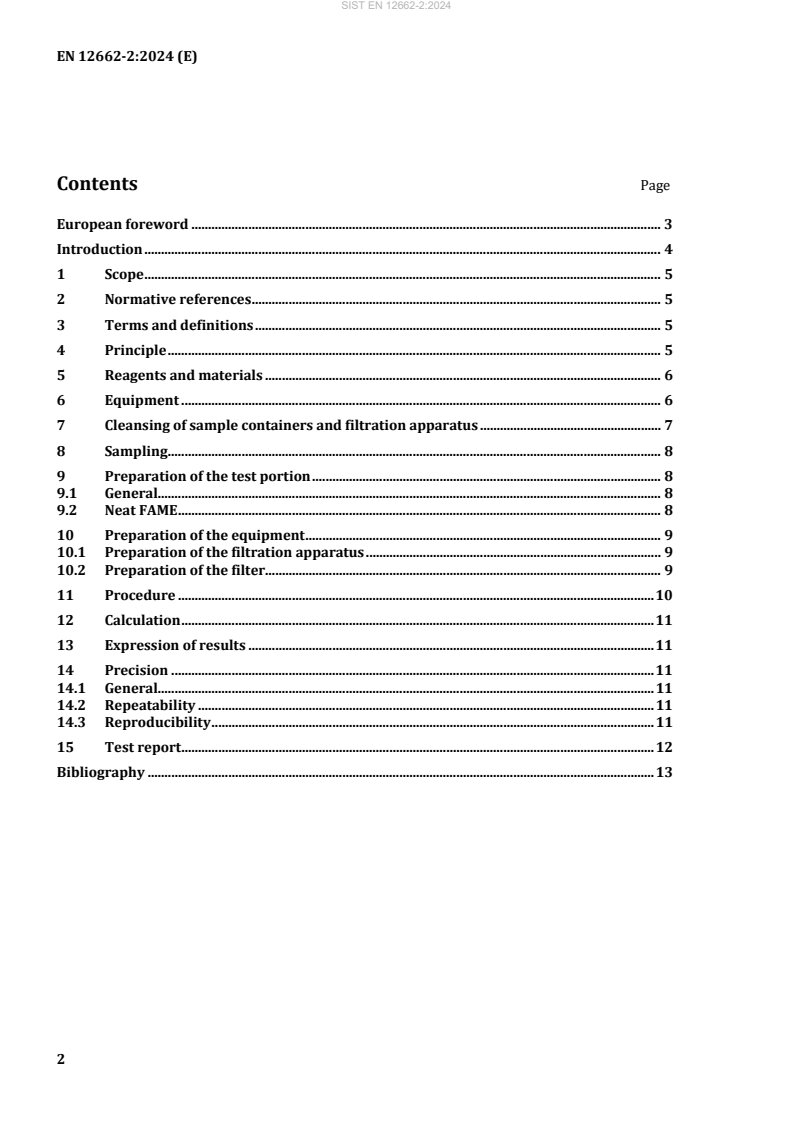
Contents Page
European foreword . 3
Introduction . 4
1 Scope . 5
2 Normative references . 5
3 Terms and definitions . 5
4 Principle . 5
5 Reagents and materials . 6
6 Equipment . 6
7 Cleansing of sample containers and filtration apparatus . 7
8 Sampling . 8
9 Preparation of the test portion . 8
9.1 General. 8
9.2 Neat FAME . 8
10 Preparation of the equipment . 9
10.1 Preparation of the filtration apparatus . 9
10.2 Preparation of the filter . 9
11 Procedure . 10
12 Calculation . 11
13 Expression of results . 11
14 Precision . 11
14.1 General. 11
14.2 Repeatability . 11
14.3 Reproducibility . 11
15 Test report . 12
Bibliography . 13
European foreword
This document (EN 12662-2:2024) has been prepared by Technical Committee CEN/TC 19 “Gaseous and
liquid fuels, lubricants and related products of petroleum, synthetic and biological origin”, the secretariat
of which is held by NEN.
This European Standard shall be given the status of a national standard, either by publication of an
identical text or by endorsement, at the latest by December 2024, and conflicting national standards shall
be withdrawn at the latest by December 2024.
Attention is drawn to the possibility that some of the elements of this document may be the subject of
patent rights. CEN shall not be held responsible for identifying any or all such patent rights.
This document supersedes EN 12662:2014.
In comparison with the previous edition, the following technical modifications have been made:
— split of the scope of the previous edition in two parts, with Part 2 covering the neat FAME in this
document and with Part 1 covering the middle distillates and the diesel fuels containing up to
30 % (V/V) of fatty acid methyl ester (FAME) in a separate document.
— update of the precision data following the statistical analysis [4] of the interlaboratory tests data
according to EN ISO 4259-1:2017 [1].
Any feedback and questions on this document should be directed to the users’ national standards body.
A complete listing of these bodies can be found on the CEN website.
According to the CEN-CENELEC Internal Regulations, the national standards organisations of the
following countries are bound to implement this European Standard: Austria, Belgium, Bulgaria, Croatia,
Cyprus, Czech Republic, Denmark, Estonia, Finland, France, Germany, Greece, Hungary, Iceland, Ireland,
Italy, Latvia, Lithuania, Luxembourg, Malta, Netherlands, Norway, Poland, Portugal, Republic of North
Macedonia, Romania, Serbia, Slovakia, Slovenia, Spain, Sweden, Switzerland, Türkiye and the United
Kingdom.
Introduction
Excessive contamination in a fuel system can give rise to premature blocking of filters and/or hardware
failure, and is therefore undesirable. The determination of the content of undissolved substances,
referred to as total contamination, is a way to control this issue.
In the previous version of this method, the scope was covering middle distillates, diesel fuels containing
up to 30 % (V/V) of FAME and neat FAME. It was found that the improvement sought in 2014, give
problems in the lab in testing FAME and correlate the results to those obtained with the previous version
of the method. A solution has been found, which resulted in splitting the methodology in two parts: to
include the previous version as Part 1 and to develop a separate standard for neat FAME as Part 2.
An interlaboratory study was conducted to determine the valid precision of the method for determining
total contamination in neat FAME according to this document.
1 Scope
This document specifies a method for the determination of the content of undissolved substances,
referred to as total contamination, in neat fatty acid methyl esters (FAME). The working range is from
5 mg/kg to 27 mg/kg and it was established in an interlaboratory study by applying EN ISO 4259-1 [1].
This document in general is applicable to FAME having a kinematic viscosity not exceeding 8 mm /s at
20 °C, or 5 mm /s at 40 °C, e.g. as specified in EN 14214 [2].
This test method can be used for FAME having a kinematic viscosity exceeding 8 mm /s at 20 °C, or
5 mm /s at 40 °C, however in such cases the precision of the test method has not been determined.
NOTE For the purposes of this document, the term “% (V/V)” is used to represent the volume fraction, φ, of a
material.
WARNING — The use of this document can involve hazardous materials, operations and equipment. This
document does not purport to address all of the safety problems associated with its use. It is the
responsibility of the user of this document to establish appropriate safety and health practices and
determine the applicability of regulatory limitations prior to use.
2 Normative references
The following documents are referred to in the text in such a way that some or all of their content
constitutes requirements of this document. For dated references, only the edition cited applies. For
undated references, the latest edition of the referenced document (including any amendments) applies.
EN ISO 3170, Petroleum liquids — Manual sampling (ISO 3170)
EN ISO 3171, Petroleum liquids — Automatic pipeline sampling (ISO 3171)
3 Terms and definitions
For the purposes of this document, the following terms and definitions apply.
ISO and IEC maintain terminology databases for use in standardization at the following addresses:
— ISO Online browsing platform: available at https://www.iso.org/obp
— IEC Electropedia: available at https://www.electropedia.org
3.1
total contamination
undissolved substances retained on a filter after filtration under test conditions
3.2
absolute pressure
pressure measured relative to zero pressure or a total vacuum
4 Principle
A sample portion is weighed and filtered under vacuum through a pre-weighed filter. The filter with the
residue is washed, dried and weighed. Contamination is calculated from the difference in mass of the filter
and expressed relative to the sample mass as mg/kg.
5 Reagents and materials
5.1 Heptane, with a purity no less than 99,0 % (V/V), filtered using a membrane filter (6.17).
NOTE Heptane used as a reference fuel in EN ISO 5164 [3] is suitable.
5.2 Propan-2-ol, with a purity no less than 99,0 % (V/V).
NOTE Propan-2-ol is used to dry glassware and the sample container after rinsing with water.
6 Equipment
All glassware and sample containers shall be carefully cleaned as described in Clause 7.
Usual laboratory apparatus and glassware, together with the following:
6.1 Filtration apparatus, suitable for a filter (6.2), as shown in Figure 1. A different filtration
apparatus may be used if it is suitable to take the filters given in 6.2.
6.2 Filters, of high retention glass fibre type, 47 mm in diameter and with a 0,7 μm mean pore size.
NOTE Glass fibre filters Whatman GF-F type have been found suitable for total contamination measurements.
This information is given for the convenience of users of this document and does not constitute an endorsement by
CEN of this product.
6.3 Beakers, tall form 0,5 l and 1 l.
6.4 Cylinders, 500 ml and 1 000 ml graduated cylinders.
6.5 Glass bottles, 0,5 l and 1 l, with screw caps.
6.6 Oven, of the static type (without fan assisted circulation), explosion-proof, capable of heating to
(110 ± 5) °C.
6.7 Desiccator, containing freshly activated silica gel (or equivalent desiccant) with a moisture content
indicator.
6.8 Glass Petri dishes with covers, greater than 50 mm in diameter or an equivalent alternative to
handling the filter, which is FAME and temperature resistant, for example an aluminium bowl.
6.9 Analytical balance, capable of weighing to the nearest 0,1 mg.
6.10 Forceps, with roun
...