


EN 17255-4:2023
(Main)Stationary source emissions - Data acquisition and handling systems - Part 4: Specification of requirements for the installation and on-going quality assurance and quality control of data acquisition and handling systems
Stationary source emissions - Data acquisition and handling systems - Part 4: Specification of requirements for the installation and on-going quality assurance and quality control of data acquisition and handling systems
This document specifies the requirements for the installation and on-going quality assurance and quality control of data acquisition and handling systems (DAHS). This includes requirements on:
- installation (Clause 5);
- quality assurance and quality control during QAL2 (Clause 6);
- quality assurance and quality control during on-going operation (Clause 7);
- annual functional test (Clause 8);
- documentation (Clause 9).
This document supports the requirements of EN 14181 and legislation such as the IED [1], MCPD [2] and E-PRTR [3]. It does not preclude the use of additional features and functions provided the minimum requirements of this document are met and that these features do not adversely affect data quality, clarity or access.
Emissionen aus stationären Quellen - Datenerfassungs- und Auswerteeinrichtungen - Teil 4: Festlegung von Anforderungen an den Einbau sowie die laufende Qualitätssicherung und Qualitätslenkung von Datenerfassungs- und Auswerteeinrichtungen
Dieses Dokument legt die Anforderungen an den Einbau sowie die laufende Qualitätssicherung und Qualitätslenkung von Datenerfassungs- und Auswerteeinrichtungen (DAHS) fest. Dies beinhaltet Anforderungen an:
- den Einbau (Abschnitt 5);
- die Qualitätssicherung und Qualitätslenkung bei der QAL2 (Abschnitt 6);
- die Qualitätssicherung und Qualitätslenkung beim laufenden Betrieb (Abschnitt 7);
- die jährliche Funktionskontrolle (Abschnitt 8);
- Dokumentation (Abschnitt 9).
Dieses Dokument unterstützt die Anforderungen von EN 14181 sowie von Rechtsvorschriften wie IED [1], MCPD [2] und E-PRTR [3]. Sie schließt die Verwendung zusätzlicher Möglichkeiten und Funktionen unter der Voraussetzung nicht aus, dass die Mindestanforderungen in diesem Dokument erfüllt werden und diese Möglichkeiten die Qualität und Verständlichkeit der Daten sowie den Datenzugriff nicht negativ beeinträchtigen.
Émissions de sources fixes - Systèmes d'acquisition et de traitement de données - Partie 4: Spécification des exigences relatives à l'installation ainsi qu'à l'assurance qualité et au contrôle qualité en continu
Le présent document spécifie les exigences relatives à l'installation ainsi qu'à l'assurance qualité et au contrôle qualité en continu des systèmes d'acquisition et de traitement de données (DAHS). Elles couvrent notamment :
- l’installation (Article 5) ;
- l'assurance qualité et le contrôle qualité pendant la procédure QAL2 (Article 6) ;
- l'assurance qualité et le contrôle qualité pendant le fonctionnement en continu (Article 7) ;
- le test opérationnel annuel (Article 8) ;
- la documentation (Article 9).
Le présent document vient à l'appui des exigences de l'EN 14181 et de législations telles que la directive IED[1], la directive MCP[2] et le règlement relatif au PRTR européen[3]. Il n'interdit pas l'utilisation de caractéristiques et de fonctions supplémentaires, à condition que les exigences minimales du présent document soient remplies et que ces caractéristiques n'aient pas d'influence négative sur la qualité et la clarté des données ou sur l'accès à ces dernières.
Emisije nepremičnih virov - Sistemi za zajem in vrednotenje podatkov (DAHS) - 4. del: Specifikacija zahtev za vgradnjo ter postopki zagotavljanja kakovosti in kontrole kakovosti sistemov za zajem in vrednotenje podatkov
Ta dokument določa zahteve za namestitev ter stalno zagotavljanje in nadzor kakovosti sistemov za zajem in vrednotenje podatkov (DAHS). To vključuje zahteve za
– namestitev (točka 5);
– zagotavljanje in nadzor kakovosti v postopku QAL2 (točka 6);
– zagotavljanje in nadzor kakovosti pri stalnem delovanju (točka 7);
– letni funkcionalni preskus (točka 8).
Ta dokument podpira zahteve standarda EN 14181 in zakonodaje, kot so Direktiva o industrijskih izpustih (IED), Direktiva o srednje velikih kurilnih napravah (MCPD) ter uredba E-RIPO. Ne izključuje uporabe dodatnih značilnosti in funkcij, če so izpolnjene minimalne zahteve tega evropskega standarda in če te značilnosti ne vplivajo negativno na kakovost, jasnost ter dostop do podatkov.
General Information
Overview
EN 17255-4:2023 (CEN) is Part 4 of the EN 17255 series for stationary source emissions and specifies minimum requirements for the installation and the on-going quality assurance and quality control (QA/QC) of data acquisition and handling systems (DAHS). The standard covers installation checks, QA/QC during QAL2, QA/QC in routine operation, the annual functional test (AST) and required documentation. EN 17255-4:2023 supports EN 14181 and legislative frameworks such as the IED, MCPD and E-PRTR and applies to DAHS installed after the implementation date.
Key Topics
Installation requirements (Clause 5)
- Plant operator responsibility for correct DAHS installation in accordance with manufacturer and legal requirements.
- DAHS must be certified via a performance test per EN 17255-3.
Checking correct installation (Clause 5.2)
- Testing laboratory role to verify installation, perform tests and produce installation reports.
- Test requirements and competence of testing bodies are defined.
QA/QC during QAL2 (Clause 6)
- Procedures and checks to be carried out by testing laboratories while the automated measuring system (AMS) is at second quality assurance level (QAL2).
QA/QC during on-going operation (Clause 7)
- Plant operator responsibilities for routine validation, monitoring, and corrective actions to maintain data quality.
Annual functional test (Clause 8)
- Scope and structure of the AST: description of DAHS, assignment of inputs/outputs, configuration checks, data transmission, backup, protection against unauthorized changes, system time, averaging times and reporting.
Documentation (Clause 9 and Annex A)
- DAHS file composition and management: identification, installation, configuration, functional test reports, interventions and follow-up records. Parameter-setting guidance provided in Annex B.
Data types & flow
- DAHS accepts analogue or digital inputs from AMS or digital buses; it converts, averages, stores and reports data and plant-operational information required for regulatory reporting.
Applications & Who Uses It
- Plant operators managing emissions monitoring for combustion plants, waste incineration and industrial installations.
- Testing laboratories performing installation checks, QAL2 activities and annual functional tests.
- DAHS manufacturers and system integrators ensuring product conformity and certification.
- Environmental regulators and compliance auditors verifying DAHS meets legislative reporting requirements.
Practical benefits: consistent DAHS installation, improved data quality, secure and auditable reporting channels, and clearer allocation of responsibilities between operators and testing laboratories.
Related Standards
- EN 17255-1, EN 17255-2, EN 17255-3 (EN 17255 series)
- EN 14181 (QA for AMS)
- Legislative frameworks: IED, MCPD, E-PRTR
Keywords: EN 17255-4:2023, DAHS, data acquisition and handling systems, stationary source emissions, QA/QC, QAL2, annual functional test, EN 14181, IED, MCPD, E-PRTR.
Frequently Asked Questions
EN 17255-4:2023 is a standard published by the European Committee for Standardization (CEN). Its full title is "Stationary source emissions - Data acquisition and handling systems - Part 4: Specification of requirements for the installation and on-going quality assurance and quality control of data acquisition and handling systems". This standard covers: This document specifies the requirements for the installation and on-going quality assurance and quality control of data acquisition and handling systems (DAHS). This includes requirements on: - installation (Clause 5); - quality assurance and quality control during QAL2 (Clause 6); - quality assurance and quality control during on-going operation (Clause 7); - annual functional test (Clause 8); - documentation (Clause 9). This document supports the requirements of EN 14181 and legislation such as the IED [1], MCPD [2] and E-PRTR [3]. It does not preclude the use of additional features and functions provided the minimum requirements of this document are met and that these features do not adversely affect data quality, clarity or access.
This document specifies the requirements for the installation and on-going quality assurance and quality control of data acquisition and handling systems (DAHS). This includes requirements on: - installation (Clause 5); - quality assurance and quality control during QAL2 (Clause 6); - quality assurance and quality control during on-going operation (Clause 7); - annual functional test (Clause 8); - documentation (Clause 9). This document supports the requirements of EN 14181 and legislation such as the IED [1], MCPD [2] and E-PRTR [3]. It does not preclude the use of additional features and functions provided the minimum requirements of this document are met and that these features do not adversely affect data quality, clarity or access.
EN 17255-4:2023 is classified under the following ICS (International Classification for Standards) categories: 13.040.40 - Stationary source emissions. The ICS classification helps identify the subject area and facilitates finding related standards.
You can purchase EN 17255-4:2023 directly from iTeh Standards. The document is available in PDF format and is delivered instantly after payment. Add the standard to your cart and complete the secure checkout process. iTeh Standards is an authorized distributor of CEN standards.
Standards Content (Sample)
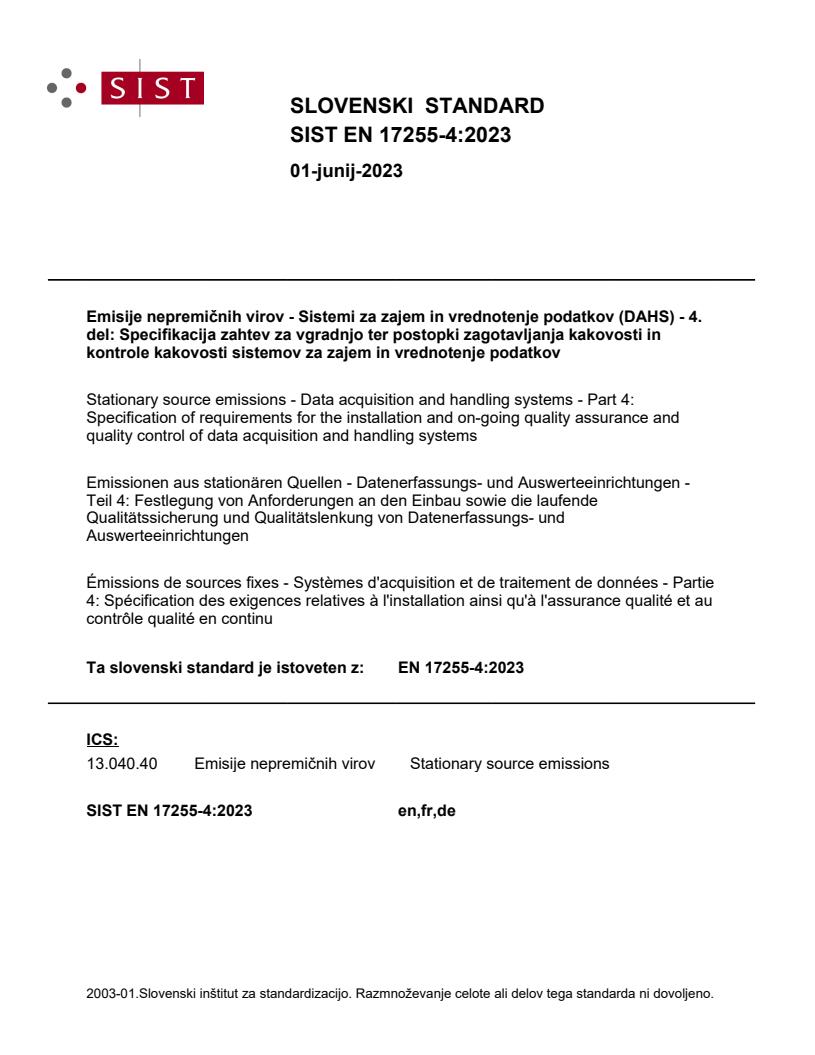
SLOVENSKI STANDARD
01-junij-2023
Emisije nepremičnih virov - Sistemi za zajem in vrednotenje podatkov (DAHS) - 4.
del: Specifikacija zahtev za vgradnjo ter postopki zagotavljanja kakovosti in
kontrole kakovosti sistemov za zajem in vrednotenje podatkov
Stationary source emissions - Data acquisition and handling systems - Part 4:
Specification of requirements for the installation and on-going quality assurance and
quality control of data acquisition and handling systems
Emissionen aus stationären Quellen - Datenerfassungs- und Auswerteeinrichtungen -
Teil 4: Festlegung von Anforderungen an den Einbau sowie die laufende
Qualitätssicherung und Qualitätslenkung von Datenerfassungs- und
Auswerteeinrichtungen
Émissions de sources fixes - Systèmes d'acquisition et de traitement de données - Partie
4: Spécification des exigences relatives à l'installation ainsi qu'à l'assurance qualité et au
contrôle qualité en continu
Ta slovenski standard je istoveten z: EN 17255-4:2023
ICS:
13.040.40 Emisije nepremičnih virov Stationary source emissions
2003-01.Slovenski inštitut za standardizacijo. Razmnoževanje celote ali delov tega standarda ni dovoljeno.
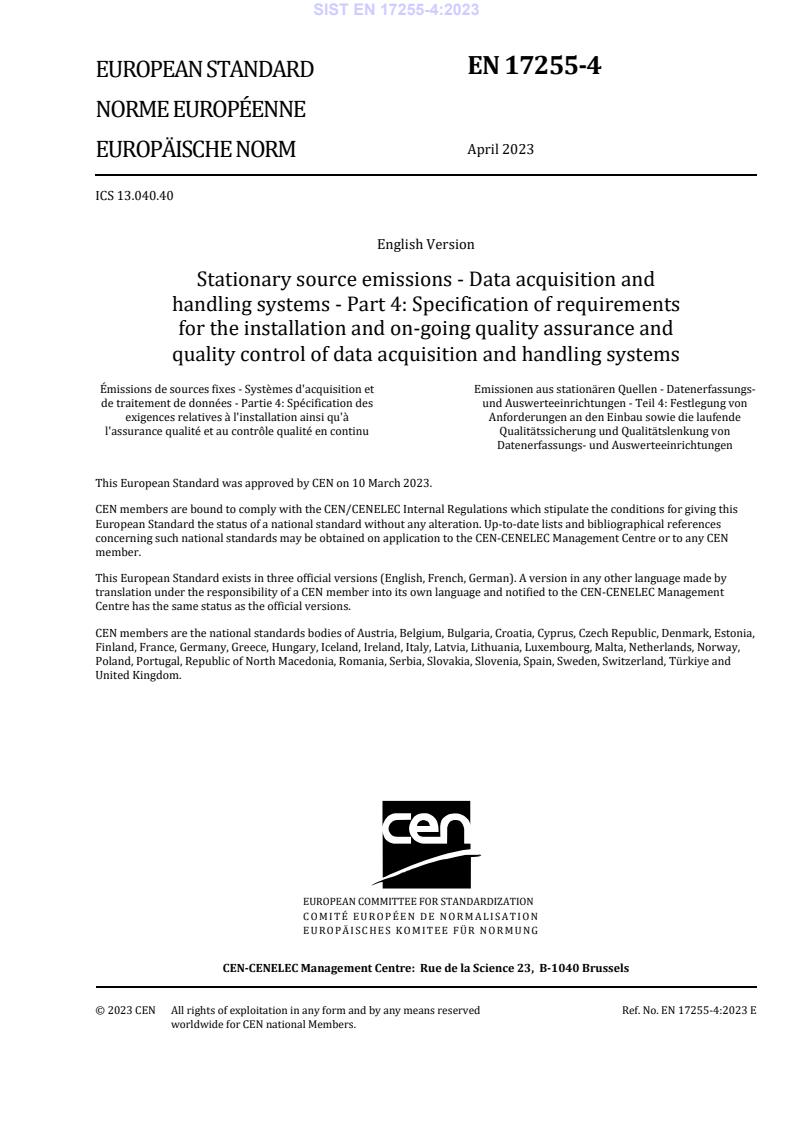
EN 17255-4
EUROPEAN STANDARD
NORME EUROPÉENNE
April 2023
EUROPÄISCHE NORM
ICS 13.040.40
English Version
Stationary source emissions - Data acquisition and
handling systems - Part 4: Specification of requirements
for the installation and on-going quality assurance and
quality control of data acquisition and handling systems
Émissions de sources fixes - Systèmes d'acquisition et Emissionen aus stationären Quellen - Datenerfassungs-
de traitement de données - Partie 4: Spécification des und Auswerteeinrichtungen - Teil 4: Festlegung von
exigences relatives à l'installation ainsi qu'à Anforderungen an den Einbau sowie die laufende
l'assurance qualité et au contrôle qualité en continu Qualitätssicherung und Qualitätslenkung von
Datenerfassungs- und Auswerteeinrichtungen
This European Standard was approved by CEN on 10 March 2023.
CEN members are bound to comply with the CEN/CENELEC Internal Regulations which stipulate the conditions for giving this
European Standard the status of a national standard without any alteration. Up-to-date lists and bibliographical references
concerning such national standards may be obtained on application to the CEN-CENELEC Management Centre or to any CEN
member.
This European Standard exists in three official versions (English, French, German). A version in any other language made by
translation under the responsibility of a CEN member into its own language and notified to the CEN-CENELEC Management
Centre has the same status as the official versions.
CEN members are the national standards bodies of Austria, Belgium, Bulgaria, Croatia, Cyprus, Czech Republic, Denmark, Estonia,
Finland, France, Germany, Greece, Hungary, Iceland, Ireland, Italy, Latvia, Lithuania, Luxembourg, Malta, Netherlands, Norway,
Poland, Portugal, Republic of North Macedonia, Romania, Serbia, Slovakia, Slovenia, Spain, Sweden, Switzerland, Türkiye and
United Kingdom.
EUROPEAN COMMITTEE FOR STANDARDIZATION
COMITÉ EUROPÉEN DE NORMALISATION
EUROPÄISCHES KOMITEE FÜR NORMUNG
CEN-CENELEC Management Centre: Rue de la Science 23, B-1040 Brussels
© 2023 CEN All rights of exploitation in any form and by any means reserved Ref. No. EN 17255-4:2023 E
worldwide for CEN national Members.
Contents Page
European foreword . 4
Introduction . 5
1 Scope . 6
2 Normative references . 6
3 Terms and definitions . 6
4 Symbols and abbreviations . 7
5 Installation . 7
5.1 Installation requirements . 7
5.2 Checking the correct installation . 8
5.2.1 General . 8
5.2.2 Test requirements . 8
5.2.3 Report . 9
5.2.4 Competence of testing laboratories . 9
6 Quality assurance and quality control during QAL2 of the AMS . 9
7 Quality assurance and quality control during on-going operation . 9
8 Annual functional test . 10
8.1 General . 10
8.2 Description of the DAHS . 10
8.3 Assignment of input and output signals . 10
8.4 Tests . 10
8.4.1 Correct setting of parameters . 10
8.4.2 Configuration parameters. 11
8.4.3 Requirements of regulatory stipulations . 11
8.4.4 Remote emission control module . 11
8.4.5 System time . 11
8.4.6 Conformity of the installation site . 11
8.4.7 Data transmission . 12
8.4.8 Protection against unauthorized parameter changes . 12
8.4.9 Data back-up . 12
8.4.10 Additionally required functionality for data transmission . 12
8.4.11 Averaging times . 12
8.4.12 Processing of plant operation modes . 12
8.4.13 Special features of the measured value processing . 12
8.4.14 Special requirements for waste incineration . 13
8.4.15 Flagging of data for special plant operation modes . 13
8.4.16 Reporting . 13
8.5 Report . 13
9 Documentation . 13
Annex A (normative) DAHS documentation . 14
A.1 General . 14
A.2 Setting-up of the DAHS file . 14
A.3 Management of the DAHS file . 14
A.4 Composition of the DAHS file . 15
A.4.1 Identification record . 15
A.4.2 Installation record . 15
A.4.3 Follow-up record . 16
A.4.4 Configuration record . 16
A.4.5 Report on installation . 16
A.4.6 Reports on functional tests . 16
A.4.7 Report on interventions . 16
Annex B (normative) Parameter setting . 17
B.1 General . 17
B.2 Measured components . 17
B.3 Reference quantities and other measurands . 17
B.4 Supplementary details on parameter setting . 17
B.5 Operating states and modes taken into account by the DAHS. 17
Bibliography . 18
European foreword
This document (EN 17255-4:2023) has been prepared by Technical Committee CEN/TC 264 “Air
Quality”, the secretariat of which is held by DIN.
This European Standard shall be given the status of a national standard, either by publication of an
identical text or by endorsement, at the latest by October 2023 and conflicting national standards shall
be withdrawn at the latest by October 2023.
Attention is drawn to the possibility that some of the elements of this document may be the subject of
patent rights. CEN shall not be held responsible for identifying any or all such patent rights.
This document is Part 4 of the EN 17255 series.
The EN 17255 series, published under the general title “Stationary source emissions — Data acquisition
and handling systems”, specifies:
— requirements for the handling and reporting of data;
— requirements on data acquisition and handling systems;
— requirements for the performance test of data acquisition and handling systems;
— requirements for the installation and on-going quality assurance and quality control of data
acquisition and handling systems.
Any feedback and questions on this document should be directed to the users’ national standards body.
A complete listing of these bodies can be found on the CEN website.
According to the CEN-CENELEC Internal Regulations, the national standards organizations of the
following countries are bound to implement this European Standard: Austria, Belgium, Bulgaria, Croatia,
Cyprus, Czech Republic, Denmark, Estonia, Finland, France, Germany, Greece, Hungary, Iceland, Ireland,
Italy, Latvia, Lithuania, Luxembourg, Malta, Netherlands, Norway, Poland, Portugal, Republic of North
Macedonia, Romania, Serbia, Slovakia, Slovenia, Spain, Sweden, Switzerland, Türkiye and the United
Kingdom.
Introduction
This document forms part of a series of standards which, between them, govern the process for the
quality assurance of data received by a data acquisition and handling system (DAHS) from automated
measuring systems (AMS), being used for monitoring emissions from stationary sources and quality
assured to EN 14181 [4].
The input data can be either in analogue representation or in digital form directly from an AMS or via a
digital bus system. Inputs can include the data from the AMS, peripheral data needed for calculation of
reportable data and information on plant conditions needed to apply data selection criteria.
The data acquisition and handling system (DAHS) receives the raw data, as they are measured, averaged
and presented by the AMS, and converts, averages, stores and reports data as required by legislation.
This series of standards suggests that the process of data handling is best performed in a dedicated DAHS.
It does not preclude the use of other options for all or part of the process provided that it can be shown
that they meet all of the requirements of the standard, particularly in relation to speed, accuracy, access,
security and validation.
This series of standards applies to DAHS installed after the date of implementation.
This document specifies the requirements for the installation and on-going QA/QC of DAHS and applies
to plant operators and testing laboratories as described in Table 1.
Table 1 — Overview of responsibilities
Clause Title Responsibility
5.1 Installation requirements Plant operator
5.2 Checking the correct installation Testing laboratory
6 Quality assurance and quality control Testing laboratory
during QAL2 of the AMS
7 Quality assurance and quality control Plant operator
during on-going operation
8 Annual functional test Testing laboratory
9 Documentation Plant operator
1 Scope
This document specifies the requirements for the installation and on-going quality assurance and quality
control of data acquisition and handling systems (DAHS). This includes requirements on:
— installation (Clause 5);
— quality assurance and quality control during QAL2 (Clause 6);
— quality assurance and quality control during on-going operation (Clause 7);
— annual functional test (Clause 8);
— documentation (Clause 9).
This document supports the requirements of EN 14181 and legislation such as the IED [1], MCPD [2] and
E-PRTR [3]. It does not preclude the use of additional features and functions provided the minimum
requirements of this document are met and that these features do not adversely affect data quality, clarity
or access.
2 Normative references
The following documents are referred to in the text in such a way that some or all of their content
constitutes requirements of this document. For dated references, only the edition cited applies. For
undated references, the latest edition of the referenced document (including any amendments) applies.
EN 15267-3, Air quality - Certification of automated measuring systems - Part 3: Performance criteria and
test procedures for automated measuring systems for monitoring emissions from stationary sources
EN 17255-1, Stationary source emissions - Data acquisition and handling systems - Part 1: Specification of
requirements for the handling and reporting of data
EN 17255-2, Stationary source emissions - Data acquisition and handling systems - Part 2: Specification of
requirements on data acquisition and handling systems
EN 17255-3, Stationary source emissions - Data acquisition and handling systems - Part 3: Specification of
requirements for the performance test of data acquisition and handling systems
3 Terms and definitions
For the purposes of this document, the terms and definitions given in EN 17255-1, EN 17255-2, and
EN 17255-3, and the following apply.
ISO and IEC maintain terminology databases for use in standardization at the following addresses:
— IEC Electropedia: available at https://www.electropedia.org/
— ISO Online browsing platform: available at https://www.iso.org/obp
3.1
testing laboratory
laboratory performing the check of the correct installation or the annual functional test of the DAHS
4 Symbols and abbreviations
AMS automated measuring system
AST annual surveillance test
DAHS data acquisition and handling system
E-PRTR European pollutant release and transfer register
FLD first level data
IED industrial emissions directive
MCPD medium combustion plant directive
QAL2 second quality assurance level
5 Installation
5.1 Installation requirements
The plant operator is responsible for the installation of the DAHS.
DAHS shall have a certification on the basis of a performance test carried out in accordance with
EN 17255-3. DAHS shall be complete as specified in the performance test report and the certificate.
DAHS shall be installed in accordance with the manufacturer's requirements. Legal requirements on
installation specified e.g. in the plant permit shall be taken into account and documented in the DAHS
documentation on installation.
A sufficiently stable and vibration-free installation at the site shall be realized. Depending on the
manufacturer's requirements or the results of the performance test, an installation in weather protected
and temperature controlled areas can be necessary.
The installation shall be documented in diagrams unambiguously identifying the elements of the DAHS.
If external A/D converters and isolation links are required which have not been subject to performance
testing of the AMS according to EN 15267-3, or the performance testing of the DAHS according to
EN 17255-3, they shall meet the corresponding performance criteria specified in EN 17255-2.
If scaling factors for AMS raw data to FLD are used in the DAHS, the QAL2 calibration factors shall be
determined by use of the scaled AMS raw data.
If AMS are already calibrated and validated, the QAL2 parameters shall be set at the DAHS by use of the
currently valid QAL2.
NOTE 1 QAL2 parameters include coefficients of calibration function and the valid calibration range.
NOTE 2 Multiple calibration functions can exist for the same measured component e.g. for different fuels used,
which are implemented in the DAHS.
In case of a completely new installation of AMS and the DAHS, preliminary parameters shall be set on the
basis of the measurement signal characteristics of the corresponding AMS, e.g. scaling factors for the
selected measuring range. The final parameter setting is then carried out after the initial QAL2, which can
be carried out in most cases only some time after the plant has been brought into service.
It is recommended that the operator establishes a test plan for the annual functional test at the time of
installation of a DAHS. The test plan should define the implementation of the requirements on the
functional test specified in this document for the plant-specific installation and configuration of the DAHS.
Such a test plan provides a clear definition of the plant-specific annual functional test which is carried out
by the testing laboratory.
NOTE 3 The test plan can be elaborated in consultation with a testing laboratory carrying out functional tests of
AMS and DAHS and/or with the DAHS manufacturer.
The test plan should be updated after changes of the plant-specific installation and configuration of the
DAHS.
The DAHS documentation on installation shall cover the elements specified in A.4.2.
5.2 Checking the correct installation
...
The EN 17255-4:2023 standard presents a comprehensive framework for the specification of requirements regarding the installation and ongoing quality assurance and quality control of data acquisition and handling systems (DAHS) specifically for stationary source emissions. The document's scope is focused on several critical areas essential for ensuring reliable and accurate data management systems. The requirements outlined for installing such systems (Clause 5) are particularly significant as they establish a foundation for effective data gathering methodologies, which are crucial in meeting regulatory standards. Furthermore, the emphasis placed on quality assurance and quality control protocols during QAL2 (Clause 6) and throughout ongoing operations (Clause 7) reflects a robust approach to maintaining data integrity, which is vital for compliance with environmental legislation. One of the notable strengths of EN 17255-4:2023 is its detailed approach to imposing an annual functional test (Clause 8) and stringent documentation protocols (Clause 9). These elements not only enhance the operational reliability of DAHS but also ensure that organizations can produce verifiable data that meets legal requirements as mandated by frameworks such as EN 14181 and directives like the IED, MCPD, and E-PRTR. Moreover, the document allows for the incorporation of additional features, provided that these do not compromise data quality, clarity, or accessibility. This flexibility enables organizations to enhance their systems according to specific operational needs without diverging from essential quality standards. Overall, the EN 17255-4:2023 standard is highly relevant for organizations aiming to optimize their emission monitoring processes through reliable data acquisition and to satisfy stringent legislative requirements. The proactive focus on installation, quality assurance, and ongoing operational checks positions this standard as a key resource for ensuring effective environmental compliance within the emissions monitoring sector.
SIST EN 17255-4:2023は、データ取得および処理システム(DAHS)の設置と継続的な品質保証・品質管理に関する具体的な要件を示す重要な文書です。この標準は、特に、以下の重要な要素に焦点を当てています。 第5条では、DAHSの設置に関する要件が明確に規定されており、システムの運用効果を最大化するためのベストプラクティスが提示されています。これにより、安定したデータ取得が可能になります。 第6条および第7条では、QAL2中及び継続的な運用中の品質保証・品質管理の要件が示されています。これらの要件は、データの正確性と信頼性を確保するために不可欠であり、適切なモニタリングと評価手法の実施を求めています。 第8条では、年間機能テストの実施が求められおり、このテストによってシステムの性能が維持され、必要な改善が施されます。このような定期的なテストが設けられていることは、長期的なデータの質を確保するための強みとなります。 さらに、第9条では、文書管理の要件が規定されており、すべての操作と品質管理に関する文書が整然と管理されることで、透明性が高まります。 EN 14181やIED、MCPD、E-PRTRといった関連法令を支持するこの標準は、環境監視やデータ処理を担う業界において、確固たる基盤を提供します。また、追加機能の使用を許可しながらも、データの質、クリアさ、およびアクセス性に悪影響を与えないことを求めるため、柔軟性があります。 このように、SIST EN 17255-4:2023は、データ取得および処理システムの設置および品質に対する包括的なアプローチを示しており、その実施により業界全体の信頼性と安全性が向上することが期待されます。
SIST EN 17255-4:2023 표준 문서는 고정 배출원에서의 데이터 수집 및 처리 시스템에 대한 요구 사항을 규명하고 있습니다. 이 표준의 범위는 데이터 수집 및 처리 시스템(DAHS)의 설치뿐만 아니라 지속적인 품질 보증(QA) 및 품질 관리(QC)에 관한 세부 요구 사항을 포함하고 있습니다. 첫째, 설치 요구 사항(조항 5)은 시스템이 올바르게 설치되어 데이터의 정확성과 신뢰성을 확보하도록 보장합니다. 둘째, QAL2 기간 동안의 품질 보증 및 품질 관리(조항 6)는 시스템의 성능을 지속적으로 평가하고 필요한 조치를 취할 수 있는 체계를 마련합니다. 셋째, 운영 중 지속적인 품질 보증 및 품질 관리(조항 7)는 시스템이 정상적으로 작동하고 있다는 것을 보장하기 위한 지침을 제공합니다. 또한, 연간 기능 테스트(조항 8)와 문서화(조항 9)는 모든 데이터 수집 시스템의 실행 가능성을 증대시키고, 필요한 증명을 어떻게 문서화할 것인지에 대해 명확한 기준을 제시합니다. 이는 EN 14181 표준과 같은 관련 법규(IED, MCPD, E-PRTR 등)의 요구 사항을 지원함으로써 데이터 품질과 접근성을 보장합니다. SIST EN 17255-4:2023은 기본 요건을 충족하는 한에서 추가 기능 및 특성을 사용할 수 있도록 허용하므로, 다양한 시스템 설계와 활용에 있어 유연성을 제공합니다. 이는 데이터 품질, 명확성, 접근성에 부정적인 영향을 미치지 않도록 확인하는 것이 중요합니다. 이러한 강점을 통해 표준은 데이터 수집 및 처리 시스템의 효율성을 극대화하고 관련 법규를 준수하는 데 기여하고 있습니다.
La norme EN 17255-4:2023 présente un cadre exhaustif pour les systèmes d'acquisition et de traitement des données (DAHS) liés aux émissions des sources fixes. Son ampleur englobe des exigences précises concernant l'installation, ainsi que les processus d'assurance qualité (AQ) et de contrôle qualité (CQ) tout au long de l'opération continue. Parmi les points forts de cette norme, la section consacrée à l'installation (Clause 5) fournit des directives claires, garantissant ainsi que les DAHS soient mis en œuvre de manière adéquate dès le départ. En outre, les exigences définies pour l'AQ et le CQ au cours des tests de QAL2 (Clause 6) et pendant l'exploitation continue (Clause 7) sont essentielles pour maintenir une collectivité harmonieuse des données. La mise en place d'un test fonctionnel annuel (Clause 8) est également un atout majeur, garantissant que les systèmes continuent de fonctionner efficacement au fil du temps. La documentation (Clause 9) est un autre aspect crucial, car elle fournit les éléments nécessaires pour assurer la transparence et la traçabilité des processus en matière de gestion des données. Cette norme soutient non seulement les exigences d'EN 14181, mais aussi des législations comme l'IED, le MCPD et l'E-PRTR, démontrant ainsi sa pertinence non seulement dans le secteur de l'environnement, mais aussi dans le domaine réglementaire. En résumé, la norme EN 17255-4:2023 se distingue par son approche systématique et détaillée, garantissant que les systèmes d'acquisition et de traitement des données répondent aux standards les plus élevés en matière de qualité et de contrôle. Les exigences établies renforcent la fiabilité des données collectées, ce qui est vital pour les applications liées à la surveillance des émissions.
Das Dokument SIST EN 17255-4:2023 stellt eine umfassende Norm dar, die spezifische Anforderungen für die Installation sowie die kontinuierliche Qualitätssicherung und Qualitätskontrolle von Datenakquisitions- und Handhabungssystemen (DAHS) definiert. Die Norm fokussiert sich auf entscheidende Aspekte, die für die Zuverlässigkeit und Genauigkeit von Messdaten bei stationären Emissionen unerlässlich sind. Ein wesentlicher Punkt der Norm ist die klare Strukturierung der Anforderungen, die in verschiedenen Abschnitten behandelt werden. So wird beispielsweise in Abschnitt 5 die Installation beschrieben, was für die Gewährleistung der Funktionalität und Zuverlässigkeit der Systeme von zentraler Bedeutung ist. Die Abschnitte 6 und 7 widmen sich der Qualitätssicherung und Qualitätskontrolle sowohl während der QAL2-Phase als auch im laufenden Betrieb, wodurch die Norm sicherstellt, dass die Systeme auch nach der Inbetriebnahme strengen Qualitätskriterien genügen. Ein weiterer Vorteil dieser Norm ist die Vorgabe eines jährlichen Funktionstests in Abschnitt 8, der einen regelmäßigen Check-up der Systeme ermöglicht und somit zur langfristigen Datenintegrität beiträgt. Die Dokumentation, wie in Abschnitt 9 erläutert, ist entscheidend für die Nachverfolgbarkeit und Transparenz der durchgeführten Qualitätsmaßnahmen. Die Norm unterstützt darüber hinaus die Anforderungen der EN 14181 sowie relevanter gesetzlicher Vorschriften wie der Industrieemissionen-Richtlinie (IED), der MCPD und des E-PRTR. Dies unterstreicht die Relevanz der SIST EN 17255-4:2023 für Unternehmen, die im Bereich der Umweltüberwachung und Emissionsmessung tätig sind. Insgesamt bietet die Norm SIST EN 17255-4:2023 einen klaren Fahrplan für die Implementierung und den Betrieb von DAHS, fördert die Datenqualität und stellt sicher, dass zusätzlich implementierte Funktionen die Mindestanforderungen nicht negativ beeinflussen. Die Stärkung der Qualitätssicherung und die klare Dokumentationsanforderung machen diese Norm zu einem unverzichtbaren Werkzeug für alle, die sich mit der Überwachung von stationären Emissionen befassen.
Questions, Comments and Discussion
Ask us and Technical Secretary will try to provide an answer. You can facilitate discussion about the standard in here.
Loading comments...