

prEN 17149
(Main)Railway Applications - Fatigue strength assessment of railway vehicle structures based on cumulative damage
General Information
- Abstract
The purpose of this European standard is to specify the procedure for fatigue strength assessment of railway vehicle structures based on cumulative damage.
This document is applicable to all rail vehicle structures, which are covered by EN 12663 series (car body) and EN 13749 (bogie frame).
It considers materials used for design of car bodies and bogie frames (steel, aluminum, castings and forgings) and the manufacturing according to the standards valid for railway applications.
Note As a manufacturing standard, EN 15085 series covers the welding of rail vehicle structures.
It is applicable for variable amplitude load data with total number of cycles higher than 10000 cycles.
This document is not applicable for:
- Corrosive conditions or
- Elevated temperature operation in the creep range.
A static strength assessment is outside the scope of this European Standard.
- Status
- Not Published
- Publication Date
- 10-Apr-2019
- Technical Committee
- CEN/TC 256 - Railway applications
- Drafting Committee
- CEN/TC 256/WG 2 - Structural requirements
- Current Stage
- 4098 - Decision to abandon - Enquiry
- Start Date
- 03-Apr-2019
- Completion Date
- 30-Sep-2026


Overview
The CEN draft standard prEN 17149:2017 addresses the fatigue strength assessment of railway vehicle structures based on cumulative damage. It specifies procedures essential for evaluating the durability of key rail vehicle components subjected to variable amplitude loading over time. This standard applies to rail vehicle structures covered by existing EN 12663 series for car bodies and EN 13749 for bogie frames. Materials within scope include steel, aluminum, castings, and forgings designed and manufactured according to recognized railway standards.
This standard complements manufacturing requirements such as those in the EN 15085 series-focusing on welding processes-and is tailored for scenarios involving more than 10,000 fatigue cycles under variable amplitude loads. It explicitly excludes conditions involving corrosive environments or elevated temperatures leading to creep. Notably, prEN 17149 does not cover static strength assessments.
Key Topics
Fatigue Strength Assessment
Emphasizes evaluation using a cumulative damage approach, accounting for varying stress amplitudes and cycle counts rather than relying solely on peak stress endurance limits. This approach helps capture realistic usage patterns in rail vehicle operations.Stress Determination Methods
Covers nominal, structural, and notch stress assessments, including specialized guidelines for welded and non-welded structures. It identifies specific locations and methods for measuring fatigue-relevant stresses on vehicle components.Material Considerations
Details fatigue properties related to steel and aluminum alloys, including castings and forgings. It integrates material mechanical characteristics, surface quality factors, and fatigue resistance curves (S-N curves) into the assessment process.Load Spectra and Damage Calculation
Provides methodologies for processing variable amplitude load data, stress cycle counting, mean stress corrections, and cumulative damage summation. Partial safety factors are introduced to cover uncertainties in load spectra, fatigue strength, inspection regimes, and validation.Fatigue Strength Factors and Enhancements
Addresses factors affecting fatigue strength like thickness effects, bending influences, and improvements from post-weld treatments or non-destructive testing (NDT) during manufacturing.Assessment Procedure
A stepwise process is defined-from stress analysis and data conditioning to damage summation and fatigue strength evaluation-aligned with European railway regulatory frameworks.
Applications
Rail Vehicle Design and Certification
Enables engineers and manufacturers to verify that car body and bogie frame structures meet fatigue durability targets, ensuring safety and reliability over operational lifetimes.Maintenance and Inspection Planning
Fatigue assessment results inform maintenance schedules, inspection intervals, and preventive repairs, optimizing lifecycle management of rolling stock.Material Selection and Welding Process Optimization
Assists in selecting materials and welding techniques that improve fatigue resistance, supporting compliance with manufacturing standards like EN 15085.Risk Management under Variable Loads
Supports comprehensive railway fatigue management by evaluating complex load histories rather than simplistic peak load checks, leading to more accurate fatigue life predictions.
Related Standards
- EN 12663 Series – Structural requirements for railway vehicle bodies
- EN 13749 – Design of bogie frames
- EN 15085 Series – Welding of railway vehicles and components
- BS 7608:2014+A1:2015 – Guidelines for fatigue design and assessment of steel products
- EN 1706:2010 – Aluminium and aluminium alloys castings
These standards provide essential context and complementary technical rules for the design, manufacturing, and fatigue analysis processes related to railway vehicle structural components.
Keywords: fatigue strength assessment, railway vehicle structures, cumulative damage, variable amplitude loading, car body fatigue, bogie frame fatigue, steel and aluminum fatigue, S-N curves, welding fatigue, EN 17149, prEN 17149, railway rolling stock durability, fatigue load spectra, structural fatigue evaluation.
Get Certified
Connect with accredited certification bodies for this standard

IRIS Certification (UNIFE)
International Railway Industry Standard certification.

TÜV SÜD Rail GmbH
TÜV SÜD railway certification services.

Bureau Veritas Railway Certification
Railway and transportation certification.
Sponsored listings
Frequently Asked Questions
prEN 17149 is a draft published by the European Committee for Standardization (CEN). Its full title is "Railway Applications - Fatigue strength assessment of railway vehicle structures based on cumulative damage". This standard covers: The purpose of this European standard is to specify the procedure for fatigue strength assessment of railway vehicle structures based on cumulative damage. This document is applicable to all rail vehicle structures, which are covered by EN 12663 series (car body) and EN 13749 (bogie frame). It considers materials used for design of car bodies and bogie frames (steel, aluminum, castings and forgings) and the manufacturing according to the standards valid for railway applications. Note As a manufacturing standard, EN 15085 series covers the welding of rail vehicle structures. It is applicable for variable amplitude load data with total number of cycles higher than 10000 cycles. This document is not applicable for: - Corrosive conditions or - Elevated temperature operation in the creep range. A static strength assessment is outside the scope of this European Standard.
The purpose of this European standard is to specify the procedure for fatigue strength assessment of railway vehicle structures based on cumulative damage. This document is applicable to all rail vehicle structures, which are covered by EN 12663 series (car body) and EN 13749 (bogie frame). It considers materials used for design of car bodies and bogie frames (steel, aluminum, castings and forgings) and the manufacturing according to the standards valid for railway applications. Note As a manufacturing standard, EN 15085 series covers the welding of rail vehicle structures. It is applicable for variable amplitude load data with total number of cycles higher than 10000 cycles. This document is not applicable for: - Corrosive conditions or - Elevated temperature operation in the creep range. A static strength assessment is outside the scope of this European Standard.
prEN 17149 is classified under the following ICS (International Classification for Standards) categories: 45.060.20 - Trailing stock. The ICS classification helps identify the subject area and facilitates finding related standards.
prEN 17149 is associated with the following European legislation: EU Directives/Regulations: 2008/57/EC. When a standard is cited in the Official Journal of the European Union, products manufactured in conformity with it benefit from a presumption of conformity with the essential requirements of the corresponding EU directive or regulation.
prEN 17149 is available in PDF format for immediate download after purchase. The document can be added to your cart and obtained through the secure checkout process. Digital delivery ensures instant access to the complete standard document.
Standards Content (Sample)
SLOVENSKI STANDARD
01-november-2017
Železniške naprave - Ocenjevanje odpornosti proti utrujenosti konstrukcije
železniških vozil na podlagi kumulativnega poškodovanja
Railway Applications - Fatigue strength assessment of railway vehicle structures based
on cumulative damage
Bahnanwendungen - Betriebsfestigkeitsnachweis von Schienenfahrzeugstrukturen
Applications ferroviaires - Évaluation de la résistance à la fatigue des structures de
véhicule ferroviaire basée sur la méthode des dommages cumulés
Ta slovenski standard je istoveten z: prEN 17149
ICS:
45.060.01 Železniška vozila na splošno Railway rolling stock in
general
2003-01.Slovenski inštitut za standardizacijo. Razmnoževanje celote ali delov tega standarda ni dovoljeno.
DRAFT
EUROPEAN STANDARD
NORME EUROPÉENNE
EUROPÄISCHE NORM
September 2017
ICS 45.060.20
English Version
Railway Applications - Fatigue strength assessment of
railway vehicle structures based on cumulative damage
Applications ferroviaires - Évaluation de la résistance à Bahnanwendungen - Betriebsfestigkeitsnachweis von
la fatigue des structures de véhicule ferroviaire basée Schienenfahrzeugstrukturen
sur la méthode des dommages cumulés
This draft European Standard is submitted to CEN members for enquiry. It has been drawn up by the Technical Committee
CEN/TC 256.
If this draft becomes a European Standard, CEN members are bound to comply with the CEN/CENELEC Internal Regulations
which stipulate the conditions for giving this European Standard the status of a national standard without any alteration.
This draft European Standard was established by CEN in three official versions (English, French, German). A version in any other
language made by translation under the responsibility of a CEN member into its own language and notified to the CEN-CENELEC
Management Centre has the same status as the official versions.
CEN members are the national standards bodies of Austria, Belgium, Bulgaria, Croatia, Cyprus, Czech Republic, Denmark, Estonia,
Finland, Former Yugoslav Republic of Macedonia, France, Germany, Greece, Hungary, Iceland, Ireland, Italy, Latvia, Lithuania,
Luxembourg, Malta, Netherlands, Norway, Poland, Portugal, Romania, Serbia, Slovakia, Slovenia, Spain, Sweden, Switzerland,
Turkey and United Kingdom.
Recipients of this draft are invited to submit, with their comments, notification of any relevant patent rights of which they are
aware and to provide supporting documentation.
Warning : This document is not a European Standard. It is distributed for review and comments. It is subject to change without
notice and shall not be referred to as a European Standard.
EUROPEAN COMMITTEE FOR STANDARDIZATION
COMITÉ EUROPÉEN DE NORMALISATION
EUROPÄISCHES KOMITEE FÜR NORMUNG
CEN-CENELEC Management Centre: Avenue Marnix 17, B-1000 Brussels
© 2017 CEN All rights of exploitation in any form and by any means reserved Ref. No. prEN 17149:2017 E
worldwide for CEN national Members.
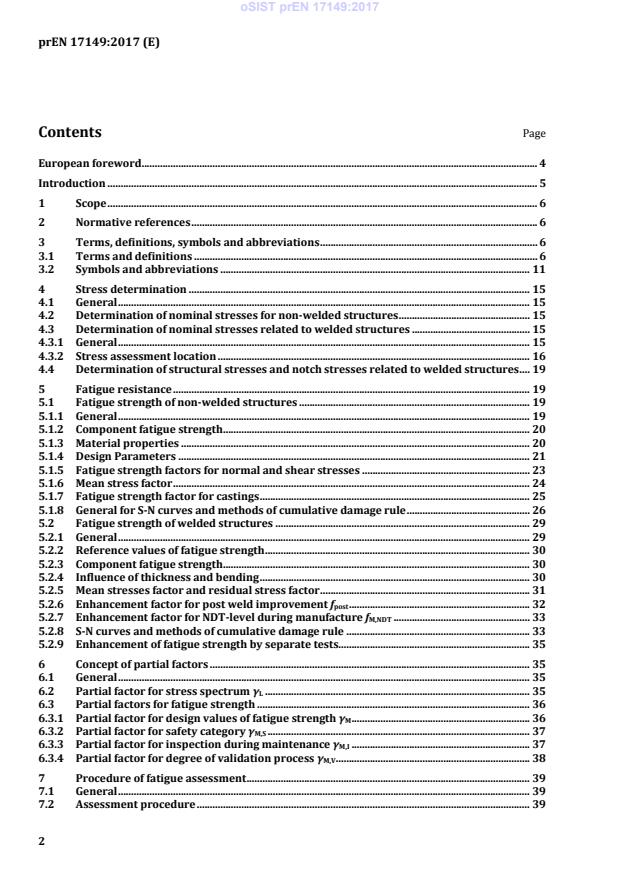
Contents Page
European foreword . 4
Introduction . 5
1 Scope . 6
2 Normative references . 6
3 Terms, definitions, symbols and abbreviations . 6
3.1 Terms and definitions . 6
3.2 Symbols and abbreviations . 11
4 Stress determination . 15
4.1 General . 15
4.2 Determination of nominal stresses for non-welded structures . 15
4.3 Determination of nominal stresses related to welded structures . 15
4.3.1 General . 15
4.3.2 Stress assessment location . 16
4.4 Determination of structural stresses and notch stresses related to welded structures . 19
5 Fatigue resistance . 19
5.1 Fatigue strength of non-welded structures . 19
5.1.1 General . 19
5.1.2 Component fatigue strength . 20
5.1.3 Material properties . 20
5.1.4 Design Parameters . 21
5.1.5 Fatigue strength factors for normal and shear stresses . 23
5.1.6 Mean stress factor . 24
5.1.7 Fatigue strength factor for castings . 25
5.1.8 General for S-N curves and methods of cumulative damage rule . 26
5.2 Fatigue strength of welded structures . 29
5.2.1 General . 29
5.2.2 Reference values of fatigue strength . 30
5.2.3 Component fatigue strength . 30
5.2.4 Influence of thickness and bending . 30
5.2.5 Mean stresses factor and residual stress factor . 31
5.2.6 Enhancement factor for post weld improvement f . 32
post
5.2.7 Enhancement factor for NDT-level during manufacture f . 33
M,NDT
5.2.8 S-N curves and methods of cumulative damage rule . 33
5.2.9 Enhancement of fatigue strength by separate tests. 35
6 Concept of partial factors . 35
6.1 General . 35
6.2 Partial factor for stress spectrum γ . 35
L
6.3 Partial factors for fatigue strength . 36
6.3.1 Partial factor for design values of fatigue strength γ . 36
M
6.3.2 Partial factor for safety category γ . 37
M,S
6.3.3 Partial factor for inspection during maintenance γ . 37
M,I
6.3.4 Partial factor for degree of validation process γ . 38
M,V
7 Procedure of fatigue assessment . 39
7.1 General . 39
7.2 Assessment procedure . 39
7.3 Stress determination . 40
7.4 Data pre-processing . 40
7.4.1 Conditioning . 40
7.4.2 Application of partial factor for stress spectrum γ . 40
L
7.4.3 Counting . 40
7.4.4 Mean stress adjustment . 40
7.4.5 Omission . 41
7.5 Damage calculation for each single stress component . 41
7.5.1 General . 41
7.5.2 Determination of stress spectrum shape factor . 41
7.5.3 Determination of admissible damage sum . 42
7.5.4 Determination of cumulative damage sum and scaling factor to reach admissible
damage sum . 42
7.6 Assessment of fatigue strength . 44
Annex A (informative) Procedure for determination of mean stress factors for non-welded
and welded structures . 46
Annex B (informative) Example specification for permissible of volumetric defects in
castings of steel, iron and aluminium . 49
Annex C (normative) Surface roughness factor for cut edges of steel . 50
Annex D (normative) Reference values of the fatigue strength Δσ and Δτ for notch cases
C C
of welded structures of steel . 51
Annex E (normative) Reference values of the fatigue strength Δσ and Δτ for notch cases of
C C
welded structures of aluminium . 80
Annex F (normative) Thickness influence for welded structures of steel and consideration
of bending for welded structures of steel and of aluminium . 96
Annex G (informative) Enhancement of reference value of the fatigue strength Δσ for load
C
carrying T- and cruciform joints with double fillet weld with or without partial
penetration . 100
Annex H (informative) Application of structural stress assessment for welded structures of
steel and aluminium . 103
Annex I (informative) Application of notch stress assessment for welded structures of steel
and aluminium . 107
Annex J (informative) Example for fatigue assessment . 121
Annex K (informative) Determination of nominal stresses in weld root of single sided
partial penetration welds . 127
Bibliography . 130
European foreword
This document (prEN 17149:2017) has been prepared by Technical Committee CEN/TC 256 “Railway
applications”, the secretariat of which is held by DIN.
This document is currently submitted to the CEN Enquiry.
Introduction
For railway vehicle structures the fatigue strength assessment is necessary. In some cases it is sufficient
to apply an endurance limit approach, i.e. assessing just against the peak stress level and not taking into
account the number of cycles and spectrum shapes of the stress history. Traditionally this endurance
limit approach is used in combination with the normative loads such as those defined in EN 12663
series or EN 13749.
A more detailed evaluation may be obtained using a cumulative damage fatigue assessment taking into
consideration stress spectra with varying amplitudes and cycle numbers or stress time histories.
This European Standard provides the basic procedure and criteria to be applied for fatigue strength
assessment based on cumulative damage approach.
The bibliography lists relevant documents that may be used for reference purposes.
The main body of the standard is based on the nominal stress approach, but the consideration of
variable amplitudes and cycles counts according to methods described in this standard may equally be
applied with the structural stress and the notch stress approach (additional information is included as
informative annexes). A combination of these approaches may be appropriate.
This Standard defines a pragmatic methodology for undertaking fatigue assessments based on
cumulative damage approach. In the application of this standard the use of more detailed information
or other validated methods is permissible under the precondition of a valid justification.
1 Scope
The purpose of this European standard is to specify the procedure for fatigue strength assessment of
railway vehicle structures based on cumulative damage.
This document is applicable to all rail vehicle structures, which are covered by EN 12663 series (car
body) and EN 13749 (bogie frame).
It considers materials used for design of car bodies and bogie frames (steel, aluminium, castings and
forgings) and the manufacturing according to the standards valid for railway applications.
NOTE As a manufacturing standard, EN 15085 series covers the welding of rail vehicle structures.
It is applicable for variable amplitude load data with total number of cycles higher than 10000 cycles.
This document is not applicable for:
— Corrosive conditions or
— Elevated temperature operation in the creep range.
A static strength assessment is outside the scope of this European Standard.
2 Normative references
The following documents, in whole or in part, are normatively referenced in this document and are
indispensable for its application. For dated references, only the edition cited applies. For undated
references, the latest edition of the referenced document (including any amendments) applies.
EN 15085-3:2007/AC:2009, Railway applications - Welding of railway vehicles and components - Part 3:
Design requirements
BS 7608:2014+A1:2015, Guide to fatigue design and assessment of steel products
EN 755-2:2016, Aluminium and aluminium alloys - Extruded rod/bar, tube and profiles - Part 2:
Mechanical properties
EN 485-2:2016, Aluminium and aluminium alloys - Sheet, strip and plate - Part 2: Mechanical properties
EN 586-2:1994, Aluminium and aluminium alloys - Forgings - Part 2: Mechanical properties and
additional property requirements
EN 1706:2010, Aluminium and aluminium alloys - Castings - Chemical composition and mechanical
properties
3 Terms, definitions, symbols and abbreviations
For the purposes of this document, the following terms and definitions apply.
3.1 Terms and definitions
3.1.1
fatigue
damage of a structural part by the process of initiation and gradual propagation of cracks caused by
time varying repeated applications of stress
3.1.2
fatigue action
time varying repeated loading events which introduces a stress into a structural component
3.1.3
fatigue stress
stress caused by fatigue action
3.1.4
fatigue resistance
structural detail’s resistance to fatigue actions expressed in terms of a S-N curve
3.1.5
fatigue strength
magnitude of stress range leading to a particular fatigue life
3.1.6
component fatigue strength
fatigue strength considering the specific design details
3.1.7
design loads
loads caused by fatigue action under the consideration of partial factor for loads
3.1.8
stress spectrum
fatigue stresses including the partial factor for actions (e.g. loads) and relevant to the fatigue strength
assessment
3.1.9
design value of fatigue strength
strength of a structural detail under the consideration of partial factor for component fatigue strength
and relevant to the fatigue strength assessment
3.1.10
endurance limit
constant amplitude fatigue below which no fatigue damage will occur
3.1.11
nominal stress
stress in a component adjacent to a potential crack location calculated in accordance with elasticity
theory excluding all stress concentration effects (e.g. welds, openings, thickness changes)
3.1.12
modified nominal stress
nominal stress including macro-geometric effects
Note 1 to entry: The macro-geometric effects are the stress raising effects caused by the macro-geometry in the
vicinity of the welded joints (e.g. concentrated load effects, misalignment, eccentricity) but disregarding stress
raising effects of the weld joint itself.
3.1.13
structural stress
surface value of linearly distributed stress across the section thickness adjacent to a welded detail
taking into account the effects of a structural discontinuity
Note 1 to entry: Structural stress is also referred to as geometric stress.
Note 2 to entry: The linear stress distribution includes the effects of gross structural discontinuities (e.g.
presence of an attachment, aperture, change of cross-section, misalignment, intersection of members) and
distortion-induced bending moments. However it excludes the notch effects of local structural discontinuities (e.g.
weld toe, weld end) which give rise to nonlinear stress distributions across the section thickness.
3.1.14
notch stress
calculated stress for a notch of welded joint with a certain assumed notch radius
3.1.15
reference values of fatigue strength
fatigue strength for a particular welded structure detail related to N = 2×10 cycles for a survival
C
probability of P = 97,5 %
s
3.1.16
mean stress
mean value of the algebraic sum of maximum and minimum alternating stress in a cycle
3.1.17
residual stress
permanent stresses in a structure caused by manufacture processes (e.g. rolling, cutting or welding)
and with static equilibrium to itself
3.1.18
membrane stress
average normal stress which is uniform across the thickness of a plate or shell
3.1.19
bending stress
stress in a shell or plate-like part of a component with linear distribution across the thickness
3.1.20
stress range
algebraic difference between the maximum and minimum stresses in a cycle
3.1.21
constant stress range
constant magnitude stress fluctuation between a maximum and minimum value in a stress cycle
3.1.22
variable stress range
variable magnitude stress fluctuation between a maximum and minimum value in a stress cycle caused
by an irregular load time history
3.1.23
stress ratio
ratio of minimum to maximum algebraic value of the stress in a particular stress cycle
3.1.24
partial factor
factor taking into account uncertainties of loads (forces), material, model and geometry
Note 1 to entry: In some of the referred documents the partial factor described with terms as “safety factor” as
in EN 12663 series and EN 13749 or partial factor for variable actions (e.g. loads or forces) and for material,
model and geometric uncertainties as in ISO 2394.
3.1.25
stress cycle
pattern of variation of stress at a point defined by the cycle counting method and consisting of a change
in stress between a minimum (trough) and maximum (peak) values and back again
3.1.26
S-N curve
quantative relationship between the fatigue strength and the number of the cycles corresponding to a
specific survival probability of the failure for a detail, derived from test data
3.1.27
stress (range) spectrum
tabular or graphical presentation of the number of occurrences (cumulative frequency) of different
magnitudes produced by the load spectrum in the design life of a structure detail
3.1.28
stress range block
part of stress spectrum with constant stress range
3.1.29
cut off limit
fatigue strength under variable stress ranges below which the stress cycles are considered to be non-
damaging
3.1.30
damage equivalent stress range
constant stress range which produces an equivalent fatigue damage to that resulted from a variable
amplitude stress spectrum
3.1.31
damage sum
sum of fatigue damage produced by a variable amplitude stress spectrum
3.1.32
cumulative damage sum
linear cumulative damage summation based on the rule devised by Palmgren and Miner of the fatigue
damage due to all cycles in a stress-range spectrum
3.1.33
cumulative damage rule
method for estimating fatigue life under variable amplitude loading from the constant S-N curve
Note 1 to entry: Often referred to as damage accumulation hypothesis, Miner’s rule or Palmgren-Miner rule.
3.1.34
proportional stresses
principal stresses or stress components with constant directions and constant ratios of their values for
time varying loads
3.1.35
non-proportional stresses
principal stresses or stress components with non-constant directions and non-constant ratios of their
values for time varying loads
3.1.36
degree of utilisation
relationship between the design values of fatigue stress and of component fatigue strength expressed as
a ratio of applied stress to component fatigue strength
3.1.37
damage equivalent degree of utilisation
relationship between the design values of fatigue stress and of component fatigue strength for an
extrapolation of stress spectra with compliance to the assessment criteria
3.1.38
misalignment
axial and angular deformation (offset) of welded joints caused by detail design or/and by manufacture
process
3.1.39
NDT
non-destructive test
3.1.40
safety category
consequences of failure of the single welded joint in respect to the effects on persons, facilities and the
environment according to EN 15085-3
3.1.41
weld performance class
performance requirements of the welded joint with respect to weld quality requirements and weld
inspection requirements as defined in EN 15085-3
Note 1 to entry: The weld performance class is abbreviated by “CP” (class of performance)
3.1.42
weld inspection class
inspections to be carried out for a given weld with respect to the frequency and the type of inspection
(e.g. volumetric, surface or visual) as defined by the weld performance class according to EN 15085-3
Note 1 to entry: The weld inspection class is abbreviated by “CT” (class of testing)
3.2 Symbols and abbreviations
A ultimate elongation according to material standards
A stress spectrum shape factor
eq
a throat thickness of fillet weld
a degree of utilisation for stress component
c
a degree of utilisation for plain axial stress state according to von Mises criterion
f
a mean stress sensitivity parameter
m
b exponent in correction term for thickness in case of membrane and bending loading (e.g.
in F.3)
b distance from weld toe or root to the stress assessment location (evaluation point) for a
EP
nominal stress, modified nominal stress or structural stress assessment
b mean stress sensitivity parameter
m
Cσ constant in equation of S-N curve for normal stresses
C constant in equation of S-N curve for shear stresses
τ
c root gap length
D cumulative damage sum of stress spectrum
it
D admissible damage sum
m
D damage sum limit
m,min
e eccentricity between midpoint of weld throat and connected plates (amount of offset to
misalignment)
f anisotropy factor for rolled sheets and extrusions with different strength in rolling or
A
extrusion and transverse directions
fbend enhancement factor for bending
f fatigue strength factor for casting
C
f enhancement factor for NDT-level during manufacture
M,NDT
f mean stress factor for normal stress
m,σ
f mean stress factor for shear stress
m,τ
f enhancement factor for post weld improvement
post
f fatigue strength factor for normal stresses
R,σ
f ratio between fatigue strength of shear stress and of normal stress
R,τ
f residual stress factor for normal stress for stress difference between R = −1 and R = 0,5
res,σ σ σ
under consideration of residual stress state
fres,τ residual stress factor for shear stress for stress difference between Rτ = −1 and Rτ = 0,5
under consideration of residual stress state
f surface roughness factor
SR
f surface roughness factor for normal stress assessment
SR,σ
f surface roughness factor for shear stress assessment
SR,τ
f factor for fatigue strength related to structural stress defined in Annex H
struc
f thickness correction factor
thick
h depth of partial penetration of butt weld
i number of blocks of stress spectrum
j total number of blocks of stress spectrum for which additionally holds: x × Δσ > Δσ
it i L
j basic partial factor according to [2]
D
K fatigue notch factor
f
K stress concentration factor
t
K weld notch shape factor
w
L toe distance or sum of thickness or length of attachment and weld leg lengths
l length of attachment of welded structures or non-load carrying rectangular or circular
pads or plates
l length of strain gauge measurement grid
SG
l total length of strain gauge including backing film
SG,tot
M mean stress sensitivity for normal stresses
σ
M mean stress sensitivity for shear stresses
τ
m exponent of S-N curve
m exponent of S-N curve before knee point
m exponent of S-N curve beyond knee point
N number of cycles
N number of cycles of reference value of fatigue strength
C
N number of cycles of knee point of S-N curve
D
N number of cycles of damage equivalent stress spectrum
eq
N number of cycles of cut-off limit for stress range
L
N total number of cycles in given stress spectrum with Δσ > Δσ
t i OM
n exponent in correction term for thickness in case of membrane loading
n cycle number of stress range block i of stress spectrum
i
P survival probability
s
R stress ratio
R upper yield strength
eH
R tensile strength relevant for determination of fatigue strength of non-welded structures
m
R normative tensile strength according to material standards
m,N
R nominal tensile strength according to drawing or to component specification
m,S
R 0,2 % proof strength
p0,2
R surface roughness
z
R stress ratio for normal stresses
σ
Rτ stress ratio for shear stresses
r actual notch radius of weld toe or weld root
r reference notch radius of weld toe or weld root
ref
t plate thickness
t effective plate thickness in correction term for thickness influence
eff
t reference plate thickness relevant to reference values of the fatigue strength for welded
ref
structural details in Annex D and Annex E
w width of loaded plates with welded longitudinal flat side gusset
x scaling factor for stress range with iteration result D (x ) ≡ D
Dm it Dm m
x scaling factor for stress range during iteration for determination of cumulative damage
it
sum
γ partial factor for stress spectrum based on design loads
L
γ partial factor for design values of fatigue strength
M
γ partial factor for inspection during maintenance
M,I
γ partial factor for safety category
M,S
γ partial factor for degree of validation process
M,V
γ partial factor considering validation of fatigue behaviour by fatigue testing
M,V,FT
γ partial factor considering validation of calculated stress data by measured stress data
M,V,ST
Δσ normal stress range
Δσ applied bending stress range
b
Δσ reference value of fatigue strength of normal stress range for N = 2 × 10 cycles, R = 0,5,
C C
P = 97,5 %
s
Δσ reference value of fatigue strength for normal notch stress assessment
C,e
Δσ reference value of fatigue strength for normal structural stress assessment
C,S
Δσ normal stress range for component fatigue strength at knee point of S-N curve N
D D
Δσ normal stress range for reference value of fatigue strength at knee point of S-N curve N
D,C D
Δσ normal notch stress range transverse to weld line
e
Δσ normal stress range of damage equivalent stress spectrum
eq
Δσ normal stress range of stress spectrum block i related to stress ratio R = −1
i
Δσ normal stress range of stress spectrum block i as a result of rain flow counting
i,RF
Δσ cut-off limit for normal stress range at N
L L
Δσ omission limit of normal stress range
OM
Δσ applied membrane stress range
mem
Δσ component fatigue strength for normal stress range
R
Δσ component fatigue strength for normal notch stress range
R,e
Δσ largest normal stress range of stress spectrum
Δτ shear stress range
ΔτC reference value of fatigue strength of shear stress range for NC = 2 × 10 cycles, R = 0,5,
P = 97,5 %
s
Δτ reference value of fatigue strength for shear notch stress assessment
,C,e
Δτ shear stress range for component fatigue strength at knee point of S-N curve N
D D
Δτ shear stress range for reference value of fatigue strength at knee point of S-N curve N
D,C D
Δτ shear notch stress range
e
Δτ shear stress range of damage equivalent stress spectrum
eq
Δτ shear tress range of stress range block i related to stress ratio R = −1
i
Δτ cut-off limit for shear stress range at N
L L
Δτ omission limit of shear stress range
OM
Δτ component fatigue strength for shear stress range
R
Δτ component fatigue strength for shear notch stress range
R,e
Δτ largest shear stress range of stress spectrum
δ first number of step in stress spectrum with x × Δσ < Δσ
it i D
θ weld flank angle
ν Poisson's ratio
ρ fictitious notch radius of weld toe or of weld root in Annex G
σ normal stress amplitude
a
σ bending stress
b
σ σ linear-elastic calculated normal notch stress transverse to weld line
e e,⊥
σ hot spot stress according to Annex H and Annex I
hs
σ mean stress
m
σ mean stress related to Δσ
m,i,RF i,RF
σ membrane stress
mem
σ nominal normal stress longitudinal to weld line
n,II
σ measured structural stress according to definition in Annex H
SG
σ nominal bending stress related to weld throat section
w,b
σ nominal welded membrane stress related to weld throat section
w,mem
σ nominal stress related to weld throat section due to combined membrane and bending
w,root
stresses
τ shear stress amplitude
a
τ τ linear-elastic calculated shear notch stress longitudinal to weld line
e e,II
τ mean stress of shear stress
m
Ω degree of bending
ω weld toe angle
4 Stress determination
4.1 General
The stress spectrum used to perform the fatigue strength assessment based on cumulative damage
approach shall be expressed in terms of stress amplitudes, mean stresses and number of cycles to
represent the design life.
The stress spectrum shall be incorporated any necessary allowance to account for uncertainties in their
values. If relevant, this may be achieved by application of a partial factors γ on the characteristic stress
L
spectrum as specified in the application code. In 6.2 recommendations and requirements for the partial
factors γ are given.
L
NOTE EN 12663 series, EN 15827 and EN 13749 contain information on how to determine design loads for
cumulative damage assessment of railway vehicles. For constant amplitude loads as given in EN 12663 and
EN 13749 an assessment against a cumulative damage approach is not mandatory.
4.2 Determination of nominal stresses for non-welded structures
The component stress values shall be determined as a plain stress tensor in a fixed coordinate system
tangential to the component surface.
The component stress values shall be determined for the three components of the plain stress tensor
(i.e. σ , σ , τ ) in terms of amplitude and mean values as well as number of cycles for each component
x y xy
stress spectrum block.
The component stress values for assessment of non-welded structure have to account for local stress
concentrations.
4.3 Determination of nominal stresses related to welded structures
4.3.1 General
The definition of nominal stresses in the welded plate or weld throat excludes the stress concentrations
effects due to the welded joint (e.g. weld shape, thickness changes) and any secondary bending effects
due to the local detail (e.g. eccentricity or misalignment). That shall be considered in the determination
of nominal stresses by calculation or measurements.
The fatigue strength values for notch cases of welded structures defined in Annex D and Annex E fulfil
these general requirements. In cases where effects of eccentricity or secondary bending effects have to
be accounted for, that is explicitly described in these both annexes.
The determination of nominal stresses during the calculation or the measurement with strain gauge
shall be carried out outside the stress concentration field of the welded joint. Appropriate distances
between the stress assessment location and the weld toe or the weld root are defined in 4.3.2.
For the assessment of the weld toe the relevant cross section is the plate section except otherwise
stated in Annex D and Annex E. For the assessment of the weld root the relevant cross section is the
weld throat section. In cases of welds with
— partial penetration or
— eccentricity of the weld throat midpoint to the plate midpoint or
— throat thickness different to the plate thickness
the stresses at the stress assessment location have to be transferred into stresses acting in the throat
section using appropriate techniques. Membrane stresses should be transferred accounting for effects
of eccentricity. Bending stresses should be transferred accounting for the applicable section modulus
against bending for the weld root. For the determination of nominal stresses in welds with partial
penetration welded on one side related to weld root the Annex K contains detailed information.
NOTE Analytical approaches or FE-modelling techniques representing the actual throat thicknesses and
eccentricity of the weld throats are such appropriate procedures.
4.3.2 Stress assessment location
To determine the position for the stress assessment location (evaluation point) the following
recommendations are made:
— The distance b of the assessment location shall be
EP
b = 10 mm ± 5 mm (1)
EP
— In case of non-symmetric weld toe positions at a plate, the weld toe with the higher distance to the
weld or plate centre line is used to determine the distance and the position at the other surface is
directly opposite.
— In case of welds at T joints welded from one side, the distance b at the root side is measured from
EP
the adjacent plate surface.
NOTE For measurements the defined value for bEP of 10 mm correlates to the broadly accepted practice for
strain gauge applications at weld lines.
For evaluation of the nominal stresses in calculations the evaluation point shall be as defined above.
For evaluation of the nominal stresses in measurements the dimension of the strain gauge, especially
the length of strain gauge measurement grid l , and the application distance from the weld toe has
SG
relevant influence on the results. The maximum length of the used strain gauge shall not exceed
— l ≤ 6 mm for measurements on bogie frames
SG
— l ≤ 10 mm for measurements on car body structures.
SG
NOTE The reason for defining different maximum strain gauge lengths is that bogie frames usually have
higher stress gradients than car body structures.
For typical welded joints the stress assessment location of nominal stress assessment is given in
Figure 1, Figure 2 and Figure 3.
Figure 1 — Stress assessment locations for a butt joint
Figure 2 — Stress assessment locations for a T joint
Figure 3 — Stress assessment locations for a cruciform joint
In the case of a weld end assessment the stress state may be regarded as a single axial stress state at the
recommended distance b to the weld toe oriented in direction of the weld line. Such weld ends are for
EP
example:
— weld ends of longitudinal attachments or gussets (see Figure 4 and Table D.42, Table D.46,
Table D.47 and Table E.57),
— weld ends of intermittent welds in T- or cruciform joints (see Figure 5 and Table D.41)
— weld ends in case of a transition of a both-sided weld to a single-sided weld type in T- or cruciform
joints (see Figure 5).
For the assessment location of these weld ends a combination of the stress components as given in 7.6
is not necessary.
Stresses in the remaining weld line have to be separately assessed with the notch cases applicable for
the appropriate notch cases of a continuous weld line.
NOTE At flat attachments like pads or doubling plates the stress state at the welds is not regarded as a single
axial stress stage. For these cases an assessments of all directions and a combination of the stress components is
necessary (see for normal stress assessment transverse to weld line in Table D.42 and longitudinal to weld line in
Table D.39).
Key
1 stresses to be used for assessment of weld ends
2 assessment location for weld end of longitudinal attachment or gusset
3 weld line area to be assessed like a continuous weld line
Figure 4 — Stress assessment locations for a structural detail with non-loaded-carrying
attachments
Key
1 stresses to be used for assessment of weld ends
2 assessment location for weld end
3 weld line area to be assessed like a continuous weld line
Figure 5 — Stress assessment locations for T- or cruciform joint with intermittent fillet weld
The stresses determined as described in this clause are usually higher than the nominal stresses.
Therefore the assessment using these stresses, with the allowable strength values defined in Annex D
and Annex E, may be assumed to be sufficiently conservative.
4.4 Determination of structural stresses and notch stresses related to welded structures
For the fatigue assessment of welded joints the structural stress approaches and the notch stress
approach may be applied. For the application of these approaches the requirements for the calculation
of the relevant stresses and fatigue resistance is described in the following informative annexes:
— Annex H for the structural stress approach and
— Annex I for the notch stress approach.
5 Fatigue resistance
5.1 Fatigue strength of non-welded structures
5.1.1 General
This clause describes the method for a fatigue strength assessment of non-welded structures under the
following conditions:
— materials used for fabricated constructions such as construction steel, weldable cast steel, ductile
cast iron, cast and wrought aluminium,
— application temperature up to 100°C for aluminium and up to 200°C for steel,
— plain stress tensor on the components surface (no significant stress component perpendicular to
the surface, e.g. press fit connection).
The restrictions defined above are met with most applications of non-welded structures for railway
vehicles, in such cases a simplified assessment method is appropriate. If the scope of the application is
exceeded, an assessment method has to be chosen which accounts for the specific application (e.g. high
temperatures and 3 dimensional stress states).
5.1.2 Component fatigue strength
The fatigue strength is specified by S-N curves, which define the values of component fatigue strength
Δσ and Δτ related to
R R
— N = 10 ,
C
— stress ratio R = R = −1,
σ τ
— survival probability of P = 97,5 %,
s
— membrane stresses.
The values of the component fatigue strength are determined with the following formulas:
Δσ (N = 10 , R = −1) = R × f × f × f (2)
R C σ m R,σ SR,σ C
Δτ (N = 10 , R = −1) = R × f × f × f × f (3)
R C τ m R,τ R,σ SR,τ C
where
R tensile strength relevant f
...