

EN 13880-12:2003
(Main)Hot applied joint sealants - Part 12: Test method for the manufacture of concrete test blocks for bond testing (recipe methods)
- Abstract
This European Standard describes a method for the manufacture of concrete test blocks for joint sealant bond
testing.
The requirements of this European Standard are applicable to concrete test blocks with a maximum aggregate size of 16 mm to 20 mm or with a maximum aggregate size of 4,0 mm.
- Status
- Published
- Publication Date
- 19-Aug-2003
- Withdrawal Date
- 30-Mar-2005
- Technical Committee
- CEN/TC 227 - Road materials
- Current Stage
- 9093 - Decision to confirm - Review Enquiry
- Start Date
- 17-Dec-2023
- Completion Date
- 07-Oct-2026

Overview
EN 13880-12:2003 is a European Standard developed by CEN specifying the method for manufacturing concrete test blocks used in the bond testing of hot applied joint sealants. The standard ensures the production of consistent and reliable concrete test blocks, which are essential for evaluating the adhesive and cohesive properties of joint sealants used in road construction and other concrete structures. This document applies to test blocks made with two aggregate categories: coarse aggregates with a maximum size of 16 mm to 20 mm, and fine aggregates with a maximum size of 4.0 mm.
Key Topics
- Scope and Purpose: EN 13880-12 defines a repeatable recipe method for making concrete test blocks, supporting the reliable bond testing of hot applied joint sealants in laboratory conditions.
- Aggregate Types: Specifies the use of both coarse (16-20 mm) and fine (up to 4.0 mm) silica-based aggregates with low water absorption to simulate realistic field conditions.
- Mixing Procedures: Offers guidelines for the proper mixing, casting, and compacting of concrete to achieve the uniformity required for accurate joint sealant testing.
- Curing and Conditioning: Details curing processes (temperature, time, humidity) and block conditioning to ensure the test pieces attain the necessary physical properties before bond tests.
- Block Handling: Provides instructions on cutting, storing, and moisture conditioning of test blocks to maintain their quality and consistency until use.
- Documentation: Lists the required test report elements, such as mix composition, aggregate specifications, production details, curing conditions, and measured compressive strengths.
Applications
EN 13880-12:2003 is widely used in the construction materials testing sector, specifically for:
- Quality control of joint sealants: Enables manufacturers, testing laboratories, and civil engineering professionals to create standardized test pieces, ensuring that hot applied joint sealants meet performance criteria for adhesion and cohesion.
- Road and pavement construction: Supports proper evaluation of materials used in expansion joints, runway surfaces, bridges, and other infrastructure requiring durable, flexible seals.
- Research and development: Provides a benchmark method for comparing various joint sealant formulations and for testing under controlled and repeatable conditions.
- Compliance and certification: Assists organizations in meeting European regulatory requirements for product testing and validation, facilitating market acceptance and ensuring public safety.
Related Standards
EN 13880-12 is part of a broader suite of European Standards focusing on hot and cold applied joint sealants and their testing. Relevant standards in this series and related topics include:
- EN 13880-1: Determination of density at 25°C for hot applied joint sealants
- EN 13880-7: Function testing of joint sealants
- EN 13880-10: Determination of adhesion and cohesion under extension/compression
- EN 13880-13: Testing for discontinuous extension (adherence test)
- EN 197-1: Specifications for common cements
- EN 933-2: Particle size distribution of aggregates
- EN 934-2: Admixtures for concrete, mortar, and grout
- EN 1008: Suitability of mixing water for concrete
- ISO 4012: Determination of compressive strength of concrete test specimens
Practical Value
Adhering to EN 13880-12:2003 enables laboratories and manufacturers to ensure the consistency, reliability, and reproducibility of bond testing for hot applied joint sealants. By standardizing the manufacture of concrete test blocks, stakeholders can confidently compare results, identify material performance issues, and uphold quality throughout the supply chain. This enhances safety and longevity in roads, bridges, and critical infrastructure where effective joint sealing is required.
Relations
- Effective Date
- 28-Jan-2026
- Effective Date
- 28-Jan-2026
- Effective Date
- 28-Jan-2026
- Effective Date
- 28-Jan-2026
- Effective Date
- 28-Jan-2026
- Effective Date
- 28-Jan-2026
- Effective Date
- 28-Jan-2026
- Refers
EN 14187-1:2017 - Cold applied joint sealants - Test methods - Part 1: Determination of rate of cure - Effective Date
- 28-Jan-2026
- Effective Date
- 28-Jan-2026
- Effective Date
- 28-Jan-2026
- Effective Date
- 28-Jan-2026
- Effective Date
- 28-Jan-2026
- Effective Date
- 28-Jan-2026
- Effective Date
- 28-Jan-2026
- Effective Date
- 28-Jan-2026
Get Certified
Connect with accredited certification bodies for this standard

Zavod za gradbeništvo Slovenije (ZAG) - Inšpekcija
ZAG inspection body for construction products, structures, and materials.
Sponsored listings
Frequently Asked Questions
EN 13880-12:2003 is a standard published by the European Committee for Standardization (CEN). Its full title is "Hot applied joint sealants - Part 12: Test method for the manufacture of concrete test blocks for bond testing (recipe methods)". This standard covers: This European Standard describes a method for the manufacture of concrete test blocks for joint sealant bond testing. The requirements of this European Standard are applicable to concrete test blocks with a maximum aggregate size of 16 mm to 20 mm or with a maximum aggregate size of 4,0 mm.
This European Standard describes a method for the manufacture of concrete test blocks for joint sealant bond testing. The requirements of this European Standard are applicable to concrete test blocks with a maximum aggregate size of 16 mm to 20 mm or with a maximum aggregate size of 4,0 mm.
EN 13880-12:2003 is classified under the following ICS (International Classification for Standards) categories: 93.080.20 - Road construction materials. The ICS classification helps identify the subject area and facilitates finding related standards.
EN 13880-12:2003 has the following relationships with other standards: It is inter standard links to EN 14187-6:2017, EN 1008:2002, EN 933-2:1995, EN 14187-7:2019, EN 13880-7:2019, EN 13880-10:2018, EN 197-1:2011, EN 14187-1:2017, EN 13880-13:2018, EN 934-2:2009+A1:2012, EN 14187-9:2006, EN 14187-6:2003, EN 14187-8:2017, EN 13880-10:2003, EN 14187-8:2003. Understanding these relationships helps ensure you are using the most current and applicable version of the standard.
EN 13880-12:2003 is associated with the following European legislation: EU Directives/Regulations: 305/2011, 89/106/EEC. When a standard is cited in the Official Journal of the European Union, products manufactured in conformity with it benefit from a presumption of conformity with the essential requirements of the corresponding EU directive or regulation.
EN 13880-12:2003 is available in PDF format for immediate download after purchase. The document can be added to your cart and obtained through the secure checkout process. Digital delivery ensures instant access to the complete standard document.
Standards Content (Sample)
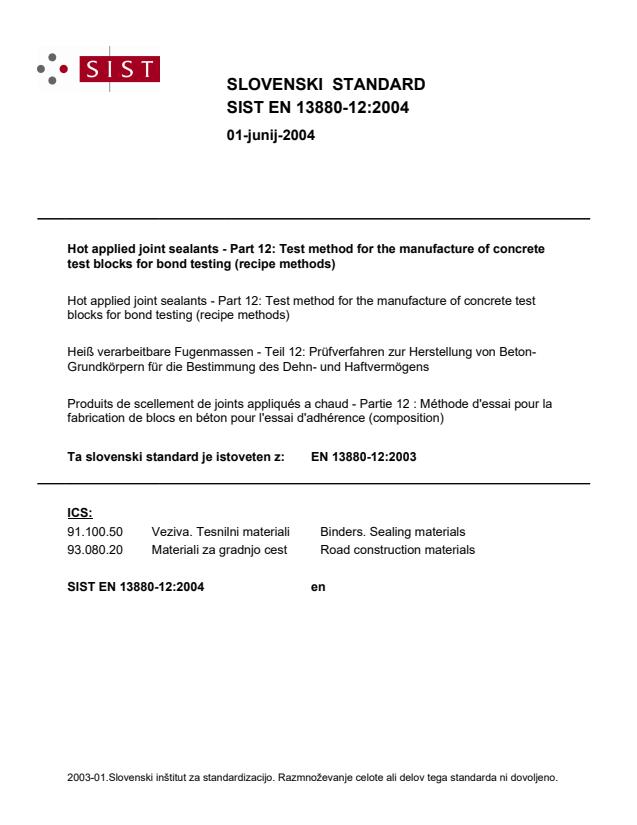
2003-01.Slovenski inštitut za standardizacijo. Razmnoževanje celote ali delov tega standarda ni dovoljeno.Hot applied joint sealants - Part 12: Test method for the manufacture of concrete test blocks for bond testing (recipe methods)Heiß verarbeitbare Fugenmassen - Teil 12: Prüfverfahren zur Herstellung von Beton-Grundkörpern für die Bestimmung des Dehn- und HaftvermögensProduits de scellement de joints appliqués a chaud - Partie 12 : Méthode d'essai pour la fabrication de blocs en béton pour l'essai d'adhérence (composition)Hot applied joint sealants - Part 12: Test method for the manufacture of concrete test blocks for bond testing (recipe methods)93.080.20Materiali za gradnjo cestRoad construction materials91.100.50Veziva. Tesnilni materialiBinders. Sealing materialsICS:Ta slovenski standard je istoveten z:EN 13880-12:2003SIST EN 13880-12:2004en01-junij-2004SIST EN 13880-12:2004SLOVENSKI
STANDARD
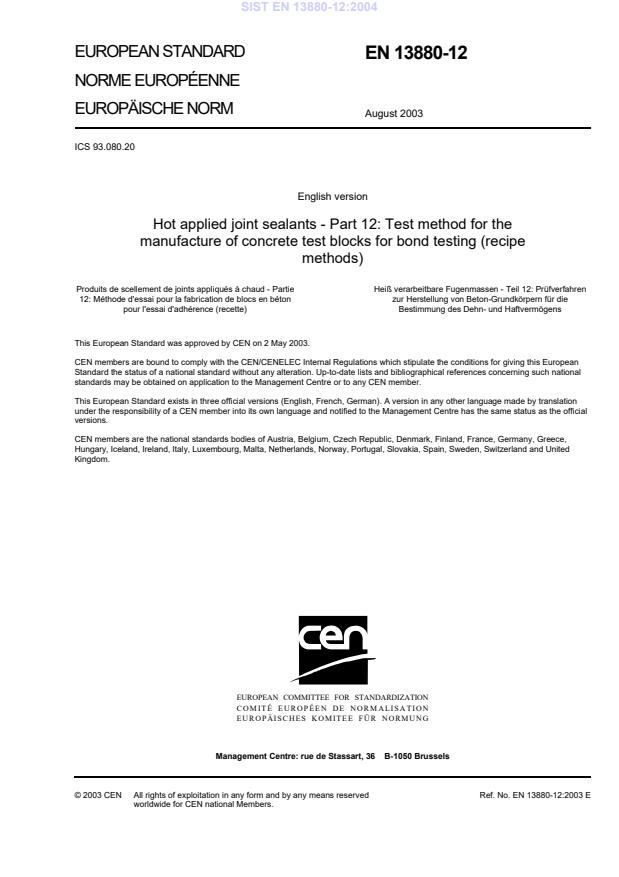
EUROPEAN STANDARDNORME EUROPÉENNEEUROPÄISCHE NORMEN 13880-12August 2003ICS 93.080.20English versionHot applied joint sealants - Part 12: Test method for themanufacture of concrete test blocks for bond testing (recipemethods)Produits de scellement de joints appliqués à chaud - Partie12: Méthode d'essai pour la fabrication de blocs en bétonpour l'essai d'adhérence (recette)Heiß verarbeitbare Fugenmassen - Teil 12: Prüfverfahrenzur Herstellung von Beton-Grundkörpern für dieBestimmung des Dehn- und HaftvermögensThis European Standard was approved by CEN on 2 May 2003.CEN members are bound to comply with the CEN/CENELEC Internal Regulations which stipulate the conditions for giving this EuropeanStandard the status of a national standard without any alteration. Up-to-date lists and bibliographical references concerning such nationalstandards may be obtained on application to the Management Centre or to any CEN member.This European Standard exists in three official versions (English, French, German). A version in any other language made by translationunder the responsibility of a CEN member into its own language and notified to the Management Centre has the same status as the officialversions.CEN members are the national standards bodies of Austria, Belgium, Czech Republic, Denmark, Finland, France, Germany, Greece,Hungary, Iceland, Ireland, Italy, Luxembourg, Malta, Netherlands, Norway, Portugal, Slovakia, Spain, Sweden, Switzerland and UnitedKingdom.EUROPEAN COMMITTEE FOR STANDARDIZATIONCOMITÉ EUROPÉEN DE NORMALISATIONEUROPÄISCHES KOMITEE FÜR NORMUNGManagement Centre: rue de Stassart, 36
B-1050 Brussels© 2003 CENAll rights of exploitation in any form and by any means reservedworldwide for CEN national Members.Ref. No. EN 13880-12:2003 ESIST EN 13880-12:2004
...