


EN 143:1990
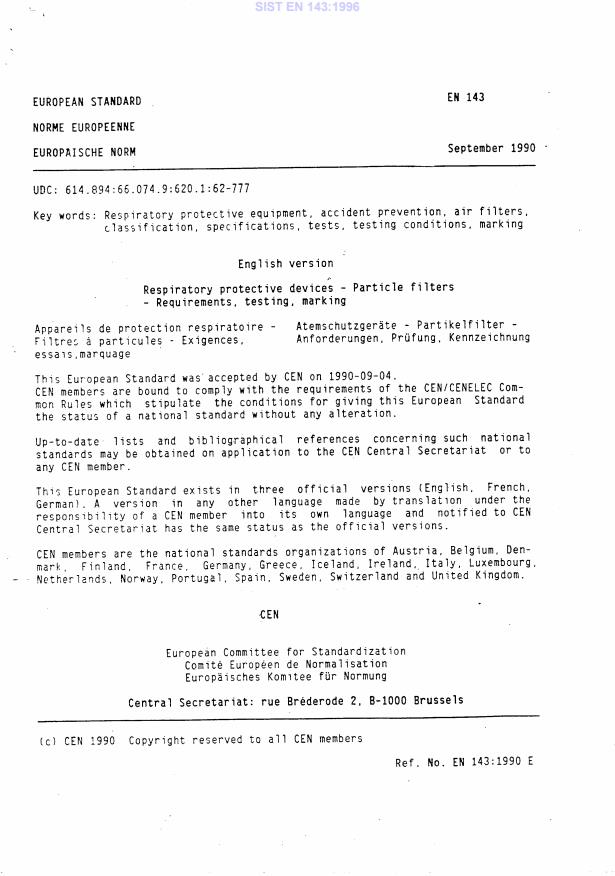
(Main)Respiratory protective devices - Particle filters - Requirements, testing, marking
General Information
- Abstract
This European Standard refers to particle filters for use as components in unassisted respiratory protective devices, except escape apparatus and filtering facepieces. Laboratory tests are included for the assessment of compliance with the requirements. Some filters complying with this standard may also be suitable for use with order types of respiratory protective devices and if so shall be tested and marked according to the appropriate European Standard.
- Status
- Withdrawn
- Publication Date
- 04-Sep-1990
- Withdrawal Date
- 15-Feb-2000
- Technical Committee
- CEN/TC 79 - Respiratory protective devices
- Drafting Committee
- SC 4 - Filters and absorption devices
- Current Stage
- 9960 - Withdrawal effective - Withdrawal
- Start Date
- 16-Feb-2000
- Completion Date
- 16-Feb-2000
- Directive
- Not Harmonized89/686/EEC - Personal protective equipment (PPE)OJ Ref: C, C 240 OJ Date: 19-Sep-1992

Relations
- Replaced By
EN 143:2000 - Respiratory protective devices - Particle filters - Requirements, testing, marking - Effective Date
- 22-Dec-2008
- Effective Date
- 09-Feb-2026
- Effective Date
- 09-Feb-2026
- Effective Date
- 09-Feb-2026
- Effective Date
- 09-Feb-2026
- Effective Date
- 09-Feb-2026
- Effective Date
- 09-Feb-2026
- Effective Date
- 09-Feb-2026
Get Certified
Connect with accredited certification bodies for this standard

CIS Institut d.o.o.
Personal Protective Equipment (PPE) certification body. Notified Body NB-2890 for EU Regulation 2016/425 PPE.

Kiwa BDA Testing
Building and construction product certification.
Kmetijski inštitut Slovenije
Agricultural Institute of Slovenia. Soil testing, plant health, agricultural product analysis.
Sponsored listings
Frequently Asked Questions
EN 143:1990 is a standard published by the European Committee for Standardization (CEN). Its full title is "Respiratory protective devices - Particle filters - Requirements, testing, marking". This standard covers: This European Standard refers to particle filters for use as components in unassisted respiratory protective devices, except escape apparatus and filtering facepieces. Laboratory tests are included for the assessment of compliance with the requirements. Some filters complying with this standard may also be suitable for use with order types of respiratory protective devices and if so shall be tested and marked according to the appropriate European Standard.
This European Standard refers to particle filters for use as components in unassisted respiratory protective devices, except escape apparatus and filtering facepieces. Laboratory tests are included for the assessment of compliance with the requirements. Some filters complying with this standard may also be suitable for use with order types of respiratory protective devices and if so shall be tested and marked according to the appropriate European Standard.
EN 143:1990 is classified under the following ICS (International Classification for Standards) categories: 13.340.30 - Respiratory protective devices. The ICS classification helps identify the subject area and facilitates finding related standards.
EN 143:1990 has the following relationships with other standards: It is inter standard links to EN 143:2000, EN IEC 60974-1:2022, EN 60974-1:2005, EN IEC 60974-9:2018, EN 60974-6:2003, EN 60974-1:2012, EN 60974-9:2010, EN IEC 60974-1:2018. Understanding these relationships helps ensure you are using the most current and applicable version of the standard.
EN 143:1990 is associated with the following European legislation: EU Directives/Regulations: 89/686/EEC; Standardization Mandates: M/BC/CEN/88/7. When a standard is cited in the Official Journal of the European Union, products manufactured in conformity with it benefit from a presumption of conformity with the essential requirements of the corresponding EU directive or regulation.
EN 143:1990 is available in PDF format for immediate download after purchase. The document can be added to your cart and obtained through the secure checkout process. Digital delivery ensures instant access to the complete standard document.
Standards Content (Sample)
2003-01.Slovenski inštitut za standardizacijo. Razmnoževanje celote ali delov tega standarda ni dovoljeno.R]QDþHYDQMHAtemschutzgeräte - Partikelfilter - Anforderungen, Prüfung, KennzeichnungAppareils de protection respiratoire - Filtres a particules - Exigences, essais, marquageRespiratory protective devices - Particle filters - Requirements, testing, marking13.340.30Varovalne dihalne napraveRespiratory protective devicesICS:Ta slovenski standard je istoveten z:EN 143:1990SIST EN 143:1996en01-april-1996SIST EN 143:1996SLOVENSKI
STANDARD
SIST EN 143:19
...