

EN 17710:2024
(Main)Plant biostimulants - Detection of Listeria monocytogenes
- Abstract
This document specifies a method for the detection of Listeria monocytogenes in microbial plant biostimulants.
This document is applicable to the blends of fertilizing products where a blend is a mix of at least two of the following component EU fertilising products categories: Fertilizers, Liming Materials, Soil Improvers, Growing Media, Plant Biostimulants and where the following category Plant Biostimulants is the highest percentage in the blend by mass or volume, or in the case of liquid form by dry mass. If Plant Biostimulants is not the highest percentage in the blend, the European Standard for the highest percentage of the blend applies. In case a blend of fertilizing products is composed of components in equal quantity or in case the component EU fertilising products used for the blend have identical formulations , the user decides which standard to apply.
- Status
- Published
- Publication Date
- 26-Nov-2024
- Technical Committee
- CEN/TC 455 - Plant Biostimulants and Agricultural Micro-Organisms
- Drafting Committee
- CEN/TC 455/WG 3 - Pathogenic and non-pathogenic microorganisms
- Current Stage
- 6060 - Definitive text made available (DAV) - Publishing
- Start Date
- 27-Nov-2024
- Due Date
- 09-Apr-2024
- Completion Date
- 27-Nov-2024
- Mandate
- M/XXX - M/XXX

Overview
EN 17710:2024 – Plant Biostimulants: Detection of Listeria monocytogenes is a European standard developed by CEN to specify a method for detecting Listeria monocytogenes in microbial plant biostimulants. This standard supports safety in agriculture by addressing the potential presence of a pathogenic microorganism in biostimulant products, which are increasingly used to enhance plant growth, health, and resilience.
The standard is applicable to blends of fertilizing products, including fertilizers, liming materials, soil improvers, growing media, and especially plant biostimulants, when the latter is the dominant component by mass, volume, or, in the case of liquids, by dry mass. Where plant biostimulants are not the predominant component, the relevant European standard for the dominant component applies. In the case of blends with equal proportions, users can select the applicable standard.
EN 17710:2024 assists manufacturers, laboratories, and regulators in ensuring the microbiological safety of plant biostimulants by providing guidance on detection methodologies, laboratory practices, and quality assurance.
Key Topics
Detection Methodology
The standard outlines a detailed procedure for the detection of Listeria monocytogenes in various types of plant biostimulant formulations. It covers:- Sampling and preparation of test samples
- Pre-enrichment, selective enrichment, and plating onto selective media
- Confirmation of suspects via morphological and biochemical testing
- Interpretation and reporting of results
Product Applicability
- The method applies to microbial plant biostimulants and their blends, ensuring compliance regardless of formulation (liquid, solid, granule, substrate).
Microbiological Safety
- Focuses on preventing the contamination of plant biostimulants with Listeria monocytogenes to protect consumer and environmental health.
Quality Assurance
- Emphasizes laboratory best practices, including the use of positive and negative controls and validation according to established microbiological standards.
Applications
Biostimulant Manufacturers
- Ensures product compliance with EU regulatory requirements (e.g., Regulation (EU) 2019/1009), facilitating market access and consumer confidence.
- Provides a harmonized testing method for detecting Listeria monocytogenes, reducing variability and uncertainty across the supply chain.
Laboratory Testing
- Acts as a reference for accredited laboratories performing microbiological analyses on plant biostimulants and related products.
- Promotes consistency in sampling, analysis, and reporting, ensuring reliable detection of contamination.
Regulators and Market Surveillance
- Assists regulatory agencies in monitoring compliance and verifying that biostimulant products are free from harmful pathogens.
- Supports enforcement of food safety and agricultural input regulations in the European market.
Related Standards
EN 17710:2024 references and relates closely to several other European and international standards, including:
EN 17724:2024
Plant biostimulants – Terminology, for standard definitions within the sector.EN 17708:2024
Preparation of samples for microbial analysis, ensuring consistent sample handling.EN 17702-1:2024
Methods for sampling and sample preparation, vital for obtaining representative product samples.EN ISO 7218:2024
General requirements and guidance for microbiological examinations.EN ISO 11133:2014
Preparation, production, storage, and performance testing of culture media.EN ISO 11290-1:2017
Detection and enumeration of Listeria monocytogenes and Listeria spp. in the food chain, providing reference methods for microbiological confirmation.
These standards together create a robust framework for the safe production, testing, and commercialization of plant biostimulants in the EU, supporting innovation and sustainable growth in agriculture.
Keywords: EN 17710:2024, plant biostimulants, Listeria monocytogenes detection, agricultural safety, microbial testing, EU fertilizing products, CEN standard, fertiliser regulation compliance, microbiological analysis, laboratory methods
Relations
- Effective Date
- 15-Feb-2023
- Effective Date
- 28-Jan-2026
- Effective Date
- 28-Jan-2026
- Effective Date
- 28-Jan-2026
- Effective Date
- 28-Jan-2026
- Effective Date
- 28-Jan-2026
- Effective Date
- 28-Jan-2026
- Effective Date
- 28-Jan-2026
- Effective Date
- 28-Jan-2026
- Effective Date
- 28-Jan-2026
- Effective Date
- 28-Jan-2026
- Effective Date
- 28-Jan-2026
- Referred By
EN ISO 307:2019 - Plastics - Polyamides - Determination of viscosity number (ISO 307:2019) - Effective Date
- 28-Jan-2026
- Effective Date
- 28-Jan-2026
- Effective Date
- 28-Jan-2026
Get Certified
Connect with accredited certification bodies for this standard

Control Union Certifications
Global certification for agriculture and sustainability.

ECOCERT
Organic and sustainability certification.

FSC International
Forest Stewardship Council certification.
Sponsored listings
Frequently Asked Questions
EN 17710:2024 is a standard published by the European Committee for Standardization (CEN). Its full title is "Plant biostimulants - Detection of Listeria monocytogenes". This standard covers: This document specifies a method for the detection of Listeria monocytogenes in microbial plant biostimulants. This document is applicable to the blends of fertilizing products where a blend is a mix of at least two of the following component EU fertilising products categories: Fertilizers, Liming Materials, Soil Improvers, Growing Media, Plant Biostimulants and where the following category Plant Biostimulants is the highest percentage in the blend by mass or volume, or in the case of liquid form by dry mass. If Plant Biostimulants is not the highest percentage in the blend, the European Standard for the highest percentage of the blend applies. In case a blend of fertilizing products is composed of components in equal quantity or in case the component EU fertilising products used for the blend have identical formulations , the user decides which standard to apply.
This document specifies a method for the detection of Listeria monocytogenes in microbial plant biostimulants. This document is applicable to the blends of fertilizing products where a blend is a mix of at least two of the following component EU fertilising products categories: Fertilizers, Liming Materials, Soil Improvers, Growing Media, Plant Biostimulants and where the following category Plant Biostimulants is the highest percentage in the blend by mass or volume, or in the case of liquid form by dry mass. If Plant Biostimulants is not the highest percentage in the blend, the European Standard for the highest percentage of the blend applies. In case a blend of fertilizing products is composed of components in equal quantity or in case the component EU fertilising products used for the blend have identical formulations , the user decides which standard to apply.
EN 17710:2024 is classified under the following ICS (International Classification for Standards) categories: 65.080 - Fertilizers. The ICS classification helps identify the subject area and facilitates finding related standards.
EN 17710:2024 has the following relationships with other standards: It is inter standard links to CEN/TS 17710:2022, EN 17708:2024, EN ISO 7218:2024, EN ISO 11133:2014/A2:2020, EN ISO 11290-1:2017, EN ISO 11133:2014/A1:2018, EN 17724:2024, EN 17702-1:2024, EN ISO 11133:2014, EN ISO 21970-2:2018, EN ISO 20557-2:2018, EN 12080:2017+A1:2022, EN ISO 307:2019, EN ISO 21809-1:2018, EN ISO 20029-2:2018. Understanding these relationships helps ensure you are using the most current and applicable version of the standard.
EN 17710:2024 is associated with the following European legislation: EU Directives/Regulations: 2019/1009; Standardization Mandates: M/564, M/564 AMD 1, M/XXX. When a standard is cited in the Official Journal of the European Union, products manufactured in conformity with it benefit from a presumption of conformity with the essential requirements of the corresponding EU directive or regulation.
EN 17710:2024 is available in PDF format for immediate download after purchase. The document can be added to your cart and obtained through the secure checkout process. Digital delivery ensures instant access to the complete standard document.
Standards Content (Sample)
SLOVENSKI STANDARD
01-februar-2025
Nadomešča:
SIST-TS CEN/TS 17710:2023
Rastlinski biostimulanti - Ugotavljanje prisotnosti Listeria monocytogenes
Plant biostimulants - Detection of Listeria monocytogenes
Pflanzen-Biostimulanzien - Nachweis von Listeria monocytogenes
Biostimulants des végétaux - Recherche de Listeria monocytogenes
Ta slovenski standard je istoveten z: EN 17710:2024
ICS:
65.080 Gnojila Fertilizers
2003-01.Slovenski inštitut za standardizacijo. Razmnoževanje celote ali delov tega standarda ni dovoljeno.
EN 17710
EUROPEAN STANDARD
NORME EUROPÉENNE
November 2024
EUROPÄISCHE NORM
ICS 65.080 Supersedes CEN/TS 17710:2022
English Version
Plant biostimulants - Detection of Listeria monocytogenes
Biostimulants des végétaux - Recherche de Listeria Pflanzen-Biostimulanzien - Nachweis von Listeria
monocytogenes monocytogenes
This European Standard was approved by CEN on 26 August 2024.
CEN members are bound to comply with the CEN/CENELEC Internal Regulations which stipulate the conditions for giving this
European Standard the status of a national standard without any alteration. Up-to-date lists and bibliographical references
concerning such national standards may be obtained on application to the CEN-CENELEC Management Centre or to any CEN
member.
This European Standard exists in three official versions (English, French, German). A version in any other language made by
translation under the responsibility of a CEN member into its own language and notified to the CEN-CENELEC Management
Centre has the same status as the official versions.
CEN members are the national standards bodies of Austria, Belgium, Bulgaria, Croatia, Cyprus, Czech Republic, Denmark, Estonia,
Finland, France, Germany, Greece, Hungary, Iceland, Ireland, Italy, Latvia, Lithuania, Luxembourg, Malta, Netherlands, Norway,
Poland, Portugal, Republic of North Macedonia, Romania, Serbia, Slovakia, Slovenia, Spain, Sweden, Switzerland, Türkiye and
United Kingdom.
EUROPEAN COMMITTEE FOR STANDARDIZATION
COMITÉ EUROPÉEN DE NORMA L I S A T IO N
EUROPÄISCHES KOMITEE FÜR NORMUN G
CEN-CENELEC Management Centre: Rue de la Science 23, B-1040 Brussels
© 2024 CEN All rights of exploitation in any form and by any means reserved Ref. No. EN 17710:2024 E
worldwide for CEN national Members.
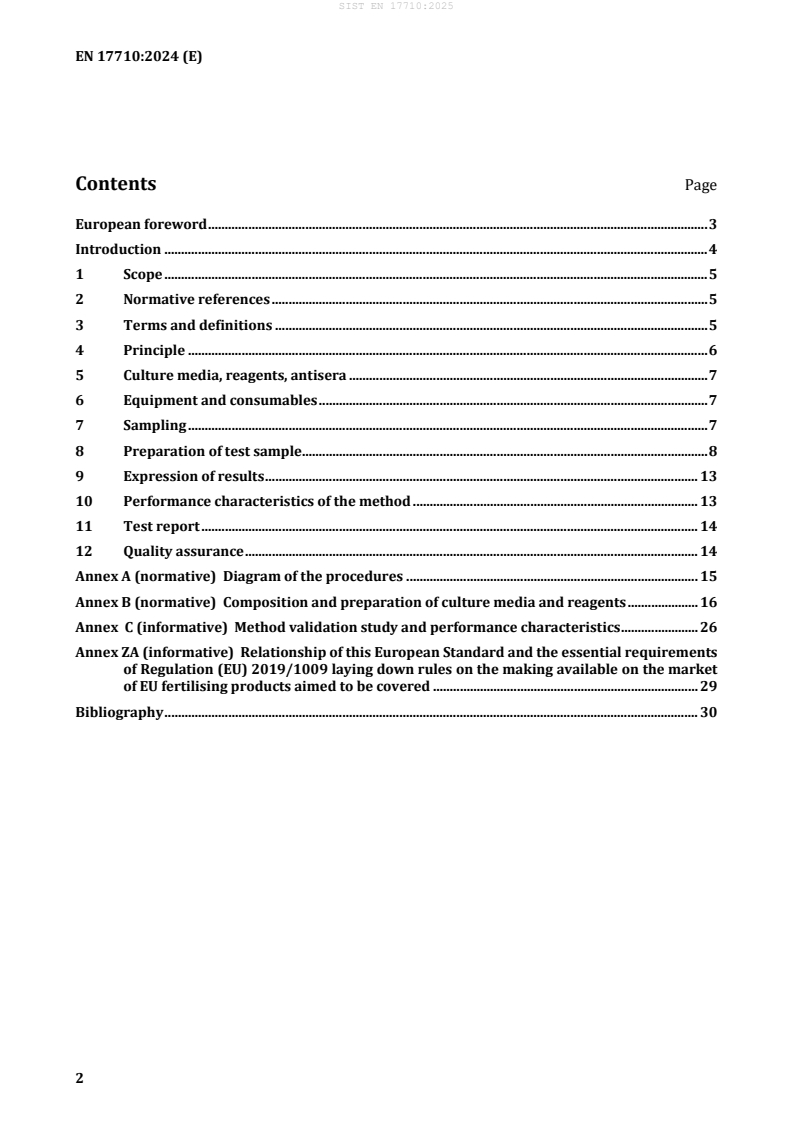
Contents Page
European foreword . 3
Introduction . 4
1 Scope . 5
2 Normative references . 5
3 Terms and definitions . 5
4 Principle . 6
5 Culture media, reagents, antisera . 7
6 Equipment and consumables . 7
7 Sampling . 7
8 Preparation of test sample . 8
9 Expression of results . 13
10 Performance characteristics of the method . 13
11 Test report . 14
12 Quality assurance . 14
Annex A (normative) Diagram of the procedures . 15
Annex B (normative) Composition and preparation of culture media and reagents . 16
Annex C (informative) Method validation study and performance characteristics . 26
Annex ZA (informative) Relationship of this European Standard and the essential requirements
of Regulation (EU) 2019/1009 laying down rules on the making available on the market
of EU fertilising products aimed to be covered . 29
Bibliography . 30
European foreword
This document (EN 17710:2024) has been prepared by Technical Committee CEN/TC 455 “Plant
Biostimulants”, the secretariat of which is held by AFNOR.
This European Standard shall be given the status of a national standard, either by publication of an
identical text or by endorsement, at the latest by May 2025, and conflicting national standards shall be
withdrawn at the latest by May 2025.
Attention is drawn to the possibility that some of the elements of this document may be the subject of
patent rights. CEN shall not be held responsible for identifying any or all such patent rights.
This document supersedes CEN/TS 17710:2022.
CEN/TS 17710:2022:
— The European foreword and the introduction have been updated;
— The Normative references reported in Clause 2 have been updated;
— The definitions in Clause 3 have been revised;
— Clauses 8 and 9 have been combined and the text has been revised;
— Annexes A, B, and C have been revised;
— Annex ZA has been added.
This document has been prepared under a standardization request addressed to CEN by the European
Commission. The Standing Committee of the EFTA States subsequently approves these requests for its
Member States.
For the relationship with EU Legislation, see informative Annex ZA, which is an integral part of this
document.
Any feedback and questions on this document should be directed to the users’ national standards body.
A complete listing of these bodies can be found on the CEN website.
According to the CEN-CENELEC Internal Regulations, the national standards organisations of the
following countries are bound to implement this European Standard: Austria, Belgium, Bulgaria, Croatia,
Cyprus, Czech Republic, Denmark, Estonia, Finland, France, Germany, Greece, Hungary, Iceland, Ireland,
Italy, Latvia, Lithuania, Luxembourg, Malta, Netherlands, Norway, Poland, Portugal, Republic of North
Macedonia, Romania, Serbia, Slovakia, Slovenia, Spain, Sweden, Switzerland, Türkiye and the United
Kingdom.
Introduction
The European Committee for Standardization (CEN) was requested by the European Commission (EC)
to draft European Standards or European Standardization deliverables to support the implementation
of Regulation (EU) 2019/1009 of 5 June 2019 [1] laying down rules on the making available on the
market of EU fertilising products (“FPR” or “Fertilising Products Regulation”).
This standardization request, presented as SR M/564 and relevant amendments, also contributes to the
Communication on “Innovating for Sustainable Growth: A Bio economy for Europe”.
The interest in plant biostimulants has increased significantly in Europe as a valuable tool to use in
agriculture. Standardization was identified as having an important role in order to promote the use of
biostimulants. The work of CEN/TC 455 seeks to improve the reliability of the supply chain, thereby
improving the confidence of farmers, industry, and consumers in biostimulants, and will promote and
support commercialisation of the European biostimulant industry.
WARNING — Persons using this document should be familiar with normal laboratory practice. This
document does not purport to address all of the safety problems, if any, associated with its use. It is the
responsibility of the user to establish appropriate safety and health practices and to ensure compliance
with any national regulatory conditions.
IMPORTANT — It is absolutely essential that tests conducted in accordance with this document be
carried out by suitably trained staff.
1 Scope
This document specifies a method for the detection of Listeria monocytogenes in microbial plant
biostimulants.
This document is applicable to the blends of fertilizing products where a blend is a mix of at least two of
the following component EU fertilising products categories: Fertilizers, Liming Materials, Soil
Improvers, Growing Media, Plant Biostimulants and where the following category Plant Biostimulants
is the highest percentage in the blend by mass or volume, or in the case of liquid form by dry mass. If
Plant Biostimulants is not the highest percentage in the blend, the European Standard for the highest
percentage of the blend applies. In case a blend of fertilizing products is composed of components in
equal quantity or in case the component EU fertilising products used for the blend have identical
formulations , the user decides which standard to apply.
2 Normative references
The following documents are referred to in the text in such a way that some or all of their content
constitutes requirements of this document. For dated references, only the edition cited applies. For
undated references, the latest edition of the referenced document (including any amendments) applies.
EN 17724:2024, Plant biostimulants — Terminology
EN 17708:2024, Plant biostimulants — Preparation of sample for microbial analysis
EN 17702-1:2024, Plant biostimulants — Sampling and sample preparation — Part 1: Sampling
EN ISO 7218:2024, Microbiology of food and animal feeding stuffs — General requirements and guidance
for microbiological examinations
EN ISO 11133:2014, Microbiology of food, animal feed and water — Preparation, production, storage and
performance testing of culture media
EN ISO 11290-1:2017, Microbiology of the food chain — Horizontal method for the detection and
enumeration of Listeria monocytogenes and of Listeria spp. — Part 1: Detection method
(ISO 11290-1:2017)
3 Terms and definitions
For the purposes of this document, the terms and definitions given in EN 17724:2024 and the following
apply.
ISO and IEC maintain terminological databases for use in standardization at the following addresses:
— IEC Electropedia: available at https://www.electropedia.org/
— ISO Online browsing platform: available at https://www.iso.org/obp
An example of such a blend is a product with 2 claimed functions consisting of a non-microbial plant biostimulant
and an organic fertilizer composed of 1 kg/kg of plant biostimulant from seaweed.
As impacted by EN ISO 11133:2014/A1:2018 and EN ISO 11133:2014/A2:2020.
3.1
Listeria monocytogenes
microorganisms which form typical colonies on solid selective media and which display the
morphological, physiological and biochemical characteristics described when tests are carried out in
accordance with this document
Note 1 to entry: L. monocytogenes is a Gram-positive, non-spore forming, rod-shaped bacterium that belongs to
the genus Listeria, phylum Firmicutes.
Note 2 to entry: L. monocytogenes is a ubiquitous bacterial pathogen that causes serious localized and generalized
infections in humans.
Note 3 to entry: L. monocytogenes are catalase positive and oxidase negative. They produce flagella when grown
at a temperature between 20 °C and 25 °C but not at 37 °C. They produce a β-hemolysin on blood agar plates, which
is part of the CAMP (Christie, Atkins, and Munch-Petersen) diagnostic test.
Note 4 to entry: L. monocytogenes can grow at temperatures between −0,4 °C and 50 °C, with an optimum
temperature of 30–37 °C. They can withstand freezing, but they are inactivated by heating at 60 °C for 30 min.
Note 5 to entry: L. monocytogenes are facultative anaerobes that utilize glucose, lactose, and rhamnose under
aerobic conditions and can ferment several hexoses and pentoses under anaerobic conditions.
Note 6 to entry: L. monocytogenes can grow over a pH range of 4–9.5 and a water activity of 0.90 to 0.97. They can
also grow in 10 % sodium chloride.
[SOURCE: EN ISO 11290-1:2017, 3.1]
4 Principle
4.1 General
The detection of Listeria monocytogenes requires four successive stages as specified in Annex A.
NOTE L. monocytogenes can be present in small numbers and is often accompanied by a considerably larger
number of bacteria belonging to different taxonomic groups or different Listeria species. Pre-enrichment is used
to permit the detection of low numbers of L. monocytogenes or injured L. monocytogenes [2].
4.2 Pre-enrichment in selective liquid medium
Half-Fraser broth (225 ml) at ambient temperature shall be inoculated with the test portion (25 g or
25 ml), then shall be incubated at 30 °C ± 2 °C for 24 h to 26 h.
For large quantities (e.g. 1 l or more), it is recommended to pre-warm the broth to 30 °C before mixing
it with the test portion.
4.3 Enrichment in/on selective media
Fraser broth shall be inoculated at 37 °C (0,1 ml of culture in 10 ml of Fraser broth) and shall be
incubated at 37 °C ± 2 °C for 24 h ± 2 h.
4.4 Plating out on selective solid media
Both primary and secondary enrichments shall be streaked onto:
— Agar Listeria according to Ottaviani and Agosti (ALOA) [3];
— A second selective agar of choice, e.g. PALCAM agar, Oxford agar.
The agar prepared according to Ottaviani and Agosti shall be incubated for 48 h ± 2 h at 37 °C ± 2 °C and
then shall be examined. The second selective agar shall be incubated as specified by the manufacturer.
4.5 Confirmation
Colonies of presumptive L. monocytogenes shall be subcultured and their identity shall be confirmed by
means of appropriate morphological and biochemical tests.
5 Culture media, reagents, antisera
Current laboratory practices shall refer to EN 17708:2024 and EN ISO 11133:2014 .
Composition of culture media and reagents and their preparation are described in Annex B.
6 Equipment and consumables
Disposable equipment is an acceptable alternative to reusable glassware if it has suitable specifications.
Usual microbiological laboratory equipment specified in EN ISO 7218:2024 shall be used and, in
particular, the following.
6.1 Apparatus for dry sterilization (oven) or wet sterilization (autoclave).
6.2 Drying cabinet or incubator, capable of operating between 25 °C and 50 °C.
6.3 Incubators, capable of operating at 30 °C ± 2 °C, 37 °C ± 2 °C, and at 25 °C ± 2 °C (optional).
6.4 Water bath, capable of operating at 47 °C ± 2 °C.
6.5 Sterile loops, approximately 3 mm in diameter or 10 μl, and inoculating needle or wire.
6.6 pH-meter, having a maximum permissible error of ± 0,1 pH unit at 25 °C.
6.7 Sterile graduated pipettes or automatic pipettes of nominal capacities of 1 ml, and 10 ml.
6.8 Sterile Petri dishes, with a diameter of approximately 90 mm and (optional) large size (diameter
approximately 140 mm).
6.9 Microscope, preferably with phase-contrast, and with slides and cover slips.
6.10 Refrigerator, capable of operating at 5 °C ± 3 °C. ®
6.11 Peristaltic blender (Stomacher ) with 400 ml sterile bags.
6.12 Blender motor and jars or vortex.
7 Sampling
Sampling is not part of the method specified in this document. A representative sample of the product
shall be obtained as specified in EN 17702-1:2024.
It is important that the laboratory receives a sample which is representative and has not been damaged
or changed during transport or storage.
3 ®
Stomacher is an example of a suitable product available commercially. This information is given for the
convenience of users of this document and does not constitute an endorsement by CEN of this product.
8 Preparation of test sample
8.1 General
Refer to EN 17708:2024 for general rules for the preparation of the initial suspension for
microbiological examination. To prepare the analytical unit, liquids or free flowing materials shall be
agitated until the contents are homogeneous. If the sample is solid, the analytical unit shall be obtained
by taking a portion from several locations within the sample. To reduce the workload, the analytical
units may be combined for analysis. It is recommended that a composite contains no more than five
analytical units.
The initial suspension of the microbial biostimulant product samples shall be prepared according to
EN ISO 11290-1:2017 using, as dilution fluid, the selective primary enrichment medium, half-Fraser
broth, described in B.2.
A representative sample of the product shall be prepared considering the different formulations of plant
biostimulants.
A portion of 25 g or 25 ml of the product shall be added to 225 ml of half-Fraser broth in a 400 ml sterile
bag (6.11) or a blender jar (6.12). For composite samples, analytical units may be combined up to 125 g
or ml (e.g. 125 g or 125 ml of biostimulant to 1 125 ml of half-Fraser broth). The half-Fraser broth shall
be pre-warmed to room temperature before use.
If alternate analytical units are required, a ratio of 1 part sample material to 9 parts half-Fraser broth
shall be maintained.
To minimize the effect of the sampling on the significance and the reliability of the analytical results, the
number of replicates tested shall be increased to 5.
8.2 Liquid (water-based) formulations
A portion of 25 ml of the product (the analytical unit) shall be aseptically added to 225 ml of half-Fraser
broth in a 400 ml sterile bag (6.11) or a blender jar (6.12). The half-Fraser broth shall be pre-warmed
to room temperature before use. The sample shall be blended, stomached or vortexed as required for
thorough mixing.
8.3 Liquid (oil-based) emulsifiable concentrate (EC) formulations
8.3.1 General
A portion of 25 ml of the product (the analytical unit) shall be aseptically added to 225 ml of half-Fraser
broth in a 400 ml sterile bag (6.11) or a blender jar (6.12). The half-Fraser broth shall be pre-warmed
to room temperature before use. The sample shall be blended, stomached or vortexed as required for
thorough mixing.
8.3.2 Solid wettable powder (WP) formulations
A portion of 25 g of the product (the analytical unit) shall be aseptically added to 225 ml of half-Fraser
broth in a 400 ml sterile bag (6.11). The half-Fraser broth shall be pre-warmed to room temperature
before use. The mixture shall be homogenized for 2 min at highest speed with a peristaltic blender
(6.11).
8.3.3 Solid water dispersible granules (WDG) formulations
A portion of 25 g of the product (the analytical unit) shall be aseptically added to 225 ml of half-Fraser
broth in a 400 ml sterile bag (6.11). The half-Fraser broth shall be pre-warmed to room temperature
before use. The mixture shall be homogenized for 2 min at highest speed with a peristaltic blender
(6.11).
8.3.4 Solid pellets, granules, microgranules (slow release) formulations
A portion of 25 g of the product (the analytical unit) shall be aseptically added to 225 ml of half-Fraser
broth in a 400 ml sterile bag (6.11). The half-Fraser broth shall be pre-warmed to room temperature
before use. The mixture shall be homogenized for 2 min at highest speed with a peristaltic blender
(6.11).
8.3.5 Solid substrates
A portion of 25 g of the product (the analytical unit) shall be aseptically added to 225 ml of half-Fraser
broth in a 400 ml sterile bag (6.11). The half-Fraser broth shall be pre-warmed to room temperature
before use. The mixture shall be homogenized for 2 min at highest speed with a peristaltic blender
(6.11).
8.4 Non-selective pre-enrichment
The test portion sample (25 g or 25 ml) shall be prepared in half-Fraser broth (225 ml). The incubation
shall be done for 25 h ± 1 h at 30 °C ± 2 °C.
NOTE 1 A black coloration can develop during incubation.
NOTE 2 After the incubation, it is possible to store the pre-enriched sample at 5 °C (6.10) before transfer to
Fraser broth for a maximum of 72 h.
8.5 Selective enrichment
8.5.1 After incubation of the initial suspension (primary enrichment in half-Fraser broth) for 25 h ± 1
h, 0,1 ml of the culture obtained in 8.4 shall be transferred to a tube or bottle containing 10 ml of
secondary enrichment medium (Fraser broth) (described in B.3).
8.5.2 The inoculated medium (8.5.1) shall be incubated for 25 h ± 1 h at 37 °C ± 2 °C (6.3).
Half-Fraser broth and Fraser broth may be refrigerated before transfer or isolation on selective agar for
a maximum of 72 h. Refrigeration provides greater laboratory productivity and analytical flexibility.
Following the period of refrigeration, the secondary enrichment broth shall always be resuspended
before transfer or plating onto agar media.
8.6 Plating out
8.6.1 General
8.6.1.1 From the primary enrichment culture (8.4) incubated for 25 h ± 1 h at 30 °C ± 2 °C (6.3), shall
inoculate the surface of the first selective plating medium, Agar Listeria according to Ottaviani and
Agosti (ALOA) (described in B.4), by means of a loop (6.5), to obtain well-separated colonies.
Proceed in the same way with the second selective plating-out medium of choice (B.5).
NOTE Half-Fraser broth and Fraser broth can be refrigerated at 5 °C (6.10) before isolation on selective agar
for a maximum of 72 h [4].
8.6.1.2 From the secondary enrichment medium incubated for 25 h ± 1 h at 37 °C ± 2 °C (6.3) (8.5.2),
the procedure described in 8.6.1.1 shall be repeated with the two selective plating-out media.
8.6.1.3 The Petri dishes obtained in 8.6.1.1 and 8.6.1.2 shall be inverted and placed in an incubator set
at 37 °C (6.3) for Agar Listeria according to Ottaviani and Agosti (B.4). For the second selective medium
(B.5), follow the manufacturer’s instructions.
8.6.1.4 For Agar Listeria according to Ottaviani and Agosti (B.4), the plates shall be incubated for a total
of 48 h ± 2 h at 37 °C ± 2 °C. If colonies of presumptive L. monocytogenes are evident at 25 h ± 1 h, the
incubation may be stopped at this stage. For second selective agar the plates shall be incubated for the
appropriate time. The dishes (8.6.1.3) shall be examined for the presence of presumptive colonies of L.
monocytogenes.
NOTE After incubation plates can be refrigerated at 5 °C (6.10) for a maximum of 48 h before reading.
8.6.2 Agar Listeria according to Ottaviani and Agosti (B.4)
The blue-green colonies surrounded by an opaque halo (typical colonies) shall be considered as
presumptive L. monocytogenes. Colonies of Listeria ivanovii are also blue-green and surrounded by an
opaque halo.
NOTE 1 Some strains of L. monocytogenes exposed to stress conditions, particularly acid stress, can show a very
weak halo (or even no halo).
NOTE 2 Some rare L. monocytogenes are characterized by a slow PIPLC (phosphatidyl inositol phospholipase
C) activity. Such bacteria are detected when the total duration of incubation is more than, for example, four days.
Some of these strains could be pathogenic [5]. No L. monocytogenes strains have been described as PIPLC negative.
NOTE 3 Some organisms other than Listeria spp. can produce blue colonies on this medium [6].
8.6.3 Second selective medium
After the appropriate time, the plates shall be examined for the presence of colonies which are
considered to be presumptive L. monocytogenes, based on their characteristics for the type of medium
used (B.5).
8.7 Confirmation of L. monocytogenes
8.7.1 General
Confirmation tests shall be conducted in accordance with the standard EN ISO 11290-1:2017; in the
recent revision and validation of this standard, catalase test and Camp-test became optional for L.
monocytogenes. The microscopic confirmation with an agar allowing the distinction of pathogenic
Listeria spp. remains mandatory. For the haemolysis test or CAMP test, blood agar shall now be extended
from defibrinated sheep blood only, to calf or bovine blood. For the haemolysis test, blood agar shall be
inoculated by stabbing or by streaking (only if positive at purification step) [2].
Appropriate positive and negative control strains for each of the confirmatory tests shall be used.
8.7.2 Selection of colonies for confirmation
For confirmation of presumptive L. monocytogenes, further colonies presumed to be L. monocytogenes
(see 8.6.2 and 8.6.3) shall be taken. One confirmed isolate per sample is sufficient. If the first colony is
negative further colonies presumed to be L. monocytogenes shall be taken from the selective medium
(up to a maximum of five colonies from each plate of each selective medium).
The selected colonies shall be streaked onto the surface of pre-dried plates of a non-selective agar, for
example blood agar, nutrient agar, tryptone soya yeast extract agar (TSYEA) (B.14), in a manner which
shall allow isolated colonies to develop.
Use of blood agar for pure culture shall enable interpretation of haemolysis, when positive, already at
that stage. If streaking on blood agar does not show haemolysis, then the haemolysis test shall be done
by stabbing or in liquid medium.
The plates shall be placed in the incubator set at 37 °C ± 2 °C (6.3) for 18 h to 25 h ± 1 h or until growth
is satisfactory.
If the colonies are not isolated, a typical L. monocytogenes colony shall be picked onto another non-
selective agar plate. Colonies of a pure culture on the non-selective agar shall be analysed using the
following tests (8.7.3).
8.7.3 Confirmation tests for L. monocytogenes
8.7.3.1 The mandatory and optional tests to be performed for confirmation of presumptive L.
monocytogenes are reported in Table 2
Table 2 — Confirmation tests for L. monocytogenes
L. monocytogenes
Tests Results
confirmation tests
Beta-haemolysis +
Mandatory L-Rhamnose +
D-Xylose -
Microscopic aspect Slim short rods or coccobacilli
Catalase +
Optional
Motility at 25 °C +
CAMP test +
As mentioned in EN ISO 7218:2024, an alternative procedure shall be used to confirm the isolate as
Listeria monocytogenes, providing the suitability of the relevant procedure is verified. If shown to be
reliable, miniaturized galleries for the biochemical identification of L. monocytogenes may be used (see
EN ISO 7218:2024). Rare strains of L. monocytogenes do not show beta-haemolysis or a positive reaction
to the CAMP test under the conditions described in this document. If typical colonies on Agar Listeria
according to Ottaviani and Agosti with PIPLC activity even if it is low are negative for haemolysis, it is
recommended to perform additional tests (e.g. Gram-stain, catalase, motility, CAMP test, PCR), in order
to determine whether this isolate is a non-haemolytic L. monocytogenes.
8.7.3.2 Catalase reaction (optional)
An isolated colony obtained in 8.7.2 shall be taken and suspended in a drop of hydrogen peroxide
solution (B.7) on a slide. The immediate formation of gas bubbles indicates a positive reaction.
NOTE A catalase reaction performed from a colony originating from a blood agar can sometimes lead to false-
positive results.
8.7.3.3 Motility test (optional)
An isolated colony obtained in 8.7.2 shall be taken and suspended in a tube containing a non-selective
nutrient liquid medium.
The incubation shall be done in the incubator (6.3) set at 25 °C ± 2 °C for 8 h to 24 h until the medium
turns cloudy.
A drop of the above culture shall be taken using a loop (6.5) onto a clean glass microscope slide. A cover
slip shall be placed on top, and the slide shall be examined under a microscope (6.9).
L. monocytogenes shall appear as slim, short rods with tumbling motility.
Cultures grown at temperatures above 25 °C ± 2 °C may fail to exhibit this motion. The operator shall
always compare them to a known L. monocytogenes culture. Cocci, large rods, or rods with rapid
swimming motility are not Listeria spp.
As an alternative test for motility, using an inoculating needle (6.5), dilute in sterile water (or a different
appropriate diluent) a fragment of isolated colony obtained on non-selective agar. L. monocytogenes
appear as slim, short rods with tumbling motility.
As another alternative test for motility, using an inoculating needle (6.5), stab the motility agar (B.8)
with a culture taken from a typical colony obtained in 8.7.2. Incubate at 25 °C for 48 h ± 2 h.
8.7.3.4 Microscopic aspect (optional)
Make a microscopic preparation (e.g. the Gram-stain, wet microscopy) on a well-separated colony
obtained in 8.7.2. L. monocytogenes shall appear as Gram-positive (if this stain is performed), slim, short
rods or coccobacilli, with tumbling motility when originating from a fresh culture.
For Gram-stain microscopic preparation EN ISO 7218:2024 shall be referred to.
8.7.3.5 Haemolysis tests
8.7.3.5.1 General
Haemolysis tests shall be performed following the procedures described in EN ISO 11290-1:2017 and
reported in 8.7.3.5.2 and 8.7.3.5.3. Choose one of the haemolysis tests (8.7.3.5.2 or 8.7.3.5.3).
NOTE There exist rare strains of L. monocytogenes which do not show β-haemolysis or a positive reaction to
the CAMP test under the condition
...