

EN 17702-1:2024
(Main)Plant biostimulants - Sampling and sample preparation - Part 1: Sampling
General Information
- Abstract
This document specifies sampling plans and methods of representative sampling of plant biostimulants to obtain samples for physical, chemical and biological analysis.
It is applicable to the sampling of batches of plant biostimulants supplied or ready for supply to third parties, as such, or in smaller batches.
This document is applicable to the blends of fertilizing products where a blend is a mix of at least two of the following component EU fertilising products: Fertilizers/Liming Materials/Soil Improvers/Growing Media/Inhibitors/Plant Biostimulants, and where the following category Plant Biostimulants is the highest percentage in the blend by mass or volume, or in the case of liquid form by dry mass. If Plant Biostimulants is not the highest percentage in the blend, the European Standard for the highest percentage of the blend applies. In case a blend of fertilizing products is composed of components in equal quantity or in case the component EU fertilising products used for the blend have identical formulations , the user decides which standard to apply.
This document is intended to be used by manufacturers, buyers and competent authorities to obtain samples prior to transport and supply it to a laboratory for testing.
- Status
- Published
- Publication Date
- 26-Nov-2024
- Technical Committee
- CEN/TC 455 - Plant Biostimulants and Agricultural Micro-Organisms
- Drafting Committee
- CEN/TC 455/WG 1 - Sampling
- Current Stage
- 6060 - Definitive text made available (DAV) - Publishing
- Start Date
- 27-Nov-2024
- Due Date
- 09-Apr-2024
- Completion Date
- 27-Nov-2024

Overview
EN 17702-1:2024 - Plant biostimulants: Sampling is a CEN European Standard that defines sampling plans and methods for representative sampling of plant biostimulants to obtain material for physical, chemical and biological analysis. Approved in November 2024 (superseding CEN/TS 17702-1:2022), the standard targets batches supplied or ready for supply and covers blends where plant biostimulants are the largest component by mass, volume or (for liquids) dry mass. It is intended for use prior to transport and laboratory testing to support quality control and regulatory compliance with the EU Fertilising Products Regulation.
Key topics and technical requirements
- Sampling plans and quantitative data: principles for determining the number and identification of sampling units, and required mass/volume reporting for incremental, combined/reduced and final samples.
- Incremental sampling methods: procedures for different product forms, including:
- solid products in packages (use of rotary mechanical sample dividers, riffle dividers, spears, or manual methods),
- liquid plant biostimulants (mixing and incremental withdrawal techniques).
- Reduction of combined samples: methods to reduce combined samples to lab-size portions (riffle dividers, coning and quartering for solids; appropriate apparatus and procedures for liquids).
- Final sample handling: division into final (laboratory) samples, container types, sealing, labelling, dispatch and storage instructions to preserve representativeness.
- Documentation: mandatory content for the sampling report (essential and additional information to accompany samples).
- Annexes: informative and normative support (examples of rotating dividers, test for bias, apparatus and mixing methods for liquids).
Practical applications
- Ensures representative, traceable sampling for:
- batch acceptance/rejection and quality control testing,
- regulatory compliance and market surveillance under the EU Fertilising Products Regulation (FPR),
- supplier–buyer disputes and certificate of analysis verification,
- R&D and product development where consistent analytics are required.
- Promotes analytical reliability by reducing sampling-related variability and providing standardised procedures for solids, liquids and blends.
Who should use this standard
- Manufacturers of plant biostimulants and blended fertilising products
- Buyers, distributors and retailers performing incoming quality checks
- Competent authorities and market surveillance bodies enforcing FPR requirements
- Analytical laboratories receiving and testing samples
- Quality assurance professionals involved in sampling protocols
Related standards
- EN 17702 series: Part 2 - Sample preparation (complements Part 1)
- References and methodological derivations from standards such as EN 1482-1 (as cited within the document)
Using EN 17702-1:2024 helps organisations standardise sampling practices, improve test result reliability, and support compliance across the plant biostimulant supply chain.
Relations
- Replaces
CEN/TS 17702-1:2022 - Plant biostimulants - Sampling and sample preparation - Part 1: Sampling - Effective Date
- 28-Jan-2023
- Effective Date
- 28-Jan-2026
- Effective Date
- 28-Jan-2026
- Effective Date
- 28-Jan-2026
- Effective Date
- 28-Jan-2026
- Effective Date
- 28-Jan-2026
- Effective Date
- 28-Jan-2026
- Effective Date
- 28-Jan-2026
- Effective Date
- 28-Jan-2026
- Effective Date
- 28-Jan-2026
- Effective Date
- 28-Jan-2026
- Effective Date
- 28-Jan-2026
- Effective Date
- 28-Jan-2026
- Effective Date
- 28-Jan-2026
- Referred By
EN 17702-2:2024 - Plant biostimulants - Sampling and sample preparation - Part 2: Sample preparation - Effective Date
- 28-Jan-2026
Get Certified
Connect with accredited certification bodies for this standard

Control Union Certifications
Global certification for agriculture and sustainability.

ECOCERT
Organic and sustainability certification.

FSC International
Forest Stewardship Council certification.
Sponsored listings
Frequently Asked Questions
EN 17702-1:2024 is a standard published by the European Committee for Standardization (CEN). Its full title is "Plant biostimulants - Sampling and sample preparation - Part 1: Sampling". This standard covers: This document specifies sampling plans and methods of representative sampling of plant biostimulants to obtain samples for physical, chemical and biological analysis. It is applicable to the sampling of batches of plant biostimulants supplied or ready for supply to third parties, as such, or in smaller batches. This document is applicable to the blends of fertilizing products where a blend is a mix of at least two of the following component EU fertilising products: Fertilizers/Liming Materials/Soil Improvers/Growing Media/Inhibitors/Plant Biostimulants, and where the following category Plant Biostimulants is the highest percentage in the blend by mass or volume, or in the case of liquid form by dry mass. If Plant Biostimulants is not the highest percentage in the blend, the European Standard for the highest percentage of the blend applies. In case a blend of fertilizing products is composed of components in equal quantity or in case the component EU fertilising products used for the blend have identical formulations , the user decides which standard to apply. This document is intended to be used by manufacturers, buyers and competent authorities to obtain samples prior to transport and supply it to a laboratory for testing.
This document specifies sampling plans and methods of representative sampling of plant biostimulants to obtain samples for physical, chemical and biological analysis. It is applicable to the sampling of batches of plant biostimulants supplied or ready for supply to third parties, as such, or in smaller batches. This document is applicable to the blends of fertilizing products where a blend is a mix of at least two of the following component EU fertilising products: Fertilizers/Liming Materials/Soil Improvers/Growing Media/Inhibitors/Plant Biostimulants, and where the following category Plant Biostimulants is the highest percentage in the blend by mass or volume, or in the case of liquid form by dry mass. If Plant Biostimulants is not the highest percentage in the blend, the European Standard for the highest percentage of the blend applies. In case a blend of fertilizing products is composed of components in equal quantity or in case the component EU fertilising products used for the blend have identical formulations , the user decides which standard to apply. This document is intended to be used by manufacturers, buyers and competent authorities to obtain samples prior to transport and supply it to a laboratory for testing.
EN 17702-1:2024 is classified under the following ICS (International Classification for Standards) categories: 65.080 - Fertilizers. The ICS classification helps identify the subject area and facilitates finding related standards.
EN 17702-1:2024 has the following relationships with other standards: It is inter standard links to CEN/TS 17702-1:2022, EN 1482-1:2024, EN 17707:2024, EN 17720:2024, EN 17706:2024, EN 17719:2024, EN 17709:2024, EN 17705:2024, EN 17703:2024, EN 17712:2024, EN 17704:2024, CEN/TS 17703:2022, EN 17710:2024, EN 17717:2024, EN 17702-2:2024. Understanding these relationships helps ensure you are using the most current and applicable version of the standard.
EN 17702-1:2024 is associated with the following European legislation: EU Directives/Regulations: 2019/1009; Standardization Mandates: M/564, M/564 Amd 1, M/XXX. When a standard is cited in the Official Journal of the European Union, products manufactured in conformity with it benefit from a presumption of conformity with the essential requirements of the corresponding EU directive or regulation.
EN 17702-1:2024 is available in PDF format for immediate download after purchase. The document can be added to your cart and obtained through the secure checkout process. Digital delivery ensures instant access to the complete standard document.
Standards Content (Sample)
SLOVENSKI STANDARD
01-februar-2025
Nadomešča:
SIST-TS CEN/TS 17702-1:2023
Rastlinski biostimulanti - Vzorčenje in priprava vzorcev - 1. del: Vzorčenje
Plant biostimulants - Sampling and sample preparation - Part 1: Sampling
Pflanzen-Biostimulanzien - Probenahme und Probenvorbereitung - Teil 1: Probenahme
Biostimulants des végétaux - Échantillonnage et préparation des échantillons - Partie 1 :
Échantillonnage
Ta slovenski standard je istoveten z: EN 17702-1:2024
ICS:
65.080 Gnojila Fertilizers
2003-01.Slovenski inštitut za standardizacijo. Razmnoževanje celote ali delov tega standarda ni dovoljeno.
EN 17702-1
EUROPEAN STANDARD
NORME EUROPÉENNE
November 2024
EUROPÄISCHE NORM
ICS 65.080 Supersedes CEN/TS 17702-1:2022
English Version
Plant biostimulants - Sampling and sample preparation -
Part 1: Sampling
Biostimulants des végétaux - Échantillonnage et Pflanzen-Biostimulanzien - Probenahme und
préparation des échantillons - Partie 1 : Probenvorbereitung - Teil 1: Probenahme
Échantillonnage
This European Standard was approved by CEN on 26 August 2024.
This European Standard was corrected and reissued by the CEN-CENELEC Management Centre on 18 December 2024.
CEN members are bound to comply with the CEN/CENELEC Internal Regulations which stipulate the conditions for giving this
European Standard the status of a national standard without any alteration. Up-to-date lists and bibliographical references
concerning such national standards may be obtained on application to the CEN-CENELEC Management Centre or to any CEN
member.
This European Standard exists in three official versions (English, French, German). A version in any other language made by
translation under the responsibility of a CEN member into its own language and notified to the CEN-CENELEC Management
Centre has the same status as the official versions.
CEN members are the national standards bodies of Austria, Belgium, Bulgaria, Croatia, Cyprus, Czech Republic, Denmark, Estonia,
Finland, France, Germany, Greece, Hungary, Iceland, Ireland, Italy, Latvia, Lithuania, Luxembourg, Malta, Netherlands, Norway,
Poland, Portugal, Republic of North Macedonia, Romania, Serbia, Slovakia, Slovenia, Spain, Sweden, Switzerland, Türkiye and
United Kingdom.
EUROPEAN COMMITTEE FOR STANDARDIZATION
COMITÉ EUROPÉEN DE NORMALISATIO N
EUROPÄISCHES KOMITEE FÜR NORMUN G
CEN-CENELEC Management Centre: Rue de la Science 23, B-1040 Brussels
© 2024 CEN All rights of exploitation in any form and by any means reserved Ref. No. EN 17702-1:2024 E
worldwide for CEN national Members.
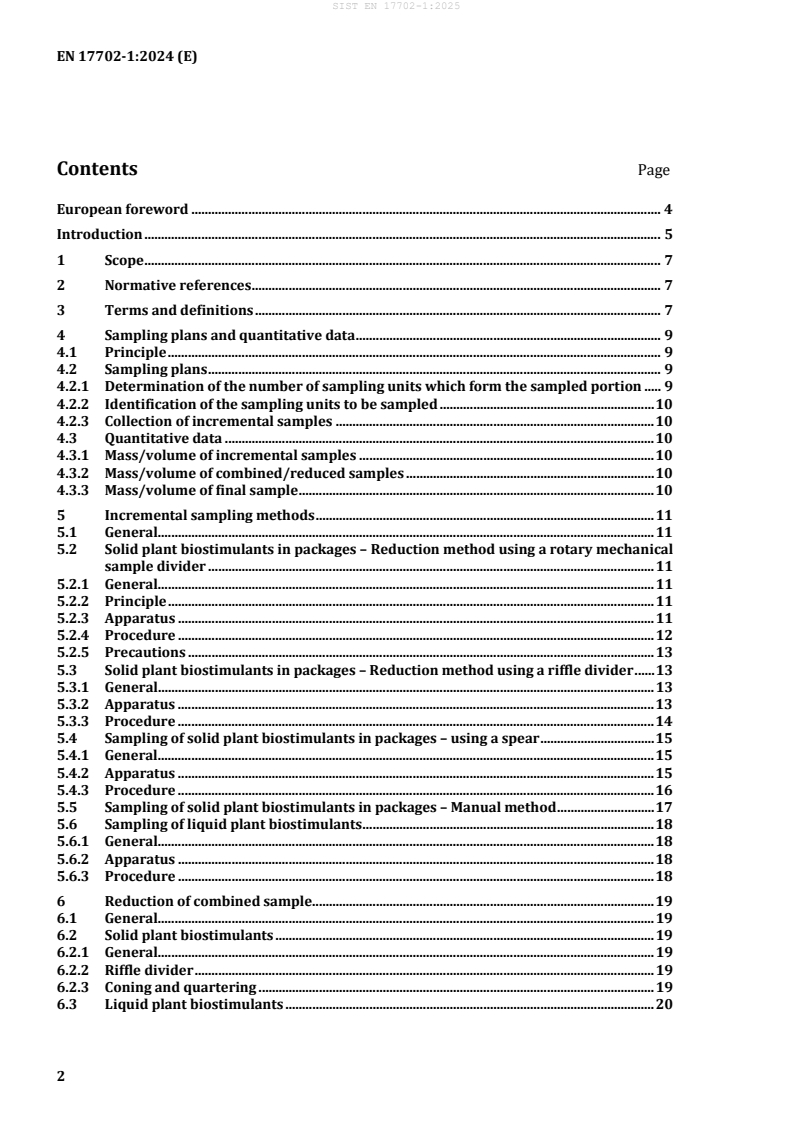
Contents Page
European foreword . 4
Introduction . 5
1 Scope . 7
2 Normative references . 7
3 Terms and definitions . 7
4 Sampling plans and quantitative data . 9
4.1 Principle . 9
4.2 Sampling plans . 9
4.2.1 Determination of the number of sampling units which form the sampled portion . 9
4.2.2 Identification of the sampling units to be sampled . 10
4.2.3 Collection of incremental samples . 10
4.3 Quantitative data . 10
4.3.1 Mass/volume of incremental samples . 10
4.3.2 Mass/volume of combined/reduced samples . 10
4.3.3 Mass/volume of final sample . 10
5 Incremental sampling methods . 11
5.1 General. 11
5.2 Solid plant biostimulants in packages – Reduction method using a rotary mechanical
sample divider . 11
5.2.1 General. 11
5.2.2 Principle . 11
5.2.3 Apparatus . 11
5.2.4 Procedure . 12
5.2.5 Precautions . 13
5.3 Solid plant biostimulants in packages – Reduction method using a riffle divider . 13
5.3.1 General. 13
5.3.2 Apparatus . 13
5.3.3 Procedure . 14
5.4 Sampling of solid plant biostimulants in packages – using a spear . 15
5.4.1 General. 15
5.4.2 Apparatus . 15
5.4.3 Procedure . 16
5.5 Sampling of solid plant biostimulants in packages – Manual method . 17
5.6 Sampling of liquid plant biostimulants . 18
5.6.1 General. 18
5.6.2 Apparatus . 18
5.6.3 Procedure . 18
6 Reduction of combined sample . 19
6.1 General. 19
6.2 Solid plant biostimulants . 19
6.2.1 General. 19
6.2.2 Riffle divider . 19
6.2.3 Coning and quartering . 19
6.3 Liquid plant biostimulants . 20
6.3.1 Apparatus . 20
6.3.2 Procedure . 20
7 Division into final samples . 20
8 Practical arrangements for final (laboratory) samples . 20
8.1 General . 20
8.2 Containers . 21
8.3 Sealing of containers . 21
8.4 Labelling of final samples . 21
8.5 Dispatch of the final sample . 21
8.6 Storage of final samples . 21
9 Sampling report . 21
9.1 General . 21
9.2 Essential information . 22
9.3 Additional information . 22
Annex A (informative) Examples of rotating sample dividers . 23
Annex B (normative) Test for bias in a rotary divider . 26
Annex C (informative) Examples of apparatus for sampling of liquid plant biostimulant . 27
Annex D (informative) Methods of mixing for liquid plant biostimulants . 29
D.1 General . 29
D.2 Small containers. 29
D.2.1 Hand shaking . 29
D.2.2 Rocking . 29
D.3 Containers bigger than 20 l and up to 1 000 l. 29
D.3.1 Rocking in a see-saw fashion . 29
D.3.2 Rolling to and fro . 29
D.3.3 Mechanically driven drum shaker or roller . 29
D.3.4 Mechanical mixing . 29
D.3.5 Hand mixing . 31
D.3.6 Compressed gas . 32
D.4 Precautions for sampling of multi-phase liquids . 32
D.5 Precautions against static electricity . 33
Bibliography . 35
European foreword
This document (EN 17702-1:2024) has been prepared by Technical Committee CEN/TC 455 “Plant
biostimulants”, the secretariat of which is held by AFNOR.
This European Standard shall be given the status of a national standard, either by publication of an
identical text or by endorsement, at the latest by May 2025, and conflicting national standards shall be
withdrawn at the latest by May 2025.
Attention is drawn to the possibility that some of the elements of this document may be the subject of
patent rights. CEN shall not be held responsible for identifying any or all such patent rights.
This document supersedes CEN/TS 17702-1:2022.
CEN/TS 17702-1:2022:
— Introduction, Scope, Terms and definitions, Figures, and Bibliography have been updated.
The EN 17702 series, Plant biostimulants — Sampling and sample preparation, consists of the following
parts:
— Part 1: Sampling;
— Part 2: Sample preparation.
This document has been prepared under a standardization request addressed to CEN by the European
Commission. The Standing Committee of the EFTA States subsequently approves these requests for its
Member States.
Any feedback and questions on this document should be directed to the users’ national standards body.
A complete listing of these bodies can be found on the CEN website.
According to the CEN-CENELEC Internal Regulations, the national standards organisations of the
following countries are bound to implement this European Standard: Austria, Belgium, Bulgaria, Croatia,
Cyprus, Czech Republic, Denmark, Estonia, Finland, France, Germany, Greece, Hungary, Iceland, Ireland,
Italy, Latvia, Lithuania, Luxembourg, Malta, Netherlands, Norway, Poland, Portugal, Republic of North
Macedonia, Romania, Serbia, Slovakia, Slovenia, Spain, Sweden, Switzerland, Türkiye and the United
Kingdom.
Introduction
The European Committee for Standardization (CEN) was requested by the European Commission (EC) to
draft European Standards or European Standardization deliverables to support the implementation of
Regulation (EU) 2019/1009 of 5 June 2019 laying down rules on the making available on the market of
EU fertilising products (“FPR” or “Fertilising Products Regulation”).
This standardization request, presented as M/564 and relevant amendments, also contributes to the
Communication on “Innovating for Sustainable Growth: A Bio economy for Europe”. The interest in plant
biostimulants has increased significantly in Europe as a valuable tool to use in agriculture.
Standardization was identified as having an important role in order to promote the use of biostimulants.
The work of CEN/TC 455 seeks to improve the reliability of the supply chain, thereby improving the
confidence of farmers, industry, and consumers in biostimulants, and will promote and support
commercialisation of the European biostimulant industry.
This document covers the following aspects of sampling, derived from EN 1482-1:2024 and documents
indicated. This document is presented in a form adapted to the specificity of plant biostimulants. The
titles of the standards are given in the Bibliography.
From a technical point of view, sampling is generally specified as the withdrawal operation, of the part of
a “mass”, of such dimensions that the properties found in the sample taken, are, within the limits of
statistical acceptability, the same as those of the mass of origin (representativeness of the sample). In
other words, the ultimate purpose of sampling is to allow the collection of representative portions of
plant biostimulants to be subject to analysis. Therefore, it fundamentally affects the significance and
reliability of the analytical results themselves.
Figure 1 gives a schematic diagram of the sampling and sample preparation process.
Figure 1 — Schematic diagram of sampling process for solid plant biostimulants
1 Scope
This document specifies sampling plans and methods of representative sampling of plant biostimulants
to obtain samples for physical, chemical and biological analysis.
It is applicable to the sampling of batches of plant biostimulants supplied or ready for supply to third
parties, as such, or in smaller batches.
This document is applicable to the blends of fertilizing products where a blend is a mix of at least two of
the following component EU fertilising products: Fertilizers/Liming Materials/Soil Improvers/Growing
Media/Inhibitors/Plant Biostimulants, and where the following category Plant Biostimulants is the
highest percentage in the blend by mass or volume, or in the case of liquid form by dry mass. If Plant
Biostimulants is not the highest percentage in the blend, the European Standard for the highest
percentage of the blend applies. In case a blend of fertilizing products is composed of components in equal
quantity or in case the component EU fertilising products used for the blend have identical formulations ,
the user decides which standard to apply.
This document is intended to be used by manufacturers, buyers and competent authorities to obtain
samples prior to transport and supply it to a laboratory for testing.
2 Normative references
The following documents are referred to in the text in such a way that some or all of their content
constitutes requirements of this document. For dated references, only the edition cited applies. For
undated references, the latest edition of the referenced document (including any amendments) applies.
EN 1482-1:2024, Fertilizers, liming materials and inhibitors — Sampling and sample preparation — Part
1: General sampling provisions
3 Terms and definitions
For the purposes of this document, the following terms and definitions apply.
3.1
batch
total quantity of material present assumed to have the same characteristics
Note 1 to entry: A batch is produced by the same process at the same time, under the same conditions and labelled
in the same manner, and assumed to have the same characteristics to be sampled using a particular sampling plan.
3.2
sampled portion
quantity of material from the same batch from which one representative combined sample is taken
3.3
sampling unit
defined quantity of material having a boundary
Note 1 to entry: An example of a physical boundary is a container. An example of a hypothetical boundary is a time
interval for a flow of material.
An example of such a blend is a product with two claimed functions consisting of a non-microbial plant
biostimulant and an organic fertilizer composed of 1 kg/kg of plant biostimulant from seaweed.
3.4
sampling point
point from which the incremental sample is taken
3.5
incremental sample
quantity of material taken from one sampling point
3.6
combined sample
combination of all incremental samples taken from one sampled portion
3.7
reduction
process of producing a representative smaller mass of material from a larger mass, with the remainder
being discarded
3.8
reduced sample
representative part of the combined sample obtained by a process of reduction in such a manner that the
mass is at least the mass of any required final samples
3.9
division
process of producing a number of representative smaller portions, approximately equal in mass to each
other, from a larger mass
3.10
final sample
in relation to chemical and physical testing only, representative part of the combined sample taken from
the sampled portion obtained, where necessary, by a process of reduction
Note 1 to entry: Often, more than one sample is prepared, at the same time, from the reduced sample (or from the
combined sample). One or more of these final samples will be used as a laboratory sample or as laboratory samples,
while others may be stored for reference purposes.
3.11
laboratory sample
in relation to chemical and physical testing, a final sample intended for laboratory testing and in relation
to microbiological testing, each separate segment sample intended for laboratory testing
3.12
consignment
quantity of goods dispatched or received at one time and covered by a particular contract or shipping
document
Note 1 to entry: A consignment can be composed of a part of a batch or one or more batches of the same material or
different materials.
3.13
delivery
quantity of material transferred at one time
3.14
package
container and material contained therein which is ready for delivery or delivered and where the
packaging remains with the material after delivery
4 Sampling plans and quantitative data
4.1 Principle
The sampling plans given in this document are not based on strict statistical principles, but samples
obtained by following the procedures described in this clause shall be considered to be representative of
the original batch or the sampled portion.
This clause specifies sampling plans for the evaluation of deliveries of plant biostimulants as well as
statutory control plans which shall be followed in certain circumstances.
According to available sources, the plant biostimulants are not supplied in other than packaged form (up
to 1 000 kg or 1 000 l). Therefore, this document specifies principles for those cases. Nevertheless, if plant
biostimulants were delivered in larger packages and containers or in bulk, the principles of EN 1482-
1:2024 shall be applied accordingly.
The size of batch is unlimited (see Table 2).
For statutory control and the commercial evaluation of plant biostimulants, one final sample is sufficient,
but this may subsequently be divided into a number of identical samples.
No incremental samples are taken at microbial plant biostimulants – in order to preserve the sensitive
content and maintain its properties intact avoiding possible contamination. Thus, the original package or
container itself shall be considered a final sample.
4.2 Sampling plans
4.2.1 Determination of the number of sampling units which form the sampled portion
4.2.1.1 General
The number of sampling units from which incremental samples are to be taken depends on the size of the
batch.
4.2.1.2 Plant biostimulant in packages or containers up to 50 kg or 50 l
The sampling unit is a package or container and the number of individual packages (containers) from
which incremental samples shall be taken should be in accordance with Table 1. For packages smaller
than 1 kg (1 l) each, it might be necessary to increase the number taken to ensure a sufficiently large
combined sample.
Table 1 — Number of individual packages (containers)
from which incremental samples are to be taken
Batch size Minimum number of sampling units
4 or fewer packages All packages
More than 4 up to 10 packages 4 packages
More than 10 up to 400 The nearest whole number above the square root of
packages the number of packages
More than 400 packages 20
4.2.1.3 Plant biostimulant in packages or containers of more than 50 kg or 50 l and up to
1 000 kg or 1 000 l
Sampling units are mostly larger containers such as Intermediate Bulk Containers (IBCs). The number of
sampling units from which incremental samples should be taken depends on the total mass present. The
number of sampling units to be sampled should be in accordance with Table 2.
Table 2 — Number of sampling units from which incremental samples are to be taken
Batch size Minimum number of sampling units
3 10
25 t (25 m ) or less
3 The nearest whole number above the square root of
More than 25 t (25 m ) and up
the number of packages
to 400 t (400 m )
3 40
More than 400 t (400 m )
4.2.2 Identification of the sampling units to be sampled
Identify the packages in the batch or sampled portion consecutively and, by using a source of random
numbers, select the packages from which incremental samples are to be taken and mark them.
For microbial plant biostimulants – identify the packages in the batch or sampled portion consecutively
and, using a source of random numbers, select five packages which are to be taken as final samples.
4.2.3 Collection of incremental samples
4.2.3.1 General
All incremental samples shall be of approximately the same mass or volume.
4.2.3.2 Solid plant biostimulants
Collect the relevant number of incremental samples from each of the selected packages (sampling units
– 4.2.2), using a divider (5.2 or 5.3), a spear (5.4) or by the manual method (5.5).
4.2.3.3 Liquid plant biostimulants
Follow the appropriate procedure described in 5.6.
4.3 Quantitative data
4.3.1 Mass/volume of incremental samples
Incremental samples should normally be of at least 250 g (250 ml) each. For packages of 1 kg (1 l) or
smaller, the entire contents are taken as the incremental sample.
4.3.2 Mass/volume of combined/reduced samples
Combine and mix all the collected incremental samples. When necessary, reduce the combined sample as
described in Clause 5, so that the mass/volume of reduced samples for chemical or biological testing is at
least 2 kg (2 l) and for physical testing at least 4 times the maximum amount required for the physical
test method.
4.3.3 Mass/volume of final sample
The mass/volume of each final sample for chemical or biological analysis shall be at least 500 g (500 ml).
For physical testing the mass/volume is dependent on the test(s) to be carried out.
5 Incremental sampling methods
5.1 General
Packages of solid plant biostimulants may be sampled by a process of reduction (see 5.2 and 5.3), starting
with the total contents of the package, or by spear sampling (see 5.4.) from the selected packages but the
latter only when the product is homogenous. The packages (including IBCs) may be sampled by emptying
the contents as in the method described in 5.5.
Containers up to 20 l of liquid plant biostimulants may be sampled by a process of pouring into collecting
vessel immediately after homogenization. All containers may be sampled by a process of filling of tube,
sucking by sampling pump or by sampling at source.
The sampling apparatus shall be clean, dry and inert (i.e. fabricated of materials that will not affect the
characteristics of the plant biostimulant to be sampled).
All sampling operations should be carried out in such a way as to minimize changes to sample properties,
e.g. moisture content.
5.2 Solid plant biostimulants in packages – Reduction method using a rotary mechanical
sample divider
5.2.1 General
This subclause specifies a method suitable for the reduction of a mass of a solid plant biostimulant to a
smaller quantity which forms the incremental sample from the package.
The method may also be used to prepare reduced samples, final samples or laboratory samples.
By choosing suitable equipment, the method is applicable to the reduction of a sample of any mass above
a minimum specified by the size and number of particles.
5.2.2 Principle
Passage of the material through a rotary mechanical sample divider. Collection of the sub-samples
followed by rejection or recombination of some of the sub-samples to give the desired quantity for the
incremental sample.
5.2.3 Apparatus
5.2.3.1 General
Rotary mechanical sample dividers are of several basic types. They can operate by collecting subsamples
from a falling stream (cutter type) or by extracting a helical ribbon from a falling cylindrical curtain, such
as is created by allowing the plant biostimulant to fall onto the apex of a cone distributor. In the case of
the cutter type, each sub-sample consists of a complete cross-section of the stream.
The sample divider is fed from a hopper fitted with one of a series of interchangeable orifices so that the
criteria below can be met.
−1
A standard divider operates at a rotational frequency of about 60 rounds min but this rotational
−1
frequency can be increased up to about 360 rounds min , the variance of the sample division being
reduced as a larger number of sub-samples are taken. However, care is needed to ensure that there is no
bias because of larger particles bouncing on the rapidly moving edges of the sample receiver or because
particles are shattered.
The hopper can be on the vertical axis of the receiver, feeding via the distributing cone, or off-centre when
no such cone is needed.
Examples of rotary sample dividers are shown in Annex A, Figures A.1, A.2 and A.3.
All sample dividers shall conform to the following basic requirements.
a) The effective opening of the cutter or slot shall be at least three times, but preferably five times, the
maximum particle size of the plant biostimulant to be divided. In practice, this means a minimum
dimension of at least 15 mm.
b) The divider shall be constructed and operated in such a manner that every particle has an equal
opportunity of being included in the sub-sample. Provided that all parts of the stream are sampled in
due proportion, an unbiased sample should be obtained.
c) During reduction, there shall be at least 50 rotations of the cup(s) so that at least 50 incremental
samples are taken from the combined sample at each stage of division.
5.2.3.2 Test for bias (referred to previous clause: Rotary mechanical sample dividers)
A suitable test for bias is given in Annex B.
5.2.4 Procedure
5.2.4.1 General
Follow the procedure specified in 5.2.4.2, or 5.2.4.3 depending on the mass of the sample.
5.2.4.2 Sample small enough for the apparatus to handle the whole quantity in one pass
5.2.4.2.1 Set the rotary sample divider in motion and allow time for it to reach its steady rotational
frequency (a period of 15 s to 20 s is normally sufficient).
Fill the feed hopper from the contents of the package and open the retaining device at the base of the
hopper.
Top up the hopper from the remainder of the contents of the package, making sure that at no time can
material run directly from the sample container through the hopper outlet. Continue until the entire
contents of the package has passed through the divider.
5.2.4.2.2 Depending on the size of the incremental sample required, take and combine an appropriate
number of the sub-samples produced by the divider. Place in a closed container and discard the
remainder.
5.2.4.2.3 Repeat the operations described in 5.2.4.2.1 and 5.2.4.2.2 on the combined sub-samples if
further reduction is needed.
5.2.4.3 Sample too large for the apparatus to handle in one pass
5.2.4.3.1 Follow the procedure described in 5.2.4.2.1. Continue to top up the hopper from the
remainder of the contents of the package, making sure that at no time can material run directly from the
sample container through the hopper outlet, until the collecting devices are about 80 % (volume fraction)
full.
5.2.4.3.2 Depending on the size of the incremental sample required, take and combine an appropriate
number of the sub-samples produced by the divider and place them in a closed container. Discard the
remainder.
5.2.4.3.3 Repeat the operations described in 5.2.4.3.1 and 5.2.4.3.2, adding the selected sub-samples to
the container and discarding the remainder, as often as necessary to completely empty the package.
5.2.4.3.4 If the masses of the sub-samples produced differ from each other by more than 3 % (mass
fraction), follow the procedure described in 5.2.4.3.5.
5.2.4.3.5 Divide the original package contents into n equal parts by weighing (n = M/m, where M is the
total net mass of the original package and m is the capacity of the divider).
Pass the first of the n parts through the divider in accordance with 5.2.4.2.
Take a number of the sub-samples depending on the mass of the incremental sample required and the
variation between the sub-samples. Place this (or these) sub-sample(s) in a closed container and discard
the remainder.
Repeat these operations on the remainder of the n parts, adding the selected sub-samples to the
container. The masses of the portions collected from the n operations should be as nearly as possible
equal to each other.
Provided that a rotary sample divider is used throughout for the reduction, it is not necessary to mix the
material passed through before further reduction in accordance with 5.2.4.2.3.
5.2.5 Precautions
5.2.5.1 Ensure that all equipment is clean and dry before use.
5.2.5.2 Carry out all the operations described in 5.2.4 as rapidly as possible to avoid loss or gain of
moisture.
5.2.5.3 Store samples in closed containers except during the actual process of reduction.
5.3 Solid plant biostimulants in packages – Reduction method using a riffle divider
5.3.1 General
If a suitable rotary sample divider is not available, or cannot be used for lack of power supply, it is still
possible to obtain incremental samples by other reduction methods. The procedure described in 5.3.2 is
known to be less precise and might introduce bias. The extent of this bias will depend on the nature of
the plant biostimulant and the tests which are subsequently to be carried out. For example, the standard
deviations for the results of particle size analysis of replicate samples obtained by the methods of
reduction described and by coning and quartering (see 6.2.3) are in the following approximate ratios:
s : s : s = 1,0: 1,5: 3,5 (1)
r f c
where
s is the standard deviation for a rotary divider;
r
s is the standard deviation for a riffle divider;
f
s is the standard deviation for coning and quartering.
c
5.3.2 Apparatus
A riffle divider is a two-way divider without moving parts. It consists of a hopper having two vertical sides
and two sloping sides which run the full length of the riffle divider. The hopper feeds a series of at least
12 rectangular slots, each having a width of at least twice the maximum particle size plus 5 mm. Each slot
constitutes an opening to a chute; alternate chutes deliver in opposite directions to two receivers. Riffle
dividers are commercially available in many sizes ranging from bench size to large floor-mounted models.
An example of a riffle divider is given in Figure 2.
5.3.3 Procedure
With the receivers in position, tip the plant biostimulant from the package gently into the hopper right
across the width of the riffle divider, so that a thin curtain of material falls vertically and equally into all
the slots. If a vertical curtain is not maintained, then more material will tend to fall into the receiver
furthest from the operator, giving unequal and biased samples.
For packages whose volume is less than the capacity of the riffle divider, discard the contents of one
receiver and if the quantity is greater than the mass required for the incremental sample, pour back the
contents of the other through the riffle divider into two fresh receivers.
Depending on the degree of reduction, repeat this process, the contents of alternate receivers being
discarded.
Packages whose volume is greater than the capacity of the riffle divider should be divided into portions
of equal size, each being within the capacity of the riffle divider. Riffle each portion separately, the
contents of one container being retained and those of the others being discarded. Mix the retained
material well and divide it again into equal portions, each within the capacity of the riffle divider.
Repeat the riffling procedure until the sample size is within the capacity of the riffle divider.
Place all incremental samples in an closed container until required to form the combined sample.
Mixing, if necessary, may be affected by passing all the material through the riffle divider three times,
recombining it between each pass.
Riffling should be carried out as quickly as possible to avoid loss or gain of moisture.
NOTE Feeding the hopper from alternate receivers from alternate directions helps to eliminate biases due to
imprecise engineering and handling technique.
Equal masses differing by less than 5 % (mass fraction) should be obtained.
Key
1 alternate sections delivering on this side
Figure 2 — Riffle sample divider
5.4 Sampling of solid plant biostimulants in packages – using a spear
5.4.1 General
This subclause specifies a method suitable for taking incremental samples by spear from packages - under
the condition that the sampled plant biostimulant is homogenous. Incremental samples are taken from
selected number of individual packages (see Tables 1 and 2).
5.4.2 Apparatus
The sampling apparatus shall be suitable to remove the required volume or mass.
The design of the apparatus for sampling should ensure that a complete discharge is possible and no
contamination of the test material occurs. The width of the opening should not be less than three times
the size of the largest particle of the plant biostimulant. The optimal spear shall guarantee capacitance of
penetration and constructive robustness that allows it to be able to force, if necessary, insertion to the
bottom of the package. It shall cover the length necessary to homogeneous sampling along the depth of a
bag and the capacity of at least 250 g. The spear should have such constructive characteristics as to ensure
mechanical and corrosion resistance as well as penetration capacity. It shall ensure that the product can
be taken even near the bottom of the package; the probe diameter shall be as small as possible, although
sufficient to guarantee an adequate unit withdrawal capacity. It shall be provided with handles of a shape
and size such as to be able to apply sufficient force to the advancement of the probe along the entire depth
of the package, possibly with a sufficiently sharp tip to facilitate this operation. Twin-tube spear with
compartments is preferred.
An example of twin-tube spears is given in Figure 3.
5.4.3 Procedure
Take the required number of incremental samples from each of the selected packages.
Introduce the spear along its entire length, limited to the dimensions of the package, with the spear
closed. Start from the upper right side to the lower left side and from the upper left side to the lower right
side – cross sampling (see Figure 4). Pay particular attention not to puncture the package, evaluating in
particular the insertion angle of the spear in the package. Open the spear by rotating of tubes to allow the
product to slide inside the spear; then close it again before starting the extraction of the spear from the
package.
The incremental samples shall be carefully spilled in a container of sufficient size and length to avoid any
partial loss of the sample itself, keeping the spear in a vertical position and partially open (taking care to
decant the entire contents). For practical purposes, if adequate in size, it is possible to use a plastic bag.
Figure 3 — Sampling spears
Figure 4 — Cross- sampling
5.5 Sampling of solid plant biostimulants in packages – Manual method
Empty the contents of each package separately onto a clean dry surface, mixing thoroughly with a shovel
(see Figure 5) and remove one shovelful as the incremental sample from that package. Return the
remainder to the package. Store samples in closed containers.
Key
l length of the shovel blade
w width of the shovel blade
Figure 5 — Example of a shovel
5.6 Sampling of liquid plant biostimulants
5.6.1 General
Solutions, slurries and suspensions may be sampled manually provided the product is homogenized (see
Annex D for methods of mixing and associated precautions). The number of vessels from which the
incremental samples are to be taken should be selected in accordance with 4.2.1.2 or 4.2.1.3. If the
selected vessels each contain no more than 1 l, the entire contents are treated as the incremental sample
and should be transferred into a clean dry vessel.
5.6.2 Apparatus
5.6.2.1 General
The sampling apparatus shall be clean, dry and made from materials which will not affect the
characteristics of the plant biostimulant to be sampled.
5.6.2.2 Tube
Device capable of closure at the end. Typical device is illustrated in Annex C, Figure C.1.
5.6.2.3 Sampling pump
It consists of sampling pump itself, hose with weight and sample box. Typical device is illustrated in
Annex C, Figure C.2.
5.6.3 Procedure
5.6.3.1 Homogeneous liquids - containers up to 20 l
Thoroughly homogenize the content of container and immediately pour incremental samples into
collecting vessel.
5.6.3.2 Homogeneous liquids - containers bigger than 20 l and up to 1 000 l
5.6.3.2.1 General
Thoroughly homogenize the content of container and take incremental samples by one of the following
methods.
5.6.3.2.2 Filling of tube
Introduce an open tube of suitable dimensions vertically into the container. Then close the end of the tube
and transfer its contents into a clean dry collecting vessel.
5.6.3.2.3 Sucking by sampling pump
Lower a hose with weight into the container and suck required amount of liquid into a clean dry collecting
vessel.
5.6.3.2.4 Sampling at source
If the plant biostimulant is being withdrawn from a container and there is a tap of adequate dimensions
in the outlet pipe, draw incremental samples from
...