

EN 17700-4:2024
(Main)Plant biostimulants - Claims - Part 4: Determination of quality traits resulting from the use of a plant biostimulant
- Abstract
This document gives guidance on a consistent approach to justify the claims associated with the use of plant biostimulants.
This document is aimed primarily at manufacturers, laboratories, researchers, technical centres and companies that intend to place plant biostimulants on the market, as well as notifying authorities, notified bodies, and market surveillance authorities.
To be in compliance with this standard, it is important to also follow the recommendations and quality criteria described in the standard EN 17700-1:2024 on general principles to demonstrate plant biostimulant claims.
- Status
- Published
- Publication Date
- 26-Nov-2024
- Technical Committee
- CEN/TC 455 - Plant Biostimulants and Agricultural Micro-Organisms
- Drafting Committee
- CEN/TC 455/WG 2 - Claims
- Current Stage
- 6060 - Definitive text made available (DAV) - Publishing
- Start Date
- 27-Nov-2024
- Due Date
- 09-Apr-2024
- Completion Date
- 27-Nov-2024
- Mandate
- M/XXX - M/XXX

Overview - EN 17700-4:2024 (CEN)
EN 17700-4:2024, published by CEN, provides guidance for a consistent, evidence-based approach to justify claims that a product is a plant biostimulant by demonstrating improvements in quality traits of crops. It complements EN 17700-1:2024 (general principles) and EN 17724:2024 (terminology) and supports compliance with Regulation (EU) 2019/1009. This standard applies to all application types (soil, foliar, seed treatment, etc.) and is intended for manufacturers, laboratories, researchers, notified bodies, market surveillance authorities and others involved in placing plant biostimulants on the market.
Key topics and technical requirements
- Claim terminology and labelling: Labels must clearly state the demonstrated effect(s) and target crop(s) following EN 17700-1:2024 (e.g., “increases fruit size”, “increases sugar content”).
- Quality trait definitions: Distinguishes agronomical traits (phenotype, growth metrics) and marketable traits (nutritional, organoleptic, techno‑functional, physical attributes).
- Markers and measurement methods: Methods used to measure markers validating claims must be consensus-based or scientifically justified and publicly available. Annex C gives practical examples (e.g., citrus diameter for fruit size, mushroom cap diameter/stalk length, juice content methods).
- Trial performance specifications: Trials measuring agronomical traits involving soil may be run under controlled conditions; however, marketable trait claims generally require appropriate (non-exempt) trial conditions to reflect real-market performance.
- Supporting documentation: Annex B lists acceptable sources for methods and markers: international/national legislation, CEN/ISO standards, UNECE/AOAC/OECD methods, peer‑reviewed literature, and industry specifications.
- Regulatory linkage: Annex ZA explains the relationship with EU Fertilising Products Regulation (EU) 2019/1009, clarifying how claim demonstration supports regulatory compliance.
Practical applications and users
Who uses EN 17700-4:
- Manufacturers preparing dossiers and label claims for market placement.
- Testing laboratories developing validated methods for markers.
- Research institutes and technical centres designing trials to substantiate product performance.
- Notified bodies and market surveillance authorities assessing claim substantiation and compliance. Practical use cases:
- Designing trials to demonstrate increased sugar, firmness or nutritional content attributable to a biostimulant.
- Selecting harmonized, evidence‑based measurement methods for claim validation.
- Preparing compliant product labelling and technical documentation for regulatory review.
Related standards
- EN 17700-1:2024 - General principles for biostimulant claims (required)
- EN 17724:2024 - Terminology
- EN 17700 series parts 2, 3 and 5 - Nutrient use efficiency, tolerance to abiotic stress, and availability of confined nutrients
Keywords: plant biostimulants, EN 17700-4:2024, claims, quality traits, CEN, Regulation (EU) 2019/1009, markers, trial specifications, marketable traits.
Relations
- Effective Date
- 28-Jan-2023
- Effective Date
- 28-Jan-2026
- Effective Date
- 28-Jan-2026
Get Certified
Connect with accredited certification bodies for this standard

Control Union Certifications
Global certification for agriculture and sustainability.

ECOCERT
Organic and sustainability certification.

FSC International
Forest Stewardship Council certification.
Sponsored listings
Frequently Asked Questions
EN 17700-4:2024 is a standard published by the European Committee for Standardization (CEN). Its full title is "Plant biostimulants - Claims - Part 4: Determination of quality traits resulting from the use of a plant biostimulant". This standard covers: This document gives guidance on a consistent approach to justify the claims associated with the use of plant biostimulants. This document is aimed primarily at manufacturers, laboratories, researchers, technical centres and companies that intend to place plant biostimulants on the market, as well as notifying authorities, notified bodies, and market surveillance authorities. To be in compliance with this standard, it is important to also follow the recommendations and quality criteria described in the standard EN 17700-1:2024 on general principles to demonstrate plant biostimulant claims.
This document gives guidance on a consistent approach to justify the claims associated with the use of plant biostimulants. This document is aimed primarily at manufacturers, laboratories, researchers, technical centres and companies that intend to place plant biostimulants on the market, as well as notifying authorities, notified bodies, and market surveillance authorities. To be in compliance with this standard, it is important to also follow the recommendations and quality criteria described in the standard EN 17700-1:2024 on general principles to demonstrate plant biostimulant claims.
EN 17700-4:2024 is classified under the following ICS (International Classification for Standards) categories: 65.080 - Fertilizers. The ICS classification helps identify the subject area and facilitates finding related standards.
EN 17700-4:2024 has the following relationships with other standards: It is inter standard links to CEN/TS 17700-4:2022, EN 17700-1:2024, EN 17724:2024. Understanding these relationships helps ensure you are using the most current and applicable version of the standard.
EN 17700-4:2024 is associated with the following European legislation: EU Directives/Regulations: 2019/1009; Standardization Mandates: M/564, M/564 AMD 1, M/XXX. When a standard is cited in the Official Journal of the European Union, products manufactured in conformity with it benefit from a presumption of conformity with the essential requirements of the corresponding EU directive or regulation.
EN 17700-4:2024 is available in PDF format for immediate download after purchase. The document can be added to your cart and obtained through the secure checkout process. Digital delivery ensures instant access to the complete standard document.
Standards Content (Sample)
SLOVENSKI STANDARD
01-februar-2025
Nadomešča:
SIST-TS CEN/TS 17700-4:2023
Rastlinski biostimulanti - Navedbe - 4. del: Določanje kakovostnih lastnosti rastlin
zaradi uporabe biostimulanta
Plant biostimulants - Claims - Part 4: Determination of quality traits resulting from the use
of a plant biostimulant
Pflanzen-Biostimulanzien - Auslobungen - Teil 4: Bestimmung der Qualitätsmerkmale,
die sich aus der Verwendung eines Pflanzen-Biostimulans ergeben
Biostimulants des végétaux - Allégations - Partie 4 : Détermination des caractéristiques
qualitatives résultant de l'utilisation d’un biostimulant des végétaux
Ta slovenski standard je istoveten z: EN 17700-4:2024
ICS:
65.080 Gnojila Fertilizers
2003-01.Slovenski inštitut za standardizacijo. Razmnoževanje celote ali delov tega standarda ni dovoljeno.
EN 17700-4
EUROPEAN STANDARD
NORME EUROPÉENNE
November 2024
EUROPÄISCHE NORM
ICS 65.080 Supersedes CEN/TS 17700-4:2022
English Version
Plant biostimulants - Claims - Part 4: Determination of
quality traits resulting from the use of a plant biostimulant
Biostimulants des végétaux - Allégations - Partie 4 : Pflanzen-Biostimulanzien - Auslobungen - Teil 4:
Détermination des caractéristiques qualitatives Bestimmung der Qualitätsmerkmale, die sich aus der
résultant de l'utilisation d'un biostimulant des Verwendung eines Pflanzen-Biostimulans ergeben
végétaux
This European Standard was approved by CEN on 26 August 2024.
CEN members are bound to comply with the CEN/CENELEC Internal Regulations which stipulate the conditions for giving this
European Standard the status of a national standard without any alteration. Up-to-date lists and bibliographical references
concerning such national standards may be obtained on application to the CEN-CENELEC Management Centre or to any CEN
member.
This European Standard exists in three official versions (English, French, German). A version in any other language made by
translation under the responsibility of a CEN member into its own language and notified to the CEN-CENELEC Management
Centre has the same status as the official versions.
CEN members are the national standards bodies of Austria, Belgium, Bulgaria, Croatia, Cyprus, Czech Republic, Denmark, Estonia,
Finland, France, Germany, Greece, Hungary, Iceland, Ireland, Italy, Latvia, Lithuania, Luxembourg, Malta, Netherlands, Norway,
Poland, Portugal, Republic of North Macedonia, Romania, Serbia, Slovakia, Slovenia, Spain, Sweden, Switzerland, Türkiye and
United Kingdom.
EUROPEAN COMMITTEE FOR STANDARDIZATION
COMITÉ EUROPÉEN DE NORMALISATION
EUROPÄISCHES KOMITEE FÜR NORMUNG
CEN-CENELEC Management Centre: Rue de la Science 23, B-1040 Brussels
© 2024 CEN All rights of exploitation in any form and by any means reserved Ref. No. EN 17700-4:2024 E
worldwide for CEN national Members.
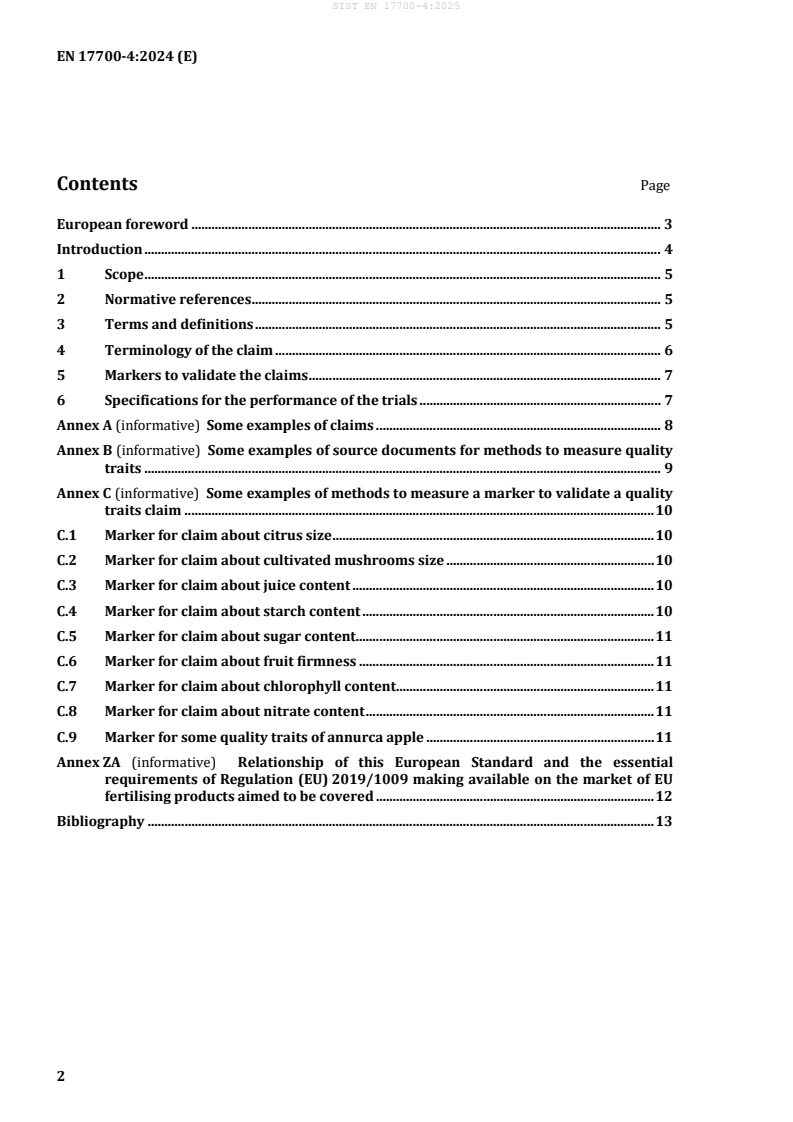
Contents Page
European foreword . 3
Introduction . 4
1 Scope . 5
2 Normative references . 5
3 Terms and definitions . 5
4 Terminology of the claim . 6
5 Markers to validate the claims . 7
6 Specifications for the performance of the trials . 7
Annex A (informative) Some examples of claims . 8
Annex B (informative) Some examples of source documents for methods to measure quality
traits . 9
Annex C (informative) Some examples of methods to measure a marker to validate a quality
traits claim . 10
C.1 Marker for claim about citrus size . 10
C.2 Marker for claim about cultivated mushrooms size . 10
C.3 Marker for claim about juice content . 10
C.4 Marker for claim about starch content . 10
C.5 Marker for claim about sugar content. 11
C.6 Marker for claim about fruit firmness . 11
C.7 Marker for claim about chlorophyll content. 11
C.8 Marker for claim about nitrate content . 11
C.9 Marker for some quality traits of annurca apple . 11
Annex ZA (informative) Relationship of this European Standard and the essential
requirements of Regulation (EU) 2019/1009 making available on the market of EU
fertilising products aimed to be covered . 12
Bibliography . 13
European foreword
This document (EN 17700-4:2024) has been prepared by Technical Committee CEN/TC 455 “Plant
biostimulants”, the secretariat of which is held by AFNOR.
This European Standard shall be given the status of a national standard, either by publication of an
identical text or by endorsement, at the latest by May 2025, and conflicting national standards shall be
withdrawn at the latest by May 2025.
Attention is drawn to the possibility that some of the elements of this document may be the subject of
patent rights. CEN shall not be held responsible for identifying any or all such patent rights.
This document supersedes CEN/TS 17700-4:2022.
CEN/TS 17700-4:2022:
— an informative Annex ZA on the relationship of this European standard and the essential
requirements of Regulation (EU) 2019/1009 has been added.
This document has been prepared under a standardization request addressed to CEN by the European
Commission. The Standing Committee of the EFTA States subsequently approves these requests for its
Member States.
For the relationship with EU Legislation, see informative Annex ZA, which is an integral part of this
document.
The EN 17700 series, Plant biostimulants — Claims, consists of the following parts:
— Part 1: General principles;
— Part 2: Nutrient use efficiency resulting from the use of a plant biostimulant;
— Part 3: Tolerance to abiotic stress resulting from the use of a plant biostimulant;
— Part 4: Determination of quality traits, resulting from the use of a plant biostimulant;
— Part 5: Determination of availability of confined nutrients in the soil or rhizosphere.
Any feedback and questions on this document should be directed to the users’ national standards body.
A complete listing of these bodies can be found on the CEN website.
According to the CEN-CENELEC Internal Regulations, the national standards organisations of the
following countries are bound to implement this European Standard: Austria, Belgium, Bulgaria, Croatia,
Cyprus, Czech Republic, Denmark, Estonia, Finland, France, Germany, Greece, Hungary, Iceland, Ireland,
Italy, Latvia, Lithuania, Luxembourg, Malta, Netherlands, Norway, Poland, Portugal, Republic of North
Macedonia, Romania, Serbia, Slovakia, Slovenia, Spain, Sweden, Switzerland, Türkiye and the United
Kingdom.
Introduction
The European Committee for Standardization (CEN) was requested by the European Commission (EC) to
draft European Standards or European Standardization deliverables to support the implementation of
Regulation (EU) 2019/1009 of 5 June 2019 [1] laying down rules on the making available on the market
of EU fertilising products (“FPR” or “Fertilising Products Regulation”).
This standardization request, presented as SR M/564 and relevant amendments, also contributes to the
Communication on “Innovating for Sustainable Growth: A Bio economy for Europe”. The interest in plant
biostimulants has increased significantly in Europe as a valuable tool to use in agriculture.
Standardization was identified as having an important role in order to promote the use of biostimulants.
The work of CEN/TC 455 seeks to improve the reliability of the supply chain, thereby improving the
confidence of farmers, industry, and consumers in biostimulants, and will promote and support
commercialisation of the European biostimulant industry.
This document has been developed to provide guidance for a consistent approach to justify the claims
associated with the use of plant biostimulants.
The definition of plant biostimulants in Regulation (EU) 2019/1009 [1] is claims-based. For this reason,
demonstrating that a product is indeed a bona fide plant biostimulant depends on a demonstration of its
function.
The placement of a plant biostimulant on the market does not guarantee effectiveness under all
conditions, as many factors can influence the performance of a plant biostimulant in the field.
Plant biostimulants can be applied in multiple ways: to the soil, on plants, as seed treatment, etc.
This document is applicable to all application types of plant biostimulants.
WARNING — Persons using this document should be familiar with normal laboratory practice. This
document does not purport to address all of the safety problems, if any, associated with its use. It is the
responsibility of the user to establish appropriate safety and health practices and to ensure compliance
with any national rules.
IMPORTANT — It is absolutely essential that tests conducted in accordance with this document be
carried out by suitably trained staff.
1 Scope
This document gives guidance on a consistent approach to justify the claims associated with the use of
plant biostimulants.
This document is aimed primarily at manufacturers, laboratories, researchers, technical centres and
companies that intend to place plant biostimulants on the market, as well as notifying authorities, notified
bodies, and market surveillance authorities.
To be in compliance with this standard, it is important to also follow the recommendations and quality
criteria described in the standard EN 17700-1:2024 on general principles to demonstrate plant
biostimulant claims.
2 Normative references
The following documents are referred to in the text in such a way that some or all of their content
constitutes requirements of this document. For dated
...