

EN 17700-1:2024
(Main)Plant biostimulants - Claims - Part 1: General principles
- Abstract
This document specifies the general principles for justifying the product claims for plant biostimulants. It is applicable to all claims and all types of application of plant biostimulants.
General principles define all general parameters, requirements and quality criteria to be applied in order to assess trials conducted to validate the claim(s) associated with the use of a plant biostimulant.
This document is aimed primarily at manufacturers, laboratories, researchers, technical centres and companies that intend to place plant biostimulants on the market, as well as notifying authorities, notified bodies, and market surveillance authorities.
- Status
- Published
- Publication Date
- 26-Nov-2024
- Technical Committee
- CEN/TC 455 - Plant Biostimulants and Agricultural Micro-Organisms
- Drafting Committee
- CEN/TC 455/WG 2 - Claims
- Current Stage
- 6060 - Definitive text made available (DAV) - Publishing
- Start Date
- 27-Nov-2024
- Due Date
- 09-Apr-2024
- Completion Date
- 27-Nov-2024
- Mandate
- M/XXX - M/XXX

Overview
EN 17700-1:2024 - "Plant biostimulants - Claims - Part 1: General principles" (CEN) sets out the general principles for justifying product claims for plant biostimulants. This European Standard defines the parameters, requirements and quality criteria used to assess trials that validate label claims for biostimulant products (e.g., nutrient use efficiency, tolerance to abiotic stress, quality traits, availability of confined nutrients). It applies to all claim types and all application methods (soil, foliar, seed treatments, protected crops, etc.) and supports conformity assessment under Regulation (EU) 2019/1009.
Key topics and requirements
- Scope and definitions: Clarifies terms such as plant biostimulant, claim, trial series, field trial, controlled conditions trial, strip trial and replicate (see EN 17724:2024 for terminology).
- Trials to demonstrate claims: Emphasises that field trials (open field or protected crop) are the primary evidence source; controlled conditions are permitted only when field demonstration is impractical (petitioner must justify).
- Trial design and statistical analysis: Covers essentials of experimental design, controls, minimum plot size, application rates, number of replicates, number of trials in a trial series and statistical analysis methods.
- Crop groupings: Guidance on grouping crops for trial planning and demonstrating claim consistency across crops or crop families.
- Quality criteria and trial conduct: Requirements for trial organisation-identity of organisations and trial sites, staff competence, equipment and facilities, verification during planning and execution, and documentation.
- Data collection and reporting: Specifies the information to record for each trial (objectives, site conditions, product application, measurement protocols) and requirements for presentation of results.
Practical applications and users
EN 17700-1:2024 is aimed at:
- Manufacturers and formulators preparing evidence dossiers and label claims for market placement.
- Research laboratories, technical centres and CROs that design and conduct trials to validate biostimulant effects.
- Notifying authorities, notified bodies and market surveillance authorities assessing conformity and verifying claims. Practical uses include designing compliant trial programs, preparing dossiers for conformity assessment under the EU Fertilising Products Regulation, and improving reproducibility and market confidence in biostimulant claims.
Related standards
- EN 17700-2:2024 - Nutrient use efficiency claims
- EN 17700-3:2024 - Tolerance to abiotic stress claims
- EN 17700-4:2024 - Quality traits determination
- EN 17700-5:2024 - Availability of confined nutrients
- EN 17724:2024 - Plant biostimulants - Terminology
EN 17700-1:2024 provides the overarching framework for claim justification; consult the related parts for claim‑specific experimental methods and analytical procedures.
Relations
- Effective Date
- 28-Jan-2023
- Effective Date
- 28-Jan-2026
- Effective Date
- 28-Jan-2026
- Effective Date
- 28-Jan-2026
- Effective Date
- 28-Jan-2026
- Effective Date
- 28-Jan-2026
Get Certified
Connect with accredited certification bodies for this standard

Control Union Certifications
Global certification for agriculture and sustainability.

ECOCERT
Organic and sustainability certification.

FSC International
Forest Stewardship Council certification.
Sponsored listings
Frequently Asked Questions
EN 17700-1:2024 is a standard published by the European Committee for Standardization (CEN). Its full title is "Plant biostimulants - Claims - Part 1: General principles". This standard covers: This document specifies the general principles for justifying the product claims for plant biostimulants. It is applicable to all claims and all types of application of plant biostimulants. General principles define all general parameters, requirements and quality criteria to be applied in order to assess trials conducted to validate the claim(s) associated with the use of a plant biostimulant. This document is aimed primarily at manufacturers, laboratories, researchers, technical centres and companies that intend to place plant biostimulants on the market, as well as notifying authorities, notified bodies, and market surveillance authorities.
This document specifies the general principles for justifying the product claims for plant biostimulants. It is applicable to all claims and all types of application of plant biostimulants. General principles define all general parameters, requirements and quality criteria to be applied in order to assess trials conducted to validate the claim(s) associated with the use of a plant biostimulant. This document is aimed primarily at manufacturers, laboratories, researchers, technical centres and companies that intend to place plant biostimulants on the market, as well as notifying authorities, notified bodies, and market surveillance authorities.
EN 17700-1:2024 is classified under the following ICS (International Classification for Standards) categories: 65.080 - Fertilizers. The ICS classification helps identify the subject area and facilitates finding related standards.
EN 17700-1:2024 has the following relationships with other standards: It is inter standard links to CEN/TS 17700-1:2022, EN 17700-5:2024, EN 17724:2024, EN 17700-4:2024, EN 17700-2:2024, EN 17700-3:2024. Understanding these relationships helps ensure you are using the most current and applicable version of the standard.
EN 17700-1:2024 is associated with the following European legislation: EU Directives/Regulations: 2019/1009; Standardization Mandates: M/564, M/564 AMD 1, M/XXX. When a standard is cited in the Official Journal of the European Union, products manufactured in conformity with it benefit from a presumption of conformity with the essential requirements of the corresponding EU directive or regulation.
EN 17700-1:2024 is available in PDF format for immediate download after purchase. The document can be added to your cart and obtained through the secure checkout process. Digital delivery ensures instant access to the complete standard document.
Standards Content (Sample)
SLOVENSKI STANDARD
01-februar-2025
Nadomešča:
SIST-TS CEN/TS 17700-1:2023
Rastlinski biostimulanti - Navedbe - 1. del: Splošna načela
Plant biostimulants - Claims - Part 1: General principles
Pflanzen-Biostimulanzien - Auslobungen - Teil 1: Allgemeine Grundsätze
Biostimulants des végétaux - Allégations - Partie 1 : Principes généraux
Ta slovenski standard je istoveten z: EN 17700-1:2024
ICS:
65.080 Gnojila Fertilizers
2003-01.Slovenski inštitut za standardizacijo. Razmnoževanje celote ali delov tega standarda ni dovoljeno.
EN 17700-1
EUROPEAN STANDARD
NORME EUROPÉENNE
November 2024
EUROPÄISCHE NORM
ICS 65.080 Supersedes CEN/TS 17700-1:2022
English Version
Plant biostimulants - Claims - Part 1: General principles
Biostimulants des végétaux - Allégations - Partie 1 : Pflanzen-Biostimulanzien - Auslobungen - Teil 1:
Principes généraux Allgemeine Grundsätze
This European Standard was approved by CEN on 26 August 2024.
CEN members are bound to comply with the CEN/CENELEC Internal Regulations which stipulate the conditions for giving this
European Standard the status of a national standard without any alteration. Up-to-date lists and bibliographical references
concerning such national standards may be obtained on application to the CEN-CENELEC Management Centre or to any CEN
member.
This European Standard exists in three official versions (English, French, German). A version in any other language made by
translation under the responsibility of a CEN member into its own language and notified to the CEN-CENELEC Management
Centre has the same status as the official versions.
CEN members are the national standards bodies of Austria, Belgium, Bulgaria, Croatia, Cyprus, Czech Republic, Denmark, Estonia,
Finland, France, Germany, Greece, Hungary, Iceland, Ireland, Italy, Latvia, Lithuania, Luxembourg, Malta, Netherlands, Norway,
Poland, Portugal, Republic of North Macedonia, Romania, Serbia, Slovakia, Slovenia, Spain, Sweden, Switzerland, Türkiye and
United Kingdom.
EUROPEAN COMMITTEE FOR STANDARDIZATION
COMITÉ EUROPÉEN DE NORMALISATION
EUROPÄISCHES KOMITEE FÜR NORMUNG
CEN-CENELEC Management Centre: Rue de la Science 23, B-1040 Brussels
© 2024 CEN All rights of exploitation in any form and by any means reserved Ref. No. EN 17700-1:2024 E
worldwide for CEN national Members.
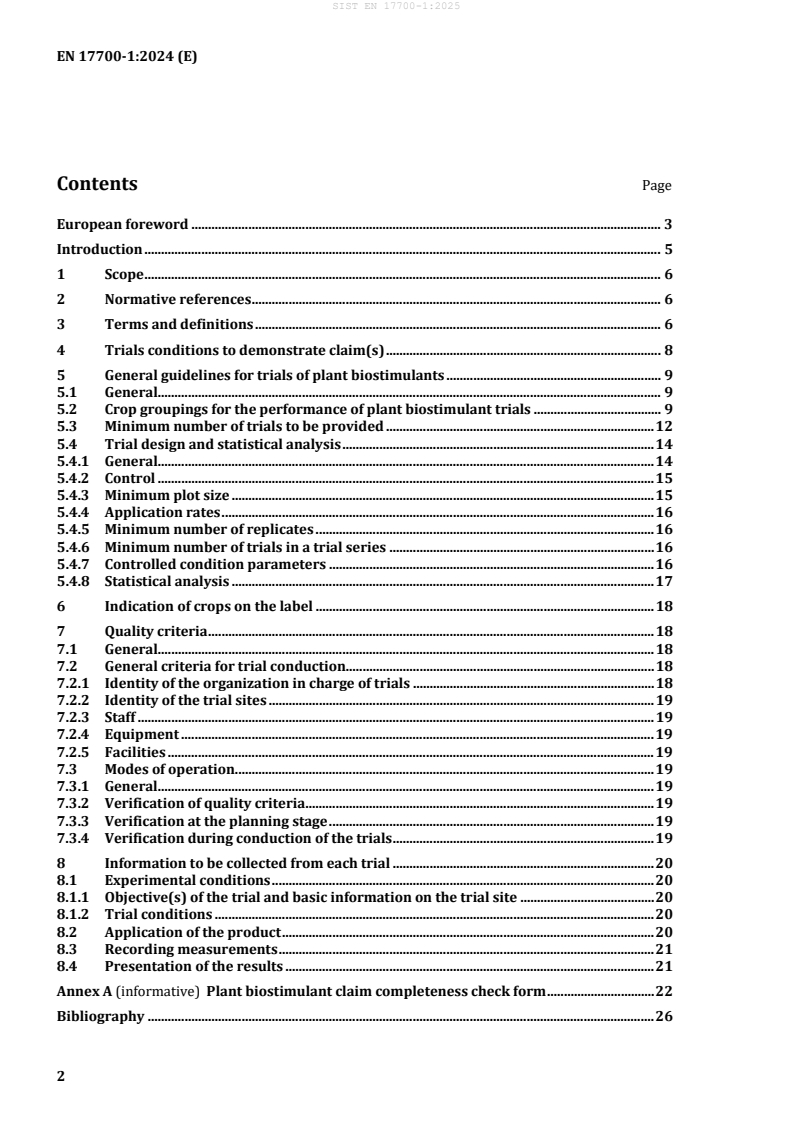
Contents Page
European foreword . 3
Introduction . 5
1 Scope . 6
2 Normative references . 6
3 Terms and definitions . 6
4 Trials conditions to demonstrate claim(s) . 8
5 General guidelines for trials of plant biostimulants . 9
5.1 General. 9
5.2 Crop groupings for the performance of plant biostimulant trials . 9
5.3 Minimum number of trials to be provided . 12
5.4 Trial design and statistical analysis . 14
5.4.1 General. 14
5.4.2 Control . 15
5.4.3 Minimum plot size . 15
5.4.4 Application rates . 16
5.4.5 Minimum number of replicates . 16
5.4.6 Minimum number of trials in a trial series . 16
5.4.7 Controlled condition parameters . 16
5.4.8 Statistical analysis . 17
6 Indication of crops on the label . 18
7 Quality criteria . 18
7.1 General. 18
7.2 General criteria for trial conduction. 18
7.2.1 Identity of the organization in charge of trials . 18
7.2.2 Identity of the trial sites . 19
7.2.3 Staff . 19
7.2.4 Equipment . 19
7.2.5 Facilities . 19
7.3 Modes of operation. 19
7.3.1 General. 19
7.3.2 Verification of quality criteria . 19
7.3.3 Verification at the planning stage . 19
7.3.4 Verification during conduction of the trials . 19
8 Information to be collected from each trial . 20
8.1 Experimental conditions . 20
8.1.1 Objective(s) of the trial and basic information on the trial site . 20
8.1.2 Trial conditions . 20
8.2 Application of the product . 20
8.3 Recording measurements . 21
8.4 Presentation of the results . 21
Annex A (informative) Plant biostimulant claim completeness check form . 22
Bibliography . 26
European foreword
This document (EN 17700-1:2024) has been prepared by Technical Committee CEN/TC 455 “Plant
biostimulants”, the secretariat of which is held by AFNOR.
This European Standard shall be given the status of a national standard, either by publication of an
identical text or by endorsement, at the latest by May 2025, and conflicting national standards shall be
withdrawn at the latest by May 2025.
Attention is drawn to the possibility that some of the elements of this document may be the subject of
patent rights. CEN shall not be held responsible for identifying any or all such patent rights.
This document supersedes CEN/TS 17700-1:2022.
CEN/TS 17700-1:2022:
— new or updated terms below:
— field trial,
— general principles,
— replicates,
— controlled conditions trial,
— trial series,
— strip trial;
— update of Clause 4 “Trials conditions to demonstrate claim(s)”;
— new sentence to introduce Table 1;
— update of Table 1;
— new sentence to introduce Tables 2, 3 and 4;
— update of subclause 5.4.2;
— update of subclause 5.4.3.1;
— modification of subclause 5.4.8.3;
— update of subclause 8.4;
— deletion of Annex A.
This document has been prepared under a standardization request addressed to CEN by the European
Commission. The Standing Committee of the EFTA States subsequently approves these requests for its
Member States.
The EN 17700 series, Plant biostimulants — Claims, consists of the following parts:
— Part 1: General principles;
— Part 2: Nutrient use efficiency resulting from the use of a plant biostimulant;
— Part 3: Tolerance to abiotic stress resulting from the use of a plant biostimulant;
— Part 4: Determination of quality traits, resulting from the use of a plant biostimulant;
— Part 5: Determination of availability of confined nutrients in the soil or rhizosphere.
Any feedback and questions on this document should be directed to the users’ national standards body.
A complete listing of these bodies can be found on the CEN website.
According to the CEN-CENELEC Internal Regulations, the national standards organisations of the
following countries are bound to implement this European Standard: Austria, Belgium, Bulgaria, Croatia,
Cyprus, Czech Republic, Denmark, Estonia, Finland, France, Germany, Greece, Hungary, Iceland, Ireland,
Italy, Latvia, Lithuania, Luxembourg, Malta, Netherlands, Norway, Poland, Portugal, Republic of North
Macedonia, Romania, Serbia, Slovakia, Slovenia, Spain, Sweden, Switzerland, Türkiye and the United
Kingdom.
Introduction
The European Committee for Standardization (CEN) was requested by the European Commission (EC) to
draft European Standards or European Standardization deliverables to support the implementation of
Regulation (EU) 2019/1009 of 5 June 2019 [1] laying down rules on the making available on the market
of EU fertilising products (“FPR” or “Fertilising Products Regulation”).
This standardization request, presented as SR M/564 and relevant amendments, also contributes to the
Communication on “Innovating for Sustainable Growth: A Bio economy for Europe”. The interest in plant
biostimulants has increased significantly in Europe as a valuable tool to use in agriculture.
Standardization was identified as having an important role in order to promote the use of biostimulants.
The work of CEN/TC 455 seeks to improve the reliability of the supply chain, thereby improving the
confidence of farmers, industry, and consumers in biostimulants, and will promote and support
commercialisation of the European biostimulant industry.
This document has been developed to provide guidance for a consistent approach to justify the claims
associated with the use of plant biostimulants.
The definition of plant biostimulants in Regulation (EU) 2019/1009 [1] is claims-based. For this reason,
demonstrating that a product is indeed a bona fide plant biostimulant depends on a demonstration of its
function.
The placement of a plant biostimulant on the market does not guarantee effectiveness under all
conditions, as many factors can influence the performance of a plant biostimulant in the field.
Plant biostimulants can be applied in multiple ways: to the soil, on plants, as seed treatment, etc.
This document is applicable to all application types of plant biostimulants.
1 Scope
This document specifies the general principles for justifying the product claims for plant biostimulants.
It is applicable to all claims and all types of application of plant biostimulants.
General principles define all general parameters, requirements and quality criteria to be applied in order
to assess trials conducted to validate the claim(s) associated with the use of a plant biostimulant.
This document is aimed primarily at manufacturers, laboratories, researchers, technical centres and
companies that intend to place plant biostimulants on the market, as well as notifying authorities, notified
bodies, and market surveillance authorities.
2 Normative references
The following documents are referred to in the text in such a way that some or all of their content
constitutes requirements of this document. For dated references, only the edition cited applies. For
undated references, the latest edition of the referenced document (including any amendments) applies.
EN 17700-5:2024, Plant biostimulants — Claims — Part 5: Determination of availability of confined
nutrients in the soil or rhizosphere
EN 17724:2024, Plant biostimulants — Terminology
3 Terms and definitions
For the purposes of this document, the terms and definitions given in EN 17724:2024 and the following
apply.
ISO and IEC maintain terminology databases for use in standardization at the following addresses:
— ISO Online browsing platform: available at https://www.iso.org/obp/
— IEC Electropedia: available at https://www.electropedia.org/
3.1
plant biostimulant
product stimulating plant nutrition processes independently of the product’s nutrient content with the
sole aim of improving one or more of the following characteristics of the plant or the plant rhizosphere:
— nutrient use efficiency,
— tolerance to abiotic stress,
— quality traits,
— availability of confined nutrient in soil or rhizosphere
[SOURCE: Regulation (EU) 2019/1009]
3.2
claim
effect(s) of the product that could be asserted on the product label of a plant biostimulant after the
conformity assessment procedure
[SOURCE: EN 17724:2024, 3.1.1.3]
3.3
general principle
rule establishing the parameters, requirements and quality criteria applicable to all plant biostimulants
for carrying out the tests necessary to justify the claim
[SOURCE: EN 17724:2024, 3.1.1.6]
3.4
crop
cultivated plant(s) including all components of the plant (above ground parts and below ground parts),
mushrooms, microalgae and macroalgae
[SOURCE: EN 17724:2024, 3.1.1.4]
3.5
plant nutrient
chemical element used by the plant for growth and development, classified as a primary macronutrient,
secondary macronutrient or micronutrient per the quantity required by the plant
Note 1 to entry:
Primary macronutrients – nitrogen (N), phosphorus (P), potassium (K),
secondary macronutrients – calcium (Ca), magnesium (Mg), sodium (Na), sulphur (S),
micronutrients – boron (B), cobalt (Co), copper (Cu), iron (Fe), manganese (Mn), molybdenum (Mo), zinc (Zn).
[SOURCE: EN 17724:2024, 3.1.1.11]
3.6
protected crop condition
crop cultivation in greenhouses or plastic tunnels with or without specific control of climate conditions
according to the farming practice
EXAMPLE Cucumber or tomato cultivation.
[SOURCE: EN 17724:2024, 3.1.1.10]
3.7
controlled conditions trial
trial carried out in a specific place like greenhouses, climatic chamber, etc., where all or some of the
environmental conditions can be controlled or can be measured (like soil, temperature, light, humidity,
etc.)
[SOURCE: EN 17724:2024, 3.1.1.9, modified – “a glasshouse” changed into “greenhouses”, “some parts of
the environmental parameters” changed to “some of the environmental conditions”]
3.8
trial series
grouping of a number of independent field trials, carried out with plants, which have the same objectives,
experimental design, protocol and parameters to prove the consistency of a result
Note 1 to entry: Trials done in controlled conditions are excluded.
Note 2 to entry: It can be conducted in different locations and/or over a number of consecutive years, as long as it
satisfies the quality criteria described in this document (same protocol, same crop, control, timing).
EXAMPLE Strip trials, replicated trials.
[SOURCE: EN 17724:2024, 3.1.1.12]
3.9
strip trial
specific trial carried out using minimum two treatments, next to each other, in the same field, to compare
a control with a plant biostimulant treatment without replicates
[SOURCE: EN 17724:2024, 3.1.1.13]
3.10
replicate
identical and independent repetition of each treatment in the same trial and under the same agronomic
management practices like plant variety choice and fertilizers and plant protection products application
[SOURCE: EN 17724:2024, 3.1.1.14]
3.11
field trial
trial performed under open field conditions (outdoors) or protected crop conditions according to
common farming practices for a specific crop
Note 1 to entry: Field trial refers to conditions, without full control of climate conditions, according to common
farming practices like plastic tunnels for strawberries, etc.
[SOURCE: EN 17724:2024, 3.1.1.5]
4 Trials conditions to demonstrate claim(s)
Trials carried out according to farming practices (open field or protected crop conditions) are essential
to demonstrate plant biostimulant claims.
For some claims, however, field conditions cannot always be easily met (e.g. salt stress, cold stress, root
measurements, availability of confined nutrients in the soil, etc.). In this case, plant biostimulant claims
can be demonstrated under controlled conditions. The petitioner shall explain why the demonstration of
the claim cannot be conducted under field conditions.
Analytical methods and methods used to measure the effect of a product can also be taken from scientific
literature as specified in EN 17700-2:2024 [2], EN 17700-3:2024 [3], EN 17700-4:2024 [4] and
EN 17700-5:2024.
5 General guidelines for trials of plant biostimulants
5.1 General
All trials/assays shall be performed according to the quality criteria specified in this document.
5.2 Crop groupings for the performance of plant biostimulant trials
For trials carried out with plants, the crop groupings are specified in Table 1. These crop groupings do
not apply to soil claims related to the availability of confined nutrients in the soil or rhizosphere. If the
crop tested is not specified in Table 1, refer to the definition below to determine the appropriate crop
grouping.
— Broadacre crops (combinable and processing products): annual and non-annual crops usually
characterized by being grown in large extensions, harvested via combiners or industrial harvesters,
with the aim of obtaining vegetative organs, roots, tubers and/or seeds/grains.
— Woody perennials: non-annual crops that cover their stems with suberized cork.
— Vegetables, ornamental and aromatic and medicinal plants (AMP): annual and non-annual crops
usually associated with seasonality and not included in the broadacre and woody perennial crops.
Table 1 — Crop groupings
Broadacre:
a
Woody Perennials Vegetables, ornamental and AMP crops
Combinable and Processing
Products
BARLEY ALMOND ANGELICA
BEAN APPLE ANISE
BEET APRICOT ASPARAGUS
BORAGE AVOCADO AUBERGINE
BUCKWHEAT BAY BALM
CHICKPEA BILBERRY BANANA
CLOVER BLACK CURRANT BASIL
COTTON BLACKBERRY BROCCOLI and CALABRESE
DURUM WHEAT BLUEBERRY BRUSSELS SPROUTS
EVENING PRIMROSE CAPERS BULB ONION
GRASS CHERIMOYA CABBAGE
HEMP CHERRY CARAWAY
LENTIL CHESTNUT CARDOON
LINSEED CITRUS TREES CARROT
LUCERNE COCOA TREE CAULIFLOWER
LUPIN COFFEE TREE CELERIAC
MAIZE CRANBERRY CELERY
MUSTARD (for seed) CURRY LEAVES CELERY LEAVES
OAT DATE CHERVIL
Broadacre:
a
Woody Perennials Vegetables, ornamental and AMP crops
Combinable and Processing
Products
PEA ELDERBERRY CHICORY (Witloof)
POPPY FIG CHILLI
POTATO GRAPE CHINESE CABBAGE
QUINOA GUAVA CHIVES
RAPE HAZELNUT CHOI SUM
RICE HOPS COLLARD
RYE JUNIPER CORIANDER
SAFFLOWER KAFFIR LIME COURGETTE and SUMMER SQUASH
SAINFOIN KIWI CRESS
SESAME LIQUORICE CUCUMBER
SORGHUM LOGANBERRY DILL
SOYBEAN MANGO EDIBLE FLOWERS
SPELT MEDLAR EDIBLE LEAF MUSTARD
SUGAR BEET MULBERRY ENDIVE
SUGARCANE NECTARINE FENNEL
SUNFLOWER OLIVE FLOWERS and FILLERS
SWEET POTATO PAPAYA GARLIC
SWEETCORN PASSION FRUIT GHERKIN
TOBACCO PEACH GLOBE ARTICHOKE
TRITICALE PEAR HORSERADISH
TURF PERSIMMON JERUSALEM ARTICHOKE
VETCH PISTACHIO KALE and CAVOLO NERO
WHEAT PLUM KOHLRABI
POMEGRANATE LAMB'S LETTUCE
QUINCE LAND CRESS
RASPBERRY LEEK
RED CURRANT LETTUCE
ROSEHIP LOVAGE
TEA TREE MAJORAM
WALNUT MELON
MINT
MUSHROOM
OREGANO
OTHERS AMP
Broadacre:
a
Woody Perennials Vegetables, ornamental and AMP crops
Combinable and Processing
Products
PARSLEY
PARSNIP
PEANUT
PEPPER
PINEAPPLE
PUMPKIN and WINTER SQUASH
PURSLANE
RADISH
RED BEET
RHUBARB
ROCKET
ROSEMARY
SAFFRON
SAGE
SALAD BURNET
SALAD ONION
SALSIFY
SAVORY
SEA KALE
SHALLOT
SPINACH
STRAWBERRY
SWEDE
SWEET CICELY
SWISS CHARD (Spinach Beet)
TARRAGON
THYME
TOMATO
TURNIP
VANILLA
WATERCRESS
WATERMELON
a
Aromatic and medicinal plants
5.3 Minimum number of trials to be provided
To justify a specific claim as defined in its related claim standard, a minimum number of trials shall be
performed with the same protocol (trial design) and methods per claim. In the case of single trials, the
minimum number is defined according to the criteria described in Tables 2 and 4; in the case of trial
series, according to the criteria described in Table 3.
Table 2 — Minimum number of trials to be carried out with plants based on the claim to be
justified
Claim Minimum number of trials
3 trials on the crop
Effect claimed for a specific crop
Claim is successfully demonstrated on the crop chosen
during the same year or in different years.
6 trials with a minimum of 2 different crops
Claim is successfully demonstrated on two crops chosen
Effect claimed for the entire crop group during the same year or in different years.
When the claim is demonstrated for two crops within a
group, this is regarded as valid for the entire crop group
8 trials in total from 2 different groups
=
4 trials per group (with a minimum of 2 different crops
Effect claimed for two entire crop groups
per group)
Claim is successfully demonstrated on crops chosen
during the same year or in different years.
9 trials in total from 3 different groups
=
Effect claimed without being required to limit it
3 trials per group (with a minimum of 2 different crops
to any specific crop grouping
per group)
Claim is successfully demonstrated on crops chosen
during the same year or in different years.
Table 3 — Minimum number of trial series to be carried out with plants based on the claim to be
justified
Claim Minimum number of trial series
One trial series on the crop
Effect claimed for a specific crop
Claim is successfully demonstrated on the crop chosen
during the same year or in different years.
One trial series per crop with a minimum of 2 different
crops
Claim is successfully demonstrated on two crops chosen
Effect claimed for the entire crop group
during the same year or in different years.
When the claim is demonstrated for two crops within a
group, this is regarded as valid for the entire crop group.
One trial series per crop with a minimum of 2 different
crops per group
=
Effect claimed for two entire crop groups
4 trial series minimum in total
Claim is successfully demonstrated on crops chosen
during the same year or in different years.
One trial series per crop with a minimum of 2 different
crops per group
=
Effect claimed without being required to limit it
to any specific crop grouping
6 trial series minimum in total
Claim is successfully demonstrated on crops chosen
during the same year or in different years.
...