


EN ISO 11102-2:1997
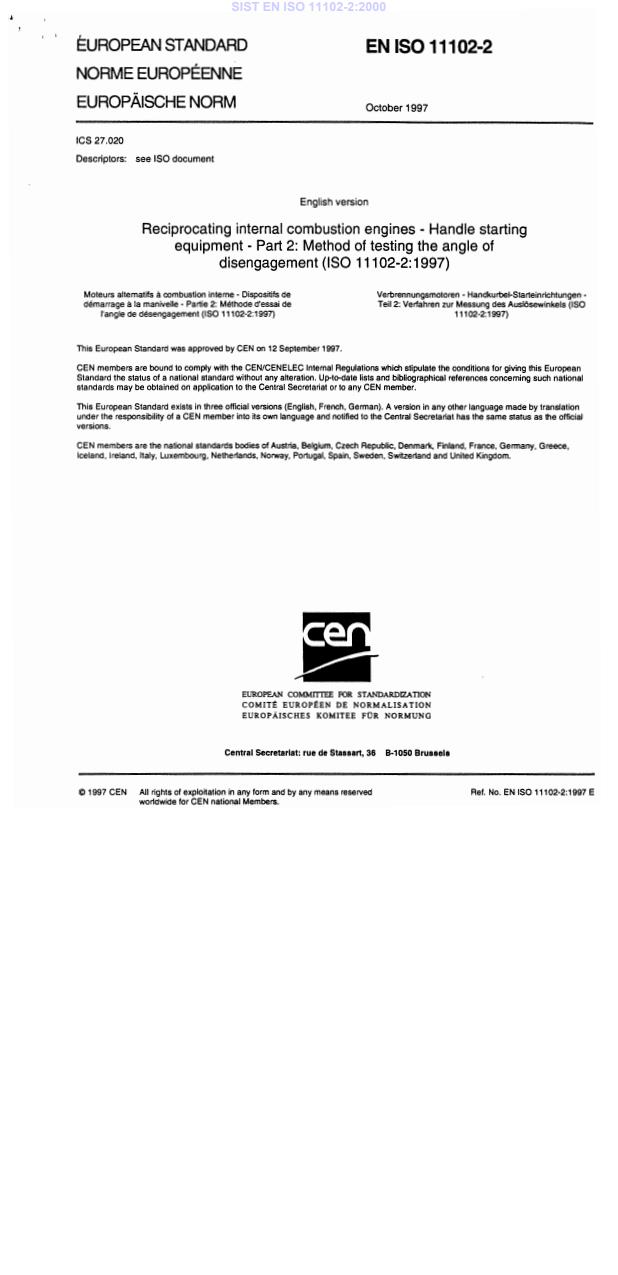
(Main)Reciprocating internal combustion engines - Handle starting equipment - Part 2: Method of testing the angle of disengagement (ISO 11102-2:1997)
Reciprocating internal combustion engines - Handle starting equipment - Part 2: Method of testing the angle of disengagement (ISO 11102-2:1997)
This part of ISO 11102 describes the method for testing the angle of disengagement of starting handle equipment i.e. testing of the essential safety requirements according to ISO 11102-1 for reciprocating internal combustion engines for land, rail and marine use, excluding engines used to propel road vehicles and aircraft. It may be applied to engines used to propel road construction, earth moving machines and for other applications where no suitable international standard exist.
Hubkolben-Verbrennungsmotoren - Handkurbel-Starteinrichtungen - Teil 2: Verfahren zur Messung des Aulösewinkels (ISO 11102-2:1997)
Dieser Teil der Europäischen Norm EN ISO 11102 gilt für die Prüfung des Auslösewinkels von Handkurbel-Starteinrichtungen von Hubkolben- Verbrennungsmotoren für Landanlagen, Schienenfahrzeuge und Schiffsbetrieb und damit für die Prüfung der sicherheitstechnischen Anforderungen nach EN ISO 11102-1. Ausgenommen sind Motoren zum Antrieb von Kraftfahrzeugen und Flugzeugen. Dieser Teil kann auch für Motoren zum Antrieb von Straßenbau- und Erdbewegungsmaschinen und für andere Verwendungen verwendet werden, falls es für diese Motoren keine entsprechende Internationale Norm gibt.
Moteurs alternatifs à combustion interne - Dispositifs de démarrage à la manivelle - Partie 2: Méthode d'essai de l'angle de désengagement (ISO 11102-2:1997)
Reciprocating internal combustion engines - Handle starting equipment - Part 2: Method of testing the angle of disengagement (ISO 11102-2:1997)
General Information
- Status
- Withdrawn
- Publication Date
- 30-Sep-1997
- Withdrawal Date
- 24-Feb-2009
- Technical Committee
- CEN/TC 270 - Internal combustion engines
- Drafting Committee
- CEN/TC 270 - Internal combustion engines
- Current Stage
- 9960 - Withdrawal effective - Withdrawal
- Start Date
- 25-Feb-2009
- Completion Date
- 25-Feb-2009
- Directive
- 89/392/EEC - Machinery - Safety of machinery: general essential health and safety requirements
- Directive
- 98/37/EC - Machinery
Relations
- Effective Date
- 04-Mar-2009
- Effective Date
- 28-Jan-2026
- Effective Date
- 28-Jan-2026
- Effective Date
- 12-Feb-2026
Get Certified
Connect with accredited certification bodies for this standard

DNV
DNV is an independent assurance and risk management provider.

Lloyd's Register
Lloyd's Register is a global professional services organisation specialising in engineering and technology.
DNV Energy Systems
Energy and renewable energy certification.
Sponsored listings
Frequently Asked Questions
EN ISO 11102-2:1997 is a standard published by the European Committee for Standardization (CEN). Its full title is "Reciprocating internal combustion engines - Handle starting equipment - Part 2: Method of testing the angle of disengagement (ISO 11102-2:1997)". This standard covers: This part of ISO 11102 describes the method for testing the angle of disengagement of starting handle equipment i.e. testing of the essential safety requirements according to ISO 11102-1 for reciprocating internal combustion engines for land, rail and marine use, excluding engines used to propel road vehicles and aircraft. It may be applied to engines used to propel road construction, earth moving machines and for other applications where no suitable international standard exist.
This part of ISO 11102 describes the method for testing the angle of disengagement of starting handle equipment i.e. testing of the essential safety requirements according to ISO 11102-1 for reciprocating internal combustion engines for land, rail and marine use, excluding engines used to propel road vehicles and aircraft. It may be applied to engines used to propel road construction, earth moving machines and for other applications where no suitable international standard exist.
EN ISO 11102-2:1997 is classified under the following ICS (International Classification for Standards) categories: 27.020 - Internal combustion engines. The ICS classification helps identify the subject area and facilitates finding related standards.
EN ISO 11102-2:1997 has the following relationships with other standards: It is inter standard links to EN ISO 11102-2:2009, EN ISO 10438-3:2007, EN ISO 13631:2002, ISO 11102-2:1997. Understanding these relationships helps ensure you are using the most current and applicable version of the standard.
EN ISO 11102-2:1997 is associated with the following European legislation: EU Directives/Regulations: 89/392/EEC, 98/37/EC; Standardization Mandates: M/079. When a standard is cited in the Official Journal of the European Union, products manufactured in conformity with it benefit from a presumption of conformity with the essential requirements of the corresponding EU directive or regulation.
EN ISO 11102-2:1997 is available in PDF format for immediate download after purchase. The document can be added to your cart and obtained through the secure checkout process. Digital delivery ensures instant access to the complete standard document.
Standards Content (Sample)
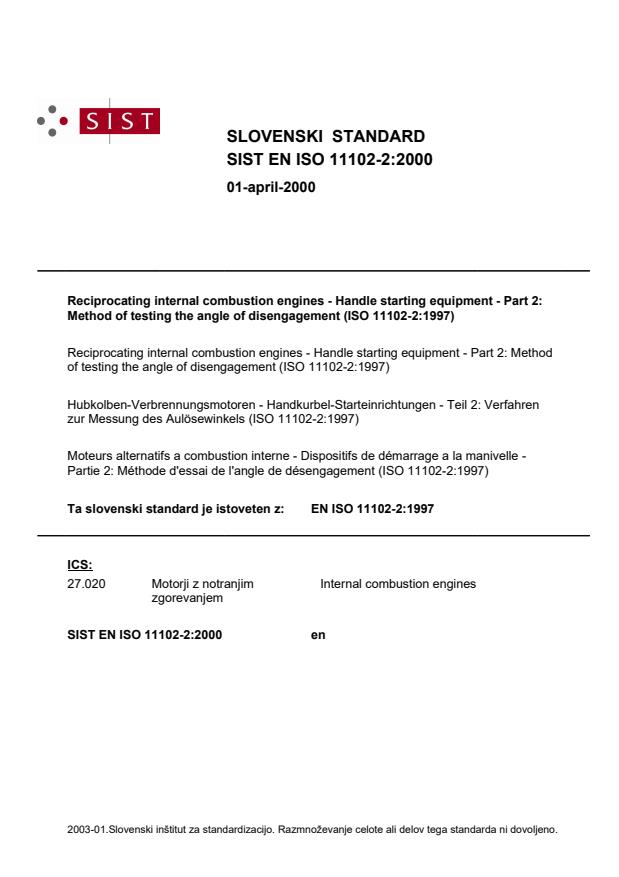
SLOVENSKI STANDARD
01-april-2000
Reciprocating internal combustion engines - Handle starting equipment - Part 2:
Method of testing the angle of disengagement (ISO 11102-2:1997)
Reciprocating internal combustion engines - Handle starting equipment - Part 2: Method
of testing the angle of disengagement (ISO 11102-2:1997)
Hubkolben-Verbrennungsmotoren - Handkurbel-Starteinrichtungen - Teil 2: Verfahren
zur Messung des Aulösewinkels (ISO 11102-2:1997)
Moteurs alternatifs a combustion interne - Dispositifs de démarrage a la manivelle -
Partie 2: Méthode d'essai de l'angle de désengagement (ISO 11102-2:1997)
Ta slovenski standard je istoveten z: EN ISO 11102-2:1997
ICS:
27.020 Motorji z notranjim Internal combustion engines
zgorevanjem
2003-01.Slovenski inštitut za standardizacijo. Razmnoževanje celot
...
Questions, Comments and Discussion
Ask us and Technical Secretary will try to provide an answer. You can facilitate discussion about the standard in here.
Loading comments...