

EN 1143-1:2005+A1:2009
(Main + Amendment)Secure storage units - Requirements, classification and methods of test for resistance to burglary - Part 1: Safes, ATM safes, strongroom doors and strongrooms
- Abstract
This European Standard establishes the basis for testing and classifying free-standing safes, built-in safes (floor and wall), ATM safes and ATM bases, strongroom doors and strongrooms (with or without a door) according to their burglary resistance. This European Standard does not cover testing and classifying Deposit Systems and ATM systems.
- Status
- Withdrawn
- Publication Date
- 27-Jan-2009
- Withdrawal Date
- 24-Apr-2012
- Technical Committee
- CEN/TC 263 - Secure storage of cash, valuables and data media
- Drafting Committee
- CEN/TC 263/WG 1 - Burglary resistance
- Current Stage
- 9960 - Withdrawal effective - Withdrawal
- Start Date
- 25-Apr-2012
- Completion Date
- 25-Apr-2012

Relations
- Effective Date
- 19-Jan-2023
- Effective Date
- 02-May-2012
- Effective Date
- 08-Jun-2022
Get Certified
Connect with accredited certification bodies for this standard

CIS Institut d.o.o.
Personal Protective Equipment (PPE) certification body. Notified Body NB-2890 for EU Regulation 2016/425 PPE.

Kiwa BDA Testing
Building and construction product certification.
Kmetijski inštitut Slovenije
Agricultural Institute of Slovenia. Soil testing, plant health, agricultural product analysis.
Sponsored listings
Frequently Asked Questions
EN 1143-1:2005+A1:2009 is a standard published by the European Committee for Standardization (CEN). Its full title is "Secure storage units - Requirements, classification and methods of test for resistance to burglary - Part 1: Safes, ATM safes, strongroom doors and strongrooms". This standard covers: This European Standard establishes the basis for testing and classifying free-standing safes, built-in safes (floor and wall), ATM safes and ATM bases, strongroom doors and strongrooms (with or without a door) according to their burglary resistance. This European Standard does not cover testing and classifying Deposit Systems and ATM systems.
This European Standard establishes the basis for testing and classifying free-standing safes, built-in safes (floor and wall), ATM safes and ATM bases, strongroom doors and strongrooms (with or without a door) according to their burglary resistance. This European Standard does not cover testing and classifying Deposit Systems and ATM systems.
EN 1143-1:2005+A1:2009 is classified under the following ICS (International Classification for Standards) categories: 13.310 - Protection against crime. The ICS classification helps identify the subject area and facilitates finding related standards.
EN 1143-1:2005+A1:2009 has the following relationships with other standards: It is inter standard links to EN 1143-1:2005, EN 1143-1:2012, EN 1143-1:2005+A1:2009/AC:2009. Understanding these relationships helps ensure you are using the most current and applicable version of the standard.
EN 1143-1:2005+A1:2009 is available in PDF format for immediate download after purchase. The document can be added to your cart and obtained through the secure checkout process. Digital delivery ensures instant access to the complete standard document.
Standards Content (Sample)
2003-01.Slovenski inštitut za standardizacijo. Razmnoževanje celote ali delov tega standarda ni dovoljeno.Varnostne shranjevalne enote - Zahteve, klasifikacija in metode preskušanja protivlomne odpornosti - 1. del: Blagajne, bankomatne blagajne, vrata trezorskih prostorov in trezorski prostoriWertbehältnisse - Anforderungen, Klassifizierung und Methoden zur Prüfung des Widerstandes gegen Einbruchdiebstahl - Teil 1: Wertschutzschränke, Wertschutzschränke für Geldautomaten, Wertschutzraumtüren und WertschutzräumeUnités de stockage en lieux sûrs - Exigences, classification et méthodes d'essai pour la résistance à l'effraction - Partie 1: Coffres-forts, distributeurs automatiques de billets (DAB), portes fortes et chambres fortesSecure storage units - Requirements, classification and methods of test for resistance to burglary - Part 1: Safes, ATM safes, strongroom doors and strongrooms35.220.99Druge naprave za shranjevanje podatkovOther data storage devices13.310Varstvo pred kriminalomProtection against crimeICS:Ta slovenski standard je istoveten z:EN 1143-1:2005+A1:2009SIST EN 1143-1:2005+A1:2009en,fr01-april-2009SIST EN 1143-1:2005+A1:2009SLOVENSKI
STANDARD
EUROPEAN STANDARD NORME EUROPÉENNE EUROPÄISCHE NORM
EN 1143-1:2005+A1
January 2009 ICS 13.310 Supersedes EN 1143-1:2005English Version
Secure storage units - Requirements, classification and methods of test for resistance to burglary - Part 1: Safes, ATM safes, strongroom doors and strongrooms
Unités de stockage en lieux sûrs - Exigences, classification et méthodes d'essai pour la résistance à l'effraction - Partie 1: Coffres-forts, distributeurs automatiques de billets (DAB), portes fortes et chambres fortes
Wertbehältnisse - Anforderungen, Klassifizierung und Methoden zur Prüfung des Widerstandes gegen Einbruchdiebstahl - Teil 1: Wertschutzschränke, Wertschutzschränke für Geldautomaten, Wertschutzraumtüren und Wertschutzräume This European Standard was approved by CEN on 7 July 2005 and includes Amendment 1 approved by CEN on 20 December 2008.
CEN members are bound to comply with the CEN/CENELEC Internal Regulations which stipulate the conditions for giving this European Standard the status of a national standard without any alteration. Up-to-date lists and bibliographical references concerning such national standards may be obtained on application to the CEN Management Centre or to any CEN member.
This European Standard exists in three official versions (English, French, German). A version in any other language made by translation under the responsibility of a CEN member into its own language and notified to the CEN Management Centre has the same status as the official versions.
CEN members are the national standards bodies of Austria, Belgium, Bulgaria, Cyprus, Czech Republic, Denmark, Estonia, Finland, France, Germany, Greece, Hungary, Iceland, Ireland, Italy, Latvia, Lithuania, Luxembourg, Malta, Netherlands, Norway, Poland, Portugal, Romania, Slovakia, Slovenia, Spain, Sweden, Switzerland and United Kingdom.
EUROPEAN COMMITTEE FOR STANDARDIZATION
COMITÉ EUROPÉEN DE NORMALISATION EUROPÄISCHES KOMITEE FÜR NORMUNG
Management Centre:
Avenue Marnix 17,
B-1000 Brussels © 2009 CEN All rights of exploitation in any form and by any means reserved worldwide for CEN national Members. Ref. No. EN 1143-1:2005+A1:2009: ESIST EN 1143-1:2005+A1:2009
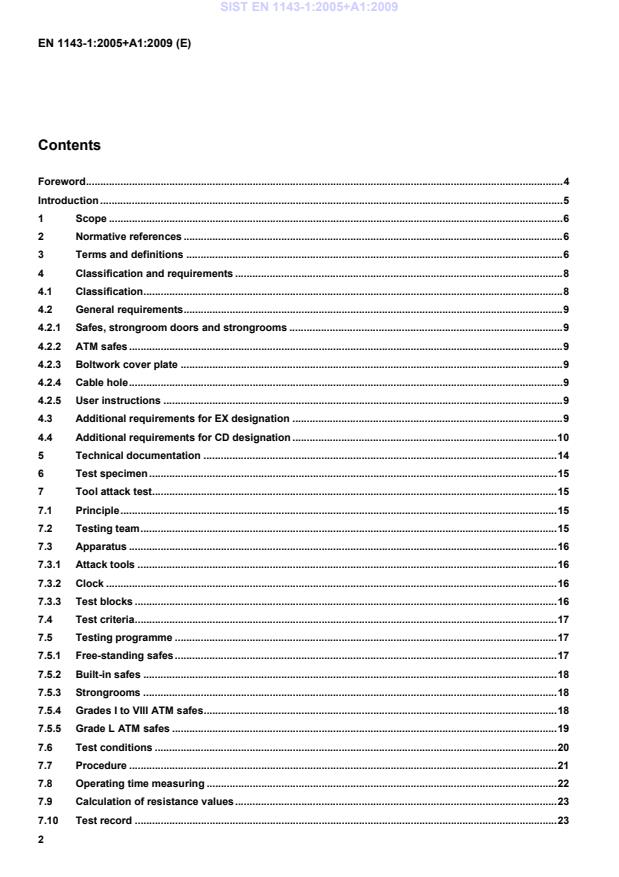
Attack tools . 32
NOTE For the purpose of this standard, automated teller machines, currency exchange machines, currency recycling machines and machines such as teller assist machines are all types of ATM.
3.10 ATM-System assembly of sub-units which provides an ATM function and affords security to cash and/or valuables stored within the ATM safe NOTE 1 An example of an ATM system is shown in Figure 1.
ATM System
ATM safe
ATM mechanism
ATM control unit
ATM base
Figure 1 — Example of an ATM system NOTE 2 Of the sub-units shown in Figure 1, the ATM mechanism and the ATM control unit are not tested according to this European Standard. 3.11 accessories installations/devices which are in the structure or which pass through the structure of the strongroom or strongroom door(s) for ventilation or for deposit of cash and valuables NOTE Accessories may be always open, usually open (but can be closed in case of emergency), or closed (but can be opened if necessary).
3.12 operating time time during which a tool is used attempting to create a change in the test specimen 3.13 resistance unit (RU) burglary resistance which results from one minute's use of a tool carrying the coefficient 1 and the basic value 0 3.14 resistance grade classification designation for burglary resistance SIST EN 1143-1:2005+A1:2009
3.17 tool coefficient number in resistance units per minute allocated to a group of tools NOTE The tool coefficient represents factors such as noise, smoke, fumes and other effects, which increase the likelihood of a burglary attack being detected.
3.18 boltwork mechanism by which a shut door is held such that until it is in the withdrawn position the door cannot be opened 3.19 lock device able to recognize a coded input and which performs a blocking function on the boltwork or the door 3.20 relocking device system comprising blocking and detecting elements which will prevent the boltwork from being withdrawn if a burglary attack is detected
NOTE A relocking device can be part of the locking mechanism (e.g. active or live relocker) or an independent unit (e.g. passive relocker). 3.21 to close to move the door so it becomes possible to bolt it 3.22 to bolt to throw the boltwork or the bolt of the lock (if there is no boltwork) to a position where it fixes the door in closed position 3.23 to lock to block a thrown boltwork by action of a lock 4 Classification and requirements 4.1 Classification Safes are classified to a resistance grade according to Table 1. ATM safes are classified to a resistance grade according to Table 2. Strongroom doors and strongrooms (with or without door) are classified to a resistance grade according to Table 3. All products shall meet general requirements (4.2) and products with EX and CD designation shall meet additional requirements (4.3 and 4.4). SIST EN 1143-1:2005+A1:2009
ATM safes shall have a fixing capability by which they can be anchored and which shall sustain the required force given in Table 2. 4.2.3 Boltwork cover plate Safes, ATM safes and strongroom doors shall have an internal boltwork cover plate which prevents unauthorized viewing of the locks and boltwork, and access to them, when the door is open. Boltwork cover plates shall be secured so that they cannot be opened or removed without leaving visible traces.
4.2.4 Cable hole Safes, strongroom doors and strongrooms of grade III and higher shall either have a hole for a cable or a preparation enabling a connection to be made to an alarm system after the secure storage unit has been installed.
4.2.5 User instructions Safes, strongrooms and ATM safes shall be provided with operating and maintenance instructions, including instructions in respect of the locks. Free-standing safes and ATM safes shall have instructions for anchoring. For built-in safes, strongroom doors and strongrooms, installation instructions shall be provided. 4.3 Additional requirements for EX designation When tested in accordance with Clause 9, safes of resistance grades II to X designated 'EX' shall achieve the minimum post-detonation resistance values given in Table 1. EX designation is not applicable to safes of resistance grade 0 to I. When tested in accordance with Clause 9, ATM safes of resistance grades II to VIII designated 'EX' shall achieve the minimum post-detonation resistance values given in Table 2. EX designation is not applicable to ATM safes of resistance grades L and I. When tested in accordance with Clause 9, strongroom doors and strongrooms (with or without doors) of resistance grades II to XIII designated 'EX' shall achieve the minimum post-detonation resistance values given in Table 3.
EX designation is not applicable to strongroom doors and strongrooms of resistance grades 0 and I. When tested in accordance with Clause 9, the cable-entry openings of safes, strongroom doors and strongrooms (with or without doors) shall not permit the entry of explosives (e.g. fuses or charges). SIST EN 1143-1:2005+A1:2009
(Clause 9)
Additional requirementsfor CD designation(optional)
(Clause 10)
Resistance value for
Required
force
Post-detonation resistance
value
Resistance value
partial access
complete access
Class
RU RU kN Quantity according to EN 1300 RU
0 30 30 50 1 A b c I 30 50 50 1 A b c II 50 80 50 1 A 4 c III 80 120 50 1 B 6 c IV 120 180 100 2 B 9 1 000 V 180 270 100 2 B 14 1 000 VI 270 400 100 2 C 20 1 000 VII 400 600 100 2 C 30 1 000 VIII 550 825 100 2 C 41 1 000 IX 700 1 050 100 2 C 53 1 000 X 900 1 350 100 2 C 68 1 000
a
Applicable only for free-standing safes with a mass less than 1 000 kg. b
EX designation is not possible for resistance grades 0 and I. c
CD designation is not possible for resistance grades 0 to III.
Resist-ance grade
Tool attack test
(Clause 7)
Resistance value for
Anchor-ing strength (8.2)
Tool attack test on fixing attachment
(Clause 7)
Locks
Additionalrequire- ments for EX designation(optional) (Clause 9)
partial access
completeaccess
Requiredforce
Resistance value
Quan-tity
Class according to EN 1300
Post-detonationresistance value
general
RU used aper-tures b
RU
RU
kN
RU
RU L
body a
20 20 30 50 50 1 A c
door 30 30 50
I
30 30 50 50 50 1 A c II
50 35 80 50 50 1 A 4 III
80 65 120 50 50 1 B 6 IV
120 100 180 100 50 2 B 9 V
180 145 270 100 50 2 B 14 VI
270 220 400 100 70 2 C 20 VII
400 350 600 100 120 2 C 30 VIII
550 500 825 100 160 2 C 41
a
Resistance values do not apply to the body of grade L ATM safes which fulfil the requirements of 7.5.5. b
Applies only to apertures actually used; plugged and unused apertures shall satisfy the general values.
c
EX designation is not possible for resistance grades L and I.
into resistance grades ! Resist-ance grade Tool attack test
(Clause 7) Locks a Additional requirements for
EX designation (optional) (Clause 9)
Additional requirements for CD designation (optional)
(Clause 10)
Resistance value
for complete access RU Quantity Class
according to EN 1300 Post-detonation
resistance value RU Resistance value c RU 0 30 1 A b d I 501Ab d II 801A4d III 1201B6d IV 1802B9d V 2702B14d VI 4002C20d VII 6002C30d VIII 8252C4110 000IX 1 0502C5310 000X 1 3502C6810 000XI 2 0003C or10010 000
2DXII 3 0003C or15010 000
2DXIII 4 5002D22510 000a Not applicable for classification of strongrooms without door. b EX designation is not possible for resistance grades 0 and I. c Resistance value for complete access by core drilling. d
CD designation is not possible for resistance grades 0 to VII.
"
5.5 Specification of the materials of construction if not contained on the drawings. 5.6 Statements of details of any materials or device(s) intended to generate gas, smoke, soot, etc. in the event of physical attack or which could generate harmful substances during testing.
5.7 Statements of the nature and position of any cables and/or facilities for penetration detection systems, for the mounting of electro-mechanical securing devices, alarm devices, etc. 5.8 Instructions for installation giving at least the following details: a) method of anchoring free-standing safes with a mass less than 1 000 kg; b) method of encasing built-in safes, i.e. proportion of body which is to be encased; the minimum size and section thickness of the encasement; the minimum quality of encasement material; (types and proportions of aggregates, cement and any other constituents, flowability of the freshly prepared mass and the 28-day cube compression strength together with the relevant methods of test to define these features); any reinforcement or anchoring to be included within the encasing mass;
c) method for the construction of monolithic cast in-situ strongrooms including the following: minimum quality of concrete (types and proportions of aggregates, cement and any other constituents, flowability of the freshly prepared mass, and the 28-day cube compression strength together with the relevant methods of test to define these features); reinforcement
to be included in the strongroom, means by which door and frame are joined to walls and means by which armouring and anchoring are jointed to elements;
6.3 Test specimens for built-in safes and cast in-situ strongrooms shall be constructed using the components supplied and following the instructions for installation, (see 5.8).
7 Tool attack test 7.1 Principle The test serves to establish the complete access, and for safes and ATM safes also the partial access minimum resistance values of the test specimen. A testing team (see 7.2) examines a test specimen (see Clause 6) together with the technical documentation (see Clause 5) and devises a programme of attacking the test specimen. The testing team attacks the test specimen.
The time taken to gain partial or complete access, assessed by inserting a test block, is recorded, and used to calculate a resistance value. The tools and programme of attack used during testing shall be those most likely, in the opinion of the testing team, to result in the lowest resistance values. Exploratory tests may be made. NOTE 1 Access to test specimens, technical documentation and observation of the testing should be restricted to people authorized by the testing house. Such authorized persons should not reveal information to non-authorized persons.
NOTE 2 Observers of the testing can comprise nominees of the applicant, nominees of the certification body e.g. surveyors, representatives of the testing house management. The number of observers can be limited by the testing house and authorization of observers should be agreed between the testing house and the applicant prior to starting testing.
WARNING: Because some of the tests specified in this European Standard involve the use of processes imposing risk on the persons concerned use only trained staff and ensure adequate supervision.
7.2 Testing team The testing team shall comprise: a) testing team leader who is responsible for the conduct of the test and whose function is to plan, direct and supervise the testing; b) time keeper whose function is confined to timekeeping and the compiling of the event record;
c) testing operatives whose function is to carry out the necessary tool attacks on the test specimen as directed by the testing team leader.
7.3 Apparatus 7.3.1 Attack tools Any tool used for the testing shall be given a coefficient and basic value according to Annex A. Tool category B includes tools of category A. Tool category C includes tools of categories A and B. Tool category D includes tools of categories A, B and C. Tool category S includes tools of categories A, B, C and D. Alterations to tools other than those permitted as 'specially made tools' shall not be made; for instance, it is not permitted to enlarge nozzles, lengthen electrodes, rods or levers etc. SAFETY WARNING: Tool safety devices such as guards, fuses and other current limiting features and/or maximum speed controls, shall not be removed or altered. To protect the operator(s), in the case of combined use of a hand impact tool and a chisel, a specially constructed chisel holder may be used.
Such a chisel holder shall be regarded as a hand gripping tool (see Table A.2). NOTE Testing houses should maintain a list of their current tools, together with their category in accordance with Annex A. 7.3.2 Clock Clock with an accuracy of at least 0,05 min in each 10 min measuring period, and the scaling shall be at least 0,01 min. Clocks shall be visible to all observers and the beginning and end of each operating time shall be indicated by an acoustic or optical signal. 7.3.3 Test blocks 7.3.3.1 General The test blocks shall be made of a rigid material. 7.3.3.2 Test blocks to measure partial access Three test blocks each with a length of 150 mm, and the following cross sections: a) circle with 125 mm diameter; b) square with 112 mm side length; edges and corners rounded with r = 5 mm; c) rectangle with 100 mm x 125 mm side length; edges and corners rounded with r = 5 mm. For all dimensions the tolerance shall be +02mm. SIST EN 1143-1:2005+A1:2009
c) for tool attack on the ATM safe fixing attachments that the fixing attachments are completely severed. In case of a built-in safe its removal from the encasement is also regarded as a complete access. Any tool attack test shall be continued until no more information necessary for determining the resistance grade can be reasonably expected.
This can occur when the resistance value discovered in previous test attacks is exceeded. An abandoned tool attack test shall count as one of the tests required in 7.5. 7.5 Testing programme 7.5.1 Free-standing safes The tests shall comprise at least one tool attack test for: a) partial access against the area of the body wall or the door of the test specimen; and
b) complete access against the body or the door. Additional tool attack tests according to (a) and (b) are required against wall, top, base or door if the test specimen has areas or zones of a different construction and for which the resistance value can be reasonably expected to be lower (e.g. in the area of pre-existing holes). SIST EN 1143-1:2005+A1:2009
7.5.2 Built-in safes The test shall comprise at least one tool attack test for: a) partial access against the door or lid (including the door frame and encasement, if appropriate); and
b) complete access against the door and/or against the body to remove the built-in safe from its encasement. Additional tool attack tests according to (a) and (b) are required if the test specimen has areas or zones of a different construction and for which the resistance value can be reasonably expected to be lower (e.g. in the area of pre-existing holes). 7.5.3 Strongrooms 7.5.3.1 General The test shall comprise at least one tool attack test for complete access against the strongroom wall and one tool attack test against the strongroom door for complete access. 7.5.3.2 Strongroom without door The test shall comprise at least one tool attack test for complete access. Additional tool attack tests for the complete access are required against ceiling, base and wall segments if the construction of the strongroom has areas or zones of different construction and for which the resistance value can reasonably be expected to be lower (e.g. in the area of pre-existing holes). 7.5.3.3 Strongroom doors The test shall comprise at least one tool attack test for complete access on the door (including frame and adjoining wall sections, if necessary). Additional tool attack tests for the complete access are required if the test specimen has areas or zones of different construction and for which the resistance value can reasonably be expected to be lower (e.g. in the area of pre-existing holes). 7.5.4 Grades I to VIII ATM safes 7.5.4.1 General Testing of grades I to VIII ATM safes shall comprise at least one tool attack test for: a) partial access against the body or door; b) complete access against the body or door; c) cutting or destroying the fixing by direct attack on any fixing attachment. Additional tool attack tests according to (a) and (b) shall be made on any area or zone of the test specimen which has a different construction and for which the resistance value can be reasonably expected to be lower (e.g. in the area of pre-existing holes). SIST EN 1143-1:2005+A1:2009
345 MPa, or from steel of not less than 12 mm thickness having an ultimate tensile strength greater than 690 MPa. b) Body is joined along all sides in a manner not less strong than a continuous 6,4 mm penetration weld of steel with an ultimate tensile strength of 345 MPa. If the body of a grade L ATM safe does not satisfy either 'a' or 'b' both partial access and complete access tests will be carried out against the body. SIST EN 1143-1:2005+A1:2009
...