

EN 13480-4:2012/A1:2013
(Amendment)Metallic industrial piping - Part 4: Fabrication and installation
- Abstract
This Part of this European standard EN 13480 describes the requirements for fabrication and installation of piping systems, including supports, designed in accordance with EN 13480-3.
- Status
- Withdrawn
- Publication Date
- 27-Aug-2013
- Withdrawal Date
- 06-Oct-2026
- Technical Committee
- CEN/TC 267 - Industrial piping and pipelines
- Drafting Committee
- CEN/TC 267/WG 4 - Manufacturing and installation
- Current Stage
- 9960 - Withdrawal effective - Withdrawal
- Start Date
- 28-Jun-2017
- Completion Date
- 07-Oct-2026
- Directive
- 2014/68/EU - Directive 2014/68/EU of the European Parliament and of the Council of 15 May 2014 on the harmonisation of the laws of the Member States relating to the making available on the market of pressure equipmentOJ Ref: C 293/01 OJ Date: 12-Aug-2016
97/23/EC - Pressure equipmentOJ Ref: C, C 22 OJ Date: 24-Jan-2014

Relations
- Effective Date
- 08-Jun-2022
- Effective Date
- 28-Jan-2026
- Effective Date
- 08-Jun-2022
Get Certified
Connect with accredited certification bodies for this standard

Institut za varilstvo d.o.o. (Welding Institute)
Slovenia's leading welding institute since 1952. ISO 3834, EN 1090, pressure equipment certification, NDT personnel, welder qualification. Only IIW Au
Sponsored listings
Frequently Asked Questions
EN 13480-4:2012/A1:2013 is a amendment published by the European Committee for Standardization (CEN). Its full title is "Metallic industrial piping - Part 4: Fabrication and installation". This standard covers: This Part of this European standard EN 13480 describes the requirements for fabrication and installation of piping systems, including supports, designed in accordance with EN 13480-3.
This Part of this European standard EN 13480 describes the requirements for fabrication and installation of piping systems, including supports, designed in accordance with EN 13480-3.
EN 13480-4:2012/A1:2013 is classified under the following ICS (International Classification for Standards) categories: 23.040.01 - Pipeline components and pipelines in general. The ICS classification helps identify the subject area and facilitates finding related standards.
EN 13480-4:2012/A1:2013 has the following relationships with other standards: It is inter standard links to EN 13480-4:2017, EN 15001-1:2023, EN 13480-4:2012. Understanding these relationships helps ensure you are using the most current and applicable version of the standard.
EN 13480-4:2012/A1:2013 is associated with the following European legislation: EU Directives/Regulations: 2014/68/EU, 97/23/EC; Standardization Mandates: M/071. When a standard is cited in the Official Journal of the European Union, products manufactured in conformity with it benefit from a presumption of conformity with the essential requirements of the corresponding EU directive or regulation.
EN 13480-4:2012/A1:2013 is available in PDF format for immediate download after purchase. The document can be added to your cart and obtained through the secure checkout process. Digital delivery ensures instant access to the complete standard document.
Standards Content (Sample)
SLOVENSKI STANDARD
01-december-2013
Kovinski industrijski cevovodi - 4. del: Proizvodnja in vgradnja - Dopolnilo A1
Metallic industrial piping - Part 4: Fabrication and installation
Metallische industrielle Rohrleitungen - Teil 4: Fertigung und Verlegung
Tuyauteries industrielles métalliques - Partie 4: Fabrication et installation
Ta slovenski standard je istoveten z: EN 13480-4:2012/A1:2013
ICS:
77.140.75 Jeklene cevi in cevni profili Steel pipes and tubes for
za posebne namene specific use
2003-01.Slovenski inštitut za standardizacijo. Razmnoževanje celote ali delov tega standarda ni dovoljeno.
EUROPEAN STANDARD
EN 13480-4:2012/A1
NORME EUROPÉENNE
EUROPÄISCHE NORM
August 2013
ICS 23.040.01
English Version
Metallic industrial piping - Part 4: Fabrication and installation
Tuyauteries industrielles métalliques - Partie 4: Fabrication Metallische industrielle Rohrleitungen - Teil 4: Fertigung
et installation und Verlegung
This amendment A1 modifies the European Standard EN 13480-4:2012; it was approved by CEN on 26 July 2013.
CEN members are bound to comply with the CEN/CENELEC Internal Regulations which stipulate the conditions for inclusion of this
amendment into the relevant national standard without any alteration. Up-to-date lists and bibliographical references concerning such
national standards may be obtained on application to the CEN-CENELEC Management Centre or to any CEN member.
This amendment exists in three official versions (English, French, German). A version in any other language made by translation under the
responsibility of a CEN member into its own language and notified to the CEN-CENELEC Management Centre has the same status as the
official versions.
CEN members are the national standards bodies of Austria, Belgium, Bulgaria, Croatia, Cyprus, Czech Republic, Denmark, Estonia,
Finland, Former Yugoslav Republic of Macedonia, France, Germany, Greece, Hungary, Iceland, Ireland, Italy, Latvia, Lithuania,
Luxembourg, Malta, Netherlands, Norway, Poland, Portugal, Romania, Slovakia, Slovenia, Spain, Sweden, Switzerland, Turkey and United
Kingdom.
EUROPEAN COMMITTEE FOR STANDARDIZATION
COMITÉ EUROPÉEN DE NORMALISATION
EUROPÄISCHES KOMITEE FÜR NORMUNG
Management Centre: Avenue Marnix 17, B-1000 Brussels
© 2013 CEN All rights of exploitation in any form and by any means reserved Ref. No. EN 13480-4:2012/A1:2013: E
worldwide for CEN national Members.
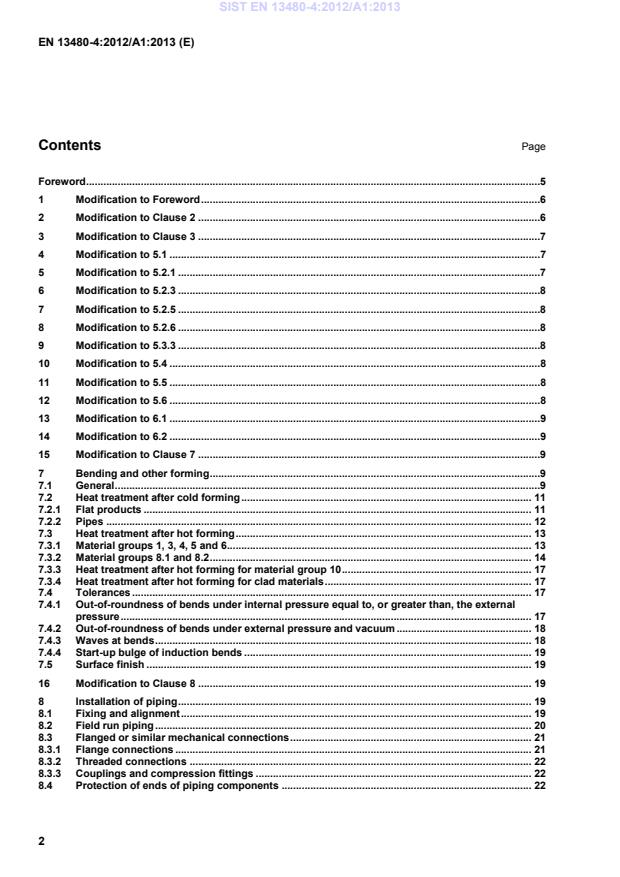
Contents Page
Foreword .5
1 Modification to Foreword .6
2 Modification to Clause 2 .6
3 Modification to Clause 3 .7
4 Modification to 5.1 .7
5 Modification to 5.2.1 .7
6 Modification to 5.2.3 .8
7 Modification to 5.2.5 .8
8 Modification to 5.2.6 .8
9 Modification to 5.3.3 .8
10 Modification to 5.4 .8
11 Modification to 5.5 .8
12 Modification to 5.6 .8
13 Modification to 6.1 .9
14 Modification to 6.2 .9
15 Modification to Clause 7 .9
7 Bending and other forming .9
7.1 General .9
7.2 Heat treatment after cold forming . 11
7.2.1 Flat products . 11
7.2.2 Pipes . 12
7.3 Heat treatment after hot forming . 13
7.3.1 Material groups 1, 3, 4, 5 and 6 . 13
7.3.2 Material groups 8.1 and 8.2 . 14
7.3.3 Heat treatment after hot forming for material group 10 . 17
7.3.4 Heat treatment after hot forming for clad materials . 17
7.4 Tolerances . 17
7.4.1 Out-of-roundness of bends under internal pressure equal to, or greater than, the external
pressure . 17
7.4.2 Out-of-roundness of bends under external pressure and vacuum . 18
7.4.3 Waves at bends . 18
7.4.4 Start-up bulge of induction bends . 19
7.5 Surface finish . 19
16 Modification to Clause 8 . 19
8 Installation of piping . 19
8.1 Fixing and alignment . 19
8.2 Field run piping . 20
8.3 Flanged or similar mechanical connections . 21
8.3.1 Flange connections . 21
8.3.2 Threaded connections . 22
8.3.3 Couplings and compression fittings . 22
8.4 Protection of ends of piping components . 22
17 Modification to Clause 9 . 22
9 Welding . 22
9.1 Welding personnel . 22
9.2 Welding procedure specifications . 22
9.3 Welding procedures . 23
9.3.1 Verification of suitability . 23
9.3.2 Application . 23
9.4 Filler metals and auxiliary materials . 24
9.5 Climatic conditions . 24
9.6 Cleaning before and after welding . 24
9.7 Joint preparation . 24
9.8 Edge protection . 24
9.9 Assembly for welding . 24
9.10 Earthing . 25
9.11 Performance of welding . 25
9.11.1 Preheating . 25
9.11.2 Striking marks . 25
9.11.3 External welds . 25
9.11.4 Dissimilar joints . 26
9.12 Backing rings . 26
9.13 Attachments . 26
9.13.1 General . 26
9.13.2 Temporary attachments . 26
9.13.3 Permanent attachments . 26
9.14 Post-weld heat treatment . 27
9.14.1 General . 27
9.14.2 Equipment . 31
9.14.3 Temperature measurements . 31
9.14.4 Controlling thickness . 31
9.14.5 Rate of heating . 33
9.14.6 Local heat treatment . 33
9.14.7 Insulation . 34
9.15 Weld identification . 34
18 Modification to 10.2.1 . 34
19 Modification to 10.2.2 . 34
20 Modification to 10.2.4 . 34
21 Modification to 10.3 . 34
22 Modification to Clause 11 . 35
11 Marking and documentation. 35
11.1 Marking of spools and components for installation . 35
11.2 Marking and identification of installed piping . 35
11.2.1 General . 35
11.2.2 CE Marking of installed piping . 35
11.2.3 Technical identification of installed piping . 36
23 Modification to 12.1 . 36
24 Modification to 12.2 . 36
25 Modification to 12.5 . 37
26 Modification to Clause A.1. 37
27 Modification to A.2.1 . 37
28 Modification to A.2.2 . 37
29 Modification to A.4.2 . 38
30 Modification to Annex B . 38
31 Modification to Clause Y.1 . 39
32 Modification to Annex ZA . 39
33 Modification to Bibliography . 40
Foreword
This document (EN 13480-4:2012/A1:2013) has been prepared by Technical Committee CEN/TC 267
“Industrial piping and pipelines”, the secretariat of which is held by AFNOR.
This Amendment to the European Standard EN 13480-4:2012 shall be given the status of a national standard,
either by publication of an identical text or by endorsement, at the latest by month year of February 2014, and
conflicting national standards shall be withdrawn at the latest by February 2014.
Attention is drawn to the possibility that some of the elements of this document may be the subject of patent
rights. CEN [and/or CENELEC] shall not be held responsible for identifying any or all such patent rights.
This document has been prepared under a mandate given to CEN by the European Commission and the
European Free Trade Association, and supports essential requirements of EU Directive(s).
For relationship with EU Directive(s), see informative Annex ZA, which is an integral part of this document.
This document includes the text of the amendment itself. The amended/corrected pages of EN 13480-4:2012
will be published in August 2013 as Issue 2 of the European Standard.
According to the CEN-CENELEC Internal Regulations, the national standards organizations of the following
countries are bound to implement this European Standard: Austria, Belgium, Bulgaria, Croatia, Cyprus, Czech
Republic, Denmark, Estonia, Finland, Former Yugoslav Republic of Macedonia, France, Germany, Greece,
Hungary, Iceland, Ireland, Italy, Latvia, Lithuania, Luxembourg, Malta, Netherlands, Norway, Poland, Portugal,
Romania, Slovakia, Slovenia, Spain, Sweden, Switzerland, Turkey and the United Kingdom.
1 Modification to Foreword
th
The first sentence of the 9 paragraph of the Foreword shall read as follows:
The contact to submit queries can be found at http://www.unm.fr (en13480@unm.fr).
2 Modification to Clause 2
Replace the existing Clause 2 with the following:
The following documents, in whole or in part, are normatively referenced in this document and are
indispensable for its application. For dated references, only the edition cited applies. For undated references,
the latest edition of the referenced document (including any amendments) applies.
EN 287-1:2011, Qualification test of welders — Fusion welding — Part 1: Steels
EN 1418:1997, Welding personnel — Approval testing of welding operators for fusion welding and resistance
weld setters for fully mechanized and automatic welding of metallic materials
EN 10204:2004, Metallic products — Types of inspection documents
EN 13480-1:2012, Metallic industrial piping — Part 1: General
EN 13480-2:2012, Metallic industrial piping — Part 2: Materials
EN 13480-3:2012, Metallic industrial piping — Part 3: Design and calculation
EN 13480-5:2012, Metallic industrial piping — Part 5: Inspection and testing
EN ISO 3834-3:2005, Quality requirements for fusion welding of metallic materials — Part 3: Standard quality
requirements (ISO 3834-3:2005)
EN ISO 4063:2010, Welding and allied processes — Nomenclature of processes and reference numbers
(ISO 4063:2009, Corrected version 2010-03-01)
EN ISO 5817:2007, Welding — Fusion-welded joints in steel, nickel, titanium and their alloys (beam welding
excluded) — Quality levels for imperfections (ISO 5817:2003, corrected version:2005, including Technical
Corrigendum 1:2006)
EN ISO 13920, Welding — General tolerances for welded constructions — Dimensions for lengths and angles
— Shape and position (ISO 13920)
EN ISO 15609 (all parts), Specification and qualification of welding procedures for metallic materials —
Welding procedure specification
EN ISO 15610:2003, Specification and qualification of welding procedures for metallic materials —
Qualification based on tested welding consumables (ISO 15610:2003)
EN ISO 15611:2003, Specification and qualification of welding procedures for metallic materials —
Qualification based on previous welding experience (ISO 15611:2003)
EN ISO 15612:2004, Specification and qualification of welding procedures for metallic materials —
Qualification by adoption of a standard welding procedure (ISO 15612:2004)
EN ISO 15613:2004, Specification and qualification of welding procedures for metallic materials —
Qualification based on pre-production welding test (ISO 15613:2004)
EN ISO 15614-1:2004, Specification and qualification of welding procedures for metallic materials — Welding
procedure test — Part 1: Arc and gas welding of steels and arc welding of nickel and nickel alloys
(ISO 15614-1:2004)
EN ISO 17663:2009, Welding — Quality requirements for heat treatment in connection with welding and allied
processes (ISO 17663:2009)
CEN ISO/TR 15608:2005, Welding — Guidelines for a metallic materials grouping system
(ISO/TR 15608:2005)
3 Modification to Clause 3
Replace the existing Clause 3 with the following:
For the purposes of this document, the terms and definitions given in EN 13480-1:2012 together with the
following apply.
3.1
field run piping
piping installed without preplanning by drawings of the piping routing and the support points
Note 1 to entry: Typical dimensions are DN 50 or smaller.
3.2
spool (with or without overlength)
prefabricated assembly of components which forms part of a piping system
3.3
cold forming
forming at ambient temperature, but not below + 5 °C
3.4
hot forming
for ferritic steels, forming at temperatures at or above the maximum permissible temperature for post-weld
heat treatment; for austenitic and austenitic-ferritic steels at temperatures above 300 °C
4 Modification to 5.1
The revised sub-clause 5.1 shall read as follows:
The manufacturer shall be responsible for the fabrication and the installation, even if this work will be sub-
contracted to other fabricators and/or installers.
5 Modification to 5.2.1
The revised sub-clause 5.2.1 shall read as follows:
The fabricators and/or installers shall ensure the correct transport, handling, storage, fabrication, installation
and testing of all piping components including supports.
6 Modification to 5.2.3
The revised sub-clause 5.2.3 shall read as follows:
The fabricators and/or installers shall employ their own responsible supervisors and competent personnel. If
sub-contractors are employed, the fabricator and/or installer remain responsible for their competence and the
compliance with this European Standard.
NOTE The task and responsibilities of a welding co-ordinator are described in EN ISO 14731.
7 Modification to 5.2.5
The revised sub-clause 5.2.5 shall read as follows:
Co-ordination between those responsible for design and those responsible for fabrication and/or installation
and testing shall be maintained at all times, to ensure that fabrication, installation and testing is carried out in
accordance with the design specification.
8 Modification to 5.2.6
Add a new sub-clause 5.2.6 as follows:
5.2.6 The fabricator and/or installer of the piping shall fulfil the requirements of EN ISO 3834-3.
9 Modification to 5.3.3
The revised NOTE of 5.3.3 shall read as follows:
NOTE 5.3.3 is deemed to be fulfilled, when the quality characteristics of the material are not impaired by cold or hot
forming, e.g. by cutting, grinding, straightening or bending, of the components and when the different components have
been joined such that stresses and deformations which can impair the safety of the piping are excluded.
10 Modification to 5.4
The revised sub-clause 5.4 shall read as follows:
The piping systems shall be classified into different categories depending on the fluid carried, diameter and
pressure. These are given in EN 13480-1.
11 Modification to 5.5
The revised sub-clause 5.5 shall read as follows:
Material grouping is given in EN 13480-2.
12 Modification to 5.6
The 1st paragraph of the sub-clause 5.6 shall read as follows:
Tolerances shall comply with EN ISO 13920, class C and class G, except where other classes are specified in
this European Standard or by design.
13 Modification to 6.1
The 2nd paragraph of the sub-clause 6.1 shall read as follows:
Flame cutting shall be permitted for material groups 1, 2, 3, 4 and 5 only with preheating as specified for
welding.
th th
The 4 and 5 paragraph of the sub-clause 6.1 shall read respectively as follows:
Plasma cutting shall be permitted for all material groups given in this European Standard. Plasma cutting shall
be preceded by preheating, as specified for welding.
Other cutting and bevelling processes are permitted, provided their suitability is demonstrated.
14 Modification to 6.2
The heading of the sub-clause 6.2 shall read as follows:
6.2 Identification of pressure parts
nd rd
The 2 and 3 paragraph of the sub-clause 6.1 shall read respectively as follows:
Stamping shall not introduce a notching effect, therefore low-stress stamping is recommended.
If any method of marking other than hard-stamping, edging or engraving (vibrograph) is used, the fabricator
shall ensure that confusion between different materials is not possible.
15 Modification to Clause 7
Replace the existing Clause 7 with the following:
7 Bending and other forming
7.1 General
7.1.1 Fabricators of formed pressure parts shall have adequate procedures, equipment and tools for the
forming and the subsequent heat treatment.
Pipes with internal coating such as glass, rubber or plastics shall not be formed unless it has been
demonstrated that the forming process is not detrimental to the lining.
NOTE There are two kinds of forming within the scope of this European Standard: cold forming and hot forming.
The thickness after bending or forming shall be not less than that required by the design.
Longitudinal welds should be located at the neutral zone. The range of the neutral zone after bending is given
in Figure 7.1.1-1.
Key
1 extrados
2 intrados
(a) optimal range for the longitudinal weld at bending
(b) weld
Figure 7.1.1-1 — Optimal range for the longitudinal weld at bending
7.1.2 The forming and post-forming heat treatment of thermomechanical steels shall be given individual
consideration. Account shall be taken of the recommendations of the steelmakers.
Pipes whose properties have been generated by thermomechanical means such as controlled rolling can be
formed by cold methods. Such materials may be substantially changed by the forming process and require
particular consideration to ensure that the specified properties are recovered after forming.
7.1.3 The following formulae shall be used for the calculation of the percentage deformation for cold formed
cylinders and cone products made by rolling (see Figure 7.1.3-1):
a) For cylinders and cones rolled from flat materials (see Figures 7.1.3-1a) and 7.1.3-1c)):
50 e
ord
(7.1.3-1)
V =
d
r
mf
b) For cylinders and cones rolled from intermediate product (see Figures 7.1.3-1b) and 7.1.3-1c)):
50 e r
int mf
V = 1− (7.1.3-2)
d
r r
mf mi
where
e is the ordered thickness;
ord
is the thickness of the intermediate product;
e
int
r is the average radius of the finished product;
mf
r is the average radius of the intermediate product;
mi
V is the deformation as a percentage.
d
NOTE If no intermediate quality heat treatment is applied between individual forming steps, the deformation is the
total amount of deformation of the individual steps. If intermediate quality heat treatment is applied between the forming
steps, the deformation is that deformation applied after the last treatment.
a) Initial product b) Intermediate product c) Finished product
Figure 7.1.3-1 — Forming of cylinders and cones
7.1.4 Tools and equipment used for forming shall be maintained to ensure a smooth profile free from stress-
raising defects, e.g. scores.
7.1.5 Heat treatment after forming shall be in accordance with the respective material standard.
7.1.6 Welding on to formed areas shall not be performed until heat treatment is complete.
7.2 Heat treatment after cold forming
7.2.1 Flat products
Flat products shall be heat treated after cold forming as required in Table 7.2.1-1.
For special design reasons, for example cyclic loading or stress corrosion cracking, heat treatment in excess
of that in Table 7.2.1-1 may be specified after cold forming.
No heat treatment for austenitic steels is required:
a) For austenitic steels having a documented minimum value of elongation after fracture (rupture) A equal
to or greater than 30 %, a maximum level of 15 % cold deformation shall be acceptable.
A greater deformation may be accepted if the evidence is supplied that there is a minimum elongation
after fracture (rupture) of 15 % after cold forming.
Such evidence shall be deemed supplied, if the acceptance certificate shows that elongation after
fracture (rupture) A is not less than 30 %. This shall be applicable only in cases where there is no risk of
stress corrosion cracking;
b) For austenitic steels having a required minimum value of elongation after fracture (rupture) A less than
30 %, evidence shall be supplied that there is a minimum elongation of 15 % after cold forming;
c) Deformation shall not exceed 10 % if the working temperature is below -196 °C.
Table 7.2.1-1 — Heat treatment after cold forming of flat products
Material groups according to Deformation Heat treatment
CEN ISO/TR 15608
a b
no
1.1, 1.2, 1.3, 2.1, 2.2 , 3, 4 , 5.1, ≤ 5 %
b b b b
5.2 , 5.3 , 5.4 , 6 ,
> 5 % yes
7.1, 7.2, 7.3, 9.1, 9.2, 10
c d
8.1, 8.2
a
If not heat treated, qualification tests are required to demonstrate that the material properties are not
impaired.
b
Heat treatment required in accordance with the material standards where the minimum metal
temperature is below - 10 °C.
c
See 7.2.1 a), b) and c).
d
Solution annealed and quenched or stabilised materials do not require heat treatment after cold
forming.
7.2.2 Pipes
Pipes shall be heat treated after cold forming in accordance with Table 7.2.2-1.
For special reasons, for example cyclic loading or stress corrosion, heat treatment may be specified after cold
forming.
Table 7.2.2-1 — Heat treatment after cold forming of pipes
Material groups Mean bending radius Outside Heat treatment
according to of the pipe diameter of the
pipe
CEN ISO/TR 15608
r d
m o
1.1, 1.2, 1.3,
2.1, r ≤ 1,3 d
all diameters yes
m o
b
2.2 ,
b
3 ,
a
d ≤ 142 mm
no
4 ,
o
1,3 d < r < 2,5 d
a a a
o m o
5.1, 5.2 , 5.3 , 5.4 ,
a
6 ,
c
d > 142 mm
yes
o
7,
8,
9,
2,5 d ≤ r
all diameters no
o m
NOTE For d and r , see Figure 7.2.2-1.
o m
a
Heat treatment required in accordance with the material standards where the minimum metal
temperature is below -10 °C.
b
If not heat treated, qualification tests are required to demonstrate that the material properties are not
impaired.
c
Not required for material groups 8.1, 8.2.
Figure 7.2.2-1 — Pipe bending
7.3 Heat treatment after hot forming
7.3.1 Material groups 1, 3, 4, 5 and 6
After hot forming, including induction bending, the parts shall be heat treated (normalising, normalising and
tempering, quenching and tempering or annealing as appropriate) in accordance with the material
specification to ensure that the properties meet those required by the material standard, or other appropriate
specification. Special consideration shall be given to materials designed to operate at elevated or sub-zero
temperatures or other special conditions.
If the hot forming of materials of groups 1, 3, 5 up to 2 % Cr has been started and ended within the
temperature range fixed in the material specification:
a) normalised steels need not be renormalised;
b) quenched and tempered steels need only be tempered provided that they have been rapidly cooled by
water or air from the forming temperature.
Pipes bent using the incremental induction heating method (induction bends) may undergo thermal treatment
during bending by the application of water or air quenches.
Non-alloy steels (C, C-Mn) formed using the induction bending process with air or water quenching may be
suitable in the as-bent condition for applications where high impact resistance and ductility are not required.
Such bends may be supplied without post-bending heat treatment provided that bend hardness does not
exceed 285 HV.
Heat treatments for high alloyed ferritic material should follow as soon after forming as practicable, to
minimise the risk of hydrogen induced cracking.
The manufacturer shall demonstrate that the requisite properties are achieved in the final product by the
examination and testing of one or more sample bends. These bends shall be made in accordance with all the
relevant parameters to be used in production bends. These parameters include, but are not limited to,
chemical composition, forming temperature, forming rate (speed), forming coolant supply, forming dimensions
(e.g. bend radius and r / d ) and post-forming heat treatment.
m o
7.3.2 Material groups 8.1 and 8.2
Austenitic steels which have been rapidly cooled from above the solution annealing temperature using water
or air during the forming process shall not require post-forming heat treatment. Stabilised austenitic steels
formed above the solution annealing temperature shall be subjected to post-forming stabilising treatment.
Stabilised austenitic steels formed in the stabilising temperature range, shall not require subsequent
treatment.
Heat treatment shall be carried out in accordance with Table 7.3.2-1.
Table 7.3.2-1 — Heat treatment of austenitic steels after hot forming
Material type Typical steel grades Conditions under which post-forming Temperature range for heat Solution
a
heat treatment may be waived annealing
treatment when stabilising
temperature
b,c
Name Number Non-welded parts Welded parts Non-welded parts Welded parts
°C °C °C
900 ± 20 920 ± 20
≥ 1 020
Stabilised steels X 6 CrNiTi 18-10 1.4541
non-Mo-alloyed X 6 CrNiNb 18-10 1.4550 c
(L)
d d
X 6 CrNiMoTi 17-12-2 1.4571
not permitted not permitted
X 6 CrNiMoNb 17-12-2 1.4580
Mo-alloyed
e
≥ 1 050
1.4505
(X 4 NiCrMoCuNb 20-18)
Forming started at 1 000 °C
Forming started at
to 1 150 °C and finished at
non stabilised 900 ± 20 920 ± 20
f
1 000 °C to 1 150 °C
> 750 °C (fastest possible
steels X 2 CrNi 19-11 1.4306
c c, g
and finished at (L) (L) ≥ 1 000
Cooling) and stabilised fillers
low C-content/ X 2 CrNiN 18-10 1.4311
> 750 °C (fastest
or non-stabilised fillers with
non-Mo-alloyed
possible Cooling).
≤ 0,04 % C in weld metal
X 2 CrNiMo 17-12-2 1.4404 960 ± 20 °C 980 ± 20
X 2 CrNiMo 18-14-3 1.4435
≥ 1 020
c, e c, g, h
(L) (L)
X 2 CrNiMoN 17-11-2 1.4406
low C-content/
Mo-alloyed
X 2 CrNiMoN 17-13-3 1.4429
X 2 CrNiMo 18-15-4 1.4438
≥ 1 040
X 2 CrNiMoN 17-13-5 1.4439
high C-content/ X 4 CrNi 18-10 1.4301 Forming started at Forming started at 1 000°C not permitted not permitted
≥ 1 000
f e e
non Mo-alloyed X 4 CrNi 18-12 1.4303
to 1 150 °C and finished at
1 000 °C to 1 150 °C
> 875°C (quenching in/with
and finished at
water for wall thicknesses
> 875 °C (quenching
high C-content/ X 5 CrNiMo 17-12-2 1.4401
in/with water for wall ≥ 6 mm) and stabilised fillers
≥ 1 050
Mo- alloyed X 3 CrNiMo 17-13-3 1.4436
or non-stabilised fillers with
thicknesses ≥ 6 mm)
≤ 0,06 % C
Table 7.3.2-1 (continued)
a
Stabilising or corresponding annealing in the case of non-stabilised steels with approximately 30 min critical interval.
b
For e ≥ 6 mm the type of cooling shall be quenching in/with water or cooling in air flow (W SL).
ord
c
For e < 6 mm cooling shall be in air flow (L).
ord
d
Unless required by process conditions.
e
Minimal critical interval is 5 min.
f
Starting temperature of 1 000 °C may be lowered if part was in the quenched state prior to hot forming.
g
Stabilising not permissible if stabilised fillers are used.
h
Steels No. 1.4406 and 1.4429 may be stabilised at lower temperatures if the same material characteristics will be reached.
7.3.3 Heat treatment after hot forming for material group 10
After hot forming, the parts shall be heat treated in accordance with the material specifications.
7.3.4 Heat treatment after hot forming for clad materials
If forming cannot be avoided, then the process of forming and heat treatment shall be demonstrated as giving
specified properties.
7.4 Tolerances
7.4.1 Out-of-roundness of bends under internal pressure equal to, or greater than, the external
pressure
The out-of-roundness, u (in %), shall be calculated from:
2(d − d )
o max o min
u= 100 (7.4.1-1)
d + d
o max o min
where
d is the maximum outside diameter measured, in mm;
omax
d is the minimum outside diameter measured at the same cross section as d , in mm.
omin omax
The out-of-roundness of the bend shall not exceed the limits given in Figure 7.4.1-1.
The ends of the bent pipes shall comply with the tolerances for the base pipe.
Key
d is the outside diameter
o
r is the mean bending radius
m
u is the out-of-roundness
Figure 7.4.1-1 — Acceptable out-of-roundness
7.4.2 Out-of-roundness of bends under external pressure and vacuum
Values for out-of-roundness shall conform to the values stated in the design.
7.4.3 Waves at bends
Waves at bends are acceptable as long as they comply with both of the following conditions:
a)
(7.4.3-1)
h ≤ 0,03 d
m 01
where
h is the mean height of adjacent waves, calculated as follows:
m
d + d
02 04
h = − d (7.4.3-2)
m 03
where d d d , d are as shown in Figure 7.4.3-1
, ,
01 02 03 04
b)
a≥ 12⋅ h (7.4.3-3)
m
where
a is the wave distance;
h is the mean height of adjacent waves, calculated as in Formula (7.4.3-1).
m
NOTE For clarity, waves have been exaggerated.
Figure 7.4.3-1 — Waves at bends
7.4.4 Start-up bulge of induction bends
The height of any start-up bulge/hump shall not exceed 25 % of the nominal wall thickness, and the maximum
dimension of its base shall be at least eight times its height and shall blend smoothly into the adjoining
surfaces (see Figure 7.4.4-1).
The out-of-roundness tolerance specified in 7.4.1 shall also be applicable on a cross-section taken at the point
of irregularity.
Key
a ≥ 8 h
e
h≤ where e is the nominal wall thickness
Figure 7.4.4-1 — Start-up bulge
7.5 Surface finish
The surface of the bend shall be such as to permit a visual examination.
All bends shall be free from surface imperfections such as cracks, indentations, laps and scabs. Where
surface imperfections are ground out, the wall thickness shall not be reduced below the calculated minimum
wall thickness. Areas which are ground to remove imperfections shall be examined by surface crack detection
methods appropriate to the material to ensure complete removal of the imperfections.
Repairs by welding shall not be permitted.
16 Modification to Clause 8
Replace the existing Clause 8 with the following:
8 Installation of piping
8.1 Fixing and alignment
The piping shall be installed in accordance with the design requirements given in EN 13480-3. For special
operations, e.g. balancing and cold pull, instructions shall be specified. The slope of the piping shall be
checked to ensure that continuous slope is achieved in accordance with the design.
Where necessary, during assembly of piping sections, the installer shall use temporary supports to ensure
that no unacceptable stress or deformation occurs in the piping and connected equipment as a consequence
of the cantilever effect of unsupported weight distribution.
Temporary auxiliary supports should be used to replace the supporting effort of connected equipment.
Piping shall not be distorted for the purpose of alignment for joint assembly.
Such distortion can introduce detrimental strains in the piping or connected equipment.
Longitudinal welds shall be located so as to avoid openings or attachments wherever possible.
Longitudinal welds in adjoining components shall be staggered by twice the nominal wall thickness, with a
minimum distance of 20 mm.
Supports shall be installed to ensure that the identification, load and travel scales are readily visible. All
threaded parts shall be fully engaged, and locking nuts tightened.
The installer shall ensure that all clamping parts fit closely on the pipe.
If not otherwise specified in the design, supports for pipes larger than DN 50 shall not be located more than
one outside diameter from the specified position. Where necessary, the fixing of the support to the structure
shall be adjusted to ensure that the angulation of support rods is in accordance with the specified limits.
Variable spring hangers and constant load hangers shall be blocked during the installation and assembly of
the piping unless otherwise specified in the design instructions. If supports are unblocked for specially
controlled operations such as balancing or cold pull, they shall be re-blocked prior to the hydrostatic pressure
test and chemical cleaning.
Temporary adjustment of the springs should be considered for operations such as hot c
...