

EN 17657:2025
(Main)Equipments for slaughterhouses - Slaughtering traps for bovine animals - Safety and cleaning requirements
- Abstract
This document specifies the safety and hygiene requirements applicable to slaughtering traps intended for bovine animals and equidae such as defined in Clause 3.
These requirements take into account hazards that may arise from the transport, mounting, adjustment, maintenance and use of these slaughtering traps.
NOTE This document takes into account the protection of animals at the time of killing.
The machinery or installations covered by this document are intended to facilitate the slaughter of bovine animals or equidae that weigh between 100 kg and 1 200 kg. They are either rotating slaughtering traps or fixed slaughtering traps.
This document does not cover the following machinery and zones:
- "restrainers": systems for holding and conveying via conveyor belts;
- slaughtering traps with a side door that opens under the weight of the animal alone;
- slaughtering traps where the only source of energy is manual effort.
This document does not cover the following essential requirements of Machinery Directive:
- safety and reliability of control systems;
- control devices;
- failure of the power supply;
- isolation of energy source.
The list of significant hazards is given in the informative Annex C.
- Status
- Published
- Publication Date
- 04-Nov-2025
- Technical Committee
- CEN/TC 153 - Food processing machinery - Safety and hygiene specifications
- Drafting Committee
- CEN/TC 153/WG 14 - Machinery and equipment for slaughterhouses
- Current Stage
- 6060 - Definitive text made available (DAV) - Publishing
- Start Date
- 05-Nov-2025
- Due Date
- 15-Aug-2022
- Completion Date
- 05-Nov-2025
- Directive
- 2006/42/EC - Directive 2006/42/EC of the European Parliament and of the Council of 17 May 2006 on machinery, and amending Directive 95/16/EC (recast)OJ Ref: OJ L, 2026/2015 OJ Date: 07-Sep-2026

Overview
EN 17657:2025 - published by CEN - specifies safety and hygiene requirements for slaughtering traps used in slaughterhouses for bovine animals and equidae (100–1 200 kg). The standard covers hazards arising from transport, mounting, adjustment, maintenance and use, and takes into account animal welfare at the time of killing. It applies to both fixed slaughtering traps and rotating slaughtering traps but excludes conveyors (“restrainers”), side‑door traps that open under animal weight, and manually powered traps. It also does not cover certain Machinery Directive essentials such as control system integrity, power‑failure behavior and energy isolation.
Key topics and technical requirements
- Scope and terms: Definitions for fixed/rotating traps, bleeding, interlocks and guard locking.
- Zoned safety measures: Specific mechanical engineering requirements for defined zones (entrance door, ejection door, working zone, transmission/technical zone, reception zone).
- Electrical safety: Requirements for electrical equipment, stop and emergency‑stop devices, control circuits, degrees of protection and electromagnetic immunity; includes electrical stunning considerations.
- Pneumatic & hydraulic hazards: Safety measures for fluid power systems.
- Noise: Test code and emission/declaration procedures (Annex A) to manage workplace noise exposure.
- Cleanability & hygiene: Design principles, materials and surface/joint requirements to ensure effective cleaning and sanitation (Annex B).
- Ergonomics & human factors: Measures aligning with ergonomic standards to reduce operator strain and injury.
- Animal welfare: Measures to respect animal protection during stunning and bleeding.
- Verification & information: Required checks, user instructions, operator training, marking and displays for electric traps. Annex C lists significant hazards; Annex ZA maps relationships with Directive 2006/42/EC.
Applications and users
EN 17657:2025 is practical for:
- Manufacturers of slaughtering traps designing compliant rotating or fixed boxes.
- Slaughterhouse engineers and installers specifying equipment, layout and safety zones.
- Health & safety officers and compliance managers ensuring conformity with CEN standards and the Machinery Directive.
- Certifiers and notified bodies assessing machine safety, noise and cleanability.
- Veterinarians and animal welfare officers involved in humane slaughter practice guidance.
- Maintenance teams and trainers preparing operation and cleaning procedures.
Related standards (examples)
This standard references and complements established machinery and acoustics standards such as EN ISO 12100 (risk assessment), EN 60204‑1 (electrical equipment), EN ISO 13850 (emergency stop), and acoustic test methods (EN ISO 3744/3746, EN ISO 11201).
Keywords: EN 17657:2025, slaughtering traps, bovine animals, slaughterhouses, safety, hygiene, cleanability, CEN, animal welfare, rotating slaughtering traps, fixed slaughtering traps.
Relations
- Effective Date
- 09-Feb-2026
- Effective Date
- 09-Feb-2026
- Effective Date
- 28-Jan-2026
- Effective Date
- 28-Jan-2026
- Effective Date
- 28-Jan-2026
- Effective Date
- 28-Jan-2026
- Effective Date
- 28-Jan-2026
- Effective Date
- 28-Jan-2026
- Effective Date
- 28-Jan-2026
- Effective Date
- 28-Jan-2026
- Effective Date
- 28-Jan-2026
- Effective Date
- 28-Jan-2026
- Effective Date
- 28-Jan-2026
- Effective Date
- 28-Jan-2026
- Effective Date
- 28-Jan-2026
Get Certified
Connect with accredited certification bodies for this standard

Control Union Certifications
Global certification for agriculture and sustainability.

ECOCERT
Organic and sustainability certification.

FSC International
Forest Stewardship Council certification.
Sponsored listings
Frequently Asked Questions
EN 17657:2025 is a standard published by the European Committee for Standardization (CEN). Its full title is "Equipments for slaughterhouses - Slaughtering traps for bovine animals - Safety and cleaning requirements". This standard covers: This document specifies the safety and hygiene requirements applicable to slaughtering traps intended for bovine animals and equidae such as defined in Clause 3. These requirements take into account hazards that may arise from the transport, mounting, adjustment, maintenance and use of these slaughtering traps. NOTE This document takes into account the protection of animals at the time of killing. The machinery or installations covered by this document are intended to facilitate the slaughter of bovine animals or equidae that weigh between 100 kg and 1 200 kg. They are either rotating slaughtering traps or fixed slaughtering traps. This document does not cover the following machinery and zones: - "restrainers": systems for holding and conveying via conveyor belts; - slaughtering traps with a side door that opens under the weight of the animal alone; - slaughtering traps where the only source of energy is manual effort. This document does not cover the following essential requirements of Machinery Directive: - safety and reliability of control systems; - control devices; - failure of the power supply; - isolation of energy source. The list of significant hazards is given in the informative Annex C.
This document specifies the safety and hygiene requirements applicable to slaughtering traps intended for bovine animals and equidae such as defined in Clause 3. These requirements take into account hazards that may arise from the transport, mounting, adjustment, maintenance and use of these slaughtering traps. NOTE This document takes into account the protection of animals at the time of killing. The machinery or installations covered by this document are intended to facilitate the slaughter of bovine animals or equidae that weigh between 100 kg and 1 200 kg. They are either rotating slaughtering traps or fixed slaughtering traps. This document does not cover the following machinery and zones: - "restrainers": systems for holding and conveying via conveyor belts; - slaughtering traps with a side door that opens under the weight of the animal alone; - slaughtering traps where the only source of energy is manual effort. This document does not cover the following essential requirements of Machinery Directive: - safety and reliability of control systems; - control devices; - failure of the power supply; - isolation of energy source. The list of significant hazards is given in the informative Annex C.
EN 17657:2025 is classified under the following ICS (International Classification for Standards) categories: 65.040.20 - Buildings and installations for processing and storage of agricultural produce. The ICS classification helps identify the subject area and facilitates finding related standards.
EN 17657:2025 has the following relationships with other standards: It is inter standard links to EN 60204-1:2018, EN 60529:1991, EN ISO 11202:2010, EN ISO 4414:2010, EN ISO 13849-1:2023, EN ISO 13850:2015, EN ISO 14119:2025, EN ISO 14122-3:2016, EN 1672-2:2020, EN ISO 13857:2019, EN ISO 3746:2010, EN ISO 11688-1:2009, EN ISO 4871:2009, EN ISO 11201:2010, EN ISO 13851:2019. Understanding these relationships helps ensure you are using the most current and applicable version of the standard.
EN 17657:2025 is associated with the following European legislation: EU Directives/Regulations: 2006/42/EC; Standardization Mandates: M/396. When a standard is cited in the Official Journal of the European Union, products manufactured in conformity with it benefit from a presumption of conformity with the essential requirements of the corresponding EU directive or regulation.
EN 17657:2025 is available in PDF format for immediate download after purchase. The document can be added to your cart and obtained through the secure checkout process. Digital delivery ensures instant access to the complete standard document.
Standards Content (Sample)
SLOVENSKI STANDARD
01-februar-2026
Oprema za klavnice - Pasti za zakol goveda - Varnostne in higienske zahteve
Equipments for slaughterhouses - Slaughtering traps for bovine animals - Safety and
hygiene requirements
Einrichtungen für Schlachthäuser - Schlachtfallen für Rinder - Sicherheits- und
Hygieneanforderungen
Equipements pour les abattoirs - Boxes d'abattage pour bovins - Prescription relatives à
la sécurité et à la nettoyabilité
Ta slovenski standard je istoveten z: EN 17657:2025
ICS:
65.040.20 Poslopja in naprave za Buildings and installations for
predelavo in skladiščenje processing and storage of
kmetijskih pridelkov agricultural produce
2003-01.Slovenski inštitut za standardizacijo. Razmnoževanje celote ali delov tega standarda ni dovoljeno.
EN 17657
EUROPEAN STANDARD
NORME EUROPÉENNE
November 2025
EUROPÄISCHE NORM
ICS 65.040.20
English Version
Equipments for slaughterhouses - Slaughtering traps for
bovine animals - Safety and cleaning requirements
Equipements pour les abattoirs - Boxes d'abattage Einrichtungen für Schlachthäuser - Schlachtungsfallen
pour bovins - Exigences relatives à la sécurité et à la für Rinder - Sicherheits- und Reinigungsanforderungen
nettoyabilité
This European Standard was approved by CEN on 29 September 2025.
CEN members are bound to comply with the CEN/CENELEC Internal Regulations which stipulate the conditions for giving this
European Standard the status of a national standard without any alteration. Up-to-date lists and bibliographical references
concerning such national standards may be obtained on application to the CEN-CENELEC Management Centre or to any CEN
member.
This European Standard exists in three official versions (English, French, German). A version in any other language made by
translation under the responsibility of a CEN member into its own language and notified to the CEN-CENELEC Management
Centre has the same status as the official versions.
CEN members are the national standards bodies of Austria, Belgium, Bulgaria, Croatia, Cyprus, Czech Republic, Denmark, Estonia,
Finland, France, Germany, Greece, Hungary, Iceland, Ireland, Italy, Latvia, Lithuania, Luxembourg, Malta, Netherlands, Norway,
Poland, Portugal, Republic of North Macedonia, Romania, Serbia, Slovakia, Slovenia, Spain, Sweden, Switzerland, Türkiye and
United Kingdom.
EUROPEAN COMMITTEE FOR STANDARDIZATION
COMITÉ EUROPÉEN DE NORMALISATION
EUROPÄISCHES KOMITEE FÜR NORMUNG
CEN-CENELEC Management Centre: Rue de la Science 23, B-1040 Brussels
© 2025 CEN All rights of exploitation in any form and by any means reserved Ref. No. EN 17657:2025 E
worldwide for CEN national Members.
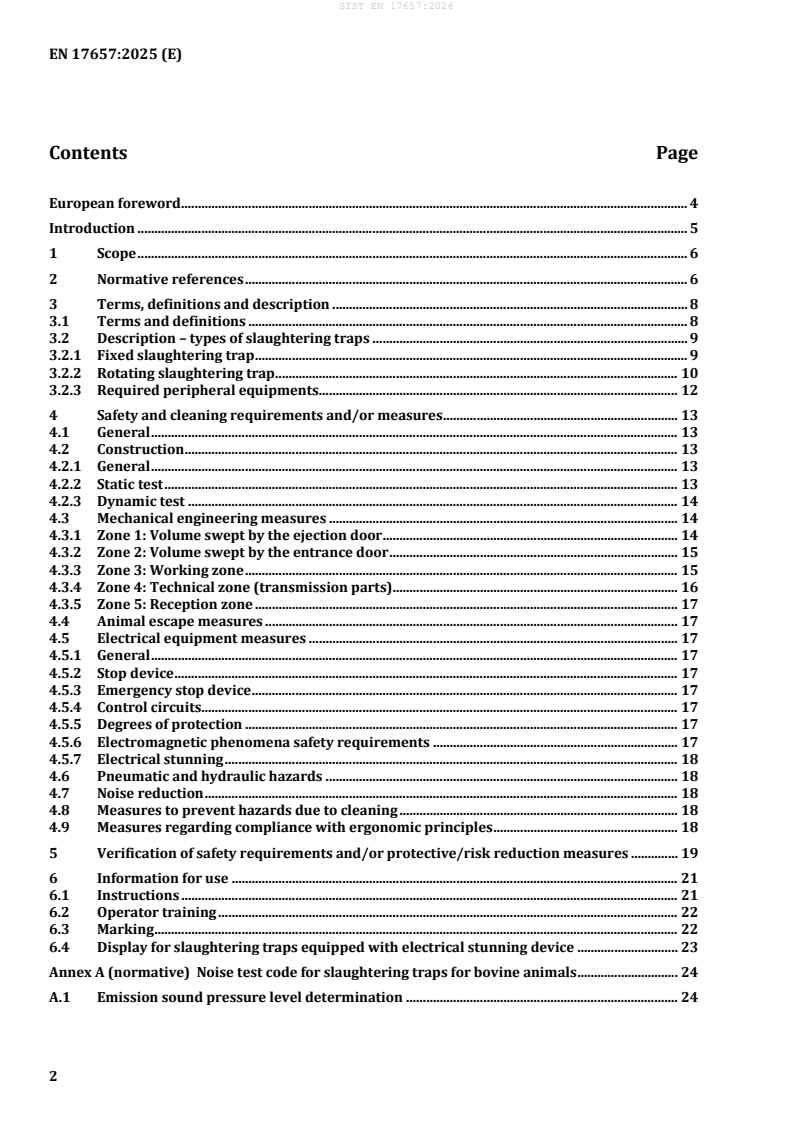
Contents Page
European foreword . 4
Introduction . 5
1 Scope . 6
2 Normative references . 6
3 Terms, definitions and description . 8
3.1 Terms and definitions . 8
3.2 Description – types of slaughtering traps . 9
3.2.1 Fixed slaughtering trap . 9
3.2.2 Rotating slaughtering trap . 10
3.2.3 Required peripheral equipments . 12
4 Safety and cleaning requirements and/or measures . 13
4.1 General . 13
4.2 Construction . 13
4.2.1 General . 13
4.2.2 Static test . 13
4.2.3 Dynamic test . 14
4.3 Mechanical engineering measures . 14
4.3.1 Zone 1: Volume swept by the ejection door . 14
4.3.2 Zone 2: Volume swept by the entrance door . 15
4.3.3 Zone 3: Working zone . 15
4.3.4 Zone 4: Technical zone (transmission parts) . 16
4.3.5 Zone 5: Reception zone . 17
4.4 Animal escape measures . 17
4.5 Electrical equipment measures . 17
4.5.1 General . 17
4.5.2 Stop device . 17
4.5.3 Emergency stop device . 17
4.5.4 Control circuits. 17
4.5.5 Degrees of protection . 17
4.5.6 Electromagnetic phenomena safety requirements . 17
4.5.7 Electrical stunning . 18
4.6 Pneumatic and hydraulic hazards . 18
4.7 Noise reduction . 18
4.8 Measures to prevent hazards due to cleaning . 18
4.9 Measures regarding compliance with ergonomic principles . 18
5 Verification of safety requirements and/or protective/risk reduction measures . 19
6 Information for use . 21
6.1 Instructions . 21
6.2 Operator training . 22
6.3 Marking . 22
6.4 Display for slaughtering traps equipped with electrical stunning device . 23
Annex A (normative) Noise test code for slaughtering traps for bovine animals . 24
A.1 Emission sound pressure level determination . 24
A.2 Sound power level determination . 24
A.3 Installation and mounting conditions . 24
A.4 Measurement uncertainty . 24
A.5 Operating conditions . 25
A.6 Measurement . 25
A.7 Information to be recorded . 25
A.8 Information to be reported . 26
A.9 Declaration and verification of the noise emission values . 26
Annex B (normative) Design principles to ensure cleanability . 27
B.1 General . 27
B.2 Definitions . 27
B.3 Materials . 27
B.4 Design . 27
B.4.1 General . 27
B.4.2 Surfaces . 27
B.4.3 Connection of internal surfaces . 27
B.4.4 Permanent joints . 27
B.4.5 Fasteners. 27
Annex C (normative) Measures regarding respect for animal protection at the time of
killing . 28
Annex D (informative) List of significant hazards . 29
Annex ZA (informative) Relationship between this European Standard and the essential
requirements of Directive2006/42/EC aimed to be covered . 34
Bibliography . 36
European foreword
This document (EN 17657:2025) has been prepared by Technical Committee CEN/TC 153 “Machinery
intended for use with foodstuffs and feed”, the secretariat of which is held by DIN.
This European Standard shall be given the status of a national standard, either by publication of an
identical text or by endorsement, at the latest by May 2026, and conflicting national standards shall be
withdrawn at the latest by May 2026.
Attention is drawn to the possibility that some of the elements of this document may be the subject of
patent rights. CEN shall not be held responsible for identifying any or all such patent rights.
This document has been prepared under a standardization request addressed to CEN by the European
Commission. The Standing Committee of the EFTA States subsequently approves these requests for its
Member States.
For the relationship with EU Legislation, see informative Annex ZA, which is an integral part of this
document.
Any feedback and questions on this document should be directed to the users’ national standards body.
A complete listing of these bodies can be found on the CEN website.
According to the CEN-CENELEC Internal Regulations, the national standards organisations of the
following countries are bound to implement this European Standard: Austria, Belgium, Bulgaria, Croatia,
Cyprus, Czech Republic, Denmark, Estonia, Finland, France, Germany, Greece, Hungary, Iceland, Ireland,
Italy, Latvia, Lithuania, Luxembourg, Malta, Netherlands, Norway, Poland, Portugal, Republic of North
Macedonia, Romania, Serbia, Slovakia, Slovenia, Spain, Sweden, Switzerland, Türkiye and the United
Kingdom.
Introduction
This document is a type-C standard as stated in EN ISO 12100.
This document is of relevance, in particular, for the following stakeholder groups representing the market
players with regard to machinery safety:
— machine manufacturers (small, medium and large enterprises);
— health and safety bodies (regulators, accident prevention organizations, market surveillance, etc.).
Others can be affected by the level of machinery safety achieved with the means of the document by the
above-mentioned stakeholder groups:
— machine users/employers (small, medium and large enterprises);
— machine users/employees (e.g. trade unions, organizations for people with special needs);
— service providers, e.g. for maintenance (small, medium and large enterprises);
— consumers (in the case of machinery intended for use by consumers).
The above-mentioned stakeholder groups have been given the possibility to participate at the drafting
process of this document.
The machinery concerned and the extent to which hazards, hazardous situations or hazardous events are
covered are indicated in the scope of this document.
When requirements of this type-C standard are different from those which are stated in type-A or type-B
standards, the requirements of this type-C standard take precedence over the requirements of the other
standards for machines that have been designed and built according to the requirements of this type-C
standard.
1 Scope
This document specifies the safety and cleaning requirements applicable to slaughtering traps intended
for bovine animals and equines such as defined in Clause 3.
These requirements take into account hazards that may arise from the transport, mounting, adjustment,
maintenance and use of these slaughtering traps.
NOTE This document takes into account the protection of animals at the time of killing.
This document is applicable to machinery or installations intended to facilitate the slaughter of bovine
animals or equidae that weigh between 100 kg and 1 200 kg. They are either rotating slaughtering traps
or fixed slaughtering traps.
This document does not apply to the following machinery and zones:
— “restrainers”: systems for holding and conveying via conveyor belts;
— slaughtering traps with a side door that opens under the weight of the animal alone;
— slaughtering traps where the only source of energy is manual effort.
This document does not cover the following essential requirements of Machinery Directive:
— safety and reliability of control systems;
— selection of control or operating modes;
— failure of the power supply;
— isolation of energy source.
The list of significant hazards is given in the informative Annex D.
Specific requirements relating to animal protection at the time of killing are also given in the normative
Annex C.
2 Normative references
The following documents are referred to in the text in such a way that some or all of their content
constitutes requirements of this document. For dated references, only the edition cited applies. For
undated references, the latest edition of the referenced document (including any amendments) applies.
EN 1672-2:2020, Food processing machinery - Basic concepts - Part 2: Hygiene and cleanability
requirements
EN 16165:2021, Determination of slip resistance of pedestrian surfaces - Methods of evaluation
EN 60204-1:2018, Safety of machinery - Electrical equipment of machines - Part 1: General requirements
EN 60529:1991, Degrees of protection provided by enclosures (IP Code)
EN ISO 3744:2010, Acoustics - Determination of sound power levels and sound energy levels of noise sources
using sound pressure - Engineering methods for an essentially free field over a reflecting plane (ISO
3744:2010)
EN ISO 3746:2010, Acoustics - Determination of sound power levels and sound energy levels of noise sources
using sound pressure - Survey method using an enveloping measurement surface over a reflecting plane (ISO
3746:2010)
EN ISO 4413:2010, Hydraulic fluid power - General rules and safety requirements for systems and their
components (ISO 4413:2010)
EN ISO 4414:2010, Pneumatic fluid power - General rules and safety requirements for systems and their
components (ISO 4414:2010)
EN ISO 4871:2009, Acoustics - Declaration and verification of noise emission values of machinery and
equipment (ISO 4871:1996)
EN ISO 11201:2010, Acoustics - Noise emitted by machinery and equipment - Determination of emission
sound pressure levels at a work station and at other specified positions in an essentially free field over a
reflecting plane with negligible environmental corrections (ISO 11201:2010)
EN ISO 11202:2010, Acoustics — Noise emitted by machinery and equipment — Determination of
emission sound pressure levels at a work station and at other specified positions applying approximate
environmental corrections (ISO 11202:2010)
EN ISO 11688-1:2009, Acoustics - Recommended practice for the design of low-noise machinery and
equipment - Part 1: Planning (ISO/TR 11688-1:1995)
EN ISO 12100:2010, Safety of machinery - General principles for design - Risk assessment and risk reduction
(ISO 12100:2010)
EN ISO 13849-1:2023, Safety of machinery - Safety-related parts of control systems - Part 1: General
principles for design (ISO 13849-1:2023)
EN ISO 13850:2015, Safety of machinery - Emergency stop function - Principles for design (ISO 13850:2015)
EN ISO 13851:2019, Safety of machinery - Two-hand control devices - Principles for design and selection
(ISO 13851:2019)
EN ISO 13857:2019, Safety of machinery - Safety distances to prevent hazard zones being reached by upper
and lower limbs (ISO 13857:2019)
EN ISO 14118:2018, Safety of machinery - Prevention of unexpected start-up (ISO 14118:2017)
EN ISO 14119:2025, Safety of machinery - Interlocking devices associated with guards - Principles for
design and selection (ISO 14119:2024)
EN ISO 14120:2015, Safety of machinery - Guards - General requirements for the design and construction
of fixed and movable guards (ISO 14120:2015)
EN ISO 14122-3:2016, Safety of machinery - Permanent means of access to machinery - Part 3: Stairs,
stepladders and guard-rails (ISO 14122-3:2016)
As impacted by EN ISO 11202:2010/A1:2021.
3 Terms, definitions and description
3.1 Terms and definitions
For the purposes of this document, the terms and definitions given in EN ISO 12100:2010, as well as the
following terms and definitions apply.
ISO and IEC maintain terminology databases for use in standardization at the following addresses:
— ISO Online browsing platform: available at https://www.iso.org/obp
— IEC Electropedia: available at https://www.electropedia.org
3.1.1
fixed slaughtering trap
non-rotating slaughtering trap to fix the animal in a standing position for stunning
3.1.2
rotating slaughtering trap
slaughtering trap for fixing and rotating the animal in a chosen slaughtering position
3.1.3
bleeding
action of emptying the animal of its blood in order to cause its death
3.1.4
interlocking device
mechanical, electrical or other type of device, the purpose of which is to prevent the operation of
hazardous machine functions under specified conditions (generally as long as a guard is not closed)
[SOURCE: EN ISO 12100:2010, 3.28.1]
3.1.5
interlocking guard with guard locking
guard associated with an interlocking device and a guard locking device so that, together with the control
system of the machine, the following functions are performed:
a) the hazardous machine functions “covered” by the guard cannot operate until the guard is closed and
locked;
b) the guard remains closed and locked until the risk due to the hazardous machine functions “covered”
by the guard has disappeared;
c) when the guard is closed and locked, the hazardous machine functions “covered” by the guard can
operate. The closure and locking of the guard do not by themselves start the hazardous machine
functions.
Note 1 to entry: EN ISO 14119:2025 gives detailed provisions.
[SOURCE: EN ISO 12100:2010, 3.27.5]
3.1.6
slaughtering
killing of animals intended for human consumption
[SOURCE: definition from Regulation (EC) no. 1099/2009]
3.1.7
stunning
intentionally induced process which causes loss of consciousness and sensibility without pain, including
any process resulting in instantaneous death
[SOURCE: definition from Regulation (EC) no. 1099/2009]
Note 1 to entry: This process may be of mechanical or electrical origin.
3.1.8
restraint
application to an animal of any procedure designed to restrict its movements sparing any avoidable pain,
fear or agitation in order to facilitate effective stunning and killing
[SOURCE: definition from Regulation (EC) no. 1099/2009]
3.1.9
anti-escape device
device preventing the animal from rearing up or escaping over the slaughtering trap
3.1.10
entrance door
device through which the animal gets into the slaughtering trap by itself
3.1.11
ejection door
device through which the animal leaves the slaughtering trap after actions
3.1.12
head fixation
application to the head of an animal of any device to restrict its movements
3.2 Description – types of slaughtering traps
3.2.1 Fixed slaughtering trap
Fixed slaughtering traps shall be equipped with devices that restrict the lateral and vertical movements
of the head of the animal. Other restricting apparatus can be added by design to prevent the animal from
moving.
An example of configuration of a fixed slaughtering trap is shown in Figure 1.
a) Rear view b) Profile view
c) Top views
Key
Elements: Other constituent bodies:
1 ejection door a) side wall
2 entrance door b) front panel and device that restricts the
lateral and vertical movements
3 working zone (bringing the animal, holding and knocking out)
c) head fixation inside or outside
31 working area (slinging and removing)
d) animal arrival corridor
32 area of operation (occasional) for bleeding the animal
e) device (neck-frame) that restricts the
5 animal reception zone
vertical movements of the head
Figure 1 — Example of fixed slaughtering trap
For a fixed slaughtering trap, ejection shall be carried out by a guillotine-type side door. Sloping ground
or a tilting floor shall facilitate the removal of the stunned animal out of the slaughtering trap.
The ejection of the animal can alternatively also be supported by a movable element located in the side
wall. The movement of this element shall be controlled by the operator.
3.2.2 Rotating slaughtering trap
The rotating slaughtering trap shall allow the blocking, turning and possible orientation of the animal by
electrical, hydraulic and/or pneumatic means.
Restraint shall be carried out at the level of the flanks, rear and head of the animal by soft devices using
pneumatic or hydraulic cylinders, or manual mechanical systems.
During ejection of the stunned animal the following operations shall be performed:
a) opening of the ejection door;
b) extraction of the stunned animal:
— pushing carried out by the holding panel;
— tilting of the floor;
— combination of pushing and tilting of the floor; or
— any other device favouring fast extraction.
An example of configuration of a rotating slaughtering trap is shown in Figure 2.
a) Orientation b) Turning c) Profile view
d) Top views with orientation
Key
Elements: Other constituent bodies:
1 ejection door a) side wall
2 entrance door b) front panel and device that restricts the
lateral and vertical movements
3 working zone (bringing the animal, holding and knocking out)
c) pivoting axis (orientation)
31 working area (slinging and removing)
d) animal arrival corridor
32 area of operation (occasional) for bleeding the animal
4 technical zone (including transmission parts)
5 animal reception zone
Figure 2 — Example of rotating slaughtering trap
3.2.3 Required peripheral equipments
Peripheral equipments such as stunning equipments (electrical, mechanical, pneumatic etc.) are
necessary to fulfil the killing of the animal. They shall be located in zones 3, 31 and/or 32.
4 Safety and cleaning requirements and/or measures
4.1 General
The slaughtering trap shall meet the safety requirements and/or protection measures of this Clause. In
addition, it shall be designed in accordance with the safety principles of EN ISO 12100:2010 for the
relevant but not significant hazards that are not covered in this document.
The slaughtering trap shall be equipped with means for lifting and handling (e.g. opening for the forklift,
rings for hooks).
No movement of movable parts of the machine shall be caused by the animal.
A braking or locking device shall be provided, e.g. if the systems for controlling and distributing movable
parts fail.
Guillotine door runners shall be protected such that fingers cannot be inserted between the runners and
the door (or the door rollers) from the work station and from normal traffic zones. The maximum gaps
between the door and the U-shape runner shall comply with EN ISO 13857:2019.
Floors shall be non-slip with a dynamic friction coefficient > 0,3 in dry conditions, measured according to
EN 16165:2021.
4.2 Construction
4.2.1 General
All of the constituent elements shall be dimensioned to take into account the operating speeds and to
withstand the force and the maximum weight of the animal, as well as its uncontrolled movements.
4.2.2 Static test
This test is applicable to fixed and rotary slaughtering traps.
This test consists of loading the floor of the slaughtering trap with a load of the maximum animal weight
for which the trap is designed multiplied by a coefficient of 1,5 (e.g. if animal weight is 1 200 kg, the test
weight is 1 800 kg).
This test shall be performed for one minute and the floor shall not show permanent deformation > 3 mm
under each load support.
This load is supported by 4 discs of diameter 150 mm (see Figure 3).
Figure 3 — Example of rotating slaughtering trap
4.2.3 Dynamic test
This test is applicable to rotary slaughtering traps.
This test consists of loading the bottom plate of the slaughtering trap with a load of the maximum animal
weight for which the trap is designed multiplied by a coefficient of 1,5 (e.g. if animal weight is 1 200 kg,
the test weight is 1 800 kg).
This load is supported by 4 discs of diameter 150 mm (see Figure 3) and shall face a minimum of 80 % of
the surface of the side panel.
The load shall be fixed into the slaughtering trap so that it will not slip away during the test using of the
trap contention system and any additional fastening apparatus.
The slaughtering trap shall be rotated at working speed to a 90° position and stand for 30 s, then the trap
is rotated to a 180° position and stand for 30 s, then back to initial position.
The side panel shall not show permanent deformation > 3 mm after the test.
4.3 Mechanical engineering measures
4.3.1 Zone 1: Volume swept by the ejection door
The devices for controlling the door shall be placed outside of the zone swept by the door and the animal
during its movement.
The ejection door of the rotating slaughtering traps shall be opened and controlled by a hold-to-run
control according to EN ISO 13851:2019. The sustained-action control shall be placed such that the
operator does not have access to the hazard zone and such that he has a direct clear view of zones 1, 5
and 31 or indirect view by use of appropriate devices (e.g. mirror, camera etc.).
The horizontal-axis doors of rotating slaughtering traps shall be equipped with an interlocking device
combined with a turning system such that they can only be opened in the ejection position defined by the
manufacturer and that rotation is only possible once the doors are closed.
For maintenance and/or cleaning operations, an additional device (e.g. a pin and pinning holes) shall
ensure that the door is held and locked in the open position.
4.3.2 Zone 2: Volume swept by the entrance door
Hold-to-run control to close the door shall be placed such that the operator has a clear view of the
entrance door.
A device (e.g.: a brake) shall ensure that the entrance door is locked in the open position for maintenance
and/or cleaning operations.
4.3.3 Zone 3: Working zone
4.3.3.1 General
On the side opposite the slaughtering trap, the operator station shall be equipped with a guard-rail in
accordance with EN ISO 14122-3:2016 or a fixed obstacle preventing any fall.
A device that restricts lateral and vertical movements of the head of the animal (e.g. chinstrap) shall be
provided, in order to protect the operator from being hit by the head of the animal; it shall be combined
with a device that prevents the animal from moving backwards to free itself.
A specific support shall be located near the working zone to hold an emergency stunning device.
Risks related to mechanical movements and animal movements shall be taken into account when
designing the slaughtering trap. Holding systems or systems that restrict movements shall be provided
to ensure the safety of the operator.
To avoid risks of animal escape, an anti-escape device or equivalent shall be installed.
According to EN ISO 13857:2019, Table 3, the control panel(s) of the box shall be placed at a
distance ≥ 850 mm from any unprotected moving parts, e.g. in zone 3. From each control panel, the
operator shall have a completely unobstructed view of the environment of the box and the other work
stations.
The control devices shall be designed to avoid any unintentional activation, according to
EN ISO 14118:2018, Clause 6.
Any slaughtering trap turning and orientation movements, as well as animal holding and ejection
movements, shall be carried out by controls requiring sustained action.
The covering of the work platforms and steps of the access stairs of the slaughtering trap shall be non-
slip.
The access stairs, if provided, shall comply with EN ISO 14122-3:2016.
In the case of two control stations (zones 3 and 31), action on one shall prohibit use of the other.
4.3.3.2 Specific requirements for fixed slaughtering traps
The walls of the fixed box (fixed walls and adjustable walls ensuring immobilisation) shall have the
following height (h) in relation to the plane on which the animal stands (see example in Figure 4):
— h ≥ 1 500 mm for adult bovine animals and equidae;
— h ≥ 1 100 mm for calves.
Dimensions in millimetres
Key
height of the wall of the fixed slaughtering trap
h
Figure 4 — Example of height of a wall of a fixed slaughtering trap
For fixed boxes with platform, the height (a) between the floor of the platform and the highest part of the
side wall of the box shall be at least 1 100 mm (see Figure 5).
Key
a height between the platform floor and the top of the fixed slaughtering trap
1 example of guard-rail
3 work station and traffic
Figure 5 — Safety height on a fixed slaughtering trap
4.3.3.3 Specific requirements for rotating slaughtering traps
By design, rotating slaughtering traps shall exclude the risks of falling on the slaughtering trap in
movement and/or in the spaces generated by these movements.
4.3.4 Zone 4: Technical zone (transmission parts)
The technical zone where the transmission parts are located shall have an emergency stop device.
Access to the hazard zones of transmission parts shall be avoided by installing either fixed guards or
movable interlocking guards with guard locking in accordance with EN ISO 14119:2025 and
EN ISO 14120:2015.
4.3.5 Zone 5: Reception zone
In order to protect by distance any operator from the movements of the slaughtering trap and the falling
of the stunned animal, the reception area shall be clearly marked on the floor and/or be separated by a
guard.
For rotating slaughtering traps and orientable slaughtering traps the rollers shall be equipped with foot
guards and finger guards.
4.4 Animal escape measures
For all types of fixed or rotating slaughtering traps, it shall not be possible to have the entrance door with
runner (guillotine-type door), located at the end of the entrance corridor, and the exit door in open
position at the same time.
A guard shall be installed in the upper section so as to contain the rearing up of the animal, for example
longitudinal security bars or a plate.
If there is an opening in the front panel, this shall not permit animal escape, or the user shall be able to
dimension it to the size of the animal.
By design, ejection door shall be operated only when entrance door is closed and vice versa.
4.5 Electrical equipment measures
4.5.1 General
Electrical equipment shall be in accordance with EN 60204-1:2018.
Additional requirements concerning electrical equipment are indicated in 4.5.2 to 4.5.5.
4.5.2 Stop device
The stop device shall comply with category 0 according to EN 60204-1:2018, 9.2.2.
4.5.3 Emergency stop device
An emergency stop device in accordance with EN ISO 13850:2015 shall be provided in order to be
activated from any location in the work area on the box side (zone 3). An emergency stop device in
accordance with EN ISO 13850:2015 shall also be provided in the animal reception area (zone 31).
The relevant control circuits shall meet at least a performance level “c” as specified in
EN ISO 13849-1:2023. The stopping time after activation of the emergency stop control device shall
be ≤ 1 s.
4.5.4 Control circuits
Control circuits shall be powered with very low voltage (24 V or 48 V).
4.5.5 Degrees of protection
Control devices and live parts shall have protection index:
— IPX6 if the slaughtering trap is cleaned using a high-pressure device; or
— IPX5 if jet-washed, according to EN 60529:1991.
4.5.6 Electromagnetic phenomena safety requirements
The slaughtering trap manufacturer shall design, install and wire the equipment and subassemblies
taking into account the recommendations of the suppliers of these subassemblies.
4.5.7 Electrical stunning
During the presence of voltage between electrodes, a visual signal shall inform the operators present in
zones 3, 31 and 32.
During the design stage, constructive provisions shall be taken to prevent the operator from being able
to be in contact with a live electrode, except if it is earthed. In addition, all provisions shall be
implemented to prevent leakage currents.
If access to the zone containing the electrodes is necessary, an interlocking device shall be installed on
the door providing access to the zone in order to make sure that the electrodes are not live when the door
is opened. It shall only be possible to reset the stunning device from outside of the zone containing the
electrodes. The stunning device reset control shall be visible from the zone containing the electrodes.
Similarly, the zone containing the electrodes shall be visible from the zone for the stunning device reset
control.
4.6 Pneumatic and hydraulic hazards
Pneumatic and hydraulic equipment shall comply with:
— EN ISO 12100:2010, 6.2.10;
— EN ISO 4413:2010, for hydraulic equipment;
— EN ISO 4414:2010, for pneumatic equipment.
4.7 Noise reduction
When designing machines covered by this standard, information on technical measures to control noise
at source given in EN ISO 11688-1:2009 shall be taken into account.
The main cause for the generation of airborne noise on the machines are the blowing nozzles.
The success of the applied noise reduction measures is assessed on the basis of the actual noise emission
values determined according to Annex A in relation to other machines of the same family.
4.8 Measures to prevent hazards due to cleaning
Bovine animals and equidae for which the traps are intended for are not food yet. In this case, hygiene
aspect only deals with cleaning requirements in the following subclauses.
Because the traps are soiled during use, they shall be cleaned according to information given in 7.1 b).
Cleanability shall be considered in the design and construction by assuming that the whole trap
represents a splash area (see Annex B).
Surfaces shall be designed and manufactured to prevent liquids from being retained (e.g. self-draining,
surface condition) so that the residual liquid can be removed by other means.
Chemical (detergent) and physical (high pressure water) risks are prevented according to the prevention
given in the instruction handbook (see 7.1 b)).
4.9 Measures regarding compliance with ergonomic principles
Unfavourable postures shall be avoided during the intended use of the machine and during maintenance,
cleaning, and other operations.
Suitably positioned lifting devices and/or transport carriages shall be provided for installation, removal
and transport of any part of the slaughtering traps weighing more than 25 kg.
If the mass of any part to be moved to fulfil the task exceeds 25 kg, a handling device shall be fitted.
If pushing and pulling is required, excessive effort shall be avoided.
5 Verification of safety requirements and/or protective/risk reduction
measures
This clause contains the verifications of compliance with the safety and health requirements of the
standard that shall be carried out in accordance with Table 1.
If partial dismantling proves necessary for certain tests, it shall not invalidate the result of the check.
Table 1 shows, for each identified parameter, whether the checks concern each box of the same series
(individual verification / I.V) or only one box (type verification / T.V), as well as whether it is a visual
inspection (V), by tests (T) or by measurement (M).
Table 1
Test method /
Subclause Parameters
Verification
4.2.2 Static test T.V
4.2.3 Dynamic test T.V
Ejection door control is placed outside of the zone swept by the door I.V / V
and the animal during its fall.
Door control is placed such that the operator has no access to the T.V / T
hazard zone and has a clear view of zones 1, 5 and 31.
4.3.1 Zone 1
Ejection door shows no permanent deformation. I.V / V
Rotating slaughtering traps: ejection door can only be opened in T.V / T
ejection position.
Hold to run control T.V / T
Closing of the entrance door is controlled by a hold to run control. T.V / T
Control of the entrance door movement is located to give the I.V / V
operator a clear view over it.
4.3.2 Zone 2
Entrance door shows no permanent deformation. I.V / V
Mechanical device for locking the door in open position is present for T.V / V
the cleaning and maintenance operations.
Compliance of the work station in relation to Figure 3 and Figure 4 as I.V / M
well as with EN ISO 14122-3:2016.
Presence of a system to restrict the movements of the head and a T.V / V
device to prevent the animal from moving backwards to get free by
itself.
Slaughtering trap controls are located in accordance with I.V / M
EN ISO 13857:2019.
4.3.3 Zone 3
Slaughtering trap controls are located to give the operator a clear I.V / V
view of the slaughtering trap environment and of the other work
stations.
Rotating slaughtering traps: orientation and rotation is a hold-to-run T.V / T
type control
Upper surfaces of the work platforms and steps of the access stairs T.V
are non-slip.
Test method /
Subclause Parameters
Verification
Category 0 emergency stops (in accordance with I.V / V
EN ISO 13850:2015) are accessible at work stations 3 and 31.
In case of doubling of the work station (zones 3 and 31), action on I.V / T
one shall prohibit use of the other.
The technical zone where the transmission parts are located is only T.V
accessible by the maintenance service and is fitted with an
emergency stop.
4.3.4 Zone 4
Transmission parts are protected with fixed or movable guards and T.V
locked.
Animal reception zone is clearly identified. I.V / V
4.3.5 Zone 5
Rotating slaughtering traps: rollers are equipped with foot guards T.V
and finger guards.
Ejection door and entrance door cannot be opened at the same time. T.V / T
Rotating slaughtering traps: rotation and orientation are only T.V / T
possible when the ejection doo
...