

EN 15895:2011+A1:2018
(Main + Amendment)Cartridge operated hand-held tools - Safety requirements - Fixing and hard marking tools
- Abstract
This European standard covers safety requirements for cartridge operated fixing and hard marking tools which operate with an intermediate member (piston).
This European standard deals with all significant hazards, hazardous situations and events relevant to cartridge operated fixing and hard marking tools, when they are used as intended and under conditions of misuse which are reasonably foreseeable (see Clause 4). It deals with the significant hazards in the different operating modes and intervention procedures as referred to in !EN ISO 12100:2010, 5.4, 5.5, 5.6".
Although the safe use of cartridge operated tools depends to an important extent on the use of appropriate cartridges and fasteners, this standard is not formulating requirements for the cartridges and fasteners to be used with the tools (see Clause 7).
This European Standard applies to tools designed for use with cartridges with casings made of metal or plastic and with solid propellant and containing a minor quantity of primer with a composition different from that of the main propellant.
The fixing tools in the scope are those intended for use with fasteners made from metal.
NOTE Information about cartridges can be found in the publication of the Permanent International Commission for the Proof of Small Arms (C.I.P.).
This European standard is not applicable to cartridge operated fixing and hard marking tools which are manufactured before the date of its publication as EN.
- Status
- Withdrawn
- Publication Date
- 22-May-2018
- Withdrawal Date
- 06-Oct-2026
- Technical Committee
- CEN/TC 213 - Cartridge operated hand-held tools - Safety
- Drafting Committee
- CEN/TC 213/WG 1 - Cartridge Operated Fixing and Hard Marking tools
- Current Stage
- 9960 - Withdrawal effective - Withdrawal
- Start Date
- 25-Jun-2025
- Completion Date
- 07-Oct-2026
- Directive
- 2006/42/EC - Directive 2006/42/EC of the European Parliament and of the Council of 17 May 2006 on machinery, and amending Directive 95/16/EC (recast)OJ Ref: L, L 75 OJ Date: 13-Mar-2019

Relations
- Effective Date
- 18-Jan-2023
- Effective Date
- 10-May-2017
- Replaced By
EN 15895:2025 - Powder actuated hand-held fixing and hard marking tools - Safety requirements - Effective Date
- 17-Nov-2021
- Effective Date
- 25-Aug-2026
- Effective Date
- 09-Feb-2026
- Effective Date
- 28-Jan-2026
- Effective Date
- 28-Jan-2026
- Effective Date
- 28-Jan-2026
- Effective Date
- 28-Jan-2026
- Effective Date
- 28-Jan-2026
- Effective Date
- 28-Jan-2026
- Effective Date
- 28-Jan-2026
- Effective Date
- 28-Jan-2026
Get Certified
Connect with accredited certification bodies for this standard

DVS-ZERT GmbH
German welding certification society.
CARES (UK Certification Authority for Reinforcing Steels)
UK certification for reinforcing steels and construction.
EWF/IIW (European/International Welding Federation)
International welding personnel certification.
Sponsored listings
Frequently Asked Questions
EN 15895:2011+A1:2018 is a standard published by the European Committee for Standardization (CEN). Its full title is "Cartridge operated hand-held tools - Safety requirements - Fixing and hard marking tools". This standard covers: This European standard covers safety requirements for cartridge operated fixing and hard marking tools which operate with an intermediate member (piston). This European standard deals with all significant hazards, hazardous situations and events relevant to cartridge operated fixing and hard marking tools, when they are used as intended and under conditions of misuse which are reasonably foreseeable (see Clause 4). It deals with the significant hazards in the different operating modes and intervention procedures as referred to in !EN ISO 12100:2010, 5.4, 5.5, 5.6". Although the safe use of cartridge operated tools depends to an important extent on the use of appropriate cartridges and fasteners, this standard is not formulating requirements for the cartridges and fasteners to be used with the tools (see Clause 7). This European Standard applies to tools designed for use with cartridges with casings made of metal or plastic and with solid propellant and containing a minor quantity of primer with a composition different from that of the main propellant. The fixing tools in the scope are those intended for use with fasteners made from metal. NOTE Information about cartridges can be found in the publication of the Permanent International Commission for the Proof of Small Arms (C.I.P.). This European standard is not applicable to cartridge operated fixing and hard marking tools which are manufactured before the date of its publication as EN.
This European standard covers safety requirements for cartridge operated fixing and hard marking tools which operate with an intermediate member (piston). This European standard deals with all significant hazards, hazardous situations and events relevant to cartridge operated fixing and hard marking tools, when they are used as intended and under conditions of misuse which are reasonably foreseeable (see Clause 4). It deals with the significant hazards in the different operating modes and intervention procedures as referred to in !EN ISO 12100:2010, 5.4, 5.5, 5.6". Although the safe use of cartridge operated tools depends to an important extent on the use of appropriate cartridges and fasteners, this standard is not formulating requirements for the cartridges and fasteners to be used with the tools (see Clause 7). This European Standard applies to tools designed for use with cartridges with casings made of metal or plastic and with solid propellant and containing a minor quantity of primer with a composition different from that of the main propellant. The fixing tools in the scope are those intended for use with fasteners made from metal. NOTE Information about cartridges can be found in the publication of the Permanent International Commission for the Proof of Small Arms (C.I.P.). This European standard is not applicable to cartridge operated fixing and hard marking tools which are manufactured before the date of its publication as EN.
EN 15895:2011+A1:2018 is classified under the following ICS (International Classification for Standards) categories: 25.140.99 - Other hand-held tools. The ICS classification helps identify the subject area and facilitates finding related standards.
EN 15895:2011+A1:2018 has the following relationships with other standards: It is inter standard links to EN 15895:2011/FprA1, EN 15895:2011, EN 15895:2025, ISO 2768-1:1989, EN 61310-1:2008, EN ISO 4871:2009, EN ISO 11201:2010, EN ISO 12100:2010, EN ISO 11688-1:2009, EN ISO 3744:2010, EN ISO 13732-1:2008, EN 12631:1999, EN 614-1:2006+A1:2009. Understanding these relationships helps ensure you are using the most current and applicable version of the standard.
EN 15895:2011+A1:2018 is associated with the following European legislation: EU Directives/Regulations: 2006/42/EC; Standardization Mandates: M/396. When a standard is cited in the Official Journal of the European Union, products manufactured in conformity with it benefit from a presumption of conformity with the essential requirements of the corresponding EU directive or regulation.
EN 15895:2011+A1:2018 is available in PDF format for immediate download after purchase. The document can be added to your cart and obtained through the secure checkout process. Digital delivery ensures instant access to the complete standard document.
Standards Content (Sample)
2003-01.Slovenski inštitut za standardizacijo. Razmnoževanje celote ali delov tega standarda ni dovoljeno.Kartuschenbetriebene handgehaltene Werkzeuge - Sicherheit - Befestigungs- und MarkierwerkzeugeOutils portatifs à charge propulsive - Exigences de sécurité - Outils de scellement et de marquageCartridge operated hand-held tools - Safety requirements - Fixing and hard marking tools25.140.99Other hand-held toolsICS:Ta slovenski standard je istoveten z:EN 15895:2011+A1:2018SIST EN 15895:2011+A1:2018en,fr,de01-julij-2018SIST EN 15895:2011+A1:2018SLOVENSKI
STANDARD
EUROPEAN STANDARD NORME EUROPÉENNE EUROPÄISCHE NORM
EN 15895:2011+A1
May
t r s z ICS
t wä s v rä { { Supersedes EN
s w z { wã t r s sEnglish Version
Cartridge operated handæheld tools æ Safety requirements æFixing and hard marking tools Outils portatifs à charge propulsive æ Exigences de sécurité æ Outils de scellement et de marquage
Kartuschenbetriebene handgehaltene Werkzeuge æ Sicherheit æ Befestigungsæ und Markierwerkzeuge This European Standard was approved by CEN on
s v April
t r s s and includes Amendment
s approved by CEN on
t s May
t r s yä
egulations which stipulate the conditions for giving this European Standard the status of a national standard without any alterationä Upætoædate lists and bibliographical references concerning such national standards may be obtained on application to the CENæCENELEC Management Centre or to any CEN memberä
translation under the responsibility of a CEN member into its own language and notified to the CENæCENELEC Management Centre has the same status as the official versionsä
CEN members are the national standards bodies of Austriaá Belgiumá Bulgariaá Croatiaá Cyprusá Czech Republicá Denmarká Estoniaá Finlandá Former Yugoslav Republic of Macedoniaá Franceá Germanyá Greeceá Hungaryá Icelandá Irelandá Italyá Latviaá Lithuaniaá Luxembourgá Maltaá Netherlandsá Norwayá Polandá Portugalá Romaniaá Serbiaá Slovakiaá Sloveniaá Spainá Swedená Switzerlandá Turkey and United Kingdomä
EUROPEAN COMMITTEE FOR STANDARDIZATION COMITÉ EUROPÉEN DE NORMALISATION EUROPÄISCHES KOMITEE FÜR NORMUNG
CEN-CENELEC Management Centre:
Rue de la Science 23,
B-1040 Brussels
t r s z CEN All rights of exploitation in any form and by any means reserved worldwide for CEN national Membersä Refä Noä EN
s w z { wã t r s s ªA sã t r s z ESIST EN 15895:2011+A1:2018
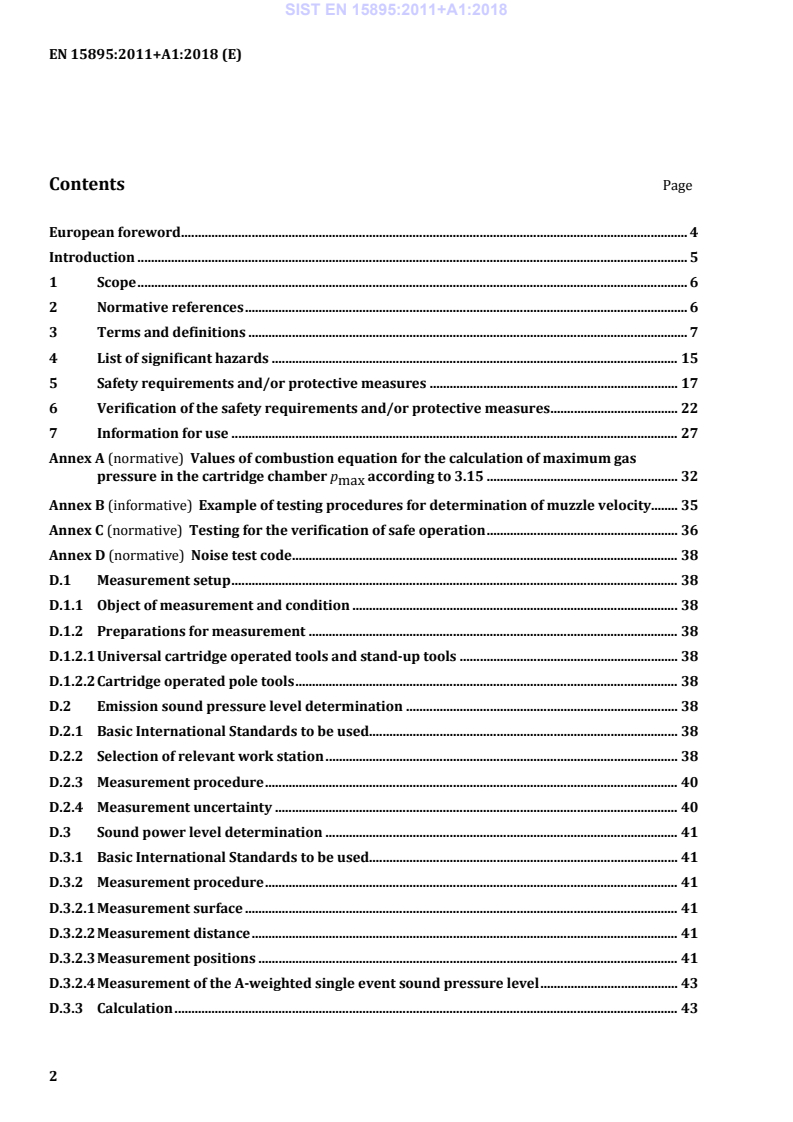
Values of combustion equation for the calculation of maximum gas pressure in the cartridge chamber pmax according to 3.15 . 32 Annex B (informative)
Example of testing procedures for determination of muzzle velocity. 35 Annex C (normative)
Testing for the verification of safe operation . 36 Annex D (normative)
Noise test code . 38 D.1 Measurement setup . 38 D.1.1 Object of measurement and condition . 38 D.1.2 Preparations for measurement . 38 D.1.2.1 Universal cartridge operated tools and stand-up tools . 38 D.1.2.2 Cartridge operated pole tools . 38 D.2 Emission sound pressure level determination . 38 D.2.1 Basic International Standards to be used. 38 D.2.2 Selection of relevant work station . 38 D.2.3 Measurement procedure . 40 D.2.4 Measurement uncertainty . 40 D.3 Sound power level determination . 41 D.3.1 Basic International Standards to be used. 41 D.3.2 Measurement procedure . 41 D.3.2.1 Measurement surface . 41 D.3.2.2 Measurement distance . 41 D.3.2.3 Measurement positions . 41 D.3.2.4 Measurement of the A-weighted single event sound pressure level . 43 D.3.3 Calculation . 43 SIST EN 15895:2011+A1:2018
Information on the ergonomic design of the handle . 47 Annex F (normative)
!Essential safety dimensions" . 48 Annex ZA (informative)
Relationship between this European Standard and the Essential Requirements of EU Directive 2006/42/EC . 49 Bibliography . 50
Key 1 Total volume Vtot (tool for single cartridges) 3.11 minimum volume of the cartridge chamber VET smallest technically possible cartridge chamber for a given calibre NOTE VET is a constant value for each calibre laid down in Table A.1 of Annex A.
Key 1 Minimum volume of the cartridge chamber VET (tool for single cartridges) 3.12 minimum operational volume of the combustion chamber Va volume consisting of the volume of the combustion chamber with the piston in its extreme top position and the open volume in the piston head NOTE Va is a design-specific value and is calculated as the difference between the design-specific volume Vtot and the calibre-specific volume VET: SIST EN 15895:2011+A1:2018
Key 1 Minimum operational volume of the combustion chamber Va (tool for single cartridges) 3.13 reduced volume of the cartridge chamber *hV volume of the minimum size cartridge chamber VET minus the volumes of the cartridge casing and the propellant NOTE *hV is a constant value for a given calibre laid down in Table A.1 of Annex A.
Key 1 Reduced volume of the cartridge chamber *hV (tool for single cartridges) 3.14 effective combustion volume Veff effective (total) volume of all connecting voids between the cartridge and the piston before the firing of the cartridge; calculated by Veff = *hV + Va = *hV + Vtot – VET SIST EN 15895:2011+A1:2018
Key 1 Effective combustion volume Veff (tool for single cartridges)
Key 1 Effective combustion volume Veff (tool for collated cartridges) 2 Va collated cartridges 3 Boundary line of VET 4 Collation strip 5 Separation line between cartridge chamber and collation strip NOTE 1 Veff is the volume which in combination with the selected cartridge strength effectively determines the gas pressure generated in a tool. NOTE 2 Veff is a design-specific value. 3.15 maximum gas pressure pmax maximum value of combustion pressure in the cartridge chamber depending on the calibre and the effective volume of the combustion chamber, calculated according to the combustion equation pmax = a „ bVeff or, with Veff = *hV + Va as the effective combustion volume SIST EN 15895:2011+A1:2018
Key 1 Reduced proof volume of the combustion chamber VE 3.19 adapted reduced proof volume of the combustion chamber VE, adapted volume of the combustion chamber reduced to an even lower value than the theoretical value VE to account for a factually available cartridge weaker than X = 0,85 in overpressure testing. VE, adapted is dependent on the relative cartridge strength X and is calculated using the equation *h1a1adaptedE,185,03,185,03,1VXVXVbb⋅−⋅+⋅⋅==This=equation=is=valid=for=′artridges=with=a=relative=strength=of=X below 0,85 as long as VE, adapted does not drop below 50 % of VE calculated according to 3.18. 3.20 reduced system testing volume of the combustion chamber VS reduced volume of the combustion chamber for system testing with an overpressure of 1,15 times of the maximum gas pressure pmax of each tested cartridge strength calculated using the equation *h1a1S115,115,1VVVbb⋅−+⋅===SIST EN 15895:2011+A1:2018
Key Va Minimum operational volume VS Reduced system testing volume VE Reduced proof volume 3.21 A-weighted emission sound pressure level LpA ten times the logarithm to the base 10 of the ratio of the square of the emission sound pressure, p, to the square of a reference value, p0, expressed in decibels dBlg10202AppLp==where=the=referen′e=value,=p0, is 20 µPa 3.22 A-weighted single event emission sound pressure level in dB LEA A-weighted and time-integrated emission sound pressure level of an isolated single sound event of specified duration T (or specified measurement time interval T = t2 – t1 covering the single event), normalized to reference time interval T0 = 1 s; given by the following equation: dBd)(1lg1002020A=∫TEtptpTL NOTE The reference sound pressure is p0 = 20 µPa. 3.23 A-weighted sound power level LWA ten times the logarithm to the base 10 of the ratio of the sound power of a source, P, to a reference value, P0, expressed in decibels SIST EN 15895:2011+A1:2018
! Tolerances ISO 2768:— mk Rt: surface roughness" Figure 1 — Test element If the test element needs additional guidance in the barrel, this shall be ensured by slipping two washers made of plastic (or of AlMg alloy material of 0,3 mm thickness) onto the front and rear end of the test element. The washers shall have a bore diameter of 5,5 mm and an outside diameter adapted to the barrel bore diameter. The mass of the test element shall be (8 ± 0,3) g. By means of a suitable rod the test element shall be pushed into the fastener guide towards the rear of the cartridge operated fixing tool so as to intimately contact the face of the piston. By this, it is ensured that the test element is accelerated at the same rate as the piston and reaches the same velocity as the piston at the muzzle. The cartridge operated fixing tool loaded with the test element shall then be pressed against a plate of thin sheet metal and fired such as to enforce the exiting of the test element from the muzzle and the penetration of the sheet metal by the test element. By this, the test element is simulating the free flight of a fastener which might occur unintentionally in a similar situation. To determine the muzzle velocity of the cartridge operated fixing tool, one of the following shall be measured: — the velocity of the piston attained close to the muzzle, i.e. immediately before the piston impacts the piston stopping device, — the velocity of the test element immediately after leaving the muzzle in its forced free flight. !For the determination of either velocity, a suitable measuring method and measuring equipment shall be used." Measuring
...