

EN 15895:2011
(Main)Cartridge operated hand-held tools - Safety requirements - Fixing and hard marking tools
- Abstract
This European standard covers safety requirements for cartridge operated fixing and hard marking tools which operate with an intermediate member (piston).
This European standard deals with all significant hazards, hazardous situations and events relevant to cartridge operated fixing and hard marking tools, when they are used as intended and under conditions of misuse which are reasonably foreseeable (see Clause 4). It deals with the significant hazards in the different operating modes and intervention procedures as referred to in EN ISO 12100-1:2003, 5.3.
Although the safe use of cartridge operated tools depends to an important extent on the use of appropriate cartridges and fasteners, this standard is not formulating requirements for the cartridges and fasteners to be used with the tools (see Clause 7).
This European Standard applies to tools designed for use with cartridges with casings made of metal or plastic and with solid propellant and containing a minor quantity of primer with a composition different from that of the main propellant.
The fixing tools in the scope are those intended for use with fasteners made from metal.
NOTE Information about cartridges can be found in the publication of the Permanent International Commission for the Proof of Small Arms (C.I.P.).
This European standard is not applicable to cartridge operated fixing and hard marking tools which are manufactured before the date of its publication as EN.
- Status
- Withdrawn
- Publication Date
- 17-May-2011
- Withdrawal Date
- 06-Oct-2026
- Technical Committee
- CEN/TC 213 - Cartridge operated hand-held tools - Safety
- Drafting Committee
- CEN/TC 213/WG 1 - Cartridge Operated Fixing and Hard Marking tools
- Current Stage
- 9960 - Withdrawal effective - Withdrawal
- Start Date
- 23-May-2018
- Completion Date
- 07-Oct-2026
- Directive
- 2006/42/EC - Directive 2006/42/EC of the European Parliament and of the Council of 17 May 2006 on machinery, and amending Directive 95/16/EC (recast)OJ Ref: C, C 338 OJ Date: 18-Nov-2011

Relations
- Effective Date
- 10-May-2017
- Effective Date
- 25-Aug-2026
- Effective Date
- 09-Feb-2026
- Effective Date
- 28-Jan-2026
- Effective Date
- 28-Jan-2026
- Effective Date
- 28-Jan-2026
- Effective Date
- 28-Jan-2026
- Effective Date
- 28-Jan-2026
- Effective Date
- 28-Jan-2026
- Effective Date
- 28-Jan-2026
- Effective Date
- 28-Jan-2026
- Effective Date
- 28-Jan-2026
- Effective Date
- 28-Jan-2026
- Effective Date
- 28-Jan-2026
- Effective Date
- 28-Jan-2026
Get Certified
Connect with accredited certification bodies for this standard

DVS-ZERT GmbH
German welding certification society.
CARES (UK Certification Authority for Reinforcing Steels)
UK certification for reinforcing steels and construction.
EWF/IIW (European/International Welding Federation)
International welding personnel certification.
Sponsored listings
Frequently Asked Questions
EN 15895:2011 is a standard published by the European Committee for Standardization (CEN). Its full title is "Cartridge operated hand-held tools - Safety requirements - Fixing and hard marking tools". This standard covers: This European standard covers safety requirements for cartridge operated fixing and hard marking tools which operate with an intermediate member (piston). This European standard deals with all significant hazards, hazardous situations and events relevant to cartridge operated fixing and hard marking tools, when they are used as intended and under conditions of misuse which are reasonably foreseeable (see Clause 4). It deals with the significant hazards in the different operating modes and intervention procedures as referred to in EN ISO 12100-1:2003, 5.3. Although the safe use of cartridge operated tools depends to an important extent on the use of appropriate cartridges and fasteners, this standard is not formulating requirements for the cartridges and fasteners to be used with the tools (see Clause 7). This European Standard applies to tools designed for use with cartridges with casings made of metal or plastic and with solid propellant and containing a minor quantity of primer with a composition different from that of the main propellant. The fixing tools in the scope are those intended for use with fasteners made from metal. NOTE Information about cartridges can be found in the publication of the Permanent International Commission for the Proof of Small Arms (C.I.P.). This European standard is not applicable to cartridge operated fixing and hard marking tools which are manufactured before the date of its publication as EN.
This European standard covers safety requirements for cartridge operated fixing and hard marking tools which operate with an intermediate member (piston). This European standard deals with all significant hazards, hazardous situations and events relevant to cartridge operated fixing and hard marking tools, when they are used as intended and under conditions of misuse which are reasonably foreseeable (see Clause 4). It deals with the significant hazards in the different operating modes and intervention procedures as referred to in EN ISO 12100-1:2003, 5.3. Although the safe use of cartridge operated tools depends to an important extent on the use of appropriate cartridges and fasteners, this standard is not formulating requirements for the cartridges and fasteners to be used with the tools (see Clause 7). This European Standard applies to tools designed for use with cartridges with casings made of metal or plastic and with solid propellant and containing a minor quantity of primer with a composition different from that of the main propellant. The fixing tools in the scope are those intended for use with fasteners made from metal. NOTE Information about cartridges can be found in the publication of the Permanent International Commission for the Proof of Small Arms (C.I.P.). This European standard is not applicable to cartridge operated fixing and hard marking tools which are manufactured before the date of its publication as EN.
EN 15895:2011 is classified under the following ICS (International Classification for Standards) categories: 25.140.99 - Other hand-held tools. The ICS classification helps identify the subject area and facilitates finding related standards.
EN 15895:2011 has the following relationships with other standards: It is inter standard links to EN 15895:2011+A1:2018, ISO 2768-1:1989, EN 61310-1:2008, EN 614-1:2006+A1:2009, EN ISO 3744:2010, EN ISO 13732-1:2008, EN 12631:1999, EN ISO 12100-2:2003, EN ISO 11688-1:2009, EN ISO 4871:2009, EN ISO 11201:2010, EN ISO 12100-1:2003, EN 13141-5:2020, EN ISO 5801:2017, EN ISO 13350:2015. Understanding these relationships helps ensure you are using the most current and applicable version of the standard.
EN 15895:2011 is associated with the following European legislation: EU Directives/Regulations: 2006/42/EC; Standardization Mandates: M/071, M/396. When a standard is cited in the Official Journal of the European Union, products manufactured in conformity with it benefit from a presumption of conformity with the essential requirements of the corresponding EU directive or regulation.
EN 15895:2011 is available in PDF format for immediate download after purchase. The document can be added to your cart and obtained through the secure checkout process. Digital delivery ensures instant access to the complete standard document.
Standards Content (Sample)
2003-01.Slovenski inštitut za standardizacijo. Razmnoževanje celote ali delov tega standarda ni dovoljeno.R]QDþHYDOQLNLKartuschenbetriebene handgehaltene Werkzeuge - Sicherheit - Befestigungs- und MarkierwerkzeugeOutils portatifs à charge propulsive - Exigences de sécurité - Outils de scellement et de marquageCartridge operated hand-held tools - Safety requirements - Fixing and hard marking tools25.140.99Other hand-held toolsICS:Ta slovenski standard je istoveten z:EN 15895:2011SIST EN 15895:2011en,fr,de01-november-2011SIST EN 15895:2011SLOVENSKI
STANDARD
EUROPEAN STANDARD NORME EUROPÉENNE EUROPÄISCHE NORM
EN 15895
May 2011 ICS 25.140.99 English Version
Cartridge operated hand-held tools - Safety requirements - Fixing and hard marking tools
Outils portatifs à charge propulsive - Exigences desécurité - Outils de scellement et de marquage
Kartuschenbetriebene handgehaltene Werkzeuge - Sicherheit - Befestigungs- und Markierwerkzeuge This European Standard was approved by CEN on 14 April 2011.
CEN members are bound to comply with the CEN/CENELEC Internal Regulations which stipulate the conditions for giving this European Standard the status of a national standard without any alteration. Up-to-date lists and bibliographical references concerning such national standards may be obtained on application to the CEN-CENELEC Management Centre or to any CEN member.
This European Standard exists in three official versions (English, French, German). A version in any other language made by translation under the responsibility of a CEN member into its own language and notified to the CEN-CENELEC Management Centre has the same status as the official versions.
CEN members are the national standards bodies of Austria, Belgium, Bulgaria, Croatia, Cyprus, Czech Republic, Denmark, Estonia, Finland, France, Germany, Greece, Hungary, Iceland, Ireland, Italy, Latvia, Lithuania, Luxembourg, Malta, Netherlands, Norway, Poland, Portugal, Romania, Slovakia, Slovenia, Spain, Sweden, Switzerland and United Kingdom.
EUROPEAN COMMITTEE FOR STANDARDIZATION
COMITÉ EUROPÉEN DE NORMALISATION EUROPÄISCHES KOMITEE FÜR NORMUNG
Management Centre:
Avenue Marnix 17,
B-1000 Brussels © 2011 CEN All rights of exploitation in any form and by any means reserved worldwide for CEN national Members. Ref. No. EN 15895:2011: ESIST EN 15895:2011
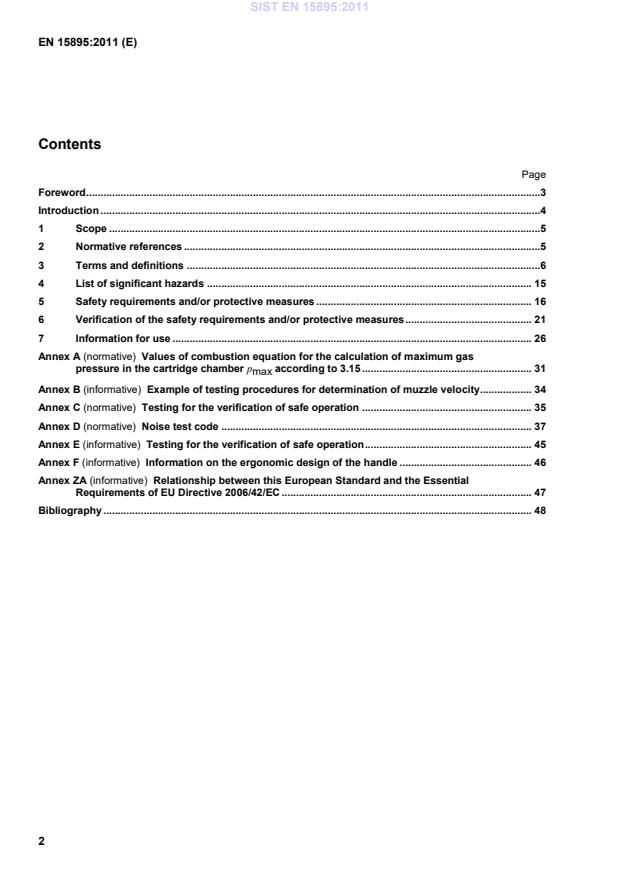
Values of combustion equation for the calculation of maximum gas pressure in the cartridge chamber pmax according to 3.15 . 31 Annex B (informative)
Example of testing procedures for determination of muzzle velocity . 34 Annex C (normative)
Testing for the verification of safe operation . 35 Annex D (normative)
Noise test code . 37 Annex E (informative)
Testing for the verification of safe operation . 45 Annex F (informative)
Information on the ergonomic design of the handle . 46 Annex ZA (informative)
Relationship between this European Standard and the Essential Requirements of EU Directive 2006/42/EC . 47 Bibliography . 48
cartridge operated tool which is intended for the operating direction vertically downward and which is operated with both hands and with the operator in a standing position NOTE A universal cartridge operated tool which is operated in the vertically downward operating direction with a long auxiliary handle or in a fixture is not considered a stand-up tool. 3.1.5 cartridge operated pole tool cartridge operated tool which is affixed to the end of a pole and which is intended exclusively for the operating direction vertically upward and which is operated with both hands and with the operator in a standing position NOTE A universal cartridge operated tool affixed to a pole which is an accessory is not considered a pole tool. 3.2 hard marking tool tool to mark materials by imprinting EXAMPLE Imprinting of letters and numerals. 3.3 cartridge device which contains propellant used to drive the piston 3.3.1 single cartridge (loose cartridge) cartridge intended to be inserted by hand in the cartridge chamber one by one SIST EN 15895:2011
mean arithmetic value of test element/piston velocity evaluated out of 10 single test values 3.8 maximum muzzle velocity (fixing tools) ve maximum test element/piston velocity to be expected calculated on the basis of the average muzzle velocity and the standard deviation for the 10 tests 3.9 reference combustion volume Vref volume defined for testing of cartridge strength; one single reference value of 0,16 cm3 3.10 total volume Vtot sum of the volumes of the combustion chamber and the empty cartridge chamber as determined from the design drawings or CAD models NOTE Vtot is a design-specific value. SIST EN 15895:2011
Key 1 Total volume Vtot (tool for single cartridges)
3.11 minimum volume of the cartridge chamber VET smallest technically possible cartridge chamber for a given calibre NOTE VET is a constant value for each calibre laid down in Table A.1 of Annex A.
Key 1 Minimum volume of the cartridge chamber VET (tool for single cartridges)
3.12 minimum operational volume of the combustion chamber Va volume consisting of the volume of the combustion chamber with the piston in its extreme top position and the open volume in the piston head NOTE Va is a design-specific value and is calculated as the difference between the design-specific volume Vtot and the calibre-specific volume VET: Va
Vtot
VET SIST EN 15895:2011
Key 1 Minimum operational volume of the combustion chamber Va (tool for single cartridges)
3.13 reduced volume of the cartridge chamber
volume of the minimum size cartridge chamber VET minus the volumes of the cartridge casing and the propellant NOTE
is a constant value for a given calibre laid down in Table A.1 of Annex A.
Key 1 Reduced volume of the cartridge chamber
(tool for single cartridges)
3.14 effective combustion volume Veff effective (total) volume of all connecting voids between the cartridge and the piston before the firing of the cartridge; calculated by Veff
Va
Vtot
VET SIST EN 15895:2011
Key 1 Effective combustion volume Veff
(tool for single cartridges)
Key 1 Effective combustion volume Veff
(tool for collated cartridges) 2 Va collated cartridges 3 Boundary line of VET 4 Collation strip 5 Separation line between cartridge chamber and collation strip
NOTE 1 Veff is the volume which in combination with the selected cartridge strength effectively determines the gas pressure generated in a tool. NOTE 2 Veff is a design-specific value. 3.15 maximum gas pressure pmax maximum value of combustion pressure in the cartridge chamber depending on the calibre and the effective volume of the combustion chamber, calculated according to the combustion equation pmax
a
Va as the effective combustion volume pmax
a
, where a, b are coefficients determined experimentally NOTE 1 Table A.1 of Annex A contains all the necessary values of a, b,
etc. per calibre. NOTE 2 The maximum gas pressure pmax is a constant value per tool with its individual minimum operational volume of the combustion chamber Va and thus its individual effective combustion volume Veff. It refers to the strongest possible cartridge of the respective calibre. 3.16 real gas pressure pmax, real combustion pressure produced by a factually available cartridge (used for an overpressure test) NOTE The real gas pressure pmax, real is generally lower than pmax. 3.17 relative cartridge strength X ratio of the combustion pressure of a factually available cartridge and the tabulated maximum combustion pressure
NOTE X would be 1,0 for cartridges producing exactly the pmax tabulated in Annex A. 3.18 reduced proof volume of the combustion chamber VE reduced proof volume of the combustion chamber for resistance testing with an overpressure of 1,3 times of the maximum gas pressure pmax, calculated using the equation
This equation is valid for cartridges with a relative strength of X between 1,0 and 0,85. SIST EN 15895:2011
Key 1 Reduced proof volume of the combustion chamber VE
3.19 adapted reduced proof volume of the combustion chamber VE, adapted volume of the combustion chamber reduced to an even lower value than the theoretical value VE to account for a factually available cartridge weaker than X
0,85 in overpressure testing.
VE, adapted is dependent on the relative cartridge strength X and is calculated using the equation
This equation is valid for cartridges with a relative strength of X below 0,85 as long as VE, adapted does not drop below 50 % of VE calculated according to 3.18. 3.20 reduced system testing volume of the combustion chamber VS reduced volume of the combustion chamber for system testing with an overpressure of 1,15 times of the maximum gas pressure pmax of each tested cartridge strength calculated using the equation
Key Va Minimum operational volume VS Reduced system testing volume VE Reduced proof volume
3.21 A-weighted emission sound pressure level LpA ten times the logarithm to the base 10 of the ratio of the square of the emission sound pressure, p, to the square of a reference value, p0, expressed in decibels
where the reference value, p0, is 20 µPa 3.22 A-weighted single event emission sound pressure level in dB LEA A-weighted and time-integrated emission sound pressure level of an isolated single sound event of specified duration T (or specified measurement time interval T
t2 – t1 covering the single event), normalized to reference time interval T0
1 s; given by the following equation:
NOTE The reference sound pressure is p0
20 µPa. 3.23 A-weighted sound power level LWA ten times the logarithm to the base 10 of the ratio of the sound power of a source, P, to a reference value, P0, expressed in decibels
where the reference value, P0, is 1 pW SIST EN 15895:2011
1 pJ
1012 J)
NOTE The A-weighted sound energy level is denoted by LJA. 3.25 peak emission sound pressure ppeak greatest absolute emission sound pressure during a stated time interval NOTE Peak sound pressure is expressed in pascals. 3.26 C-weighted peak emission sound pressure level in dB LpC, peak ten times the logarithm to the base 10 of the ratio of the square of the peak emission sound pressure, ppeak, to the square of a reference value, p0, expressed in decibels
where the reference value, p0, is 20 µPa 3.27 piston stopping device dedicated component used in some tool designs for preventing the piston from being ejected from the tool
NOTE The piston stopping device is often an exchangeable wear part. SIST EN 15895:2011
1.5 Use of fasteners (inappropriate for the tool or the application) breaking when entering the base material 5.3.3, 7.3.1, 7.3.2 2.1 Stabbing, puncture, crushing or severing due to ejection of fragments from the tool, cartridge casings or the collation system Insufficient strength of the tool for the intended cartridges and types of use 5.4 2.2 Use with cartridges with too high charge 7.3.1, 7.3.2, 7.4 2.3 Cartridge exploding outside the closed chamber 5.4, 5.7, 7.3.1, 7.3.2 2.4 Tool not adapted to the cartridges or collation systems or to the fasteners for which it is intended 5.4, 7.3.1 2.5 Ejection of the piston (or other components) because of poor design of the retention provisions 5.6.1 2.6 Ejection of parts of the piston after breakage of the piston 5.6.2 3 Stabbing or puncture due to ejection of fragments of base material Fragments or spalling from base material created by the penetration of a fastener 5.3.2, 5.3.3, 7.3.1, 7.3.2 4.1 Burns due to escaping combustion gases Poor design of tool allowing for the emission of hot combustion gases toward the user 5.11 4.2 Cartridge exploding outside the closed chamber 5.4, 5.7, 7.3.1, 7.3.2 5.1 Permanent hearing loss, tinnitus, reduced perception of warning signals, reduced speech communication abilities due to noise during firing Single burst noise emission when firing 5.8, 7.2, 7.3 5.2 Cartridge exploding outside the closed chamber 5.4, 5.7, 7.3.1, 7.3.2
parts normally touched when holding the tool
parts of control devices (short duration contact)
parts not intended to be touched 5.10, 7.2, 7.3.2 7.2 Contact with tool surfaces at high temperature during transport, servicing or maintenance 5.10, 7.2, 7.3.2 8.1 Hazards due to neglecting ergonomic principles Poor ergonomic design of the tool in general 5.12.1 8.2 Poor design of the handle not ensuring a firm grip on the tool with the possibility of loosing control, in particular concerning:
control of the tool in case of heavy tools
use by both left-handed and right-handed operators
use with protective gloves if necessary inadequate location of the trigger 5.12.2, 5.12.3 8.3 Poor design of the trigger with too high actuation force causing repetitive strain injury 5.12.3 9 Possible injuries when using the tool after incorrect (re)-assembling Design allowing for errors of fitting of parts of the tool 5.3.2
5 Safety requirements and/or protective measures 5.1 General Cartridge operated hand-held tools shall comply with the safety requirements and/or protective measures of this clause. In addition, the machine shall be designed according to the principles of EN ISO 12100-1:2003 and EN ISO 12100-2:2003 for relevant but not significant hazards, which are not dealt with by this document. 5.2 Carrying box and tools to be supplied Cartridge operated fixing and hard marking tools shall be supplied with the following equipment: a) specific tools required for maintenance and cleaning of the cartridge operated tool in compliance with the instruction handbook, b) solid box which can be protected/secured against unauthorised opening and having space for the cartridge operated tool, instructions for use, essential tools for daily maintenance and cleaning (e.g. brushes), and safety-related accessories (e.g. safety goggles). To protect the box against unauthorised opening, the box shall have a lock or allow the user to affix a lock of his own choice, e.g. a padlock. SIST EN 15895:2011
Cartridge operated fixing and marking tools shall be designed for correct and safe functioning with the cartridges, collation systems and the fasteners or marking accessories for which they are intended. 5.3.2 The design of the tool shall prevent errors that could be made when assembling and reassembling parts of them if such errors can be a hazard. Relevant errors in assembly are e.g.
assembling a tool with a wrong piston stopping device or without inserting a piston stopping device,
assembling a tool without sufficiently tightening the thread joining the fastener guide and the main tool body,
fitting a splinter guard with too much distance from the work surface. The manufacturer shall identify all the parts which can be disassembled and reassembled by the user which could create a hazard if they were mounted incorrectly. These parts shall be designed such that they cannot be assembled in a way that they create a hazard. In particular, parts that shall be considered are:
piston;
piston stopping device;
fastener guide;
magazine (tools for collated fasteners);
splinter guard. For verification see 6.3.1. 5.3.3 Tools that are intended to be used in applications where splinters might occur shall have fixtures where splinter guards can be attached. Matching splinter guards shall be made available by the manufacturer. For verification see 6.3.2. 5.4 Resistance at overpressure and temperature/operating safety and reliability 5.4.1 General The design of the tool shall ensure that the combustion pressure and the temperature do not cause damage to the tool itself or to the system components which are directly affected by this pressure and this temperature and are relevant for user safety. 5.4.2 The tool shall be able to withstand the highest pressures that can be expected without any deformation, cracks or other defects. For verification see 6.4.2. SIST EN 15895:2011
the average velocity
of piston and fasteners does not exceed 100 m/s, and
the maximum velocity ve of piston and fasteners does not exceed 110 m/s. For verification see 6.5. 5.6 Safe retention of the piston of a cartridge operated tool 5.6.1 The cartridge operated tool shall ensure a reliable stopping of the piston under those conditions where the highest piston velocity is obtained and if the piston is stopped inside the tool with no energy being dissipated in the base material. For verification see 6.6.1. 5.6.2 The design of the cartridge operated tool shall prevent that the piston breaks in such a way that major parts of it are ejected from the tool. NOTE This does not address the normal wear of the piston tip. For verification see 6.6.2. 5.7 Prevention of unintentional firing 5.7.1 Operating safety Firing shall be prevented during loading and unloading and with open cartridge chamber. For verification see 6.7.1. 5.7.2 The tool shall not fire in the case of impacts or blows. For verification see 6.7.2. 5.7.3 The tool shall not fire if it is dropped from heights as specified in 6.6.3. For verification see 6.7.3. SIST EN 15895:2011
the ergonomic design of the handle and the required hand gripping force (see also 5.12),
the required pressing effort that shall be as low as compatible with the free firing safety measures and as functionally possible (see 5.7.4),
the possibility of using charge and power setting appropriate for the types of work for which the tool is intended (see also 7.3.2 a),
the ratio of the mass of the piston and the mass of the tool shall be as low as practically possible. For verification see 6.9. 5.10 Maximum permissible surface temperatures Cartridge operated tools shall be designed and constructed in such a way that the surface temperatures do not exceed the limit values laid down in EN ISO 13732-1:2008. The temperature of handles or other surfaces of the tool which are intended to be touched for holding the tool shall not exceed 48 °C. For other intentional contacts the contact times to be considered for defining the maximum surface tempera-tures shall be
4 seconds for the activation of the trigger or switches,
10 seconds for the activation of power adjustment devices. SIST EN 15895:2011
EN 792-13+A1:2008, Annex C. Tools with a mass of 6 kg or more shall be capable to be held with both hands. The provision for the second hand can be either:
a second handle which may be removable or
an appropriate grip zone on the tool body. For verification see 6.12.2. 5.12.3 Trigger and actuation The trigger shall be adapted to the (main) handle so that it can be used easily as well by right-handed as by left-handed operators. NOTE Guidance on the trigger can be found in Annex F. The actuation force of the trigger shall be as low as functionally possible and compatible with the measures for prevention of unintended actuation. NOTE Guidance can be found in EN 894-3+A1:2008, 8.2. Similarly, the required force for pressing the tool against the surface before firing shall be as low as compatible with the measures for prevention of unintended firing (see also 5.7.4) and as functionally possible. For verification see 6.12.3. SIST EN 15895:2011
The verification methods are presented in the same order as the corresponding requirements of Clause 5. All tests shall be carried out at ambient temperature of (20 ± 5) °C. 6.2 Verification of equipment and packaging Verification of carrying box and specific tools shall be done by visual inspection. 6.3 Verification of safe design 6.3.1 The result of the analysis of potentially hazardous exchangeable components shall be documented and retained. The identified parts shall be listed. For all parts listed, assembly tests shall be carried out to verify that they cannot be mounted in a way which could create a hazard. 6.3.2 Design verification and assembly test 6.4 Verification of resistance at overpressure and of operating safety 6.4.1 General Testing is carried out on the basis of the following criteria:
the tool with dimensions within the manufacturing tolerances,
the largest and heaviest piston,
the piston and barrel shall be selected for ensuring the minimum clearance between both within the manufacturing tolerances,
the heaviest fasteners or marking head and letters, and,
if applicable, the matching collation systems. 6.4.2 Overpressure test The power setting of the tool shall be set to maximum power. Ten fasteners are fired into a material suitable for their application. Compliance with 5.4.2 is verified at an overpressure of 1,3
pmax as defined in 3.15. Two methods exist to reach the targeted overpressure: a) using proof cartridges developing at least 1,3
pmax or SIST EN 15895:2011
pmax (see 3.15). This procedure is carried out using
cartridges which in standardised pressure testing with Va
Vref
0,16 cm3 shall develop a mean pressure p10 at least equal to 85 % of pmax (0,16) specified for the calibre in question
in combination with a test piston with reduced additional volume VE in order to achieve at least 1,3
pmax. If the strongest cartridges which are available do not develop a mean pressure p10 of at least 85 % of pmax (0,16), the procedure of indent b) may also be used but with an adapted reduced proof volume VE, adapted (see 3.19) reduced below the value of VE to account for the weaker cartridge. This method is acceptable as long as the resulting adapted reduced proof volume VE, adapted is greater or equal to 50 % of VE. The tool will pass the overpressure test if no plastic deformation or cracks are observed in those parts of the tool which bear the gas pressure load (chamber, barrel, locking parts).
If in case of tools for collated cartridges defects occur during the test in the standard collation system, a special collation system made of metal shall be used for a repeat test. 6.4.3 Temperature test The cartridge operated tool is operated for a period of 10 minutes with the maximum operation rate as specified in the instruction manual and the temperatures thus produced are measured. The tool is used with the strongest available cartridge and, if adjustable, is set at the power setting which produces the highest temperatures of the tool. NOTE Depending on design, this setting need not be the maximum setting. The test is passed if upon visual inspection the tool does not show damage to any of its parts. 6.4.4 Verification of correct chambering Verification is done using the test described in 6.4.2 using the reduced system testing volume VS instead of VE (see 3.20).
The tool will pass if after the test the walls and bottoms of the cartridges are not cracked. 6.4.5 Verification of the specific design elements for tools for collated cartridges Design of the elements of the tool relevant for the correct functioning of the collated cartridge system for which it is intended shall be verified. Additionally a compatibility test shall be carried out for every type of collated cartridges intended to be used with the tool. A description of an adequate testing procedure is given in Annex E. 6.5 Verification of the permissible muzzle velocity (fixing tools) Compliance with 5.5 shall be verified by measuring the ―muzzle velocity‖ by measuring the velocity of a free flying test element or of the piston.
For this purpose, the tool shall be loaded with a special test element made of steel as shown in Figure 1 and the strongest charge which technically can be used in the tool. Tools with adjustable power are tested at their maximum power setting. If a tool is intended to be fitted with different pistons and barrels, all tests shall be carried out with all of these pistons and barrels considering only the highest velocities. SIST EN 15895:2011
Tolerances: ISO 2768 –m Rz Surface roughness Figure 1 — Test element If the test element needs additional guidance in the barrel, this shall be ensured by slipping two washers made of plastic (or of AlMg alloy material of 0,3 mm thickness) onto the front and rear end of the test element. The washers shall have a bore diameter of 5,5 mm and an outside diameter adapted to the barrel bore diameter. The mass of the test element shall be (8
0,3) g. By means of a suitable rod the test element shall be pushed into the fastener guide towards the rear of the cartridge operated fixing tool so as to intimately contact the face of the piston. By this, it is ensured that the test element is accelerated at the same rate as the piston and reaches the same velocity as the piston at the muzzle. The cartridge operated fixing tool loaded with the test element shall then be pressed against a plate of thin sheet metal and fired such as to enforce the exiting of the test element from the muzzle and the penetration of the sheet metal by the test element. By this, the test element is simulating the free flight of a fastener which might occur unintentionally in a similar situation. To determine the muzzle velocity of the cartridge operated fixing tool, one of the following shall be measured:
the velocity of the piston attained close to the muzzle, i.e. immediately before the piston impacts the piston stopping device,
the velocity of the test element immediately after leaving the muzzle in its forced free flight. For the determination of either velocity, the tool manufacturer shall use a suitable measuring method and measuring equipment. Measuring equipment shall be used which allows the measurement of the average muzzle velocity with a maximum measuring error of
3 %. By definition, the average muzzle velocity
is the mean value of 10 measurements, whereby the unilateral upper tolerance limit at 95 % confidence level, related to 95 % of the populations, shall not exceed the maximum permissible value by more than 10 %. The maximum velocity ve is computed according to the laws of statistics using the coefficient k2,10 and the value s for the standard deviation of each series: ve
k2,10
s10 k2,10
2,91 SIST EN 15895:2011
value of the standard deviation of each series During the 10 successive velocity firings it is permissible to replace a jammed or blocked piston. However, the piston shall not break. The test is passed if the average muzzle velocity does not exceed 100 m/s and the maximum velocity ve does not exceed 110 m/s. NOTE An example of testing procedures for the determination of muzzle velocity is given in Annex B. 6.6 Verification of measures for safe retention of the piston 6.6.1 Verification of piston stopping provision For testing the stopping provision of the fixing or hard marking tool, the tool shall be fitted with a piston with a reduced system testing volume of the combustion chamber VS such as to produce an overpressure of 115 % of the maximum gas pressure pmax. The fixing or hard marking tool shall be applied to a thin metal plate and fired. NOTE See Annex B for a detailed example of test setup which can be used for the testing of piston stopping device. The test shall be repeated three times. If necessary in accordance with the instruction manual, the stopping device and/or the piston shall be replaced. The test is passed if the tool does not break and the piston is not ejected from the tool. 6.6.2 Verification of measures against breakage of the piston Verification is done using the same test as described in 6.6.1. The test is passed if no parts of the piston are ejected from the tool. 6.7 Prevention of unintentional firing or improper use 6.7.1 Verification of safe operation Verification of the design and functional testing. Functional testing shall be done according to the following procedure: The empty tool (i.e. without cartridges) shall be loaded with a metal feeler gauge of 5,0 mm thickness and with square or rectangular cross section by inserting the feeler gauge between the cartridge chamber and the firing unit. If necessary to allow triggering, tools designed for collated fasteners shall be loaded with a strip of matching fasteners. The cartridge operated tool is pressed onto a surface until reaching the end of its stroke. In this position the trigger is depressed. The test is passed if the trigger does not operate, i.e. the firing pin is not released (see Annex C for illustrations of the measurement procedure). 6.7.2 Verification of firing safety in the case of impacts and blows Verification shall be done according to the following procedure: SIST EN 15895:2011
For verification, the drop test of the tool shall be carried out as follows: A tool shall be used with a cartridge inserted but without a piston or fastener if relevant. The tool shall be dropped twelve times from a height of 1,5 m and three times from a height of 3 m onto a square steel plate having a thickness of 30 mm and an edge length of at least 500 mm. The tool shall be dropped such that, upon impact of the tool on the plate, its muzzle is pointed
vertically downwards: four drops from a height of 1,5 m and one drop from a height of 3 m (the tool shall fall on the muzzle),
horizontally: four drops from a height of 1,5 m and one drop from a height of 3 m,
vertically upwards: four drops from a height of 1,5 m and one drop from a height of 3 m. In a case where a different angle of impact is obviously the most critical, the angle of impact shall be modified according to the design so that the most unfavourable case is assumed.
After each drop the function shall be verified visually and manually.
If necessary, any damaged components shall be exchanged before the next drop in order to ensure the function of the tool. After each drop it shall be verified whether a striking pin mark can be seen on the cartridge base with the naked eye even if the tool has not fired.
The test is passed if in none of all drops any striking marks are found on the base of the
...