

EN 4049-001:2006
(Main)Aerospace series - Thermocouple extension cable - Operating tempera-tures between - 65 °C to 260 °C - Part 001: Technical specification
- Abstract
This standard specifies the required characteristics, test methods, qualification and acceptance conditions of thermocouple used for the connection between the thermocouple and the equipment.
- Status
- Published
- Publication Date
- 12-Dec-2006
- Withdrawal Date
- 29-Jun-2007
- Technical Committee
- ASD-STAN - Aerospace
- Drafting Committee
- ASD-STAN/D 2 - Electrical
- Current Stage
- 9093 - Decision to confirm - Review Enquiry
- Start Date
- 01-Jun-2017
- Completion Date
- 30-Sep-2026

Overview
EN 4049-001:2006 is a European standard developed by CEN for aerospace thermocouple extension cables operating between -65 °C and 260 °C. As part of the aerospace series, this standard outlines the technical specifications, required characteristics, test methods, and quality assurance procedures for thermocouple extension cables used to connect thermocouples to equipment in demanding aerospace environments. Compliance with EN 4049-001:2006 ensures high reliability and performance, which is critical for safety and functionality in aerospace electrical systems.
Key Topics
- Scope and Purpose: The standard defines all essential requirements for thermocouple extension cables, such as mechanical, electrical, and environmental characteristics. It guides manufacturers and users in the aerospace industry on ensuring quality and reliability.
- Materials and Construction:
- Only specific conductor materials such as nickel-chromium and nickel-aluminium are permitted, following relevant ISO standards.
- Insulation must be unaffected by corrosion and must be resistant to the effects of mould and microorganisms.
- Cable construction requires proper strand elongation, tensile strength, and optimal screen or braid coverage for protection and durability.
- Required Characteristics:
- Detailed specifications regarding conductor performance, insulation integrity, and mechanical strength.
- Adherence to electrical and thermal performance criteria, including minimum elongation, breaking strength, and resistance to environmental factors.
- Testing and Acceptance:
- Comprehensive list of optical, mechanical, and electrical tests to ensure compliance before cable delivery and at periodic intervals.
- Includes tests for resistance, voltage proof, insulation, bending, chemical resistance, flammability, and marking durability.
- Quality Assurance and Qualification:
- Sets out qualification tests, acceptance and production routine tests, and documentation requirements.
- Requires that each production batch is tested and traceable, with clear marking and labelling for identification and quality control.
- Identification and Packaging:
- Requires permanent marking on cables for traceability, as per ISO 2574.
- Specifies packaging, labelling, and delivery length criteria to maintain cable integrity during transport and storage.
Applications
The EN 4049-001:2006 standard is essential for manufacturers, maintenance organizations, and engineers involved in the aerospace sector. Key applications include:
- Aircraft Electrical Systems: Used for accurate measurement and control of temperatures in engines, avionics, and environmental control systems.
- Thermocouple Sensor Installations: Ensures safe and reliable cable connections between sensing points and monitoring equipment.
- Maintenance and Replacement: Provides a reference for quality assessment during cable replacement in aircraft and spacecraft.
Compliance with this standard is crucial for aerospace projects where safety, durability, and performance are non-negotiable. Using compliant thermocouple extension cables minimizes risks associated with cable failures in critical applications.
Related Standards
- ISO 2574: Aircraft electrical cables - Identification marking
- ISO 8056-1: Aircraft nickel-chromium and nickel-aluminium thermocouple extension cables - General requirements and conductors
- EN 3475-100: Aerospace cables - Test methods
- EN 60584-2: Thermocouples - Tolerances
- EN 9133: Aerospace quality management systems - Qualification procedures for standard parts
These related standards support the implementation of EN 4049-001:2006, ensuring cohesive quality management and technical compatibility across the aerospace industry.
Keywords: EN 4049-001, thermocouple extension cable, aerospace series, technical specification, quality assurance, cable test methods, cable marking, aerospace electrical systems, cable qualification, CEN, IEC standards.
Relations
- Effective Date
- 25-Aug-2026
- Effective Date
- 09-Feb-2026
- Effective Date
- 09-Feb-2026
- Effective Date
- 09-Feb-2026
- Effective Date
- 28-Jan-2026
- Effective Date
- 28-Jan-2026
- Effective Date
- 28-Jan-2026
- Effective Date
- 28-Jan-2026
- Effective Date
- 28-Jan-2026
- Effective Date
- 28-Jan-2026
- Effective Date
- 28-Jan-2026
- Effective Date
- 28-Jan-2026
- Effective Date
- 28-Jan-2026
Get Certified
Connect with accredited certification bodies for this standard

BUREAU VERITAS Certification Germany
Bureau Veritas certification in Germany.

Element Materials Technology
Materials testing and product certification.

AQMS Ltd.
AQMS provides ISO certification to SMEs across the UK.
Sponsored listings
Frequently Asked Questions
EN 4049-001:2006 is a standard published by the European Committee for Standardization (CEN). Its full title is "Aerospace series - Thermocouple extension cable - Operating tempera-tures between - 65 °C to 260 °C - Part 001: Technical specification". This standard covers: This standard specifies the required characteristics, test methods, qualification and acceptance conditions of thermocouple used for the connection between the thermocouple and the equipment.
This standard specifies the required characteristics, test methods, qualification and acceptance conditions of thermocouple used for the connection between the thermocouple and the equipment.
EN 4049-001:2006 is classified under the following ICS (International Classification for Standards) categories: 49.060 - Aerospace electric equipment and systems. The ICS classification helps identify the subject area and facilitates finding related standards.
EN 4049-001:2006 has the following relationships with other standards: It is inter standard links to ISO 8815:1994, EN 60584-1:2013, ISO 8056-1:1985, ISO 2574:1994, EN 3475-100:2010, EN 9133:2018, EN 4049-004:2006, EN 3155-056:2006, EN 4049-002:2005, EN 3155-054:2006, EN 4049-003:2006, EN 3155-057:2006, EN 3155-055:2006. Understanding these relationships helps ensure you are using the most current and applicable version of the standard.
EN 4049-001:2006 is available in PDF format for immediate download after purchase. The document can be added to your cart and obtained through the secure checkout process. Digital delivery ensures instant access to the complete standard document.
Standards Content (Sample)
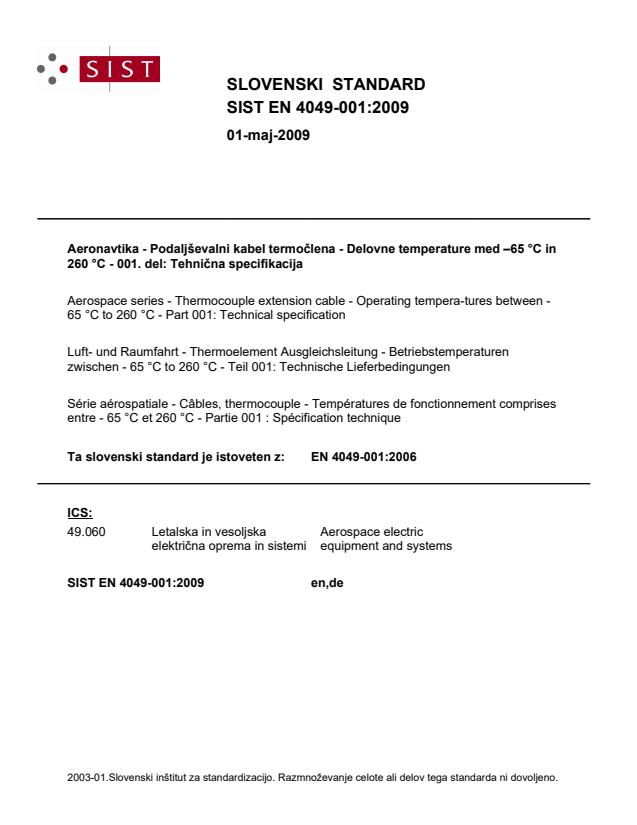
2003-01.Slovenski inštitut za standardizacijo. Razmnoževanje celote ali delov tega standarda ni dovoljeno.Luft- und Raumfahrt - Thermoelement Ausgleichsleitung - Betriebstemperaturen zwischen - 65 °C to 260 °C - Teil 001: Technische LieferbedingungenSérie aérospatiale - Câbles, thermocouple - Températures de fonctionnement comprises entre - 65 °C et 260 °C - Partie 001 : Spécification techniqueAerospace series - Thermocouple extension cable - Operating tempera-tures between - 65 °C to 260 °C - Part 001: Technical specification49.060Aerospace electric equipment and systemsICS:Ta slovenski standard je istoveten z:EN 4049-001:2006SIST EN 4049-001:2009en,de01-maj-2009SIST EN 4049-001:2009SLOVENSKI
STANDARD
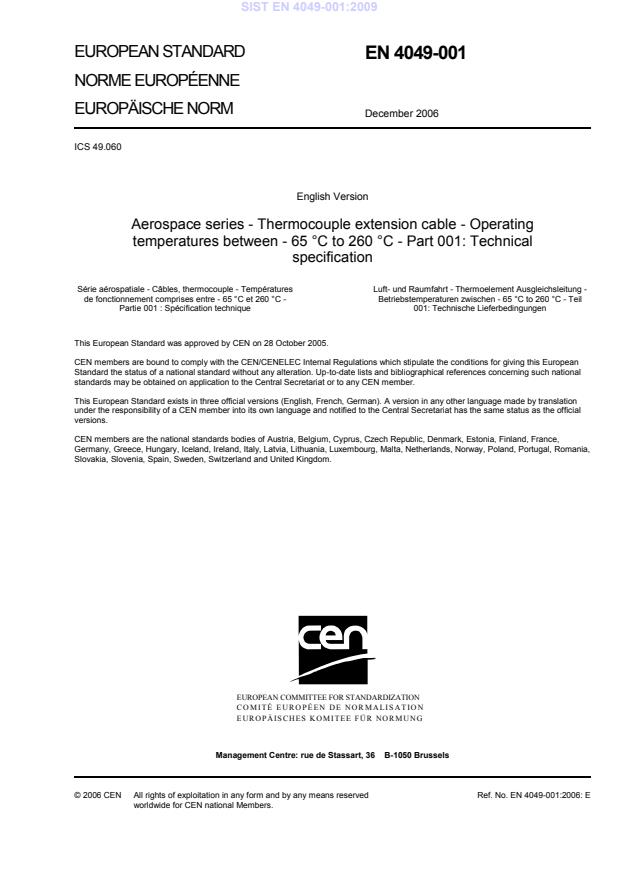
EUROPEAN STANDARD NORME EUROPÉENNE EUROPÄISCHE NORM
EN 4049-001
December 2006 ICS 49.060 English Version
Aerospace series - Thermocouple extension cable - Operating temperatures between - 65 °C to 260 °C - Part 001: Technical specification
Série aérospatiale - Câbles, thermocouple - Températures de fonctionnement comprises entre - 65 °C et 260 °C - Partie 001 : Spécification technique
Luft- und Raumfahrt - Thermoelement Ausgleichsleitung - Betriebstemperaturen zwischen - 65 °C to 260 °C - Teil 001: Technische Lieferbedingungen This European Standard was approved by CEN on 28 October 2005.
CEN members are bound to comply with the CEN/CENELEC Internal Regulations which stipulate the conditions for giving this European Standard the status of a national standard without any alteration. Up-to-date lists and bibliographical references concerning such national standards may be obtained on application to the Central Secretariat or to any CEN member.
This European Standard exists in three official versions (English, French, German). A version in any other language made by translation under the responsibility of a CEN member into its own language and notified to the Central Secretariat has the same status as the official versions.
CEN members are the national standards bodies of Austria, Belgium, Cyprus, Czech Republic, Denmark, Estonia, Finland, France, Germany, Greece, Hungary, Iceland, Ireland, Italy, Latvia, Lithuania, Luxembourg, Malta, Netherlands, Norway, Poland, Portugal, Romania, Slovakia, Slovenia, Spain, Sweden, Switzerland and United Kingdom.
EUROPEAN COMMITTEE FOR STANDARDIZATION
COMITÉ EUROPÉEN DE NORMALISATION EUROPÄISCHES KOMITEE FÜR NORMUNG
Management Centre: rue de Stassart, 36
B-1050 Brussels © 2006 CEN All rights of exploitation in any form and by any means reserved worldwide for CEN national Members. Ref. No. EN 4049-001:2006: ESIST EN 4049-001:2009
Strand dia. 0,15 mm Strand dia. 0,20 mmStrand dia. 0,15 mm Strand dia. 0,20 mmNickel chromium 15 15 10,2 17,7 Nickel aluminium 15 15
9,7 16,7
...