


EN 1264-2:2008+A1:2012
(Main)Water based surface embedded heating and cooling systems - Part 2: Floor heating: Prove methods for the determination of the thermal output using calculation and test methods
Water based surface embedded heating and cooling systems - Part 2: Floor heating: Prove methods for the determination of the thermal output using calculation and test methods
This European Standard specifies the boundary conditions and the prove methods for the determination of the thermal output of hot water floor heating systems as a function of the temperature difference between the heating medium and the room temperature.
This standard shall be applied to commercial trade and practical engineering if proved and certifiable values of the thermal output shall be used.
This European Standard applies to heating and cooling systems embedded into the enclosure surfaces of the room to be heated or to be cooled. This Part of this European Standard applies to hot water floor heating systems. Applying of Part 5 of this European Standard requires the prior use of this Part of this European Standard. Part 5 of this European Standard deals with the conversion of the thermal output of floor heating systems determined in Part 2 into the thermal output of heating surfaces embedded in walls and ceilings as well as into the thermal output of cooling surfaces embedded in floors, walls and ceilings.
The thermal output is proved by a calculation method (Clause 6) and by a test method (Clause 9). The calculation method is applicable to systems corresponding to the definitions in EN 1264-1 (type A, type B, type C, type D). For systems not corresponding to these definitions, the test method shall be used. The calculation method and the test method are consistent with each other and provide correlating and adequate prove results.
The prove results, expressed depending on further parameters, are the standard specific thermal output and the associated standard temperature difference between the heating medium and the room temperature as well as fields of characteristic curves showing the relationship between the specific thermal output and the temperature difference between the heating medium and the room.
Raumflächenintegrierte Heiz- und Kühlsysteme mit Wasserdurchströmung - Teil 2: Fußbodenheizung: Prüfverfahren für die Bestimmung der Wärmeleistung unter Benutzung von Berechnungsmethoden und experimentellen Methoden
Diese Europäische Norm legt die Randbedingungen und die Prüfverfahren für die Bestimmung der Wärme-leistung von Warmwasser Fußbodenheizsystemen in Abhängigkeit von der Differenz zwischen der Heiz-mittel und der Raumtemperatur fest.
Die vorliegende Norm ist auf den kommerziellen Handel und das praktische Ingenieurwesen anzuwenden, sofern geprüfte und zertifizierbare Werte für die Wärmeleistung erforderlich sind.
Diese Europäische Norm gilt für Heiz und Kühlsysteme, die in die Raumumschließungsflächen des zu heizenden oder zu kühlenden Raumes integriert sind. Der vorliegende Teil dieser Europäischen Norm gilt für Warmwasser-Fußbodenheizsysteme. Die Anwendung von Teil 5 dieser Europäischen Norm erfordert die vorherige Anwendung des vorliegenden Teils dieser Europäischen Norm. Teil 5 dieser Europäischen Norm behandelt die Umrechnung der in Teil 2 bestimmten Wärmeleistung der Fußbodenheizsysteme in die Wärme-leistung von Heizflächen in Wänden und Decken sowie in die Kühlleistung von Kühlflächen in Fußböden, Wänden und Decken.
Die Wärmeleistung wird durch ein Berechnungsverfahren (Abschnitt 6) und ein experimentelles Verfahren (Abschnitt 9) geprüft. Das Berechnungsverfahren ist auf Systeme anwendbar, die den Definitionen nach EN 1264 1 (Typ A, Typ B, Typ C, Typ D) entsprechen. Bei Systemen, die diesen Definitionen nicht entspre-chen, ist das experimentelle Verfahren anzuwenden. Das Berechnungsverfahren und das experimentelle Verfahren entsprechen einander und liefern korrelierende, adäquate Prüfergebnisse.
Als Prüfergebnisse werden die spezifische Normwärmeleistung mit der zugehörigen Normdifferenz zwischen der Heizmittel und der Raumtemperatur sowie Kennlinienfelder für die Beziehung zwischen der spezifischen Wärmeleistung und der Differenz zwischen der Heizmittel und der Raumtemperatur in Abhängigkeit von weiteren Parametern angegeben.
Systèmes de surfaces chauffantes et rafraîchissantes hydrauliques intégrées - Partie 2 : Chauffage par le sol: Méthodes de démonstration pour la détermination de l'émission thermique utilisant des méthodes par le calcul et à l'aide de méthodes d'essai
La présente Norme européenne spécifie les conditions limites et les méthodes de démonstration pour la détermination de l’émission thermique des systèmes de chauffage par le sol à circulation d’eau chaude sous la forme d’une fonction de la différence de température entre le fluide chauffant et la température ambiante.
La présente norme doit être appliquée aux fins de commercialisation et d’ingénierie pratique, si des valeurs éprouvées et certifiées de l’émission thermique doivent être utilisées.
La présente Norme européenne s'applique aux systèmes de surfaces chauffantes et rafraîchissantes intégrées dans le sol, les plafonds et les murs d'une pièce devant être chauffée ou rafraîchie. Cette partie de la présente norme européenne s’applique aux systèmes de chauffage par le sol à circulation d’eau chaude. L’application de la partie 5 de la présente Norme européenne nécessite l’utilisation préalable de la présente partie. La partie 5 de la présente Norme européenne traite de la conversion de l’émission thermique des systèmes de chauffage par le sol déterminée dans la Partie 2 en émission thermique des surfaces chauffantes intégrées dans les plafonds ou en émission thermique des surfaces rafraîchissantes intégrées dans les sols, les murs et les plafonds.
L’émission thermique est démontrée par une méthode de calcul (Article 6) et par une méthode d’essai (Article 9). La méthode de calcul s’applique aux systèmes correspondant aux définitions données dans l’EN 1264 1 (type A, type B, type C et type D). La méthode d’essai doit quant à elle être appliquée à tous les systèmes ne correspondant pas à ces définitions. Ces deux méthodes sont convergentes et fournissent des résultats de démonstration concordants.
Les résultats de la démonstration, exprimés en fonction d’autres paramètres, constituent l’émission surfacique normalisée et la différence de température associée entre le fluide chauffant et la pièce, ainsi que les familles des courbes caractéristiques qui montrent la relation existant entre l’émission surfacique et la différence de température entre le fluide chauffant et la pièce.
Ploskovni sistemi za gretje in hlajenje z vodo - 2. del: Talno gretje - Preskusne metode za določevanje oddaje toplote talnega gretja z računsko metodo in preskušanjem
Ta evropski standard določa robne pogoje in preskusne metode za določevanje oddaje toplote sistemov talnega gretja s toplo vodo z uporabo funkcije temperaturne razlike med sredstvom ogrevanja in sobno temperaturo. Ta standard se uporablja za komercialno trgovanje in praktični inženiring, če se uporabljajo dokazane in overljive vrednosti oddaje toplote. Ta evropski standard se uporablja za sisteme za gretje in hlajenje, ki so vgrajeni v površine okoli sobe, ki se ogreva in ohlaja. Ta del tega evropskega standarda se uporablja za sisteme talnega gretja s toplo vodo. Uporaba 5. dela tega evropskega standarda zahteva predhodno uporabo tega dela tega evropskega standarda. 5. del tega evropskega standarda obravnava pretvarjanje oddaje toplote sistemov talnega gretja, ki so določeni v 2. delu, v oddajo toplote ploskovnih sistemov za gretje, ki so vgrajeni v zidove in strope, ter v oddajo toplote sistemov za hlajenje, ki so vgrajeni v tla, zidove in strope. Oddajo toplote se dokazuje z računsko metodo (točka 6) in preskušanjem (točka 9). Računska metoda se uporablja za sisteme, ki ustrezajo definicijam v standardu EN 1264-1 (tip A, tip B, tip C, tip D). Za sisteme, ki ne ustrezajo tem definicijam, se uporablja preskusna metoda. Računska in preskusna metoda sta medsebojno skladni ter zagotavljata povezane in ustrezne rezultate preskusa. Rezultati preskusa, izraženi glede na nadaljnje parametre, so standardna specifična oddaja toplote talnega gretja in povezana standardna temperaturna razlika med sredstvom ogrevanja in sobno temperaturo ter tudi polja krivulje delovanja, ki prikazuje razmerje med specifično oddajo toplote talnega gretja in temperaturno razliko med sredstvom ogrevanja in sobo.
General Information
- Status
- Withdrawn
- Publication Date
- 13-Nov-2012
- Withdrawal Date
- 10-Feb-2026
- Technical Committee
- CEN/TC 130 - Space heating appliances without integral heat sources
- Drafting Committee
- CEN/TC 130/WG 9 - Floor heating - Systems and components
- Current Stage
- 9960 - Withdrawal effective - Withdrawal
- Start Date
- 19-May-2021
- Completion Date
- 11-Feb-2026
Relations
- Effective Date
- 18-Jan-2023
- Effective Date
- 26-May-2021
- Effective Date
- 28-Jan-2026
- Refers
EN 1264-3:2009 - Water based surface embedded heating and cooling systems - Part 3: Dimensioning - Effective Date
- 28-Jan-2026


Get Certified
Connect with accredited certification bodies for this standard

ICC Evaluation Service
Building products evaluation and certification.

QAI Laboratories
Building and construction product testing and certification.

Aboma Certification B.V.
Specialized in construction, metal, and transport sectors.
Sponsored listings
Frequently Asked Questions
EN 1264-2:2008+A1:2012 is a standard published by the European Committee for Standardization (CEN). Its full title is "Water based surface embedded heating and cooling systems - Part 2: Floor heating: Prove methods for the determination of the thermal output using calculation and test methods". This standard covers: This European Standard specifies the boundary conditions and the prove methods for the determination of the thermal output of hot water floor heating systems as a function of the temperature difference between the heating medium and the room temperature. This standard shall be applied to commercial trade and practical engineering if proved and certifiable values of the thermal output shall be used. This European Standard applies to heating and cooling systems embedded into the enclosure surfaces of the room to be heated or to be cooled. This Part of this European Standard applies to hot water floor heating systems. Applying of Part 5 of this European Standard requires the prior use of this Part of this European Standard. Part 5 of this European Standard deals with the conversion of the thermal output of floor heating systems determined in Part 2 into the thermal output of heating surfaces embedded in walls and ceilings as well as into the thermal output of cooling surfaces embedded in floors, walls and ceilings. The thermal output is proved by a calculation method (Clause 6) and by a test method (Clause 9). The calculation method is applicable to systems corresponding to the definitions in EN 1264-1 (type A, type B, type C, type D). For systems not corresponding to these definitions, the test method shall be used. The calculation method and the test method are consistent with each other and provide correlating and adequate prove results. The prove results, expressed depending on further parameters, are the standard specific thermal output and the associated standard temperature difference between the heating medium and the room temperature as well as fields of characteristic curves showing the relationship between the specific thermal output and the temperature difference between the heating medium and the room.
This European Standard specifies the boundary conditions and the prove methods for the determination of the thermal output of hot water floor heating systems as a function of the temperature difference between the heating medium and the room temperature. This standard shall be applied to commercial trade and practical engineering if proved and certifiable values of the thermal output shall be used. This European Standard applies to heating and cooling systems embedded into the enclosure surfaces of the room to be heated or to be cooled. This Part of this European Standard applies to hot water floor heating systems. Applying of Part 5 of this European Standard requires the prior use of this Part of this European Standard. Part 5 of this European Standard deals with the conversion of the thermal output of floor heating systems determined in Part 2 into the thermal output of heating surfaces embedded in walls and ceilings as well as into the thermal output of cooling surfaces embedded in floors, walls and ceilings. The thermal output is proved by a calculation method (Clause 6) and by a test method (Clause 9). The calculation method is applicable to systems corresponding to the definitions in EN 1264-1 (type A, type B, type C, type D). For systems not corresponding to these definitions, the test method shall be used. The calculation method and the test method are consistent with each other and provide correlating and adequate prove results. The prove results, expressed depending on further parameters, are the standard specific thermal output and the associated standard temperature difference between the heating medium and the room temperature as well as fields of characteristic curves showing the relationship between the specific thermal output and the temperature difference between the heating medium and the room.
EN 1264-2:2008+A1:2012 is classified under the following ICS (International Classification for Standards) categories: 91.140.10 - Central heating systems. The ICS classification helps identify the subject area and facilitates finding related standards.
EN 1264-2:2008+A1:2012 has the following relationships with other standards: It is inter standard links to EN 1264-2:2008, EN 1264-2:2021, EN 1264-1:2011, EN 1264-3:2009. Understanding these relationships helps ensure you are using the most current and applicable version of the standard.
EN 1264-2:2008+A1:2012 is available in PDF format for immediate download after purchase. The document can be added to your cart and obtained through the secure checkout process. Digital delivery ensures instant access to the complete standard document.
Standards Content (Sample)
2003-01.Slovenski inštitut za standardizacijo. Razmnoževanje celote ali delov tega standarda ni dovoljeno.SUHVNXãDQMHPRaumflächenintegrierte Heiz- und Kühlsysteme mit Wasserdurchströmung - Teil 2: Fußbodenheizung: Prüfverfahren für die Bestimmung der Wärmeleistung unter Benutzung von Berechnungsmethoden und experimentellen MethodenSystèmes de surfaces chauffantes et rafraîchissantes hydrauliques intégrées - Partie 2 : Chauffage par le sol: Méthodes de démonstration pour la détermination de l'émission thermique utilisant des méthodes par le calcul et à l'aide de méthodes d'essaiWater based surface embedded heating and cooling systems - Part 2: Floor heating: Prove methods for the determination of the thermal output using calculation and test methods91.140.10Sistemi centralnega ogrevanjaCentral heating systemsICS:Ta slovenski standard je istoveten z:EN 1264-2:2008+A1:2012SIST EN 1264-2:2009+A1:2013en,fr,de01-april-2013SIST EN 1264-2:2009+A1:2013SLOVENSKI
STANDARD
EUROPEAN STANDARD NORME EUROPÉENNE EUROPÄISCHE NORM
EN 1264-2:2008+A1
November 2012 ICS 91.140.10 Supersedes EN 1264-2:2008English Version
Water based surface embedded heating and cooling systems - Part 2: Floor heating: Prove methods for the determination of the thermal output using calculation and test methods
Systèmes de surfaces chauffantes et rafraîchissantes hydrauliques intégrées - Partie 2 : Chauffage par le sol: Méthodes de démonstration pour la détermination de l'émission thermique utilisant des méthodes par le calcul et à l'aide de méthodes d'essai
Raumflächenintegrierte Heiz- und Kühlsysteme mit Wasserdurchströmung - Teil 2: Fußbodenheizung: Prüfverfahren für die Bestimmung der Wärmeleistung unter Benutzung von Berechnungsmethoden und experimentellen Methoden This European Standard was approved by CEN on 13 September 2008 and includes Amendment 1 approved by CEN on 1 October 2012.
CEN members are bound to comply with the CEN/CENELEC Internal Regulations which stipulate the conditions for giving this European Standard the status of a national standard without any alteration. Up-to-date lists and bibliographical references concerning such national standards may be obtained on application to the CEN-CENELEC Management Centre or to any CEN member.
This European Standard exists in three official versions (English, French, German). A version in any other language made by translation under the responsibility of a CEN member into its own language and notified to the CEN-CENELEC Management Centre has the same status as the official versions.
CEN members are the national standards bodies of Austria, Belgium, Bulgaria, Croatia, Cyprus, Czech Republic, Denmark, Estonia, Finland, Former Yugoslav Republic of Macedonia, France, Germany, Greece, Hungary, Iceland, Ireland, Italy, Latvia, Lithuania, Luxembourg, Malta, Netherlands, Norway, Poland, Portugal, Romania, Slovakia, Slovenia, Spain, Sweden, Switzerland, Turkey and United Kingdom.
EUROPEAN COMMITTEE FOR STANDARDIZATION
COMITÉ EUROPÉEN DE NORMALISATION EUROPÄISCHES KOMITEE FÜR NORMUNG
Management Centre:
Avenue Marnix 17,
B-1000 Brussels © 2012 CEN All rights of exploitation in any form and by any means reserved worldwide for CEN national Members. Ref. No. EN 1264-2:2008+A1:2012: ESIST EN 1264-2:2009+A1:2013
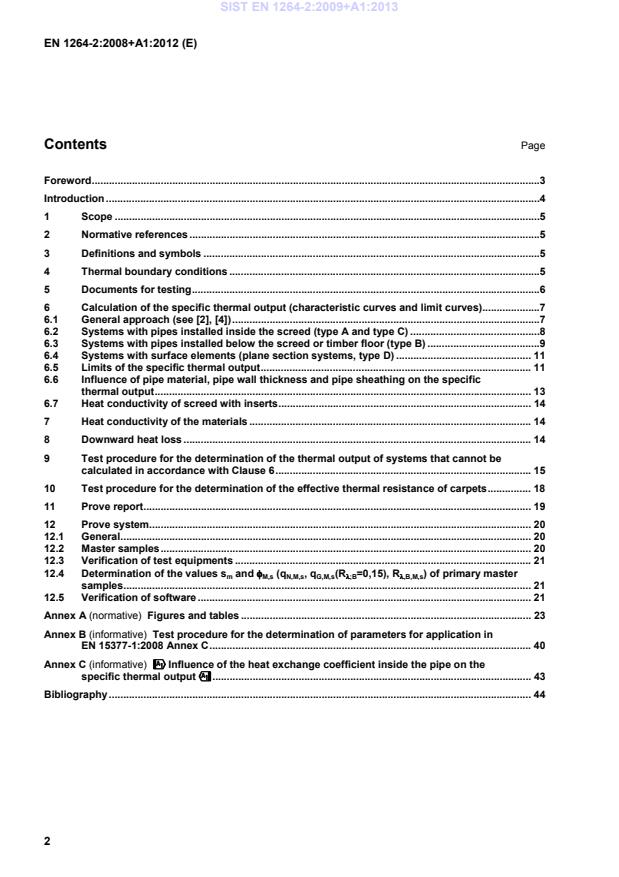
Figures and tables . 23Annex B (informative)
Test procedure for the determination of parameters for application in EN 15377-1:2008 Annex C . 40Annex C (informative)
!!!!Influence of the heat exchange coefficient inside the pipe on the specific thermal output"""" . 43Bibliography . 44 SIST EN 1264-2:2009+A1:2013
1) National regulations may limit this temperature to a lower value. 2) Some floor covering materials may require lower temperatures. SIST EN 1264-2:2009+A1:2013
= 1,06; au is the covering factor in accordance with Equation (12); aB is the floor covering factor: B,TuBTRaaBam⋅⋅⋅+=11 (17) 6.5 Limits of the specific thermal output The procedure for the determination of the limits of the specific thermal output is shown in principle within Figure A.5. The limit curve (see Figure A.5) gives the relationship between the specific thermal output and the temperature difference between the heating medium and the room for cases where the maximum permissible difference between surface temperature and indoor room temperature (9 K or 15 K respectively) is achieved. The limit curve is calculated using the following expression in form of a product: GHGGnBq⋅⋅=ϕθ∆ϕ (18) where SIST EN 1264-2:2009+A1:2013
11GiiGGH,nmiaBB−⋅⋅=ϕϑ∆ (20) For type A and type C systems, the above mentioned Equations (18) and (20) apply directly to pipe spacing T ≤ 0,375 m. In case of spacing T > 0,375 m, for these systems the following conversion shall be made: GGGfTqq⋅=375,0375,0; (21) GGH,GH,f⋅=375,0;ûûϑϑ (22) where qG; 0,375 is the limit specific thermal output, calculated for a spacing T = 0,375 m; ϑH, G; 0,375 is the limit temperature difference between the heating medium and the room, calculated for a spacing T = 0,375 m. The factor fG shall be determined as follows, depending on the ratio su/T: For su/T ≤ 0,173, fG = 1 applies. For su/T > 0,173, the following equation applies: TqeTqqqfTs375,0)375,0(375,0)173,0/(20375,02⋅⋅⋅−−=−⋅−G;G;maxG,maxG,Gu (23) where SIST EN 1264-2:2009+A1:2013
∆ϑH, G is designated as standard temperature difference between the heating medium and the room ∆ϑN (see Figure A.5). These values serve as characteristic values in the system comparison. The maximum possible value of the specific thermal output qG, max for an isothermal surface temperature distribution is represented by the ordinate value for ϑF, m = ϑF, max on the basic characteristic curve (see Figure A.1). Table A.12 gives values for qG, max, depending on the maximum floor surface temperature ϑF, max and the standard indoor room temperature ϑi. If (due to calculation and interpolation inaccuracies as well as linearization) higher values for qG than qG, max are calculated using Equations (18), (21), (24), qG, max has to be used. 6.6 Influence of pipe material, pipe wall thickness and pipe sheathing on the specific thermal output The factors B0 are specified in Equations (4a) and (11) for a pipe heat conductivity λR, 0 = 0,35 W/(m ⋅ K), a wall thickness sR, 0 = 0,002 m. For other materials (see Table A.13) with a heat conductivity of the pipe material λR or other wall thicknesses sR, the factor B shall be calculated using: ()⋅⋅Π⋅π+=Ta1,1B1B1mi0ii (25) −λ−−λ00,s2ddln21s2ddln21R,aaRRaaR If the pipe has an additional sheathing with an external diameter dM, an internal diameter da and a heat conductivity of the sheathing λM, the following equation applies: SIST EN 1264-2:2009+A1:2013
downward specific heat loss q
specific thermal output of the floor heating system RU
downwards partial heat transmission resistance of the floor structure RO
upwards partial heat transmission resistance of the floor structure ϑi
standard indoor room temperature of the floor heated room ϑU
indoor room temperature of a room under the floor heated room SIST EN 1264-2:2009+A1:2013
1/α at the floor surface is simulated by the heat transfer layer (see key 2).The two lateral heating pipes serve as a protection field to enable the optimum undisturbed temperature field around the central pipe. The heat transfer resistance 1/α at the floor surface, given by the basic characteristic curve, is replaced by the heat conduction resistance s/λ of the heat transfer layer (see key 2) of equal magnitude (mean value): 1/α = s/λ = 0,092 6 m2 ⋅ K/W
(32) The tolerance on the value s/λ is ± 0,01 m2 ⋅ K/W. The temperature drop of the sample ϑV –ϑR (see Figure A.8) shall not exceed 0,5 K. The temperature rise of the water flow in the cooling plates ϑC,out – ϑC,in (see Figure A.7) shall not exceed 0,3 K. ϑV
is the heat water supply temperature of the sample ϑR
is the heat water return temperature of the sample SIST EN 1264-2:2009+A1:2013
214,F5,Fmax,Fϑ+ϑ=ϑ where i,Fϑ are the local floor surface temperatures (measuring points) m,Fϑ is the average floor surface temperature max,Fϑis the maximum floor surface temperature In the case of not feasible values of the measured temperature field caused by inhomogeneity of the screed, another part of the surface shall be taken. NOTE 1 Because of the fact that the temperature drop of the sample ϑV –ϑR is very little and the fact that the temperature measurements shall be carried out in the undisturbed area around the central pipe no variation is necessary depending on the laying system (spirally or meandering). NOTE 2 The explanations above refer to the most usual case that the floor heating system is characterized by the repetition of the pipe spacing. The test sample in Figure A.6 which is symmetrical with respect to the central pipe is based on this fact. If another dimension characterizes the system the procedure has to be adjusted. In a first working step the test is realized for R,B = 0. The average floor surface temperature ϑF, m is determining the specific thermal output, and the maximum floor surface temperature ϑF, max is limiting the thermal output. The measurement is carried out when steady state conditions are reached and a temperature of both cooling plates of ϑi = 20 °C ± 0,5 K is maintained. Under these conditions the average temperature of the heating medium ϑH is set to achieve a maximum floor surface temperature of ϑF, max = 29 °C (i.e. ϑF, max – ϑi = 9 K), and in this case the difference between the average temperature of the heating medium and the temperature of the cooling plates ϑH - ϑi = ∆ϑH = ∆ϑN (standard value) applies. If it is not possible to set the value of the temperature difference (ϑF, max – ϑi) exactly to 9 K, a value slightly below and a value slightly above 9 K shall be set and the results used to formulate a mean value. SIST EN 1264-2:2009+A1:2013
(35) Using Equation (35), the gradients of the characteristic curves KH(Rλ, B) can be calculated for thermal resistances Rλ, B = 0,05 m2 ⋅ K/W, 0,10 m2 ⋅ K/W and 0,15 m2 ⋅ K/W. In order to establish the gradient of the characteristic curve HK′ to be used in Equation (35), another measurement like the one described above for Rλ, B = 0, has to be carried out, but with a resistance of the floor covering B,λR′ = 0,15 m2 ⋅ K/W ± 0,01 m2 ⋅ K/W. By doing this measurement, the limit specific thermal output Gq′ and the limit temperature difference ∆GH,ϑ′are determined, which give the needed value HK′: GH,B,HHϑ′′=′′=′û)(GqRKK (36) In accordance with the following Equation (37), the limit temperature differences ∆ϑH, G for the heat conduction resistances Rλ, B > 0 are given by the interfaces of the characteristic curves and the limit curve resulting from the measurement data and the gradient KH of the characteristic curve calculated from Equation (35): ∆ϑH, G = ϕ ⋅ GGqqqq′+−′−⋅′−⋅′NGHNHGHNNK)ûû(ûû,,ϑϑϑϑ
(37) For systems having several spacing, the maximum and the minimum spacing as well as sufficient intermediate spacing to achieve a spacing ratio not exceeding 1:2, shall be tested in accordance with the method described. Values for spacing not tested this way, shall be determined by interpolation using suitable polynomials. The results shall be presented in a prove report as specified in Clause 11. SIST EN 1264-2:2009+A1:2013
1m x 1m. The equipment is situated in the centre of the floor of a test booth in accordance with EN 14037-2 (Figure A.9), i.e. in a room with constant controlled ambient room temperatures. Between the test equipment and the floor of the booth insulation is recommended (key 3). The essential parts of the equipment are a heating plate (key 2) in accordance with the cooling plate in Figure A.7, a heat flow meter plate (key 1) with a well-known thermal conduction resistance RHFM, temperature measuring sensors on the surfaces and a globe thermometer Gl according to EN 14037-2. NOTE Between the heat flow meter plate (key 1) and the heating plate (key 2) an elastic layer shall be interposed, for instance consisting of PE lather of about 2 mm thickness. The meaning of the used symbols is as follows: q
specific thermal output ϑGl
ambient reference temperature measured with globe thermometer ϑH
average heating medium temperature ϑHFM,a
temperature of the surface on top of the heat flow meter plate ϑHFM,b
temperature of the surface at the bottom of the heat flow meter plate R.
heat exchange resistance on the heating surface RHFM
thermal conduction resistance of the heat flow meter plate Rλ,B
effective thermal resistance of carpet covering subscripts 1: means test 1 (example: ϑGl,1 is the valid value of ϑGl of test 1) 2: means test 2 (example: ϑGl,2 is the valid value of ϑGl of test 2) For the thermal conduction resistance of the heat flow meter plate the following specification is valid: The material of the plate is plexiglass with the thickness of 10 mm. Its thermal conduction resistance depends on the temperature t as follows: RHFM = - 0,000188 ⋅ t + 0,0578 m2·K/W with t = (ϑHFM,a + ϑHFM,b)/2 Temperatures shall be measured with a permissible uncertainty of ± 0,1 K. Temperature differences shall be measured with a permissible uncertainty of ± 0,05 K. The temperature drop of the heating medium shall not exceed 0,5 K if possible. Two test procedures are necessary. The globe thermometer in both cases is situated 0,75 m above the centre of the heating surface, i.e. in test 2 higher above the floor of the test booth by the thickness of the carpet. Test 1 Test 1 aims to the determination of the heat exchange resistance R. In this test the heating surface is the upper surface of the heat flow meter plate and no carpet exists, see Figure A.10. SIST EN 1264-2:2009+A1:2013
q = 80 ± 2,0 W/m2 With this value, the measured temperatures ϑHFM,a,2, ϑGl,2 and the value R. of test 1 the effective thermal resistance of the carpet covering can be calculated as follows: αλ−ϑ−ϑ=Rq)(R2,Gl2,a,HFMB, (41) Following from the described procedure, i.e. the determination of R. without carpet, the gained value Rλ,B of Equation (41) includes not only the thermal conduction resistance but also (should the occasion arise) the above mentioned effect of a changed heat exchange coefficient. This attribute is necessary for using this value for the determination of the thermal output according to the calculation method (Clause 6) and to the test procedure (Clause 9). For that reason the supplement "effective" is used. For carpets used in practice as floor covering for floor heating systems only values Rλ,B determined by the test method described above are valid to determinate the t
...
Questions, Comments and Discussion
Ask us and Technical Secretary will try to provide an answer. You can facilitate discussion about the standard in here.
Loading comments...