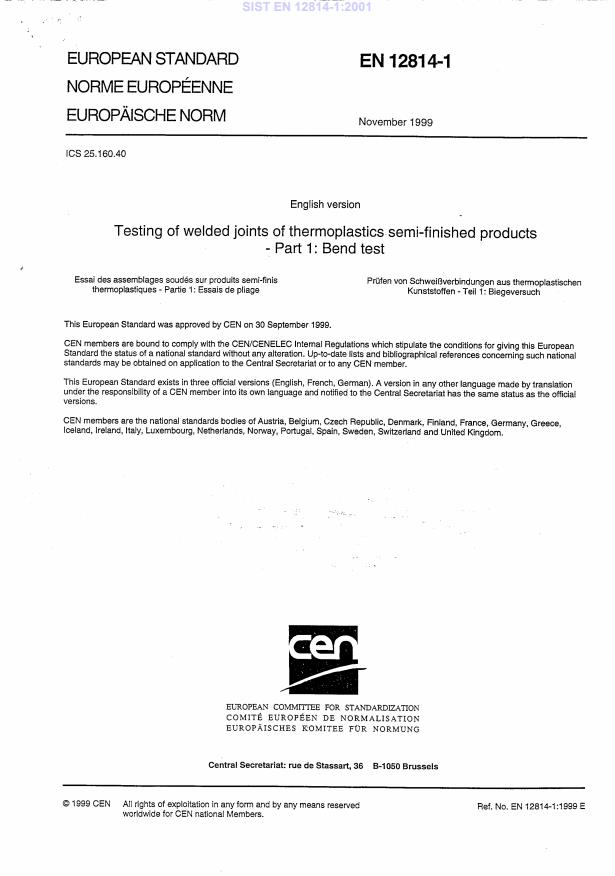
Testing of welded joints of thermoplastics semi-finished products - Part 1: Bend test

This standard specifies the dimensions and the method for sampling and preparing test specimens, together with the conditions for carrying out the bend test. The result of the test is also influenced by the deformation behaviour of the tested material, the kind of welding process and the geometry of the sample. The test is applicable to plate and tube butt jointed assemblies made from thermoplastic materials filled or unfilled, but not reinforced, irrespective of the welding process used. It is not applicable to assemblies with a wall thickness < 3 mm.

Prüfen von Schweißverbindungen aus thermoplastischen Kunststoffen - Teil 1: Biegeversuch

Die vorliegende Norm legt die Maße, das Verfahren für die Probenahme und die Herstellung von Proben sowie die Bedingungen für die Durchführung des Biegeversuchs fest. Das Prüfergebnis wird unter anderem durch das Verformungsverhalten des geprüften Werkstoffs, die Art des Schweißverfahrens und die Probengeometrie beeinflußt. Die Prüfung ist unabhängig vom angewendeten Schweißverfahren auf stumpfgeschweißte Platten- oder Rohrverbindungen aus thermoplastischen Kunststoffen mit oder ohne Füllstoff anwendbar, die jedoch nicht verstärkt sein dürfen.

Essai des assemblages soudés sur produits semi-finis thermoplastiques - Partie 1: Essais de pliage

La présente norme européenne définit les dimensions et les méthodes pour le prélèvement et la préparation des éprouvettes, ainsi que les conditions de l'essai de pliage. Le résultat de l'essai est également influencé par le comportement à la déformation du matériau soumis à l'essai, par le procédé de soudage utilisé et par la géométrie de l'échantillon. Cet essai est applicable aux assemblages en matières thermoplastiques chargées ou non chargées, mais non renforcées, sous forme de plaque ou de tube, soudés bout à bout, quel que soit le procédé de soudage utilisé.

Preskus zvarjenih spojev plastomernih polizdelkov - 1. del: Preskus upogibnosti

General Information

Status
Withdrawn
Publication Date
16-Nov-1999
Withdrawal Date
05-Dec-2025
Current Stage
9092 - Decision on results of review/2YR ENQ - revise - Review Enquiry
Start Date
19-Jan-2024
Completion Date
06-Dec-2025

Relations

Standard
EN 12814-1:2001
English language
15 pages
sale 10% off
Preview
sale 10% off
Preview
e-Library read for
1 day

Frequently Asked Questions

EN 12814-1:1999 is a standard published by the European Committee for Standardization (CEN). Its full title is "Testing of welded joints of thermoplastics semi-finished products - Part 1: Bend test". This standard covers: This standard specifies the dimensions and the method for sampling and preparing test specimens, together with the conditions for carrying out the bend test. The result of the test is also influenced by the deformation behaviour of the tested material, the kind of welding process and the geometry of the sample. The test is applicable to plate and tube butt jointed assemblies made from thermoplastic materials filled or unfilled, but not reinforced, irrespective of the welding process used. It is not applicable to assemblies with a wall thickness < 3 mm.

This standard specifies the dimensions and the method for sampling and preparing test specimens, together with the conditions for carrying out the bend test. The result of the test is also influenced by the deformation behaviour of the tested material, the kind of welding process and the geometry of the sample. The test is applicable to plate and tube butt jointed assemblies made from thermoplastic materials filled or unfilled, but not reinforced, irrespective of the welding process used. It is not applicable to assemblies with a wall thickness < 3 mm.

EN 12814-1:1999 is classified under the following ICS (International Classification for Standards) categories: 25.160.40 - Welded joints and welds. The ICS classification helps identify the subject area and facilitates finding related standards.

EN 12814-1:1999 has the following relationships with other standards: It is inter standard links to EN 12814-1:2025, EN 12814-1:1999/AC:2003; is excused to EN 12814-2:2000, EN 12814-8:2001, EN 12814-6:2000, EN 12814-7:2002, EN 12814-4:2001, EN 12814-3:2000, EN 12814-5:2000. Understanding these relationships helps ensure you are using the most current and applicable version of the standard.

You can purchase EN 12814-1:1999 directly from iTeh Standards. The document is available in PDF format and is delivered instantly after payment. Add the standard to your cart and complete the secure checkout process. iTeh Standards is an authorized distributor of CEN standards.

Standards Content (Sample)


2003-01.Slovenski inštitut za standardizacijo. Razmnoževanje celote ali delov tega standarda ni dovoljeno.Preskus zvarjenih spojev plastomernih polizdelkov - 1. del: Preskus upogibnostiPrüfen von Schweißverbindungen aus thermoplastischen Kunststoffen - Teil 1: BiegeversuchEssai des assemblages soudés sur produits semi-finis thermoplastiques - Partie 1: Essais de pliageTesting of welded joints of thermoplastics semi-finished products - Part 1: Bend test25.160.40Varjeni spoji in variWelded jointsICS:Ta
...

Questions, Comments and Discussion

Ask us and Technical Secretary will try to provide an answer. You can facilitate discussion about the standard in here.

Loading comments...

Die Norm EN 12814-1:1999 befasst sich mit der Prüfung von geschweißten Verbindungen thermoplastischer Halbzeuge und bietet spezifische Vorgaben für die Durchführung von Biegetests. Sie legt die Dimensionen sowie die Methoden zur Entnahme und Vorbereitung von Prüfn deutlich fest und definiert die Bedingungen, unter denen der Biegetest durchgeführt werden muss. Ein herausragendes Merkmal dieser Norm ist die Berücksichtigung des Deformationsverhaltens des getesteten Materials, des verwendeten Schweißverfahrens und der Geometrie der Probe, was die Validität der Testergebnisse erhöht. Die Anwendung der Norm ist insbesondere relevant für Platten- und Rohrverbindungen, die aus ungefüllten oder gefüllten thermoplastischen Materialien bestehen, jedoch nicht verstärkt sind. Dies zeigt die Vielseitigkeit der Norm, da sie für diverse Kunststoffarten und Schweißverfahren Anwendung findet. Die explizite Ausschlussklausel für Komponenten mit einer Wandstärke von weniger als 3 mm gewährleistet, dass die Norm nur auf geeignete Produkte zutrifft, was die Zuverlässigkeit der Testergebnisse weiter erhöht. Ein weiterer Vorteil der EN 12814-1:1999 liegt in der Standardisierung des Prüfprozesses, die es ermöglicht, Vergleichbarkeit und Nachvollziehbarkeit der Ergebnisse über verschiedene Prüfungen hinweg zu gewährleisten. Dies ist besonders wichtig für die Qualitätssicherung in der Kunststoffverarbeitung und in der Industrie, die thermoplastische Materialien verwendet. Insgesamt zeigt sich, dass die Norm EN 12814-1:1999 eine essentielle Richtlinie für die Prüfung von geschweißten Verbindungen thermoplastischer Halbzeuge darstellt, welche die wissenschaftlichen und industriellen Anforderungen an die Qualität und Sicherheit von Kunststoffverbindungen adressiert. Die Stärken liegen in der klaren Definition der Prüfmethoden, der Berücksichtigung relevanter Faktoren und der breiten Anwendbarkeit, was sie zu einem unverzichtbaren Bestandteil der Normung im Bereich der Thermoplastik macht.

EN 12814-1:1999は、熱可塑性半製品の溶接接合部の試験に関する重要な基準です。この規格は、試験標本の採取と準備のための寸法および方法を明確に規定しており、曲げ試験を実施するための条件も示しています。特に、試験結果は被験材料の変形挙動、溶接プロセスの種類、サンプルの形状によっても影響を受けるため、これらの要素を考慮することが重要です。 この基準は、熱可塑性材料で作られた板および管の端面接合体に適用可能であり、充填剤の有無にかかわらず、強化材を含まない構造において使用されます。ただし、壁厚が3 mm未満の組立品には適用されないため、適切な材料選定が求められます。このように、EN 12814-1:1999は、様々な熱可塑性材料の溶接に関する実践的なガイドラインを提供し、業界における標準化の重要性を強調しています。 この標準の強みは、具体的な試験手順と条件を提供することで、試験の一貫性と再現性を確保する点にあります。また、材料の物性や形状の違いに対応するための柔軟性があり、これにより製造業者は自社の製品特性に応じた評価が可能になります。このように、EN 12814-1:1999は、熱可塑性材料の溶接試験における信頼性の高い基準として、現場での適用性と有用性を兼ね備えています。

The EN 12814-1:1999 standard provides a comprehensive framework for the testing of welded joints in thermoplastics semi-finished products, focusing specifically on the bend test. This document meticulously outlines the dimensions and methodologies for sampling and preparing test specimens, ensuring that practitioners have clear guidelines to follow. One of the notable strengths of this standard is its detailed description of the conditions necessary for conducting the bend test, which is crucial for achieving accurate and reliable results. The emphasis on the deformation behaviour of the thermoplastic materials, the welding processes utilized, and the sample geometry underscores the standard's relevance in real-world applications, allowing for variations in material properties and joint configurations. The applicability of this standard extends to both plate and tube butt jointed assemblies made from thermoplastic materials, whether filled or unfilled, albeit not reinforced, which broadens its utility in various industrial contexts. Moreover, the specification delineates a clear boundary by noting that it is not applicable for assemblies with a wall thickness of less than 3 mm, thus streamlining the testing process to relevant scenarios. Overall, the EN 12814-1:1999 standard stands out for its thoroughness in addressing the complexities of testing welded joints in thermoplastics. Its well-defined scope, combined with its robust methodology for the bend test, makes it an indispensable resource for manufacturers and quality assurance professionals working with thermoplastic materials.

EN 12814-1:1999는 열가소성 반제품의 용접 이음부 시험에 대한 표준으로, 특히 굽힘 시험 방법을 규정하고 있습니다. 이 표준은 샘플 시편의 치수와 준비 방법, 그리고 굽힘 시험을 수행하는 조건을 명확하게 정의하고 있어, 테스트의 일관성과 정확성을 보장합니다. 이러한 표준화는 다양한 열가소성 재료의 용접 품질을 평가하는 데 필수적인 요소로 작용합니다. 이 표준의 강점은 용접 공정의 종류와 샘플의 기하학적 형상에 따른 변형 거동의 영향을 고려하여, 실제 재료의 성질을 정확하게 반영할 수 있는 시험 방법을 제시한다는 점입니다. 또한, 표준은 3mm 이상의 두께를 가진 판 및 튜브의 맞대기 용접 조립체에 적용 가능하며, 이는 다양한 산업 분야에서 널리 사용되는 열가소성 재료의 용접 품질 보증에 큰 도움이 됩니다. EN 12814-1:1999는 용접된 열가소성 제품의 신뢰성과 내구성을 평가하기 위한 기초가 되며, 산업계에서 필수적인 기준으로 자리잡고 있습니다. 이 문서의 체계적인 접근 방식은 품질 관리 및 제조 과정에서 중요한 역할을 하며, 열가소성 재료의 적절한 사용과 그에 따른 성능 분석에 대한 요구를 충족합니다. 따라서 이 표준은 열가소성 반제품의 시험 및 평가에 있어 핵심적인 역할을 하며, 그 관련성은 미래에도 변하지 않을 것입니다.

La norme EN 12814-1:1999, intitulée "Testing of welded joints of thermoplastics semi-finished products - Part 1: Bend test", se distingue par sa portée exacte et ses spécifications techniques. Elle établit des directives claires concernant les dimensions et la méthode pour l'échantillonnage et la préparation des échantillons de test, tout en précisant les conditions dans lesquelles le test de flexion doit être réalisé. La force de cette norme réside dans sa capacité à prendre en compte divers facteurs qui influencent les résultats, tels que le comportement de déformation du matériau testé, le type de procédé de soudage utilisé et la géométrie de l'échantillon. En clarifiant ces éléments, la norme assure une approche cohérente et standardisée pour l’évaluation des joints soudés des produits semi-finis en thermoplastique. Sa pertinence est particulièrement marquée car elle s'applique aux assemblages soudés, que ce soit pour des plaques ou des tubes, fabriqués à partir de matériaux thermoplastiques, qu'ils soient remplis ou non, mais sans renforcement. Il est également important de noter que la norme exclut explicitement les assemblages ayant une épaisseur de paroi inférieure à 3 mm, ce qui précise davantage son champ d'application. Dans un contexte industriel où la qualité des assemblages en thermoplastique est cruciale, cette norme représente un outil essentiel pour garantir la conformité et la fiabilité des joints soudés, renforçant ainsi la confiance dans les produits fabriqués. En résumé, la norme EN 12814-1:1999 s'avère être un cadre précieux pour les professionnels du secteur, permettant de standardiser les tests de flexion et de promouvoir des pratiques sûres et efficaces dans le domaine du soudage de thermoplastiques.