


EN 15273-1:2013
(Main)Railway applications - Gauges - Part 1: General - Common rules for infrastructure and rolling stock
General Information
- Abstract
This European Standard is applicable to authorities involved in railway operation and may also be applied for light vehicles (e.g. trams, metros, etc. running on two rails) and their associated infrastructure, but not for systems such as rail-guided buses.
It allows rolling stock and infrastructures to be dimensioned and their compliance to be checked relative to applicable gauging rules.
For rolling stock and infrastructure, this standard is applicable to new designs, to modifications and to the checking of vehicles and infrastructures already in use.
This document EN 15273-1 covers:
the general principles;
the various elements and phenomena affecting the determination of gauges;
the various calculation methods applicable to the elements shared by the infrastructure and by the rolling stock;
the sharing rules for elements taken into account in calculations specific to the infrastructure and to the rolling stock;
a catalogue of European gauges.
This document does not cover:
conditions to be met to ensure safety of passengers on platforms and of persons required to walk along the tracks;
conditions to be met by the fixed equipment maintenance machines in active position;
the space to be cleared for the running track of rubber-tyred metros and other vehicles;
rules applicable to extraordinary transportation, however some formulae may be used;
rules applicable to the design of the overhead contact line system;
rules applicable to the design of the current collection system on a third rail;
simulation methods for the running of vehicles, however, it does not confirm the validity of existing simulations;
verification rules of wagon loadings;
coding methods for combined transportation;
infrastructure gauges for very small curve radii (e.g. R < 150 m for gauge G1).
- Status
- Withdrawn
- Publication Date
- 07-May-2013
- Withdrawal Date
- 16-Sep-2026
- Technical Committee
- CEN/TC 256 - Railway applications
- Drafting Committee
- CEN/TC 256/WG 32 - Vehicle gauge
- Current Stage
- 9960 - Withdrawal effective - Withdrawal
- Start Date
- 16-Nov-2016
- Completion Date
- 17-Sep-2026


Relations
- Effective Date
- 15-May-2013
- Effective Date
- 18-Jan-2023
- Effective Date
- 09-Feb-2026
- Effective Date
- 09-Feb-2026
- Effective Date
- 28-Jan-2026
- Effective Date
- 28-Jan-2026
- Effective Date
- 28-Jan-2026
- Effective Date
- 28-Jan-2026
- Effective Date
- 28-Jan-2026
- Effective Date
- 28-Jan-2026
- Effective Date
- 28-Jan-2026
- Effective Date
- 28-Jan-2026
- Effective Date
- 08-Jul-2015
- Effective Date
- 05-Jun-2013
Get Certified
Connect with accredited certification bodies for this standard

IRIS Certification (UNIFE)
International Railway Industry Standard certification.

TÜV SÜD Rail GmbH
TÜV SÜD railway certification services.

Bureau Veritas Railway Certification
Railway and transportation certification.
Sponsored listings
Frequently Asked Questions
EN 15273-1:2013 is a standard published by the European Committee for Standardization (CEN). Its full title is "Railway applications - Gauges - Part 1: General - Common rules for infrastructure and rolling stock". This standard covers: This European Standard is applicable to authorities involved in railway operation and may also be applied for light vehicles (e.g. trams, metros, etc. running on two rails) and their associated infrastructure, but not for systems such as rail-guided buses. It allows rolling stock and infrastructures to be dimensioned and their compliance to be checked relative to applicable gauging rules. For rolling stock and infrastructure, this standard is applicable to new designs, to modifications and to the checking of vehicles and infrastructures already in use. This document EN 15273-1 covers: the general principles; the various elements and phenomena affecting the determination of gauges; the various calculation methods applicable to the elements shared by the infrastructure and by the rolling stock; the sharing rules for elements taken into account in calculations specific to the infrastructure and to the rolling stock; a catalogue of European gauges. This document does not cover: conditions to be met to ensure safety of passengers on platforms and of persons required to walk along the tracks; conditions to be met by the fixed equipment maintenance machines in active position; the space to be cleared for the running track of rubber-tyred metros and other vehicles; rules applicable to extraordinary transportation, however some formulae may be used; rules applicable to the design of the overhead contact line system; rules applicable to the design of the current collection system on a third rail; simulation methods for the running of vehicles, however, it does not confirm the validity of existing simulations; verification rules of wagon loadings; coding methods for combined transportation; infrastructure gauges for very small curve radii (e.g. R < 150 m for gauge G1).
This European Standard is applicable to authorities involved in railway operation and may also be applied for light vehicles (e.g. trams, metros, etc. running on two rails) and their associated infrastructure, but not for systems such as rail-guided buses. It allows rolling stock and infrastructures to be dimensioned and their compliance to be checked relative to applicable gauging rules. For rolling stock and infrastructure, this standard is applicable to new designs, to modifications and to the checking of vehicles and infrastructures already in use. This document EN 15273-1 covers: the general principles; the various elements and phenomena affecting the determination of gauges; the various calculation methods applicable to the elements shared by the infrastructure and by the rolling stock; the sharing rules for elements taken into account in calculations specific to the infrastructure and to the rolling stock; a catalogue of European gauges. This document does not cover: conditions to be met to ensure safety of passengers on platforms and of persons required to walk along the tracks; conditions to be met by the fixed equipment maintenance machines in active position; the space to be cleared for the running track of rubber-tyred metros and other vehicles; rules applicable to extraordinary transportation, however some formulae may be used; rules applicable to the design of the overhead contact line system; rules applicable to the design of the current collection system on a third rail; simulation methods for the running of vehicles, however, it does not confirm the validity of existing simulations; verification rules of wagon loadings; coding methods for combined transportation; infrastructure gauges for very small curve radii (e.g. R < 150 m for gauge G1).
EN 15273-1:2013 is classified under the following ICS (International Classification for Standards) categories: 45.020 - Railway engineering in general; 45.060.01 - Railway rolling stock in general. The ICS classification helps identify the subject area and facilitates finding related standards.
EN 15273-1:2013 has the following relationships with other standards: It is inter standard links to EN 15273-1:2009, EN 15273-1:2013+A1:2016, EN 50119:2020, EN 50367:2020, EN 15313:2024, EN 14067-3:2003, EN 14067-4:2024+A1:2025, EN 15273-3:2013, EN 14363:2016+A2:2022, EN 15273-2:2013, EN 16207:2014+A1:2019, EN 16207:2014, EN 15273-1:2013/FprA1, prEN 15273-1:2018. Understanding these relationships helps ensure you are using the most current and applicable version of the standard.
EN 15273-1:2013 is associated with the following European legislation: EU Directives/Regulations: 2008/57/EC; Standardization Mandates: M/483. When a standard is cited in the Official Journal of the European Union, products manufactured in conformity with it benefit from a presumption of conformity with the essential requirements of the corresponding EU directive or regulation.
EN 15273-1:2013 is available in PDF format for immediate download after purchase. The document can be added to your cart and obtained through the secure checkout process. Digital delivery ensures instant access to the complete standard document.
Standards Content (Sample)
2003-01.Slovenski inštitut za standardizacijo. Razmnoževanje celote ali delov tega standarda ni dovoljeno.Železniške naprave - Profili - 1. del: Splošno - Skupna pravila, ki se nanašajo na infrastrukturo in železniška vozilaBahnanwendungen - Begrenzungslinien - Teil 1: Allgemeines - Gemeinsame Vorschriften für Infrastruktur und FahrzeugeApplications ferroviaires - Gabarits - Partie 1: Généralités - Règles communes à l'infrastructure et au matériel roulantRailway applications - Gauges - Part 1: General - Common rules for infrastructure and rolling stock45.060.01Železniška vozila na splošnoRailway rolling stock in generalICS:Ta slovenski standard je istoveten z:EN 15273-1:2013SIST EN 15273-1:2013en,fr,de01-julij-2013SIST EN 15273-1:2013SLOVENSKI
STANDARDSIST EN 15273-1:20111DGRPHãþD
EUROPEAN STANDARD NORME EUROPÉENNE EUROPÄISCHE NORM
EN 15273-1
May 2013 ICS 45.020; 45.060.01 Supersedes EN 15273-1:2009English Version
Railway applications - Gauges - Part 1: General - Common rules for infrastructure and rolling stock
Applications ferroviaires - Gabarits - Partie 1: Généralités -Règles communes à l'infrastructure et au matériel roulant Bahnanwendungen - Begrenzungslinien - Teil 1: Allgemeines - Gemeinsame Vorschriften für Infrastruktur und Fahrzeuge This European Standard was approved by CEN on 15 December 2012.
CEN members are bound to comply with the CEN/CENELEC Internal Regulations which stipulate the conditions for giving this European Standard the status of a national standard without any alteration. Up-to-date lists and bibliographical references concerning such national standards may be obtained on application to the CEN-CENELEC Management Centre or to any CEN member.
This European Standard exists in three official versions (English, French, German). A version in any other language made by translation under the responsibility of a CEN member into its own language and notified to the CEN-CENELEC Management Centre has the same status as the official versions.
CEN members are the national standards bodies of Austria, Belgium, Bulgaria, Croatia, Cyprus, Czech Republic, Denmark, Estonia, Finland, Former Yugoslav Republic of Macedonia, France, Germany, Greece, Hungary, Iceland, Ireland, Italy, Latvia, Lithuania, Luxembourg, Malta, Netherlands, Norway, Poland, Portugal, Romania, Slovakia, Slovenia, Spain, Sweden, Switzerland, Turkey and United Kingdom.
EUROPEAN COMMITTEE FOR STANDARDIZATION
COMITÉ EUROPÉEN DE NORMALISATION EUROPÄISCHES KOMITEE FÜR NORMUNG
Management Centre:
Avenue Marnix 17,
B-1000 Brussels © 2013 CEN All rights of exploitation in any form and by any means reserved worldwide for CEN national Members. Ref. No. EN 15273-1:2013: ESIST EN 15273-1:2013
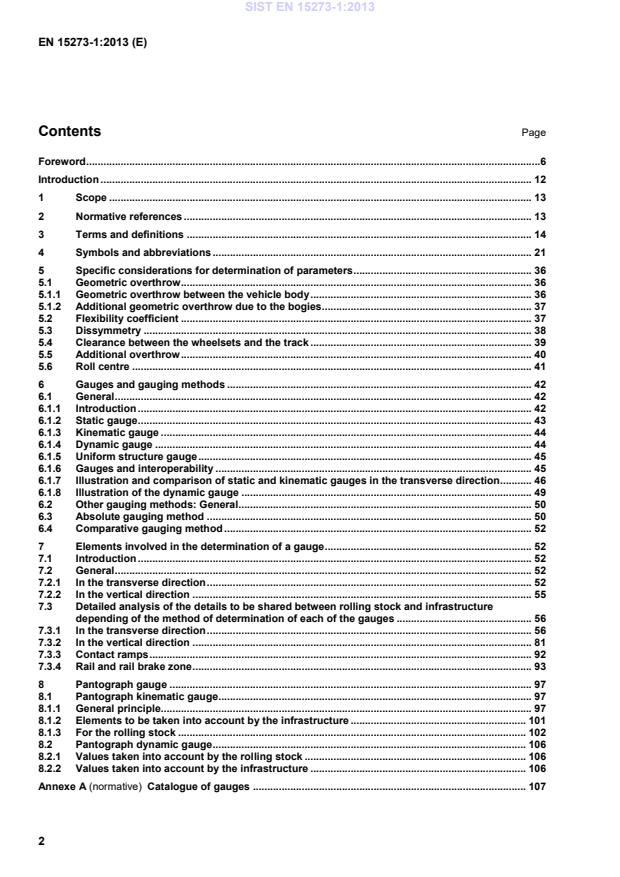
Catalogue of gauges . 107 SIST EN 15273-1:2013
Reference profiles and associated rules for static gauges . 110 B.1 Static gauges G1 and G2 . 110 B.1.1 Upper parts of static gauges G1 and G2 . 110 B.1.2 Lower parts of static gauges GI1 and GI2 . 112 B.2 Static gauges GA, GB and GC . 115 B.2.1 Lateral part . 115 B.2.2 Static reference profiles for the upper parts . 115 B.2.3 Associated rules . 116 B.3 Static gauge GB1 and GB2 . 120 B.3.1 Lateral part . 120 B.3.2 Static reference profiles for the upper parts . 120 B.3.3 Associated rules . 121 B.4 Static gauges OSJD . 123 B.4.1 General comment . 123 B.4.2 Static reference profiles for the upper parts . 123 B.4.3 Associated rules . 126 B.4.4 Static reference profiles for the lower parts . 127 B.5 Static gauge FIN 1 . 128 B.5.1 General comment . 128 B.5.2 Static reference profile for the upper parts . 128 B.5.3 Associated rules . 130 B.5.4 Position of the platforms . 130 B.6 Spanish static gauges GHE16, GEA16, GEB16, GEC16, GEE10 and GED10 . 131 B.6.1 Reference profiles for static gauges . 131 B.6.2 Basic rules . 137 Annexe C (normative)
Reference profiles and associated rules for kinematic gauges . 141 C.1 Kinematic gauges G1 and G2 . 141 C.1.1 Upper part of gauges G1 and G2 . 141 C.1.2 Gauges of the lower parts of GI1, GI2 . 143 C.2 Kinematic gauges GA, GB, and GC . 146 C.2.1 Lateral part . 146 C.2.2 Kinematic reference profiles for the upper parts . 146 C.2.3 Associated rules . 147 C.3 Kinematic gauges GB1 and GB2 . 149 C.3.1 Lateral part . 149 C.3.2 Kinematic reference profiles for the upper parts . 149 C.3.3 Associated rules . 150 C.4 Kinematic gauge GI3 . 151 C.4.1 Upper parts . 151 C.4.2 Reference profile for the lower parts . 152 C.4.3 Associated rules . 153 C.5 Kinematic gauge FR3.3 . 153 C.5.1 Lateral part . 153 C.5.2 Kinematic reference profile for upper parts . 153 C.5.3 Associated rules . 154 C.6 Kinematic gauges BE1, BE2 and BE3 . 156 C.6.1 Lateral part . 156 C.6.2 Kinematic reference profiles for the upper parts . 156 C.6.3 Associated rules . 158 C.6.4 Kinematic reference profiles for the lower parts . 159 C.7 Kinematic gauges NL1 and NL2 . 160 C.7.1 Reference profiles of kinematic gauges NL1 and NL2 . 160 C.7.2 Associated rules . 161 C.8 Kinematic gauges PTb, PTb+ and PTc . 162 SIST EN 15273-1:2013
Reference profiles and associated rules for dynamic gauges . 184 D.1
General . 184 D.2 Dynamic gauge SEa and SEc . 184 D.2.1 Dynamic reference profile SEa . 184 D.2.2 Dynamic reference profile SEc . 186 D.2.3 Associated rules . 186 Annexe E (normative)
Uniform gauges . 188 E.1 General information on gauges GUC, GU1, GU2 and Z-dČa . 188 E.2 Uniform gauge GU1 . 188 General . 188 E.2.1 Basic data . 189 E.3 Uniform gauge Z -dČa . 190 E.3.1 Uniform reference profile . 190 E.3.2 Basic data . 191 Annexe F (normative)
Specific rules in the vertical direction . 192 F.1 General . 192 F.2 Passing over link spans onto ferries . 192 F.3 Marshalling humps . 193 F.3.1 Convention for gauges in groups G1, G2, GA, GB, GB1, GB2, GC, FR3.3, BE1, BE2, BE3, GHE16, GEA16, GEB16, GEC16, GEC14, GEE10 AND GED10, etc. . 193 F.3.2 Other agreements . 196 Annexe G (normative)
Rules relating to pantographs . 197 G.1 Catalogue of standard heads . 197 G.2 Reference vehicle parameters . 197 G.3 Electrical insulating allowances . 198 G.4 Characteristics of the collection system . 198 G.5 Specific cases . 199 G.5.1 Pantograph gauges linked to gauges BE1, BE2 and BE3, 3kV network . 199 G.5.2 Pantograph gauges linked to gauges BE1, BE2 and BE3, 25 kV network . 200 Annexe H (normative)
Rules relating to access steps and platform installation . 201 H.1 Actual and conventional gap between step and platform: general . 201 H.2 Actual and conventional gap between step and platform: position of the platforms . 203 H.2.1 Actual position of the platforms . 203 SIST EN 15273-1:2013
Widening of the vehicles according to the possibilities offered by the infrastructure . 208 I.1 General . 208 I.2 Possible gain on the track centre side . 208 I.2.1 Basic principle . 208 I.2.2 Application . 210 I.3 Possible gain on the structure side . 211 Annexe J (normative)
Application of the probability theory in conjunction with the limit values taking into account the oscillations and dissymmetry in the determination of allowance M1 . 212 J.1 General . 212 J.2 Reminder of some principles of the probability theory . 212 J.3 Taking into account oscillations and dissymmetry in the determination of allowance M1 . 213 J.3.1 General . 213 J.3.2 Additional comments . 214 Annexe K (informative)
A–deviations . 216 Bibliography . 218
7.3.2.2.2: change to the symbols, 7.3.2.2.3: new reference in the first Subclause, change to Figure 30 and its key, new Formulae (104), (105) and modified text, 7.3.2.2.4: new symbols in the text, new Formulae (106), (107), (108), 7.3.2.2.5: new reference in the first paragraph, change to Figure 31 and its key, new Formulae (109), (110), (111), (112) and modified text with new symbols, 7.3.2.4.1: change to the symbols and references, 7.3.2.4.2: change to symbols, references, new Formula (113) and new Figure 35, 7.3.2.4.3: new symbols and references in the text, change to Formulae (114), (115), (116), (121), 7.3.3: new symbols and references, change to Figure 38, 7.3.3.2: change to Formula (122), 7.3.3.3: new symbols and references in the text, 7.3.4.1.2: change to Formula (123), 7.3.4.1.3: change to references in the text, new Formula (124), new Figures 40 and 41, 7.3.4.1.5: new symbols and references in the text, new Formulae (125), new Figure 44, 8.1.1: change to text, SIST EN 15273-1:2013
8.1.3.1.4: change to text, 8.2.1: new Formulae (163), (164), (165), Annex A: change to Table A.1, Table A.2 and Table A.4, B.1.1.2.1: new symbol, B.1.1.2.2: new Table B.1, B.1.1.2.3: new introductory subclause and change to Table B.2, B.1.2.1: new key for Figure B.3, B.1.2.2: new title, new introductory subclause, new key and title for Figure B.4, B.1.2.3.1: new symbol and new Table B.5,
B.2.3.1: new symbol, B.2.3.2: new introductory subclause and change to Figure B.6, Table B.4, and Table B.5, B.2.3.3: new introductory subclause and new Table B.6, B.3.2: new references, B.3.3.1: new symbol, B.3.3.2: change to Table B.7 and Table B.8, B.3.3.3: new introductory subclause and change to Table B.9, B.4.2: new references, B.4.3.1: new symbol, B.4.3.2: new Table B.10, B.4.3.3: new text, B.4.4.1: new references, B.5.2: new references and new Figure B.15, B.5.3.1: new symbol, SIST EN 15273-1:2013
D.1.1: change to the first sentence and new Figure D.1, D.1.2: change to the first sentence and new Figure D.3, D.1.3.1: new symbol, D.1.3.2: new Table D.1, D.1.3.3: new Table D.2, E.1: change to the first sentence, E.2.2: new symbol and new formula, E.3.2: new symbol, Annex F: new introductory subclause, F.3.1: new title, F.3.1.1: new symbol, F.3.1.2: new Figure F.1 with new key, new text, new Formulae (F.2), (F.3), (F.4), (F.6), F.3.1.3: new text, new Formulae (F.8) and (F.10), F.3.2: new references, G.2: change to Table G.1, G.3: new references, G.4: change to Table G.3, G.5.1: change to symbols and formulae in the text, new Figures G.1 and G.2, G.5.2: changes to references, symbols and formulae in the text, SIST EN 15273-1:2013
EN 14067-2, Railway applications — Aerodynamics — Part 2: Aerodynamics on open track SIST EN 15273-1:2013
Key 1 running surface 2 centreline of the vehicle and of the track Figure 1 — Reference axes SIST EN 15273-1:2013
3.4 Reference Profile
RP line specific to each gauge, representing the cross-section shape and used as a common basis to work out the sizing rules of the infrastructure and of the rolling stock
3.5 upper parts, lower parts upper parts correspond to the upper zone of the gauge and the lower parts correspond to the lower zone of the gauge Note 1 to entry: The limit between the two parts is defined for each gauge.
3.6 associated rules mathematical laws associated with each reference profile in order to size the infrastructure or rolling stock
3.7 static gauge
combination of the specific reference profile and its associated static rules 3.8 kinematic gauge combination of the specific reference profile and its associated kinematic rules 3.9 dynamic gauge combination of the specific reference profile and its associated dynamic rules 3.10 absolute gauging method combination of a directory of the reference position of structures along a given route and of the dynamic rules associated with this route 3.11 comparative gauging method set of rules allowing the comparing of the swept envelopes of various vehicles on the basis of their dynamic movements 3.12 geometric overthrow
or difference between the distance, measured parallel to the running surface and in the transverse direction, of a part of the vehicle under consideration to the centre of a curved track with radius R and the distance of this same part, in the same conditions, to the centre of a straight track Note 1 to entry: See detailed explanation in 5.1. SIST EN 15273-1:2013
ratio of the angle (between the body tilted on its suspension with the plane perpendicular to the running surface) to the angle / (between the running surface and the horizontal plane with the vehicle stationary on a canted track) Note 1 to entry: See detailed explanation in 5.2. 3.14 dissymmetry
angle 0 that would be made by the centreline of the body of a stationary vehicle on a level track relative to the vertical in the absence of any friction Note 1 to entry: See detailed explanation in 5.3. 3.15 clearance between wheelsets and track
transverse displacement of the wheelset in relation to the track centre Note 1 to entry: See detailed explanation in 5.4. 3.16 transverse clearance between wheelset and body
sum of the amount “q” at the level of the axle boxes and of the amoun
...