


prEN 1366-14
(Main)Fire resistance tests for service installations - Part 14: Partial penetration seals
Fire resistance tests for service installations - Part 14: Partial penetration seals
This part of the EN 1366 series specifies a method of test and criteria for the evaluation (including field of direct application rules) of the ability of a partial penetration seal to maintain the fire resistance of a separating element at the position at which it has been penetrated by a device or devices that passes through one face of the element only. Partial penetration seals are used to seal apertures for electrical sockets, downlighters, media devices, cables and any item which requires an opening to be made in one face of the element of construction but does not include a device which passes through both faces. Supporting constructions are used in this part of the EN 1366 series to represent separating elements such as walls or floors. These simulate the interaction between the test specimen and the separating element into which the sealing system is to be installed in practice.
This part of the EN 1366 series is used in conjunction with EN 1363 1.
The purpose of a test described in this part of the EN 1366 series is to assess the integrity and insulation performance of the partial penetration seal, of the penetrating service(s) or device(s) and of the separating element in the surrounding area of the partial penetration seal. Where partial penetration seals are installed in ceilings and floors, the loadbearing capacity shall also be considered.
No information can be implied by the test concerning the influence of the inclusion of such penetrations and penetration seals on the loadbearing capacity of walls.
It is not the intention of this test to provide quantitative information on the rate of leakage of smoke and/or hot gases or on the transmission or generation of fumes. Such phenomena are only to be noted in the test report in describing the general behaviour of test specimens during the test.
Tests in accordance with this part of the EN 1366 series are not intended to supply any information on the ability of the partial penetration seal to withstand stress caused by movements or displacements of the penetrating devices.
The risk of spread of fire downwards cannot be assessed with this test.
Tests in accordance with this part of the EN 1366 series do not address any risks associated with leakage of dangerous liquids or gases caused by failure of the device in case of fire.
Feuerwiderstandsprüfungen für Installationen - Teil 14: Partielle Abschottungen
Dieser Teil der Normenreihe EN 1366 legt ein Prüfverfahren und Kriterien zur Beurteilung (inklusive Regeln zum direkten Anwendungsbereich) der Fähigkeit einer partiellen Abschottung fest, den Feuerwiderstand eines raumabschließenden Bauteils an der Stelle, wo durch dieses eine oder mehrere Installationen durchgeführt werden, die nur durch eine Sichtfläche des Bauelements führt/führen, aufrechtzuerhalten. Partielle Abschottungen dienen der Abschottung von Öffnungen für Steckdosen, Downlighter, Mediengeräte, Kabel und jegliche Elemente, die eine Öffnung in einer Sichtfläche des Konstruktionselements erfordern, jedoch keine durch beide Sichtflächen geführte Installation umfassen. In diesem Teil der Normenreihe EN 1366 werden Tragkonstruktionen stellvertretend für raumabschließende Bauteile, wie zum Beispiel Wände und Decken, verwendet. Diese stellen die Wechselwirkungen zwischen Prüfkörper und raumabschließendem Bauteil, in welche die Abschottung in der Praxis eingebaut werden soll, nach.
Dieser Teil der Normenreihe EN 1366 wird in Verbindung mit EN 1363-1 verwendet.
Die in diesem Teil der Normenreihe EN 1366 beschriebene Prüfung dient der Beurteilung des Raumabschlusses und Wärmedämmverhaltens der partiellen Abschottung, der durchlaufenden Leitung(en) oder Installation(en) und des raumabschließenden Bauteils um die partielle Abschottung. Bei der Installation von partiellen Abschottungen in Decken oder Böden muss auch die Tragfähigkeit berücksichtigt werden.
Die Prüfung kann keine Aussagen darüber ermöglichen, inwieweit das Vorhandensein derartiger Durchführungen und Abschottungen einen Einfluss auf die Tragfähigkeit der Wände ausübt.
Der Zweck dieser Prüfung besteht nicht darin, quantitative Angaben über die Leckrate von Rauch und/oder heißen Gasen oder die Übertragung bzw. Erzeugung von Rauchgasen zu ermitteln. Derartige Beobachtungen werden nur bei der Beschreibung des allgemeinen Verhaltens der Probekörper während der Prüfung im Prüfbericht festgehalten.
Prüfungen in Übereinstimmung mit diesem Teil der Normenreihe EN 1366 liefern keine Angaben über das Leistungsverhalten einer partiellen Abschottung, Spannungen zu widerstehen, die durch Bewegungen oder Verschiebungen der durchlaufenden Installationen erzeugt werden.
Die Risiken einer abwärts gerichteten Brandausbreitung können mittels dieser Prüfung nicht ermittelt werden.
Die Prüfungen in Übereinstimmung mit diesem Teil der Normenreihe EN 1366 befassen sich nicht mit Risiken in Verbindung mit dem Austritt gefährlicher Flüssigkeiten oder Gase aufgrund des Versagens von Installationen im Brandfall.
Essais de résistance au feu des installations techniques - Partie 14 : Calfeutrements de trémies partielles
La présente partie de la série EN 1366 spécifie une méthode d’essai et des critères pour l’évaluation (incluant des règles de domaine d’application directe) de l’aptitude d’un calfeutrement de trémie partielle à maintenir la résistance au feu d’un élément séparatif à l’endroit où il est pénétré par un ou plusieurs dispositifs traversant une face de l’élément uniquement. Les calfeutrements de trémies partielles sont utilisés pour calfeutrer les ouvertures des prises électriques, des luminaires encastrés, des appareils multimédias, des câbles et de tout autre élément nécessitant une ouverture à effectuer sur l’une des faces de l’élément de construction, mais n’incluent aucun dispositif traversant les deux faces. Des constructions support sont utilisées dans la présente partie de la série EN 1366 pour représenter les éléments séparatifs tels que les murs ou les planchers. Elles simulent l’interaction entre l’éprouvette d’essai et l’élément séparatif dans lequel le système de calfeutrement doit être installé dans les conditions réelles.
La présente partie de la série EN 1366 est utilisée conjointement avec l’EN 1363-1.
L’objet des essais décrits dans la présente partie de la série EN 1366 est d’évaluer les performances d’étanchéité au feu et d’isolation thermique du calfeutrement de trémie partielle, du ou des traversants et de l’élément séparatif dans la zone environnante du calfeutrement de trémie partielle. La capacité portante doit également être prise en considération lorsque les calfeutrements de trémies partielles sont installés dans les plafonds et les planchers.
Aucune information ne peut être déduite de l’essai en ce qui concerne l’incidence de l’intégration de ces trémies et de ces calfeutrements de trémies sur la capacité portante des murs.
Cet essai n’a pas pour but de fournir des informations quantitatives sur le taux d’étanchéité aux fumées et/ou aux gaz chauds, ou sur la transmission de gaz chauds ou la génération de fumées. Ces phénomènes sont uniquement à consigner dans le rapport d’essai qui décrit le comportement général des éprouvettes d’essai au cours de l’essai.
Les essais réalisés conformément à la présente partie de la série EN 1366 ne sont pas destinés à fournir des informations sur la capacité du calfeutrement de trémie partielle à résister aux contraintes engendrées par les mouvements ou les déplacements des traversants.
Le risque de propagation du feu vers le bas ne peut pas être évalué dans le cadre de cet essai.
Les essais effectués conformément à la présente partie de la série EN 1366 ne couvrent pas les risques associés aux fuites de liquides ou de gaz dangereux dues au dysfonctionnement du traversant en cas d’incendie.
Preskusi požarne odpornosti servisnih inštalacij - 14. del: Delne tesnitve prebojev
General Information
- Status
- Not Published
- Publication Date
- 26-May-2025
- Technical Committee
- CEN/TC 127 - Fire safety in buildings
- Drafting Committee
- CEN/TC 127/WG 2 - Services
- Current Stage
- 4098 - Decision to abandon - Enquiry
- Start Date
- 17-Sep-2025
- Completion Date
- 09-Feb-2026
Overview
The prEN 1366-14:2024 standard, published by CEN, specifies fire resistance test methods and evaluation criteria for partial penetration seals used in service installations. These seals are designed to maintain the fire resistance of separating elements such as walls and floors when penetrated by devices that go through only one face of the element. Typical applications include sealing apertures for electrical sockets, downlighters, media devices, and cables. This document complements the broader EN 1366 series on fire resistance for device installations and is used alongside EN 1363-1, which covers general fire resistance testing requirements.
The core objective of prEN 1366-14 is to assess:
- The integrity and insulation performance of partial penetration seals.
- The performance of the penetrating devices or services.
- The interaction with the separating element surrounding the seal.
Additional considerations include the loadbearing capacity for seals installed in ceilings and floors. Notably, this standard does not evaluate the risk of fire spreading downward, nor the ability of seals to withstand mechanical stresses from device movement or to prevent leakage of dangerous liquids or gases.
Key Topics
- Test Specimen Construction: Involving partial penetration seal specimens installed within supporting constructions mimicking walls or floors.
- Performance Criteria:
- Integrity: The seal must prevent flames and hot gases from passing through.
- Insulation: Limitations on temperature rise on the non-exposed side.
- Loadbearing Capacity: Assessed where applicable, especially for ceiling and floor installations.
- Test Conditions: Defined heating, pressure, and loading conditions to simulate realistic fire scenarios.
- Instrumentation and Measurement: Use of thermocouples, temperature sensors, and integrity measurement tools to monitor seal performance.
- Field of Direct Application: Rules on orientation, construction types, seal sizes, device depths, and distances influencing test applicability.
- Scope Limitations:
- Smoke and hot gas leakage rates are not quantitatively measured but noted descriptively.
- Mechanical stress resistance and downward fire spread are outside the test scope.
- Normative References: Includes relevant standards such as EN 1363-1 for general fire resistance tests, EN 520 for plasterboards, and EN IEC 60670-1 concerning electrical enclosures.
Applications
prEN 1366-14 is critical for manufacturers, installers, and safety engineers involved in:
- Designing and certifying fire-resistant sealing systems for electrical and media service penetrations.
- Ensuring compliance with fire safety regulations in building construction, particularly for:
- Residential and commercial walls with electrical sockets or lighting fixtures.
- Ceilings and floors where service installations pass partially through construction elements.
- Fire safety assessment of buildings requiring upgraded fire integrity on partial penetration openings to limit fire spread.
- Specialists working on fire protection of service installations in partitions, facades, and floor constructions.
- Evaluations for architectural elements where partial penetration devices are present but do not extend through both faces of a separating element.
Using this standard helps mitigate fire risks associated with service penetrations and supports compliance with European fire safety regulations.
Related Standards
The prEN 1366-14 links with several other standards within the fire resistance field, including but not limited to:
- EN 1366 Series: A comprehensive framework covering fire resistance tests for various service installations like ducts (Part 1), fire dampers (Part 2), and penetration seals (Part 3).
- EN 1363-1: General requirements for fire resistance testing procedures.
- EN 13501-1 & EN 13501-2: Classification standards for construction products and elements based on fire reaction and resistance tests.
- EN IEC 60670-1: Guidelines for electrical accessories, essential for understanding device enclosures passing through construction elements.
- Other parts of EN 1366, which address different penetrations and seals such as linear joint seals (Part 4) and non-mechanical fire barriers (Part 12).
This interconnected network of standards provides a robust methodology ensuring fire safety for a wide spectrum of service installations in modern building environments.
Keywords: partial penetration seals, fire resistance tests, service installations, fire safety standard, EN 1366-14, fire integrity, insulation performance, loadbearing capacity, electrical sockets fire seal, fire resistance certification, fire protection systems.

Get Certified
Connect with accredited certification bodies for this standard

ICC Evaluation Service
Building products evaluation and certification.

NSF International
Global independent organization facilitating standards development and certification.

QAI Laboratories
Building and construction product testing and certification.
Sponsored listings
Frequently Asked Questions
prEN 1366-14 is a draft published by the European Committee for Standardization (CEN). Its full title is "Fire resistance tests for service installations - Part 14: Partial penetration seals". This standard covers: This part of the EN 1366 series specifies a method of test and criteria for the evaluation (including field of direct application rules) of the ability of a partial penetration seal to maintain the fire resistance of a separating element at the position at which it has been penetrated by a device or devices that passes through one face of the element only. Partial penetration seals are used to seal apertures for electrical sockets, downlighters, media devices, cables and any item which requires an opening to be made in one face of the element of construction but does not include a device which passes through both faces. Supporting constructions are used in this part of the EN 1366 series to represent separating elements such as walls or floors. These simulate the interaction between the test specimen and the separating element into which the sealing system is to be installed in practice. This part of the EN 1366 series is used in conjunction with EN 1363 1. The purpose of a test described in this part of the EN 1366 series is to assess the integrity and insulation performance of the partial penetration seal, of the penetrating service(s) or device(s) and of the separating element in the surrounding area of the partial penetration seal. Where partial penetration seals are installed in ceilings and floors, the loadbearing capacity shall also be considered. No information can be implied by the test concerning the influence of the inclusion of such penetrations and penetration seals on the loadbearing capacity of walls. It is not the intention of this test to provide quantitative information on the rate of leakage of smoke and/or hot gases or on the transmission or generation of fumes. Such phenomena are only to be noted in the test report in describing the general behaviour of test specimens during the test. Tests in accordance with this part of the EN 1366 series are not intended to supply any information on the ability of the partial penetration seal to withstand stress caused by movements or displacements of the penetrating devices. The risk of spread of fire downwards cannot be assessed with this test. Tests in accordance with this part of the EN 1366 series do not address any risks associated with leakage of dangerous liquids or gases caused by failure of the device in case of fire.
This part of the EN 1366 series specifies a method of test and criteria for the evaluation (including field of direct application rules) of the ability of a partial penetration seal to maintain the fire resistance of a separating element at the position at which it has been penetrated by a device or devices that passes through one face of the element only. Partial penetration seals are used to seal apertures for electrical sockets, downlighters, media devices, cables and any item which requires an opening to be made in one face of the element of construction but does not include a device which passes through both faces. Supporting constructions are used in this part of the EN 1366 series to represent separating elements such as walls or floors. These simulate the interaction between the test specimen and the separating element into which the sealing system is to be installed in practice. This part of the EN 1366 series is used in conjunction with EN 1363 1. The purpose of a test described in this part of the EN 1366 series is to assess the integrity and insulation performance of the partial penetration seal, of the penetrating service(s) or device(s) and of the separating element in the surrounding area of the partial penetration seal. Where partial penetration seals are installed in ceilings and floors, the loadbearing capacity shall also be considered. No information can be implied by the test concerning the influence of the inclusion of such penetrations and penetration seals on the loadbearing capacity of walls. It is not the intention of this test to provide quantitative information on the rate of leakage of smoke and/or hot gases or on the transmission or generation of fumes. Such phenomena are only to be noted in the test report in describing the general behaviour of test specimens during the test. Tests in accordance with this part of the EN 1366 series are not intended to supply any information on the ability of the partial penetration seal to withstand stress caused by movements or displacements of the penetrating devices. The risk of spread of fire downwards cannot be assessed with this test. Tests in accordance with this part of the EN 1366 series do not address any risks associated with leakage of dangerous liquids or gases caused by failure of the device in case of fire.
prEN 1366-14 is classified under the following ICS (International Classification for Standards) categories: 13.220.50 - Fire-resistance of building materials and elements; 91.060.10 - Walls. Partitions. Facades. The ICS classification helps identify the subject area and facilitates finding related standards.
prEN 1366-14 is associated with the following European legislation: EU Directives/Regulations: 305/2011; Standardization Mandates: M/117. When a standard is cited in the Official Journal of the European Union, products manufactured in conformity with it benefit from a presumption of conformity with the essential requirements of the corresponding EU directive or regulation.
prEN 1366-14 is available in PDF format for immediate download after purchase. The document can be added to your cart and obtained through the secure checkout process. Digital delivery ensures instant access to the complete standard document.
Standards Content (Sample)
SLOVENSKI STANDARD
01-maj-2024
Preskusi požarne odpornosti servisnih inštalacij - 14. del: Delne tesnitve prebojev
Fire resistance tests for device installations - Part 14: Partial penetration seals
Feuerwiderstandsprüfungen für Installationen - Teil 14: Partielle Abschottungen
Essais de résistance au feu des installations techniques - Partie 14 : Calfeutrements de
trémies partielles
Ta slovenski standard je istoveten z: prEN 1366-14
ICS:
13.220.50 Požarna odpornost Fire-resistance of building
gradbenih materialov in materials and elements
elementov
91.060.10 Stene. Predelne stene. Walls. Partitions. Facades
Fasade
2003-01.Slovenski inštitut za standardizacijo. Razmnoževanje celote ali delov tega standarda ni dovoljeno.
DRAFT
EUROPEAN STANDARD
NORME EUROPÉENNE
EUROPÄISCHE NORM
April 2024
ICS 13.220.50
English Version
Fire resistance tests for device installations - Part 14:
Partial penetration seals
Essai de résistance au feu des installations - Partie 14 : Feuerwiderstandsprüfungen für Installationen - Teil
Joints de pénétration partielle 14: Teilabschottungen
This draft European Standard is submitted to CEN members for enquiry. It has been drawn up by the Technical Committee
CEN/TC 127.
If this draft becomes a European Standard, CEN members are bound to comply with the CEN/CENELEC Internal Regulations
which stipulate the conditions for giving this European Standard the status of a national standard without any alteration.
This draft European Standard was established by CEN in three official versions (English, French, German). A version in any other
language made by translation under the responsibility of a CEN member into its own language and notified to the CEN-CENELEC
Management Centre has the same status as the official versions.
CEN members are the national standards bodies of Austria, Belgium, Bulgaria, Croatia, Cyprus, Czech Republic, Denmark, Estonia,
Finland, France, Germany, Greece, Hungary, Iceland, Ireland, Italy, Latvia, Lithuania, Luxembourg, Malta, Netherlands, Norway,
Poland, Portugal, Republic of North Macedonia, Romania, Serbia, Slovakia, Slovenia, Spain, Sweden, Switzerland, Türkiye and
United Kingdom.
Recipients of this draft are invited to submit, with their comments, notification of any relevant patent rights of which they are
aware and to provide supporting documentation.
Warning : This document is not a European Standard. It is distributed for review and comments. It is subject to change without
notice and shall not be referred to as a European Standard.
EUROPEAN COMMITTEE FOR STANDARDIZATION
COMITÉ EUROPÉEN DE NORMALISATION
EUROPÄISCHES KOMITEE FÜR NORMUNG
CEN-CENELEC Management Centre: Rue de la Science 23, B-1040 Brussels
© 2024 CEN All rights of exploitation in any form and by any means reserved Ref. No. prEN 1366-14:2024 E
worldwide for CEN national Members.
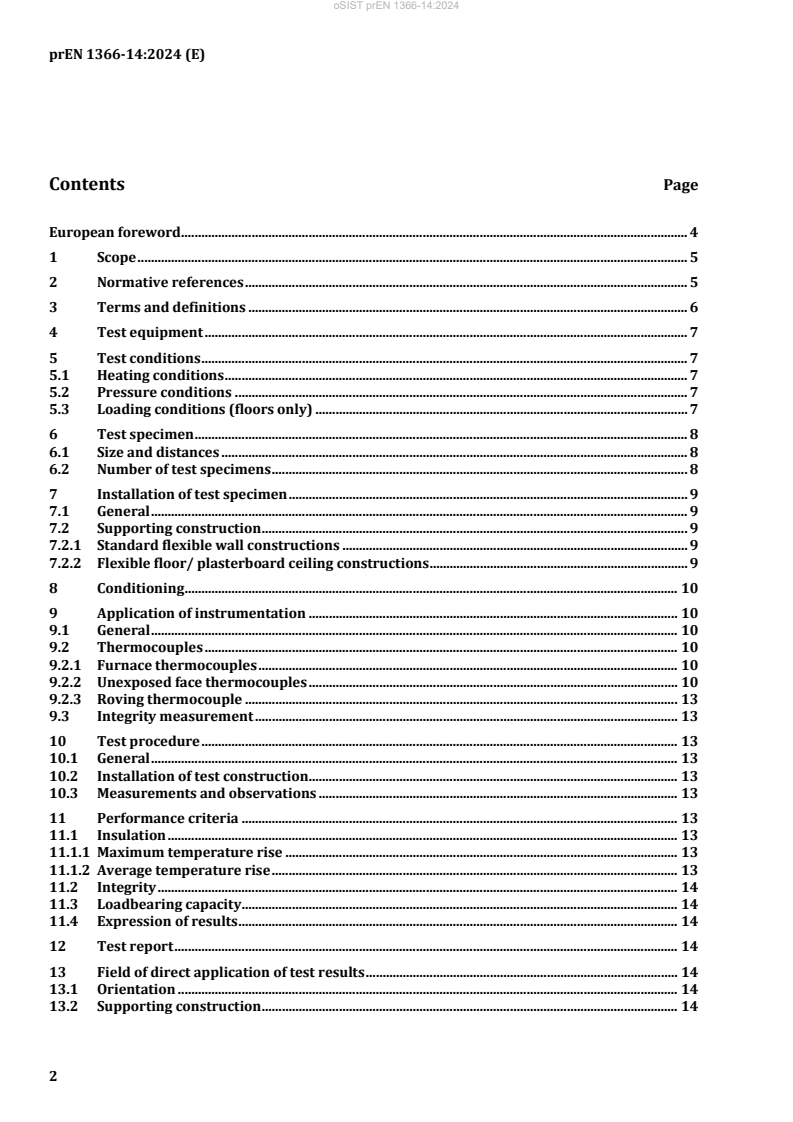
Contents Page
European foreword . 4
1 Scope . 5
2 Normative references . 5
3 Terms and definitions . 6
4 Test equipment . 7
5 Test conditions . 7
5.1 Heating conditions . 7
5.2 Pressure conditions . 7
5.3 Loading conditions (floors only) . 7
6 Test specimen . 8
6.1 Size and distances . 8
6.2 Number of test specimens . 8
7 Installation of test specimen . 9
7.1 General . 9
7.2 Supporting construction . 9
7.2.1 Standard flexible wall constructions . 9
7.2.2 Flexible floor/ plasterboard ceiling constructions . 9
8 Conditioning . 10
9 Application of instrumentation . 10
9.1 General . 10
9.2 Thermocouples . 10
9.2.1 Furnace thermocouples . 10
9.2.2 Unexposed face thermocouples . 10
9.2.3 Roving thermocouple . 13
9.3 Integrity measurement . 13
10 Test procedure . 13
10.1 General . 13
10.2 Installation of test construction . 13
10.3 Measurements and observations . 13
11 Performance criteria . 13
11.1 Insulation . 13
11.1.1 Maximum temperature rise . 13
11.1.2 Average temperature rise . 13
11.2 Integrity . 14
11.3 Loadbearing capacity . 14
11.4 Expression of results . 14
12 Test report . 14
13 Field of direct application of test results . 14
13.1 Orientation . 14
13.2 Supporting construction . 14
13.2.1 Flexible wall constructions . 14
13.2.2 Flexible floor constructions . 15
13.3 Seal size . 16
13.4 Device depth . 16
13.5 Distances . 16
Annex A (normative) Partial penetration seals for electrical sockets in walls . 17
A.1 Standard configuration. 17
A.2 Direct field of application . 18
Annex B (normative) Partial penetration seals for devices other than electrical sockets in
walls . 20
B.1 Standard condition . 20
B.2 Direct field of application . 20
Annex C (normative) Partial penetration seals for services in walls . 22
C.1 Standard condition . 22
C.2 Direct field of application . 23
Annex D (normative) Partial penetration seals in ceilings with loadbearing test - Standard
condition . 25
Annex E (normative) Partial penetration seals in floors. 26
E.1 Standard condition . 26
E.2 Direct field of application . 26
Annex F (normative) Partial penetration seals cavity temperature test . 27
F.1 General . 27
F.2 Test configuration . 27
F.3 Test performance requirements . 28
F.4 Use of cavity temperature method . 28
Annex G (normative) Flexible floor designs . 29
Bibliography . 30
European foreword
This document (prEN 1366-14:2023) has been prepared by Technical Committee CEN/TC 127 “Fire
safety in buildings”, the secretariat of which is held by BSI.
This document is currently submitted to the CEN Enquiry.
This document has been prepared under a standardization request addressed to CEN by the European
Commission. The Standing Committee of the EFTA States subsequently approves these requests for its
Member States.
EN 1366 ‘Fire resistance tests for device installations’ consists of the following Parts:
— Part 1: Ducts
— Part 2: Fire dampers
— Part 3: Penetration seals
— Part 4: Linear joint seals
— Part 5: Device ducts and shafts
— Part 6: Raised access and hollow core floors
— Part 7: Conveyor systems and their closures
— Part 8: Smoke extraction ducts
— Part 9: Single compartment smoke extraction ducts
— Part 10: Smoke control dampers
— Part 11: Fire protective systems for cable systems and associated components
— Part 12: Non-mechanical fire barrier for ventilation ductwork
— Part 13: Chimneys
— Part 14: Partial penetration seals (this document)
1 Scope
This part of the EN 1366 series specifies a method of test and criteria for the evaluation (including field
of direct application rules) of the ability of a partial penetration seal to maintain the fire resistance of a
separating element at the position at which it has been penetrated by a device or devices that passes
through one face of the element only. Partial penetration seals are used to seal apertures for electrical
sockets, downlighters, media devices, cables and any item which requires an opening to be made in one
face of the element of construction but does not include a device which passes through both faces.
Supporting constructions are used in this part of the EN 1366 series to represent separating elements
such as walls or floors. These simulate the interaction between the test specimen and the separating
element into which the sealing system is to be installed in practice.
This part of the EN 1366 series is used in conjunction with EN 1363-1.
The purpose of a test described in this part of the EN 1366 series is to assess the integrity and insulation
performance of the partial penetration seal, of the penetrating service(s) or device(s) and of the
separating element in the surrounding area of the partial penetration seal. Where partial penetration
seals are installed in ceilings and floors, the loadbearing capacity shall also be considered.
No information can be implied by the test concerning the influence of the inclusion of such penetrations
and penetration seals on the loadbearing capacity of walls.
It is not the intention of this test to provide quantitative information on the rate of leakage of smoke
and/or hot gases or on the transmission or generation of fumes. Such phenomena are only to be noted in
the test report in describing the general behaviour of test specimens during the test.
Tests in accordance with this part of the EN 1366 series are not intended to supply any information on
the ability of the partial penetration seal to withstand stress caused by movements or displacements of
the penetrating devices.
The risk of spread of fire downwards cannot be assessed with this test.
Tests in accordance with this part of the EN 1366 series do not address any risks associated with leakage
of dangerous liquids or gases caused by failure of the device in case of fire.
2 Normative references
The following documents are referred to in the text in such a way that some or all of their content
constitutes requirements of this document. For dated references, only the edition cited applies. For
undated references, the latest edition of the referenced document (including any amendments) applies.
EN 520, Gypsum plasterboards — Definitions, requirements and test methods
EN 1363-1, Fire resistance tests — Part 1: General requirements
EN 1363-2, Fire resistance tests — Part 2: Alternative and additional procedures
EN 1365-2, Fire resistance tests for loadbearing elements — Part 2: Floors and roofs
EN 13501-1, Fire classification of construction products and building elements — Part 1: Classification
using test data from reaction to fire tests
EN 13501-2, Fire classification of construction products and building elements — Part 2: Classification
using data from fire resistance and/or smoke control tests, excluding ventilation services
EN ISO 13943, Fire safety — Vocabulary (ISO 13943)
EN IEC 60670-1, Boxes and enclosures for electrical accessories for household and similar fixed electrical
installations — Part 1: General requirements (IEC 60670-1)
3 Terms and definitions
For the purposes of this document, the terms and definitions given in EN 1363-1 and EN ISO 13943 and
the following apply.
ISO and IEC maintain terminology databases for use in standardization at the following addresses:
— IEC Electropedia: available at https://www.electropedia.org/
— ISO Online browsing platform: available at https://www.iso.org/obp
3.1
back to back
devices installed on both faces of a vertical construction within 200 mm of each other vertically or
horizontally (in the plane of the wall)
3.2
device
electrical or mechanical equipment which penetrates one face of the separating element, often at the
termination of a service, e.g. electrical socket or recessed media equipment
3.3
flexible construction
horizontal or vertical supporting construction consisting of studs or joists, including linings and optional
insulation
3.4
offset
distance between the centres two partial penetration seals in opposite faces of the element of
construction
3.5
partial penetration
service(s) or device(s) that penetrate(s) one face of the separating element but does not pass completely
through the element
3.5.1
small partial penetration
partial penetration with an area of up to 0,025 m
3.5.2
medium partial penetration
2 2
partial penetration with an area greater than 0,025 m up to 0,12 m
3.5.3
large partial penetration
partial penetration with an area greater than 0,12 m
3.6
partial penetration seal
system used to maintain the fire resistance of a separating element at the position where one or more
services or devices pass through one face of a separating element
3.7
separation
distance between the closest extremities two partial penetration seals in the same face of the element of
construction
3.8
supporting construction
wall or floor construction used to support the penetration seal being evaluated
3.9
test specimen
assembly for the fire test consisting of the penetrating service(s) or device(s) and the partial penetration
seal materials or partial penetration seal devices
3.10
wall segment
section of a stud wall between adjacent studs
4 Test equipment
See EN 1363-1, and if applicable EN 1363-2.
5 Test conditions
5.1 Heating conditions
The heating and furnace atmosphere shall conform to those given in EN 1363-1 or, if applicable,
EN 1363-2.
5.2 Pressure conditions
A vertical furnace shall be operated so that a minimum pressure of 10 Pa exists in the centre of the test
specimen mounted in the lowest position on the exposed side of the wall.
A horizontal furnace shall be operated so that a pressure of (20 ± 3) Pa is established at a position
(100 ± 10) mm below the lowest point of the test construction.
5.3 Loading conditions (floors only)
The test specimen shall be subjected to loads determined in accordance with EN 1365-2 and EN 1363-1.
The determination of the load shall be clearly indicated in the test report.
6 Test specimen
6.1 Size and distances
Partial penetration seals for walls shall be tested in a wall with minimum dimensions of 3 m high × 1,2 m
wide.
Partial penetration seals for ceilings shall be tested in a floor/ceiling construction, with minimum
dimensions of 4 m × 3 m (with a minimum span of 4 m).
In order to avoid boundary effects, the distance between the perimeter of the partial penetration seal and
the internal surfaces of the furnace shall be not less than 200 mm at any point.
Separation of partial penetration seals installed within the same face of a wall construction shall comply
with the following:
a) partial penetration seals that are intended to be evaluated separately shall be separated by a
minimum 200 mm vertically or horizontally in the plane of the wall, unless the separation distance
used in practice is less, in which case the actual separation distance shall be used;
b) partial penetration seals that are intended to be evaluated with interaction, shall be tested with a
separation of less than 200 mm (vertically or horizontally in the plane of the wall), unless the
separation distance used in practice is less. In each case the actual separation distance used shall be
the desired minimum separation;
c) the distances between partial penetration seals shall be recorded in the test report wherever this is
less than 200 mm (horizontally or vertically in the plane of the wall).
Separation of partial penetration seals installed within the opposite faces of a wall construction shall
comply with the following:
a) the centre point of partial penetration seals that are intended to be evaluated separately shall be
separated by a minimum 200 mm vertically or horizontally in the plane of the wall, unless the
separation distance used in practice is less, in which case the actual separation distance shall be used;
b) partial penetration seals that are intended to be evaluated with interaction, shall be tested with a
separation of less than 200 mm (vertically or horizontally in the plane of the wall), unless the
separation distance used in practice is less. In each case the actual separation distance used shall be
the desired minimum separation;
c) the distances (both vertical and horizontal in the plane of the wall) between the centre points of
partial penetration seals shall be recorded in the test report wherever this is less than 200 mm
(horizontally or vertically in the plane of the wall).
Annex F provides an alternative test method for partial penetrations seals in wall or floor constructions
that have already been subject to a fire test.
6.2 Number of test specimens
In the case of vertical elements, a minimum two installations shall be carried out, one for each direction
of exposure.
In the case of horizontal elements, the test specimen shall be exposed to heating from the underside.
7 Installation of test specimen
7.1 General
The test specimen(s) shall be installed, as far as possible, in a manner representative of their use in
practice, including any associated required wiring etc. Care shall be taken to avoid any artificial support
which could be provided to the device, e.g. if it sags during the test.
When more than one test specimen is incorporated into a single supporting construction, care shall be
taken to ensure that there is no interaction between different test specimens, except if the determination
of the interaction is the intention of the test.
7.2 Supporting construction
7.2.1 Standard flexible wall constructions
The standard supporting construction shall be in accordance with the provisions given in EN 1363-1,
except where modified by provisions within this document.
The size of the flexible wall shall be as defined in 6.1. The wall shall be restrained only on the top and
bottom edge. A construction omitting insulation shall be used.
The overall thickness and number of the gypsum board(s) shall be as given in Table 1. Steel studs of
varying widths may be used to fit the flexible wall constructions defined in Table 1. At the discretion of
the test sponsor, a lower specification for any of the parameters in Table 1 may be selected for the test
and the direct field of application rules applied relative to the tested parameters.
Table 1 — Standard flexible wall constructions
Intended fire Steel stud Gypsum board type F in accordance with Overall wall
resistance depth EN 520 thickness
[mm] [mm]
Number of layers at Thickness of
each side boards
[mm]
EI 30 44—55 1 12,5 69—80
EI 60 44—55 2 12,5 94—105
EI 90 or EI 120 44—55 2 a 94—105
12,5
EI 120 62—70 2 15 122—130
a
Restrictions to the field of direct application apply. See 13.2.2. If for EI 90 walls it is intended to cover walls
with only one layer of board on each side, a wall with a gypsum board with a thickness of 25 mm may be used
in the test.
7.2.2 Flexible floor/ plasterboard ceiling constructions
7.2.2.1 General
Currently there is no defined standard supporting construction for flexible floors/plasterboard ceiling
constructions, however Annex G (informative) provides guidance for timber joist constructions that may
be used for test periods of up to 90 min. The size of the flexible floor shall be as defined in 6.1. The floor
shall be of one of the constructions detailed below:
a) timber joists lined on the underside with gypsum board and on top with chipboard floor boards;
b) engineered timber joists (such as ‘I’ Sections) lined on the underside with gypsum board and on top
with chipboard floor boards;
c) ‘C‘ sectional metal structural joist system lined on the underside with gypsum board and on top with
chipboard floor boards;
d) engineered timber/steel composite joist system lined on the underside with gypsum board and on
top with chipboard floor boards.
Alternative constructions are permitted but will not have any direct field of application beyond the tested
design.
7.2.2.2 Flexible floor/ suspended tiled ceiling constructions
The size of the flexible floor shall be as defined in 6.1. The floor and ceiling assembly shall be selected as
representing the desired end use.
8 Conditioning
The test construction shall be conditioned in accordance with EN 1363-1.
9 Application of instrumentation
9.1 General
The control, monitoring and recording equipment shall be in accordance with EN 1363-1.
9.2 Thermocouples
9.2.1 Furnace thermocouples
Plate thermometers shall be provided in accordance with EN 1363-1. The plate thermometer shall be
located in a plane 100 mm from the exposed face of the separating element. At least one thermometer
shall be provided for every 1,5 m of the heated area of the test construction, subject to a minimum
number of four thermometers for each test construction. These thermometers shall be symmetrically
distributed with respect to the heated area of the test construction.
For vertical test constructions, the plate thermometers shall be oriented so that side ‘A’ faces the walls of
the furnace opposite the test construction being evaluated.
For horizontally oriented test constructions, side ‘A’ of the plate thermometers positioned below the test
construction being evaluated shall face the floor of the furnace.
9.2.2 Unexposed face thermocouples
9.2.2.1 General
Surface temperature measurements and the thermocouples shall be in accordance with EN 1363-1.
Thermocouples shall be provided in locations given in the paragraphs below.
9.2.2.2 Position A
On the surface of the device or blank seal (where a seal is tested without the inclusion of a device for the
purpose of generating field of application), at mid-width and 25 mm from the edge of the opening. In the
case of wall mounted seals, this shall be the top edge. Where the surface of the device
...
Questions, Comments and Discussion
Ask us and Technical Secretary will try to provide an answer. You can facilitate discussion about the standard in here.
Loading comments...