

FprEN 1656
(Main)Chemical disinfectants and antiseptics - Quantitative suspension test for the evaluation of bactericidal activity of chemical disinfectants and antiseptics used in the veterinary area - Test method and requirements (phase 2, step 1)
- Abstract
This document specifies a test method and the minimum requirements for bactericidal activity of chemical disinfectant and antiseptic products that form a homogeneous, physically stable preparation when diluted with hard water or - in the case of ready-to-use products - with water. Products can only be tested at a concentration of 80 % or less, as some dilution is always produced by adding the test organisms and interfering substance.
The method described is intended to determine the activity of commercial formulations or active substances under the conditions in which they are used. This document is also applicable to products that are used for equipment disinfection by immersion, surface disinfection by wiping, spraying, flooding or other means and teat disinfection in the veterinary area – e.g. in the breeding, husbandry, production, veterinary care facilities, transport and disposal of all animals except when in the food chain following death and entry into processing industry. This document is also applicable to products used for teat disinfection in these veterinary areas.
This method does not apply to the evaluation the activity of hand hygiene products. For these products reference is made to EN 14885, which specifies in detail the relationship of the various tests to one another and to “use recommendations”.
NOTE This method corresponds to a phase 2 step 1 test.
- Status
- Not Published
- Publication Date
- 29-Oct-2026
- Technical Committee
- CEN/TC 216 - Chemical disinfectants and antiseptics
- Drafting Committee
- CEN/TC 216/WG 2 - Veterinary use
- Current Stage
- 4599 - Dispatch of FV draft to CMC - Finalization for Vote
- Start Date
- 05-Jun-2026
- Due Date
- 14-Feb-2026
- Completion Date
- 14-Feb-2026

FprEN 1656 is a draft CEN European Standard for a quantitative suspension test used to evaluate bactericidal activity of chemical disinfectants and antiseptics in the veterinary area. It specifies the test method and the minimum performance requirements for products used for equipment, surface and teat disinfection, and it is intended for manufacturers, test laboratories and users who need a defined laboratory basis for product claims.
What does FprEN 1656 specify?
FprEN 1656 specifies a phase 2, step 1 suspension test for chemical disinfectant and antiseptic products that form a homogeneous, physically stable preparation when diluted with hard water, or with water for ready-to-use products. The document is written for veterinary-area uses and excludes hand hygiene products.
The document is organized into five clauses and four informative annexes.
| Annex | What it covers |
|---|---|
| Annex A | Referenced strains in national collections |
| Annex B | Examples of neutralizers and rinsing liquids |
| Annex C | Dilution-neutralization method |
| Annex D | Example of a typical test report |
Clause 1 defines the scope, Clause 2 lists normative references, Clause 3 points to EN 14885 for terms and definitions, Clause 4 gives the minimum bactericidal requirements, and Clause 5 sets out the full test method, calculations, validation rules, result expression and report content.
What are the key requirements of FprEN 1656?
FprEN 1656 requires a product to show at least a 5 decimal log (lg) reduction under the chosen test conditions. In practice, that means the product must reduce the bacterial count by at least 100 000 times in a valid test, using the specified organisms, temperature, contact time and interfering substance.
Product scope and test conditions
The standard applies to products used for:
- equipment disinfection by immersion
- surface disinfection by wiping, spraying, flooding or other means
- teat disinfection in veterinary settings
For general disinfection products, the minimum test organism spectrum is Enterococcus hirae, Proteus hauseri, Pseudomonas aeruginosa and Staphylococcus aureus. For teat disinfectants, the test organisms are Escherichia coli, Staphylococcus aureus and Streptococcus uberis. Additional organisms may be used when specific use conditions need to be covered.
Table 1 sets the permitted temperature and contact-time ranges, together with the interfering substances that simulate use conditions. For surface disinfection, the test uses low-level soiling, high-level soiling, or other relevant substances. For teat disinfection, the test uses either bovine albumin, skimmed milk, or other relevant substances depending on whether the product is for pre-milking or post-milking use.
Test method and validation
FprEN 1656 gives two test routes:
- dilution-neutralization, which is the preferred method
- membrane filtration, used when no suitable neutralizer can be validated
The method is built around a test suspension of bacteria, a validation suspension for controls, and a product test solution. The product, test organisms and interfering substance are mixed at the selected temperature and contact time, then the bactericidal effect is stopped by neutralization or filtration. The surviving bacteria are counted and the reduction is calculated.
Validation is not optional. The standard requires control of the experimental conditions, control of neutralizer toxicity or filtration performance, and method validation for each organism and each selected condition. These checks are run in parallel with the actual test, using the same neutralizer or rinsing liquid as in the test itself.
Cultures, media and test solutions
FprEN 1656 requires preservation and stock culture handling in accordance with EN 12353. Working cultures are prepared from stock cultures on tryptone soya agar (TSA), and the same incubation temperature is used throughout a test and its controls.
Product test solutions are prepared freshly and used within 2 h. The document requires at least three product concentrations so that one lies in the active range and one in the non-active range. The product as received may be used as the highest concentration, and the highest concentration tested is 80 %.
The product test solutions must remain physically homogeneous during the procedure. If a precipitate or flocculent appears, that is recorded in the test report because it can affect how reliably bacteria are counted.
Calculations, validity and pass criteria
FprEN 1656 defines the calculation of the test suspension count, the validation count and the survivor count after exposure. It also gives the rules for weighted mean counts, counting limits and rounding.
A test is valid only when the basic limits are met for the test suspension and validation suspension, the control values are acceptable, and the weighted-mean check stays within the permitted ratio. The standard also requires at least one concentration to show 5 lg or more reduction and at least one concentration to show less than 5 lg reduction.
The limiting test organism is the organism that requires the highest product concentration to pass. That concentration is the bactericidal concentration determined by the standard. Replication is recommended, and the document notes that six replicates are recommended for a precision of ±1 lg in reduction.
What terms does FprEN 1656 define?
FprEN 1656 uses the terms and definitions from EN 14885. The following are the key terms used in the method.
- Decimal log (lg) reduction - the logarithmic measure of how much the bacterial count falls after contact with the product.
- Test suspension (N) - the bacterial suspension used to start the bactericidal test mixture.
- Validation suspension (Nv) - the bacterial suspension used for control and validation mixtures.
- Interfering substance - the soil load added to simulate the practical conditions of use.
- Neutralizer - the reagent used to stop remaining antimicrobial activity after the contact time.
- Limiting test organism - the strain that needs the highest product concentration to pass.
- Bactericidal concentration - the lowest concentration that gives the required 5 lg reduction under the chosen conditions.
Who uses FprEN 1656?
FprEN 1656 is used by testing laboratories that perform bactericidal efficacy studies for veterinary disinfectants and antiseptics. It is also used by product manufacturers and formulators who need to select test concentrations, validate neutralizers, and prepare technical files or claims.
Quality and regulatory staff use FprEN 1656 to review whether a product has been tested under the correct veterinary use conditions. Buyers and technical assessors use it to compare products for surface disinfection, equipment disinfection and teat disinfection in breeding, husbandry, production, veterinary care, transport and disposal settings.
What changed in FprEN 1656 from the previous edition?
FprEN 1656 will supersede EN 1656:2019. The foreword states that the document was revised to harmonize its structure and wording with other quantitative suspension tests of CEN/TC 216. Results obtained using the previous version remain valid.
Which standards are used with FprEN 1656?
FprEN 1656 names two normative references.
- EN 12353 - gives the preservation requirements for the test organisms used in bactericidal and other antimicrobial activity tests.
- EN 14885 - provides the framework for applying European standards for chemical disinfectants and antiseptics, and its terms and definitions apply in FprEN 1656. It is also the reference for hand hygiene products.
What does the FprEN 1656 document contain?
FprEN 1656 contains the full laboratory procedure for a quantitative suspension test, including the principle of the method, the required culture media and reagents, apparatus, and preparation of test and validation suspensions. It also gives two alternative counting workflows, one based on dilution-neutralization and one based on membrane filtration.
The document includes calculation rules for N, Nv, Na, A, B and C, plus the log-reduction formula and the criteria used to judge validity. Annex B provides examples of neutralizers and rinsing liquids, Annex C shows the dilution-neutralization workflow, and Annex D gives an example test report that shows how results are presented in practice.
Relations
- Effective Date
- 22-May-2024
Get Certified
Connect with accredited certification bodies for this standard

ECOCERT
Organic and sustainability certification.

Eurofins Food Testing Global
Global leader in food, environment, and pharmaceutical product testing.

Intertek Bangladesh
Intertek certification and testing services in Bangladesh.
Sponsored listings
Frequently Asked Questions
FprEN 1656 is a draft published by the European Committee for Standardization (CEN). Its full title is "Chemical disinfectants and antiseptics - Quantitative suspension test for the evaluation of bactericidal activity of chemical disinfectants and antiseptics used in the veterinary area - Test method and requirements (phase 2, step 1)". This standard covers: This document specifies a test method and the minimum requirements for bactericidal activity of chemical disinfectant and antiseptic products that form a homogeneous, physically stable preparation when diluted with hard water or - in the case of ready-to-use products - with water. Products can only be tested at a concentration of 80 % or less, as some dilution is always produced by adding the test organisms and interfering substance. The method described is intended to determine the activity of commercial formulations or active substances under the conditions in which they are used. This document is also applicable to products that are used for equipment disinfection by immersion, surface disinfection by wiping, spraying, flooding or other means and teat disinfection in the veterinary area – e.g. in the breeding, husbandry, production, veterinary care facilities, transport and disposal of all animals except when in the food chain following death and entry into processing industry. This document is also applicable to products used for teat disinfection in these veterinary areas. This method does not apply to the evaluation the activity of hand hygiene products. For these products reference is made to EN 14885, which specifies in detail the relationship of the various tests to one another and to “use recommendations”. NOTE This method corresponds to a phase 2 step 1 test.
This document specifies a test method and the minimum requirements for bactericidal activity of chemical disinfectant and antiseptic products that form a homogeneous, physically stable preparation when diluted with hard water or - in the case of ready-to-use products - with water. Products can only be tested at a concentration of 80 % or less, as some dilution is always produced by adding the test organisms and interfering substance. The method described is intended to determine the activity of commercial formulations or active substances under the conditions in which they are used. This document is also applicable to products that are used for equipment disinfection by immersion, surface disinfection by wiping, spraying, flooding or other means and teat disinfection in the veterinary area – e.g. in the breeding, husbandry, production, veterinary care facilities, transport and disposal of all animals except when in the food chain following death and entry into processing industry. This document is also applicable to products used for teat disinfection in these veterinary areas. This method does not apply to the evaluation the activity of hand hygiene products. For these products reference is made to EN 14885, which specifies in detail the relationship of the various tests to one another and to “use recommendations”. NOTE This method corresponds to a phase 2 step 1 test.
FprEN 1656 is classified under the following ICS (International Classification for Standards) categories: 71.100.35 - Chemicals for industrial and domestic disinfection purposes. The ICS classification helps identify the subject area and facilitates finding related standards.
FprEN 1656 has the following relationships with other standards: It is inter standard links to EN 1656:2019. Understanding these relationships helps ensure you are using the most current and applicable version of the standard.
FprEN 1656 is available in PDF format for immediate download after purchase. The document can be added to your cart and obtained through the secure checkout process. Digital delivery ensures instant access to the complete standard document.
Standards Content (Sample)
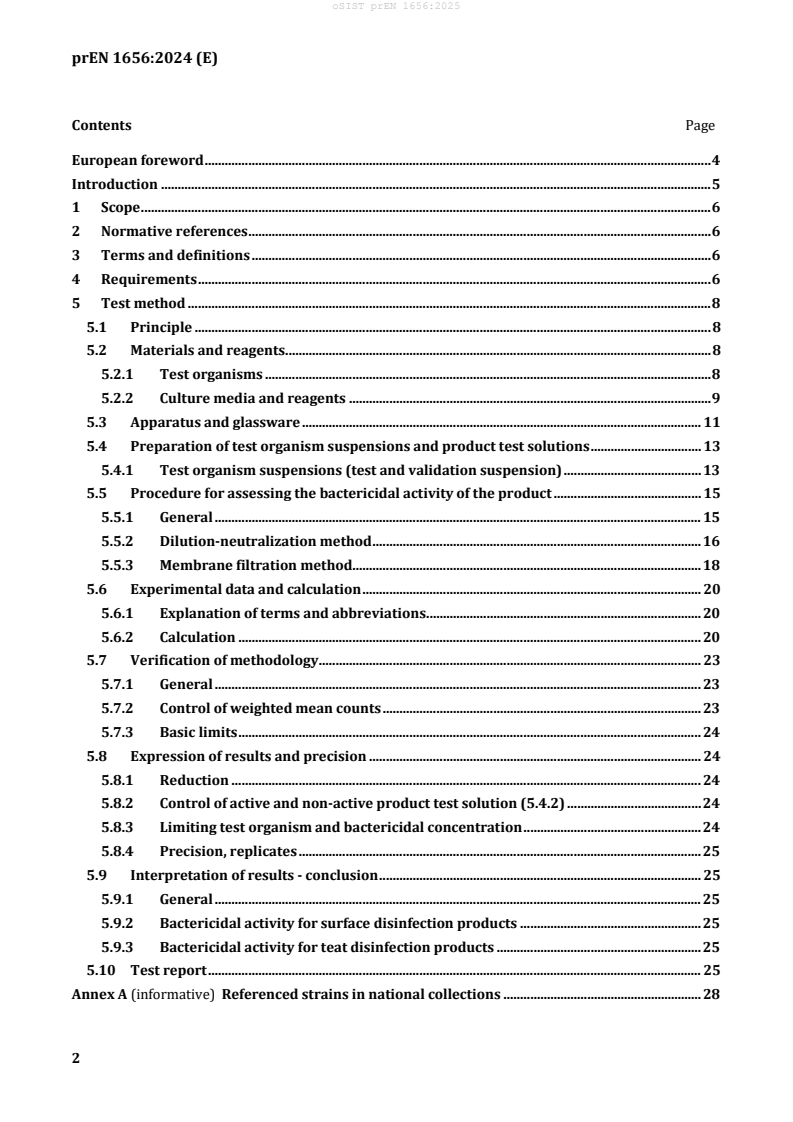
Contents
- Introduction
- 1 Scope
- 2 Normative references
- 3 Terms and definitions
- 4 Requirements
- 5 Test method
- 5.1 Principle
- 5.2 Materials and reagents
- 5.3 Apparatus and glassware
- 5.4 Preparation of test organism suspensions and product test solutions
- 5.5 Procedure for assessing the bactericidal activity of the product
- 5.6 Experimental data and calculation
- 5.7 Verification of methodology
- 5.8 Expression of results and precision
- 5.9 Interpretation of results - conclusion
- 5.10 Test report
- Annex A
- Annex B
- Annex C
- Annex D
- Bibliography
Introduction
This document specifies a suspension test for establishing whether a chemical disinfectant or antiseptic has a bactericidal activity in the fields described in the scope. This laboratory test takes into account practical conditions of application of the product, including contact time, temperature, test organisms and interfering substances, i.e. conditions which may influence its action in practical situations.
The conditions are intended to cover general purposes and to allow reference between laboratories and product types. Each utilization concentration of the chemical disinfectant or antiseptic found by this test corresponds to defined experimental conditions. However, for some applications the recommendations of use of a product may differ and therefore additional test conditions need to be used.
oSIST prEN 1656:2025 prEN 1656:2024 (E)
1 Scope
This document specifies a test method and the minimum requirements for bactericidal activity of chemical disinfectant and antiseptic products that form a homogeneous, physically stable preparation when diluted with hard water or - in the case of ready-to-use products - with water. Products can only be tested at a concentration of 80 % or less, as some dilution is always produced by adding the test organisms and interfering substance.
The method described is intended to determine the activity of commercial formulations or active substances under the conditions in which they are used. This document applies to products that are used for equipment disinfection by immersion, surface disinfection by wiping, spraying, flooding or other means and teat disinfection in the veterinary area – e.g. in the breeding, husbandry, production, veterinary care facilities, transport and disposal of all animals except when in the food chain following death and entry into processing industry. This document also applies to products used for teat disinfection in these veterinary areas.
This method is not applicable to evaluate the activity of hand hygiene products. For these products reference is made to EN 14885, which specifies in detail the relationship of the various tests to one another and to “use recommendations”.
NOTE This method corresponds to a phase 2 step 1 test.
2 Normative references
The following documents are referred to in the text in such a way that some or all of their content constitutes requirements of this document. For dated references, only the edition cited applies. For undated references, the latest edition of the referenced document (including any amendments) applies. EN 12353, Chemical disinfectants and antiseptics - Preservation of test organisms used for the determination of bactericidal (including Legionella), mycobactericidal, sporicidal, fungicidal and virucidal (including bacteriophages) activity EN 14885, Chemical disinfectants and antiseptics - Application of European Standards for chemical disinfectants and antiseptics
3 Terms and definitions
For the purposes of this document, the terms and definitions given in EN 14885 apply. ISO and IEC maintain terminology databases for use in standardization at the following addresses:
- ISO Online browsing platform: available at https://www.iso.org/obp
- IEC Electropedia: available at https://www.electropedia.org/
4 Requirements
The product shall demonstrate at least a 5 decimal log (lg) reduction when diluted with hard water (5.2.2.7) or – in the case of ready-to-use products – with water (5.2.2.2) and tested in accordance with Table 1 and Clause 5 under simulated low level soiling (3 g/l bovine albumin) or high level soiling (10 g/l yeast extract and 10 g/l bovine albumin) or 10 g/l skimmed milk for post-milking teat disinfectants or 3 g/l bovine albumin for pre-milking teat disinfectants or in additional test conditions.
oSIST prEN 1656:2025 prEN 1656:2024 (E) Table 1 — Test conditions Bactericidal Bactericidal activity for teat Test conditions activity on disinfectants surfaces Minimum spectrum of Enterococcus hirae Escherichia coli test organisms 1) Proteus hauseri Staphylococcus aureus Pseudomonas Streptococcus uberis aeruginosa Staphylococcus aureus additional any relevant test any relevant test organism organism Test temperature at intervals of 5 °C minimum 5 °C ± 1 °C 20 °C ± 1 °C maximum 40 °C ± 1 °C 30 °C ± 1 °C Contact time at intervals of 30 s from 30 s to 5 min and at intervals of 5 min from 5 min to 120 min minimum 1 min ± 5 s 1 min ± 5 s for post-milking teat disinfectants 30 s ± 5 s for pre-milking teat disinfectants maximum 120 min ± 10 s 30 min ± 10 s for post-milking teat disinfectants 3 min ± 10 s for pre-milking teat disinfectants Interfering substance Interfering substance low level soiling 3,0 g/l bovine albumin Post milking: 10,0 g/l of milk powder high level soiling 10 g/l yeast extract plus 10 g/l bovine Pre-milking: 3,0 g/l bovine albumin albumin additional any relevant any relevant substance substance 1) Was known as Proteus vulgaris.
oSIST prEN 1656:2025 prEN 1656:2024 (E) Any additional specific bactericidal activity shall be determined in accordance with 5.2.1 and 5.5.1.1 in
order to take into account intended specific use conditions.
5 Test method
5.1 Principle
5.1.1 A sample of the product as delivered and/or diluted with hard water (or water for ready-to-use products) is added to a test suspension of bacteria in a solution of an interfering substance. The mixture is maintained at the test temperature θ for the test contact time t. At the end of this contact time, an aliquot is taken, and the bactericidal and/or the bacteriostatic activity in this portion is immediately neutralized or suppressed by a validated method. The method of choice is dilution-neutralization. If a suitable neutralizer cannot be found, membrane filtration is used. The numbers of surviving bacteria in each sample are determined and the reduction is calculated.
5.1.2 For general disinfectant products, the test is performed using Enterococcus hirae, Proteus hauseri, Pseudomonas aeruginosa and Staphylococcus aureus as test organisms. For teat disinfectants the test is performed using Escherichia coli, Staphylococcus aureus and Streptococcus uberis as test organisms. 5.1.3 Additional and optional contact times and temperatures are specified. Additional test organisms can be used.
5.2 Materials and reagents
5.2.1 Test organisms
The bactericidal activity shall be evaluated using the following strains as test organisms:
NOTE The ATCC numbers are the collection numbers of strains supplied by the American Type Culture Collection (ATCC). This information is given for the convenience of users of this document and does not constitute an endorsement by CEN of the product named.
a) General disinfection products - Enterococcus hirae ATCC 10541 - Proteus hauseri ATCC 13315 - Pseudomonas aeruginosa ATCC 15442 - Staphylococcus aureus ATCC 6538 b) Teat disinfectants - Escherichia coli ATCC 10536 - Staphylococcus aureus ATCC 6538 - Streptococcus uberis ATCC 19436 NOTE Refer to Annex A for strain references in some other culture collections.
oSIST prEN 1656:2025 prEN 1656:2024 (E) The required incubation temperature for these test organisms is 36 °C ± 1 °C or 37 °C ± 1 °C (5.3.2.3). The same temperature (either 36 °C or 37 °C) shall be used for all incubations performed during a test and its control and validation.
If additional test organisms are used, they shall be incubated under optimum growth conditions (temperature, time, atmosphere, media) noted in the test report. If the additional test organisms selected do not correspond to the specified strains, their suitability for supplying the required inocula shall be verified. If these additional test organisms are not classified at a reference centre, their identification characteristics shall be stated. In addition, they shall be held by the testing laboratory or national culture collection under a reference for five years.
5.2.2 Culture media and reagents
5.2.2.1 General
All weights of chemical substances given in this document refer to the anhydrous salts. Hydrated forms may be used as an alternative, but the weights required shall be adjusted to allow for consequent molecular weight differences.
The reagents shall be of analytical grade and/or appropriate for microbiological purposes. They shall be free from substances that are toxic or inhibitory to the test organisms. To improve reproducibility, it is recommended that commercially available dehydrated material is used for the preparation of culture media. The manufacturer's instructions relating to the preparation of these products should be rigorously followed.
For each culture medium and reagent, a shelf life should be fixed (see ISO/IEC 17025:2017).
5.2.2.2 Water
The water shall be freshly glass-distilled water and not demineralized water. Sterilize in the autoclave [5.3.2.1 a)].
Refer to 5.2.2.7 for the procedure to prepare hard water.
NOTE 1 Sterilization is not necessary if the water is used e.g. for preparation of culture media and subsequently sterilized.
NOTE 2 If distilled water of adequate quality is not available, water for injections (see bibliographic reference [1]) can be used.
5.2.2.3 Tryptone Soya Agar (TSA)
Tryptone soya agar, consisting of:
Tryptone, pancreatic digest of casein 15,0 g; Soya peptone, papaic digest of soybean meal 5,0 g; Sodium chloride (NaCl) 5,0 g; Agar 15,0 g; Water (5.2.2.2) to 1 000,0 ml.
Sterilize in the autoclave [5.3.2.1 a)]. After sterilization the pH of the medium shall be equivalent to 7,2 ± 0,2 when measured at (20 ± 1) °C.
In case of encountering problems with neutralization (5.5.1.2 and 5.5.1.3) it may be necessary to add neutralizer to the TSA. Annex B gives guidance on the neutralizers that may be used.
oSIST prEN 1656:2025 prEN 1656:2024 (E)
5.2.2.4 Diluent
Tryptone sodium chloride solution, consisting of:
Tryptone, pancreatic digest of casein 1,0 g; Sodium chloride (NaCl) 8,5 g; Water (5.2.2.2) to 1 000,0 ml.
- Sterilize in the autoclave [5.3.2.1 a)].
- After sterilization, the pH of the diluent shall be equivalent to 7,0 ± 0,2 when measured at (20 ± 1) °C.
5.2.2.5 Neutralizer
The neutralizer shall be validated for the product being tested in accordance with 5.5.1.2, 5.5.1.3 and 5.5.2. It shall be sterile.
Information on neutralizers that have been found to be suitable for some categories of products is given in Annex B.
5.2.2.6 Rinsing liquid (for membrane filtration)
The rinsing liquid shall be validated for the product being tested in accordance with 5.5.1.2, 5.5.1.3 and 5.5.3. It shall be sterile, compatible with the filter membrane and capable of filtration through the filter membrane under the test conditions described in 5.5.3.
Information on rinsing liquids that have been found to be suitable for some categories of products is given in Annex B.
5.2.2.7 Hard water for dilution of products
For the preparation of 1 000 ml of hard water, the procedure is as follows:
- prepare solution A: dissolve 19,84 g magnesium chloride (MgCl ) and 46,24 g calcium chloride
(CaCl ) in water (5.2.2.2) and dilute to 1 000 ml. Sterilize by membrane filtration (5.3.2.7) or in the
autoclave [5.3.2.1 a)]. Autoclaving – if used - may cause a loss of liquid. In this case make up to 1 000 ml with water (5.2.2.2) under aseptic conditions. Store the solution in the refrigerator (5.3.2.8) for no longer than one month; - prepare solution B: dissolve 35,02 g sodium bicarbonate (NaHCO ) in water (5.2.2.2) and dilute to
1 000 ml. Sterilize by membrane filtration (5.3.2.7). Store the solution in the refrigerator (5.3.2.8) for no longer than one week; - place 600 ml to 700 ml of water (5.2.2.2) in a 1 000 ml volumetric flask (5.3.2.12) and add 6,0 ml (5.3.2.9) of solution A, then 8,0 ml of solution B. Mix and dilute to 1 000 ml with water (5.2.2.2). The pH of the hard water shall be 7,0 ± 0,2 (5.3.2.4) when measured at (20 ± 1) °C. If necessary, adjust the pH by using a solution of approximately 40 g/l (about 1 mol/l) of sodium hydroxide (NaOH) or approximately 36,5 g/l (about 1 mol/l) of hydrochloric acid (HCl). The hard water shall be freshly prepared under aseptic conditions and used within 12 h. NOTE When preparing the product test solutions (5.4.2), the addition of the product to the hard water produces a different final water hardness in each test tube. In any case the final hardness is lower than 300 mg/l of calcium carbonate (CaCO ) in the test tube.
oSIST prEN 1656:2025 prEN 1656:2024 (E)
5.2.2.8 Interfering substance
5.2.2.8.1 General The interfering substance shall be chosen according to the conditions of use laid down for the product. The interfering substance shall be sterile and prepared at 10 times its final concentration in the test. The ionic composition (e.g. pH, calcium and/or magnesium hardness) and chemical composition (e.g. mineral substances, protein, carbohydrates, lipids and detergents) shall be defined. NOTE The term “interfering substance” is used even if it contains more than one substance. 5.2.2.8.2 Low-level soiling and Pre-milking teat disinfection (bovine albumin solution) Dissolve 3,0 g of bovine albumin fraction V (suitable for microbiological purposes) in 100 ml of water (5.2.2.2).
Sterilize by membrane filtration (5.3.2.7), keep in the refrigerator (5.3.2.8) and use within one month. The final concentration of bovine albumin in the test procedure (5.5) is 3,0 g/l. 5.2.2.8.3 High-level soiling (mixture of bovine albumin solution with yeast extract) Dissolve 50,0 g yeast extract powder in 150 ml of water (5.2.2.2) in a 250 ml volumetric flask (5.3.2.12) and allow foam to collapse. Make up to the mark with water (5.2.2.2). Transfer to a clean dry bottle and sterilize in an autoclave [5.3.2.1 a)]. Allow to cool to (20 ± 1) °C. Pipette 25 ml of this solution into a 50 ml volumetric flask (5.3.2.12) and add 10 ml of water (5.2.2.2). Dissolve 5,0 g of bovine albumin fraction V (suitable for microbiological purposes) in the solution with shaking and allow foam to collapse. Make up to the mark with water (5.2.2.2), sterilize by membrane filtration (5.3.2.7), keep in the refrigerator (5.3.2.8) and use within one month. The final concentration in the test procedure (5.5) is 10,0 g/l yeast extract and 10,0 g/l bovine albumin. 5.2.2.8.4 Milk for post milking teat disinfection Skimmed milk, guaranteed free of antibiotics and additives and reconstituted at a rate of 100 g powder per litre of water (5.2.2.2), shall be prepared as follows:
- prepare a solution of 10,0 % (v/v) in water (5.2.2.2) by adding 10 parts of reconstituted milk to 90 parts of water. Heat for 30 min at (105 ± 3) °C [or 5 min at (121 ± 3) °C].
- The final concentration of reconstituted milk in the test procedure (5.5) is 1,0 % (v/v) of reconstituted milk.
5.3 Apparatus and glassware
5.3.1 General
Sterilize all glassware and parts of the apparatus that will come into contact with the culture media and reagents or the sample, except those which are supplied sterile, by one of the following methods:
a) by moist heat, in the autoclave [5.3.2.1 a)]; b) by dry heat, in the hot air oven [5.3.2.1 b)].
5.3.2 Usual microbiological laboratory equipment and, in particular, the following:
NOTE When selecting laboratory equipment, disposable sterile equipment is an acceptable alternative to reusable glassware.
oSIST prEN 1656:2025 prEN 1656:2024 (E) 5.3.2.1 Apparatus for sterilization:
+3 a) for moist heat sterilization, an autoclave capable of being maintained at (121 ) °C for a minimum
holding time of 15 min; +5 b) for dry heat sterilization, a hot air oven capable of being maintained at (180 ) °C for a minimum
+5 +5 holding time of 30 min, at (170 ) °C for a minimum holding time of 1 h or at (160 ) °C for a 0 0 minimum holding time of 2 h.
5.3.2.2 Water baths, capable of being controlled between 5 and 40 °C ± 1 °C as required by the test conditions, and at 45 °C ± 1 °C (to maintain melted TSA in case of pour plate technique). 5.3.2.3 Incubator, capable of being controlled either at 36 °C ± 1 °C or 37 °C ± 1 °C. 5.3.2.4 pH-meter, having an inaccuracy of calibration of no more than ± 0,1 pH units at 20 °C ± 1 °C. A puncture electrode or a flat membrane electrode should be used for measuring the pH of the agar media (5.2.2.3).
5.3.2.5 Stopwatch
5.3.2.6 Shaker
a) Electromechanical agitator e.g. Vortex® mixer ; b) mechanical shaker.
5.3.2.7 Membrane filtration apparatus, constructed of a material compatible with the substances
to be filtered.
The apparatus shall have a filter holder of at least 50 ml volume. It shall be suitable for use with filters of diameter 47 mm to 50 mm and 0,45 µm pore size for sterilization of hard water (5.2.2.7), bovine albumin (5.2.2.8.2 and 5.2.2.8.3) and if the membrane filtration method (5.5.3) is used. The vacuum source used shall give an even filtration flow rate. In order to obtain a uniform distribution of the microorganisms over the membrane and to prevent overlong filtration, the device shall be set so as to obtain the filtration of 100 ml of rinsing liquid in 20 s to 40 s. 5.3.2.8 Refrigerator, capable of being controlled at 2 °C to 8 °C. 5.3.2.9 Graduated pipettes, of nominal capacities 10 ml and 1 ml and 0,1 ml, or calibrated automatic pipettes.
5.3.2.10 Petri dishes (plates) of size 90 mm to 100 mm.
5.3.2.11 Glass beads, 3 mm to 4 mm in diameter.
5.3.2.12 Volumetric flasks
Vortex® is an example of a suitable product available commercially. This information is given for the convenience of users of this document and does not constitute an endorsement by CEN of this product.
oSIST prEN 1656:2025 prEN 1656:2024 (E)
5.4 Preparation of test organism suspensions and product test solutions
5.4.1 Test organism suspensions (test and validation suspension)
5.4.1.1 General
For each test organism, two different suspensions shall be prepared: the “test suspension” to perform the test and the “validation suspension” to perform the controls and method validation.
5.4.1.2 Preservation and stock cultures of test organisms
The test organisms and their stock cultures shall be prepared and kept in accordance with EN 12353.
5.4.1.3 Working culture of test organisms
In order to prepare the working culture of the test organisms (5.2.1), prepare a subculture from the stock culture (5.4.1.2) by streaking onto TSA slopes or plates (5.2.2.3) and incubate (5.3.2.3). After 18 h to 24 h prepare a second subculture from the first subculture in the same way and incubate for 18 h to 24 h. From this second subculture, a third subculture may be produced in the same way. The second and (if produced) third subcultures are the working cultures.
If it is not possible to prepare the second subculture on a particular day, a 48 h subculture may be used for subsequent subculturing, provided that the subculture has been kept in the incubator (5.3.2.3) during the 48 h period.
Never produce and use a fourth subculture.
For additional test organisms, any departure from this method of culturing the test organisms or preparing the suspensions shall be noted, giving the reasons in the test report.
...