


EN 16418:2014
(Main)Paper and board - Determination of the cytotoxicity of aqueous extracts using a metabolically competent hepatoma cell line (HepG2)
Paper and board - Determination of the cytotoxicity of aqueous extracts using a metabolically competent hepatoma cell line (HepG2)
This European Standard specifies a test method for the laboratory assessment of the potential cytotoxic effect of paper and board intended to come into contact with foodstuffs using specifically the HepG2 cell line.
Compared to the EN 15845[1], HepG2 cells are more representative of a human oral exposure to xenobiotics, due to the presence in the cells of phase I, II and III enzymes of the metabolism.
Papier und Pappe - Bestimmung der Zytotoxizität von wässrigen Extrakten unter Verwendung einer metabolisch kompetenten Hepatom-Zelllinie (HepG2)
Dieses Dokument legt ein Prüfverfahren für die Laboruntersuchung des potentiellen zytotoxischen Effekts von Lebensmittelkontaktmaterialien aus Papier oder Pappe, spezifisch unter Verwendung der HepG2-Zelllinie, fest.
Im Vergleich zur EN 15845 [1] repräsentieren HepG2-Zellen besser den oralen Kontakt des Menschen mit Xenobiotika aufgrund des Vorhandenseins von Phase I, II und III –Stoffwechselenzymen in den Zellen.
Papier et carton - Détermination de l’effet cytotoxique d’extraits aqueux en utilisant une lignée cellulaire d’hépatome possédant des enzymes du métabolisme (cellules HepG2)
La présente Norme européenne définit une méthode d’essai utilisant spécifiquement la lignée cellulaire HepG2 pour l’évaluation en laboratoire de l’effet cytotoxique potentiel du papier et du carton destinés à entrer en contact avec des denrées alimentaires.
Par rapport à la méthode décrite dans l’EN 15845[1], les cellules HepG2 sont plus représentatives de l’exposition des individus aux xénobiotiques par voie orale, en raison de la présence dans les cellules d’enzymes du métabolisme de phase I, II et III.
Papir, karton in lepenka - Ugotavljanje citotoksičnosti vodnih ekstraktov z uporabo metabolno kompetentnih hepatom celic linije (HepG2)
Standard EN 16418 določa preskusno metodo za laboratorijsko oceno morebitnega citotoksičnega učinka materialov iz papirja, kartona in lepenke, ki imajo stik z živili, z uporabo zlasti celic linije HepG2. V primerjavi s standardom EN 15845 celice HepG2 bolje predstavljajo človeško oralno izpostavljenost ksenobiotikom zaradi prisotnosti v celicah encimov faz I, II in III metabolizma.
General Information
- Status
- Published
- Publication Date
- 01-Apr-2014
- Withdrawal Date
- 30-Oct-2014
- Technical Committee
- CEN/TC 172 - Pulp, paper and board
- Drafting Committee
- CEN/TC 172/WG 12 - Cytotoxicity
- Current Stage
- 9093 - Decision to confirm - Review Enquiry
- Start Date
- 03-Sep-2025
- Completion Date
- 11-Feb-2026
Relations
- Effective Date
- 28-Jan-2026
- Effective Date
- 28-Jan-2026
- Effective Date
- 28-Jan-2026
- Effective Date
- 28-Jan-2026
- Effective Date
- 28-Jan-2026
- Effective Date
- 28-Jan-2026
- Effective Date
- 28-Jan-2026
- Effective Date
- 28-Jan-2026
- Effective Date
- 28-Jan-2026
- Effective Date
- 28-Jan-2026
Overview
EN 16418:2014 - "Paper and board - Determination of the cytotoxicity of aqueous extracts using a metabolically competent hepatoma cell line (HepG2)" - is a CEN European Standard that defines an in vitro laboratory method to assess the potential cytotoxicity of paper and board intended to come into contact with food. The method uses the human hepatoma HepG2 cell line, which expresses phase I, II and III metabolic enzymes and therefore provides a more realistic model of human oral exposure to xenobiotics than non‑metabolically competent lines.
Key Topics
- Test principle: Measure inhibition of cellular RNA synthesis by quantifying incorporation of tritiated uridine ([5,6-3H] uridine) into HepG2 cell RNA after exposure to aqueous extracts of paper/board.
- Sample extraction: Use purified reference water (HPLC-quality or per EN ISO 3696) and extraction procedures referenced in EN 645 / EN 647 for cold and hot water extracts.
- Cell line handling: Sourcing (e.g., ATCC/ECACC), culture maintenance without antibiotics, mycoplasma monitoring, subculturing and storage in liquid nitrogen with 10% DMSO.
- Controls and reagents: Negative and positive controls (potassium dichromate and benzo[a]pyrene), culture media formulations, trypsin/EDTA dissociation, scintillation counting for tritium, and cleaning/validation of glassware.
- Data analysis: Express results as percentage RNA synthesis relative to reference water (set at 100%), use kinetic measurements and regression criteria for test validity (see Clause 13.3).
Applications
- Assessing food contact materials (paper and board) for potential cytotoxic leachables in wet-food applications.
- Routine compliance testing in quality control laboratories of packaging manufacturers.
- Pre-market safety evaluation for converters, brand owners and regulatory bodies concerned with migration and toxicological safety.
- Supporting risk assessment where metabolic activation of contaminants is relevant (HepG2 metabolic competence provides improved relevance for oral exposure).
Who Uses It
- Testing laboratories performing migration and cytotoxicity assays
- Paper, board and packaging manufacturers
- Food safety and regulatory compliance teams
- Product safety assessors and toxicologists
Related Standards
- EN 645 - Preparation of a cold water extract (paper and board)
- EN 647 - Preparation of a hot water extract (paper and board)
- EN 15845 - Earlier cytotoxicity method (comparison: HepG2 offers enhanced metabolic relevance)
- EN ISO 3696 - Water purity (reference for reference water quality)
EN 16418:2014 is a practical, standardized route to evaluate cytotoxic hazards from aqueous migrants in food-contact paper and board, with specific procedures, controls and validity criteria tailored for metabolically competent HepG2 in vitro testing.

Get Certified
Connect with accredited certification bodies for this standard

Control Union Certifications
Global certification for agriculture and sustainability.

Gozdarski inštitut Slovenije
Slovenian Forestry Institute. Forest management certification support, timber testing.
Sponsored listings
Frequently Asked Questions
EN 16418:2014 is a standard published by the European Committee for Standardization (CEN). Its full title is "Paper and board - Determination of the cytotoxicity of aqueous extracts using a metabolically competent hepatoma cell line (HepG2)". This standard covers: This European Standard specifies a test method for the laboratory assessment of the potential cytotoxic effect of paper and board intended to come into contact with foodstuffs using specifically the HepG2 cell line. Compared to the EN 15845[1], HepG2 cells are more representative of a human oral exposure to xenobiotics, due to the presence in the cells of phase I, II and III enzymes of the metabolism.
This European Standard specifies a test method for the laboratory assessment of the potential cytotoxic effect of paper and board intended to come into contact with foodstuffs using specifically the HepG2 cell line. Compared to the EN 15845[1], HepG2 cells are more representative of a human oral exposure to xenobiotics, due to the presence in the cells of phase I, II and III enzymes of the metabolism.
EN 16418:2014 is classified under the following ICS (International Classification for Standards) categories: 85.060 - Paper and board. The ICS classification helps identify the subject area and facilitates finding related standards.
EN 16418:2014 has the following relationships with other standards: It is inter standard links to EN 647:1993, EN 645:1993, EN 14265:2003, EN 14263:2003, EN 14266:2003, EN 14262:2003, EN 14260:2003, EN 14261:2003, EN 14264:2003, EN 14639:2005. Understanding these relationships helps ensure you are using the most current and applicable version of the standard.
EN 16418:2014 is available in PDF format for immediate download after purchase. The document can be added to your cart and obtained through the secure checkout process. Digital delivery ensures instant access to the complete standard document.
Standards Content (Sample)
2003-01.Slovenski inštitut za standardizacijo. Razmnoževanje celote ali delov tega standarda ni dovoljeno.Papier und Pappe - Bestimmung der Zytotoxizität von wässrigen Extrakten
unter Vewendung einer metabolisch kompetenten Hepatom-Zelllinie (HepG2)Papier et carton - Détermination de l'effet cytotoxique d'extraits aqueux en utilisant une lignée cellulaire d'hépatome possédant des enzymes du métabolisme (cellules HepG2)Paper and board - Determination of the cytotoxicity of aqueous extracts using a metabolically competent hepatoma cell line (HepG2)85.060Papir, karton in lepenkaPaper and boardICS:Ta slovenski standard je istoveten z:EN 16418:2014SIST EN 16418:2014en,fr,de01-september-2014SIST EN 16418:2014SLOVENSKI
STANDARD
EUROPEAN STANDARD NORME EUROPÉENNE EUROPÄISCHE NORM
EN 16418
April 2014 ICS 85.060 English Version
Paper and board - Determination of the cytotoxicity of aqueous extracts using a metabolically competent hepatoma cell line (HepG2)
Papier et carton - Détermination de l'effet cytotoxique d'extraits aqueux en utilisant une lignée cellulaire d'hépatome possédant des enzymes du métabolisme (cellules HepG2)
Papier und Pappe - Bestimmung der Zytotoxizität von wässrigen Extrakten unter Verwendung einer metabolisch kompetenten Hepatom-Zelllinie (HepG2) This European Standard was approved by CEN on 8 February 2014.
CEN members are bound to comply with the CEN/CENELEC Internal Regulations which stipulate the conditions for giving this European Standard the status of a national standard without any alteration. Up-to-date lists and bibliographical references concerning such national standards may be obtained on application to the CEN-CENELEC Management Centre or to any CEN member.
This European Standard exists in three official versions (English, French, German). A version in any other language made by translation under the responsibility of a CEN member into its own language and notified to the CEN-CENELEC Management Centre has the same status as the official versions.
CEN members are the national standards bodies of Austria, Belgium, Bulgaria, Croatia, Cyprus, Czech Republic, Denmark, Estonia, Finland, Former Yugoslav Republic of Macedonia, France, Germany, Greece, Hungary, Iceland, Ireland, Italy, Latvia, Lithuania, Luxembourg, Malta, Netherlands, Norway, Poland, Portugal, Romania, Slovakia, Slovenia, Spain, Sweden, Switzerland, Turkey and United Kingdom.
EUROPEAN COMMITTEE FOR STANDARDIZATION
COMITÉ EUROPÉEN DE NORMALISATION EUROPÄISCHES KOMITEE FÜR NORMUNG
CEN-CENELEC Management Centre:
Avenue Marnix 17,
B-1000 Brussels © 2014 CEN All rights of exploitation in any form and by any means reserved worldwide for CEN national Members. Ref. No. EN 16418:2014 ESIST EN 16418:2014
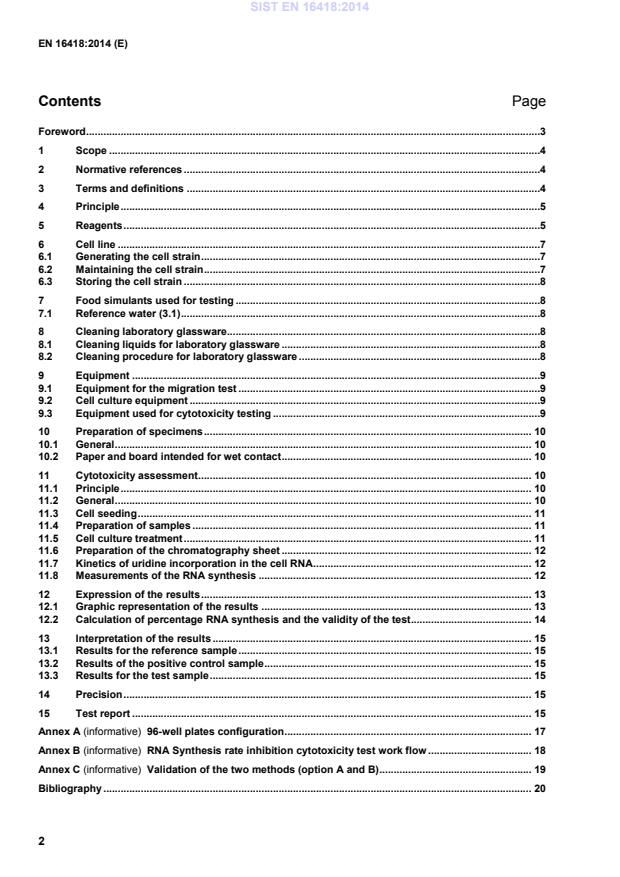
Foreword .3 1 Scope .4 2 Normative references .4 3 Terms and definitions .4 4 Principle .5 5 Reagents .5 6 Cell line .7 6.1 Generating the cell strain .7 6.2 Maintaining the cell strain .7 6.3 Storing the cell strain .8 7 Food simulants used for testing .8 7.1 Reference water (3.1) .8 8 Cleaning laboratory glassware .8 8.1 Cleaning liquids for laboratory glassware .8 8.2 Cleaning procedure for laboratory glassware .8 9 Equipment .9 9.1 Equipment for the migration test .9 9.2 Cell culture equipment .9 9.3 Equipment used for cytotoxicity testing .9 10 Preparation of specimens . 10 10.1 General . 10 10.2 Paper and board intended for wet contact . 10 11 Cytotoxicity assessment . 10 11.1 Principle . 10 11.2 General . 10 11.3 Cell seeding . 11 11.4 Preparation of samples . 11 11.5 Cell culture treatment . 11 11.6 Preparation of the chromatography sheet . 12 11.7 Kinetics of uridine incorporation in the cell RNA . 12 11.8 Measurements of the RNA synthesis . 12 12 Expression of the results . 13 12.1 Graphic representation of the results . 13 12.2 Calculation of percentage RNA synthesis and the validity of the test . 14 13 Interpretation of the results . 15 13.1 Results for the reference sample . 15 13.2 Results of the positive control sample . 15 13.3 Results for the test sample . 15 14 Precision . 15 15 Test report . 15 Annex A (informative)
96-well plates configuration . 17 Annex B (informative)
RNA Synthesis rate inhibition cytotoxicity test work flow . 18 Annex C (informative)
Validation of the two methods (option A and B) . 19 Bibliography . 20 SIST EN 16418:2014
100 ml b) sodium bicarbonate solution1), 7,5 % (m/V)
30 ml c) glutamine solution, 200 mmol/l (or Glutamax I®)1), (100x)2)
10 ml d) non-essential amino acids solution1), (100x)2)
10 ml e) foetal calf serum3)
100 ml f) reference water 800 ml 5.2.3 Concentrated culture medium for testing samples A 5,45-fold concentrated culture medium is prepared by successively mixing: a) minimum Essential Medium Eagle with Earl's salts1), (10x)2)
100 ml b) sodium bicarbonate solution1), 7,5 % (m/V) 30 ml c) glutamine solution, 200 mmol/l (or Glutamax I®)1), (100x)2)
10 ml d) non-essential amino acids solution1), (100x)2)
10 ml e) foetal calf serum3)
5 ml The serum concentration of reconstituted treatment medium is reduced to 0,5 % since serum proteins can mask the toxicity of the water extract. 5.3 Solution for rinsing cell lawns Phosphate buffered saline (PBS)1) without Ca2+ and Mg2+. 5.4 Cell dissociation reagent Cells are detached using a trypsin/EDTA solution1) (0,25 % m/V trypsin, 1mM EDTA/Na4).
1) Commercially available. Glutamax I® is an example of a suitable product available commercially and based on Earle's salt with a minimum of the medium necessary. This information is given for the convenience of this European Standard and does not constitute an endorsement by CEN of this product. 2) 10x or 100x imply tenfold or hundredfold concentrated media or solutions. 3) Heat inactivated (56 °C for 40 min) before use. SIST EN 16418:2014
[5,6-3H] uridine Use uridine (35 Ci/mmol to 50 ; 1 mCi/ml or 1,29 TBq/mmol to 1,85, 37MBq/ml): a sterile and non-cytotoxic aqueous solution. On the day of kinetic measurement of uridine incorporation, the required volume of uridine is taken under sterile conditions and put into a sterile tube to prepare a uridine solution at 10 µCi/ml in culture medium (5.2.3) prepared with reference water (3.1). NOTE The products and materials referred to in the present document are considered non-cytotoxic if they do not trigger a cytotoxic response, i.e. if the linear regression line generated by measuring the rate of RNA synthesis meets the conditions set out in 13.3. 6 Cell line 6.1 Generating the cell strain The cell line used is HepG2, a human hepatoma cell line. This line shall be generated from recognised sources, such as the HB-8065 line of the American Type Culture Collection (ATCC) or European Collection of Cell Cultures (ECACC) No. 85011430. 6.2 Maintaining the cell strain Cells shall be cultured without antibiotics, and checks of absence of mycoplasma shall be run at frequent intervals: a) seed the HepG2 cells in the culture medium (5.2.2) in a flask (9.2.1) and incubate at (37 ± 1) °C until a 90 % confluent lawn of growth is formed; b) remove the culture medium, and rinse the cell lawn at least twice with about 10 ml of the rinse medium (5.3); c) cover the cell lawn with 2 ml of the dissociation solution (5.4) and swirl around gently to cover the entire bottom of the flask. Leave on for 1 min and remove excess trypsin/EDTA solution; d) incubate the flask at (37 ± 1) °C for 2 min to 5 min. Observe the cells detaching under the inverted microscope periodically tapping on the side of the flask to assist in detachment; e) once the cells are detached, add 10 ml of the culture medium (5.2.2) to stop the reaction. Pipette the medium up and down over the bottom of the flask ensuring that all the cells are detached and resuspend in the medium; f) transfer the cell suspension to a sterilized polypropylene tube; g) homogenise cell suspension with a syringe and needle (9.2.3); h) redistribute the cell suspension obtained into the required number of flasks, and add the appropriate volume of culture medium (5.2.2); SIST EN 16418:2014
That will be used directly for contact with paper and board intended for wet foodstuffs 8 Cleaning laboratory glassware 8.1 Cleaning liquids for laboratory glassware 8.1.1 Laboratory detergent: RBS 25® 4) at 5 % (v/V) or Aquet® at 1 % (v/V) or any equivalent alkaline detergent prepared in reference water (3.1). 8.1.2 Nitric acid: in solution, at 5 % (v/V), prepared by diluting 65 % to 70 % analysis-grade nitric acid in the reference water (3.1). 8.1.3 Rinsing water 8.1.3.1 Reference water (3.1) 8.1.3.2 Water prepared by mixing 3,30 g of analytical-grade CaCl2 x 2H2O in 20 l of reference water (3.1). 8.2 Cleaning procedure for laboratory glassware Cleanliness of the laboratory glassware is a very important factor, since it affects the quality of the results. Glassware cleanliness is therefore checked by measuring the rate of RNA synthesis with negative control water (3.3). The cleaning procedure consists of the following steps: — soaking in the laboratory detergent (8.1.1) for at least 12 h; — washing and copiously rinsing using the rinsing water (8.1.3.2); — soaking in analytical grade nitric acid (8.1.2) for about 2 h; — copiously rinsing using the rinsing water (8.1.3.1); — air-drying in a dust-free area away from toxic vapour;
4)
RBS and Aquet are examples of suitable products available commercially. This information is given for the convenience of the user of this European Standard and does not constitute an endorsement by CEN of these products SIST EN 16418:2014
...
Questions, Comments and Discussion
Ask us and Technical Secretary will try to provide an answer. You can facilitate discussion about the standard in here.
Loading comments...