

EN 13203-6:2022
(Main)Gas-fired domestic appliances producing hot water - Part 6: Assessment of energy consumption of adsorption and absorption heat pumps
- Abstract
This document is applicable to gas-fired appliances producing domestic hot water. It applies to sorption heat pumps connected to or including a domestic hot water storage tank. It applies to a package marketed as single unit or fully specified that have:
- a heat input not exceeding 400 kW;
- a hot water storage tank capacity (if any) not exceeding 2 000 l.
In the case of gas-fired sorption heat pumps, with or without storage tank, domestic hot water production is integrated or coupled, the whole being marketed as a single unit.
EN 13203-1:2015 sets out in qualitative and quantitative terms the performance in delivery of domestic hot water for a selected variety of uses. It also gives a system for presenting the information to the user. The present document sets out a method for assessing the energy performance of the appliances. It specifies a number of daily load profiles for each domestic hot water use, kitchen, shower, bath and a combination of these, together with corresponding test procedures, enabling the energy performances of different gas-fired appliances to be compared and matched to the needs of the user. Where other technologies are combined with a gas-fired sorption heat to produce domestic hot water, specific parts of EN 13203 apply.
Horizontal ground heat sources are not covered by the scope of the present document.
- Status
- Published
- Publication Date
- 09-Aug-2022
- Technical Committee
- CEN/TC 109 - Central heating boilers using gaseous fuels
- Current Stage
- 6060 - Definitive text made available (DAV) - Publishing
- Start Date
- 10-Aug-2022
- Due Date
- 14-Oct-2022
- Completion Date
- 10-Aug-2022


Overview
EN 13203-6:2022 - "Gas-fired domestic appliances producing hot water - Part 6" defines a standardized method to assess the energy consumption of adsorption and absorption (sorption) heat pumps used for domestic hot water (DHW). It covers gas‑fired sorption heat pumps sold as single units or fully specified packages with a heat input up to 400 kW and storage tanks up to 2 000 L. The standard enables objective comparison of gas‑fired DHW systems that incorporate sorption heat pumps, including those with integrated or coupled storage tanks.
Key topics and technical requirements
- Scope limitations: Applies to gas‑fired adsorption and absorption heat pumps for domestic hot water; horizontal ground heat sources are excluded.
- System definition: Covers packages marketed as a single unit (gas‑fired sorption heat pump ± storage tank) where DHW delivery is a primary function.
- Test conditions and reference environments: Specifies reference ambient, water and brine temperatures, test room and water supply conditions, and permissible measurement variations.
- Load profiles and test procedures: Defines daily load profiles for kitchen, shower, bath and combinations to simulate realistic DHW demand and enable direct performance comparisons.
- Measurement modules: Procedures for key measurement stages including:
- M1 Heating‑up time and storage filling,
- M2 Standby gas and electrical input,
- M3 Load profile testing (daily consumption).
- Energy accounting: Methods to calculate gas energy and electrical energy consumption (daily and annual), energy recovered by useful water, and measurement of standby/off auxiliary consumption.
- Eco-design and labelling data: Specifies output data relevant to EU ecodesign and energy labelling such as water heating energy efficiency (WHE), Smart Control Factor (SCF), Annual Fuel Consumption (AFC), Annual Electricity Consumption (AEC), and mixed water volume at 40 °C (V40) for storage heaters.
- Measurement uncertainty & instrumentation: Guidance on allowable uncertainties, steady‑state criteria and recommended test rig/measuring devices.
Applications and who uses this standard
EN 13203-6:2022 is used by:
- Manufacturers designing or marketing gas‑fired sorption heat pumps to demonstrate and optimize DHW energy performance.
- Test laboratories performing standardized energy consumption tests for product data and certification.
- Regulators and conformity assessors verifying compliance with EU ecodesign and energy labelling requirements.
- Specifiers, installers and energy consultants comparing systems and matching appliance performance to user hot‑water demand profiles.
- R&D teams evaluating design changes, controls (smart features) and hybrid systems combining gas sorption with other technologies.
Related standards
- EN 13203-1:2015 - DHW delivery performance and user information
- EN 13203-2:2022 - General assessment methods for energy consumption (referenced/adapted)
- EN 14511-3:2018 - Test methods for heat pumps (electrically driven compressors)
- Annexes in EN 13203-6 link the method to EU ecodesign and energy‑labelling regulations.
Keywords: EN 13203-6:2022, gas‑fired domestic appliances, sorption heat pumps, adsorption heat pump, absorption heat pump, energy consumption assessment, domestic hot water, DHW, ecodesign, energy labelling, load profiles.
Relations
- Effective Date
- 17-Aug-2022
- Effective Date
- 28-Jan-2026
- Effective Date
- 28-Jan-2026
- Effective Date
- 28-Jan-2026
- Effective Date
- 28-Jan-2026
Get Certified
Connect with accredited certification bodies for this standard

DIBt (Deutsches Institut für Bautechnik)
German Institute for Building Technology.
DIN CERTCO
DIN Group product certification.

Aboma Certification B.V.
Specialized in construction, metal, and transport sectors.
Sponsored listings
Frequently Asked Questions
EN 13203-6:2022 is a standard published by the European Committee for Standardization (CEN). Its full title is "Gas-fired domestic appliances producing hot water - Part 6: Assessment of energy consumption of adsorption and absorption heat pumps". This standard covers: This document is applicable to gas-fired appliances producing domestic hot water. It applies to sorption heat pumps connected to or including a domestic hot water storage tank. It applies to a package marketed as single unit or fully specified that have: - a heat input not exceeding 400 kW; - a hot water storage tank capacity (if any) not exceeding 2 000 l. In the case of gas-fired sorption heat pumps, with or without storage tank, domestic hot water production is integrated or coupled, the whole being marketed as a single unit. EN 13203-1:2015 sets out in qualitative and quantitative terms the performance in delivery of domestic hot water for a selected variety of uses. It also gives a system for presenting the information to the user. The present document sets out a method for assessing the energy performance of the appliances. It specifies a number of daily load profiles for each domestic hot water use, kitchen, shower, bath and a combination of these, together with corresponding test procedures, enabling the energy performances of different gas-fired appliances to be compared and matched to the needs of the user. Where other technologies are combined with a gas-fired sorption heat to produce domestic hot water, specific parts of EN 13203 apply. Horizontal ground heat sources are not covered by the scope of the present document.
This document is applicable to gas-fired appliances producing domestic hot water. It applies to sorption heat pumps connected to or including a domestic hot water storage tank. It applies to a package marketed as single unit or fully specified that have: - a heat input not exceeding 400 kW; - a hot water storage tank capacity (if any) not exceeding 2 000 l. In the case of gas-fired sorption heat pumps, with or without storage tank, domestic hot water production is integrated or coupled, the whole being marketed as a single unit. EN 13203-1:2015 sets out in qualitative and quantitative terms the performance in delivery of domestic hot water for a selected variety of uses. It also gives a system for presenting the information to the user. The present document sets out a method for assessing the energy performance of the appliances. It specifies a number of daily load profiles for each domestic hot water use, kitchen, shower, bath and a combination of these, together with corresponding test procedures, enabling the energy performances of different gas-fired appliances to be compared and matched to the needs of the user. Where other technologies are combined with a gas-fired sorption heat to produce domestic hot water, specific parts of EN 13203 apply. Horizontal ground heat sources are not covered by the scope of the present document.
EN 13203-6:2022 is classified under the following ICS (International Classification for Standards) categories: 91.140.65 - Water heating equipment. The ICS classification helps identify the subject area and facilitates finding related standards.
EN 13203-6:2022 has the following relationships with other standards: It is inter standard links to EN 13203-6:2018, EN 13203-2:2022, EN 14511-3:2018, EN 12897:2016+A1:2020, EN 12897:2016. Understanding these relationships helps ensure you are using the most current and applicable version of the standard.
EN 13203-6:2022 is associated with the following European legislation: EU Directives/Regulations: 2016/426, 80/779/EEC, 811/2013, 812/2013, 813/2013, 814/2013; Standardization Mandates: M/534, M/535. When a standard is cited in the Official Journal of the European Union, products manufactured in conformity with it benefit from a presumption of conformity with the essential requirements of the corresponding EU directive or regulation.
EN 13203-6:2022 is available in PDF format for immediate download after purchase. The document can be added to your cart and obtained through the secure checkout process. Digital delivery ensures instant access to the complete standard document.
Standards Content (Sample)
SLOVENSKI STANDARD
01-december-2022
Nadomešča:
SIST EN 13203-6:2019
Plinske gospodinjske naprave za pripravo tople sanitarne vode - 6. del:
Ocenjevanje rabe energije adsorpcijskih in absorpcijskih toplotnih črpalk
Gas-fired domestic appliances producing hot water - Part 6: Assessment of energy
consumption of adsorption and absorption heat pumps
Gasgeräte für die häusliche Warmwasserbereitung - Teil 6: Bewertung des
Energieverbrauchs von Adsorptions- und Absorptionswärmepumpen
Appareils domestiques produisant de l’eau chaude sanitaire utilisant les combustibles
gazeux - Partie 6 : Évaluation de la consommation énergétique des pompes à chaleur à
ad-sorption et ab-sorption
Ta slovenski standard je istoveten z: EN 13203-6:2022
ICS:
27.080 Toplotne črpalke Heat pumps
91.140.65 Oprema za ogrevanje vode Water heating equipment
2003-01.Slovenski inštitut za standardizacijo. Razmnoževanje celote ali delov tega standarda ni dovoljeno.
EN 13203-6
EUROPEAN STANDARD
NORME EUROPÉENNE
August 2022
EUROPÄISCHE NORM
ICS 91.140.65 Supersedes EN 13203-6:2018
English Version
Gas-fired domestic appliances producing hot water - Part
6: Assessment of energy consumption of adsorption and
absorption heat pumps
Appareils domestiques produisant de l'eau chaude Gasbefeuerte Geräte zur Warmwasserbereitung für
sanitaire utilisant les combustibles gazeux - Partie 6 : den Hausgebrauch - Teil 6: Bewertung des
Évaluation de la consommation énergétique des Energieverbrauchs von Adsorptions- und
pompes à chaleur à ad-sorption et ab-sorption Absorptionswärmepumpen
This European Standard was approved by CEN on 13 June 2022.
This European Standard was corrected and reissued by the CEN-CENELEC Management Centre on 7 September 2022.
CEN members are bound to comply with the CEN/CENELEC Internal Regulations which stipulate the conditions for giving this
European Standard the status of a national standard without any alteration. Up-to-date lists and bibliographical references
concerning such national standards may be obtained on application to the CEN-CENELEC Management Centre or to any CEN
member.
This European Standard exists in three official versions (English, French, German). A version in any other language made by
translation under the responsibility of a CEN member into its own language and notified to the CEN-CENELEC Management
Centre has the same status as the official versions.
CEN members are the national standards bodies of Austria, Belgium, Bulgaria, Croatia, Cyprus, Czech Republic, Denmark, Estonia,
Finland, France, Germany, Greece, Hungary, Iceland, Ireland, Italy, Latvia, Lithuania, Luxembourg, Malta, Netherlands, Norway,
Poland, Portugal, Republic of North Macedonia, Romania, Serbia, Slovakia, Slovenia, Spain, Sweden, Switzerland, Turkey and
United Kingdom.
EUROPEAN COMMITTEE FOR STANDARDIZATION
COMITÉ EUROPÉEN DE NORMALISATIO N
EUROPÄISCHES KOMITEE FÜR NORMUN G
CEN-CENELEC Management Centre: Rue de la Science 23, B-1040 Brussels
© 2022 CEN All rights of exploitation in any form and by any means reserved Ref. No. EN 13203-6:2022 E
worldwide for CEN national Members.
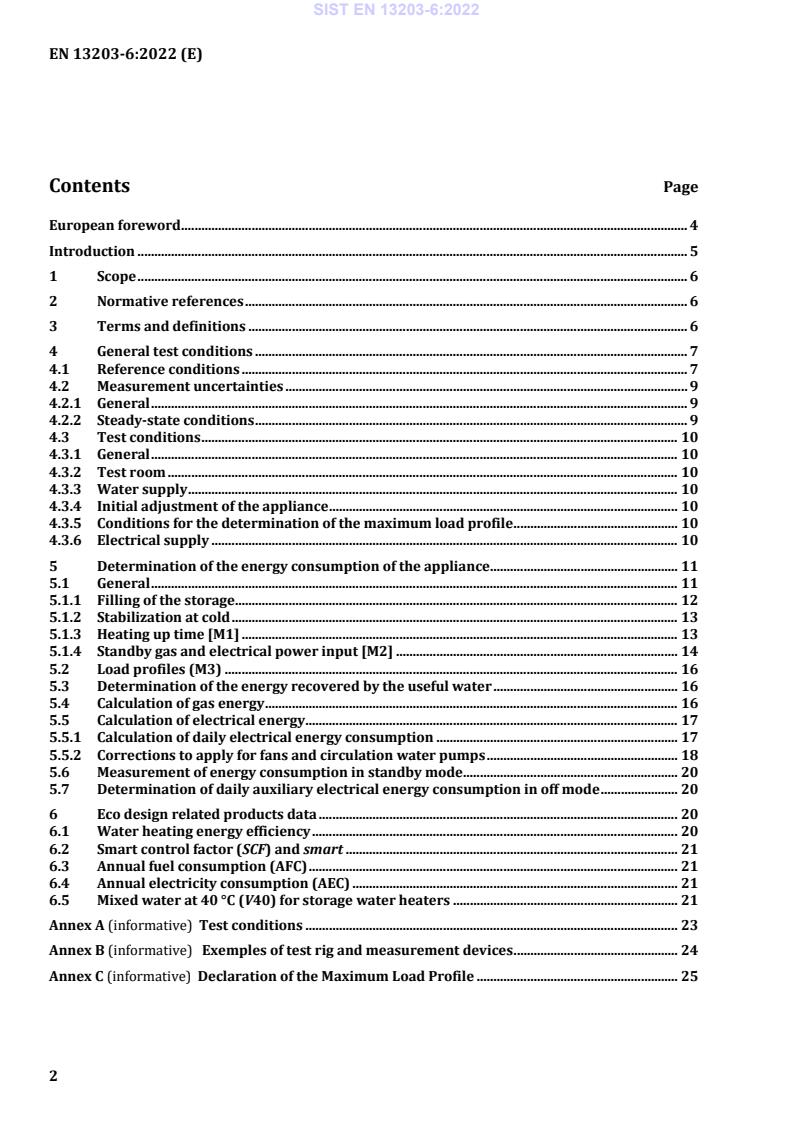
Contents Page
European foreword . 4
Introduction . 5
1 Scope . 6
2 Normative references . 6
3 Terms and definitions . 6
4 General test conditions . 7
4.1 Reference conditions . 7
4.2 Measurement uncertainties . 9
4.2.1 General . 9
4.2.2 Steady-state conditions . 9
4.3 Test conditions . 10
4.3.1 General . 10
4.3.2 Test room . 10
4.3.3 Water supply . 10
4.3.4 Initial adjustment of the appliance . 10
4.3.5 Conditions for the determination of the maximum load profile . 10
4.3.6 Electrical supply . 10
5 Determination of the energy consumption of the appliance . 11
5.1 General . 11
5.1.1 Filling of the storage. 12
5.1.2 Stabilization at cold . 13
5.1.3 Heating up time [M1] . 13
5.1.4 Standby gas and electrical power input [M2] . 14
5.2 Load profiles (M3) . 16
5.3 Determination of the energy recovered by the useful water . 16
5.4 Calculation of gas energy . 16
5.5 Calculation of electrical energy . 17
5.5.1 Calculation of daily electrical energy consumption . 17
5.5.2 Corrections to apply for fans and circulation water pumps . 18
5.6 Measurement of energy consumption in standby mode . 20
5.7 Determination of daily auxiliary electrical energy consumption in off mode . 20
6 Eco design related products data . 20
6.1 Water heating energy efficiency . 20
6.2 Smart control factor (SCF) and smart . 21
6.3 Annual fuel consumption (AFC) . 21
6.4 Annual electricity consumption (AEC) . 21
6.5 Mixed water at 40 °C (V40) for storage water heaters . 21
Annex A (informative) Test conditions . 23
Annex B (informative) Exemples of test rig and measurement devices . 24
Annex C (informative) Declaration of the Maximum Load Profile . 25
Annex ZA (informative) Relationship between this European Standard and the ecodesign
requirements of Commission Regulation (EU) n° 814/2013 [OJEU L239 of 6 September
2013] aimed to be covered . 26
Annex ZB (informative) Relationship between this European Standard and the energy labelling
requirements of Commission Delegated Regulation (EU) No 812/2013 [OJEU L239 of 6
September 2013] aimed to be covered . 27
Annex ZC (informative) Relationship between this European Standard and the ecodesign
requirements of Commission Regulation (EU) n° 813/2013 [OJEU L239 of 6 September
2013] aimed to be covered . 29
Annex ZD (informative) Relationship between this European Standard and the energy labelling
requirements of Commission Delegated Regulation (EU) No 811/2013 [OJEU L239 of 6
September 2013] aimed to be covered . 30
Bibliography . 32
European foreword
This document (EN 13203-6:2022) has been prepared by Technical Committee CEN/TC 109 “Central heating
boilers using gaseous fuels”, the secretariat of which is held by NEN.
This European Standard shall be given the status of a national standard, either by publication of an identical
text or by endorsement, at the latest by February 2023, and conflicting national standards shall be withdrawn
at the latest by February 2023.
Attention is drawn to the possibility that some of the elements of this document may be the subject of patent
rights. CEN shall not be held responsible for identifying any or all such patent rights.
This document supersedes EN 13203-6:2018.
The main technical changes compared to EN 13203-6:2018 are the following:
— to provide a means of conforming to requirements of Commission Delegated Regulation (EC) n°
813/2013, (EC) n° 811/2013, (EC) n° 812/2013 and (EC) n° 814/2013;
— incorporation of ECOTESTS results.
This document has been prepared under a Standardization Request given to CEN by the European
Commission and the European Free Trade Association, and supports essential requirements of EU
Directive(s) / Regulation(s).
For relationship with EU Directive(s) / Regulation(s), see informative Annex ZA, ZB, ZC or ZD, which is an
integral part of this document.
The safety operation of the boiler or water heater is not covered by this document. Safety should be proved by
means of the essential safety requirements of the Gas Appliances Regulation 2016/426/UE. This may be
achieved by compliance with the appropriate existing harmonized standards.
Any feedback and questions on this document should be directed to the users’ national standards body. A
complete listing of these bodies can be found on the CEN website.
According to the CEN-CENELEC Internal Regulations, the national standards organisations of the following
countries are bound to implement this European Standard: Austria, Belgium, Bulgaria, Croatia, Cyprus, Czech
Republic, Denmark, Estonia, Finland, France, Germany, Greece, Hungary, Iceland, Ireland, Italy, Latvia,
Lithuania, Luxembourg, Malta, Netherlands, Norway, Poland, Portugal, Republic of North Macedonia,
Romania, Serbia, Slovakia, Slovenia, Spain, Sweden, Switzerland, Turkey and the United Kingdom.
Introduction
This document refers to clauses of EN 13203-2:2022 or adapts clauses by stating in the corresponding clause,
on the principle:
— shall be according to EN 13203-2:2022, (clause number) with the following modification;
— shall be according to EN 13203-2:2022, (clause number) with the following addition;
— EN 13203-2:2022, (clause number) is replaced with the following;
— EN 13203-2:2022, (clause number) is not applicable.
NOTE Useful standards are series EN 15502 and series EN 12309.
1 Scope
This document is applicable to gas-fired appliances producing domestic hot water. It applies to sorption heat
pumps connected to or including a domestic hot water storage tank. It applies to a package marketed as single
unit or fully specified that have:
— a heat input not exceeding 400 kW;
— a hot water storage tank capacity (if any) not exceeding 2 000 l.
In the case of gas-fired sorption heat pumps, with or without storage tank, domestic hot water production is
integrated or coupled, the whole being marketed as a single unit.
EN 13203-1:2015 sets out in qualitative and quantitative terms the performance in delivery of domestic hot
water for a selected variety of uses. It also gives a system for presenting the information to the user. The
present document sets out a method for assessing the energy performance of the appliances. It specifies a
number of daily load profiles for each domestic hot water use, kitchen, shower, bath and a combination of
these, together with corresponding test procedures, enabling the energy performances of different gas-fired
appliances to be compared and matched to the needs of the user. Where other technologies are combined
with a gas-fired sorption heat pump to produce domestic hot water, specific parts of EN 13203 apply.
Horizontal ground heat sources are not covered by the scope of the present document.
2 Normative references
The following documents are referred to in the text in such a way that some or all of their content constitutes
requirements of this document. For dated references, only the edition cited applies. For undated references,
the latest edition of the referenced document (including any amendments) applies.
Shall be according to EN 13203-2:2022, Clause 2, with the following additions:
EN 13203-2:2022, Gas-fired domestic appliances producing hot water — Part 2: Assessment of energy
consumption
EN 14511-3:2018, Air conditioners, liquid chilling packages and heat pumps for space heating and cooling and
process chillers, with electrically driven compressors — Part 3: Test methods
3 Terms and definitions
Shall be according to EN 13203-2:2022, Clause 3, with the following additions:
3.1
indoor ambient air
heat source for a heat pump which absorbs heat by a heat exchanger in direct contact with the air inside a
building without any dedicated duct
3.2
brine
heat transfer medium which has a freezing point depressed relative to water
3.3
sorption heat pump
encased assembly or assemblies designed as an appliance whose primary function is delivery of domestic hot
water or domestic hot water and heating, where the primary function is dependent on circulation of fluid
(refrigerant and/or solution) within the absorption, adsorption or refrigerant circuit(s)
3.4
gas-fired sorption heat pump combined with a gas-fired appliance
appliance which is either placed on the market or specified as a complete package to deliver safely and
effectively domestic hot water and/or heating, comprising as relevant:
— gas-fired sorption heat pump;
— gas-fired appliance;
— ducts if appropriate;
— thermal store
3.5
ground heat source
heat source of a sorption heat pump for which a heat exchanger, vertically embedded into the ground, is used
to extract heat from the surrounding soil or rock by way of a brine circuit through the evaporator
3.6
solar collector source
heat source of a sorption heat pump for which a solar thermal collector is used to capture radiation energy
from the sun by way of a brine circuit through the evaporator
3.7
external static pressure difference (Δp )
e
positive pressure difference measured between the air (or water) outlet section and the air (or water) inlet
section of the unit, which is available for overcoming the pressure drop of any additional ducted air (or water)
circuit
3.8
internal static pressure difference (Δp )
i
negative pressure difference measured between the air (or water) outlet section and the air (or water) inlet
section of the unit, which corresponds to the total pressure drop of all components on the air (or water) side
of the unit
4 General test conditions
4.1 Reference conditions
Shall be according to EN 13203-2:2022, 4.1, with the following additions:
“The tests shall be carried out at the test conditions specified in Table 1 as appropriate.
Table 1 — Test conditions for particular types of systems
Heat source
Heat source inlet
Air Dry (Wet) Range of ambient Ambient
a
Type of heat source bulb temperature of temperature of
/ outlet or bath
temperature heat pump (°C) storage tank (°C)
temperature (°C)
(°C)
Outdoor air heat pump from 15 to 30 20
(placed indoor side)
Average
7 (6)
Colder
2 (1)
Warmer
14 (13)
Outdoor air heat pump Heat source 20
(outdoor side) temperature
Average
7 (6)
Colder
2 (1)
Warmer
14 (13)
Non heated space air 15 (12) Heat source 15
temperature
Indoor air 20 (15) Heat source 20
temperature
Exhaust air 20 (12) from 15 to 30 20
Water 10 / 7 from 15 to 30 20
Brine 0 / −3 from 15 to 30 20
Direct evaporation a from 15 to 30 20
a
Brine bath mean temperature for direct evaporation testing case, the ambient temperature.
In addition the permissible variations allowed for the test conditions when the heat pump is running shall not
exceed shall not exceed the values specified in Table 2.
Table 2 — Variations allowed for the test conditions when the heat pump is running
Variations of arithmetical mean values Variations of individual readings from
from specified test conditions specified test conditions
Readings
a Interval D c a b c
Interval H Interval S Interval H Interval D Interval S
b
Air temperature
d ±0,6 K ±1,5 K ±1,0 K ±5,0 K ±2,5 K
dry bulb
wet bulb ±0,4 K ±1,0 K ±0,6 K -
Volume flow ±5 % ±10 %
Static pressure
- ±10 %
difference
ambient
temperature of
the tank (if not ±1,0 K ±2,0 K
used as heat
source)
a
Interval H applies when the heat pump is operating, except for the first 10 min after termination of a defrost cycle,
and the first 10 min after a restart of the heat pump.
b
Interval D applies during a defrost cycle and during the first 10 min after the termination of a defrost cycle when the
heat pump is operating in the heating mode.
c
Interval S applies when the compressor is stopped and during the first 10 min after the hot water thermostat has
started again the heat pump.
d 2
For units with outdoor heat exchanger surfaces greater than 5 m , the deviation on the air inlet dry bulb temperature
is doubled.
“.
4.2 Measurement uncertainties
4.2.1 General
Shall be according to EN 13203-2:2022, 4.2.1, with the following additions: “
— air as heat source dry bulb temperature: ± 0,2 K;
— air as heat source wet bulb temperature: ± 0,3 K;
— water/brine as heat source: ± 0,15 K;
— brine from ground or solar source: ± 0,2 K.”.
4.2.2 Steady-state conditions
Shall be according to EN 13203-2:2022, 4.2.2.
4.3 Test conditions
4.3.1 General
Shall be according to EN 13203-2:2022, 4.3.1, except the second sentence modified as follows:
“For gas fired appliances combined with gas heat pump, the tests shall be …”.
and the following sentences added:
“If liquid heat transfer media other than water is used, the specific heat capacity and density of such heat
transfer media shall be determined and taken into consideration in the evaluation.
When the gas-fired sorption heat pump combined with a gas-fired appliance does not operate in heat pump
mode for domestic hot water production according to data in Table 1, the test shall be performed according to
EN 13203-2:2022 instead.”.
4.3.2 Test room
Shall be according to EN 13203-2:2022, 4.3.2, with the following additions:
“If the package incorporates an air source outdoor heat exchanger a further test room is needed. The size of
this test room shall be designed to avoid any resistance to air flow at the air inlet and air outlet orifices of the
test object. The air flow through this room shall not cause any short circuit between the two orifices, and
therefore the velocity of air flow at these two locations shall not exceed 1,5 m/s when the test object is
switched off. The air velocity in the room shall also not be greater than the mean velocity through the unit
inlet.
Unless otherwise stated in the technical documentation, the air inlet and air outlet orifices shall not be less
than 1 m from the surfaces of the test room; this also applies to any measuring ducts.
For sorption heat pumps separated from the storage tank, the liquid flow rate has to be set on the liquid outlet
side of the heat pump to the nominal flow rate specified in the installation and/or operation manual.
The sorption heat pump and/or package shall be installed and connected for the test as specified in the
installation instructions.
Temperature and pressure measuring points shall be situated in order to obtain significant mean values.
Set points for internal control equipment of the unit such as thermostats, pressure switches or mixing valves
shall be set to the values stated in the installation and/or operation instructions.
Air and entrained gases shall be removed from all water and other heat transfer liquid systems.
Each water pipe shall be installed in accordance with the installation instructions to the maximum stated
length or 5 m whichever is shorter. Thermal insulation shall be applied to the pipes in accordance with the
installation instructions.”.
4.3.3 Water supply
Shall be according to EN 13203-2:2022, 4.3.3.
4.3.4 Initial adjustment of the appliance
Shall be according to EN 13203-2:2022, 4.3.4.
4.3.5 Conditions for the determination of the maximum load profile
Shall be according to EN 13203-2:2022, 4.3.5.
4.3.6 Electrical supply
Shall be according to EN 13203-2:2022, 4.3.6.
5 Determination of the energy consumption of the appliance
5.1 General
EN 13203-2:2022, 5.1, is replaced by the new clause as follows:
“5.1 Basic principles for the measurements of the performance
This clause specifies the test methods to apply for the determination of the energy consumption of the
covered appliances which consists of the following two preparation tests and the four measurement tests.
— [P1] Filling and storage volume (see 5.1.2);
— [P2] Stabilization at cold conditions (see 5.1.3);
— [M1] Heating up (see 5.1.4);
— [M2] Standby mode for electrical power input and gas input measurements (see 5.1.5);
— [M3] Tapping cycle application with all water draw-offs according to EN 13203-2:2022, 5.2;
— [M4] Mixed water at 40 °C and reference hot water temperature (see 7.7).
The measurement steps 1 to 4 are performed according to in Figure 1.
Each individual test can be performed independently provided that its starting conditions are the same as the
ending conditions of the tests just before.
M1 M2 M3
M4
Key
M1: heating up time
M2: standby power (electric and gas)
M3: water draw-offs (tapping)
M4: mixed water at 40 °C and reference hot water temperature
T : temperature
t : time
a : set point temperature
Figure 1 — Measurements [M1] to [M4]
5.1.1 Filling of the storage
The empty storage tank of the appliance is weighted including the inlet and outlet taps or connections.
Then it is filled with water as stated in the installation and operation instructions at the pressure of the
incoming cold water. When it is filled, the water supply is cut off and the appliance is weighed, including the
taps or connections.
The difference between the two weights (m ) shall be converted into volume, in litres, according to the
act
following formula:
m
act
Vm= 1000 (1)
ρ T
( )
where
V is the rated volume of the hot water storage tank, in l;
m
m is the difference of the two weights, in kg;
act
ρ(T) 3
is the specific volume of cold water, in kg/m ;
T is the temperature of the water used to fill the tank, in °C.
This volume is to be reported in litres to the nearest one-tenth litres.
Filling of the storage are not applicable to heat pump combination heaters.
NOTE The temperature (T) reached after stabilization (see 5.1.2) can be used to calculate the specific volume ρ(T).
5.1.2 Stabilization at cold
The appliance is kept at ambient conditions until all its parts have reached ambient conditions ± 1 K.
NOTE A waiting time of 24 h is enough to reach stabilization.
5.1.3 Heating up time [M1]
The test consists of determining the heating up time (t ) necessary to heat the stored water from its initial
eh
cold state temperature until the first time the gas heat pump is turned off by the set thermostat of the storage
tank. The gas and/or electrical consumption are also measured.
Before launching the test, the cold water is circulated in the tank until the outlet temperature becomes equal
to the inlet temperature within the allowed variation specified (±0,5 K).
When this initial state temperature of the cold water is reached, the gas heat pump is switched on.
After this initial start of the gas heat pump, the gas and electrical supplies are left on for the duration of the
test.
The heating up time (t ) and the corresponding gas input (Q ) and/or electrical (W ) consumptions
eh gas,eh eh
shall be measured from the moment the gas heat pump is switched on until it is shut off by the thermostat of
the storage tank.
The gas consumption is calculated according to the following formula:
Q = K.NCV V (2)
gas,eh g
where
Q is the gas energy consumption to heating up the tank, in kWh;
gas eh
V 3
g is the measured gas consumption during the heating up period, in m ;
NCV 3
is the net calorific value (at 15 °C and 1 013,25 mbar), in kWh/m ;
K is the correction constant and is calculated according to the following formula:
pp+− p
a gs 288,15
K ⋅ (3)
1013,,25 T + 273 15
g
Ps exp 21,094− (4)
273,15+ T
g
with
p is the atmospheric pressure, in mbar;
a
=
=
p is the gas pressure, in mbar;
g
p is the saturated vapour pressure of water at T (mbar); if a dry meter is used for the
s g
measurement of the volume, the value of (P ) is equal to zero;
s
T is the gas temperature, in °C.
g
The total electrical energy consumption is calculated according to following formula:
W W − W (5)
eh eh−−M EL Corr
where
W is the total electrical energy consumption during the heating up duration (t ), in kWh;
eh eh
W is the measured electrical energy consumption during the heating up duration, in kWh;
eh-M
W is the correction due to electrical energy consumption of f
...