


EN 12312-8:2018
(Main)Aircraft ground support equipment - Specific requirements - Part 8: Maintenance or service stairs and platforms
Aircraft ground support equipment - Specific requirements - Part 8: Maintenance or service stairs and platforms
1.1 General
This document specifies the technical requirements to minimize the hazards listed in Clause 4 which can arise during the commissioning, the operation and the maintenance of maintenance or service stairs and platforms when used as intended, including misuse reasonably foreseeable by the manufacturer, when carried out in accordance with the specifications given by the manufacturer or his authorized representative. It also takes into account some requirements recognized as essential by authorities, aircraft and ground support equipment (GSE) manufacturers as well as airlines and handling agencies.
These machines are designed to be used as aircraft ground support equipment with the intended use to serve aircraft in outdoor conditions on the apron. They can also be used indoors at hangars. The use of such equipment for operations not in conjunction with aircraft is not defined as intended use therein. Due to the good operational conditions on the apron, deviations from some clauses of EN 280 were deemed acceptable.
This European Standard applies to:
a) self-propelled fixed or adjustable maintenance or service stairs and elevating platforms;
b) towable maintenance or service stairs and platforms equipped with powered means, e.g. for height adjustment, stabilizers;
designed for aircraft maintenance or service purposes including access to the aircraft.
NOTE 1 Powered will be also understood as manual effort stored in springs or hydraulic accumulators, etc., the dangerous action of which can be produced or can continue after the manual effort has ceased or directly applied manual effort for lifting or lowering loads.
NOTE 2 Those clauses of this standard that can apply can also be used as a guideline for the design of towable maintenance or service stairs and platforms without powered means.
This European Standard does not apply to:
c) maintenance docks either fixed to the ground or moveable only for docking procedure;
d) ground support equipment specifically intended, built and equipped with a fluid system for aircraft de-icing and anti-icing (see EN 12312 6);
NOTE 3 This does not prevent aircraft de-icers meeting the requirements of EN 12312 6 from being used as a means of access for aircraft maintenance, e.g. windshield cleaning, etc.
e) mobile elevating work platforms (MEWP) used at the airports for purposes other than aircraft maintenance, e.g. buildings and facilities (see EN 280).
No extra requirements on noise and vibration are provided other than those given in EN 1915 3 and EN 1915 4.
NOTE 4 EN 1915 3 and EN 1915 4 provide the general GSE vibration and noise requirements.
This European Standard does not deal with hazards in respect to a standard automotive chassis and from other vehicles on the apron.
This part of EN 12312 is not applicable to maintenance or service stairs and platforms which are manufactured before the date of publication of this standard by CEN.
This part of EN 12312 when used in conjunction with EN 1915 1, EN 1915 2, EN 1915 3 and EN 1915 4 provides the requirements for maintenance or service stairs and platforms.
1.2 Classification
For the purposes of this document, mobile elevating work platforms (MEWPs) used for aircraft maintenance access are divided into two main groups A and B. In addition, group C is considered as described in c) hereafter:
a) Group A: MEWPs where the vertical projection of the centre of the platform area is always inside the tipping lines.
NOTE 1 See 5.2 hereafter for the specific requirements applying to Group A MEWPs.
b) Group B: MEWPs where the vertical projection of the centre of the platform area may be outside the tipping lines.
NOTE 2 See 5.3 hereafter for the specific requirements applying to Group B MEWPs.
c) Group C consists of maintenance or service access stairs, where persons are not elevated by the machine but climb a flight of steps.
(...)
Luftfahrt-Bodengeräte - Besondere Anforderungen - Teil 8: Wartungs- oder Servicetreppen und -bühnen
1.1 Allgemeines
Dieses Dokumentlegt die technischen Anforderungen zur Minimierung der in Abschnitt 4 aufgelisteten Gefährdungen fest, die bei Inbetriebnahme, Betrieb und Wartung von Wartungs- oder Servicetreppen und bühnen bei vorgesehener Verwendung, einschließlich vom Hersteller vernünftigerweise vorhersehbarer Fehlanwendung, auftreten können, wenn diese in Übereinstimmung mit den Anweisungen des Herstellers oder seines Beauftragten ausgeführt werden. Sie berücksichtigt auch einige Anforderungen, die von offiziellen Stellen, den Herstellern von Luftfahrzeugen und Bodengeräten (en: ground support equipment, GSE) sowie Luftverkehrs- und Abfertigungsgesellschaften als wesentlich erachtet wurden.
Diese Maschinen sind entsprechend ausgelegt, um als Luftfahrt-Bodengeräte mit der vorgesehenen Verwendung, das Luftfahrzeug im Freien auf dem Vorfeld zu bedienen, eingesetzt zu werden. Sie können auch in Hangars verwendet werden. Die Verwendung dieser Geräte für Einsätze, die nicht im Zusammenhang mit dem Luftfahrzeug stehen, ist nicht als vorgesehene Verwendung festgelegt. Aufgrund der guten Betriebsbedingungen auf dem Vorfeld wurden Abweichungen von einigen Abschnitten von EN 280 als annehmbar erachtet.
Diese Europäische Norm gilt für
a) selbstfahrende, feststehende oder einstellbare, Wartungs- oder Servicetreppen und –hubbühnen,
b) schleppbare Wartungs- oder Servicetreppen und -bühnen mit kraftbetriebenen Einrichtungen, z. B. zur Höhenanpassung, Abstützungen,
die für Wartungs- und Servicearbeiten an Luftfahrzeugen einschließlich des Zugangs zum Luftfahrzeug bestimmt sind.
ANMERKUNG 1 Kraftbetrieben wird auch verstanden als in Federn oder hydraulische Akkumulatoren usw. gespeicherte menschliche Arbeitskraft, deren gefährliche Wirkung entstehen kann oder nach dem Einstellen der menschlichen Tätigkeit weiterhin bestehen kann, oder als unmittelbar angewandte menschliche Arbeitskraft zum Heben oder Senken von Lasten.
ANMERKUNG 2 Zutreffende Abschnitte dieser Norm können auch als Richtlinie für die Gestaltung von schleppbaren Wartungs- oder Servicetreppen und -bühnen ohne kraftbetätigte Einrichtungen dienen.
Diese Europäische Norm gilt nicht für
c) Wartungsdocks, die fest installiert oder nur für den Andockvorgang beweglich sind,
d) Bodengeräte, die speziell für die Enteisung oder den Vereisungsschutz von Luftfahrzeugen vorgesehen, gebaut und mit einem Flüssigkeitssystem ausgerüstet sind (siehe EN 12312 6);
ANMERKUNG 3 Das hindert nicht daran, dass Enteiser und Enteisungs-/Vereisungsschutzgeräte für Luftfahrzeuge, die die Anforderungen von EN 12312 6 erfüllen, als Mittel zum Zugang für Wartungsarbeiten am Luftfahrzeug eingesetzt werden, z. B. Reinigung der Windschutzscheiben usw.
e) fahrbare Hubarbeitsbühnen (FHAB), die an Flughäfen für andere Zwecke als die Wartung von Luftfahrzeugen verwendet werden, z. B. für Gebäude und Anlagen (siehe EN 280).
Es werden keine zusätzlichen Anforderungen zu Lärm und Schwingungen neben jenen aus EN 1915 3 und EN 1915 4 angeführt.
ANMERKUNG 4 EN 1915 3 und EN 1915 4 behandeln die allgemeinen Lärm- und Vibrationsanforderungen an Bodengeräte (GSE).
Diese Europäische Norm behandelt keine Gefährdungen, die von einem Serienfahrgestell und von anderen Fahrzeugen auf dem Vorfeld ausgehen.
Dieser Teil von EN 12312 gilt nicht für Wartungs- oder Servicetreppen und -bühnen, die vor der Veröffentlichung dieser Norm durch CEN hergestellt wurden.
Dieser Teil von EN 12312 stellt bei Anwendung in Verbindung mit EN 1915 1, EN 1915 2, EN 1915 3 und EN 1915 4 die Anforderungen an Wartungs- oder Servicetreppen und -bühnen bereit.
1.2 Klassifizierung
Für die Anwendung dieses Dokuments werden fahrbare Hubarbeitsbühnen (FHAB), die für den Zugang zum Luftfahrzeug bei der Wartung verwendet werden, in die zwei Hauptgruppen A und B eingeteilt. Hinzu kommt die nachstehend in c) beschriebene Gruppe C
(...)
Matériel au sol pour aéronefs - Exigences particulières - Partie 8: Escabeaux et plate-formes de maintenance ou de service
Podporna oprema na tleh za letalski promet - Posebne zahteve - 8. del: Stopnice in odri za vzdrževalna dela in servisiranje
Ta evropski standard določa tehnične zahteve za zmanjšanje nevarnosti, navedenih v točki 4, do katerih lahko pride pri začetku uporabe, delovanju ter vzdrževanju stopnic in odrov za vzdrževalna dela ter pri namenski uporabi, vključno s pričakovano nepravilno uporabo, ki jo določi proizvajalec, ko jih v skladu s specifikacijami izvaja proizvajalec ali njegov zakoniti zastopnik. Upošteva tudi nekatere zahteve, ki jih vladni organi, proizvajalci letal in podporne opreme na tleh, letalske družbe in agencije za oskrbo letal priznavajo za bistvene.
Ti stroji so namenjeni za uporabo kot podporna oprema na tleh za letalski promet s predvideno uporabo za letala v zunanjih pogojih na letalski ploščadi. Lahko se uporabljajo tudi v zaprtih prostorih v hangarjih. Uporaba takšne opreme za postopke, ki niso v zvezi z letali, v tem dokumentu ni opredeljena kot predvidena uporaba. Zaradi dobrih obratovalnih pogojev na letalski ploščadi so bila odstopanja od nekaterih točk standarda EN 280 opredeljena kot sprejemljiva.
Ta evropski standard se uporablja za:
a) fiksne ali nastavljive stopnice za vzdrževalna dela in dvižne odre z lastnim pogonom;
b) vlečne stopnice in odre za vzdrževalna dela, ki so opremljeni s pogonsko enoto, na primer za višinsko prilagoditev, ali stabilizatorji
za namene vzdrževanja letala, vključno z dostopom do letala.
OPOMBA 1: Izraz »s pogonsko enoto« se razume tudi kot ročna sila, shranjena v vzmeteh ali hidravličnih akumulatorjih itd., katerih nevarno proizvajanje ali nadaljevanje delovanja je mogoče še po prenehanju ročnega proizvajanja sile, ali neposredno uveljavljena ročna sila za dvigovanje ali spuščanje bremen.
OPOMBA 2: Primerne točke tega standarda je mogoče uporabiti tudi kot smernice za projektiranje vlečenih stopnic brez pogonske enote.
Ta evropski standard se ne uporablja za:
c) priključke za vzdrževanje, ki so pritrjeni na tla ali so premični le za namene priključitve;
d) podporno opremo na tleh, ki je posebej predvidena, izdelana in opremljena s sistemom s tekočino za odstranjevanje/preprečevanje nastanka ledu na letalu (glej EN 12312 6);
OPOMBA 3: To ne preprečuje uporabe sistemov za odstranjevanje ledu, ki izpolnjujejo zahteve standarda EN 12312-6, kot sredstva za dostop pri vzdrževanju letala, na primer za čiščenje vetrobranskega stekla itd.
e) mobilne dvižne delovne platforme (MEWP), ki se uporabljajo na letališčih za namene, ki niso vzdrževanje letal, npr. stavbe in naprave (glej EN 280).
Ta standard ne postavlja zahtev za nevarnosti, ki jih povzročajo hrup in vibracije.
OPOMBA 4: Standarda EN 1915-3 in EN 1915-4 določata splošne zahteve glede hrupa in vibracij pri podporni opremi na tleh.
Ta evropski standard ne obravnava nevarnosti v zvezi z standardno avtomobilsko šasijo in drugimi vozili na letališki ploščadi.
Ta del standarda EN 12312 se ne uporablja za stopnice in odre za vzdrževalna dela, izdelane, preden je CEN objavil ta standard.
Ta del standarda EN 12312 skupaj z deli EN 19151, EN 19152, EN 19153 in EN 19154 določa zahteve za stopnice in odre za vzdrževalna dela.
1.2 Klasifikacija
Za namene tega evropskega standarda so premične dvižne delovne ploščadi (MEWP), ki se uporabljajo za dostop pri vzdrževanju letala, razdeljene v dve glavni skupini (A in B):
a) Skupina A: premične dvižne delovne ploščadi, pri katerih je navpična projekcija središča ploščadi vedno znotraj zunanjih linij.
OPOMBA: Za zahteve glede premičnih dvižnih delovnih ploščadi skupine A glej točko 5.2 v tem dokumentu.
b) Skupina B: premične dvižne delovne ploščadi, pri katerih je navpična projekcija središča ploščadi lahko zunaj zunanjih linij.
OPOMBA: Za zahteve glede premičnih dvižnih delovnih ploščadi skupine B glej točko 5.3 v tem dokumentu.
c) Dodatna skupina C zajema dostopne stopnice za vzdrževalna dela, pri katerih osebe ne dviga stroj, temveč morajo te same preplezati določen sklop stopnic.
General Information
- Status
- Published
- Publication Date
- 14-Aug-2018
- Withdrawal Date
- 27-Feb-2019
- Technical Committee
- CEN/TC 274 - Aircraft ground support equipment
- Drafting Committee
- CEN/TC 274/WG 1 - Working Group Revision
- Current Stage
- 9093 - Decision to confirm - Review Enquiry
- Start Date
- 04-Sep-2024
- Completion Date
- 23-Sep-2025
Relations
- Effective Date
- 22-Aug-2018
Overview
EN 12312-8:2018 - "Aircraft ground support equipment - Specific requirements - Part 8: Maintenance or service stairs and platforms" is a CEN European Standard that defines technical and safety requirements for maintenance/service stairs and elevating platforms used to access aircraft on the apron or in hangars. It specifies measures to minimize hazards during commissioning, operation and maintenance when equipment is used as intended (including reasonably foreseeable misuse). The standard is a type‑C standard (per EN ISO 12100) and is intended to be used together with EN 1915‑1/2/3/4 and other relevant EN/ISO machinery standards.
Key topics and technical requirements
- Scope and applicability
- Applies to self‑propelled and towable maintenance/service stairs and elevating platforms with powered means (including stored manual power such as springs or hydraulic accumulators).
- Excludes fixed maintenance docks, dedicated de‑icers (EN 12312‑6), and MEWPs used for non‑aircraft purposes (refer EN 280).
- Classification
- Group A: MEWPs where the platform centre projection is always within tipping lines.
- Group B: MEWPs where the projection may fall outside tipping lines.
- Group C: Passive maintenance/service stairs (users climb steps; not elevating platforms).
- Travelling types: Type 1 (travel only stowed), Type 2 (travel with raised platform controlled from chassis), Type 3 (travel controlled from platform).
- Safety and design requirements
- Technical measures to address hazards listed in normative Annex A (hazard list).
- Requirements for stability, strength, control systems, emergency stop, and anti‑overturning measures (refer to EN 280 and EN 1915 series).
- Marking, warnings, user instructions and verification/testing (Clause 6 and Clause 7).
- Normative/Informative annexes
- Annex A: List of hazards (normative)
- Annex B: Additional stair on maintenance platforms (normative)
- Annex C: Loading control guidance (informative)
- Annex ZA: Relationship to EU Machinery Directive 2006/42/EC
Applications and users
- Who uses this standard
- GSE manufacturers and designers, airport operators, airlines, ground handling agencies, safety regulators, procurement teams and maintenance/service providers.
- Practical uses
- Design and certification of aircraft access stairs and elevating platforms.
- Procurement specifications to ensure compliance and operator safety on the apron and in hangars.
- Risk assessment, testing and verification during commissioning and periodic maintenance.
- Integration with airport safety programs and conformity with the EU Machinery Directive.
Related standards
- EN 1915‑1/2/3/4 (general GSE requirements: safety, stability, vibration, noise)
- EN 280 (MEWP design and stability)
- EN 12312‑6 (de‑icing equipment)
- EN ISO 12100, EN ISO 13849‑1, EN ISO 13850 (machine safety, control systems, emergency stop)
By following EN 12312-8:2018, stakeholders ensure safer, compliant maintenance stairs and platforms for aircraft ground support equipment (GSE), improving operational safety on the apron and in hangars.



Frequently Asked Questions
EN 12312-8:2018 is a standard published by the European Committee for Standardization (CEN). Its full title is "Aircraft ground support equipment - Specific requirements - Part 8: Maintenance or service stairs and platforms". This standard covers: 1.1 General This document specifies the technical requirements to minimize the hazards listed in Clause 4 which can arise during the commissioning, the operation and the maintenance of maintenance or service stairs and platforms when used as intended, including misuse reasonably foreseeable by the manufacturer, when carried out in accordance with the specifications given by the manufacturer or his authorized representative. It also takes into account some requirements recognized as essential by authorities, aircraft and ground support equipment (GSE) manufacturers as well as airlines and handling agencies. These machines are designed to be used as aircraft ground support equipment with the intended use to serve aircraft in outdoor conditions on the apron. They can also be used indoors at hangars. The use of such equipment for operations not in conjunction with aircraft is not defined as intended use therein. Due to the good operational conditions on the apron, deviations from some clauses of EN 280 were deemed acceptable. This European Standard applies to: a) self-propelled fixed or adjustable maintenance or service stairs and elevating platforms; b) towable maintenance or service stairs and platforms equipped with powered means, e.g. for height adjustment, stabilizers; designed for aircraft maintenance or service purposes including access to the aircraft. NOTE 1 Powered will be also understood as manual effort stored in springs or hydraulic accumulators, etc., the dangerous action of which can be produced or can continue after the manual effort has ceased or directly applied manual effort for lifting or lowering loads. NOTE 2 Those clauses of this standard that can apply can also be used as a guideline for the design of towable maintenance or service stairs and platforms without powered means. This European Standard does not apply to: c) maintenance docks either fixed to the ground or moveable only for docking procedure; d) ground support equipment specifically intended, built and equipped with a fluid system for aircraft de-icing and anti-icing (see EN 12312 6); NOTE 3 This does not prevent aircraft de-icers meeting the requirements of EN 12312 6 from being used as a means of access for aircraft maintenance, e.g. windshield cleaning, etc. e) mobile elevating work platforms (MEWP) used at the airports for purposes other than aircraft maintenance, e.g. buildings and facilities (see EN 280). No extra requirements on noise and vibration are provided other than those given in EN 1915 3 and EN 1915 4. NOTE 4 EN 1915 3 and EN 1915 4 provide the general GSE vibration and noise requirements. This European Standard does not deal with hazards in respect to a standard automotive chassis and from other vehicles on the apron. This part of EN 12312 is not applicable to maintenance or service stairs and platforms which are manufactured before the date of publication of this standard by CEN. This part of EN 12312 when used in conjunction with EN 1915 1, EN 1915 2, EN 1915 3 and EN 1915 4 provides the requirements for maintenance or service stairs and platforms. 1.2 Classification For the purposes of this document, mobile elevating work platforms (MEWPs) used for aircraft maintenance access are divided into two main groups A and B. In addition, group C is considered as described in c) hereafter: a) Group A: MEWPs where the vertical projection of the centre of the platform area is always inside the tipping lines. NOTE 1 See 5.2 hereafter for the specific requirements applying to Group A MEWPs. b) Group B: MEWPs where the vertical projection of the centre of the platform area may be outside the tipping lines. NOTE 2 See 5.3 hereafter for the specific requirements applying to Group B MEWPs. c) Group C consists of maintenance or service access stairs, where persons are not elevated by the machine but climb a flight of steps. (...)
1.1 General This document specifies the technical requirements to minimize the hazards listed in Clause 4 which can arise during the commissioning, the operation and the maintenance of maintenance or service stairs and platforms when used as intended, including misuse reasonably foreseeable by the manufacturer, when carried out in accordance with the specifications given by the manufacturer or his authorized representative. It also takes into account some requirements recognized as essential by authorities, aircraft and ground support equipment (GSE) manufacturers as well as airlines and handling agencies. These machines are designed to be used as aircraft ground support equipment with the intended use to serve aircraft in outdoor conditions on the apron. They can also be used indoors at hangars. The use of such equipment for operations not in conjunction with aircraft is not defined as intended use therein. Due to the good operational conditions on the apron, deviations from some clauses of EN 280 were deemed acceptable. This European Standard applies to: a) self-propelled fixed or adjustable maintenance or service stairs and elevating platforms; b) towable maintenance or service stairs and platforms equipped with powered means, e.g. for height adjustment, stabilizers; designed for aircraft maintenance or service purposes including access to the aircraft. NOTE 1 Powered will be also understood as manual effort stored in springs or hydraulic accumulators, etc., the dangerous action of which can be produced or can continue after the manual effort has ceased or directly applied manual effort for lifting or lowering loads. NOTE 2 Those clauses of this standard that can apply can also be used as a guideline for the design of towable maintenance or service stairs and platforms without powered means. This European Standard does not apply to: c) maintenance docks either fixed to the ground or moveable only for docking procedure; d) ground support equipment specifically intended, built and equipped with a fluid system for aircraft de-icing and anti-icing (see EN 12312 6); NOTE 3 This does not prevent aircraft de-icers meeting the requirements of EN 12312 6 from being used as a means of access for aircraft maintenance, e.g. windshield cleaning, etc. e) mobile elevating work platforms (MEWP) used at the airports for purposes other than aircraft maintenance, e.g. buildings and facilities (see EN 280). No extra requirements on noise and vibration are provided other than those given in EN 1915 3 and EN 1915 4. NOTE 4 EN 1915 3 and EN 1915 4 provide the general GSE vibration and noise requirements. This European Standard does not deal with hazards in respect to a standard automotive chassis and from other vehicles on the apron. This part of EN 12312 is not applicable to maintenance or service stairs and platforms which are manufactured before the date of publication of this standard by CEN. This part of EN 12312 when used in conjunction with EN 1915 1, EN 1915 2, EN 1915 3 and EN 1915 4 provides the requirements for maintenance or service stairs and platforms. 1.2 Classification For the purposes of this document, mobile elevating work platforms (MEWPs) used for aircraft maintenance access are divided into two main groups A and B. In addition, group C is considered as described in c) hereafter: a) Group A: MEWPs where the vertical projection of the centre of the platform area is always inside the tipping lines. NOTE 1 See 5.2 hereafter for the specific requirements applying to Group A MEWPs. b) Group B: MEWPs where the vertical projection of the centre of the platform area may be outside the tipping lines. NOTE 2 See 5.3 hereafter for the specific requirements applying to Group B MEWPs. c) Group C consists of maintenance or service access stairs, where persons are not elevated by the machine but climb a flight of steps. (...)
EN 12312-8:2018 is classified under the following ICS (International Classification for Standards) categories: 49.100 - Ground service and maintenance equipment. The ICS classification helps identify the subject area and facilitates finding related standards.
EN 12312-8:2018 has the following relationships with other standards: It is inter standard links to EN 12312-8:2005+A1:2009. Understanding these relationships helps ensure you are using the most current and applicable version of the standard.
EN 12312-8:2018 is associated with the following European legislation: EU Directives/Regulations: 2006/42/EC; Standardization Mandates: M/079, M/396. When a standard is cited in the Official Journal of the European Union, products manufactured in conformity with it benefit from a presumption of conformity with the essential requirements of the corresponding EU directive or regulation.
You can purchase EN 12312-8:2018 directly from iTeh Standards. The document is available in PDF format and is delivered instantly after payment. Add the standard to your cart and complete the secure checkout process. iTeh Standards is an authorized distributor of CEN standards.
Standards Content (Sample)
2003-01.Slovenski inštitut za standardizacijo. Razmnoževanje celote ali delov tega standarda ni dovoljeno.Podporna oprema na tleh za letalski promet - Posebne zahteve - 8. del: Stopnice in odri za vzdrževalna dela in servisiranjeLuftfahrt-Bodengeräte - Besondere Anforderungen - Teil 8: Wartungs- oder Servicetreppen und -bühnenMatériel au sol pour aéronefs - Exigences particulières - Partie 8: Escabeaux et plate-formes de maintenance ou de serviceAircraft ground support equipment - Specific requirements - Part 8: Maintenance or service stairs and platforms49.100Oprema za servis in vzdrževanje na tlehGround service and maintenance equipmentICS:Ta slovenski standard je istoveten z:EN 12312-8:2018SIST EN 12312-8:2018en,fr,de01-november-2018SIST EN 12312-8:2018SLOVENSKI
STANDARDSIST EN 12312-8:2005+A1:20091DGRPHãþD
EUROPEAN STANDARD NORME EUROPÉENNE EUROPÄISCHE NORM
EN 12312-8
August
t r s z ICS
v {ä s r r Supersedes EN
s t u s tæ zã t r r w ªA sã t r r {English Version
Aircraft ground support equipment æ Specific requirements æ Part
zã Maintenance or service stairs and platforms Matériel au sol pour aéronefs æ Exigences particulières æ Partie
zã Escabeaux et plateæformes de maintenance ou de service
LuftfahrtæBodengeräte æ Besondere Anforderungen æ Teil
zã Wartungsæ oder Servicetreppen und æbühnen This European Standard was approved by CEN on
t u April
t r s zä
egulations which stipulate the conditions for giving this European Standard the status of a national standard without any alterationä Upætoædate lists and bibliographical references concerning such national standards may be obtained on application to the CENæCENELEC Management Centre or to any CEN memberä
translation under the responsibility of a CEN member into its own language and notified to the CENæCENELEC Management Centre has the same status as the official versionsä
CEN members are the national standards bodies of Austriaá Belgiumá Bulgariaá Croatiaá Cyprusá Czech Republicá Denmarká Estoniaá Finlandá Former Yugoslav Republic of Macedoniaá Franceá Germanyá Greeceá Hungaryá Icelandá Irelandá Italyá Latviaá Lithuaniaá Luxembourgá Maltaá Netherlandsá Norwayá Polandá Portugalá Romaniaá Serbiaá Slovakiaá Sloveniaá Spainá Swedená Switzerlandá Turkey and United Kingdomä
EUROPEAN COMMITTEE FOR STANDARDIZATION COMITÉ EUROPÉEN DE NORMALISATION EUROPÄISCHES KOMITEE FÜR NORMUNG
CEN-CENELEC Management Centre:
Rue de la Science 23,
B-1040 Brussels
t r s z CEN All rights of exploitation in any form and by any means reserved worldwide for CEN national Membersä Refä Noä EN
s t u s tæ zã t r s z ESIST EN 12312-8:2018
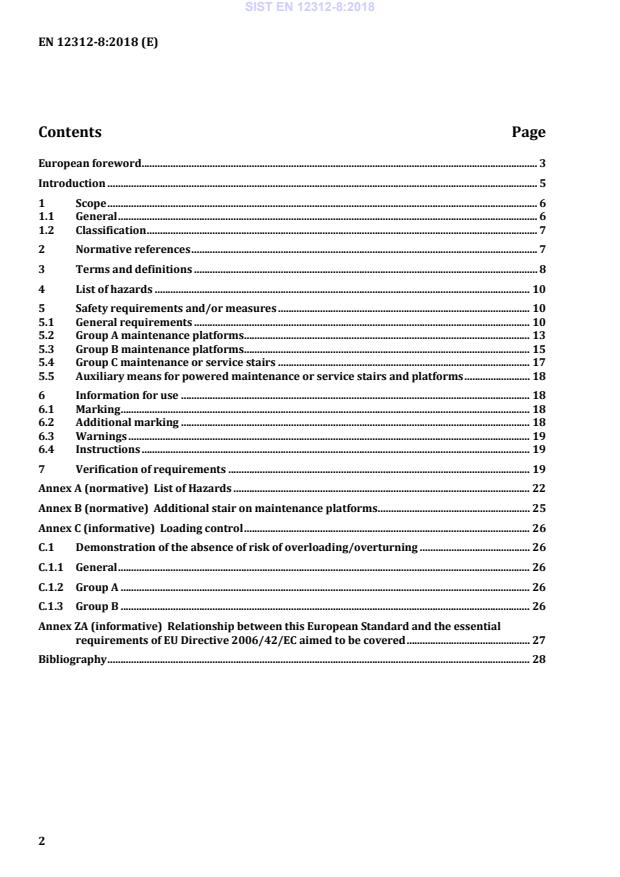
List of Hazards . 22 Annex B (normative)
Additional stair on maintenance platforms . 25 Annex C (informative)
Loading control . 26 C.1 Demonstration of the absence of risk of overloading/overturning . 26 C.1.1 General . 26 C.1.2 Group A . 26 C.1.3 Group B . 26 Annex ZA (informative)
Relationship between this European Standard and the essential requirements of EU Directive 2006/42/EC aimed to be covered . 27 Bibliography . 28
IEC Electropedia: available at http://www.electropedia.org/
ISO Online browsing platform: available at http://www.iso.org/obp 3.1 maintenance platform mobile elevating work platform (MEWP) designed for: — the transport of persons and tools to reach and/or access to elevated parts of the aircraft; — carrying out maintenance work on aircraft at the airport 3.1.1 mobile elevating work platform MEWP mobile machine intended to elevate persons to working positions for purposes of aircraft maintenance access at airports 3.1.2 group A MWEPs on which the vertical projection of the centre of the platform area, in all platform configurations at the maximum inclination, is always inside the tipping lines Note 1 to entry: See ISO 16368. SIST EN 12312-8:2018
...
EN 12312-8:2018は、航空機の地上支援設備に関する特定要求事項を定義した重要な標準であり、特にメンテナンスまたはサービス階段およびプラットフォームに焦点を当てています。この文書は、製造業者またはその権限を与えられた代理人による仕様に従って利用されることを前提に、設置、運用、メンテナンス中に発生する可能性のある危険を最小限に抑えるための技術要件を明確に規定しています。 この標準の強みは、航空機のメンテナンスやサービスを目的とする設備に特化した要件を提供する点です。特に、屋外および屋内での使用を考慮しており、航空機のアクセスを容易にするよう設計されています。この文書は、航空機および地上支援設備(GSE)メーカー、航空会社、ハンドリングエージェンシーによって認識されている重要な要件を考慮しています。また、設備の使用目的に関しても明確に定義されており、航空機に関連しない使用については意図された使用とは見なされないとされています。 標準には、自己推進式および牽引可能なメンテナンス階段やプラットフォームに関する要件が含まれており、これらは航空機のメンテナンスやサービスのための施設を提供します。特に、電動または手動の手段で高さを調整できる機能を持つ設計が求められている点は、さまざまな運用条件に対応できるようになっています。また、ノイズや振動に関する特別な要件は、既存の標準に基づいており、業界全体に共通する基準を提供します。 この標準は、航空機のメンテナンスに直接関連しない移動式昇降作業プラットフォーム(MEWP)に対して適用されないことも明確にされています。これにより、航空機の運用における安全性と効率性を向上させるためのガイドラインが提供されています。 まとめると、EN 12312-8:2018は、航空機地上支援設備のメンテナンスおよびサービス階段とプラットフォームに関する技術的要件を包括的に定めており、その適用範囲、強み、および関連性は、多くの関係者にとって重要な指針となります。
The EN 12312-8:2018 standard delineates the technical requirements and guidelines for maintenance or service stairs and platforms specifically used as aircraft ground support equipment (GSE). This document provides a comprehensive approach to ensuring safety and functionality in outdoor conditions, particularly on the apron, while also accommodating indoor use in hangars. One significant strength of this standard is its detailed scope, which encompasses both self-propelled and towable stairs and platforms, including those equipped with powered means for height adjustment. This broad applicability ensures that diverse types of ground support equipment can meet consistent safety and operational benchmarks, significantly minimizing potential hazards associated with their use. The standard also acknowledges foreseeable misuses, adding another layer of safety by addressing the responsibilities of manufacturers and authorized representatives in ensuring their equipment is utilized correctly. Moreover, the classification of mobile elevating work platforms (MEWPs) into groups A, B, and C offers a nuanced understanding of various configurations of equipment, thereby enabling manufacturers and users to align their operations strictly with the defined safety regulations and design standards. This clear classification aids the development of tailored safety measures and maintenance practices for each group, thereby enhancing operational safety in aircraft servicing scenarios. The standard recognizes essential requirements from authorities, GSE manufacturers, airlines, and handling agencies, ensuring that it remains relevant across the industry. Its alignment with established European standards (such as EN 280 and various EN 1915 parts concerning noise and vibration) further substantiates its credibility and usability as a benchmark for design and operational practices. While the standard does not cover certain types of maintenance docks or de-icing equipment, it effectively communicates the boundaries of its application, ensuring users understand what is included and excluded. The absence of additional noise and vibration requirements simplifies compliance by referencing existing regulations, streamlining the process for manufacturers and service providers alike. Overall, EN 12312-8:2018 stands out as a vital standard for ensuring the safety and reliability of maintenance or service stairs and platforms, reinforcing best practices within the aircraft GSE sector while accommodating various operational contexts.
표준 EN 12312-8:2018은 항공기 지상 지원 장비의 특정 요구 사항을 다루며, 유지 보수 또는 서비스 계단 및 플랫폼에 대한 기술적 요구 사항을 설정합니다. 이 문서는 유지 보수 또는 서비스 계단과 플랫폼을 사용할 때, 운영 및 유지 관리 과정에서 발생할 수 있는 위험을 최소화하기 위한 필수 조건을 규정하고 있습니다. 표준의 주요 강점은 항공기 유지 보수 및 서비스 목적을 위한 안전한 접근 수단을 제공하며, 항공기와 지상 지원 장비 제조업체 및 항공사, 운송업체들에 의해 인정받는 요구 사항을 포함하고 있다는 점입니다. 안전하게 작동하기 위한 조건들이 포함되어 있어, 기계적 고장이나 잘못된 사용으로 인한 위험을 줄일 수 있습니다. 또한, 이 표준은 자가 추진형 또는 조정 가능한 유지 보수 계단 및 플랫폼과, 전동식 수단이 장착된 견인 가능한 유지 보수 계단 및 플랫폼을 모두 포함합니다. 이를 통해 다양한 작업 환경에서의 유연한 사용을 지원합니다. 그러나 이 표준은 고정된 또는 이동 가능한 유지 보수 도크와 항공기 제빙 및 항공기 껍질에 대한 유체 시스템이 장착된 장비에는 적용되지 않습니다. 이 표준의 사용은 항공기 유지 보수를 위한 작업을 수행하는 데 매우 중요한 의미를 가지며, 조정 가능한 장비의 안전성을 보장하는 데 기여합니다. 또한, 유럽 내 다양한 항공사와 서비스 제공 업체들이 이 표준을 준수함으로써, 서비스 품질을 높이고, 잠재적인 사고를 예방할 수 있습니다. EN 12312-8:2018 표준은 항공기 지상 지원 장비의 효율성과 안전성을 보장하기 위한 필수적인 문서로, 전체적인 항공 운영 환경을 개선하기 위한 중요한 요소로 자리잡고 있습니다.
Questions, Comments and Discussion
Ask us and Technical Secretary will try to provide an answer. You can facilitate discussion about the standard in here.
Loading comments...