

EN 13480-8:2007
(Main)Metallic industrial piping - Part 8: Additional requirements for aluminium and aluminium alloy piping
- Abstract
This Part of this European Standard specifies requirements for industrial piping systems made of aluminium and aluminium alloys in addition to the general requirements for industrial piping according to the series of standards EN 13480 and CEN/TR 13480-7.
- Status
- Withdrawn
- Publication Date
- 13-Mar-2007
- Withdrawal Date
- 26-Jun-2012
- Technical Committee
- CEN/TC 267 - Industrial piping and pipelines
- Drafting Committee
- CEN/TC 267/WG 9 - Aluminium and aluminium alloy piping
- Current Stage
- 9960 - Withdrawal effective - Withdrawal
- Start Date
- 27-Jun-2012
- Completion Date
- 27-Jun-2012
- Directive
- 97/23/EC - Pressure equipmentOJ Ref: C, C 46 OJ Date: 25-Feb-2009

Relations
- Effective Date
- 20-Jun-2012
- Effective Date
- 28-Jan-2026
- Effective Date
- 28-Jan-2026
- Effective Date
- 28-Jan-2026
- Effective Date
- 08-Jun-2022
Get Certified
Connect with accredited certification bodies for this standard

Institut za varilstvo d.o.o. (Welding Institute)
Slovenia's leading welding institute since 1952. ISO 3834, EN 1090, pressure equipment certification, NDT personnel, welder qualification. Only IIW Au
Sponsored listings
Frequently Asked Questions
EN 13480-8:2007 is a standard published by the European Committee for Standardization (CEN). Its full title is "Metallic industrial piping - Part 8: Additional requirements for aluminium and aluminium alloy piping". This standard covers: This Part of this European Standard specifies requirements for industrial piping systems made of aluminium and aluminium alloys in addition to the general requirements for industrial piping according to the series of standards EN 13480 and CEN/TR 13480-7.
This Part of this European Standard specifies requirements for industrial piping systems made of aluminium and aluminium alloys in addition to the general requirements for industrial piping according to the series of standards EN 13480 and CEN/TR 13480-7.
EN 13480-8:2007 is classified under the following ICS (International Classification for Standards) categories: 23.040.01 - Pipeline components and pipelines in general. The ICS classification helps identify the subject area and facilitates finding related standards.
EN 13480-8:2007 has the following relationships with other standards: It is inter standard links to EN 13480-8:2012, EN 378-2:2008+A2:2012, EN 1993-4-3:2007, EN 1473:2007, EN 13480-8:2007/A1:2011. Understanding these relationships helps ensure you are using the most current and applicable version of the standard.
EN 13480-8:2007 is associated with the following European legislation: EU Directives/Regulations: 97/23/EC; Standardization Mandates: M/071. When a standard is cited in the Official Journal of the European Union, products manufactured in conformity with it benefit from a presumption of conformity with the essential requirements of the corresponding EU directive or regulation.
EN 13480-8:2007 is available in PDF format for immediate download after purchase. The document can be added to your cart and obtained through the secure checkout process. Digital delivery ensures instant access to the complete standard document.
Standards Content (Sample)
2003-01.Slovenski inštitut za standardizacijo. Razmnoževanje celote ali delov tega standarda ni dovoljeno.Kovinski industrijski cevovodi - 8. del: Dodatne zahteve za cevovode iz aluminija in aluminijevih zlitinMetallische industrielle Rohrleitungen - Teil 8: Zusatzanforderungen an Rohrleitungen aus Aluminium und AluminumlegierungenTuyauteries industrielles métalliques - Partie 8: Exigences complémentaires relatives aux tuyauteries en aluminium et alliages d'aluminiumMetallic industrial piping - Part 8: Additional requirements for aluminium and aluminium alloy piping77.150.10Aluminijski izdelkiAluminium products77.140.75Jeklene cevi in cevni profili za posebne nameneSteel pipes and tubes for specific useICS:Ta slovenski standard je istoveten z:EN 13480-8:2007SIST EN 13480-8:2007en,fr,de01-september-2007SIST EN 13480-8:2007SLOVENSKI
STANDARD
EUROPEAN STANDARDNORME EUROPÉENNEEUROPÄISCHE NORMEN 13480-8March 2007ICS 23.040.01 English VersionMetallic industrial piping - Part 8: Additional requirements foraluminium and aluminium alloy pipingTuyauteries industrielles métalliques - Partie 8: Exigencescomplémentaires relatives aux tuyauteries en aluminium etalliages d'aluminiumMetallische industrielle Rohrleitungen - Teil 8:Zusatzanforderungen an Rohrleitungen aus Aluminium undAluminumlegierungenThis European Standard was approved by CEN on 29 December 2006.CEN members are bound to comply with the CEN/CENELEC Internal Regulations which stipulate the conditions for giving this EuropeanStandard the status of a national standard without any alteration. Up-to-date lists and bibliographical references concerning such nationalstandards may be obtained on application to the CEN Management Centre or to any CEN member.This European Standard exists in three official versions (English, French, German). A version in any other language made by translationunder the responsibility of a CEN member into its own language and notified to the CEN Management Centre has the same status as theofficial versions.CEN members are the national standards bodies of Austria, Belgium, Bulgaria, Cyprus, Czech Republic, Denmark, Estonia, Finland,France, Germany, Greece, Hungary, Iceland, Ireland, Italy, Latvia, Lithuania, Luxembourg, Malta, Netherlands, Norway, Poland, Portugal,Romania, Slovakia, Slovenia, Spain, Sweden, Switzerland and United Kingdom.EUROPEAN COMMITTEE FOR STANDARDIZATIONCOMITÉ EUROPÉEN DE NORMALISATIONEUROPÄISCHES KOMITEE FÜR NORMUNGManagement Centre: rue de Stassart, 36
B-1050 Brussels© 2007 CENAll rights of exploitation in any form and by any means reservedworldwide for CEN national Members.Ref. No. EN 13480-8:2007: ESIST EN 13480-8:2007
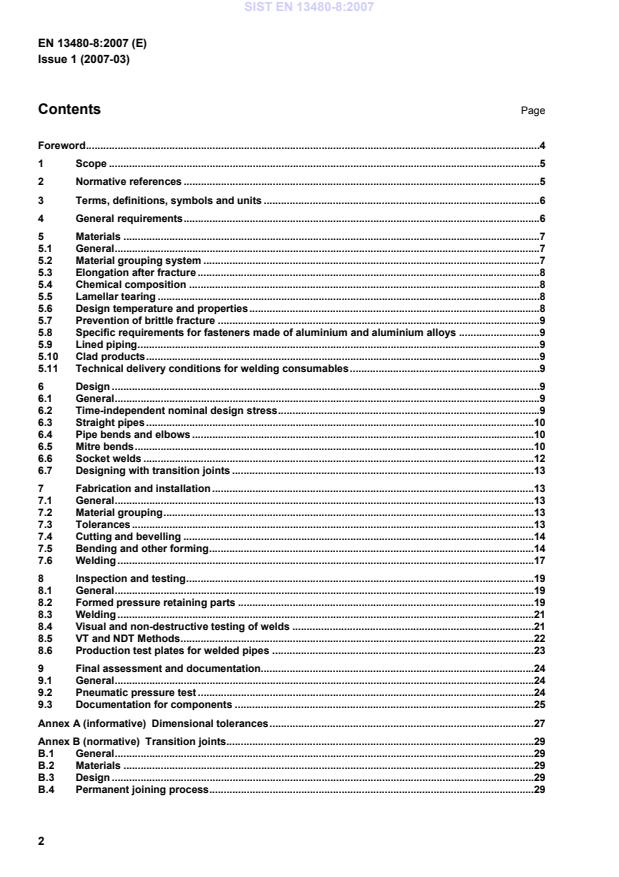
Dimensional tolerances.27 Annex B (normative)
Transition joints.29 B.1 General.29 B.2 Materials.29 B.3 Design.29 B.4 Permanent joining process.29 SIST EN 13480-8:2007
3 B.5 Testing.30 B.6 Marking.30 B.7 Documentation.31 B.8 Protection against overheating.31 Annex ZA (informative)
Relationship between this European Standard and the Essential
Requirements of EU Directive 97/23/EC.33 Bibliography.35
Figures Figure 6.5-1 — Mitre bend.12 Figure 7.6.3-1 — Socket welds.18 Figure A.1 — Dimensional details of spools.28 Tables Table 5.2-1 — Grouping system based on CEN ISO/TR 15608:2005 and allowable materials of construction based on EN 12392:2000 using the EN AW numbers according to EN 573-3.7 Table 6.2-1 — Design stresses for aluminium and aluminium alloy material.10 Table 6.2-2 — Allowable design strength values for 6 000 series aluminium alloys in the welded condition (see 5.6).10 Table 6.5.1 — Special symbols for subclause 6.5.12 Table 7.3-1 — Tolerances for welded pipes.14 Table 7.5-3 Heat treatment after hot forming.16 Table 8.2-1 — Destructive testing of formed and heat treated parts.20 Table 8.4-1 — Extent of testing for circumferential, branch, socket and seal welds.21 Table 8.4-2 — Extent of VT and NDT for longitudinal welds and
spiral welded tubes / pipes.22 Table 8.5-1 — Techniques, methods, acceptance criteria.23 Table 8.6-1 — Production test plates for welded pipes according to 8.6 a).24 Table 8.6-2 — Required tests and acceptance criteria for production test plates.24 Table 9.2-1 — Extent of NDT in case of pneumatic pressure test according to 9.2b).25 Table A.1 — Tolerances.27 Table ZA.1 — Correspondence between this European Standard and Directive 97/23/EC.33
5 1 Scope This Part of this European Standard specifies requirements for industrial piping systems made of aluminium and aluminium alloys in addition to the general requirements for industrial piping according to the series of standards EN 13480 and CEN/TR 13480-7. 2 Normative references The following referenced documents are indispensable for the application of this document. For dated references, only the edition cited applies. For undated references, the latest edition of the referenced document (including any amendments) applies. EN 485-3, Aluminium and aluminium alloys — Sheet, strip and plate — Part 3: Tolerances on dimensions and form for hot-rolled products EN 485-4, Aluminium and aluminium alloys - Sheet, strip and plate - Part 4: Tolerances on shape and dimensions for cold-rolled products EN 571-1:1997, Non-destructive testing — Penetrant testing – Part 1: General principles EN 573-3:2003, Aluminium and aluminium alloys — Chemical composition and form of wrought products — Part 3: Chemical composition EN 583 (all parts), Non-destructive testing - Ultrasonic examination EN 895:1995, Destructive tests on welds in metallic materials — Transverse tensile test EN 910:1996, Destructive tests on welds in metallic materials — Bend tests EN 970:1997, Non-destructive examination of fusion welds — Visual examination EN 1289:1998, Non-destructive examination of welds - Penetrant testing of welds - Acceptance levels EN 1321:1996, Destructive tests on welds in metallic materials - Macroscopic and microscopic examination of welds
EN 1435:1997, Non-destructive examination of welds - Radiographic examination of welded joints EN 1712:1997, Non-destructive examination of welds - Ultrasonic examination of welded joints - Acceptance levels EN 1714:1997, Non-destructive examination of welds - Ultrasonic examination of welded joints EN 1779, Non-destructive testing - Leak testing - Criteria for method and technique selection EN 10002 (all parts), Metallic materials - Tensile testing
EN 10045-1, Metallic materials - Charpy impact test - Part 1: Test method EN 10204, Metallic products - Types of inspection documents SIST EN 13480-8:2007
7 5 Materials 5.1 General The requirements of EN 13480-2 shall apply with the following additions/exclusions: 5.2 Material grouping system Annex A of EN 13480-2:2002 is not applicable for aluminium and aluminium alloys. The allowable materials for industrial piping of aluminium and aluminium alloys shall be according to Table 5.2–1. Any product form available in EN 12392:2000 for a material in this table at an acceptable temper is acceptable for construction to this European Standard. Other materials not defined here may be used by agreement by the parties concerned (see 4.3 of EN 13480-2:2002) if they meet the requirements of 5.2 and 5.3 of this standard and a Particular Material Appraisal is produced (see EN 764-4). Table 5.2-1 — Grouping system based on CEN ISO/TR 15608:2005 and allowable materials of construction based on EN 12392:2000 using the EN AW numbers according to EN 573-3 Designation Group Sub group Type of aluminium and aluminium alloys EN AW number Chemical symbol Temper 21
Pure aluminium with ≤ 1 % impurities or alloy content EN AW – 1050A EN AW – 1070A EN AW – 1080A
EN AW–Al 99,5 EN AW–Al 99,7 EN AW–Al 99,8(A) O, H111, H112 O, H111, H112 O, H111, H112 Non heat treatable alloys 22.1 Aluminium-manganese alloys EN AW – 3003
EN AW – 3103 EN AW – 3105 EN AW–Al Mn1Cu EN AW–Al Mn1 EN AW–Al Mn0,5Mg0,5 O, H111, H112 O, H111, H112 O, H111
22.2 Aluminium-magnesium alloys with Mg ≤ 1,5 % EN AW – 5005 EN AW – 5005A EN AW – 5050 EN AW–Al Mg1(B) EN AW–Al Mg1(C) EN AW–Al Mg1,5 (C) O, H111, H112 O, H111, H112 O, H111 22.3 Aluminium-magnesium alloys with 1,5 % < Mg ≤ 3,5 % EN AW – 5049 EN AW – 5052 EN AW – 5154A EN AW – 5251 EN AW – 5454 EN AW – 5754 EN AW–Al Mg2Mn0,8 EN AW–Al Mg2,5 EN AW–Al Mg3,5(A) EN AW–Al Mg2 EN AW–Al Mg3Mn(A) EN AW–Al Mg3 O, H111, H112 O, H111, H112 O, H111, H112 O, H111, H112 O, H111, H112 O, H111, H112 22 22.4 Aluminium-magnesium alloys with Mg > 3,5 % EN AW – 5083 EN AW – 5086 EN AW–Al Mg4,5Mn0,7 EN AW–Al Mg4 O, H111, H112 O, H111
Heat treatable alloys 23 23.1 Aluminium-magnesium-silicon alloys EN AW 6060 EN AW 6061 EN AW–Al MgSi
EN AW–Al Mg1SiCu T4a
T4b, T6c
a for seamless pipes and profiles only b for seamless pipes and flanges only c for flanges only
Aluminium and aluminium alloys used for parts of industrial piping that are not subjected to cold forming (e.g. straight flanges and nozzles) shall have a specified minimum elongation after fracture measured on a gauge length
ooSL65,5= that is ≥ 10 % in the longitudinal or transverse direction as defined by the material specification.
5.4 Chemical composition The chemical composition shall be in accordance with the material specification. All materials shall have a maximum lead content of 150 µg/g. NOTE 5.1.3 of EN 12392:2000 recommends a maximum hydrogen level of 0,2 ml per 100 g aluminium, measured in the liquid metal during casting for parts to be welded. 5.5 Lamellar tearing Specific requirements to avoid lamellar tearing for industrial piping of aluminium and aluminium alloys are not applicable. NOTE Specific requirements apply to steel (see EN 1011-2) whereas in EN 1011-4 no requirement is given because lamellar tearing is not a recognized phenomenon.
5.6 Design temperature and properties NOTE See also 4.2.2 of EN 13480-2:2002.
The 2nd paragraph of 4.2.2.1 of EN 13480-2:2002 is not applicable for aluminium and aluminium alloys.
The maximum design temperature shall not exceed that defined in Table 1 of EN 12392:2000 as the maximum working temperature. For material of group 22.4 the maximum design temperature is 75 °C (200 °C for non-corrosive service). The mechanical properties used for design shall be taken from the tabulated values in EN 12392 at room temperature for Rm/20 / Re/20 and at the highest design temperature for Re/t.
For welded parts and heat treated parts after forming only the values equivalent to the O temper shall be used for design when 6 000 series flanges, etc. are welded. These values are not quoted in EN 12392 and so the tabulated values for f shown in Table 6.2-2 shall be used for design. The weld area shall be based on the O temper but the flange strength away from the weld (2t) may be based on the actual temper (T4 or T6). For aluminium and aluminium alloys values of 0,2 % proof stress (or 1 % proof stress for material group 21-1 000 series aluminium) for temperatures above 20 °C shall be established by linear interpolation between two adjacent values in EN 12392 except that for alloys 5083 and 5086 the respective value at 50 °C may be used for 65 °C. SIST EN 13480-8:2007
9 For material of group 22.4: For short periods, higher temperatures are permitted (e.g. when defrosting refrigerating plant) up to 150 °C are permissible provided that the pressure is reduced to half the working pressure for a period up to 8 h and to atmospheric pressure for a period up to 24 h.
5.7 Prevention of brittle fracture Annex B of EN 13480-2:2002 is not applicable. All materials of Table 5.2-1 are suitable for any minimum metal temperature without impact testing. NOTE See also EN 1252-1 and 8.4 of EN 12392:2000. 5.8 Specific requirements for fasteners made of aluminium and aluminium alloys Threads of bolts and studs shall be rolled. Regarding prevention of brittle fracture for materials of fasteners 5.6 of this standard applies. NOTE 1 Other manufacturing techniques may be agreed by the parties involved. In this case, special considerations regarding the application and testing requirements may be necessary. Such requirements are not addressed by this standard. NOTE 2 Materials other than aluminium and aluminium alloys may be used for bolting for piping constructions according to this European Standard. The designer should give special consideration to these different bolting materials. 5.9 Lined piping Specific requirements for lined piping are not applicable for aluminium and aluminium alloys. 5.10 Clad products Specific requirements for clad products are not applicable for aluminium and aluminium alloys. 5.11 Technical delivery conditions for welding consumables The requirements of 4.3.5 of EN 13480-2:2002 shall apply. 6 Design 6.1 General The requirements of EN 13480-3 shall apply with the following additions/exclusions. 6.2 Time-independent nominal design stress The design stresses for aluminium and aluminium alloys materials shall be in accordance with the Table 6.2-1. SIST EN 13480-8:2007
Table 6.2-2 — Allowable design strength values for 6 000 series aluminium alloys in the welded condition (see 5.6) Value of f for design temperature (°C) not exceeding
Material designation to EN 12392 50 75 100 125 a 150 175 a EN AW 6060 40 40 40 38 - - EN AW 6061 55 55 55 54 51 43 a For maximum design temperature see 5.6. Values for 125 °C (EN AW 6060) and 175 °C (EN AW 6061) shall be used for interpolation only. NOTE Data are derived from EN 13445-8.
6.3 Straight pipes In general, straight pipes shall be designed in accordance with 6.1 of EN 13480-3:2002. For D0/Di > 1,2 Equation 6.3-1 may be used. In this case pipes shall be seamless or tested in accordance with 8.4.3 and 8.6 of this European Standard for z = 1,0 and the maximum allowable pressure pa shall be determined as follows: 1,51xlnxxa=i0t,2,0p32DDRp (6.3-1) For material group 21 Rp1,0,t shall be used instead of Rp0,2,t. 6.4 Pipe bends and elbows The standard method for calculation of bends and elbows for aluminium and aluminium alloys shall be the method described in B.4.1.3 of EN 13480-3:2002, Annex B. NOTE 1 This clause should not be understood as to prohibit the other methods given in EN 13480-3, but to reflect the actual situation at the bend manufacturers. NOTE 2 Also see 6.2.3 and Annex B, Equation B4.1-11 of EN 13480-3:2002. 6.5 Mitre bends 6.3 of EN 13480-3:2002 may be used for the design of mitre bends for aluminium and aluminium alloys.
Alternatively the method described in Equations 6.5-1 to 6.5-4 may also be used for multiple mitre bends for aluminium and aluminium alloys according to Figure 6.5-1 with a maximum angle , of 22,5°. The pressure limit given in EN 13480-3:2002, 6.3.1 is not applicable for this method. SIST EN 13480-8:2007
11 NOTE 1 Current experiences are available up to pressures of 63 bar for time independent design stresses, however this does not prohibit the calculation of mitre bends to the given equation for use of higher pressures, but shows the reference pressure for which mitre bends made of aluminium and aluminium alloys and designed to the rules are in safe operation. NOTE 2 Source: FDBR Guideline, Design of power piping, July 1995 The following symbols apply for the alternative method in addition to those mentioned in Clause 3. SIST EN 13480-8:2007
mm a See footnote a in Table 3.2-1 of EN 13480-3:2002.
fzedBpaiviv≤+⋅⋅⋅⋅=502,σ (6.5-1) shall be met with regard to internal pressure loading, where with the smaller value of
()Θtan,iviveededr⋅+⋅++=8021 (6.5-2) Θtan⋅=22br (6.5-3) the value Bi is found as follows
()edrdrB+⋅−⋅−=ivivi,,50250 (6.5-4)
Figure 6.5-1 — Mitre bend 6.6 Socket welds Socket welds may only be used for pipes DN 50 and below. SIST EN 13480-8:2007
13 6.7 Designing with transition joints 6.7.1 Design considerations The use of transition joints shall be considered during design analysis. Transition joints should be treated as elements within the piping and the designer should consider all the loadings likely to arise under the design conditions. 6.7.2 Location of transition joints A transition joint shall be positioned so that it does not undergo undue loading effects such as tensile and shear forces or bending and torsional moments. Where appropriate, the transition joint fabricator shall provide allowable loads or criteria for assessing pressure and combined external loads. In general, positioning transition joints directly against piping elbows shall as far as possible be avoided. 6.7.3 Requirements for transition joints Transition joints shall meet the requirements of Annex B. 7 Fabrication and installation 7.1 General The requirements of EN 13480-4 shall apply with the following additions/exclusions. NOTE Reference to EN 14717 may be useful to avoid and reduce the possible environmental impacts of aluminium and aluminium alloy piping. 7.2 Material grouping Aluminium and aluminium alloy materials and their grouping shall be in accordance with Table 5.2-1 of this European Standard. 7.3 Tolerances 7.3.1 Welded pipes and connection dimensions of pipe fittings Table 7.3.-1 applies for welded pipes fabricated in accordance with this European Standard. Connection dimensions of pipe fittings (e.g. elbows, tees, reducers) shall comply with Table 7.3-1. Greater values may be acceptable provided they are verified by design calculation. NOTE 1 For pipe/fitting to flange connection, see Table 9 of EN 1092-4:2002. NOTE 2 Other tolerances may be applied, if specified by the designer (see 3.1.6 of EN 13480-1:2002). NOTE 3 For tolerances of material fabricated to other European Standards, see applicable European Standard (e.g. Clause 7 of EN 12392:2000, 5.9 of EN 1092-4:2002). SIST EN 13480-8:2007
± 1,5 %
Out of roundness
maximum 1,5 % for the ratio e/D < 0,01 maximum 1,0 % for the ratio e/D ≥ 0,01 EN 13480-4:2002, Equation 7.4.1-1 Wall thickness As for sheet, strip or plate EN 485-3; EN 485-4
Out of roundness shall be calculated in accordance with Equation 7.4.1-1 of EN 13480-4:2002. The determination of the out of roundness need not consider the elastic deformation due to dead-weight of the pipe. 7.3.2 Welded piping construction 5.6 of EN 13480-4:2002 is not applicable for piping in aluminium and aluminium alloys. Guidance for the tolerances of piping spools made of aluminium and aluminium alloys is given in Annex A. 7.4 of EN 13480-4:2002 is applicable for aluminium and aluminium alloys, except 7.4.4 concerning induction forming. The requirements according to 9.9 of EN 13480-4:2002 shall apply with the following modification for aluminium and aluminium alloys: Replace the reference to EN 25817 with EN ISO 10042. 7.4 Cutting and bevelling In addition to the requirements of 6.1 of EN 13480-4:2002 the following shall apply for industrial piping of aluminium and aluminium alloys: Aluminium and its alloys shall be cut to size and shape preferably by machining or by thermal cutting process, e.g. plasma arc cutting, or by a combination of both. Additionally, hydro mechanical methods of edge preparation are acceptable. Flame cutting is not permitted. For plates of ≤ 25 mm thickness cold shearing is permissible. Edges that are cut by thermal process or by cold shearing shall be dressed back by machining unless the manufacturer can demonstrate that the material and the weldability has not been adversely affected by the cutting process. The surface to be welded shall be thoroughly cleaned of aluminium oxide traces and greases by mechanical means or by pickling. Chloride containing detergents are prohibited. 7.5 Bending and other forming 7.5.1 General The requirements of Clause 7 of EN 13480-4:2002 shall apply with the following additions/exclusions.
7.5.2 Definition of cold- and hot forming Cold forming of material groups 21 and 22 shall be carried out at temperatures below 200 °C. Cold and hot forming of material of group 23.1 is not allowed. SIST EN 13480-8:2007
15 Hot forming of aluminium and its alloys shall be carried out in a temperature range of 320 °C to 450 °C. The last stage of the hot forming process shall be completed above 300 °C, otherwise a subsequent heat treatment to achieve the O Temper is required.
7.5.3 Heat treatment after cold forming 7.5.3.1 General For heat treatment after cold forming the requirements of 7.2 of EN 13480-4:2002 are not applicable for industrial piping of aluminium and aluminium alloys. For aluminium and aluminium alloys the heat treatment shall be carried out as follows: The heat treatment parameters shall be in accordance with the material specification of the material manufacturer. The general heat treatment parameters shall be: a) the heating rate shall be as rapid as possible;
b) the holding temperature shall be in the range between 320 °C and 380 °C depending on the alloy type; c) the holding time at the holding temperature shall be between 10 min and 60 min depending on the ratio of cold forming;
d) the cooling shall be performed in still air, the cooling rate needs not to be controlled.
7.5.3.2 Flat products For aluminium and aluminium alloys heat treatment shall be carried out in accordance with Table 7.5 -1.
Table 7.5-1 — Heat treatment of flat products after cold forming Material groups according to Table 5.2-1 Ratio of deformationd Vd (%) Heat treatment 21 ≤ 15 % no 21 > 15 % yesa, annealing 22.1b, 22.2b, 22.3b, 22.4b ≤ 5 % no 22.1b, 22.2b, 22.3b, 22.4b > 5 % yesc, annealing a With levels of cold forming and a ratio of deformation above 15 % for materials of group 21 or above, if proof can be furnished in specific cases that the residual elongation after rupture after cold forming remains at least 10 %, then in these cases annealing is not required. b Elongation prior to forming ≥ 14 %. c With levels of cold forming and a ratio of deformation above 5 % for materials of group 22 or above, if proof can be furnished in specific cases that the residual elongation after rupture after cold forming remains at least 10 %, then in these cases annealing is not required. d For Vd (%) for cylinders and cones see 7.13 of EN 13480-4:2002, for Vd (%) for dished circular products see 9.2.1 of EN 13445-4:2002.
Table 7.5-2 Heat treatment of pipes after cold forming Material groups according to Table 5.2-1 Mean bending radius of the pipe rm External diameter of the tube do Heat treatment 21 ≥ 1,3 De all diameters no 21 < 1,3 De all diameters yes, annealing 22.1a, 22.2a, 22.3a, 22.4a ≥ 2,5 De all diameters no 22.1a, 22.2a, 22.3a, 22.4a < 2,5 De all diameters yes, annealing NOTE For do
and rm see Figure 7.2.2-1 of EN 13480-4:2002 a Elongation prior to forming ≥ 14 %.
7.5.4 Heat treatment after hot forming For heat treatment after hot forming the requirements of 7.3 of EN 13480-4:2002 are not applicable for industrial piping of aluminium and aluminium alloys. For aluminium and aluminium alloys the heat treatment shall be carried out in accordance with Table 7.5-3 and as following: The heat treatment parameters shall be in accordance with the material specification of the material manufacturer. The general heat treatment parameters shall be: a) the heating rate shall be as rapid as possible;
b) the holding temperature shall be in the range between 320 °C and 380 °C depending on the alloy type; c) the holding time at the holding temperature shall be between 10 min and 60 min depending on the ratio of cold forming; d) the cooling shall be performed in still air, the cooling rate needs not to be controlled.
Table 7.5-3 Heat treatment after hot forming Material groups according to Table 5.2-1 Hot forming conditions Heat treatment Heat treatment should be applied if the forming process of the last forming stage is completed at ≤ 300 °C. Yes, annealing 21, 22 No subsequent heat treatment should be applied if the forming process of the last forming stage is completed above 300 °C.
no
17 7.6 Welding 7.6.1 Welding personnel The requirements according to 9.1 of EN 13480-4:2002 shall apply with the following modification for aluminium and aluminium alloys: Replace the reference to EN 287-1 by EN ISO 9606-2.
7.6.2 Welding processes The requirements according to 9.3 of EN 13480-4:2002 shall apply with the following modification for aluminium and aluminium alloys: Qualification of welding procedure specifications (WPQR). The requirements according to 9.3.1 of EN 13480-4:2002 shall apply with the following modifications for aluminium and aluminium alloys: Replace reference to EN 288-3 by EN ISO 15614-2. Furthermore, impact testing is not applicable for piping of aluminium and aluminium alloys, see 5.7 of this European Standard. Oxy fuel gas welding processes according to EN ISO 4063 are not permitted. For qualification of welding procedures for EN AW 6061 material, the result of the tensile tests carried out in accordance with EN ISO 15614-2 shall show the following data with T = 1: minimum Rm = 165 MPa; minimum Rp0,2 = 110 MPa. 7.6.3 Weld joint preparation The weld joint preparation shall be in accordance with the applicable WPS.
Assembly and welding of socket welds shall be in accordance with Figure 7.6.3-1. It is important that the 1,5 mm internal gap is maintained prior to welding to allow for weld shrinkage and the fillet weld leg length shall be 1,25 times the pipe minimum thickness calculated for pressure or 3 mm, whichever is the greater. Where the size of fillet weld permits, it should be completed in two runs with the stop/start positions of the second run staggered relative to the first. SIST EN 13480-8:2007
Key a Approximate gap before welding Cx (min) = 1 ¼ t but not less than 3 mm t = Minimum thickness calculated under consideration of the maximum allowable pressure Figure 7.6.3-1 — Socket welds 7.6.4 Preheating In addition to the requirements according to 9.11.1 of EN 13480-4:2002, the following shall apply for industrial piping of aluminium and aluminium alloys: Preheating of aluminium is not required for metallurgical reasons and is therefore not mandatory. Preheating may be applied by the manufacturer for practical reasons, e.g. a heating at about 50 °C may facilitate the elimination of traces of moisture. SIST EN 13480-8:2007
19 For aluminium alloys containing 3,0 % or more magnesium an extended preheating and interpass time at temperatures of 150 °C and above may result in grain boundary precipitation of Al3-Mg2 disintegration in weld areas. 7.6.5 Backing rings and backing strips In addition to the requirements according to 9.12 of EN 13480-4:2002, the following shall apply for industrial piping of aluminium and aluminium alloys: Permanent backing strips shall not be used for longitudinal seams. Permanent backing rings may be used for circumferential seams in all piping classes only under the following conditions: a) non–destructive examination is carried out in accordance with the design/joint efficiency to the same quality and acceptance criteria as a single sided butt weld;
b) the inside of the piping is not subject to corrosion;
c) backing ring material shall be of the same aluminium sub group as the piping unless the combination of other backing ring material has been proven by a WPQR according to EN ISO 15614-2. 7.6.6 Post-weld heat treatment (PWHT) The requirements according to 9.14 of EN 13480-4:2002 are not applicable for industrial piping of for aluminium and aluminium alloys. The following shall apply for aluminium and aluminium alloys:
a) stress relieving heat treatment is normally not necessary or desirable for welded aluminium piping except there is a risk of stress corrosion due to the operation service. Annealing heat treatment carried out for obtaining the delivery state O is the only usable heat treatment;
b) for material group 23.1 PWHT is not permitted; c) the heat treatment parameters (annealing) shall be in accordance with the material specification of the material manufacturer or those as stated in 7.5.3 of this European Standard. 8 Inspection and testing 8.1 General The requirements according to EN 13480-5 shall apply with the following additions/exclusions: 8.2 Formed pressure retaining parts 8.2.1 General 7.2.1 of EN 13480-5:2002 shall not apply to aluminium and aluminium alloys. The requirements for testing and inspection specified below shall apply to all formed parts of aluminium and aluminium alloys fabricated according to this European Standard. SIST EN 13480-8:2007
The following examinations shall be carried out on formed parts of aluminium and aluminium alloys: a) verification of wall thickness, b) dimensional check (ovality, angle of bend etc.), c) examination for surface imperfection (VT). 8.2.3 Destructive testing of formed and heat treated parts The requirements according to 7.2.5 of EN 13480-5:2002 shall not apply to aluminium and aluminium alloys. Testing shall be performed to verify the heat treatment. If heat treatment is not required by Table 7.5-1 and 7.5-2 after cold forming, no mechanical tests are required in respect of forming. Destructive testing shall be performed for hot formed parts, and cold formed parts with subsequent heat treatment for piping with DN > 25.
One test shall be performed for parts of the same cast, wall thickness range and heat treatment lot. The wall thickness range shall be by ± 20 % of the average wall thickness of the parts. The tests specified in Table 8.2-1 shall be performed. Table 8.2-1 — Destructive testing of formed and heat treated parts Size of formed part Ty
...