

EN 13791:2007
(Main)Assessment of in-situ compressive strength in structures and precast concrete components
- Abstract
This European Standard:
gives methods and procedures for the assessment of the in-situ compressive strength of concrete in structures and precast concrete components;
provides principles and guidance for establishing the relationships between test results from indirect test methods and the in-situ core strength;
provides guidance for the assessment of the in-situ concrete compressive strength in structures or precast concrete components by indirect or combined methods.
This European Standard does not include the following cases:
where indirect methods are used without correlation to core strength;
assessment based on cores less than 50 mm in diameter;
assessment based on less than 3 cores;
use of microcores.
NOTE In these cases provisions valid in place of use apply.
This European Standard is not for the assessment of conformity of concrete compressive strength in accordance with EN 206-1 or EN 13369 except as indicated in EN 206-1:2000, 5.5.1.2 or 8.4.
- Status
- Withdrawn
- Publication Date
- 16-Jan-2007
- Withdrawal Date
- 06-Oct-2026
- Technical Committee
- CEN/TC 104 - Concrete ( performance, production, placing and compliance criteria )
- Drafting Committee
- CEN/TC 104/SC 1 - Revision of ENV 206
- Current Stage
- 9960 - Withdrawal effective - Withdrawal
- Start Date
- 21-Aug-2019
- Completion Date
- 07-Oct-2026

Relations
- Effective Date
- 28-Aug-2019
- Effective Date
- 28-Jan-2026
- Effective Date
- 28-Jan-2026
- Effective Date
- 28-Jan-2026
- Effective Date
- 28-Jan-2026
- Effective Date
- 28-Jan-2026
- Effective Date
- 28-Jan-2026
- Effective Date
- 28-Jan-2026
- Refers
EN 12390-2:2019 - Testing hardened concrete - Part 2: Making and curing specimens for strength tests - Effective Date
- 28-Jan-2026
- Effective Date
- 28-Jan-2026
Get Certified
Connect with accredited certification bodies for this standard

DIBt (Deutsches Institut für Bautechnik)
German Institute for Building Technology.
DIN CERTCO
DIN Group product certification.

Aboma Certification B.V.
Specialized in construction, metal, and transport sectors.
Sponsored listings
Frequently Asked Questions
EN 13791:2007 is a standard published by the European Committee for Standardization (CEN). Its full title is "Assessment of in-situ compressive strength in structures and precast concrete components". This standard covers: This European Standard: gives methods and procedures for the assessment of the in-situ compressive strength of concrete in structures and precast concrete components; provides principles and guidance for establishing the relationships between test results from indirect test methods and the in-situ core strength; provides guidance for the assessment of the in-situ concrete compressive strength in structures or precast concrete components by indirect or combined methods. This European Standard does not include the following cases: where indirect methods are used without correlation to core strength; assessment based on cores less than 50 mm in diameter; assessment based on less than 3 cores; use of microcores. NOTE In these cases provisions valid in place of use apply. This European Standard is not for the assessment of conformity of concrete compressive strength in accordance with EN 206-1 or EN 13369 except as indicated in EN 206-1:2000, 5.5.1.2 or 8.4.
This European Standard: gives methods and procedures for the assessment of the in-situ compressive strength of concrete in structures and precast concrete components; provides principles and guidance for establishing the relationships between test results from indirect test methods and the in-situ core strength; provides guidance for the assessment of the in-situ concrete compressive strength in structures or precast concrete components by indirect or combined methods. This European Standard does not include the following cases: where indirect methods are used without correlation to core strength; assessment based on cores less than 50 mm in diameter; assessment based on less than 3 cores; use of microcores. NOTE In these cases provisions valid in place of use apply. This European Standard is not for the assessment of conformity of concrete compressive strength in accordance with EN 206-1 or EN 13369 except as indicated in EN 206-1:2000, 5.5.1.2 or 8.4.
EN 13791:2007 is classified under the following ICS (International Classification for Standards) categories: 91.080.40 - Concrete structures. The ICS classification helps identify the subject area and facilitates finding related standards.
EN 13791:2007 has the following relationships with other standards: It is inter standard links to EN 13791:2019, EN 206-1:2000, EN 12504-2:2021, EN 12504-1:2019, EN 12504-3:2005, EN 12390-3:2019, EN 12350-1:2019, EN 12390-1:2021, EN 12390-2:2019, EN 12504-4:2021. Understanding these relationships helps ensure you are using the most current and applicable version of the standard.
EN 13791:2007 is available in PDF format for immediate download after purchase. The document can be added to your cart and obtained through the secure checkout process. Digital delivery ensures instant access to the complete standard document.
Standards Content (Sample)
2003-01.Slovenski inštitut za standardizacijo. Razmnoževanje celote ali delov tega standarda ni dovoljeno.Assessment of in-situ compressive strength in structures and precast concrete componentsEvaluation de la résistance a la compression du béton en place dans les structures et les éléments préfabriquésBewertung der Druckfestigkeit von Beton in Bauwerken oder in BauwerksteilenTa slovenski standard je istoveten z:EN 13791:2007SIST EN 13791:2007en91.100.30Beton in betonski izdelkiConcrete and concrete products91.080.40Betonske konstrukcijeConcrete structuresICS:SLOVENSKI
STANDARDSIST EN 13791:200701-april-2007
EUROPEAN STANDARDNORME EUROPÉENNEEUROPÄISCHE NORMEN 13791January 2007ICS 91.080.40 English VersionAssessment of in-situ compressive strength in structures andprecast concrete componentsEvaluation de la résistance à la compression du béton enplace dans les structures et les éléments préfabriquésBewertung der Druckfestigkeit von Beton in Bauwerkenoder in BauwerksteilenThis European Standard was approved by CEN on 10 November 2006.CEN members are bound to comply with the CEN/CENELEC Internal Regulations which stipulate the conditions for giving this EuropeanStandard the status of a national standard without any alteration. Up-to-date lists and bibliographical references concerning such nationalstandards may be obtained on application to the CEN Management Centre or to any CEN member.This European Standard exists in three official versions (English, French, German). A version in any other language made by translationunder the responsibility of a CEN member into its own language and notified to the CEN Management Centre has the same status as theofficial versions.CEN members are the national standards bodies of Austria, Belgium, Bulgaria, Cyprus, Czech Republic, Denmark, Estonia, Finland,France, Germany, Greece, Hungary, Iceland, Ireland, Italy, Latvia, Lithuania, Luxembourg, Malta, Netherlands, Norway, Poland, Portugal,Romania, Slovakia, Slovenia, Spain, Sweden, Switzerland and United Kingdom.EUROPEAN COMMITTEE FOR STANDARDIZATIONCOMITÉ EUROPÉEN DE NORMALISATIONEUROPÄISCHES KOMITEE FÜR NORMUNGManagement Centre: rue de Stassart, 36
B-1050 Brussels© 2007 CENAll rights of exploitation in any form and by any means reservedworldwide for CEN national Members.Ref. No. EN 13791:2007: E
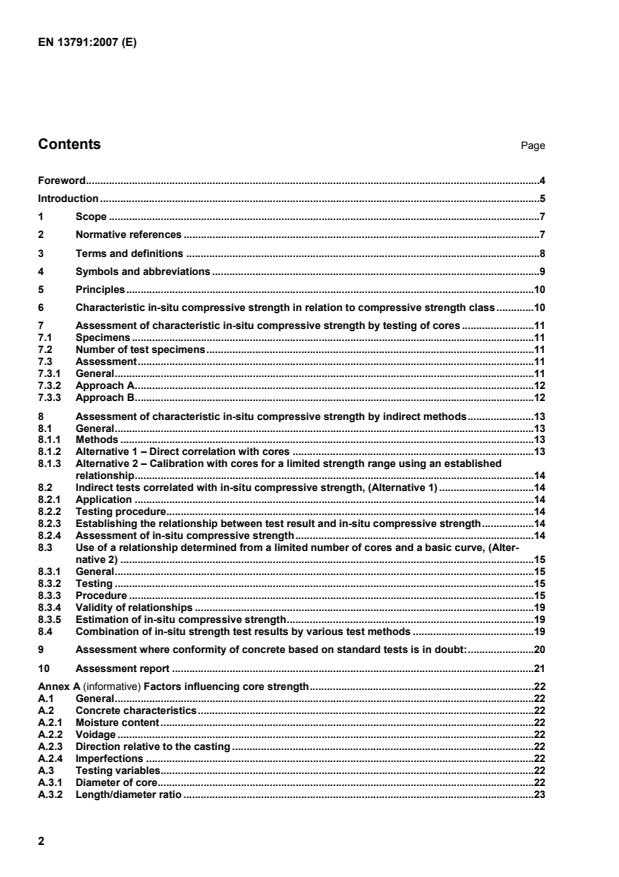
Concepts concerning the relationship between in-situ strength and strength from standard test specimens.25 Annex D (informative) Guidelines for planning, sampling and evaluation of test results when assessing in-situ strength.26 D.1 Planning.26 D.2 Sampling.26 D.3 Testing programme.26 D.4 Assessment.27 Bibliography.28
Flowchart 1
1 Scope This European Standard: gives methods and procedures for the assessment of the in-situ compressive strength of concrete in structures and precast concrete components; provides principles and guidance for establishing the relationships between test results from indirect test methods and the in-situ core strength;
provides guidance for the assessment of the in-situ concrete compressive strength in structures or precast concrete components by indirect or combined methods. This European Standard does not include the following cases: where indirect methods are used without correlation to core strength; assessment based on cores less than 50 mm in diameter; assessment based on less than 3 cores; use of microcores. NOTE In these cases provisions valid in place of use apply. This European Standard is not for the assessment of conformity of concrete compressive strength in accordance with EN 206-1 or EN 13369 except as indicated in EN 206-1:2000, 5.5.1.2 or 8.4. 2 Normative references The following referenced documents are indispensable for the application of this document. For dated references, only the edition cited applies. For undated references, the latest edition of the referenced document (including any amendments) applies. EN 206-1:2000, Concrete – Part 1: Specification, performance, production and conformity EN 12350-1,Testing fresh concrete – Part 1: Sampling EN 12390-1, Testing hardened concrete - Part 1: Shape, dimensions and other requirements for specimens and moulds EN 12390-2, Testing hardened concrete – Part 2: Making and curing specimens for strength tests EN 12390-3, Testing hardened concrete – Part 3: Compressive strength of test specimens EN 12504-1, Testing concrete in structures – Part 1: Cored specimens – Taking, examining and testing in compression EN 12504-2, Testing concrete in structures – Part 2: Non-destructive testing – Determination of rebound number EN 12504-3, Testing concrete in structures – Part 3: Determination of pull-out force
pull-out force test result fis in-situ compressive strength test result fis, lowest lowest in-situ compressive strength test result fm(n), is mean in-situ compressive strength of n test results fck characteristic compressive strength of standard specimens fck, is characteristic in-situ compressive strength
fck, is, cube characteristic in-situ compressive strength expressed in equivalent strength of a 150 mm cube, see 7.1 fck, is, cyl characteristic in-situ compressive strength expressed in equivalent strength of a 150 mm × 300 mm cylinder, see 7.1 fis, l estimated in-situ compressive strength test result by indirect test methods when a specificrelationship is established by core tests, (Alternative 1) fis, F estimated in-situ compressive strength test result by pull-out tests calibrated by core tests, (Alternative 2) fis, R estimated in-situ compressive strength test result by rebound hammer tests calibrated by coretests, (Alternative 2) fis, v estimated in-situ compressive strength test result by ultrasonic pulse velocity tests calibrated bycore tests, (Alternative 2) fF initial
value of in-situ strength obtained from the basic curve for a pull-out force, Figure 4, test result F used in the determination of the shift fR initial value of in-situ strength obtained from the basic curve for a rebound hammer, Figure 2, testresult R
used in the determination of the shift fv initial value of in-situ strength obtained from the basic curve for a pulse-velocity, Figure 3 test result v used in the determination of the shift γc partial safety factor for concrete k margin associated with small numbers of test results k1 coefficient that depends on the number of paired tests k2 coefficient that depends upon provisions valid in the place of use or, if none are given, acoefficient with a value of 1,48 n number of test results R rebound hammer test result s standard deviation v ultrasonic pulse velocity test result
Table 1 — Minimum characteristic in-situ compressive strength for the EN 206-1 compressive strength classes Minimum characteristic in-situ strength N/mm2
Compressive
strength class
according to EN 206-1 Ratio of in-situ characteristic strength to characteristic strength of standard specimens fck, is, cyl fck, is, cube C8/10 0,85 7 9 C12/15 0,85 10 13 C16/20 0,85 14 17 C20/25 0,85 17 21 C25/30 0,85 21 26 C30/37 0,85 26 31 C35/45 0,85 30 38 C40/50 0,85 34 43 C45/55 0,85 38 47 C50/60 0,85 43 51 C55/67 0,85 47 57 C60/75 0,85 51 64 C70/85 0,85 60 72 C80/95 0,85 68 81 C90/105 0,85 77 89 C100/115 0,85 85 98 NOTE 1 The in-situ compressive strength may be less than that measured on standard test specimens taken from the same batch ofconcrete.
NOTE 2 The ratio 0,85 is part of
γc in EN 1992-1-1: 2004.
NOTE 1 For factors influencing the core strength, see Annex A. NOTE 2 If for practical reasons 3 days of exposure is not feasible, record the period of exposure, if any. The influence of this deviation from standard procedure should be evaluated. Where the in-situ strength is determined from cores:
testing a core with equal length and a nominal diameter of 100 mm gives a strength value equivalent to the strength value of a 150 mm cube manufactured and cured under the same conditions; testing a core with a nominal diameter at least 100 mm and not larger than 150 mm and with a length to diameter ratio equal to 2,0 gives a strength value equivalent to the strength value of a 150 mm by 300 mm cylinder manufactured and cured under the same conditions; the transposition of the test results from cores with diameters from 50 mm up to 150 mm and other length to diameter ratios shall be based on conversion factors of established suitability. NOTE 3 Conversion factors of established suitability for other specimen sizes and length to diameter ratios may be given in provisions valid in the place of use. Normally the core result should not be modified to take account of the direction of drilling unless required by provisions valid in pace of use or required by the project specification. 7.2 Number of test specimens The number of cores to be taken from one test region shall be determined by the volume of concrete involved and the purpose for the testing of cores. Each test location comprises one core. For assessment of in-situ compressive strength for statistical and safety reasons, as many cores as are practicable should be used. An assessment of in-situ compressive strength for a particular test region shall be based on at least 3 cores. Consideration shall be given to any structural implications resulting from taking cores, see EN 12504-1. NOTE The number of specimens identified above relates to cores with a nominal diameter of at least 100 mm. The number of cores should be increased when the nominal diameter is less than 100 mm, see A.3.1. 7.3 Assessment 7.3.1 General In-situ characteristic compressive strength is assessed using either approach A in 7.3.2 or approach B in 7.3.3. Approach A applies where at least 15 cores are available. Approach B applies where 3 to 14 cores are available. The applicability of the two approaches to the assessment of the strength of concrete in existing structures, about which there is no prior knowledge, may be defined in the place of use.
(1) or 4+=lowestis,isck,ff (2)
where s is the standard deviation of the test results or 2,0 N/mm2, whichever is the higher value;
k2 is given in national provisions or, if no value is given, taken as 1,48. The strength class is obtained from Table 1 using the estimated in-situ characteristic strength. NOTE 1 The estimate of characteristic strength using the lowest core result should reflect the confidence that the lowest core result represents the lowest strength in the structure or component under consideration. NOTE 2 Where the distribution of the core strength appears to come from two populations, the
...