

EN 14081-1:2005
(Main)Timber structures - Strength graded structural timber with rectangular cross section - Part 1: General requirements
- Abstract
This European Standard specifies the requirements for visual and machine graded structural timber with rectangular cross-sections shaped by sawing, planing or other methods, and having deviations from the target sizes corresponding to EN 336.
This European Standard covers structural rectangular timber, untreated or treated against biological attack.
This European Standard does not cover timber treated by fire retardant products.
This European Standard identifies as a minimum the characteristics for which limits shall be given in visual grading rules.
Finger jointed timber is not covered in this European Standard.
- Status
- Withdrawn
- Publication Date
- 22-Nov-2005
- Withdrawal Date
- 01-Feb-2011
- Technical Committee
- CEN/TC 124 - Timber structures
- Drafting Committee
- CEN/TC 124 - Timber structures
- Current Stage
- 9960 - Withdrawal effective - Withdrawal
- Start Date
- 02-Feb-2011
- Completion Date
- 02-Feb-2011
89/106/EEC - Construction productsOJ Ref: C, C 304 OJ Date: 13-Dec-2006

Relations
- Replaces
EN 518:1995 - Structural timber - Grading - Requirements for visual strength grading standards - Effective Date
- 22-Dec-2008
- Effective Date
- 22-Dec-2008
- Effective Date
- 18-Jan-2023
- Effective Date
- 28-Jan-2026
- Referred By
EN 15228:2009 - Structural timber - Structural timber preservative treated against biological attack - Effective Date
- 28-Jan-2026
- Referred By
EN 386:2001 - Glued laminated timber - Performance requirements and minimum production requirements - Effective Date
- 28-Jan-2026
- Effective Date
- 12-May-2010
- Effective Date
- 18-Jan-2023
Get Certified
Connect with accredited certification bodies for this standard

Gozdarski inštitut Slovenije
Slovenian Forestry Institute. Forest management certification support, timber testing.
Sponsored listings
Frequently Asked Questions
EN 14081-1:2005 is a standard published by the European Committee for Standardization (CEN). Its full title is "Timber structures - Strength graded structural timber with rectangular cross section - Part 1: General requirements". This standard covers: This European Standard specifies the requirements for visual and machine graded structural timber with rectangular cross-sections shaped by sawing, planing or other methods, and having deviations from the target sizes corresponding to EN 336. This European Standard covers structural rectangular timber, untreated or treated against biological attack. This European Standard does not cover timber treated by fire retardant products. This European Standard identifies as a minimum the characteristics for which limits shall be given in visual grading rules. Finger jointed timber is not covered in this European Standard.
This European Standard specifies the requirements for visual and machine graded structural timber with rectangular cross-sections shaped by sawing, planing or other methods, and having deviations from the target sizes corresponding to EN 336. This European Standard covers structural rectangular timber, untreated or treated against biological attack. This European Standard does not cover timber treated by fire retardant products. This European Standard identifies as a minimum the characteristics for which limits shall be given in visual grading rules. Finger jointed timber is not covered in this European Standard.
EN 14081-1:2005 is classified under the following ICS (International Classification for Standards) categories: 79.040 - Wood, sawlogs and sawn timber. The ICS classification helps identify the subject area and facilitates finding related standards.
EN 14081-1:2005 has the following relationships with other standards: It is inter standard links to EN 518:1995, EN 519:1995, EN 14081-1:2005+A1:2011, EN 14081-4:2009, EN 15228:2009, EN 386:2001, EN 14081-1:2005/FprA1, prEN 14081-1 rev. Understanding these relationships helps ensure you are using the most current and applicable version of the standard.
EN 14081-1:2005 is associated with the following European legislation: EU Directives/Regulations: 305/2011, 89/106/EEC; Standardization Mandates: M/112. When a standard is cited in the Official Journal of the European Union, products manufactured in conformity with it benefit from a presumption of conformity with the essential requirements of the corresponding EU directive or regulation.
EN 14081-1:2005 is available in PDF format for immediate download after purchase. The document can be added to your cart and obtained through the secure checkout process. Digital delivery ensures instant access to the complete standard document.
Standards Content (Sample)
2003-01.Slovenski inštitut za standardizacijo. Razmnoževanje celote ali delov tega standarda ni dovoljeno.Timber structures - Strength graded structural timber with rectangular cross section - Part 1: General requirementsStructures en bois - Bois de structure de section rectangulaire classé selon la résistance - Partie 1: Exigences généralesHolzbauwerke - Nach Festigkeit sortiertes Bauholz für tragende Zwecke mit rechteckigem Querschnitt - Teil 1: Allgemeine AnforderungenTa slovenski standard je istoveten z:EN 14081-1:2005SIST EN 14081-1:2006en91.080.2079.040ICS:SIST EN 519:1996SIST EN 518:19961DGRPHãþDSLOVENSKI
STANDARDSIST EN 14081-1:200601-maj-2006
EUROPEAN STANDARDNORME EUROPÉENNEEUROPÄISCHE NORMEN 14081-1November 2005ICS 79.040Supersedes EN 518:1995, EN 519:1995
English VersionTimber structures - Strength graded structural timber withrectangular cross section - Part 1: General requirementsStructures en bois - Bois de structure à sectionrectangulaire classé pour sa résistance - Partie 1:Exigences généralesHolzbauwerke - Nach Festigkeit sortiertes Bauholz fürtragende Zwecke mit rechteckigem Querschnitt - Teil 1:Allgemeine AnforderungenThis European Standard was approved by CEN on 26 August 2005.CEN members are bound to comply with the CEN/CENELEC Internal Regulations which stipulate the conditions for giving this EuropeanStandard the status of a national standard without any alteration. Up-to-date lists and bibliographical references concerning such nationalstandards may be obtained on application to the Central Secretariat or to any CEN member.This European Standard exists in three official versions (English, French, German). A version in any other language made by translationunder the responsibility of a CEN member into its own language and notified to the Central Secretariat has the same status as the officialversions.CEN members are the national standards bodies of Austria, Belgium, Cyprus, Czech Republic, Denmark, Estonia, Finland, France,Germany, Greece, Hungary, Iceland, Ireland, Italy, Latvia, Lithuania, Luxembourg, Malta, Netherlands, Norway, Poland, Portugal, Slovakia,Slovenia, Spain, Sweden, Switzerland and United Kingdom.EUROPEAN COMMITTEE FOR STANDARDIZATIONCOMITÉ EUROPÉEN DE NORMALISATIONEUROPÄISCHES KOMITEE FÜR NORMUNGManagement Centre: rue de Stassart, 36
B-1050 Brussels© 2005 CENAll rights of exploitation in any form and by any means reservedworldwide for CEN national Members.Ref. No. EN 14081-1:2005: E
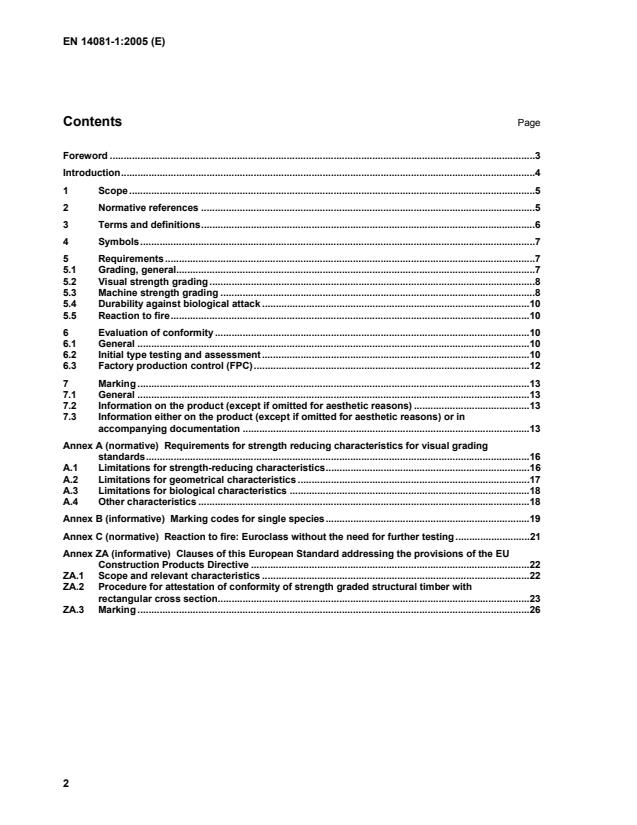
Requirements for strength reducing characteristics for visual grading standards.16 A.1 Limitations for strength-reducing characteristics.16 A.2 Limitations for geometrical characteristics.17 A.3 Limitations for biological characteristics.18 A.4 Other characteristics.18 Annex B (informative)
Marking codes for single species.19 Annex C (normative)
Reaction to fire: Euroclass without the need for further testing.21 Annex ZA (informative)
Clauses of this European Standard addressing the provisions of the EU Construction Products Directive.22 ZA.1 Scope and relevant characteristics.22 ZA.2 Procedure for attestation of conformity of strength graded structural timber with rectangular cross section.23 ZA.3 Marking.26
— Strength graded structural timber with rectangular cross section — Part 2: Machine grading; additional requirements for initial type testing EN 14081-3:2005, Timber structures — Strength graded structural timber with rectangular cross section — Part 3: Machine grading; additional requirements for factory production control EN 14081-4:2005, Timber structures — Strength graded structural timber with rectangular cross section — Part 4: Machine grading; grading machine settings for machine controlled systemsprEN 15228, Structural timber — Structural timber preservative treated against biological attack EN ISO 3166-1, Codes for the representation of names of countries and their subdivisions — Part 1: Country codes (ISO 3166-1:1997) EN ISO 11925-2, Reaction to fire tests — Ignitability of building products subjected to direct impingement of flame — Part 2: Single-flame source test (ISO 11925-2:2002) 3 Terms and definitions For the purposes of this European Standard, the following terms and definitions apply. 3.1 batch timber of one species population and size graded in one working shift. In the case of machine graded timber, the timber should also be graded by one machine 3.2 characteristic strength population 5-percentile value obtained from the results of tests with a duration of (300 ± 120) s using test pieces at an equilibrium moisture content resulting from a temperature of 20 °C and a relative humidity of
65 % 3.3 control plank object that simulates the characteristics of timber that are being sensed by the measuring devices in a grading machine, which, when passed through the machine, is able to check the calibration of the machine dynamically 3.4 dry-graded timber timber that is part of a batch that has intentionally been graded at a mean moisture content of 20 % or less, without any measurement exceeding 24 % 3.5 grade strength grade or strength class 3.6 machine strength grading process by which a piece of timber can be sorted by a machine sensing, non-destructively, one or more properties of the timber, with any necessary visual inspection, into grades to which characteristic values of strength, stiffness and density may be allocated. There are two methods of control, machine control and output control (see Introduction) 3.7 producer legal entity responsible for the conformity of the product to the requirements of this European Standard
Timber shall be visual graded to a grading standard that meets the requirements given in Annex A. 5.2.2 If the grade and species have been assigned to a strength class by EN 1912, the characteristic values for the properties shall be those given for the assigned strength class in EN 338; otherwise they are determined in accordance with EN 384. 5.2.3 If there are any restrictions or additional criteria related to the strength or constructional use of timber, resulting from the method of grading or species of timber, they shall be stated in the grading standard. 5.3 Machine strength grading 5.3.1 If the timber is machine graded to a strength class from EN 338, the characteristic values for the properties shall be those given for the strength class in EN 338; otherwise they shall be determined in accordance with EN 384. 5.3.2 For a grade and species (or species combination) graded by a machine controlled system, the settings shall be derived for the total growth area from which the timber will be graded within one or more countries. Timber from a lesser area e.g. sub-division of the growth area, i.e. region within a country, shall be machine graded using the output controlled system. 5.3.3 Grading machines operating in a machine controlled system shall use settings determined in accordance with Clause 6 in EN 14081-2:2005 and listed in EN 14081-4:2005. Machines operating in an output controlled system shall use settings determined in accordance with Clause 7 of EN 14081-2:2005. 5.3.4 The visual characteristics of each piece of machine graded timber shall meet the requirements of the grade, which shall as a maximum be those given in Table 1. Fissures, warp and slope of grain shall be measured in accordance with EN 1310. 5.3.5 Where a machine does not fully grade to the ends of each piece of timber (as in bending type machines) these non-fully graded portions shall be visually examined. If the diameter of knots and slope of grain in the non-fully graded portions exceeds the size of such defects in the fully graded portion of the same piece of timber, and exceeds the limits given in Table 2, then the piece shall be rejected. 5.3.6 Timber that has previously been graded shall not be re-graded to the same or different grades unless the method of determining settings has made allowances for such changes to the species population caused by the previous grading. NOTE The number of grades that can be graded in one pass through the machine will depend upon the accuracy and capabilities of the machine and the settings available.
Fissures less than half the thickness may be ignored Fissures not going through the thickness Not greater than 1,5 m or ½ the length of the piece, whichever is the lesser Not greater than 1 m or ¼ the length of the piece, whichever is the lesser
Max. permitted length of fissures a Fissures going through the thickness Not greater than 1 m or ¼ the length of the piece, whichever is the lesser. If at the ends, a length not greater than two times the width of the piece Only permitted at the ends with a length not greater than the width of the piece Bow 20 mm 10 mm Spring 12 mm 8 mm Twist 2 mm/25 mm width 1 mm/25 mm width
Max. warp b in mm over 2 m of length Cup Unrestricted Unrestricted Wane
Wane shall not be greater than one third of the full edge and/or face dimensions of the piece Soft rot and dote c (see EN 844-10)
Soft rot is not permitted. Dote is permitted Soft rot is not permitted. Dote is not permitted Insect damage
No active infestation is permitted. Wood wasp holes are not permitted and worm and pin holes shall be assessed as abnormal defects Abnormal defects
Where the reduction in strength caused by the abnormal defect is obviously less than caused by other defects permitted by this table, the piece may be accepted provided the defect is of a type that will not increase after conversion and drying a The length of fissures is linked with moisture content and therefore the limits given apply only at the time of grading. Limitations on fissures for special grades for specific components may be disregarded if research confirms that they have no effect on strength. Permitted limits for both the depth and length of fissures refer to the cumulative sum of fissures in one plane in a piece of timber. b Because warp is influenced by moisture content, the limits apply only at the time of grading. Limits of warp will be less if required by the method of operation of the grading machine. Longitudinal curvature in square section pieces shall be assessed using the limits for bow. c Sapstain is not a structural defect and is acceptable without limitation.
Strength class according to EN 338
C18 and below Above C18 Knot diameter on face ½ x width of piece ¼ x width of piece Knot diameter on edge ¾ x thickness of piece ½ x thickness of piece Slope of grain 1 in 6 1 in 10 NOTE 1 These maximum limits are only applicable where the size of knots and slope of grain in the non-fully graded portion exceeds the size of similar characteristics in the fully graded portion of the same piece. NOTE 2 The knot diameter is measured perpendicular to the longitudinal axis of the piece of timber. For arris knots the above limits apply to the portion of the knot visible on the particular face or edge being considered.
5.4 Durability against biological attack 5.4.1 Natural durability If listed in EN 350-2, the natural durability shall be as given therein; otherwise it shall be assessed in accordance with EN 350-1. 5.4.2 Timber treated against biological attack Timber treated against biological attack shall meet the requirements of prEN 15228. 5.5 Reaction to fire Where the manufacturer wishes to claim performance (e.g. when the product is subject to regulatory requirements) reaction to fire shall be tested and classified according to EN 13501-1, except for products covered by Annex C, which are classified without the need for further testing. 6 Evaluation of conformity 6.1 General Compliance with the requirements of this European Standard shall be demonstrated by: initial type testing or initial assessment; factory production control by the producer. All records shall be kept for at least ten years. 6.2 Initial type testing and assessment 6.2.1 Initial type testing or assessment shall be performed to demonstrate conformity with this European Standard and when a change occurs, e.g. in raw materials, which could significantly change one or more of the characteristics. Where testing has previously been performed according to the requirements of this European Standard, such testing may be taken into account for the purpose of initial type testing.
EN 14081-2. 6.2.3 Where control planks are required to be used to calibrate a grading machine, they shall meet the requirements of Annex C in EN 14081-2:2005. 6.2.4 The testing and assessment methods shall be in accordance with Table 3. Table 3 – Sampling plan and compliance criteria for initial and further testing Property Requirement Method Number of specimens Compliance criteria Characteristic strength - bending - compressive - tensile - shear - density
See EN 408 or for machine grading see EN 14081-2 See EN 384 or for machine grading see EN 14081-2 Characteristic values estimated according to EN 384 shall not be less than declared values. For machine grading see EN 14081-2 Modulus of elasticity
See EN 408 or for machine grading see EN 14081-2 See EN 384 or for machine grading see EN 14081-2 Characteristic values estimated according to EN 384 shall not be less than declared values. For machine grading see EN 14081-2 Natural durability Fungi: Class 1-5 Termites, wood boring insects and marine organisms: Class D,M,S Beetles: Class D,S,SH EN 350-1 EN 350-2
Natural durability shall be taken as given in EN 350-2. If the species is not given it shall be tested in accordance with EN 350-1 Timber tr
...