

EN 14034-4:2004+A1:2011
(Main + Amendment)Determination of explosion characteristics of dust clouds - Part 4: Determination of the limiting oxygen concentration LOC of dust clouds
- Abstract
This document describes a test method for the determination of the limiting oxygen concentration of dust clouds in a closed vessel under defined initial conditions of pressure and temperature.
This method is not suitable for use with recognised explosives, like gunpowder and dynamite, substances which do not require oxygen for combustion, pyrophoric substances, or substances or mixtures of substances which may under some circumstances behave in a similar manner. Where any doubt exists about the existence of hazard due to explosive properties, expert advice should be sought.
- Status
- Published
- Publication Date
- 11-Jan-2011
- Current Stage
- 9093 - Decision to confirm - Review Enquiry
- Start Date
- 24-Aug-2026
- Completion Date
- 07-Oct-2026
- Directive
- 2014/34/EU - Directive 2014/34/EU Of The European Parliament And Of The Council of 26 February 2014 on the harmonisation of the laws of the Member States relating to equipment and protective systems intended for use in potentially explosive atmospheres (recast)OJ Ref: C, C 126, C 293/52, HARMONIZIRAN OJ Date: 08-Apr-2016
94/9/EC - Equipment and protective systems intended for use in potentially explosive atmospheres (ATEX)OJ Ref: C, C 168 OJ Date: 08-Jun-2011



Overview
EN 14034-4:2004+A1:2011 - Determination of explosion characteristics of dust clouds - Part 4: Determination of the limiting oxygen concentration (LOC) of dust clouds - is a CEN European Standard that specifies a laboratory test method to determine the limiting oxygen concentration (LOC) of dust/air/inert-gas mixtures in a closed vessel under defined initial pressure and temperature. The LOC is the maximum oxygen concentration at which a dust cloud will not propagate an explosion; this value underpins explosion protection by “inerting.”
This part of the EN 14034 series is intended for combustible dusts (typical particle sizes up to ~500 µm) and excludes recognised explosives, pyrophoric materials, substances that do not require oxygen for combustion, or mixtures that may behave similarly - expert advice is recommended where doubt exists.
Key topics and technical requirements
- Test vessels and apparatus: Standard test uses a 1 m³ explosion-resistant vessel (spherical or cylindrical, recommended design pressure ≥20 bar). A 20 l sphere is referenced as an alternative (Annex C).
- Dust dispersion system: Describes a 5.4 dm³ dust container with a fast-acting valve and a perforated dust disperser (semicircular spray pipe with specified hole pattern). Connecting tube length and valve opening timing are defined to ensure reproducible dust clouds.
- Ignition source: Two pyrotechnic igniters (nominal calorimetric energy ~5 kJ each) placed centrally are used to initiate ignition under controlled conditions.
- Measurement and control: Pressure measurement (≥ two sensors, accuracy ~±0.1 bar, 1 ms resolution), oxygen analysis, control unit for sequencing, and systems to create air/inert gas mixtures are specified.
- Procedures: Test procedure, calibration, verification, safety precautions, alternative equipment, and mandatory reporting requirements are covered. Annexes include alternative equipment details and example LOC procedures.
Applications and users
- Practical uses: Determining LOC values for hazard identification, designing inerting systems, specifying safe oxygen levels in storage and processing, and informing process risk assessments and explosion protection strategies.
- Who uses it: Safety engineers, industrial hygienists, laboratory technicians, test houses, certification bodies, equipment manufacturers, and process operators in food, chemical, pharmaceutical, metal powder, and other industries handling combustible dusts.
- Regulatory context: Supports compliance with EU directives relating to potentially explosive atmospheres and is part of the EN 14034 series for dust explosion characteristics.
Related standards
- EN 14034-1 (pmax), EN 14034-2 ((dp/dt)max / KSt), EN 14034-3 (LEL) - complementary parts of the EN 14034 series.
- EN 14460 - explosion resistant equipment (referenced for vessel design).
Keywords: EN 14034-4:2004+A1:2011, limiting oxygen concentration, LOC, dust clouds, dust explosion testing, inerting, explosion protection, 1 m³ vessel, dust disperser, ignition source.
Relations
- Effective Date
- 19-Jan-2023
- Effective Date
- 28-Jan-2026
- Effective Date
- 28-Jan-2026
- Effective Date
- 28-Jan-2026
- Effective Date
- 28-Jan-2026
- Effective Date
- 28-Jan-2026
Get Certified
Connect with accredited certification bodies for this standard

CIS Institut d.o.o.
Personal Protective Equipment (PPE) certification body. Notified Body NB-2890 for EU Regulation 2016/425 PPE.

Kiwa BDA Testing
Building and construction product certification.
Kmetijski inštitut Slovenije
Agricultural Institute of Slovenia. Soil testing, plant health, agricultural product analysis.
Sponsored listings
Frequently Asked Questions
EN 14034-4:2004+A1:2011 is a standard published by the European Committee for Standardization (CEN). Its full title is "Determination of explosion characteristics of dust clouds - Part 4: Determination of the limiting oxygen concentration LOC of dust clouds". This standard covers: This document describes a test method for the determination of the limiting oxygen concentration of dust clouds in a closed vessel under defined initial conditions of pressure and temperature. This method is not suitable for use with recognised explosives, like gunpowder and dynamite, substances which do not require oxygen for combustion, pyrophoric substances, or substances or mixtures of substances which may under some circumstances behave in a similar manner. Where any doubt exists about the existence of hazard due to explosive properties, expert advice should be sought.
This document describes a test method for the determination of the limiting oxygen concentration of dust clouds in a closed vessel under defined initial conditions of pressure and temperature. This method is not suitable for use with recognised explosives, like gunpowder and dynamite, substances which do not require oxygen for combustion, pyrophoric substances, or substances or mixtures of substances which may under some circumstances behave in a similar manner. Where any doubt exists about the existence of hazard due to explosive properties, expert advice should be sought.
EN 14034-4:2004+A1:2011 is classified under the following ICS (International Classification for Standards) categories: 13.230 - Explosion protection. The ICS classification helps identify the subject area and facilitates finding related standards.
EN 14034-4:2004+A1:2011 has the following relationships with other standards: It is inter standard links to EN 14034-4:2004, EN 14460:2018, EN 14034-2:2006+A1:2011, EN 1127-1:2011, EN ISO/ASTM 52938-1:2025, CEN/TS 17274:2018. Understanding these relationships helps ensure you are using the most current and applicable version of the standard.
EN 14034-4:2004+A1:2011 is associated with the following European legislation: EU Directives/Regulations: 2014/34/EU, 94/9/EC; Standardization Mandates: M/BC/CEN/92/46. When a standard is cited in the Official Journal of the European Union, products manufactured in conformity with it benefit from a presumption of conformity with the essential requirements of the corresponding EU directive or regulation.
EN 14034-4:2004+A1:2011 is available in PDF format for immediate download after purchase. The document can be added to your cart and obtained through the secure checkout process. Digital delivery ensures instant access to the complete standard document.
Standards Content (Sample)
2003-01.Slovenski inštitut za standardizacijo. Razmnoževanje celote ali delov tega standarda ni dovoljeno.Bestimmung der Explosionskenngrößen von Staub/Luft-Gemischen - Teil 4: Bestimmung der Sauerstoffgrenzkonzentration SGK von Staub/Luft-GemischenDétermination des caractéristiques d'explosion des nuages de poussière - Partie 4: Détermination de la concentration limite en oxygène CLO des nuages de poussièreDetermination of explosion characteristics of dust clouds - Part 4: Determination of the limiting oxygen concentration LOC of dust clouds13.230Varstvo pred eksplozijoExplosion protectionICS:Ta slovenski standard je istoveten z:EN 14034-4:2004+A1:2011SIST EN 14034-4:2005+A1:2011en,fr,de01-maj-2011SIST EN 14034-4:2005+A1:2011SLOVENSKI
STANDARD
EUROPEAN STANDARD NORME EUROPÉENNE EUROPÄISCHE NORM
EN 14034-4:2004+A1
January 2011 ICS 13.230 Supersedes EN 14034-4:2004English Version
Determination of explosion characteristics of dust clouds - Part 4: Determination of the limiting oxygen concentration LOC of dust clouds
Détermination des caractéristiques d'explosion des nuages de poussière - Partie 4: Détermination de la concentration limite en oxygène CLO des nuages de poussière
Bestimmung der Explosionskenngrößen von Staub/Luft-Gemischen - Teil 4: Bestimmung der Sauerstoffgrenzkonzentration SGK von Staub/Luft-Gemischen This European Standard was approved by CEN on 9 July 2004 and includes Amendment 1 approved by CEN on 13 November 2010.
CEN members are bound to comply with the CEN/CENELEC Internal Regulations which stipulate the conditions for giving this European Standard the status of a national standard without any alteration. Up-to-date lists and bibliographical references concerning such national standards may be obtained on application to the CEN-CENELEC Management Centre or to any CEN member.
This European Standard exists in three official versions (English, French, German). A version in any other language made by translation under the responsibility of a CEN member into its own language and notified to the CEN-CENELEC Management Centre has the same status as the official versions.
CEN members are the national standards bodies of Austria, Belgium, Bulgaria, Croatia, Cyprus, Czech Republic, Denmark, Estonia, Finland, France, Germany, Greece, Hungary, Iceland, Ireland, Italy, Latvia, Lithuania, Luxembourg, Malta, Netherlands, Norway, Poland, Portugal, Romania, Slovakia, Slovenia, Spain, Sweden, Switzerland and United Kingdom.
EUROPEAN COMMITTEE FOR STANDARDIZATION
COMITÉ EUROPÉEN DE NORMALISATION EUROPÄISCHES KOMITEE FÜR NORMUNG
Management Centre:
Avenue Marnix 17,
B-1000 Brussels © 2011 CEN All rights of exploitation in any form and by any means reserved worldwide for CEN national Members. Ref. No. EN 14034-4:2004+A1:2011: ESIST EN 14034-4:2005+A1:2011
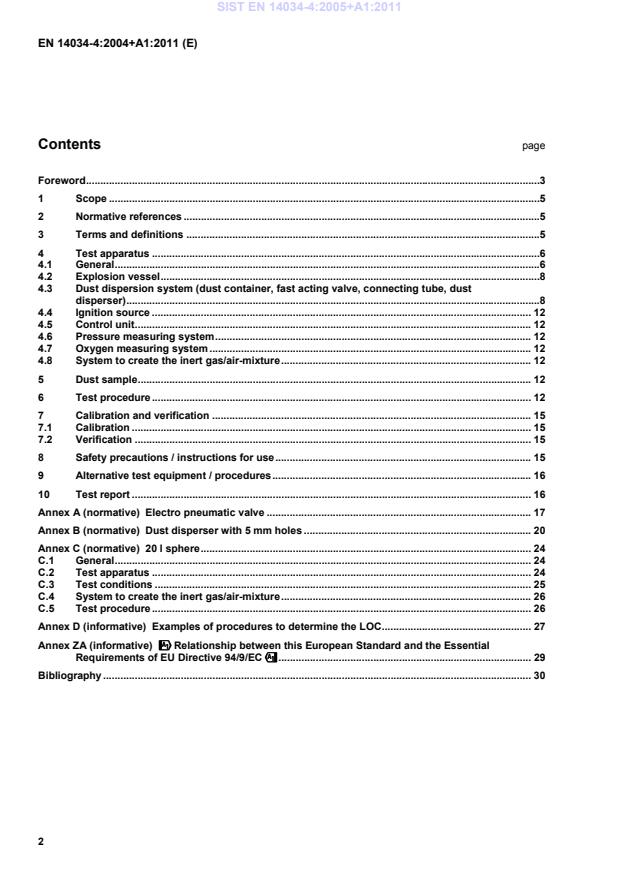
Electro pneumatic valve . 17Annex B (normative)
Dust disperser with 5 mm holes . 20Annex C (normative)
20 l sphere . 24C.1General . 24C.2Test apparatus . 24C.3Test conditions . 25C.4System to create the inert gas/air-mixture . 26C.5Test procedure . 26Annex D (informative)
Examples of procedures to determine the LOC . 27Annex ZA (informative)
!!!!Relationship between this European Standard and the Essential Requirements of EU Directive 94/9/EC"""" . 29Bibliography . 30 SIST EN 14034-4:2005+A1:2011
!". This document has been prepared under a mandate given to CEN by the European Commission and the European Free Trade Association, and supports essential requirements of EU Directive(s). For relationship with EU Directive(s), see informative Annex ZA, which is an integral part of this document. This document includes a Bibliography. This document is one of a series of standards as listed below: EN 14034-1,Determination of explosion characteristics of dust clouds - Part 1: Determination of the maximum explosion pressure pmax of dust clouds; !EN 14034-2", Determination of explosion characteristics of dust clouds - Part 2: Determination of the maximum rate of explosion pressure rise (dp/dt)max of dust clouds; !EN 14034-3", Determination of explosion characteristics of dust clouds – Part 3: Determination of the lower explosion limit LEL of dust clouds; EN 14034-4, Determination of explosion characteristics of dust clouds – Part 4: Determination of the limiting oxygen concentration LOC of dust clouds. According to the CEN/CENELEC Internal Regulations, the national standards organizations of the following countries are bound to implement this European Standard: Austria, Belgium, Bulgaria, Croatia, Cyprus, Czech Republic, Denmark, Estonia, Finland, France, Germany, Greece, Hungary, Iceland, Ireland, Italy, Latvia, Lithuania, Luxembourg, Malta, Netherlands, Norway, Poland, Portugal, Romania, Slovakia, Slovenia, Spain, Sweden, Switzerland and United Kingdom.
1 Scope This document describes a test method for the determination of the limiting oxygen concentration of dust clouds in a closed vessel under defined initial conditions of pressure and temperature.
This method is not suitable for use with recognised explosives, like gunpowder and dynamite, substances which do not require oxygen for combustion, pyrophoric substances, or substances or mixtures of substances which may under some circumstances behave in a similar manner. Where any doubt exists about the existence of hazard due to explosive properties, expert advice should be sought. 2 Normative references The following referenced documents are indispensable for the application of this document. For dated references, only the edition cited applies. For undated references, the latest edition of the referenced document (including any amendments) applies.
!EN 14034-1:2004+A1:2011"; Determination of explosion characteristics of dust clouds — Part 1: Determination of the maximum explosion pressure pmax of dust clouds !EN 14034-2:2006+A1:2011; Determination of explosion characteristics of dust clouds — Part 2: Determination of the maximum rate of explosion pressure rise (dp/dt)max of dust clouds" !EN 14460", Explosion resistant equipment 3 Terms and definitions For the purposes of this document, the following terms and definitions apply. 3.1 dust small solid particles in the atmosphere which settle out under their own weight, but which may remain suspended in air for some time (includes dust and grit, as defined in ISO 4225). NOTE Generally maximum particle size will not exceed 500 µm. 3.2 combustible dust dust able to undergo an exothermic reaction with air when ignited NOTE The terms “flammable” and “combustible” are used synonymously. 3.3 ignition delay tv time between the initiation of the dust dispersion and the activation of the ignition source 3.4 inert gas non-flammable gas which will not support combustion and does not react to produce a flammable gas SIST EN 14034-4:2005+A1:2011
Key 1 Pressure sensor 2 Chemical igniters 3 Inlet for purge air / inert gas 4 Dust disperser 5 Dust container 6 Fast acting valve 7 Connecting tube 8 Outlet for exhaust gas 9 Oxygen analyser Figure 1 — 1 m³ vessel (schematic) SIST EN 14034-4:2005+A1:2011
4.2 Explosion vessel The standard explosion vessel is an explosion pressure resistant, spherical or cylindrical vessel having a volume of 1 m³ in accordance with !EN 14460". The aspect ratio of the cylindrical vessel shall be 1:1 ± 10 % (see Figure 1). NOTE It is recommended that the explosion vessel be designed to withstand an overpressure of at least 20 bar. The apparatus shall be fitted with electrical and/or mechanical cut-offs as far as possible to ensure that any openings in the vessel (e.g. main door, instrument ports, inlet or outlet) are properly closed before a test procedure can start. The apparatus shall also be equipped as far as possible to ensure that any residual pressure inside the vessel is vented before the vessel can be opened. 4.3 Dust dispersion system (dust container, fast acting valve, connecting tube, dust disperser) The dust to be dispersed is charged into a dust container having a volume of 5,4 dm³. Its aspect ratio is 3:1. It is designed to withstand an overpressure of at least 20 bar (see Figure 2). The dust container has an outlet at the base, through which the dust leaves the container. This outlet is closed by a fast acting valve activated by a blasting cap. The valve has a mushroom-shaped seal. The seal is held in position against the pressure in the dust container by a small ring. The ring is destroyed by firing a blasting cap and the valve opens due to the pressure inside the dust container (see Figure 2). The valve shall be designed so that it opens in less than 10 ms. For alternative valves see annex A.
The fast acting valve is connected to the side of the explosion vessel. The connecting tube between the fast acting valve and the dust disperser shall be not longer than 350 mm (see Figure 1). SIST EN 14034-4:2005+A1:2011
Key 1 Dust container 5 Protective hood 2 Mushroom shaped seal 6 Protective hood 3 Seal housing 7 Blasting cap 4 Support ring 8 Connecting tube Figure 2 — Dust container with blasting cap activated valve as commonly used for explosion suppression (schematic; it is commercially available) SIST EN 14034-4:2005+A1:2011
1) (e.g. EN ISO 1127, DN 20, 3/4") SIST EN 14034-4:2005+A1:2011
Key
1 6 mm hole 2 End cap with 6 mm hole Figure 3 — Location of the 6 mm holes in the dust disperser SIST EN 14034-4:2005+A1:2011
4.8 System to create the inert gas/air
...