

EN 15224:2012
(Main)Health care services - Quality management systems - Requirements based on EN ISO 9001:2008
- Abstract
1.1 General
This European standard specifies requirements for a quality management system where an organization:
a) needs to demonstrate its ability to consistently provide health care services that meet requirements from customers as well as applicable statutory and regulatory requirements, and professional standards
b) aims to enhance customer satisfaction through the effective application of the system, including continual improvement of the management system, the clinical processes and the assurance of conformity to requirements related to the quality characteristics ; appropriate, correct care; availability; continuity of care; effectiveness; efficiency; equity; evidence/knowledge based care; patient centred care including physical and psychological integrity; patient involvement; patient safety and timelines/accessibility.
Material products such as tissue, blood products, pharmaceuticals, cell culture products and medical devices have not been focused in the scope of the standard as they are regulated elsewhere.
This European Standard is focused on requirements for clinical processes. Organizations that also include research or education processes, or both in their quality management system could use the requirements in this European Standard where applicable.
This European Standard aims to adjust and specify the requirements, as well as the “product” concept and customer perspectives in EN ISO 9001:2008 to the specific conditions for health care where products are mainly services and customers are mainly patients.
The focus of this European Standard is the clinical processes and their risk management in order to promote good quality health care.
1.2 Application
This European Standard
a) gives requirements for systematic approaches for the organization’s ability to produce good quality health care.
b) can be used by management at all levels in the health care organization to implement and maintain a quality management system or by internal and external parties, including certification bodies, to assess the organization’s ability to meet patients’ needs and expectations as well those from other customers.
c) is applicable to health care organizations, regardless of structure, organization, owner, size or type of health care services provided.
d) is applicable to e.g. primary health care, pre-hospital and hospital care, tertiary care, nursing homes, hospices, preventive health care, mental health services, dental services, physiotherapy, occupational health services and pharmacies.
e) is focused on requirements for clinical processes. Organizations that also include research or education processes, in the scope of their quality management system could use the requirements in this standard where applicable.
Where any requirement(s) of this European Standard cannot be applied due to the nature of a health care organization and its product (including services), this can be considered for exclusion.
Where exclusions are made, claims of conformity to this European Standard are not acceptable unless these exclusions are limited to requirements within Clause 7, and such exclusions do not affect the health care organization’s ability, or responsibility, to provide products (including services) that meets customer and applicable statutory and regulatory requirements.
- Status
- Withdrawn
- Publication Date
- 23-Oct-2012
- Withdrawal Date
- 29-Sep-2026
- Current Stage
- 9960 - Withdrawal effective - Withdrawal
- Start Date
- 21-Dec-2016
- Completion Date
- 30-Sep-2026
Buy Documents

Relations
- Effective Date
- 31-Oct-2012
- Effective Date
- 11-Nov-2015
- Effective Date
- 28-Jan-2026
Buy Documents
Get Certified
Connect with accredited certification bodies for this standard

BSI Group
BSI (British Standards Institution) is the business standards company that helps organizations make excellence a habit.

TÜV SÜD
TÜV SÜD is a trusted partner of choice for safety, security and sustainability solutions.

Bureau Veritas
Bureau Veritas is a world leader in laboratory testing, inspection and certification services.
Sponsored listings
Frequently Asked Questions
EN 15224:2012 is a standard published by the European Committee for Standardization (CEN). Its full title is "Health care services - Quality management systems - Requirements based on EN ISO 9001:2008". This standard covers: 1.1 General This European standard specifies requirements for a quality management system where an organization: a) needs to demonstrate its ability to consistently provide health care services that meet requirements from customers as well as applicable statutory and regulatory requirements, and professional standards b) aims to enhance customer satisfaction through the effective application of the system, including continual improvement of the management system, the clinical processes and the assurance of conformity to requirements related to the quality characteristics ; appropriate, correct care; availability; continuity of care; effectiveness; efficiency; equity; evidence/knowledge based care; patient centred care including physical and psychological integrity; patient involvement; patient safety and timelines/accessibility. Material products such as tissue, blood products, pharmaceuticals, cell culture products and medical devices have not been focused in the scope of the standard as they are regulated elsewhere. This European Standard is focused on requirements for clinical processes. Organizations that also include research or education processes, or both in their quality management system could use the requirements in this European Standard where applicable. This European Standard aims to adjust and specify the requirements, as well as the “product” concept and customer perspectives in EN ISO 9001:2008 to the specific conditions for health care where products are mainly services and customers are mainly patients. The focus of this European Standard is the clinical processes and their risk management in order to promote good quality health care. 1.2 Application This European Standard a) gives requirements for systematic approaches for the organization’s ability to produce good quality health care. b) can be used by management at all levels in the health care organization to implement and maintain a quality management system or by internal and external parties, including certification bodies, to assess the organization’s ability to meet patients’ needs and expectations as well those from other customers. c) is applicable to health care organizations, regardless of structure, organization, owner, size or type of health care services provided. d) is applicable to e.g. primary health care, pre-hospital and hospital care, tertiary care, nursing homes, hospices, preventive health care, mental health services, dental services, physiotherapy, occupational health services and pharmacies. e) is focused on requirements for clinical processes. Organizations that also include research or education processes, in the scope of their quality management system could use the requirements in this standard where applicable. Where any requirement(s) of this European Standard cannot be applied due to the nature of a health care organization and its product (including services), this can be considered for exclusion. Where exclusions are made, claims of conformity to this European Standard are not acceptable unless these exclusions are limited to requirements within Clause 7, and such exclusions do not affect the health care organization’s ability, or responsibility, to provide products (including services) that meets customer and applicable statutory and regulatory requirements.
1.1 General This European standard specifies requirements for a quality management system where an organization: a) needs to demonstrate its ability to consistently provide health care services that meet requirements from customers as well as applicable statutory and regulatory requirements, and professional standards b) aims to enhance customer satisfaction through the effective application of the system, including continual improvement of the management system, the clinical processes and the assurance of conformity to requirements related to the quality characteristics ; appropriate, correct care; availability; continuity of care; effectiveness; efficiency; equity; evidence/knowledge based care; patient centred care including physical and psychological integrity; patient involvement; patient safety and timelines/accessibility. Material products such as tissue, blood products, pharmaceuticals, cell culture products and medical devices have not been focused in the scope of the standard as they are regulated elsewhere. This European Standard is focused on requirements for clinical processes. Organizations that also include research or education processes, or both in their quality management system could use the requirements in this European Standard where applicable. This European Standard aims to adjust and specify the requirements, as well as the “product” concept and customer perspectives in EN ISO 9001:2008 to the specific conditions for health care where products are mainly services and customers are mainly patients. The focus of this European Standard is the clinical processes and their risk management in order to promote good quality health care. 1.2 Application This European Standard a) gives requirements for systematic approaches for the organization’s ability to produce good quality health care. b) can be used by management at all levels in the health care organization to implement and maintain a quality management system or by internal and external parties, including certification bodies, to assess the organization’s ability to meet patients’ needs and expectations as well those from other customers. c) is applicable to health care organizations, regardless of structure, organization, owner, size or type of health care services provided. d) is applicable to e.g. primary health care, pre-hospital and hospital care, tertiary care, nursing homes, hospices, preventive health care, mental health services, dental services, physiotherapy, occupational health services and pharmacies. e) is focused on requirements for clinical processes. Organizations that also include research or education processes, in the scope of their quality management system could use the requirements in this standard where applicable. Where any requirement(s) of this European Standard cannot be applied due to the nature of a health care organization and its product (including services), this can be considered for exclusion. Where exclusions are made, claims of conformity to this European Standard are not acceptable unless these exclusions are limited to requirements within Clause 7, and such exclusions do not affect the health care organization’s ability, or responsibility, to provide products (including services) that meets customer and applicable statutory and regulatory requirements.
EN 15224:2012 is classified under the following ICS (International Classification for Standards) categories: 03.100.70 - Management systems; 03.120.10 - Quality management and quality assurance; 11.020 - Medical sciences and health care facilities in general; 11.020.01 - Quality and environmental management in health care; 11.020.10 - Health care services in general. The ICS classification helps identify the subject area and facilitates finding related standards.
EN 15224:2012 has the following relationships with other standards: It is inter standard links to CEN/TS 15224:2005, EN 15224:2016, EN ISO 9000:2005. Understanding these relationships helps ensure you are using the most current and applicable version of the standard.
EN 15224:2012 is available in PDF format for immediate download after purchase. The document can be added to your cart and obtained through the secure checkout process. Digital delivery ensures instant access to the complete standard document.
Standards Content (Sample)
2003-01.Slovenski inštitut za standardizacijo. Razmnoževanje celote ali delov tega standarda ni dovoljeno.Zdravstvene storitve - Sistemi vodenja kakovosti - Zahteve na osnovi EN ISO 9001:2008Dienstleistungen in der Gesundheitsversorgung - Qualitätsmanagementsysteme - Anforderungen nach EN ISO 9001:2008Services de santé - Systèmes de management de la qualité - Exigences d'après l'EN ISO 9001:2008Health care services - Quality management systems - Requirements based on EN ISO 9001:200811.020]GUDYVWYHQRYDUVWYHQLMedical sciences and health care facilities in general03.120.10Vodenje in zagotavljanje kakovostiQuality management and quality assuranceICS:Ta slovenski standard je istoveten z:EN 15224:2012SIST EN 15224:2012en,fr,de01-december-2012SIST EN 15224:2012SLOVENSKI
STANDARDSIST-TS CEN/TS 15224:20061DGRPHãþD
EUROPEAN STANDARD NORME EUROPÉENNE EUROPÄISCHE NORM
EN 15224
October 2012 ICS 03.120.10; 11.020 Supersedes CEN/TS 15224:2005English Version
Health care services - Quality management systems - Requirements based on EN ISO 9001:2008
Services de santé - Systèmes de management de la qualité - Exigences selon l'EN ISO 9001:2008
Dienstleistungen in der Gesundheitsversorgung - Qualitätsmanagementsysteme - Anforderungen nach EN ISO 9001:2008 This European Standard was approved by CEN on 13 July 2012.
CEN members are bound to comply with the CEN/CENELEC Internal Regulations which stipulate the conditions for giving this European Standard the status of a national standard without any alteration. Up-to-date lists and bibliographical references concerning such national standards may be obtained on application to the CEN-CENELEC Management Centre or to any CEN member.
This European Standard exists in three official versions (English, French, German). A version in any other language made by translation under the responsibility of a CEN member into its own language and notified to the CEN-CENELEC Management Centre has the same status as the official versions.
CEN members are the national standards bodies of Austria, Belgium, Bulgaria, Croatia, Cyprus, Czech Republic, Denmark, Estonia, Finland, Former Yugoslav Republic of Macedonia, France, Germany, Greece, Hungary, Iceland, Ireland, Italy, Latvia, Lithuania, Luxembourg, Malta, Netherlands, Norway, Poland, Portugal, Romania, Slovakia, Slovenia, Spain, Sweden, Switzerland, Turkey and United Kingdom.
EUROPEAN COMMITTEE FOR STANDARDIZATION
COMITÉ EUROPÉEN DE NORMALISATION EUROPÄISCHES KOMITEE FÜR NORMUNG
Management Centre:
Avenue Marnix 17,
B-1000 Brussels © 2012 CEN All rights of exploitation in any form and by any means reserved worldwide for CEN national Members. Ref. No. EN 15224:2012: ESIST EN 15224:2012
Process approach . 10 0.2.1
General . 10 0.2.2
Process approach and improvements. 11 0.3 Compatibility with other standards. 12 1 Scope . 13 1.1 General . 13 1.2 Application . 13 2 Normative references . 14 3 Terms and definitions . 14 4 Quality management systems . 18 4.1 General requirements . 18 4.2 Documentation requirements . 19 4.2.1 General . 19 4.2.2 Quality manual . 20 4.2.3 Control of documents . 20 4.2.4 Control of records. 21 5 Management responsibility . 21 5.1
Management commitment . 21 5.2 Customer focus . 22 5.3 Quality policy . 22 5.4 Planning . 22 5.4.1 Quality objectives . 22 5.4.2 Quality management system planning . 23 5.5 Responsibility, authority and communication . 23 5.5.1 Responsibility and authority . 23 5.5.2 Management representative . 23 5.5.3 Internal communication . 24 5.6 Management review . 24 5.6.1 General . 24 5.6.2 Review input . 25 5.6.3 Review output . 25 6 Resource management . 26 6.1 Provision of resources . 26 6.2 Human resources. 26 6.2.1 General . 26 6.2.2 Competence, awareness and training . 26 6.3 Infrastructure . 27 6.4 Work environment . 27 7 Product realization. 27 SIST EN 15224:2012
(informative)
Correspondence between ISO 9001:2008 and EN 15224 . 41 Annex B (informative)
Practical guide for the implementation of this standard in health care organizations . 45 B.1 General . 45 B.2 Preparation and planning . 45 B.2.1 General . 45 B.2.2 Leadership in quality. 46 B.2.3 Planning the quality management system set-up . 46 B.2.4 Education and training in quality management . 46 B.2.5 Customer focus . 47 B.2.6 Planning the documentation . 47 B.2.7 Provision of necessary resources . 48 B.3 Implementing the quality management system . 48 B.3.1 General . 48 B.3.2 Quality policy . 48 B.3.3 Quality characteristics and quality requirements in health care . 49 B.3.4 Quality objectives . 50 B.3.5 Personnel working for and on behalf of the organization . 50 B.3.6 Authority, responsibility and accountability . 51 B.3.7 Communication and information management . 51 B.3.8 Documenting the quality management system . 51 B.3.9 Process-oriented quality management . 53 SIST EN 15224:2012
Correspondence between CEN/TS 15224:2005 and EN 15224 . 60 Bibliography . 64
The requirements in this standard incorporate those from EN ISO 9001:2008 with additional interpretations and specifications for health care. Requirements have been added to and clarified according to the specific health care context. New requirements have been added when considered relevant. This standard also includes aspects related to clinical risk management throughout the planning, operation and control of processes.
This quality management system does not include requirements specific to environmental management. Therefore, it is recommended that organisations that apply a management system also apply an environmental management. The congruence and difference between this standard and EN ISO 9001:2008 is explained in this introduction and in cross reference table (Annex A).
The congruence and difference between CEN/TS 15224:2005 and this standard is explained in cross reference table (Annex C). A practical guide for the implementation of this standard in health care organizations is presented in Annex B. Further guidance for quality improvement approaches can be found in CEN/TR 15592:2007, Health services - Quality management systems - Guide for the use of EN ISO 9004:2000 in health services for performance Improvement. The following quality management principles from EN ISO 9000:2005 are applied in this standard:
a) Customer focus Organizations depend on their customers and therefore should understand current and future customer needs, should meet customer requirements and strive to exceed customer expectations. b) Leadership Leaders establish unity of purpose and direction of the organization. They should create and maintain the internal environment in which people can become fully involved in achieving the organization's objectives. c) Involvement of personnel Staff at all levels are the essence of an organization and their full involvement enables their abilities to be used for the organization’s benefit. SIST EN 15224:2012
qhe torld eealth lrganization (telc definition of health is “a state of complete physical, mental and social well-being and not merely the absence of disease or infirmity.” qhe fnternational Classification of cunctioningf Disability and Health (ICF), by WHO, identifies five health components; body function, body structure, activity, participation and environmental factors.
0.1.3 Health care
In this standard health is not a stand alone concept but is used in several terms as a prefix. When used as a prefix the concept of health is based on the health components in of ICF by WHO. The concept of health relates to both health care and social care. This standard is focused on requirements for health care.
What is included in health care can differ from country to country and this has to be considered in national applications. In this standard health care includes e.g. primary health care, pre-hospital and hospital care, tertiary care, nursing homes, hospices, preventive health care, mental health services, dental services, physiotherapy, occupational health services, rehabilitation and pharmacies.
0.1.4 Quality in health care
nuality in general is defined as “degree to which a set of inherent characteristics fulfils requirements”. qo make quality in health care measurable and testable the quality characteristics of clinical processes must be identified and described. In this standard the requirements of the patients or customers for health care services must be specified according to effectiveness, safety, availability, timeliness/accessibility, continuity of care, respect of patient values and preferences and appropriateness, Aspects of efficiency; fair distribution and evidence must be considered (3.14, Note 2). Where any of the above mentioned requirements can not be applied due to the nature of an organisation and its product this can be considered for exclusion. The requirements can be specified in quality objectives according to 3.11. SIST EN 15224:2012
appropriate, correct care;
availability;
continuity of care;
effectiveness;
efficiency;
equity;
evidence/knowledge based care;
patient centred care including physical, psychological and social integrity;
patient involvement;
patient safety;
timeliness/accessibility.
The health care organisation defines their quality vision/policy and it identifies the quality characteristics for their context / situation.
A quality management system is a system to direct and control an organization with regard to quality. The requirements for a quality management system in this standard are consequently focused on the quality characteristics.
0.1.5 The concept of "clinical"
The term "Clinical” can have different meanings in different countries. In this standard "clinical" refers to all types of interactions between patients and all kinds of health care professionals. fn this standard “clinical” is not restricted to the hospital context. 0.1.6 Clinical risk
Clinical risk denotes any risk that could have negative effects on the outcomes for any of the quality requirements. The risk factors could be non-clinical, but the risk is considered a clinical risk if it could have any negative impact on any of the quality requirements. Aspects of clinical risk management are integrated in this standard.
0.1.7 Health care specific preconditions Health care is characterised by numerous interactions between patients, health care personnel, suppliers, insurers, industry and governmental bodies which shall be identified and taken into consideration. Examples of such specific preconditions in health care are given below: a) Health care is delivered through clinical processes which are dependent on a number of management and supporting activities/processes. A clinical process is a continuum of care from the patient's SIST EN 15224:2012
f) National legislation, directives and recommendations from regulatory authorities concerning health care services are additional to the requirements in this standard and shall be identified and taken into account. An example of a national directive is implementation of clinical governance where organizations are accountable for continuously monitoring and improving the quality of their care and services. SIST EN 15224:2012
Process approach
0.2.1
General There are three types of directly customer oriented processes in health care organizations: • clinical processes,
• research processes and, • educational processes
0.2.1.1 Processes in the provision of health care
The main activities in health care organizations are related to the interaction between patients and health care professionals. These activities are performed in a wide variety of processes, called clinical processes, which encompasses all health care activities related to one or more health issues.
Clinical processes, as processes in general, are influenced by leadership and management activities as well as by resource management activities. Depending on the scope of the organization, the health care services provided can encompass comprehensive clinical processes or parts of it. Depending of the scope of the organization it can deal with any combination of the types of processes mentioned here. This standard focuses on the clinical processes.
0.2.1.2 Clinical processes The clinical processes are the main type of processes in health care services and all health care organizations participate in such processes. The clinical process includes all health care activities and interactions between the patient and health care professionals from the initial health request to the last activity concerning that health issue.
The clinical processes shall be designed to meet the quality objectives and quality requirements set for the quality characteristics.
Clinical processes shall be designed and developed in relation to certain specified health issues, for example stroke, and includes all care within the complete continuum of care related to that health issue; pre-hospital, emergency care, hospital care, primary care and rehabilitation.
Clinical processes may cross organizational borders depending on the scope of the organization. 0.2.1.3 Research processes The objective of the research process is to contribute to knowledge and subsequently improvement in health care.
0.2.1.4 Educational processes
The educational process encompasses the processes for basic professional education.
NOTE Competence development is not regarded as an educational process but should be integrated in the resource management of all organizations.
Process approach and improvements This standard and EN ISO 9001:2008 are based on a process approach when developing, implementing and improving the quality management system. The application of a system of processes within an organization, together with the identification and interactions of these processes, and their management to produce the desired outcome, can be referred to as a “process approach”. Clauses 1 to 4 in the standard constitute the basis for the quality management system. The relevance of Clauses 5 to 8 are shown in the improvement figure below. The PDCA (plan-do-check-act) cycle is applicable to the improvement of the health care organization's processes encompassed in the quality management system, Figure 1.
Figure 1 — Model of a process-based quality management system ISO 9001 Clause 7 Health care service realization
Interested parties Patients and other customers Interested parties Patients and other customers Continual Improvement of the Quality Management System Needs & Expectations Clause 5 Management responsibility
Clause 6 Resource management Clause 8 Measurement analysis and improvement
Satisfaction Foundation: Quality management principles (ISO 9000) Value-adding activities
Information flow Services SIST EN 15224:2012
This standard is a quality management system standard and can be applied together with other standards for example, EN ISO 14001, Environmental management systems — Requirements with guidance for use,
EN ISO 27799:2008, Health informatics — Information security management in health using ISO/IEC 27002, ISO 31000, Risk Management — Principles and guidelines. This standard enables an organization to align or integrate its own quality management system with related management system requirements. ft is possible to adapt the organization’s existing management system(sc in order to comply with the requirements of this standard
This European Standard is focused on requirements for clinical processes. Organizations that also include research or education processes, or both in their quality management system could use the requirements in this European Standard where applicable. This European Standard aims to adjust and specify the requirements, as well as the “product” concept and customer perspectives in EN ISO 9001:2008 to the specific conditions for health care where products are mainly services and customers are mainly patients. The focus of this European Standard is the clinical processes and their risk management in order to promote good quality health care. 1.2 Application This European Standard
a)
gives requirements for systematic approaches for the organization’s ability to produce good quality health care. b)
can be used by management at all levels in the health care organization to implement and maintain a quality management system or by internal and external parties, including certification bodies, to assess the organization’s ability to meet patients’ needs and expectations as well those from other customers. c)
is applicable to health care organizations, regardless of structure, organization, owner, size or type of health care services provided. d) is applicable to e.g. primary health care, pre-hospital and hospital care, tertiary care, nursing homes, hospices, preventive health care, mental health services, dental services, physiotherapy, occupational health services and pharmacies.
e) is focused on requirements for clinical processes. Organizations that also include research or education processes, in the scope of their quality management system could use the requirements in this standard where applicable. Where any requirement(s) of this European Standard cannot be applied due to the nature of a health care organization and its product (including services), this can be considered for exclusion. SIST EN 15224:2012
3 Terms and definitions For the purposes of this document the terms and definitions given in EN ISO 9000, together with the following terms and definitions apply. Specifications for health care are added in Notes. 3.1 clinical
context where patients and health care personnel interact concerning a health issue
NOTE The term clinical is used regardless of types of health care service, organizations or levels involved. 3.2 customer
organization or person that receives a product
[EN ISO 9000:2005, 3.3.5] NOTE 1
The patient is the key customer in health care. NOTE 2
In health care, the citizens in the affiliated area or target group should be taken into consideration as potential customers.
NOTE 3 Some interested parties are considered as customers in certain circumstances, e.g. other customers could be other health care organizations or departments or parts of the organization co-operating in the products or services produced. It can also be insurance companies, purchasers and funders asking for services from the health care organization. NOTE 4
Concerning relatives and next of kin see interested party in health care. 3.2.1 patient person who is the subject of care
3.3 customer satisfaction customer's perception of the degree to which the customer's requirements have been fulfilled [EN ISO 9000:2005 3.1.4] SIST EN 15224:2012
The term stakeholder can be used as a synonym to the concept interested party. Examples of stakeholders are patients, relatives, personnel, citizens, health care administration, health insurance organizations, patient organizations, professional organizations, municipalities and suppliers. NOTE 3
Relative or next of kin can be regarded as an interested party. NOTE 4
In some specific situations the patient can refer to his or her legal representatives.
3.5 nonconformity
non-fulfilment of a requirement [EN ISO 9000:2005, 3.6.2] NOTE 1 Nonconformity in health care is a non-fulfilment of a requirement directly or indirectly related to any of the quality characteristics in health care [EN 13940-1:2007]. NOTE 2 Nonconformity includes non compliance to legislation. NOTE 3 Near misses, incidents and adverse events should be treated as nonconformities. 3.5.1 near miss situation or event that has the potential to cause an adverse event, but fails to do so because of chance or because it is intercepted
[EN 13940-1:2007] NOTE
An example of a near miss could be the patient was to be given the wrong drug or blood but this was noticed and stopped prior to administration. 3.5.2 adverse event
situation or event that has caused harm to a patient 3.6 organization
group of people and facilities with an orderly arrangement of responsibilities, authorities and relationships [EN ISO 9000:2005, 3.3.1] NOTE 1
A health care organization is an organization involved in the direct provision of health care [EN 13940-1:2007]. SIST EN 15224:2012
3.6.1 staff personnel within a health care organization NOTE
Staff includes health care personnel and other personnel. 3.6.2 health care personnel personnel involved in the direct provision of health care 3.6.3 health care professional health care personnel with a professional entitlement in a given jurisdiction 3.7 procedure
specified way to carry out an activity or a process
[EN ISO 9000:2005, 3.4.5] 3.8 process set of interrelated or interacting activities which transforms inputs into outputs
[EN ISO 9000:2005, 3.4.1] NOTE 1
Health care process is defined as a process where a patient and health care personnel interact with the aim to directly or indirectly influence the health state of that patient [prEN ISO 13940] NOTE 2 Clinical processes are health care processes where a subject of care and health care actors interact encompassing all health care activities related to one or more health issues. [prEN ISO 13940] NOTE 3 A clinical process comprises all kinds of health care activities, mainly those provided by health care professionals, but also self care activities as prescribed or recommended by health care professionals. NOTE 4
The primary input and output to a clinical process is the health state of a patient. 3.9 product
result of a process
[EN ISO 9000:2005 3.4.2] NOTE 1 EN ISO 9000:2005 describes a service as a category of product.
NOTE 2 Products of health care are mainly services as the results of clinical processes. [EN 13940-1:2007] NOTE 3 The result of a health care process can also be a tangible product, e.g. blood, plasma.
3.10 quality characteristic
inherent characteristic of a product, process or system related to a requirement SIST EN 15224:2012
...
SLOVENSKI SIST EN 15224
STANDARD
december 2012
Zdravstvene storitve – Sistemi vodenja kakovosti – Zahteve na osnovi
EN ISO 9001:2008
Health care services – Quality management systems – Requirements based on
EN ISO 9001:2008
Services de santé – Systèmes de management de la qualité – Exigences d'après
l'EN ISO 9001:2008
Dienstleistungen in der Gesundheitsversorgung – Qualitätsmanagementsysteme –
Anforderungen nach EN ISO 9001:2008
Referenčna oznaka
ICS 03.120.10; 11.020 SIST EN 15224:2012 (sl, en)
Nadaljevanje na straneh II in od 1 do 95
© 2014-07. Slovenski inštitut za standardizacijo. Razmnoževanje celote ali delov tega standarda ni dovoljeno.
SIST EN 15224 : 2012
NACIONALNI UVOD
Standard SIST EN 15224 (sl, en), Zdravstvene storitve – Sistemi vodenja kakovosti – Zahteve na
osnovi EN ISO 9001:2008, 2012, ima status slovenskega standarda in je istoveten evropskemu
standardu EN 15224, Health care services – Quality management systems – Requirements based on
EN ISO 9001:2008, 2012.
Ta standard nadomešča SIST-TS CEN/TS 15224:2006.
NACIONALNI PREDGOVOR
Besedilo standarda EN 15224:2012 je pripravil tehnični odbor CEN/TC 362 Zdravstvene storitve –
Sistemi vodenja kakovosti, katerega sekretariat vodi SIS. Slovenski standard SIST EN 15224:2012 je
prevod angleškega besedila evropskega standarda EN 15224:2012. V primeru spora glede besedila
slovenskega prevoda v tem standardu je odločilen izvirni evropski standard v angleškem jeziku.
Slovensko-angleško izdajo standarda je pripravil SIST/TC VZK Vodenje in zagotavljanje kakovosti.
Odločitev za privzem tega standarda je 5. novembra 2012 sprejel tehnični odbor SIST/TC VZK Vodenje
in zagotavljanje kakovosti.
ZVEZE S STANDARDI
S privzemom tega evropskega standarda veljajo za omejeni namen referenčnih standardov vsi
standardi, navedeni v izvirniku, razen standarda, ki smo ga že sprejeli v nacionalno standardizacijo:
SIST EN ISO 9000:2005 (sl, en) Sistemi vodenja kakovosti – Osnove in slovar (ISO 9000:2005)
OSNOVA ZA IZDAJO STANDARDA
– privzem standarda EN 15224:2012
PREDHODNA IZDAJA
– SIST-TS CEN/TS 15224:2006, Zdravstvene storitve – Sistemi vodenja kakovosti – Vodilo za
uporabo EN ISO 9001:2000
OPOMBE
– Povsod, kjer se v besedilu standarda uporablja izraz “evropski standard”, v SIST EN 15224:2012
to pomeni “slovenski standard”.
– Nacionalni uvod in nacionalni predgovor nista sestavni del standarda.
– Ta nacionalni dokument je istoveten EN 15224:2012 in je objavljen z dovoljenjem
CEN
Management Centre
Avenue Marnix 17
B-1000 Bruselj
This national document is identical with EN 15224:2012 and is published with the permission of
CEN
Management Centre
Avenue Marnix 17
B-1000 Brussels
II
EVROPSKI STANDARD EN 15224
EUROPEAN STANDARD
EUROPÄISCHE NORM
NORME EUROPÉENNE oktober 2012
ICS: 03.120.10; 11.020 Nadomešča CEN/TS 15224:2005
Slovenska izdaja
Zdravstvene storitve – Sistemi vodenja kakovosti – Zahteve na osnovi
EN ISO 9001:2008
Health care services – Services de santé – Systèmes de Dienstleistungen in der
Quality management systems – management de la qualité – Gesundheitsversorgung –
Requirements based on Exigences selon Qualitätsmanagementsysteme –
EN ISO 9001:2008 l'EN ISO 9001:2008 Anforderungen nach EN ISO 9001:2008
Ta evropski standard je CEN sprejel 13. julija 2012.
Člani CEN morajo izpolnjevati notranje predpise CEN/CENELEC, s katerim je predpisano, da mora biti
ta standard brez kakršnih koli sprememb sprejet kot nacionalni standard. Najnovejši seznami teh
nacionalnih standardov in njihovi bibliografski podatki se na zahtevo lahko dobijo pri Upravnem centru
CEN-CENELEC ali katerem koli članu CEN.
Ta evropski standard obstaja v treh uradnih izdajah (angleški, francoski in nemški). Izdaje v drugih
jezikih, ki jih člani CEN na lastno odgovornost prevedejo in izdajo ter prijavijo pri Upravnem centru CEN-
CENELEC, veljajo kot uradne izdaje.
Člani CEN so nacionalni organi za standarde Avstrije, Belgije, Bolgarije, Cipra, Češke republike,
Danske, Estonije, Finske, Francije, Grčije, Hrvaške, Irske, Islandije, Italije, Latvije, Litve, Luksemburga,
Madžarske, Malte, Nekdanje jugoslovanske republike Makedonije, Nemčije, Nizozemske, Norveške,
Poljske, Portugalske, Romunije, Slovaške, Slovenije, Španije, Švedske, Švice, Turčije in Združenega
kraljestva.
CEN
Evropski komite za standardizacijo
European Committee for Standardization
Comité Européen de Normalisation
Europäisches Komitee für Normung
Upravni center: Avenue Marnix 17, B-1000 Brussels
© 2012 CEN Lastnice avtorskih pravic so vse države članice CEN Ref. oznaka EN 15224:2012 E
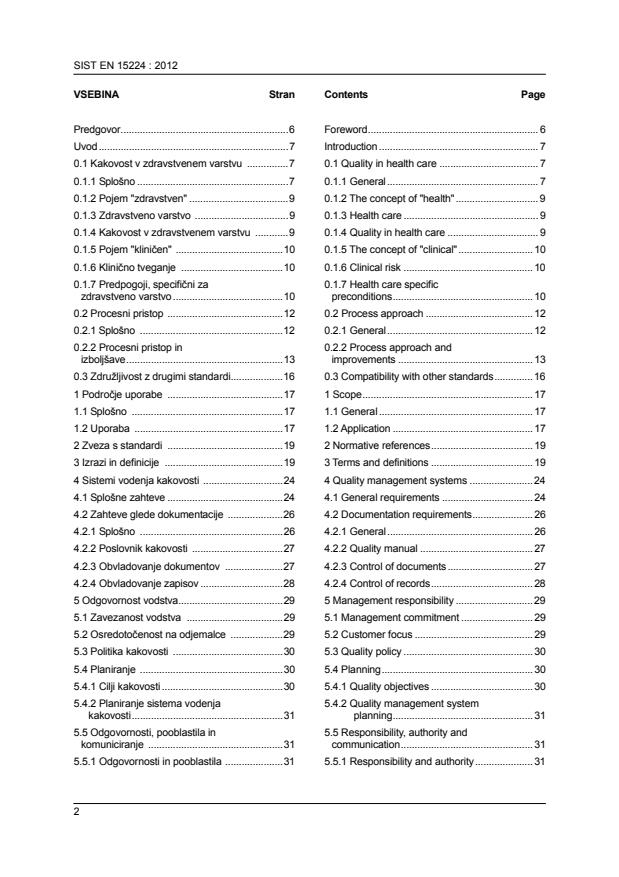
SIST EN 15224 : 2012
VSEBINA Stran Contents Page
Predgovor.6 Foreword. 6
Uvod.7 Introduction . 7
0.1 Kakovost v zdravstvenem varstvu .7 0.1 Quality in health care . 7
0.1.1 Splošno .7 0.1.1 General. 7
0.1.2 Pojem "zdravstven" .9 0.1.2 The concept of "health". 9
0.1.3 Zdravstveno varstvo .9 0.1.3 Health care . 9
0.1.4 Kakovost v zdravstvenem varstvu .9 0.1.4 Quality in health care . 9
0.1.5 Pojem "kliničen" .10 0.1.5 The concept of "clinical".10
0.1.6 Klinično tveganje .10 0.1.6 Clinical risk .10
0.1.7 Predpogoji, specifični za 0.1.7 Health care specific
zdravstveno varstvo.10 preconditions.10
0.2 Procesni pristop .12 0.2 Process approach .12
0.2.1 Splošno .12 0.2.1 General.12
0.2.2 Procesni pristop in 0.2.2 Process approach and
izboljšave.13 improvements .13
0.3 Združljivost z drugimi standardi.16 0.3 Compatibility with other standards.16
1 Področje uporabe .17 1 Scope.17
1.1 Splošno .17 1.1 General.17
1.2 Uporaba .17 1.2 Application .17
2 Zveza s standardi .19 2 Normative references.19
3 Izrazi in definicije .19 3 Terms and definitions .19
4 Sistemi vodenja kakovosti .24 4 Quality management systems .24
4.1 Splošne zahteve .24 4.1 General requirements .24
4.2 Zahteve glede dokumentacije .26 4.2 Documentation requirements.26
4.2.1 Splošno .26 4.2.1 General.26
4.2.2 Poslovnik kakovosti .27 4.2.2 Quality manual .27
4.2.3 Obvladovanje dokumentov .27 4.2.3 Control of documents.27
4.2.4 Obvladovanje zapisov .28 4.2.4 Control of records.28
5 Odgovornost vodstva.29 5 Management responsibility .29
5.1 Zavezanost vodstva .29 5.1 Management commitment .29
5.2 Osredotočenost na odjemalce .29 5.2 Customer focus .29
5.3 Politika kakovosti .30 5.3 Quality policy .30
5.4 Planiranje .30 5.4 Planning.30
5.4.1 Cilji kakovosti .30 5.4.1 Quality objectives .30
5.4.2 Planiranje sistema vodenja 5.4.2 Quality management system
kakovosti.31 planning.31
5.5 Odgovornosti, pooblastila in 5.5 Responsibility, authority and
komuniciranje .31 communication.31
5.5.1 Odgovornosti in pooblastila .31 5.5.1 Responsibility and authority.31
SIST EN 15224 : 2012
5.5.2 Predstavnik vodstva .32 5.5.2 Management representative.32
5.5.3 Notranje komuniciranje .32 5.5.3 Internal communication.32
5.6 Vodstveni pregled .33 5.6 Management review.33
5.6.1 Splošno .33 5.6.1 General.33
5.6.2 Vhodni podatki za pregled .33 5.6.2 Review input.33
5.6.3 Rezultati pregleda .34 5.6.3 Review output.34
6 Vodenje virov .35 6 Resource management.35
6.1 Priskrba virov .35 6.1 Provision of resources.35
6.2 Človeški viri.35 6.2 Human resources.35
6.2.1 Splošno .35 6.2.1 General.35
6.2.2 Kompetentnost, zavedanje in 6.2.2 Competence, awareness
usposabljanje .35 and training .35
6.3 Infrastruktura .36 6.3 Infrastructure .36
6.4 Delovno okolje .37 6.4 Work environment .37
7 Realizacija proizvoda.37 7 Product realization.37
7.1 Planiranje realizacije proizvoda .37 7.1 Planning of product realization .37
7.2 Procesi, povezani z odjemalci .38 7.2 Customer-related processes.38
7.2.1 Določitev zahtev v zvezi s proizvodom 7.2.1 Determination of requirements related
(zdravstveno storitvijo) .38 to the product (health care service).38
7.2.2 Pregled zahtev v zvezi s proizvodom 7.2.2 Review of requirements related to
(zdravstveno storitvijo) .39 the product (health care service).39
7.2.3 Komuniciranje z odjemalci .40 7.2.3 Customer communication .40
7.3 Snovanje in razvoj .40 7.3 Design and development .40
7.3.1 Planiranje snovanja in razvoja .40 7.3.1 Design and development planning .40
7.3.2 Vhodi za snovanje in razvoj .41 7.3.2 Design and development inputs .41
7.3.3 Rezultati snovanja in razvoja .42 7.3.3 Design and development outputs.42
7.3.4 Pregled snovanja in razvoja .43 7.3.4 Design and development review .43
7.3.5 Overjanje snovanja in razvoja.43 7.3.5 Design and development verification .43
7.3.6 Validacija snovanja in razvoja .43 7.3.6 Design and development validation .43
7.3.7 Obvladovanje sprememb snovanja 7.3.7 Control of design and development
in razvoja .44 changes.44
7.4 Nabava .44 7.4 Purchasing.44
7.4.1 Proces nabave .44 7.4.1 Purchasing process.44
7.4.2 Informacije za nabavo .45 7.4.2 Purchasing information .45
7.4.3 Overjanje nabavljenih storitev/ 7.4.3 Verification of purchased service/
proizvodov .45 product .45
7.5 Proizvodnja in izvedba storitev .46 7.5 Production and service provision.46
7.5.1 Obvladovanje proizvodnje in izvedbe 7.5.1 Control of production and service
storitev .46 provision.46
7.5.2 Validacija procesov za proizvodnjo 7.5.2 Validation of processes for
in izvedbo storitev .46 production and service provision.46
7.5.3 Identifikacija in sledljivost .47 7.5.3 Identification and traceability.47
SIST EN 15224 : 2012
7.5.4 Lastnina odjemalcev .48 7.5.4 Customer property .48
7.5.5 Ohranitev proizvoda .48 7.5.5 Preservation of product.48
7.6 Obvladovanje nadzorne in merilne 7.6 Control of monitoring and measuring
opreme .49 equipment .49
8 Merjenje, analize in 8 Measurement, analysis and
izboljševanje .50 improvement .50
8.1 Splošno .50 8.1 General.50
8.2 Nadzorovanje in merjenje .50 8.2 Monitoring and measurement.50
8.2.1 Zadovoljstvo odjemalcev .50 8.2.1 Customer satisfaction.50
8.2.2 Notranja presoja .50 8.2.2 Internal audit.50
8.2.3 Nadzorovanje in merjenje 8.2.3 Monitoring and measurement of
procesov .51 processes.51
8.2.4 Nadzorovanje in merjenje proizvodov 8.2.4 Monitoring and measurement of
(zdravstvenih storitev) .52 product (health care service).52
8.3 Obvladovanje neskladnih proizvodov 8.3 Control of non-conforming product
(zdravstvenih storitev) .52 (health care service) .52
8.4 Analiza podatkov .53 8.4 Analysis of data .53
8.5 Izboljševanje .54 8.5 Improvement.54
8.5.1 Nenehno izboljševanje .54 8.5.1 Continual improvement.54
8.5.2 Korektivni ukrepi .54 8.5.2 Corrective action .54
8.5.3 Preventivni ukrepi .54 8.5.3 Preventive action.54
Dodatek A (informativni): Primerjava med Annex A (informative): Correspondence
ISO 9001:2008 in EN 15224 .56 between ISO 9001:2008 and EN 15224.57
Dodatek B (informativni): Praktična Annex B (informative): Practical guide for
navodila za izvajanje tega standarda the implementation of this standard
v zdravstvenih organizacijah .64 in health care organizations .64
B.1 Splošno .64 B.1 General.64
B.2 Priprava in planiranje .65 B.2 Preparation and planning .65
B.2.1 Splošno.65 B.2.1 General.65
B.2.2 Voditeljstvo na področju kakovosti .65 B.2.2 Leadership in quality.65
B.2.3 Planiranje vzpostavitve sistema B.2.3 Planning the quality management
vodenja kakovosti .66 system set-up.66
B.2.4 Izobraževanje in usposabljanje na B.2.4 Education and training in quality
področju kakovosti .66 management.66
B.2.5 Osredotočenost na odjemalce .67 B.2.5 Customer focus.67
B.2.6 Planiranje dokumentacije .68 B.2.6 Planning the documentation.68
B.2.7 Priskrba potrebnih virov .69 B.2.7 Provision of necessary resources .69
B.3 Izvajanje sistema vodenja B.3 Implementing the quality management
kakovosti .69 system.69
B.3.1 Splošno .69 B.3.1 General.69
B.3.2 Politika kakovosti.70 B.3.2 Quality policy.70
B.3.3 Karakteristike in zahteve kakovosti v B.3.3 Quality characteristics and quality
zdravstvenem varstvu .70 requirements in health care.70
B.3.4 Cilji kakovosti .72 B.3.4 Quality objectives.72
SIST EN 15224 : 2012
B.3.5 Osebje, ki dela za organizacijo B.3.5 Personnel working for and on
in v njenem imenu .72 behalf of the organization .72
B.3.6 Pooblastila in B.3.6 Authority, responsibility and
odgovornosti .73 accountability.73
B.3.7 Vodenje komuniciranja B.3.7 Communication and information
in informiranja .74 management.74
B.3.8 Dokumentiranje sistema vodenja B.3.8 Documenting the quality management
kakovosti .74 system.74
B.3.9 Procesno usmerjeno vodenje B.3.9 Process-oriented quality
kakovosti .76 management.76
B.4 Vzpostavljanje sistema nadzorovanja B.4 Establishing the monitoring and
in vrednotenja .80 evaluation system .80
B.4.1 Splošno .80 B.4.1 General.80
B.4.2 Obvladovanje tveganja .84 B.4.2 Risk management.84
B.5 Nenehno izboljševanje .86 B.5 Continual improvement.86
B.5.1 Splošno .86 B.5.1 General.86
B.5.2 Analiza zbranih podatkov.86 B.5.2 Analysis of collected data .86
B.5.3 Vodstveni pregledi .87 B.5.3 Management reviews .87
B.5.4 Korektivni ukrepi.87 B.5.4 Corrective action.87
Dodatek C (informativni): Primerjava med Annex C (informative): Correspondence
CEN/TS 15224:2005 between CEN/TS 15224:2005 and
in EN 15224 .88 EN 15224 .89
Literatura .94 Bibliography.94
SIST EN 15224 : 2012
Predgovor Foreword
Ta dokument (EN 15224:2012) je pripravil This document (EN 15224:2012) has been
tehnični odbor CEN/TC 362 Zdravstvene storitve prepared by Technical Committee CEN/TC 362,
– Sistemi vodenja kakovosti, katerega sekretariat "Health services - Quality management
vodi SIS. systems”, the secretariat of which is held by SIS.
Ta evropski standard mora z objavo istovetnega This European Standard shall be given the
besedila ali z razglasitvijo dobiti status status of a national standard, either by
nacionalnega standarda najpozneje do aprila publication of an identical text or by
2013, nacionalne standarde, ki so v nasprotju s endorsement, at the latest by April 2013, and
tem standardom, pa je treba umakniti najpozneje conflicting national standards shall be
do aprila 2013. withdrawn at the latest by April 2013.
Opozoriti je treba na možnost, da je lahko nekaj Attention is drawn to the possibility that some of
elementov tega dokumenta predmet patentnih the elements of this document may be the
pravic. CEN [in/ali CENELEC] ne prevzema subject of patent rights. CEN [and/or
odgovornosti za identifikacijo katerihkoli ali vseh CENELEC] shall not be held responsible for
takih patentnih pravic. identifying any or all such patent rights.
Ta dokument nadomešča CEN/TS 15224:2005. This document supersedes CEN/TS 15224:2005.
V ta dokument je vključeno besedilo standarda This document includes the text of ISO 9001 as
ISO 9001, ki ga je leta 2008 izdala Mednarodna published in 2008 by the International
organizacija za standardizacijo ISO, zato ni Organization for Standardization, ISO, and
nujno, da je to zadnja objavljena izdaja. therefore may not be the last version published.
V skladu z notranjimi predpisi CEN/CENELEC According to the CEN/CENELEC Internal
morajo ta evropski standard obvezno uvesti Regulations, the national standards organisations
nacionalne organizacije za standardizacijo of the following countries are bound to
naslednjih držav: Avstrije, Belgije, Bolgarije, implement this European Standard: Austria,
Cipra, Češke republike, Danske, Estonije, Belgium, Bulgaria, Croatia, Cyprus, Czech
Finske, Francije, Grčije, Hrvaške, Irske, Islandije, Republic, Denmark, Estonia, Finland, Former
Italije, Latvije, Litve, Luksemburga, Madžarske, Yugoslav Republic of Macedonia, France,
Malte, Nekdanje jugoslovanske republike Germany, Greece, Hungary, Iceland, Ireland,
Makedonije, Nemčije, Nizozemske, Norveške, Italy, Latvia, Lithuania, Luxembourg, Malta,
Poljske, Portugalske, Romunije, Slovaške, Netherlands, Norway, Poland, Portugal,
Slovenije, Španije, Švedske, Švice, Turčije in Romania, Slovakia, Slovenia, Spain, Sweden,
Združenega kraljestva. Switzerland, Turkey and the United Kingdom.
SIST EN 15224 : 2012
Uvod Introduction
0.1 Kakovost v zdravstvenem varstvu 0.1 Quality in health care
0.1.1 Splošno 0.1.1 General
Ta standard za sisteme vodenja kakovosti je This is a sector specific quality management
namenjen posebej za zdravstvene organizacije. system standard for health care organizations.
Vključuje EN ISO 9001:2008 in nadomešča This standard incorporates EN ISO 9001:2008
CEN/TS 15224:2005, Zdravstvene storitve – and replaces CEN/TS 15224:2005 Health
Sistemi vodenja kakovosti – Vodilo za uporabo services – Quality management systems –
EN ISO 9001:2000. Besedilo iz standarda EN Guide for the use of EN ISO 9001:2000. The text
ISO 9001:2008 je v točkah 3 do 8 tega from EN ISO 9001:2008 in Clause 3 to Clause 8
evropskega standarda prikazano v črnem is shown in black in this European Standard and
pokončnem tisku, dodatno besedilo, posebej additional text specific to health care services is
namenjeno zdravstvenim storitvam, pa je v toč- in Clause 3 to Clause 8 shown in blue italics.
kah 3 do 8 prikazano v modrem poševnem tisku.
To je samostojen standard in se lahko uporablja This is a stand alone standard and can be used
za certificiranje v zdravstvenem varstvu. for certification in health care.
Zahteve v tem standardu vključujejo zahteve iz The requirements in this standard incorporate
standarda EN ISO 9001:2008 z dodatnimi those from EN ISO 9001:2008 with additional
razlagami in specifikacijami za zdravstveno interpretations and specifications for health
varstvo. Dodane in razjasnjene so zahteve v care. Requirements have been added to and
skladu s posebnostmi v zdravstvenem varstvu. clarified according to the specific health care
Po potrebi so dodane nove zahteve. Ta standard context. New requirements have been added
vključuje tudi vidike, povezane z obvladovanjem when considered relevant. This standard also
kliničnega tveganja med planiranjem, includes aspects related to clinical risk
delovanjem in obvladovanjem procesov. management throughout the planning,
operation and control of processes.
Ta sistem vodenja kakovosti ne vključuje This quality management system does not include
posebnih zahtev za ravnanje z okoljem. requirements specific to environmental
Organizacijam, ki uporabljajo sistem vodenja, se management. Therefore, it is recommended that
zato priporoča, da ga uporabljajo tudi za organisations that apply a management system
ravnanje z okoljem. also apply an environmental management.
V tem uvodu in v primerjalni preglednici (dodatek The congruence and difference between this
A) sta razložena ujemanje in razlika med tem standard and EN ISO 9001:2008 is explained in
standardom in EN ISO 9001:2008. this introduction and in cross reference table
(Annex A).
V primerjalni preglednici (dodatek C) sta The congruence and difference between
razložena ujemanje in razlika med CEN/TS CEN/TS 15224:2005 and this standard is
15224:2005 in tem standardom. explained in cross reference table (Annex C).
V dodatku B so podana praktična navodila za A practical guide for the implementation of this
izvajanje tega standarda v zdravstvenih standard in health care organizations is
organizacijah. presented in Annex B.
V tehničnem poročilu CEN/TR 15592:2007, Further guidance for quality improvement
Zdravstvene storitve – Sistemi vodenja kakovosti approaches can be found in CEN/TR
– Vodilo za uporabo EN ISO 9004:2000 za 15592:2007, Health services - Quality
izboljšanje izvajanja zdravstvenih storitev, so management systems - Guide for the use of EN
podani nadaljnji napotki za pristope k izboljšanju ISO 9004:2000 in health services for
kakovosti. performance Improvement.
SIST EN 15224 : 2012
V tem standardu so uporabljena naslednja The following quality management principles
načela vodenja kakovosti iz EN ISO 9000:2005: from EN ISO 9000:2005 are applied in this
standard:
a) Osredotočenost na odjemalce a) Customer focus
Organizacije so odvisne od svojih Organizations depend on their customers
odjemalcev, zato naj razumejo njihove and therefore should understand current
trenutne in prihodnje potrebe, izpolnjujejo and future customer needs, should meet
njihove zahteve in si prizadevajo preseči customer requirements and strive to exceed
njihova pričakovanja. customer expectations.
b) Voditeljstvo b) Leadership
Voditelji poenotijo namen in usmeritev Leaders establish unity of purpose and
organizacije. Ustvarijo in vzdržujejo naj tako direction of the organization. They should
notranje okolje, v katerem se lahko create and maintain the internal
zaposleni popolnoma vključijo v doseganje environment in which people can become
ciljev organizacije. fully involved in achieving the organization's
objectives.
c) Vključenost zaposlenih c) Involvement of personnel
Zaposleni na vseh ravneh so jedro Staff at all levels are the essence of an
organizacije in njihova popolna vključenost organization and their full involvement
omogoča, da se njihove sposobnosti enables their abilities to be used for the
uporabijo v korist organizacije. organization’s benefit.
d) Procesni pristop d) Process approach
Želeni rezultat se doseže učinkoviteje, A desired result is achieved more efficiently
kadar se aktivnosti in z njimi povezani viri when activities and related resources are
vodijo kot proces. managed as a process.
e) Sistemski pristop k vodenju e) System approach to management
Identificiranje, razumevanje in vodenje med Identifying, understanding and managing
seboj povezanih procesov kot sistem interrelated processes as a system
pripomorejo k uspešnosti in učinkovitosti contributes to the organization’s effectiveness
organizacije pri doseganju njenih ciljev. and efficiency in achieving its objectives.
f) Nenehno izboljševanje f) Continual improvement
Nenehno izboljševanje celotnega delovanja Continual improvement of the organization’s
organizacije naj bo stalen cilj organizacije. overall performance should be a permanent
objective of the organization.
g) Odločanje na podlagi dejstev g) Factual approach to decision making
Uspešne odločitve temeljijo na analizi Effective decisions are based on the
podatkov in informacij. analysis of data and information.
h) Vzajemno koristni odnosi z dobavitelji h) Mutually beneficial supplier relationships
Organizacija in njeni dobavitelji so med An organization and its suppliers are
seboj odvisni in vzajemno koristen odnos interdependent and a mutually beneficial
povečuje sposobnost obeh strani za relationship enhances the ability of both to
ustvarjanje vrednosti. create value.
Teh osem načel vodenja kakovosti tvori podlago These eight quality management principles form
za standarde sistemov vodenja kakovosti znotraj the basis for the quality management system
skupine standardov ISO 9000. standards within the ISO 9000 family.
SIST EN 15224 : 2012
0.1.2 Pojem "zdravstven" 0.1.2 The concept of "health"
Po definiciji Svetovne zdravstvene organizacije The World Health Organization (WHO) definition
(WHO) je zdravje "stanje popolne telesne, of health is “a state of complete physical, mental
psihološke in socialne blaginje in ne le odsotnost and social well-being and not merely the absence
bolezni ali nemoči". V Mednarodni klasifikaciji of disease or infirmity.” The International
funkcioniranja, zmanjšane zmožnosti in zdravja Classification of Functioning, Disability and Health
(ICF), ki jo je izdelala WHO, je prepoznanih pet (ICF), by WHO, identifies five health components;
sestavin zdravja: telesne funkcije, telesna body function, body structure, activity, participation
zgradba, aktivnost, sodelovanje in okoljski and environmental factors.
dejavniki.
0.1.3 Zdravstveno varstvo 0.1.3 Health care
Izraz "zdravstven" v tem standardu ni samostojen In this standard health is not a stand alone
pojem, temveč se uporablja kot pridevnik v več concept but is used in several terms as a prefix.
izrazih. Kadar se pojem "zdravstven" uporablja When used as a prefix the concept of health is
kot pridevnik, temelji na sestavinah zdravja po based on the health components in of ICF by
mednarodni klasifikaciji ICF organizacije WHO. WHO. The concept of health relates to both
Pojem zdravja je povezan tako z zdravstvenim health care and social care. This standard is
kot s socialnim varstvom. Ta standard je focused on requirements for health care.
osredotočen na zahteve za zdravstveno varstvo.
V različnih državah lahko zdravstveno varstvo What is included in health care can differ from
vključuje različne stvari in to je pri nacionalni rabi country to country and this has to be considered
treba upoštevati. V tem standardu zdravstveno in national applications. In this standard health
varstvo vključuje npr. primarno zdravstveno care includes e.g. primary health care, pre-
varstvo, predbolnišnično in bolnišnično hospital and hospital care, tertiary care, nursing
zdravstveno varstvo, terciarno zdravstveno homes, hospices, preventive health care, mental
varstvo, negovalne domove, hospice, health services, dental services, physiotherapy,
preventivno zdravstveno varstvo, psihiatrične occupational health services, rehabilitation and
zdravstvene storitve, zobozdravstvene storitve, pharmacies.
fizioterapijo, storitve zdravja pri delu,
rehabilitacijo in lekarne.
0.1.4 Kakovost v zdravstvenem varstvu 0.1.4 Quality in health care
Kakovost je na splošno opredeljena kot "stopnja, Quality in general is defined as “degree to which a
do katere niz pripadajočih karakteristik izpolnjuje set of inherent characteristics fulfils requirements”.
postavljene zahteve". Da bi lahko izmerili in To make quality in health care measurable and
preskusili kakovost na področju zdravstvenega testable the quality characteristics of clinical
varstva, je treba identificirati in opisati processes must be identified and described. In
karakteristike kakovosti kliničnih procesov. V tem this standard the requirements of the patients or
standardu morajo biti zahteve pacientov oziroma customers for health care services must be
odjemalcev zdravstvenih storitev specificirane specified according to effectiveness, safety,
glede na uspešnost, varnost, razpoložljivost, availability, timeliness/accessibility, continuity of
pravočasnost/dostopnost, neprekinjenost zdrav- care, respect of patient values and preferences
stvenega varstva, spoštovanje vrednot in and appropriateness, Aspects of efficiency; fair
preferenc pacientov ter glede na ustreznost, distribution and evidence must be considered
vidike učinkovitosti, pravično porazdelitev in (3.14, Note 2). Where any of the above
dokaze (3.14, opomba 2). Če katere od gornjih mentioned requirements can not be applied due
zahtev zaradi narave organizacije in njenega to the nature of an organisation and its product
proizvoda ni mogoče uporabiti, se lahko razmisli this can be considered for exclusion. The
o njeni opustitvi. Zahteve so lahko opredeljene v requirements can be specified in quality objectives
ciljih kakovosti v skladu s 3.11. according to 3.11.
Da bi lahko kakovost v zdravstvenem varstvu To be able to define and describe the quality in
opredelili in opisali, je treba identificirati in opisati health care the quality characteristics need to be
karakteristike kakovosti. Karakteristika kakovosti identified and described. A quality characteristic
SIST EN 15224 : 2012
je vedno povezana z zahtevo kakovosti. Zato je always relates to a quality requirement. Therefore
identificiranih enajst karakteristik kakovosti eleven quality characteristics of health care
zdravstvenih storitev z njihovimi povezanimi services with interrelated quality requirements are
zahtevami kakovosti, in sicer: identified as:
ustrezna, korektna zdravstvena oskrba, appropriate, correct care;
razpoložljivost, availability;
neprekinjenost zdravstvene oskrbe; continuity of care;
uspešnost, effectiveness;
učinkovitost, efficiency;
enakost, equity;
na dokazih/znanju temelječa zdravstvena evidence/knowledge based care;
oskrba,
na pacienta osredotočena zdravstvena oskrba, patient centred care including physical,
vključno s telesno, psihološko in socialno psychological and social integrity;
integriteto,
vključenost pacientov, patient involvement;
varnost pacientov, patient safety;
pravočasnost/dostopnost. timeliness/accessibility.
Zdravstvena organizacija določi svojo vizijo/ The health care organisation defines their quality
politiko kakovosti in identificira karakteristike vision/policy and it identifies the quality
kakovosti za svoje okolje oziroma stanje. characteristics for their context / situation.
Sistem vodenja kakovosti je sistem, ki usmerja in A quality management system is a system to
obvladuje organizacijo glede kakovosti. Zahteve direct and control an organization with regard to
za sistem vodenja kakovosti v tem standardu so quality. The requirements for a quality manage-
posledično osredotočene na karakteristike ment system in this standard are consequently
kakovosti. focused on the quality characteristics.
0.1.5 Pojem "kliničen" 0.1.5 The concept of "clinical"
Izraz "kliničen" ima lahko v različnih državah The term "Clinical” can have different meanings
različne pomene. V tem standardu se "kliničen" in different countries. In this standard "clinical"
nanaša na vse vrste interaktivnosti med pacienti refers to all types of interactions between
in različnimi vrstami zdravstvenih delavcev. V patients and all kinds of health care
tem standardu "kliničen" ni omejen na okolje professionals. In this standard “clinical” is not
bolnišnice. restricted to the hospital context.
0.1.6 Klinično tveganje 0.1.6 Clinical risk
Klinično tveganje označuje vsako tveganje, ki bi Clinical risk denotes any risk that could have
lahko negativno vplivalo na izide katerekoli od negative effects on the outcomes for any of the
zahtev kakovosti. Dejavniki tveganja so lahko quality requirements. The risk factors could be
neklinični, vendar se tveganje šteje za klinično, non-clinical, but the risk is considered a clinical
če bi lahko negativno vplivalo na katerokoli od risk if it could have any negative impact on any
zahtev kakovosti. V ta standard so vključeni of the quality requirements. Aspects of clinical
vidiki obvladovanja kliničnega tveganja. risk management are integrated in this standard.
0.1.7 Predpogoji, specifični za zdravstveno 0.1.7 Health care specific preconditions
varstvo
Za zdravstveno varstvo so značilne številne Health care is characterised by numerous
interaktivnosti med pacienti, zdravstvenim interactions between patients, health care
SIST EN 15224 : 2012
osebjem, dobavitelji, zavarovalnicami, industrijo personnel, suppliers, insurers, industry and
in državnimi organi, ki jih je treba identificirati in governmental bodies which shall be identified
upoštevati. and taken into consideration.
V nadaljevanju so navedeni primeri takih Examples of such specific preconditions in
specifičnih predpogojev v zdravstvenem varstvu: health care are given below:
a) Zdravstveno varstvo se izvaja s kliničnimi a) Health care is delivered through clinical
procesi, ki so vsi odvisni od številnih processes which are dependent on a
vodstvenih in podpornih aktivnosti oziroma number of management and supporting
procesov. S pacientovega zornega kota activities/processes. A clinical process is a
klinični proces pomeni celoten potek continuum of care from the patient's
zdravstvene obravnave. Odvisno od obsega perspective. Depending on the scope of the
organizacije je klinični proces sestavljen iz organization the clinical processes consists
celotnega ali delnega poteka zdravstvene of the whole or part of the continuum of
obravnave. Rezultati procesov v care. The results of processes in health
zdravstvenem varstvu so v glavnem care are mainly services.
storitve.
b) Splošni cilj organizacije je zadovoljstvo b) Patient satisfaction based on needs and
pacientov, ki temelji na njihovih potrebah in expectations is an overall objective for the
pričakovanjih. Pacient ne more vedno organization. The patient cannot always
ovrednotiti vseh vidikov rezultatov procesov evaluate all aspects of the results of the
v zdravstvenem varstvu. Nekatere vidike processes in health care. Some aspects of
storitev morajo ovrednotiti zdravstveni the services have to be evaluated by health
delavci. care professionals.
c) Organizacija je tista, ki je odgovorna za c) It is the responsibility of the organization to
podporo in uravnoteženost med support and balance between the patient's
pacientovimi pričakovanji in strokovno expectations and the professionally
ocenjenimi potrebami zdravstvene oskrbe. assessed needs of care. There may be
Med pričakovanji, ki jih izrazi pacient, in differences between the expectations
pacientovimi potrebami, kot jih presodijo expressed by the patient and the patient’s
strokovnjaki, so lahko razlike, ki jih je treba needs as judged by the professionals which
upoštevati. must be considered.
d) V zdravstvenem varstvu obstajajo tako d) In health care there are both individual
zapisi o posameznih pacientih, ki vsebujejo patient records, which contain confidential
zaupne podatke o posameznem pacientu, information about a single patient, and
kakor tudi vzporedni zapisi, v katerih se collated records where accumulated
zbirajo nabrani podatki o pacientih. information on patients are collected. The
Zaupnost vseh takih informacij je predmet privacy of all such information and docu-
nacionalnih predpisov. mentation is subject to national regulation.
e) Obvladovanje kliničnega tveganja je ključni e) Clinical risk management is a key
sestavni del sistema vodenja kakovosti. component in the quality management
system.
f) Nacionalna zakonodaja, smernice in f) National legislation, directives and recom-
priporočila regulativnih organov, ki se mendations from regulatory authorities
nanašajo na zdravstvene storitve, so concerning health care services are
dodane k zahtevam tega standarda ter jih je additional to the requirements in this
treba identificirati in upoštevati. Primer standard and shall be identified and taken
nacionalne smernice je klinično upravljanje, into account. An example of a national
kjer so organizacije odgovorne za nenehno directive is implementation of clinical gover-
nadzorovanje in izboljševanje kakovosti nance where organizations are accountable
svoje zdravstvene oskrbe in storitev. for continuously monitoring and improving
the quality of their care and services.
SIST EN 15224 : 2012
0.2 Procesni pristop 0.2 Process approach
0.2.1 Splošno 0.2.1 General
V zdravstvenih organizacijah obstajajo tri vrste There are three types of directly customer
procesov, neposredno usmerjenih k odjemalcem: oriented processes in health care organizations:
– klinični procesi, – clinical processes,
– raziskovalni procesi in – research processes and,
– izobraževalni procesi. – educational processes
0.2.1.1 Procesi pri izvajanju zdravstvenega 0.2.1.1 Processes in the provision of health
varstva care
V zdravstvenih organizacijah so glavne aktivnosti The
...