

prEN 896
(Main)Chemicals used for treatment of water intended for human consumption - Sodium hydroxide
- Abstract
This document is applicable to sodium hydroxide used for treatment of water intended for human consumption. It describes the characteristics and specifies the requirements and the corresponding test methods for sodium hydroxide. It gives information on its use in water treatment.
- Status
- Not Published
- Publication Date
- 27-Apr-2022
- Withdrawal Date
- 27-Oct-2022
- Technical Committee
- CEN/TC 164 - Water supply
- Drafting Committee
- CEN/TC 164/WG 9 - Drinking water treatment
- Current Stage
- 4098 - Decision to abandon - Enquiry
- Start Date
- 30-Sep-2022
- Completion Date
- 07-Oct-2026

Overview
prEN 896 is a European standard developed by CEN/TC 164 focusing on the use of sodium hydroxide in water treatment for human consumption. This document outlines the specifications, purity criteria, physical and chemical properties, and testing methods for sodium hydroxide intended for treating potable water. It replaces the earlier EN 896:2012 and provides updated guidelines on labelling, transportation, and safe handling procedures, ensuring sodium hydroxide meets stringent safety and quality standards for water treatment applications.
Key Topics
- Scope and Application: Defines sodium hydroxide for use in potable water treatment, covering its characteristics and required purity levels. It includes provisions on safe use and specific test methods.
- Chemical Identification: Covers sodium hydroxide's chemical formula (NaOH), CAS number (1310-73-2), synonyms such as caustic soda, and physical forms (flakes, pearls, solids, and aqueous solutions).
- Physical and Chemical Properties: Details appearance, density, solubility, vapor pressure, boiling and crystallization points, viscosity, and highly alkaline nature, emphasizing its behavior in various states critical for handling and dosing in water treatment.
- Purity and Impurity Limits: Specifies minimum NaOH content (≥96% for solids), maximum permissible impurities like sodium chloride, sodium carbonate, and sodium chlorate, and critical trace element thresholds for arsenic, cadmium, chromium, mercury, nickel, lead, antimony, and selenium.
- Testing and Sampling Methods: Describes standardized sampling techniques to avoid contamination and analytical methods such as titration, ionic chromatography, inductively coupled plasma optical emission spectrometry (ICP/OES), and atomic absorption spectrometry (AAS) for quality control.
- Labelling, Transportation, and Storage: Provides EU-compliant labelling guidelines including hazard warnings (such as "H314: causes severe skin burns and eye damage"), recommended containers, transport safety rules, marking, and storage conditions for maintaining product integrity.
Applications
- Water Treatment for Drinking Water: Sodium hydroxide is widely used to adjust pH levels, control acidity, and remove heavy metals, ensuring safe and compliant drinking water quality.
- Industrial Water Purification: It serves as an essential reagent in water treatment plants for neutralizing acidic components and improving water stability.
- Chemical Production and Processing: Supports various industrial processes requiring stringent purity sodium hydroxide, protected by standardized testing and quality requirements.
- Safety and Regulatory Compliance: The standard guides water treatment facilities and chemical suppliers on maintaining compliance with EU safety regulations and proper hazard communication to protect workers and consumers.
Related Standards
- EN ISO 3696: Water for analytical laboratory use - Specification and test methods
- EN ISO 12846: Water quality - Determination of mercury by atomic absorption spectrometry
- ISO 979: Sodium hydroxide for industrial use - Method of assay
- ISO 3196: Sodium hydroxide for industrial use - Determination of carbonates content
- ISO 8213: Sampling techniques for chemical products in powder and particle forms
- EU Regulation on Classification, Labelling and Packaging of Substances (CLP): Governs hazard communication and safety data sheets for chemicals like sodium hydroxide
Keywords: prEN 896, sodium hydroxide, caustic soda, drinking water treatment, water purification chemicals, chemical specifications, water treatment standards, purity criteria, test methods, EU chemical regulation, sodium hydroxide handling, hazard labelling, water treatment safety
Relations
- Effective Date
- 19-Jan-2023
Get Certified
Connect with accredited certification bodies for this standard

ECOCERT
Organic and sustainability certification.

Eurofins Food Testing Global
Global leader in food, environment, and pharmaceutical product testing.

Intertek Bangladesh
Intertek certification and testing services in Bangladesh.
Sponsored listings
Frequently Asked Questions
prEN 896 is a draft published by the European Committee for Standardization (CEN). Its full title is "Chemicals used for treatment of water intended for human consumption - Sodium hydroxide". This standard covers: This document is applicable to sodium hydroxide used for treatment of water intended for human consumption. It describes the characteristics and specifies the requirements and the corresponding test methods for sodium hydroxide. It gives information on its use in water treatment.
This document is applicable to sodium hydroxide used for treatment of water intended for human consumption. It describes the characteristics and specifies the requirements and the corresponding test methods for sodium hydroxide. It gives information on its use in water treatment.
prEN 896 is classified under the following ICS (International Classification for Standards) categories: 71.100.80 - Chemicals for purification of water. The ICS classification helps identify the subject area and facilitates finding related standards.
prEN 896 has the following relationships with other standards: It is inter standard links to EN 896:2012. Understanding these relationships helps ensure you are using the most current and applicable version of the standard.
prEN 896 is available in PDF format for immediate download after purchase. The document can be added to your cart and obtained through the secure checkout process. Digital delivery ensures instant access to the complete standard document.
Standards Content (Sample)
SLOVENSKI STANDARD
01-julij-2020
Kemikalije, ki se uporabljajo za pripravo pitne vode - Natrijev hidroksid
Chemicals used for treatment of water intended for human consumption - Sodium
hydroxide
Produkte zur Aufbereitung von Wasser für den menschlichen Gebrauch -
Natriumhydroxid
Produits chimiques utilisés pour le traitement de l’eau destinée à la consommation
humaine - Hydroxyde de sodium
Ta slovenski standard je istoveten z: prEN 896
ICS:
13.060.20 Pitna voda Drinking water
71.100.80 Kemikalije za čiščenje vode Chemicals for purification of
water
2003-01.Slovenski inštitut za standardizacijo. Razmnoževanje celote ali delov tega standarda ni dovoljeno.
DRAFT
EUROPEAN STANDARD
NORME EUROPÉENNE
EUROPÄISCHE NORM
May 2020
ICS 71.100.80 Will supersede EN 896:2012
English Version
Chemicals used for treatment of water intended for human
consumption - Sodium hydroxide
Produits chimiques utilisés pour le traitement de l'eau Produkte zur Aufbereitung von Wasser für den
destinée à la consommation humaine - Hydroxyde de menschlichen Gebrauch - Natriumhydroxid
sodium
This draft European Standard is submitted to CEN members for enquiry. It has been drawn up by the Technical Committee
CEN/TC 164.
If this draft becomes a European Standard, CEN members are bound to comply with the CEN/CENELEC Internal Regulations
which stipulate the conditions for giving this European Standard the status of a national standard without any alteration.
This draft European Standard was established by CEN in three official versions (English, French, German). A version in any other
language made by translation under the responsibility of a CEN member into its own language and notified to the CEN-CENELEC
Management Centre has the same status as the official versions.
CEN members are the national standards bodies of Austria, Belgium, Bulgaria, Croatia, Cyprus, Czech Republic, Denmark, Estonia,
Finland, France, Germany, Greece, Hungary, Iceland, Ireland, Italy, Latvia, Lithuania, Luxembourg, Malta, Netherlands, Norway,
Poland, Portugal, Republic of North Macedonia, Romania, Serbia, Slovakia, Slovenia, Spain, Sweden, Switzerland, Turkey and
United Kingdom.
Recipients of this draft are invited to submit, with their comments, notification of any relevant patent rights of which they are
aware and to provide supporting documentation.
Warning : This document is not a European Standard. It is distributed for review and comments. It is subject to change without
notice and shall not be referred to as a European Standard.
EUROPEAN COMMITTEE FOR STANDARDIZATION
COMITÉ EUROPÉEN DE NORMALISATION
EUROPÄISCHES KOMITEE FÜR NORMUNG
CEN-CENELEC Management Centre: Rue de la Science 23, B-1040 Brussels
© 2020 CEN All rights of exploitation in any form and by any means reserved Ref. No. prEN 896:2020 E
worldwide for CEN national Members.
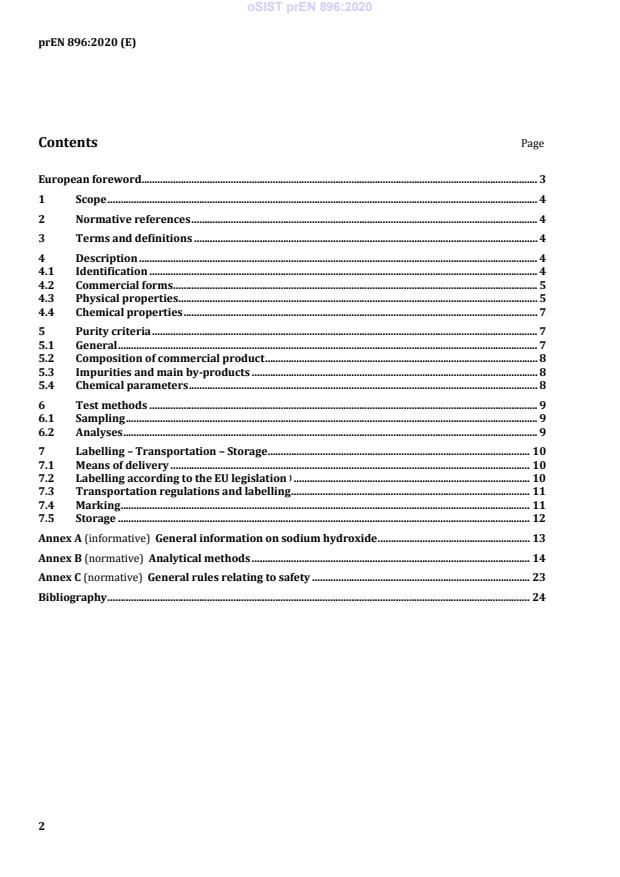
Contents Page
European foreword . 3
1 Scope . 4
2 Normative references . 4
3 Terms and definitions . 4
4 Description . 4
4.1 Identification . 4
4.2 Commercial forms . 5
4.3 Physical properties . 5
4.4 Chemical properties . 7
5 Purity criteria . 7
5.1 General . 7
5.2 Composition of commercial product . 8
5.3 Impurities and main by-products . 8
5.4 Chemical parameters . 8
6 Test methods . 9
6.1 Sampling . 9
6.2 Analyses . 9
7 Labelling – Transportation – Storage . 10
7.1 Means of delivery . 10
)
7.2 Labelling according to the EU legislation . 10
7.3 Transportation regulations and labelling . 11
7.4 Marking . 11
7.5 Storage . 12
Annex A (informative) General information on sodium hydroxide . 13
Annex B (normative) Analytical methods . 14
Annex C (normative) General rules relating to safety . 23
Bibliography . 24
European foreword
This document (prEN 896:2020) has been prepared by Technical Committee CEN/TC 164 “Water supply”,
the secretariat of which is held by AFNOR.
This document is currently submitted to the CEN Enquiry.
This document will supersede EN 896:2012.
In comparison with the previous edition, the following technical modifications have been made:
a) Modification of 7.3 on transportation regulations and labelling, adding the sentence “The user must be
aware of the incompatibilities between transported products.”;
b) Modification of 7.4 on marking. The requirements of marking are also applied to the accompanying
documents.
1 Scope
This document is applicable to sodium hydroxide used for treatment of water intended for human
consumption. It describes the characteristics and specifies the requirements and the corresponding test
methods for sodium hydroxide. It gives information on its use in water treatment.
2 Normative references
The following documents are referred to in the text in such a way that some or all of their content constitutes
requirements of this document. For dated references, only the edition cited applies. For undated references,
the latest edition of the referenced document (including any amendments) applies.
EN ISO 3696, Water for analytical laboratory use — Specification and test methods (ISO 3696)
EN ISO 12846:2012, Water quality — Determination of mercury — Method using atomic absorption
spectrometry (AAS) with and without enrichment (ISO 12846:2012)
ISO 979, Sodium hydroxide for industrial use — Method of assay
ISO 3165, Sampling of chemical products for industrial use — Safety in sampling
ISO 3196, Sodium hydroxide for industrial use — Determination of carbonates content — Titrimetric method
ISO 6206, Chemical products for industrial use — Sampling — Vocabulary
ISO 8213, Chemical products for industrial use — Sampling techniques — Solid chemical products in the form
of particles varying from powders to coarse lumps
3 Terms and definitions
No terms and definitions are listed in this document.
ISO and IEC maintain terminological databases for use in standardization at the following addresses:
— ISO Online browsing platform: available at https://www.iso.org/obp
— IEC Electropedia: available at https://www.electropedia.org/
4 Description
4.1 Identification
4.1.1 Chemical name
Sodium hydroxide.
4.1.2 Synonym or common name
Caustic soda.
4.1.3 Relative molecular mass
40,0.
4.1.4 Empirical formula
NaOH.
4.1.5 Chemical formula
NaOH.
1)
4.1.6 CAS Registry Number
1310-73-2.
2)
4.1.7 EINECS reference
215-185-5.
4.2 Commercial forms
The product is available as flakes, pearls, solid, or as an aqueous solution of different concentrations. For safe
handling and use and emergency procedures of sodium permanganate, refer to Annex C.
4.3 Physical properties
4.3.1 Appearance
Solid: the product is white, deliquescent.
Liquid: the product is a clear solution, slightly turbid colourless solution, slightly viscous.
4.3.2 Density
Solid : the density of this product is 2,1 g/cm .
The bulk density of pearls is 1,2 kg/dm .
Liquid : the density of solution is 1,52 g/ml for a product concentration of mass fraction of 50 % at 20 °C.
4.3.3 Solubility in water
The product is highly soluble at all temperatures above 20 °C (partial crystallization occurs above
concentration of mass fraction of 55 %, (see Figure 1).
1)
Chemical Abstracts Service Registry Number.
2)
European Inventory of Existing Commercial Chemical Substances.
Key
1 temperature in °C
2 NaOH concentration in mass fraction in %
Figure 1 — Solubility of sodium hydroxide
4.3.4 Vapour pressure
Solution of concentration of mass fraction of 50 %
— 120 Pa at 20 °C;
— 450 Pa at 40 °C;
— 5 000 Pa at 80 °C.
3)
4.3.5 Boiling point at 100 kPa
145 °C for a solution of concentration of mass fraction of 50 %.
4.3.6 Crystallization point
+ 12 °C for a solution of concentration of mass fraction of 50 % (see Figure 1).
3)
100 kPa = 1 bar.
4.3.7 Specific heat
3 220 J/(kg K) at 20 °C for a solution of concentration of mass fraction of 50 %.
4.3.8 Viscosity (dynamic)
For a solution of concentration of mass fraction of 50 %:
— 100 Pa.s at 20 °C;
— 25 Pa.s at 40 °C;
— 5 Pa.s at 80 °C.
4.3.9 Critical temperature
Not applicable.
4.3.10 Critical pressure
Not applicable.
4.3.11 Physical hardness
Not applicable.
4.4 Chemical properties
The solutions of sodium hydroxide are strongly alkaline.
Dilution of sodium hydroxide is very exothermic. For additional information on sodium hydroxide see
Annex A.
5 Purity criteria
5.1 General
This document specifies the minimum purity requirements for sodium hydroxide used for the treatment of
water intended for human consumption. Limits are given for impurities commonly present in the product.
Depending on the raw material and the manufacturing process other impurities may be present and, if so,
this shall be notified to the user and when necessary to relevant authorities.
The national regulations allow to users to clarify whether the product is of appropriate purity for the
treatment of water intended for human consumption, taking into account raw water quality, required
dosage, contents of other impurities and additives used in the product and not stated in this product
standard.
Limits have been given for impurities and chemical parameters where these are likely to be present in
significant quantities from the current production process and raw materials. If the production process or
raw materials leads to significant quantities of impurities, by-products or additives being present, this shall
be notified to the user.
5.2 Composition of commercial product
The product shall contain not less than a mass fraction of 96 % of NaOH for the solid form. Typical
concentration for solutions of sodium hydroxide is either a mass fraction of 50 % or 30 % , and shall be in
any case within the manufacturer’s stated tolerance.
5.3 Impurities and main by-products
The product shall conform to the requirements specified in Table 1.
The concentration limits refer to pure NaOH mass fraction of 100 %.
Table 1 — Impurities
Impurity Limit
in mass fraction in
% of NaOH
a max. 2,4
Sodium chloride (NaCl)
b
max. 0,4
Sodium carbonate (Na CO )
2 3
c
max. 0,7
Sodium chlorate (NaClO )
a
Too high concentrations can cause problems with some ion exchange resins.
b
Sodium carbonate is formed in contact with atmospheric carbon dioxide.
c
The presence of any oxidizing agent in sodium hydroxide is to be avoided.
5.4 Chemical parameters
The product shall conform to the requirements specified in Table 2.
Table 2 — Chemical parameters
Parameter Limit in
mg/kg of NaOH
Type 1 Type 2
Arsenic (As) max. 2 10
Cadmium (Cd) max. 1 5
Chromium (Cr) max. 1 10
Mercury (Hg) max. 0,1 1
Nickel (Ni) max. 2 10
Lead (Pb) max. 5 20
Antimony (Sb) max. 5 5
Selenium (Se) max. 5 5
NOTE Cyanides, pesticides and polycyclic aromatic hydrocarbons
are not relevant in sodium hydroxide. For parametric values of
sodium hydroxide on trace metal content in drinking water, see
[1].
6 Test methods
6.1 Sampling
Prepare the laboratory sample(s) required by the relevant procedure described in ISO 8213, observe the
recommendations of ISO 3165 and also take into account ISO 6206. The nature of caustic alkalis requires
special care at all points of sampling and preparation for analysis. Sampling techniques shall be such as to
limit or prevent atmospheric exposure since sodium hydroxides, either as aqueous solutions or as
anhydrous products, rapidly absorb moisture and carbon dioxide (and other acid gases) from the
atmosphere. Additional precautions are necessary if trace constituents are to be determined.
NOTE For sampling liquids see [2].
6.2 Analyses
6.2.1 Main product
6.2.1.1 Total alkalinity
The total alkalinity shall be determined by titration with an acid standard volumetric solution in accordance
with ISO 979.
6.2.1.2 Caustic alkalinity
The caustic alkalinity equals the total alkalinity as NaOH (see 6.2.1.1) minus the alkalinity as Na CO
2 3
multiplied by 0,755 determined in accordance with ISO 3196.
6.2.2 Impurities
6.2.2.1 Sodium chloride
The sodium chloride content shall be determined by potentiometric titration with silver nitrate solution (see
B.1).
6.2.2.2 Sodium carbonate
The sodium carbonate content shall be determined by the titrimetric method, in accordance with ISO 3196.
6.2.2.3 Sodium chlorate
The sodium chlorate content shall be determined by ionic chromatography (see B.2).
6.2.3 Chemical parameters
6.2.3.1 Principle
The elements antimony, arsenic, cadmium, chromium, lead, nickel and selenium are determined by
inductively coupled plasma optical emission spectrometry. Mercury is determined by cold vapour atomic
absorption spectrometry.
6.2.3.2 Arsenic
The arsenic content shall be determined by inductively coupled plasma optical emission spectrometry
(ICP/OES) (see B.3).
6.2.3.3 Cadmium
The cadmium content shall be determined by inductively coupled plasma optical emission spectrometry
(ICP/OES) (see B.3).
6.2.3.4 Chromium
The chromium content shall be determined by inductively coupled plasma optical emission spectrometry
(ICP/OES) (see B.3).
6.2.3.5 Nickel
The nickel content shall be determined by inductively coupled plasma optical emission spectrometry
(ICP/OES) (see B.3).
6.2.3.6 Lead
The lead content shall be determined by inductively coupled plasma optical emission spectrometry
(ICP/OES) (see B.3).
6.2.3.7 Antimony
The antimony content shall be determined by inductively coupled plasma optical emission spectrometry
(ICP/OES) (see B.3).
6.2.3.8 Selenium
The selenium content shall be determined by inductively coupled plasma optical emission spectrometry
(ICP/OES) (see B.3).
6.2.3.9 Mercury
The mercury content shall be determined by cold vapour atomic absorption spectrometry in accordance
with
EN ISO 12846 (see B.4).
7 Labelling – Transportation – Storage
7.1 Means of delivery
Sodium hydroxide can be delivered in rail or road tankers, in containers, in drums or in plastics bags.
In order that the purity of the products is not affected, the means of delivery shall not have been used
previously for any different product or it shall have been specially cleaned and prepared before use.
4)
7.2 Labelling according to the EU legislation
The following labelling requirements (Figure 2) shall apply to sodium hydroxide at the date of the
publication of this standard.
)
See [3]
Hazard label − Signal word:
Danger
− Hazard statement:
H 314: causes severe skin burns and eye damage
Precautionary statements (“P statements”) should be
provided by the company being responsible for the
marketing of the substance. They should be indicated
on the packaging label and in the extended safety data
sheet (eSDS) of the substance.
Figure 2 — GHS 05
The regulation [3], and its amendments for the purposes of its adaptation to technical and scientific
progress, contains a list of substances classified by the EU. Substances not listed in this regulation can be
classified on the basis of their intrinsic properties according to the criteria in the regulation by the person
responsible for the marketing of the substance.
7.3 Transportation regulations and labelling
5)
Sodium hydroxide solid is listed as UN Number : 1823.
Sodium hydroxide solution is listed as UN Number: 1824.
6) 7)
RID /ADR :
— class 8, classification code C6, packing group II for solid;
— class 8, classification code C5, packing group II for solution.
8)
IMDG : Class 8, packing group II.
9)
IATA : Class 8, packing group II.
The user shall be aware of the incompatibilities between transported products.
7.4 Marking
The marki
...