

EN ISO 12402-7:2006
(Main)Personal flotation devices - Part 7: Materials and components - Safety requirements and test methods (ISO 12402-7:2006)
- Abstract
ISO 12402-7:2006 specifies the minimum requirements for construction and performance of materials and components of personal flotation devices as well as relevant test methods.
- Status
- Withdrawn
- Publication Date
- 14-Nov-2006
- Withdrawal Date
- 06-Oct-2026
- Technical Committee
- CEN/TC 162 - Protective clothing including hand and arm protection and lifejackets
- Drafting Committee
- CEN/TC 162/WG 6 - Lifejackets
- Current Stage
- 9960 - Withdrawal effective - Withdrawal
- Start Date
- 14-Oct-2020
- Completion Date
- 07-Oct-2026

Relations
- Effective Date
- 21-Oct-2020
- Effective Date
- 25-Aug-2026
- Effective Date
- 25-Aug-2026
- Effective Date
- 25-Aug-2026
- Effective Date
- 25-Aug-2026
- Effective Date
- 25-Aug-2026
- Effective Date
- 25-Aug-2026
- Effective Date
- 25-Aug-2026
- Effective Date
- 25-Aug-2026
- Effective Date
- 25-Aug-2026
- Effective Date
- 25-Aug-2026
- Effective Date
- 25-Aug-2026
- Effective Date
- 25-Aug-2026
- Refers
ISO 105-E02:1994 - Textiles — Tests for colour fastness — Part E02: Colour fastness to sea water - Effective Date
- 25-Aug-2026
- Effective Date
- 25-Aug-2026
Get Certified
Connect with accredited certification bodies for this standard

CIS Institut d.o.o.
Personal Protective Equipment (PPE) certification body. Notified Body NB-2890 for EU Regulation 2016/425 PPE.

Kiwa BDA Testing
Building and construction product certification.
Kmetijski inštitut Slovenije
Agricultural Institute of Slovenia. Soil testing, plant health, agricultural product analysis.
Sponsored listings
Frequently Asked Questions
EN ISO 12402-7:2006 is a standard published by the European Committee for Standardization (CEN). Its full title is "Personal flotation devices - Part 7: Materials and components - Safety requirements and test methods (ISO 12402-7:2006)". This standard covers: ISO 12402-7:2006 specifies the minimum requirements for construction and performance of materials and components of personal flotation devices as well as relevant test methods.
ISO 12402-7:2006 specifies the minimum requirements for construction and performance of materials and components of personal flotation devices as well as relevant test methods.
EN ISO 12402-7:2006 is classified under the following ICS (International Classification for Standards) categories: 13.340.70 - Lifejackets, buoyancy aids and floating devices. The ICS classification helps identify the subject area and facilitates finding related standards.
EN ISO 12402-7:2006 has the following relationships with other standards: It is inter standard links to EN ISO 12402-7:2020, ISO 13938-1:1999, ISO 80000-9:2009, ISO 13938-2:1999, ISO 139:2005, ISO 80000-2:2009, ISO 80000-10:2009, ISO 4674-1:2003, ISO 13934-1:1999, ISO 13937-2:2000, ISO 80000-5:2007, ISO 7854:1995, ISO 1926:2005, ISO 105-E02:1994, ISO 5470-2:2003. Understanding these relationships helps ensure you are using the most current and applicable version of the standard.
EN ISO 12402-7:2006 is associated with the following European legislation: EU Directives/Regulations: 2016/425, 89/686/EEC, 93/68/EEC, 93/95/EEC, 96/58/EC; Standardization Mandates: M/031. When a standard is cited in the Official Journal of the European Union, products manufactured in conformity with it benefit from a presumption of conformity with the essential requirements of the corresponding EU directive or regulation.
EN ISO 12402-7:2006 is available in PDF format for immediate download after purchase. The document can be added to your cart and obtained through the secure checkout process. Digital delivery ensures instant access to the complete standard document.
Standards Content (Sample)
2003-01.Slovenski inštitut za standardizacijo. Razmnoževanje celote ali delov tega standarda ni dovoljeno.Personal flotation devices - Part 7: Materials and components - Safety requirements and test methods (ISO 12402-7:2006)Équipements individuels de flottabilité - Partie 7: Matériaux et composants - Exigences de sécurité et méthodes d'essai (ISO 12402-7:2006)Persönliche Auftriebsmittel - Teil 7: Werkstoffe und Bestandteile - Sicherheitstechnische Anforderungen und Prüfverfahren (ISO 12402-7:2006)Ta slovenski standard je istoveten z:EN ISO 12402-7:2006SIST EN ISO 12402-7:2007en13.340.70SULSRPRþNLLifejackets, buoyancy aids and floating devicesICS:SLOVENSKI
STANDARDSIST EN ISO 12402-7:200701-marec-2007
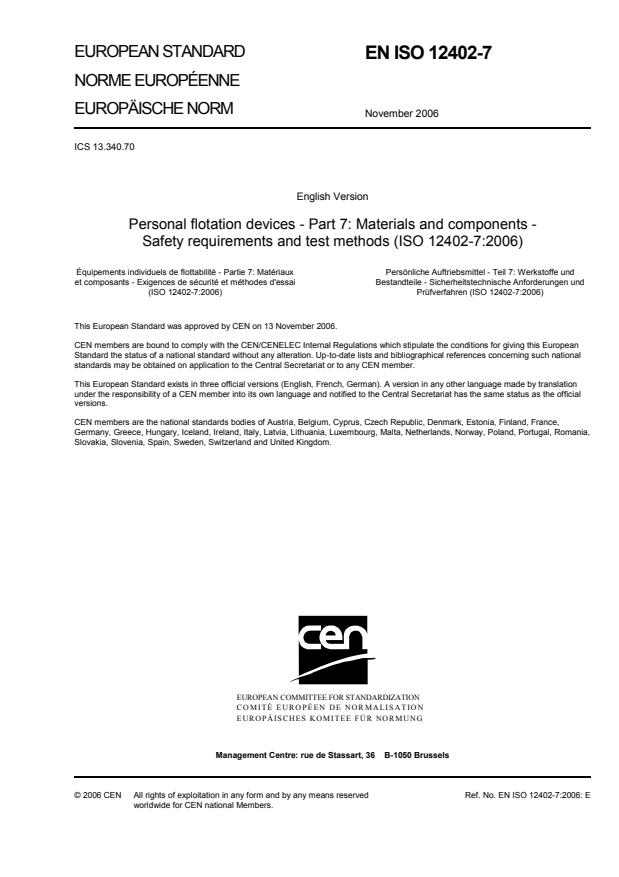
EUROPEAN STANDARD NORME EUROPÉENNE EUROPÄISCHE NORM
EN ISO 12402-7
November 2006 ICS 13.340.70 English Version
Personal flotation devices - Part 7: Materials and components - Safety requirements and test methods (ISO 12402-7:2006)
Équipements individuels de flottabilité - Partie 7: Matériaux et composants - Exigences de sécurité et méthodes d'essai (ISO 12402-7:2006)
Persönliche Auftriebsmittel - Teil 7: Werkstoffe und Bestandteile - Sicherheitstechnische Anforderungen und Prüfverfahren (ISO 12402-7:2006) This European Standard was approved by CEN on 13 November 2006.
CEN members are bound to comply with the CEN/CENELEC Internal Regulations which stipulate the conditions for giving this European Standard the status of a national standard without any alteration. Up-to-date lists and bibliographical references concerning such national standards may be obtained on application to the Central Secretariat or to any CEN member.
This European Standard exists in three official versions (English, French, German). A version in any other language made by translation under the responsibility of a CEN member into its own language and notified to the Central Secretariat has the same status as the official versions.
CEN members are the national standards bodies of Austria, Belgium, Cyprus, Czech Republic, Denmark, Estonia, Finland, France, Germany, Greece, Hungary, Iceland, Ireland, Italy, Latvia, Lithuania, Luxembourg, Malta, Netherlands, Norway, Poland, Portugal, Romania, Slovakia, Slovenia, Spain, Sweden, Switzerland and United Kingdom.
EUROPEAN COMMITTEE FOR STANDARDIZATION
COMITÉ EUROPÉEN DE NORMALISATION EUROPÄISCHES KOMITEE FÜR NORMUNG
Management Centre: rue de Stassart, 36
B-1050 Brussels © 2006 CEN All rights of exploitation in any form and by any means reserved worldwide for CEN national Members. Ref. No. EN ISO 12402-7:2006: E
Foreword
This document (EN ISO 12402-7:2006) has been prepared by Technical Committee CEN/TC 162 "Protective clothing including hand and arm protection and lifejackets", the secretariat of which is held by DIN, in collaboration with Technical Committee ISO/TC 188 "Small craft".
This European Standard shall be given the status of a national standard, either by publication of an identical text or by endorsement, at the latest by May 2007, and conflicting national standards shall be withdrawn at the latest by May 2007.
According to the CEN/CENELEC Internal Regulations, the national standards organizations of the following countries are bound to implement this European Standard: Austria, Belgium, Cyprus, Czech Republic, Denmark, Estonia, Finland, France, Germany, Greece, Hungary, Iceland, Ireland, Italy, Latvia, Lithuania, Luxembourg, Malta, Netherlands, Norway, Poland, Portugal, Romania, Slovakia, Slovenia, Spain, Sweden, Switzerland and United Kingdom.
Reference numberISO 12402-7:2006(E)© ISO 2006
INTERNATIONAL STANDARD ISO12402-7First edition2006-11-15Personal flotation devices — Part 7: Materials and components — Safety requirements and test methods Équipements individuels de flottabilité — Partie 7: Matériaux et composants — Exigences de sécurité et méthodes d'essai
ISO 12402-7:2006(E) PDF disclaimer This PDF file may contain embedded typefaces. In accordance with Adobe's licensing policy, this file may be printed or viewed but shall not be edited unless the typefaces which are embedded are licensed to and installed on the computer performing the editing. In downloading this file, parties accept therein the responsibility of not infringing Adobe's licensing policy. The ISO Central Secretariat accepts no liability in this area. Adobe is a trademark of Adobe Systems Incorporated. Details of the software products used to create this PDF file can be found in the General Info relative to the file; the PDF-creation parameters were optimized for printing. Every care has been taken to ensure that the file is suitable for use by ISO member bodies. In the unlikely event that a problem relating to it is found, please inform the Central Secretariat at the address given below.
©
ISO 2006 All rights reserved. Unless otherwise specified, no part of this publication may be reproduced or utilized in any form or by any means, electronic or mechanical, including photocopying and microfilm, without permission in writing from either ISO at the address below or ISO's member body in the country of the requester. ISO copyright office Case postale 56 • CH-1211 Geneva 20 Tel.
+ 41 22 749 01 11 Fax
+ 41 22 749 09 47 E-mail
copyright@iso.org Web
www.iso.org Published in Switzerland
ii © ISO 2006 – All rights reserved
ISO 12402-7:2006(E) © ISO 2006 – All rights reserved iiiContents Page Foreword.iv Introduction.v 1 Scope.1 2 Normative references.1 3 Terms and definitions.3 4 Materials and components.5 4.1 General.5 4.2 Sewing thread.7 4.3 Fabric.8 4.4 Structural webbing and tie tape.13 4.5 Structural lacing.15 4.6 Structural zippers.15 4.7 Hardware.18 4.8 Foam flotation material.24 4.9 Inflation chamber materials.32 4.10 Polymeric foam coatings.36 4.11 Inflation systems for hybrid and fully inflatable PFDs.41 4.12 Gas-filled cylinders.57 Annex A (informative)
Mildew resistance of materials: Soil burial method.73 Annex B (informative)
Abrasion resistance of cloth: Oscillatory method (Wyzenbeek method).75 Annex C (informative)
Example of a design drawing.78 Bibliography.79
ISO 12402-7:2006(E) iv © ISO 2006 – All rights reserved Foreword ISO (the International Organization for Standardization) is a worldwide federation of national standards bodies (ISO member bodies). The work of preparing International Standards is normally carried out through ISO technical committees. Each member body interested in a subject for which a technical committee has been established has the right to be represented on that committee. International organizations, governmental and non-governmental, in liaison with ISO, also take part in the work. ISO collaborates closely with the International Electrotechnical Commission (IEC) on all matters of electrotechnical standardization. International Standards are drafted in accordance with the rules given in the ISO/IEC Directives, Part 2. The main task of technical committees is to prepare International Standards. Draft International Standards adopted by the technical committees are circulated to the member bodies for voting. Publication as an International Standard requires approval by at least 75 % of the member bodies casting a vote. Attention is drawn to the possibility that some of the elements of this document may be the subject of patent rights. ISO shall not be held responsible for identifying any or all such patent rights. ISO 12402-7 was prepared by the European Committee for Standardization (CEN) Technical Committee CEN/TC 162, Protective clothing including hand and arm protection and lifejackets, in collaboration with Technical Committee ISO/TC 188, Small craft, in accordance with the Agreement on technical cooperation between ISO and CEN (Vienna Agreement). ISO 12402 consists of the following parts, under the general title Personal flotation devices: ⎯ Part 1: Lifejackets for seagoing ships — Safety requirements ⎯ Part 2: Lifejackets, performance level 275 — Safety requirements ⎯ Part 3: Lifejackets, performance level 150 — Safety requirements ⎯ Part 4: Lifejackets, performance level 100 — Safety requirements ⎯ Part 5: Buoyancy aids (level 50) — Safety requirements ⎯ Part 6: Special purpose lifejackets and buoyancy aids — Safety requirements and additional test methods ⎯ Part 7: Materials and components — Safety requirements and test methods ⎯ Part 8: Accessories — Safety requirements and test methods ⎯ Part 9: Test methods ⎯ Part 10: Selection and application of personal flotation devices and other relevant devices
ISO 12402-7:2006(E) © ISO 2006 – All rights reserved vIntroduction ISO 12402 has been prepared to give guidance on the design and application of personal flotation devices (hereafter referred to as PFDs) for persons engaged in activities, whether in relation to their work or their leisure, in or near water. PFDs manufactured, selected, and maintained to this standard should give a reasonable assurance of safety from drowning to a person who is immersed in water. Requirements for lifejackets on large, commercial seagoing ships are regulated by the International Maritime Organization (IMO) under the International Convention for the Safety of Life at Sea (SOLAS). ISO 12402-1 addresses lifejackets for seagoing ships. ISO 12402 allows for the buoyancy of a PFD to be provided by a wide variety of materials or designs, some of which may require preparation before entering the water (e.g. inflation of chambers by gas from a cylinder or blown in orally). However, PFDs can be divided into the following two main classes: ⎯ those which provide face up in-water support to the user regardless of physical conditions (lifejackets), and ⎯ those which require the user to make swimming and other postural movements to position the user with the face out of the water (buoyancy aids). Within these main two classes there are a number of levels of support, types of buoyancy, activation methods for inflatable devices, and auxiliary items (such as location aids), all of which will affect the user’s probability of survival. Within the different types of buoyancy allowed, inflatable PFDs either provide full buoyancy without any user intervention other than arming (i.e. PFDs inflated by a fully automatic method) or require the user to initiate the inflation. Hybrid PFDs always provide some buoyancy but rely on the same methods as inflatable PFDs to achieve full buoyancy. With inherently buoyant PFDs, the user only needs to put the PFD on to achieve the performance of its class. PFDs that do not require intervention (automatically operating PFDs) are suited to activities where persons are likely to enter the water unexpectedly; whereas PFDs requiring intervention (e.g. manually inflated PFDs) are only suitable for use if the user believes there will be sufficient time to produce full buoyancy, or help is close at hand. In every circumstance, the user should ensure that the operation of the PFD is suited to the specific application. The conformity of a PFD to this part of ISO 12402 does not imply that it is suitable for all circumstances. The relative amount of required inspection and maintenance is another factor of paramount importance in the choice and application of specific PFDs. ISO 12402 is intended to serve as a guide to manufacturers, purchasers, and users of such safety equipment in ensuring that the equipment provides an effective standard of performance in use. Equally essential is the need for the designer to encourage the wearing of the equipment by making it comfortable and attractive for continuous wear on or near water, rather than for it to be stored in a locker for emergency use. Throwable devices and flotation cushions are not covered by this part of ISO 12402. The primary function of a PFD is to support the user in reasonable safety in the water. Within the two classes, alternative attributes make some PFDs better suited to some circumstances than others or make them easier to use and care for than others. Important alternatives allowed by ISO 12402 are the following: ⎯ to provide higher levels of support (levels 100, 150, or 275) that generally float the user with greater water clearance, enabling the user’s efforts to be expended in recovery rather than avoiding waves; or to provide lighter or less bulky PFDs (levels 50 to 100); ⎯ to provide the kinds of flotation (inherently buoyant foam, hybrid, and inflatable) that will accommodate the sometimes conflicting needs of reliability and durability, in-water performance, and continuous wear;
ISO 12402-7:2006(E) vi © ISO 2006 – All rights reserved ⎯ to provide automatically operating (inherently buoyant or automatically inflated) PFDs that float users without any intervention on their part, except in initially donning the PFD (and regular inspection and rearming of inflatable types), or to provide user control of the inflatable PFD’s buoyancy by manual and oral operation; and ⎯ to assist in detection (location aids) and recovery of the user. PFDs provide various degrees of buoyancy in garments that are light in weight and only as bulky and restrictive as needed for their intended use. They will need to be secure when worn, in order to provide positive support in the water and to allow the user to swim or actively assist herself/himself or others. The PFD selected shall ensure that the user is supported with the mouth and nose clear of the water under the expected conditions of use and the user’s ability to assist. Under certain conditions (such as rough water and waves), the use of watertight and multilayer clothing, which provide (intentionally or otherwise) additional buoyancy, or the use of equipment with additional weight (such as tool belts) will likely alter the performance of the PFD. Users, owners and employers need to ensure that this is taken into account when selecting a PFD. Similarly, PFDs may not perform as well in extremes of temperature, although fully approved under this part of ISO 12402. PFDs may also be affected by other conditions of use, such as chemical exposure and welding, and may require additional protection to meet the specific requirements of use. If the user intends taking a PFD into such conditions, she/he has to be assured that the PFD will not be adversely affected. This part of ISO 12402 also allows a PFD to be an integral part of a safety harness designed to conform to ISO 12401, or an integral part of a garment with other uses, for example to provide thermal protection during immersion, in which case the complete assembly as used is required to conform to this part of ISO 12402. In compiling the attributes required of a PFD, consideration has also been given to the potential length of service that the user might expect. Whilst a PFD needs to be of substantial construction and material, its potential length of service often depends on the conditions of use and storage, which are the responsibility of the owner, user and/or employer. Furthermore, whilst the performance tests included are believed to assess relevant aspects of performance in real-life use, they do not accurately simulate all conditions of this. For example, the fact that a device passes the self-righting tests in swimming attire, as described herein, does not guarantee that it will self-right an unconscious user wearing waterproof clothing; neither can it be expected to completely protect the airway of an unconscious person in rough water. Waterproof clothing can trap air and further impede the self-righting action of a lifejacket. It is essential that owners, users and employers choose those PFDs that meet the correct standards for the circumstances in which they will be used. Manufacturers and those selling PFDs have to make clear to prospective purchasers the product properties, alternative choices and the limitations to normal use, prior to the purchase. Similarly, those framing legislation regarding the use of these garments should consider carefully which class and performance levels are most appropriate for the foreseeable conditions of use, allowing for the higher risk circumstances. These higher risk circumstances should account for the highest probabilities of occurrence of accidental immersion and the expected consequences in such emergencies. More information on the selection and application is given in ISO 12402-10.
INTERNATIONAL STANDARD ISO 12402-7:2006(E) © ISO 2006 – All rights reserved 1Personal flotation devices — Part 7: Materials and components — Safety requirements and test methods 1 Scope This part of ISO 12402 specifies the minimum requirements for construction and performance of materials and components of personal flotation devices as well as relevant test methods. 2 Normative references The following referenced documents are indispensable for the application of this document. For dated references, only the edition cited applies. For undated references, the latest edition of the referenced document (including any amendments) applies. ISO 31 (all parts), Quantities and units ISO 105-A02, Textiles — Tests for colour fastness — Part A02: Grey scale for assessing change in colour ISO 105-B02:1994, Textiles — Tests for colour fastness — Part B02: Colour fastness to artificial light: Xenon arc fading lamp test ISO 105-E02, Textiles — Tests for colour fastness — Part E02: Colour fastness to sea water ISO 105-X12, Textiles — Tests for colour fastness — Part X12: Colour fastness to rubbing ISO 139, Textiles — Standard atmospheres for conditioning and testing ISO 188, Rubber, vulcanized or thermoplastic — Accelerated ageing and heat resistance tests ISO 1302, Geometrical Product Specifications (GPS) — Indication of surface texture in technical product documentation ISO 1421:1998, Rubber- or plastics-coated fabrics — Determination of tensile strength and elongation at break ISO 1926, Rigid cellular plastics — Determination of tensile properties ISO 2062, Textiles — Yarns from packages — Determination or single-end breaking force and elongation at break ISO 2411:2000, Rubber- or plastics-coated fabrics — Determination of coating adhesion ISO 3696:1987, Water for analytical laboratory use — Specification and test methods ISO 4674-1:2003, Rubber- or plastics-coated fabrics — Determination of tear resistance — Part 1: Constant rate of tear methods
ISO 12402-7:2006(E) 2 © ISO 2006 – All rights reserved ISO 4892-1, Plastics — Methods of exposure to laboratory light sources — Part 1: General guidance ISO 4892-2, Plastics — Methods of exposure to laboratory light sources — Part 2: Xenon-arc lamps ISO 5470-2:2003, Rubber- or plastics-coated fabrics — Determination of abrasion resistance — Part 2: Martindale abrader ISO 6330, Textiles — Domestic washing and drying procedures for textile testing ISO 7229, Rubber- or plastics-coated fabrics — Measurement of gas permeability ISO 7854:1995, Rubber- or plastics-coated fabrics — Determination of resistance to damage by flexing ISO 9073-4, Textiles — Test methods for nonwovens — Part 4: Determination of tear resistance ISO 9227, Corrosion tests in artificial atmospheres — Salt spray tests ISO 12402-1, Personal flotation devices — Part 1: Lifejackets for seagoing ships — Safety requirements ISO 12402-2, Personal flotation devices — Part 2: Lifejackets, performance level 275 — Safety requirements ISO 12402-3, Personal flotation devices — Part 3: Lifejackets, performance level 150 — Safety requirements ISO 12402-4, Personal flotation devices — Part 4: Lifejackets, performance level 100 — Safety requirements ISO 12402-5, Personal flotation devices — Part 5: Buoyancy aids (level 50) — Safety requirements ISO 12402-6, Personal flotation devices — Part 6: Special purpose lifejackets and buoyancy aids — Safety requirements and additional test methods ISO 12947-2, Textiles — Determination of the abrasion resistance of fabrics by the Martindale method — Part 2: Determination of specimen breakdown ISO 13934-1, Textiles — Tensile properties of fabrics — Part 1: Determination of maximum force and elongation at maximum force using the strip method ISO 13934-2, Textiles — Tensile properties of fabrics — Part 2: Determination of maximum force using the grab method ISO 13937-2, Textiles — Tear properties of fabrics — Part 2: Determination of tear force of trouser-shaped test specimens (Single tear method) ISO 13938-1, Textiles — Bursting properties of fabrics — Part 1: Hydraulic method for determination of bursting strength and bursting distension ISO 13938-2, Textiles — Bursting properties of fabrics — Part 2: Pneumatic method for determination of bursting strength and bursting distension EN 590, Automotive fuels — Diesel — Requirements and test methods EN 10088-1, Stainless steels — Part 1: List of stainless steels CIE publication No. 15.2, Colorimetry ASTM D 412-98, Standard Test Methods for Vulcanized Rubber and Thermoplastic Elastomers —Tension ASTM D 471-98, Standard Test Method for Rubber Property-Effect of Liquids ASTM D 882-02, Standard Test Method for Tensile Properties of Thin Plastic Sheeting
ISO 12402-7:2006(E) © ISO 2006 – All rights reserved 3ASTM D 1683, Standard Test Method for Failure in Sewn Seams of Woven Apparel Fabrics ASTM D 2061, Standard Test Methods for Strength Tests for Zippers ASTM D 2062, Standard Test Methods for Operability of Zippers ASTM D 5034-95, Standard Test Method for Breaking Strength and Elongation of Textile Fabrics (Grab Test) FTMS 191A, Federal Test Method Standard 3 Terms and definitions For the purposes of this document, the terms and definitions given in ISO 12402-1 to ISO 12402-5 and the following apply. 3.1 coated fabric flexible material composed of a textile fabric and an adherent polymeric material 3.2 course series of successive loops lying crosswise in knitted fabrics, that is, lying at right angles to a line passing through the open throat to the closed end of the loops 3.3 cylinder seal indicator visual display on an inflation system which provides information regarding the status of the seal on an installed cylinder 3.4 design inflation range range of buoyancy and pressure, as specified by the manufacturer, to which a chamber is capable of being inflated to provide the intended in-water performance 3.5 weft yarn running from selvage to selvage at right angles to the warp in woven fabrics NOTE For knitted fabric, see 3.21. 3.6 filling density mass of the gas charge for gas-filled cylinders or other inflation-medium containers, in kilograms, divided by the volume of the inflation-medium container, in litres 3.7 foam flotation material closed-cell (cells not interconnecting) foamed polymeric material 3.8 full inflation chamber or chambers inflated to any value within the design inflation range 3.9 inflation system means of inflating one or more chambers to make the PFD buoyant or more buoyant on demand, either actively or passively with respect to the user’s action
ISO 12402-7:2006(E) 4 © ISO 2006 – All rights reserved 3.10 initial jaw separation distance between the bottom of the top clamp and the top of the bottom clamp of a tensile test machine prior to testing 3.11 laminated fabric layered fabric structure wherein a fabric is combined with a continuous sheet material, either by heat or by an adhesive, in such a way that the identity of the continuous sheet material is retained 3.12 lot number marking assigned to each group of materials or component produced which incorporates a means of identifying the year and quarter of manufacture (unless provided elsewhere), and provides a means of identifying the production of a particular factory when a manufacturer produces at more than one factory 3.13 multi-eyelet guide polymeric part designed to be sewn into a PFD and having a series of holes to insert lacing for adjustment of the fit of a PFD 3.14 multi-point status indicator status indicator which utilizes two or more independent visual display points to communicate inflation system readiness 3.15 polymeric foam coating coating applied to flotation foam in place of a fabric covering to protect and strengthen the finished PFD 3.16 selvage uncut edge portion of a fabric 3.17 serviceability ease with which the inflation system mechanism is properly rearmed 3.18 serviceable capable of continued use, i.e. exhibits no signs of functional deterioration, broken or deformed hardware, non-functional indicators, blocked or detached oral inflation tube, or detached manual inflator trigger 3.19 single-point status indicator status indicator which combines all system checks into a single visual display point to communicate inflation system readiness 3.20 status indicator part or parts of an inflation system which provide user feedback to assist in keeping an inflatable PFD in an armed and ready condition 3.21 wale column of loops in successive courses in knitted fabrics, which is parallel to the loop axes
ISO 12402-7:2006(E) © ISO 2006 – All rights reserved 53.22 warp yarn running lengthwise, parallel to the selvage, in a woven fabric NOTE For knitted fabrics, see 3.2. 3.23 warp test test which consists of breaking or tearing the warp yarns or course loops NOTE In the breaking load and seam slippage tests, warp is the long dimension of the sample; in the tearing strength test, warp is the short dimension of the sample. 4 Materials and components 4.1 General 4.1.1 Principles All structural materials and components of personal flotation devices shall meet the requirements specified in this part of ISO 12402. It is recommended that ⎯ all test procedures described hereafter will be performed only by third-party test houses which comply with the requirements of ISO/IEC 17025; ⎯ the tests will be performed by experienced test houses familiar with the products specified by ISO 12402 where assessment is subjective. Those tests involving human test subjects shall be witnessed by a test panel of at least three experts familiar with testing and the products specified in ISO 12402. 4.1.2 Sampling Two samples (one from each end of the range) of materials and components common to a range of products may be presented and the results used to cover the full range of products. 4.1.3 Pass or fail criteria All required samples shall pass all objective tests for the component or material to meet the requirements of this part of ISO 12402. For any test identified as subjective or which uses human test subjects, because of the high variability between subjects and the difficulty in assessing some subjective measures, a component may be accepted on the basis of the following additional testing. If a component does not completely meet the requirements of a test for a particular measurement or does so but with only one test subject, another two samples or subjects (within similar physical characteristics, if applicable) shall be subjected to the same test and before the same test personnel. Such subjective tests shall be witnessed by a test panel of at least two experts familiar with testing the products specified in the series of ISO 12402 and repeated with three experts if there is any question about the performance observed. If this additional test is still not clearly passed in accordance with this part of ISO 12402, then the component or material shall be deemed to have failed. The test panel should deem that the component or material has passed the test only if it has now fulfilled the test requirements completely. 4.1.4 Units of measurement Units of measurement shall be in accordance with ISO 31.
ISO 12402-7:2006(E) 6 © ISO 2006 – All rights reserved 4.1.5 Material 4.1.5.1 Non-metallic components and fabrics Non-metallic components and fabrics shall not be damaged by storage at temperatures of −30 °C to +65 °C. 4.1.5.2 Corrosion of metal components When tested in accordance with ISO 9227 for a period of 160 h, metal components shall not be significantly affected by corrosion. This shall be tested according to the relevant clauses of this part of ISO 12402. 4.1.5.3 Magnetic properties No metallic component shall affect a magnetic compass of a type commonly used in small boats by more than 1° when placed 500 mm from the compass. 4.1.5.4 Innocuousness The foam flotation material shall not contain CFC or HCFC. 4.1.6 Sample conditioning 4.1.6.1 General Materials and components common to a range of products may be presented as one sample of each item. Prior to testing, materials and components shall be conditioned. 4.1.6.2 Standard conditioning a) Except for textile products (i.e., fabric, webbing, thread, tie tape), the applicable number of samples specified in each section shall be conditioned at (23 ± 2) °C and (50 ± 5) % relative humidity for not less than 24 h prior to the tests.
b) For textile products, the samples shall be conditioned according to ISO 139 for not less than 24 h. c) If it is spelled out that the sample is to be tested under “wet conditions”, the sample shall be soaked for 60,20+ h in fresh water, or as specified by the test procedure itself. 4.1.6.3 Temperature cycling Where required by the test method, the component or sample of fabric shall be conditioned, in its normal storage state, and then immediately exposed for (24,0 ± 0,5) h at a temperature of (−30 ± 2) °C, then for (24,0 ± 0,5) h at a temperature of (65 ± 2)°C. Any damage shall be assessed by visual examination and be reported. The component or sample shall undergo ten cycles. 4.1.6.4 Accelerated weathering Laboratory exposure of components and fabrics for PFDs to conditions representative of elements found in a severe outdoor environment including light and water shall be conducted by exposing samples in a xenon weathering machine in accordance with ISO 4892-1 and ISO 4892-2 as further defined by the following specifications. ⎯ Exposure: 500 kJ/(m2 × nm) at 340 nm of UV radiation.
ISO 12402-7:2006(E) © ISO 2006 – All rights reserved 7⎯ Sample mounting: mount samples with the face side (the side normally exposed to sunlight in service) toward the light so that the centre of each sample is in the same plane as the perpendicular to the centreline of the light source. ⎯ Irradiance: 0,55 W/m2 at 340 nm. ⎯ Filters: daylight filters. ⎯ Black panel temperature: (63 ± 2) °C. ⎯ Dry bulb temperature: (42 ± 2) °C. ⎯ Relative humidity: 50 % (during light-only cycle). ⎯ Water temperature: (20 ± 5) °C. ⎯ Test cycles: 102 min of light/18 min of light and continuous water spray/24 min dark and water spray. 4.2 Sewing thread 4.2.1 Construction Sewing thread shall not contain natural fibres or be monofilament. 4.2.2 Performance Sewing thread shall comply with the requirements specified in Table 1. 4.2.3 Loop breaking strength For the loop breaking strength test, the test machine described in ISO 2062 shall be used. Secure both ends of one piece in one clamp of the testing machine so that the length of the loop equals half the total length between the jaws. Pass one end of the second piece through the loop formed by the first, and secure both ends of the second piece in the other clamp of the machine. Separate the clamps at a rate of (300 ± 10) mm/min. Table 1 — Sewing thread Property Exposure Test method Number of samples Sample size a mm Compliance criteria Single strand breaking 1 Standard conditioning 2 Accelerated weathering according to 4.1.6.4 ISO 2062 5 for each colour for each exposure1 000 ± 10 For exposure 1, the average breaking strength of five samples shall be at least 25 N. For exposure 2, the average breaking strength of five samples shall retain at least 60 % of the strength determined following standard conditioning. In addition, the average breaking strength of five samples shall be at least 23 N. Loop breaking strength Standard conditioning a See 4.2.3 5 (each consisting of two pieces) 500 min. Average breaking strength of five samples shall be at least 44 N. a Applies to each colour.
ISO 12402-7:2006(E) 8 © ISO 2006 – All rights reserved 4.3 Fabric 4.3.1 General Only fabrics which are structural to maintain the performance of the product under test shall be tested. Decorative and other fabrics shall not be tested. 4.3.2 Performance 4.3.2.1 Fabric used as drainage material shall comply with all of the applicable fabric requirements. Following weathering according to 4.1.6, the tensile strength shall be measured using the grab method given in ISO 13934-2. 4.3.2.2 Textile woven fabrics shall have an as received tensile strength of at least 400 N, measured using the grab method given in ISO 13934-2. 4.3.2.3 Textile knitted fabrics shall have an as received tensile strength of at least 400 N, measured using the grab method given in ISO 13934-2. 4.3.2.4 Fabrics used in the construction of covers of buoyant compartments, the retention system, and any other component the failure of which would render the PFD non-conformant with this part of ISO 12402, shall comply with the following requirements. a) Tensile strength for woven fabrics shall be tested according to ISO 13934-2 using the grab method, following conditioning according to 4.1.6, and shall have the strength given in Table 2, b) Tear resistance of woven fabrics shall be tested according to ISO 13937-2, [tensile speed (100 ± 10) mm/min, with a pretension of 2 N for materials of up to 200 g/m2, 5 N for materials of over 200 g/m2 and up to 500 g/m2, and 10 N for materials of over 500 g/m2], and shall be not less than 35 N. 4.3.2.5 Fabric shall comply with the acceptance criteria specified in Table 2 when subjected to the tests therein. Separate samples shall be used for each different conditioning exposure.
ISO 12402-7:2006(E) © ISO 2006 – All rights reserved 9Table 2 — Fabric Property Exposure Test method Number of samples Sample size a (mm) Compliance criteria Tensile strength (woven
fabrics only) 1
Standard conditioning
Accelerated weathering according to 4.1.6.4
70 h immersion in:
3.1
fuel B according to ASTM
D 471-98 or diesel fuel according to EN 590
3.2
IRM 902 oil according to ASTM D 471-98
3.3
0,5 %
detergent according to ISO 6330 ISO 13934-2 5 warp and 5 weft for each separate exposure As specified by test method Following each separate exposure in 1 and 2, the average of five samples shall be at least 400 N for each direction. Following exposures 2 and 3, the average of five samples shall retain at least 60 % of the strength determined following standard conditioning. Following exposure 2, the average of five samples shall be at least 290 N. Burst
(knitted
fabrics only) 1
Standard conditioning
Accelerated weathering according to 4.1.6.4
70 h immersion in:
3.1
fuel B according to ASTM
D 471-98 or diesel fuel according to EN 590
3.2
IRM 902 oil according to ASTM D 471-98
3.3
0,5 %
detergent according to ISO 6330 ISO 13938-1 orISO 13938-2 10 for each separate exposure 130 × 130 Following each separate exposure in 1 and 2, the average of 10 samples shall be at least 800 kPa. Following exposure 3, the average of 10 samples shall retain at least 60 % of the strength determined following standard conditioning.
ISO 12402-7:2006(E) 10 © ISO 2006 – All rights reserved Table 2 (continued) Property Exposure Test method Number of samples Sample size a (mm) Compliance criteria Elongation at break (woven fabrics only) Standard conditioning ISO 13934-1 5 warp and 5 weft for each separate exposure As
specified by test method Following standard conditioning, the average of five samples shall not exceed 60 % increase of elongation at break. Tearing strength (woven fabrics only) Standard conditioning ISO 13937-2 5 warp
5 weft 50 × 200 The average of five samples shall be at least 35 N for each direction. Yarn slippage (woven fabrics only) Standard conditioning See 4.3.2.6 5 warp 5 weft 100 × 150 The average of five samples shall be at least 220 N. Openness of weave b
Standard conditioning See 4.3.2.7
The openness of weave shall not exceed 20 %. Adhesion strength c Standard conditioning ISO 2411 2 warp and 2 weft or 5 warp and 5 weft 50 × 200 or 75 × 200 The coating adhesion shall be at least 7 N/cm. a Applies to each colour. b Applies only to coated fabric with a coating of 185 g/m2 or more and where the base fabric or scrim does not comply with the applicable strength requirements when fabric is uncoated. c Applies to external cover fabrics only; does not apply to gusset, lining, or drainage fabric. 4.3.2.6 Yarn slippage (woven fabrics only) The warp samples specified in Table 2 shall be cut with the long dimension parallel to the warp yarns and weft samples shall be cut with the long dimension parallel to the weft yarns. No two warp samples shall contain the same warp yarns and no two weft samples shall contain the same weft yarns. No sample shall include selvage. The narrow end of the sample shall be inserted approximately 5 mm into the nine-hole chuck illustrated in Figure 1 and centred. A nine-needle bit shall be aligned with the holes in the chuck so that the smooth side of the needles faces the 5 mm edge of the sample. The needles shall be forced through the fabric past the scarf joint so that the fabric lays against the blade of the needles. The tensile machine shall be a constant-rate-of-traverse (CRT) or constant-rate-of-extension (CRE) machine. The tensile machine shall be equipped with clamps having front jaws 25 mm × 25 mm and back jaws 25 mm × 38 mm or more wide. The nine-hole chuck shall be centred and clamped in the upper jaws of the machine so the sample hangs lengthwise. The holes in the chuck shall be perpendicular to the direction of pull. The fabric shall be clamped to the lower jaws of the machine. Separation between the holes in the chuck and the top of the jaws shall be 65 mm. The yarns shall be parallel to the direction of pull. The jaws shall then be separated at a rate of (300 ± 10) mm/min. The maximum force required to cause rupture shall be recorded.
ISO 12402-7:2006(E) © ISO 2006 – All rights reserved 11Dimensions in millimetres
Key 1 Singer® 1) thin ball-point needles (size 18). The needles used have a conventional cylindrical profile (not U-bladed) and standard scarf. The grooves of the needles all face in the same direction, perpendicular to the plane formed by the nine needles 2 nine-hole spacer Figure 1 — Nine-needle apparatus 4.3.2.7 Openness of weave The openness of weave, see Table 2, shall be determined using a full width sample at least 1 000 mm long. Five separate measurements shall be taken across the width of the roll. For each measurement, a 650 mm2 area shall be marked on the fabric. No measurement shall be within 25 mm of the selvage edge. In the area of the marked fabric material, the size of each opening shall be measured using an optical comparator with a magnification of 5 ×. Openings on the edge of a 650 mm2 area shall be counted as one whole opening only if more than 50 % of the opening is inside the marked square.
1) This information is given for the convenience of users of this part of ISO 12402 and does not constitute an endorsement by ISO of the product named. Equivalent products may be used if they can be shown to lead to the same results.
ISO 12402-7:2006(E) 12 © ISO 2006 – All rights reserved The openness of the weave shall be calculated as follows: 100Snθ×= (1) where
is the openness of weave; S is the total surface area of openings (mm2); n is the number of 650 mm2 areas. 4.3.3 Colour 4.3.3.1 The colour of the exposed portions (excluding components such as webbing, zips and other fittings) of a lifejacket when deployed in normal floating position shall be in the colour range from yellow to red; the chromaticity for non-fluorescent colours shall lie within one of the areas defined in Table 3 and the luminance factor shall exceed the corresponding minimum in Table 3. The chromaticity coordinates and the minimum luminance factor for fluorescent colours shall comply with Table 4. 4.3.3.2 The colour of the material samples shall be measured after accelerated weathering in accordance with 4.1.6.4 with the procedures defined in CIE publication No. 15.2 with polychromatic illumination D65, 45/0 geometry and 2° standard observer. The specimen shall have a black underlay with reflectance of less than 0,04. The specimens shall be conditioned for at least 24 h at (20 ± 2) °C and (65 ± 5) % relative humidity. If the test is carried out in other conditions, the test shall be conducted within 5 min after withdrawal from the conditioning atmosphere. 4.3.3.3 Xenon light exposure for material samples shall be performed in accordance with ISO 105-B02:1994, method 3. The exposure shall continue until blue scale control standard number 5 has changed to step 3 for red and red–orange materials, and for yellow and yellow–orange the blue scale control standard number 4 has changed to step 4 of the grey scale when determined in accordance with ISO 105-A02. 4.3.3.4 The colour fastness (dry and wet) of lifejacket material when determined in accordance with ISO 105-A02 shall be resistant to rubbing (wet and dry), when tested in accordance with ISO 105-X12 to at least step 4, and to salt water when tested in accordance with ISO 105-E02 to at least step 4. Table 3 — Chromaticity coordinates x and y and luminance factor β for yellow–orange and orange–red non-fluorescent colours of lifejacket material Chromaticity coordinates Minimum luminance factor Colour x y βmin=Yellow–orange 0,387 0,346 0,438 0,525 0,610 0,478 0,400 0,476 0,40 Orange–red 0,610 0,690 0,550 0,485 0,390 0,310 0,275 0,358 0,15
ISO 12402-7:2006(E) © ISO 2006 – All rights reserved 13Table 4 — Chromaticity coordinates x and y and luminance factor β
for yellow, orange–red and red fluorescent colours of lifejacket material Chromaticity coordinates Minimum luminance factor Colour x y βmin=Fluorescent yellow 0,387 0,356 0,398 0,460 0,610 0,494 0,452 0,540 0,70 Fluorescent orange–red 0,610 0,535 0,570 0,655 0,390 0,375 0,340 0,345 0,40 Fluorescent red 0,655 0,570 0,595 0,690 0,345 0,340 0,315 0,310 0,25 4.4 Structural webbing and tie tape 4.4.1 General Structural webbing and tie tape shall comply with this part of ISO 12402 when subjected to the tests described in Table 5 and Table 6. 4.4.2 Torsional stiffness Three samples shall be used. The samples specified in Table 6 shall be laid flat on a hard surface, straight, and not under tension. One end of the sample shall be marked as the reference end. Marks are to be placed on the sample 32 mm and 1 000 mm from the reference end. The reference end
...