

EN 15322:2009
(Main)Bitumen and bituminous binders - Framework for specifying cut-back and fluxed bituminous binders
- Abstract
This document provides a framework for specifying cut-back and fluxed bituminous binders which are suitable for the use in the construction and maintenance of roads, airfields and other paved areas.
This document applies to un-modified and polymer modified bituminous cut-back and fluxed materials.
- Status
- Withdrawn
- Publication Date
- 18-Aug-2009
- Withdrawal Date
- 07-May-2013
- Technical Committee
- CEN/TC 336 - Bituminous binders
- Drafting Committee
- CEN/TC 336/WG 2 - Emulsions and fluxed bitumens
- Current Stage
- 9960 - Withdrawal effective - Withdrawal
- Start Date
- 08-May-2013
- Completion Date
- 08-May-2013
89/106/EEC - Construction productsOJ Ref: C, C 309 OJ Date: 18-Dec-2009

Relations
- Effective Date
- 15-May-2013
- Effective Date
- 17-Sep-2026
- Effective Date
- 27-May-2026
- Effective Date
- 28-Jan-2026
- Effective Date
- 28-Jan-2026
- Effective Date
- 28-Jan-2026
- Effective Date
- 28-Jan-2026
- Effective Date
- 28-Jan-2026
- Effective Date
- 28-Jan-2026
- Effective Date
- 28-Jan-2026
- Effective Date
- 28-Jan-2026
- Effective Date
- 28-Jan-2026
- Effective Date
- 28-Jan-2026
- Effective Date
- 28-Jan-2026
- Effective Date
- 28-Jan-2026
Get Certified
Connect with accredited certification bodies for this standard

DIBt (Deutsches Institut für Bautechnik)
German Institute for Building Technology.
DIN CERTCO
DIN Group product certification.

Element Materials Technology
Materials testing and product certification.
Sponsored listings
Frequently Asked Questions
EN 15322:2009 is a standard published by the European Committee for Standardization (CEN). Its full title is "Bitumen and bituminous binders - Framework for specifying cut-back and fluxed bituminous binders". This standard covers: This document provides a framework for specifying cut-back and fluxed bituminous binders which are suitable for the use in the construction and maintenance of roads, airfields and other paved areas. This document applies to un-modified and polymer modified bituminous cut-back and fluxed materials.
This document provides a framework for specifying cut-back and fluxed bituminous binders which are suitable for the use in the construction and maintenance of roads, airfields and other paved areas. This document applies to un-modified and polymer modified bituminous cut-back and fluxed materials.
EN 15322:2009 is classified under the following ICS (International Classification for Standards) categories: 75.140 - Waxes, bituminous materials and other petroleum products; 91.100.50 - Binders. Sealing materials. The ICS classification helps identify the subject area and facilitates finding related standards.
EN 15322:2009 has the following relationships with other standards: It is inter standard links to EN 15322:2013, EN ISO 9001:2026, EN 1427:2026, EN 12592:2014, EN 58:2012, EN 1426:2024, EN 12846-2:2011, EN 13074-2:2011, EN 12596:2023, EN 13588:2017, EN ISO 13736:2021, EN 13358:2019, EN 14023:2010, EN 12591:2009, EN 13808:2013. Understanding these relationships helps ensure you are using the most current and applicable version of the standard.
EN 15322:2009 is associated with the following European legislation: EU Directives/Regulations: 305/2011, 89/106/EEC; Standardization Mandates: M/124. When a standard is cited in the Official Journal of the European Union, products manufactured in conformity with it benefit from a presumption of conformity with the essential requirements of the corresponding EU directive or regulation.
EN 15322:2009 is available in PDF format for immediate download after purchase. The document can be added to your cart and obtained through the secure checkout process. Digital delivery ensures instant access to the complete standard document.
Standards Content (Sample)
2003-01.Slovenski inštitut za standardizacijo. Razmnoževanje celote ali delov tega standarda ni dovoljeno.Bitumen in bitumenska veziva - Okvir za specificiranje rezanih in fluksiranih bitumenskih vezivBitumen und bitumenhaltige Bindemittel - Rahmenwerk für die Spezifizierung von verschnittenen und gefluxten bitumenhaltigen BindemittelnBitumes et liants bitumineux - Cadre de spécifications pour les liants bitumineux fluidifiés et fluxésBitumen and bituminous binders - Framework for specifying cut-back and fluxed bituminous binders91.100.50Veziva. Tesnilni materialiBinders. Sealing materials75.140Voski, bitumni in drugi naftni proizvodiWaxes, bituminous materials and other petroleum productsICS:Ta slovenski standard je istoveten z:EN 15322:2009SIST EN 15322:2009en,fr,de01-november-2009SIST EN 15322:2009SLOVENSKI
STANDARD
EUROPEAN STANDARDNORME EUROPÉENNEEUROPÄISCHE NORMEN 15322August 2009ICS 75.140; 91.100.50 English VersionBitumen and bituminous binders - Framework for specifying cut-back and fluxed bituminous bindersBitumes et liants bitumineux - Cadre de spécifications pourles liants bitumineux fluidifiés et fluxésBitumen und bitumenhaltige Bindemittel - Rahmenwerk fürdie Spezifizierung von verschnittenen und gefluxtenbitumenhaltigen BindemittelnThis European Standard was approved by CEN on 17 July 2009.CEN members are bound to comply with the CEN/CENELEC Internal Regulations which stipulate the conditions for giving this EuropeanStandard the status of a national standard without any alteration. Up-to-date lists and bibliographical references concerning such nationalstandards may be obtained on application to the CEN Management Centre or to any CEN member.This European Standard exists in three official versions (English, French, German). A version in any other language made by translationunder the responsibility of a CEN member into its own language and notified to the CEN Management Centre has the same status as theofficial versions.CEN members are the national standards bodies of Austria, Belgium, Bulgaria, Cyprus, Czech Republic, Denmark, Estonia, Finland,France, Germany, Greece, Hungary, Iceland, Ireland, Italy, Latvia, Lithuania, Luxembourg, Malta, Netherlands, Norway, Poland, Portugal,Romania, Slovakia, Slovenia, Spain, Sweden, Switzerland and United Kingdom.EUROPEAN COMMITTEE FOR STANDARDIZATIONCOMITÉ EUROPÉEN DE NORMALISATIONEUROPÄISCHES KOMITEE FÜR NORMUNGManagement Centre:
Avenue Marnix 17,
B-1000 Brussels© 2009 CENAll rights of exploitation in any form and by any means reservedworldwide for CEN national Members.Ref. No. EN 15322:2009: ESIST EN 15322:2009
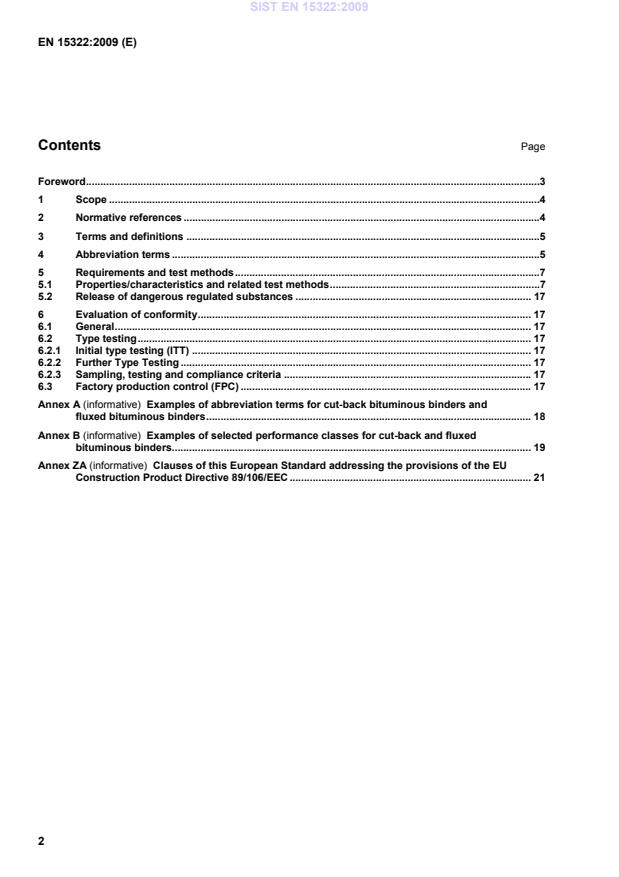
Examples of abbreviation terms for cut-back bituminous binders and fluxed bituminous binders . 18Annex B (informative)
Examples of selected performance classes for cut-back and fluxed bituminous binders. 19Annex ZA (informative)
Clauses of this European Standard addressing the provisions of the EU Construction Product Directive 89/106/EEC . 21 SIST EN 15322:2009
NOTE Industrial applications are not covered by mandate M/124. Bituminous binders Paving Grade Bitumens EN 12591 Oxidized Bitumens (industrial applications) EN 13304 Hard GradeindustrialBitumens (industrial applications)EN 13924 Hard paving Grade Bitumens PolymerModifiedBitumens EN 14023 EN 13305Cut-back &Fluxed Bitumens EN 15322 Cationic Bitumen EmulsionsEN 13808 SIST EN 15322:2009
Fv a Mineral oil fluxed bitumen or cut-back bitumen
Vegetable oil fluxed bitumen EN 12597 3
from Class 2
to Class 4
from Class 5
to Class 7 Viscosity class
prEN 12846-2 (Efflux time)
EN 13302 (Dynamic viscosity) 4 and 5 (if appropriate)
B
P Indication of the binder type Paving grade bitumen
Addition of polymer b
EN 12591
EN 14023 b 5 or 6
Setting ability of Fm types
from Class 2
to Class 6 % of total distillate
distilling at 225 °C EN 13358
Setting ability of Fv types
from Class 2
to Class 7 R&B softening point
on recovered binder EN 1427 prEN 13074-1:2008 (Subclause 7.3) a F has been used for both cut-back and fluxed bitumens to avoid confusion as C has been used already to designate cationic bitumen emulsions. b May be prepared using polymer modified bitumen (EN 14023) or by addition of polymer to the cut-back or fluxed bituminous material. The following abbreviation terms are used in the specification tables of this European standard (see Table 3, Table 4 and Table 5): NR for "No Requirement": this class has been included to accommodate countries where the characteristic, for a given intended use, is not subject to regulatory requirements, i.e. when there are no regulations for the property/characteristic in the territory of intended use. TBR for "To Be Reported": this class shall mean that the manufacturer is invited, but not required, to provide information, regarding performance characteristics, with the product. NOTE The reported values (TBR) are intended to be used for future development of specifications. DV for "Declared Value": this class shall mean that the manufacturer is required to provide a value or a range of values, or limiting value(s) as part of a regulatory declaration and subsequent regulatory marking. SIST EN 15322:2009
Dynamic viscosity EN 13302 Water effect on binder adhesion Adhesivity with reference aggregate
EN 15626 Setting ability Fm types from Table 3 Distillation EN 13358 % of total distillate fraction distilling at 225°C Fv types from Table 3 Softening point EN 1427 of recovered binder prEN 13074-1:2008
(Subclause 7.3) Consistency at intermediate service temperature Residual binder
(after stabilisation
according to prEN 13074-2) from Table 4
Penetration EN 1426 Consistency at elevated service temperature As appropriate: Softening point EN 1427 or
dynamic viscosity EN 12596 or kinematic viscosity EN 12595 Cohesion (for polymer modified materials only) As appropriate Pendulum test EN 13588 or Tensile test EN 13587 and EN 13703 or
Force ductility EN 13589 and EN 13703 Durability of consistency at intermediate service temperature Long-term aged binder
(after stabilisation according to prEN 13074-2, followed by ageing according to EN 14769) from Table 5
Penetration EN 1426 Durability of consistency at elevated service temperature As appropriate: Softening point EN 1427 or
dynamic viscosity EN 12596 or kinematic viscosity EN 12595 Durability of cohesion (for polymer modified
materials only) As appropriate: Pendulum test EN 13588
or
Tensile test EN 13587 and EN 13703
or
Force ductility EN 13589 and EN 13703 SIST EN 15322:2009
Softening point (EN 1427) after recovery (prEN 13074-1:2008, subclause 7.3) is used for Fv (vegetable oil fluxed bitumen) grade binders. For residual binder after stabilisation (prEN 13074-1 followed by prEN 13074-2) of cut-back and fluxed bituminous binders, for each characteristic, the following test methods have been selected. Consistency at intermediate service temperature The test to be used is the penetration test (EN 1426). The temperature to be used for the test is dependent of the consistency of the stabilised binder. The penetration test shall be performed at 25 °C when stabilised binder has a penetration smaller than or equal to 330 x 0,1 mm, if greater test is performed at 15 °C. Consistency at elevated service temperature The test method to be used is dependent on the consistency of the stabilised binder. If penetration at 25 °C is smaller than or equal to 330 x 0,1 mm, the consistency is carried out by EN 1427. If penetration at 25 °C is greater than 330 x 0,1 mm, the consistency is assessed either by dynamic (EN 12596) or kinematic (EN 12595) viscosity, depending on the consistency of the stabilised binder. Cohesion (for modified binders only) The test method to be used is dependent on intended use of the product. The cohesion of stabilised binder from polymer modified cut-back and fluxed bituminous binders which are used for surface dressings, shall be determined by EN 13588. For binders used in asphalt mixes the test methods given in either EN 13587 or EN 13589 may be used. For binders used in other applications any one of the three methods listed above, EN 13587, EN 13589 or EN 13588, may be used. For residual binder after stabilisation (prEN 13074-1 followed by prEN 13074-2) and ageing procedure (EN 14769) of cut-back and fluxed bituminous binders, for each characteristic, the following test methods have been selected. Durability of the consistency at intermediate service temperature The test to be used is the penetration test (EN 1426).The temperature to be used for the test is dependent of the consistency of the long-term aged binder. The penetration test shall be performed at 25 °C when aged binder has a penetration smaller than or equal to 330 x 0,1 mm, if greater test is performed at 15 °C. Durability of the consistency at elevated service temperature The test method to be used is dependent on the consistency of the long-term aged binder. If penetration at 25 °C is smaller than or equal to 330 x 0,1 mm, the consistency is carried out by EN 1427. If penetration at SIST EN 15322:2009
Class 2 Class 3 Class 4 Class 5 Class 6 Class 7 Class 8 Class 9 Class 10 Viscosity
Efflux time 4 mm 25 °C b prEN 12846-2 s
< 200 c
Efflux time 10 mm 25 °C b prEN 12846-2 s
15 – 500 c
Efflux time 10 mm 40 °C b prEN 12846-2 s
50 – 500 c
Dynamic viscosity at 60 °C b EN 13302 Pa.s
10 - 50 30 - 100 > 80
Solubility EN 12592 % NR d TBR > 99,0
Flash Point EN ISO 13736 °C
≤ 23 > 23 > 35 > 45 > 55
EN ISO 2719 °C
> 60 > 65
EN ISO 2592 °C
> 160 > 200 Adhesivity with reference aggregate EN 15626 / NR d TBR ≥ 75 ≥ 90
Fm grades setting ability by distillation test EN 13358
Total distillate at 360 °C
% NR d TBR < 5 < 10 < 15 < 20 < 32 < 55
% of total distillate fraction distilling at 190 °C
% NR d TBR < 5 2 - 15 10 - 25 > 20
% of total distillate fraction distilling at 225 °C
% NR d TBR < 15 10 - 25 20 - 40 35 - 60 > 55
% of total distillate fraction distilling at 260 °C
% NR d TBR < 20 15 - 40 35 - 60 > 55
% of total distillate fraction distilling at 315 °C
% NR d TBR < 40 35 - 70 65 - 90 > 85
Fv grades setting ability by softening point of recovered binder EN 1427 prEN 13074-1:2008 °C NR d TBR ≤ 35 > 35 > 39 > 43 > 50 > 55
Part A — Penetration at 25 °C after stabilisation, smaller or equal to 330 x 0,1 mm Stabilisation procedure: prEN 13074-1 followed by prEN 13074-2 Technical requirements Standard Units Class 0 Class 1 a Class 2 Class 3 Class 4 Class 5 Class 6 Class 7 Consistency at intermediate service temperature Penetration at 25 °C
EN 1426
0,1 mm
NR c
TBR
< 50
< 100
< 150
< 220
≤ 330
Consistency at elevated service temperature Softening point
EN 1427
oC
NR c
TBR
> 55
> 50
> 43
> 39
> 35
≥ 30 Cohesion
(modified binders only)
Class 0 Class 1 a Class 2 Class 3 Class 4 Class 5 Class 6
Cohesion energy by tensile test at 5 ºC (100 mm/min traction) b EN 13587 EN 13703 J/cm2 NR c TBR > 1 > 2 > 3
Cohesion energy by force ductility at 5 °C (50 mm/min traction)b EN 13589 EN 13703 J/cm2 NR c TBR > 1 > 2 > 3
Cohesion energy by pendulum test b EN 13588 J/cm2 NR c TBR > 0,5 > 0,7 > 1,0 > 1,2 > 1,4
Elastic recovery at 10 °C (for elastic polymer binders) EN 13398 % NR c TBR > 30 > 40 > 50 > 75
Elastic recovery at 25 °C (for elastic polymer binders) EN 13398 % NR c TBR > 30 > 40 > 50 > 75
a Class 1, TBR, may not be used for regulatory declaration and marking purposes. b The cohesion of stabilised binder from polymer modified cut-back and fluxed bituminous binders which are used for surface dressings, shall be determined in accordance with EN 13588. For binders used in asphalt mixes, the test methods given in either EN 13587 or EN 13589 may be used. For binders used in other applications, any one of the three methods listed above, EN 13587, EN 13589 or EN 13588, may be used. c NR: No Requirement may be used when there are no regulations for the property in the territory of intended use.
Part B — Penetration at 25 °C after stabilisation, greater than 330 x 0,1 mm
Stabilisation procedure: prEN 13074-1 followed by prEN 13074-2 Technical requirements Standard Units Class 0 Class 1 a Class 7 Class 8 Class 9 Class 10 Class 11 Consistency at intermediate service temperature Penetration at 15 °C
EN 1426
0,1 mm
NR d
TBR
90 - 170
140 - 260
180 - 360
> 360
Consistency at elevated service temperature b
Dynamic viscosity at 60 °C EN 12596 Pa.s NR d TBR
≥
...