

EN 17069-1:2019
(Main)Railway applications - Systems and procedures for change of track gauge - Part 1: Automatic Variable Gauge Systems
General Information
- Abstract
This document defines the interfaces and gives guidance for the design of systems and procedures for change of track gauge. It defines also their assessment for technical approval, for the automatic variable-gauge systems.
The document is focused on the change of track gauge among the following nominal track gauges: 1 435 mm, 1 520 mm, 1 524 mm, 1 600 mm and 1 668 mm.
This document is not limited to the aforementioned nominal track gauges but the interfaces to change to/from other nominal track gauges can be different. The established assessment procedures can be used as well.
- Status
- Published
- Publication Date
- 09-Apr-2019
- Withdrawal Date
- 30-Oct-2019
- Technical Committee
- CEN/TC 256 - Railway applications
- Drafting Committee
- CEN/TC 256/SC 2/WG 11 - Wheels - Wheelsets
- Current Stage
- 9093 - Decision to confirm - Review Enquiry
- Start Date
- 03-Dec-2024
- Completion Date
- 30-Sep-2026
- Directive
- 2008/57/EC - DIRECTIVE 2008/57/EC OF THE EUROPEAN PARLIAMENT AND OF THE COUNCIL of 17 June 2008 on the interoperability of the rail system within the Community (Recast)OJ Ref: L, L 95/3 OJ Date: 30-Mar-2020

Overview
EN 17069-1:2019 (CEN) - "Railway applications - Systems and procedures for change of track gauge - Part 1: Automatic Variable Gauge Systems" defines interfaces and provides design guidance and assessment methods for automatic variable-gauge systems. The standard focuses on automatic change of track gauge among the nominal gauges 1 435 mm, 1 520 mm, 1 524 mm, 1 600 mm and 1 668 mm, while noting that the assessment framework can be applied to other gauges where interfaces differ. EN 17069-1:2019 supports technical approval processes and aligns with EU Directive 2008/57/EC requirements for interoperability.
Key Topics
The standard addresses the full lifecycle of automatic variable-gauge systems with emphasis on safety, interoperability and technical approval. Major technical areas include:
- Running gear and running gear dimensions - interfaces and dimensional requirements for variable-gauge bogies and wheelsets.
- Axles and wheels - functional requirements for rotating/non-rotating axles and wheel movement during gauge change.
- Axleboxes / bearings - design, lubrication and monitoring interfaces (linking to axlebox condition monitoring).
- Locking mechanisms - requirements for safe unlocking and re-locking of running elements during the automatic gauge changeover process.
- Running gear frames and braking equipment - structural and braking interfaces affecting gauge-change performance.
- Validation, testing and technical approval - validation plans, acceptance testing, technical files and finalisation steps required for certification.
- Gauge changeover facilities - design, operation, maintenance, track layout and ancillary systems (e.g., de-icing, shelters) for gauge changeover platforms.
- Interfaces with other subsystems - control-command, signalling, energy and trackside equipment (including Hot Axlebox Detector interfaces for non‑1 435 mm gauges).
Applications and Who Uses It
EN 17069-1:2019 is practical for organizations involved in cross-border rail operations and rolling-stock design:
- Railway infrastructure managers planning or operating gauge changeover facilities.
- Rolling-stock manufacturers and bogie designers developing automatic variable-gauge running gear.
- Vehicle acceptance authorities and certification bodies performing technical approval and safety assessments.
- System integrators and project engineers implementing trackside interfaces, signalling and maintenance provisions.
- Operators seeking to reduce passenger transhipment and freight handling by enabling through-running across different track gauges.
Related Standards
EN 17069-1 references and complements existing railway standards, including (but not limited to):
- EN 12080 / EN 12081 / EN 12082 (axleboxes and bearings)
- EN 13260 / EN 13261 / EN 13262 (wheelsets, axles, wheels)
- EN 14363 (running behaviour testing)
- EN 15273 series (gauges)
- EN 15437 (axlebox condition monitoring)
- EN 50126 series (RAMS)
For projects involving automatic variable-gauge systems, EN 17069-1:2019 provides the interoperable, safety-focused framework for design, testing and approval.
Relations
- Effective Date
- 15-Jul-2026
- Effective Date
- 01-Jul-2026
- Effective Date
- 17-Jun-2026
- Effective Date
- 09-Feb-2026
- Effective Date
- 09-Feb-2026
- Effective Date
- 09-Feb-2026
- Effective Date
- 28-Jan-2026
- Effective Date
- 28-Jan-2026
- Effective Date
- 28-Jan-2026
- Effective Date
- 28-Jan-2026
- Effective Date
- 28-Jan-2026
- Effective Date
- 28-Jan-2026
- Effective Date
- 28-Jan-2026
- Effective Date
- 28-Jan-2026
- Effective Date
- 28-Jan-2026
Get Certified
Connect with accredited certification bodies for this standard

IRIS Certification (UNIFE)
International Railway Industry Standard certification.

TÜV SÜD Rail GmbH
TÜV SÜD railway certification services.

Bureau Veritas Railway Certification
Railway and transportation certification.
Sponsored listings
Frequently Asked Questions
EN 17069-1:2019 is a standard published by the European Committee for Standardization (CEN). Its full title is "Railway applications - Systems and procedures for change of track gauge - Part 1: Automatic Variable Gauge Systems". This standard covers: This document defines the interfaces and gives guidance for the design of systems and procedures for change of track gauge. It defines also their assessment for technical approval, for the automatic variable-gauge systems. The document is focused on the change of track gauge among the following nominal track gauges: 1 435 mm, 1 520 mm, 1 524 mm, 1 600 mm and 1 668 mm. This document is not limited to the aforementioned nominal track gauges but the interfaces to change to/from other nominal track gauges can be different. The established assessment procedures can be used as well.
This document defines the interfaces and gives guidance for the design of systems and procedures for change of track gauge. It defines also their assessment for technical approval, for the automatic variable-gauge systems. The document is focused on the change of track gauge among the following nominal track gauges: 1 435 mm, 1 520 mm, 1 524 mm, 1 600 mm and 1 668 mm. This document is not limited to the aforementioned nominal track gauges but the interfaces to change to/from other nominal track gauges can be different. The established assessment procedures can be used as well.
EN 17069-1:2019 is classified under the following ICS (International Classification for Standards) categories: 45.040 - Materials and components for railway engineering. The ICS classification helps identify the subject area and facilitates finding related standards.
EN 17069-1:2019 has the following relationships with other standards: It is inter standard links to EN 15273-4:2025, EN 13262:2026, EN 15839:2024+A1:2026, EN 50126-2:2017, EN 50153:2014, EN 50126-1:2017, EN 15437-1:2009+A1:2022, EN 14363:2016+A2:2022, EN 12080:2025, EN 13749:2021+A1:2023, EN 15273-2:2025, EN 13979-1:2023, EN 12082-2:2025, EN 15551:2022, EN 15663:2017+A2:2024. Understanding these relationships helps ensure you are using the most current and applicable version of the standard.
EN 17069-1:2019 is associated with the following European legislation: EU Directives/Regulations: 2008/57/EC; Standardization Mandates: M/483. When a standard is cited in the Official Journal of the European Union, products manufactured in conformity with it benefit from a presumption of conformity with the essential requirements of the corresponding EU directive or regulation.
EN 17069-1:2019 is available in PDF format for immediate download after purchase. The document can be added to your cart and obtained through the secure checkout process. Digital delivery ensures instant access to the complete standard document.
Standards Content (Sample)
SLOVENSKI STANDARD
01-junij-2019
Železniške naprave - Sistemi in postopki za spremembo tirne širine - 1. del:
Sistemi za samodejno spreminjanje širine
Railway applications - Systems and procedures for change of track gauge - Part 1:
Automatic Variable Gauge Systems
Bahnanwendungen - Systeme und Verfahren zur Umspurung - Automatische
Umspursysteme
Applications ferroviaires - Systèmes et procédures de changement d'écartement de voie
- Systèmes à écartement variable automatique
Ta slovenski standard je istoveten z: EN 17069-1:2019
ICS:
45.040 Materiali in deli za železniško Materials and components
tehniko for railway engineering
2003-01.Slovenski inštitut za standardizacijo. Razmnoževanje celote ali delov tega standarda ni dovoljeno.
EN 17069-1
EUROPEAN STANDARD
NORME EUROPÉENNE
April 2019
EUROPÄISCHE NORM
ICS 45.040
English Version
Railway applications - Systems and procedures for change
of track gauge - Part 1: Automatic Variable Gauge Systems
Applications ferroviaires - Systèmes et procédures de Bahnanwendungen - Systeme und Verfahren zur
changement d'écartements de voie - Partie 1 : Umspurung - Teil 1: Automatische Umspursysteme
Systèmes à écartement variable automatique
This European Standard was approved by CEN on 2 December 2018.
CEN members are bound to comply with the CEN/CENELEC Internal Regulations which stipulate the conditions for giving this
European Standard the status of a national standard without any alteration. Up-to-date lists and bibliographical references
concerning such national standards may be obtained on application to the CEN-CENELEC Management Centre or to any CEN
member.
This European Standard exists in three official versions (English, French, German). A version in any other language made by
translation under the responsibility of a CEN member into its own language and notified to the CEN-CENELEC Management
Centre has the same status as the official versions.
CEN members are the national standards bodies of Austria, Belgium, Bulgaria, Croatia, Cyprus, Czech Republic, Denmark, Estonia,
Finland, Former Yugoslav Republic of Macedonia, France, Germany, Greece, Hungary, Iceland, Ireland, Italy, Latvia, Lithuania,
Luxembourg, Malta, Netherlands, Norway, Poland, Portugal, Romania, Serbia, Slovakia, Slovenia, Spain, Sweden, Switzerland,
Turkey and United Kingdom.
EUROPEAN COMMITTEE FOR STANDARDIZATION
COMITÉ EUROPÉEN DE NORMALISATION
EUROPÄISCHES KOMITEE FÜR NORMUNG
CEN-CENELEC Management Centre: Rue de la Science 23, B-1040 Brussels
© 2019 CEN All rights of exploitation in any form and by any means reserved Ref. No. EN 17069-1:2019 E
worldwide for CEN national Members.
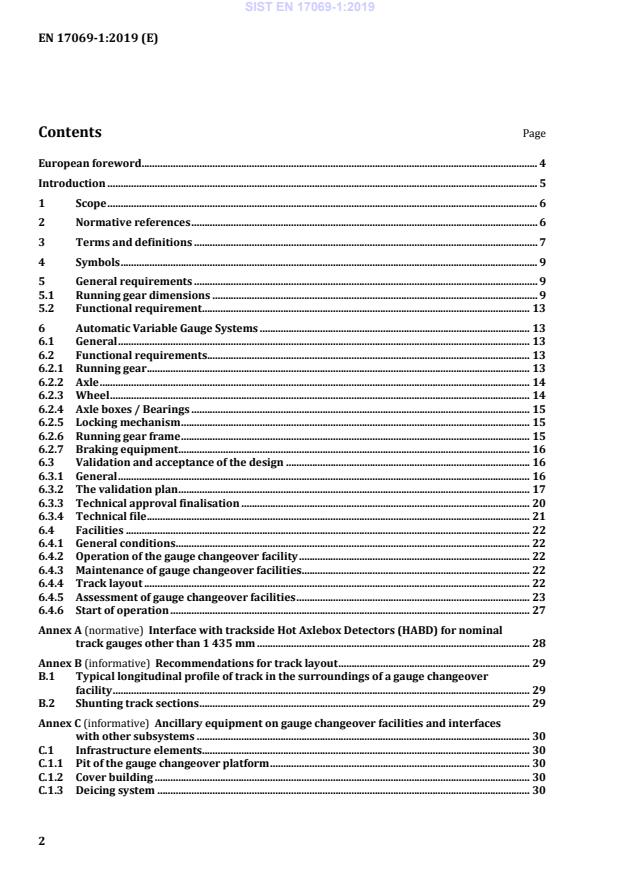
Contents Page
European foreword . 4
Introduction . 5
1 Scope . 6
2 Normative references . 6
3 Terms and definitions . 7
4 Symbols . 9
5 General requirements . 9
5.1 Running gear dimensions . 9
5.2 Functional requirement. 13
6 Automatic Variable Gauge Systems . 13
6.1 General . 13
6.2 Functional requirements. 13
6.2.1 Running gear . 13
6.2.2 Axle . 14
6.2.3 Wheel . 14
6.2.4 Axle boxes / Bearings . 15
6.2.5 Locking mechanism . 15
6.2.6 Running gear frame . 15
6.2.7 Braking equipment . 16
6.3 Validation and acceptance of the design . 16
6.3.1 General . 16
6.3.2 The validation plan . 17
6.3.3 Technical approval finalisation . 20
6.3.4 Technical file . 21
6.4 Facilities . 22
6.4.1 General conditions . 22
6.4.2 Operation of the gauge changeover facility . 22
6.4.3 Maintenance of gauge changeover facilities . 22
6.4.4 Track layout . 22
6.4.5 Assessment of gauge changeover facilities . 23
6.4.6 Start of operation . 27
Annex A (normative) Interface with trackside Hot Axlebox Detectors (HABD) for nominal
track gauges other than 1 435 mm . 28
Annex B (informative) Recommendations for track layout . 29
B.1 Typical longitudinal profile of track in the surroundings of a gauge changeover
facility . 29
B.2 Shunting track sections . 29
Annex C (informative) Ancillary equipment on gauge changeover facilities and interfaces
with other subsystems . 30
C.1 Infrastructure elements. 30
C.1.1 Pit of the gauge changeover platform . 30
C.1.2 Cover building . 30
C.1.3 Deicing system . 30
C.1.4 Slab track . 30
C.2 Interfaces with energy subsystem . 30
C.3 Interfaces with control-command and signalling subsystem . 31
C.4 Other ancillary equipment . 31
Annex ZA (informative) Relationship between this European Standard and the Essential
Requirements of EU Directive 2008/57/EC aimed to be covered. 32
Bibliography . 37
European foreword
This document (EN 17069-1:2019) has been prepared by Technical Committee CEN/TC 256 “Railway
applications”, the secretariat of which is held by DIN.
This document shall be given the status of a national standard, either by publication of an identical text
or by endorsement, at the latest by October 2019, and conflicting national standards shall be withdrawn
at the latest by October 2019.
Attention is drawn to the possibility that some of the elements of this document may be the subject of
patent rights. CEN shall not be held responsible for identifying any or all such patent rights.
This document has been prepared under a standardization request given to CEN by the European
Commission and the European Free Trade Association, and supports essential requirements of
Directive 2008/57/EC.
For relationship with Directive 2008/57/EC, see informative Annex ZA, which is an integral part of this
document.
According to the CEN-CENELEC Internal Regulations, the national standards organisations of the
following countries are bound to implement this document: Austria, Belgium, Bulgaria, Croatia, Cyprus,
Czech Republic, Denmark, Estonia, Finland, Former Yugoslav Republic of Macedonia, France, Germany,
Greece, Hungary, Iceland, Ireland, Italy, Latvia, Lithuania, Luxembourg, Malta, Netherlands, Norway,
Poland, Portugal, Romania, Serbia, Slovakia, Slovenia, Spain, Sweden, Switzerland, Turkey and the United
Kingdom.
Introduction
For historical reasons, several track gauges are used on the rail networks in Europe. In order to cross the
borders among these, passengers and goods need to be transferred.
In order to increase comfort of passengers by avoiding transhipments, and to reduce both the risk of
damaging goods and the involved cost of transferring them, several systems and procedures for change
of track gauge have been developed. Nowadays, there are three main possibilities to attain connection
among rail networks with different track gauges:
— automatic variable-gauge systems;
— interchange of complete bogies;
— interchange of complete wheelsets.
The interfaces and the approval methods for such systems were defined in several UIC-leaflets and
national regulations. This document is intended to set all related requirements together in a single
document for automatic variable-gauge systems.
1 Scope
This document defines the interfaces and gives guidance for the design of systems and procedures for
change of track gauge. It defines also their assessment for technical approval, for the automatic variable-
gauge systems.
The document is focused on the change of track gauge among the following nominal track gauges:
1 435 mm, 1 520 mm, 1 524 mm, 1 600 mm and 1 668 mm.
This document is not limited to the aforementioned nominal track gauges but the interfaces to change
to/from other nominal track gauges can be different. The established assessment procedures can be used
as well.
2 Normative references
The following documents are referred to in the text in such a way that some or all of their content
constitutes requirements of this document. For dated references, only the edition cited applies. For
undated references, the latest edition of the referenced document (including any amendments) applies.
EN 12080, Railway applications – Axleboxes - Rolling bearings
EN 12081, Railway applications – Axleboxes – Lubricating greases
EN 12082, Railway applications – Axleboxes – Performance testing
EN 13103-1, Railway applications – Wheelsets and bogies – Part 1: Design method for axles with external
journals
EN 13260, Railway applications – Wheelsets and bogies – Wheelsets – Product requirements
EN 13261, Railway applications – Wheelsets and bogies – Axles – Product requirements
EN 13262, Railway applications – Wheelsets and bogies – Wheels – Product requirements
EN 13749, Railway applications – Wheelsets and bogies – Method of specifying the structural requirements
of bogie frames
EN 13979-1, Railway applications – Wheelsets and bogies – Monobloc wheels – Technical approval
procedure – Part 1: Forged and rolled wheels
EN 14363, Railway applications – Testing and Simulation for the acceptance of running characteristics of
railway vehicles – Running Behaviour and stationary tests
EN 15273-1, Railway applications – Gauges – Part 1: General – Common rules for infrastructure and rolling
stock
EN 15273-2, Railway applications – Gauges – Part 2: Rolling stock gauge
EN 15437-1, Railway applications – Axlebox condition monitoring – Interface and design requirements –
Part 1: Track side equipment and rolling stock axlebox
EN 15437-2, Railway applications – Axlebox condition monitoring – Interface and design requirements –
Part 2: Performance and design requirements of on-board systems for temperature monitoring
EN 15551, Railway applications – Railway rolling stock – Buffers
EN 15663, Railway applications – Vehicle reference masses
EN 15827, Railway applications – Requirements for bogies and running gears
EN 15839, Railway applications – Testing for the acceptance of running characteristics of railway vehicles –
Freight wagons – Testing of running safety under longitudinal compressive forces
EN 15877-1, Railway applications – Marking on railway vehicles – Part 1: Freight wagons
EN 50126-1, Railway applications – The specification and demonstration of Reliability, Availability,
Maintainability and Safety (RAMS) – Part 1: Basic requirements and generic process
EN 50126-2, Railway Applications – The Specification and Demonstration of Reliability, Availability,
Maintainability and Safety (RAMS) – Part 2: Systems Approach to Safety
CLC/TR 50126-3, Railway applications – The specification and demonstration of Reliability, Availability,
Maintainability and Safety (RAMS) – Part 3: Guide to the application of EN 50126-1 for rolling stock RAM
EN 50153, Railway applications – Rolling stock – Protective provisions relating to electrical hazards
3 Terms and definitions
For the purposes of this document, the following terms and definitions apply.
ISO and IEC maintain terminological databases for use in standardization at the following addresses:
• IEC Electropedia: available at http://www.electropedia.org/
• ISO Online browsing platform: available at http://www.iso.org/obp
3.1
nominal track gauge
single value which identifies the track gauge, but may differ from the design track gauge
Note 1 to entry: Definition in addition to the EN 15273 series. As example 1 435 mm.
3.2
gauge changeover technology
set of systems and devices specifically designed to perform the automatic gauge changeover process on
certain types of compatible rolling stock fitted with variable-gauge running gear
3.3
automatic variable-gauge running gear
specific type of running gear designed to automatically switch between different track gauges when
passing through a gauge changeover facility
Note 1 to entry: This process does not involve the removal or assembly of any component of the running gear.
3.4
non-rotating axle
axle fixed to bogie frame, that does not rotate and during the service, the wheel can freely-rotate, and
lateral movement between wheels and axle is not possible
Note 1 to entry: Only during the automatic gauge changeover process, the wheels can move laterally to reach the
corresponding track gauge position.
3.5
rotating axle
axle not fixed to bogie frame, during service wheels rotate together with the axle and lateral movement
between wheels and axle is not possible
Note 1 to entry: Only during the automatic gauge changeover process, lateral movements are possible to reach
the corresponding track gauge position.
3.6
automatic gauge changeover process
automatic change of track gauge in variable-gauge running gear, consisting at least of the following
phases:
— unlocking of the rolling elements;
— displacement of the rolling elements while variable-gauge running gear is in the gauge changeover
platform;
— safe locking of the rolling elements in their new position
3.7
gauge changeover facility
facility where the automatic gauge changeover process is performed when passed through by trains at a
given speed
Note 1 to entry: It includes the gauge changeover platform along with all ancillary systems that may be required
to prepare the train for the automatic gauge changeover process (e.g. deicing system) and those for sheltering, if
any.
3.8
gauge changeover platform
core element of a gauge changeover facility in which all systems directly related to change of track gauge
for variable-gauge running gear are installed
3.9
multi-mode gauge changeover facility
gauge changeover facility where several gauge changeover technologies are implemented and thus more
than one mode of change is allowed
3.10
mode of change
configuration of a multi-mode gauge changeover facility for a specific gauge changeover technology
3.11
area of a gauge changeover facility
area between the signals of entrance and exit of a gauge changeover facility, including the gauge
changeover facility itself as well as switches and crossings of shunting track sections
3.12
surroundings of a gauge changeover facility
track section before and after the area of a gauge changeover facility, the considered external limits of
which are the entrance and exit signals of main tracks
3.13
nominal passage speed
vehicle speed during the changeover process at which both the gauge changeover facility and the
variable-gauge running gear are designed
Note 1 to entry: Nominal passage speed depends on the gauge changeover technology.
4 Symbols
For the purposes of this document, the following symbols apply.
Table 1 — Symbols
Symbol Designation
a Back to back dimension
a Front-to-front dimension
e Thickness of flange
h Height of flange
qR Face of the flange
d Wheel diameter
Y Lateral position of the centre of the target area
TA
W Lateral width in mm of the target area
TA
L Longitudinal length in mm of the target area
TA
Y Lateral position of the centre of the prohibitive zone
PZ
W Lateral width in mm of the prohibitive zone
PZ
L Longitudinal length in mm of the prohibitive zone
PZ
NOTE Symbols given in Table 1 come from EN 15313 and EN 15437-1.
5 General requirements
5.1 Running gear dimensions
Running gear shall comply with minimum and maximum values in Tables 2 and 3 and Tables 4 and 5 for
any service condition. For 1 435 mm nominal track gauge, the values which are given in Tables 2 and 3
and Tables 4 and 5 are the same as in EN 15313.
Table 2 — Limit values for front-to-front and back-to-back dimensions for freight wagons
Designation Wheel diameter Minimum value Maximum value
d [mm] [mm] [mm]
330 ≤ d ≤ 760 1 415 1 426
Front-to-front dimension (a )
760 < d ≤ 840 1 412 1 426
a = a + e + e
2 1 1 2
d > 840 1 410 1 426
1 435 mm
330 ≤ d ≤ 760 1 359 1 363
Back to back dimension (a ) 760 < d ≤ 840 1 358 1 363
d > 840 1 357 1 363
400 ≤ d < 840 1 492 1 514
Front-to-front dimension (a )
a = a + e + e
2 1 1 2
d ≥ 840 1 487 1 514
1 524 mm
400 ≤ d < 840 1 444 1 448
Back to back dimension (a )
d ≥ 840 1 442 1 448
Front-to-front dimension (a )
690 ≤ d ≤ 1 016 1 573 1 592
a = a + e + e
2 1 1 2
1 600 mm
Back to back dimension (a ) 690 ≤ d ≤ 1 016 1 521 1 526
a
330 ≤ d < 840 1 659
1 648
Front-to-front dimension (a )
a = a + e + e
2 1 1 2
a
840 ≤ d ≤ 1 250 1 659
1 643
1 668 mm
330 ≤ d < 840 1 592 1 596
Back to back dimension (a )
840 ≤ d ≤ 1 250 1 590 1 596
e and e are the thicknesses of each wheel.
1 2
a
Two-axle wagons with axle load up to 22,5 t the value shall be taken as 1 651 mm.
Table 3 — Limit values for front-to-front and back-to-back dimensions for rolling stock other
than freight wagons
Designation Wheel diameter Minimum value Maximum value
d [mm] [mm] [mm]
330 ≤ d ≤ 760 1 415 1 426
Front-to-front dimension
(a )
760 < d ≤ 840 1 412 1 426
a = a + e + e
2 1 1 2
d > 840 1 410 1 426
1 435 mm
330 ≤ d ≤ 760 1 359 1 363
Back to back dimension
760 < d ≤ 840 1 358 1 363
(a )
d > 840 1 357 1 363
Front-to-front dimension
(a )
2 400 ≤ d < 1 220 1 487 1 509
a = a + e + e
2 1 1 2
1 520 mm
Back to back dimension
400 ≤ d < 1 220 1 437 1 443
(a )
Front-to-front dimension 400 ≤ d < 725 1 506 1 509
(a )
d ≥ 725 1 487 1 514
a = a + e + e
2 1 1 2
1 524 mm
400 ≤ d < 725 1 444 1 446
Back to back dimension
(a )
d ≥ 725 1 442 1 448
Front-to-front dimension
(a )
690 ≤ d ≤ 1 016 1 573 1 592
a = a + e + e
2 1 1 2
1 600 mm
Back to back dimension
690 ≤ d ≤ 1 016 1 521 1 526
(a )
Front-to-front dimension 330 ≤ d < 840 1 648 1 659
(a )
840 ≤ d ≤ 1 250 1 643 1 659
a = a + e + e
2 1 1 2
1 668 mm
330 ≤ d < 840 1 592 1 596
Back to back dimension
(a )
840 ≤ d ≤ 1 250 1 590 1 596
Table 4 — Limit values for wheel flange and rim for freight wagons
Designation Wheel diameter Minimum Value Maximum Value
[mm]
[mm] [mm]
Width of the rim d ≥ 330 133 140
330 ≤ d ≤ 760 27,5 33
Thickness of flange (e) 760 < d ≤ 840 25 33
d > 840 22 33
1 435 mm
330 ≤ d ≤ 630 31,5 36
Height of flange (h) 630 < d ≤ 760 29,5 36
d > 760 27,5 36
Face of the flange qR d ≥ 330 6,5 -
Width of the rim d ≥ 400 134 140
400 ≤ d ≤ 760 27,5 33
Thickness of flange (e) 760 < d ≤ 840 25 33
d > 840 22 33
1 524 mm
400 ≤ d ≤ 630 31,5 36
Height of flange (h) 630 < d ≤ 760 29,5 36
d > 760 27,5 36
Face of the flange qR d ≥ 400 6,5 -
Width of the rim 690 ≤ d ≤ 1 016 137 139
Thickness of flange (e) 690 ≤ d ≤ 1 016 26 33
1 600 mm
Height of flange (h) 690 ≤ d ≤ 1 016 28 38
Face of the flange qR 690 ≤ d ≤ 1 016 6,5 -
Width of the rim d ≥ 330 133 140
330 ≤ d ≤ 840 27,5 33
Thickness of flange (e)
a
d > 840 33
1 668 mm
330 ≤ d ≤ 630 31,5 36
Height of flange (h) 630 < d ≤ 760 29,5 36
d > 760 27,5 36
Face of the flange qR d ≥ 330 6,5 -
a
Other values may be used. For instance 25 mm in Spain.
Table 5 — Limit values for wheel flange and rim for rolling stock other than freight wagons
Designation Wheel diameter Minimum Value Maximum Value
[mm] [mm] [mm]
Width of the rim d ≥ 330 133 145
330 ≤ d ≤ 760 27,5 33
Thickness of flange (e) 760 < d ≤ 840 25 33
d > 840 22 33
330 ≤ d ≤ 630 31,5 36
Height of flange (h) 630 < d ≤ 760 29,5 36
d > 760 27,5 36
Face of the flange qR d ≥ 330 6,5 -
5.2 Functional requirement
The design of the earthing system shall comply with EN 50153.
The requirements regarding electrical resistance as set out in EN 13260 shall be applied. If necessary,
specific electrical installation can be mounted.
Vehicles fitted with variable-gauge systems shall fulfil EN 15273-1 and EN 15273-2.
6 Automatic Variable-Gauge Systems
6.1 General
The functionality of the system shall be defined at the design stage, together with its main features
(e.g. how forces are received and transferred) in order to set an appropriate assessment methodology.
6.2 Functional requirements
6.2.1 Running gear
Vehicles fitted with variable-gauge running gear should be capable of being operated with no restrictions
due to the special features of their running gear.
Vehicles equipped with variable-gauge running gear shall be able to negotiate curves with a radius of
150 m when coupled into a train.
Individual wagons shall be able to negotiate curves with a radius of 75 m. Wagons intended to be
operated between the 1 435 mm and 1 520 mm track gauge systems shall be able to negotiate curves
with a radius of 60 m either when empty or loaded.
In order to identify the variable-gauge running gear, rules for marking, as set out in EN 15877-1, shall be
applied to all types of vehicles and nominal track gauges.
NOTE The referred standard was originally intended for wagons only.
For the design of the variable-gauge system, the following points shall be considered:
— suitable combinations shall be chosen in order to avoid frictional corrosion on sliding surfaces
between axle body and wheel hub. Protection against corrosion and dirt of the locking system and
bearing surfaces for axial movement of wheels shall be taken into account;
— vehicles shall be designed to be lifted without dismounting their running gear;
— it should be possible to fit and remove wheelsets with the equipment for lifting and exchange that is
normally used for standard wheelsets;
— reprofiling of wheels should not require any equipment other than that for standard wheelsets;
— checks on wheelset geometry shall be possible and integrity should be possible by using existing
equipment for measuring and testing.
6.2.2 Axle
Depending on the technology, two main types of axles can be distinguished: rotating axles and non-
rotating axles with freely rotating wheels.
Validation of axles shall be documented in a validation plan according to EN 15827:
— Rotating axles:
• methods for calculation as set out in EN 13103-1 shall be applied according to the design of the
system. Requirements from EN 13261 shall also be considered;
NOTE In these cases, the validation plan identifies that EN 13103-1 and EN 13261 are fulfilled and no further
assessment is necessary.
• when design is out of the scope of EN 13103-1, the calculation should follow as far as possible
the methods and load systems provided for in this document. Requirements from EN 13261 shall
be considered when applicable.
— Non-rotating axles with freely rotating wheels:
• non-rotating axles with freely rotating wheels are not subject to rotating bending stresses. In
addition, the number of cycles and the range of dynamic forces that non-rotating axles shall
withstand are much lower. They shall, therefore, be considered as a part of the running gear
frame to be calculated and approved according to EN 13749.
6.2.3 Wheel
Wheels shall comply with EN 13979-1 and EN 13262. When these standards do not apply due to the use
of other type of technology, they should be considered at least as a guide. A validation process according
to 6.3.1 shall be applied in any case.
NOTE When wheels comply with EN 13979-1 and EN 13262, the validation process is defined in EN 13979-1.
Any tread profile may be used, but the dynamic behaviour shall always be in accordance with EN 14363.
6.2.4 Axle boxes / Bearings
Axle boxes, greases and bearings shall comply with EN 12080, EN 12081 and EN 12082. When these
standards are not to be directly applied due to the use of other type of technology, they should be
considered at least as a guide. A validation process according to 6.3.1 shall be applied in any case.
It shall be possible to monitor the axle bearing condition either by:
— track side detection equipment; or
— on-board equipment.
Vehicles intended to be monitored by track side equipment on networks with 1 435 mm nominal track
gauge shall comply with all requirements regarding target zone and prohibitive zone as set out in
EN 15437-1.
For vehicles intended to be monitored by track side equipment on networks with nominal track gauges
of 1 520 mm, 1 524 mm, 1 600 mm or 1 668 mm, the corresponding requirements for target zone and
prohibitive zone are established in Annex A.
When hot-box detection is not possible at track-side, on-board systems according to EN 15437-2 shall be
installed.
6.2.5 Locking mechanism
The locking mechanism, which is an integral part of the variable-gauge running gear, shall reliably
perform the following functions, allowing for static and dynamic forces, the effects of weather, wear, and
possible heating due to braking:
— locking of wheels of variable-gauge running gear at the corresponding position for a given track
gauge, irrespective of the operating conditions outside the gauge changeover facility;
— release and locking of wheels while passing through the gauge changeover facility.
Correct locking of the system shall be verified after every passage through the gauge changeover facility
by means of controlling the correct position of the locking system by using at least one of the following
methods:
— visual control;
— on-board control system;
— infrastructure/facility control system.
Arrangements shall be made in order to prevent the intrusion of rain, snow or dust, which can jeopardize
safety and increase wear.
The correct performance of axial movement of wheels shall be ensured. This shall be verified during in-
service tests.
During in-service operation and maintenance, the locking mechanism of variable-gauge running gear
shall not show any defect that could cause displacement of one or both wheels. Defects on the sealing
elements of wheels and/or the locking mechanism of variable-gauge running gear are permissible insofar
wheels are properly locked.
6.2.6 Running gear frame
The running gear frame shall comply with EN 13749. When this document does not apply due to the use
of other type of technology, it should be considered at least as a guide. A validation process according to
6.3.1 shall be applied in any case. According to the design, the locking mechanism can be part of the
running gear frame.
6.2.7 Braking equipment
In the case that the braking system is displaced during the automatic gauge changeover process, an
adapting system shall be used. This system shall automatically switch the position of braking elements
within the automatic gauge changeover process. After the referred switching process is completed, the
braking system shall stay in its correct position.
The correct position of the braking system can be ensured by means of a locking system. It shall be
possible to supervise the locking system, if any, by a visual check or by any other means.
6.3 Validation and acceptance of the design
6.3.1 General
Validation plans are intended to prove that the design of variable-gauge running gear fulfils the
specifications defined in the relevant standards. This document includes the request of a validation plan
according to the state of the art in 6.3.2. When the characteristics or the conditions of use of a previously
approved system are changed, the scope of the assessment shall be established on the basis of a risk
assessment.
When, for the novelty of the applied concepts, design is so different from conventional solutions that
common railway standards cannot be directly applied, a defined engineering process shall be followed in
order to ensure that variable-gauge running gear, together with its associated systems and subsystems,
have the same level of reliability, availability, maintainability and safety as conventional running gear
designed and validated according to the relevant European railway standards in force.
NOTE An engineering process that is consistent with EN ISO 9001 is recognized as satisfying the minimum
requirements specified by this clause.
This process shall be based on EN 15827, which brings together in a single document the design
requirements (i.e. structural and dynamic behaviour), the validation procedures, the maintenance plans
and the quality requirements for all systems and subsystems. It is also defined therein what information
is needed for the technical specification of systems and interfaces, together with the relevant European
standards.
For some elements of variable-gauge systems (e.g. locking systems, non-conventional axles, wheels), it
may not be possible to apply existing standards due to its novelty. It shall hence follow a specific
procedure to analyse failure modes and criticality of each (e.g. FMECA, HAZOP) in order to determine
their possible causes, the severity of their consequences and their probability of occurrence. The
EN 50126 series details how to perform this analysis in the context of RAMS Management along the whole
life cycle of the product.
The acceptance process shall cover the following stages:
— validation plan (e.g. combination of load cases for analysis and static tests, programs for fatigue tests,
routes for track tests);
— values for every load case;
— acceptance criteria (e.g. treatment of measured or calculated values, limiting stresses, criteria for
completion of fatigue tests).
6.3.2 Validation plan
6.3.2.1 Content
The validation plan shall include a list of the planned validation steps in order to demonstrate compliance
with this document.
The procedure for the validation of the variable-gauge running gear against the defined acceptance
criteria shall be established on the basis of:
— design analysis;
— laboratory tests;
— on track tests;
— in service tests.
6.3.2.2 Design review
The design review shall include the following documents:
— technical specification of the variable-gauge system, including the operational and climatic
conditions for which it has been designed, shall define the requirements and acceptance criteria to
be achieved. It shall be explained how the system works, how forces are received and transferred
and, if necessary, the reasons why the referred railway standards do not apply;
— calculations:
• EN standards shall be followed for the calculation of those elements that have been designed in
accordance therewith (e.g. wheels and bogie frames). Where validated components are used,
these calculations are only required if there is a significant variation in the climatic or operation
conditions in operational use;
• axle;
• running gear stiffness: The assembly shall be stiff enough to maintain the back-to-back distance
within the limits, in any operational condition;
• locking mechanism;
• maximum permissible component wear from the standpoint of functional and operational safety;
— thermal effect of braking on the variable-gauge systems. It shall be studied whether any additional
test is needed;
— study of safe running. It shall be proven that wheels are not accidentally released in the following
situations:
• when passing over twisted track as defined in EN 14363;
• during buffing tests in accordance with EN 15551;
• under high longitudinal compression forces as defined in EN 15839;
• when passing over rail mounted brakes in shunting yard tracks;
— maintenance plan shall be included in the validation file;
— study of functional reliability (RAMS - Reliability, Availability, Maintainability, and Safety) of the
wheel locking and release mechanism, to be performed in accordance with EN 50126-1, EN 50126-2
and CLC/TR 50126-3. Additionally, these studies shall determine whether or not the following
measures are necessary:
• additional calculations on the strength of locking mechanism components;
• further tests than those defined in 6.3.2.3 and 6.3.2.4;
• stricter limit values for maximum component wear;
• application of a special maintenance cycle.
6.3.2.3 Laboratory tests
As a minimum, the following laboratory testing shall be performed:
— EN standards shall be followed for testing of those elements that have been designed in accordance
therewith (e.g. wheels, bogie frames). Where validated components are used, these tests are only
required if there is a significant variation in the climatic or operation conditions in operational use.
Determination of the fatigue strength of variable-gauge running gear shall be made by means of a
rotational bending test at a speed equal to or greater than 50 km/h. This test shall be in accordance with
stages, number of cycles and forces as set out in Table 6.
Table 6 — Stages for fatigue testing of variable-gauge running gear
Vertical force [kN] Transverse force [kN]
Stage No. of cycles
static dynamic static dynamic
I 6 P ±0,5 P at 4 Hz 0 ±0,3 P at 2 Hz
II 2 P ±0,6 P at 4 Hz 0 ±0,36 P at 2 Hz
III 2 P ±0,7 P at 4 Hz 0 ±0,42 P at 2 Hz
It is allowed to perform this fatigue test at a higher speed. In this case, all frequencies shall be multiplied
by the following ratio: speed/50.
P load, that represents the static axle load corresponding to design mass under normal payload as defined
in EN 15663.
load cycles without
This test shall be regarded as completed when the running gear has withstood 10
suffering damage (positive test) or when a crack or fracture has occurred (negative test).
The non-rotating axle with freely-rotating wheels and non-rotating locking system shall be considered as
a part of the bogie frame to be tested as such according to EN 13749.
6.3.2.4 Tests on track gauge changeover facility
Before starting in service tests, the functional reliability of the locking mechanism shall be demonstrated.
A minimum of 500 automatic gauge changeover processes shall be made without servicing or inspection
at the nominal passage speed and under conditions representative of those in-service. After these 500
automatic gauge changeover processes, the locking system should be checked:
— back-to-back dimension shall be in accordance with Tables 2 and 3 when the sum of guiding forces
ƩY limit as set out in EN 14363 is applied;
max
— verify that all exerted forces during the automatic gauge changeover process are in the defined range;
— measured wear of components for maintenance purposes.
Further tests can result from the study of functional reliability.
Once all of these tests are successful, it is allowed to perform in-service tests.
6.3.2.5 In-service test
Once all the previous tests are successful, and, after the necessary tests of the behaviour of the vehicle
with the system to run on track has been undertaken, it is allowed to perform in-service tests.
For Phases 1 and 2, tests shall be representative of in-service conditions for the vehicle:
— operational mass under normal payload according to EN 15663. Freight wagons shall also be tested
under dead mass conditions, as defined in EN 15663. In order to consider both load conditions for
freight wagons, the total mileages defined below include both load conditions;
— speeds of up to the maximum design speed of the vehicle, when possible;
— tracks for testing as similar as possible to those on which the vehicle shall run.
For in-service tests, at least 4 variable-gauge sets of running gear shall be used (8 for multiple units). The
variable-gauge running gear shall cover the following distances:
— a phase 1 of 50 000 km on one of the track gauges. No automatic gauge changeover processes shall
be made until the end of this stage.
— a phase 2 of 50 000 km in both track gauges. Not less than 20 % of this distance shall be covered in
any of the track gauges for which the vehicle is being tested. At least 50 automatic gauge changeover
processes shall be performed evenly distributed during this phase.
The controls to be performed during the phases 1 and 2 should be the following as given in Table 7:
a) visual control every 1 000 km of all parts of the running gear that are visible without dismounting
any part of the vehicle. Any incidence should be reported.
b) running gear control (i.e. qR, flange width and flange height, back to back dimension, front to front
dimension and electrical resistance).
c) control of axle stiffness: Back-to-back dimension shall be measured after applying lateral forces
according to EN 14363 at the height of the wheel flange.
d) measurement of translational forces during the automatic gauge changeover process: The maximum
and the average force per wheel shall be measured. The results of these measurements shall be
according to the design.
Table 7 — Controls for in-service test phase 1 and 2:
Phase Running Running Running gear Translational
distance gear stiffness force comments
control measurement measurement
0 x x x
2 000 x
5 000 x
No automatic gauge
10 000 x x
Phase 1 changeover process will be
20 000 x
made at this stage.
30 000 x x
40 000 x
50 000 x x x
60 000 x x
70 000 x x x
At least 50 automatic gauge
Phase 2 80 000 x x changeover processes shall
be performed.
90 000 x x
100 000 x x x
Reports shall be created.
After all these tests are successfully performed, the running gear shall be granted a provisional technical
approval.
This approval may be used to cover in-service tests as required in phase 3, which can involve a
commercial use. Phase 4 is authorized to start once the referred in-service tests of phase 3 are completed.
6.3.3 Technical approval finalisation
Following the issuance of the provisional approva
...