


prEN 16039
(Main)Water quality - Guidance standard on assessing the hydromorphological features of lakes
Water quality - Guidance standard on assessing the hydromorphological features of lakes
This document is applicable to lakes, which are water bodies occupying one or more basins with surface areas typically greater than 1 ha (0,01 km2) and maximum depths (at mean water level) greater than 1 m. All types of permanent and temporary lakes, including natural, modified and artificial, freshwater and brackish, except for those systems which regularly connect to the sea, are included in this document.
Based on these criteria, it can be estimated that there are at least 500 000 natural lakes across Europe, most of which are located in the glaciated landscapes in northern and western provinces and in Scandinavia. Lakeland districts also occur locally in areas such as large river catchments (e.g. the Danubian plain) and around the Alps. Elsewhere, naturally occurring lakes are relatively sparse and in such areas reservoirs or pits are more common.
This document is designed to:
a) support environmental and conservation agencies in meeting the monitoring requirements of the WFD (Article 8, Annex II and Annex V);
b) generate data sets appropriate for monitoring and reporting of Natura 2000 sites designated under the Habitats Directive and the Birds Directive;
c) provide information supporting other environmental reporting requirements (e.g. in relation to biodiversity or environmental impact assessment);
d) support lake management and restoration initiatives.
This document:
e) defines the key term of ‘hydromorphology’ and other terms relating to the morphological characteristics of lakes and their hydrological regimes;
f) details essential features and processes of lakes that should be characterized as part of a hydromorphological survey and for determining the hydromorphological condition of a lake;
g) identifies and defines the key pressures affecting European lakes;
h) provides guidance on strategies for collecting hydromorphological data depending on resources available and the anticipated use of the assessment; a hierarchy of approaches is recognized from the ‘overview method’ utilizing existing databases, maps and remote sensing data through to recognized field-based survey techniques such as Lake Habitat Survey (LHS) [3];
i) offers guidance on data presentation;
j) establishes guidance on data quality assurance issues.
This document does not deal with biological assessments in lakes such as the presence or absence of individual species or community composition, nor does it attempt to link specific hydromorphological features with their associated biological communities or to create a classification based on such links. However, it is relevant where plants or other organisms form significant structural elements of the habitat (e.g. a gradation from riparian to littoral vegetation).
With respect to the WFD, the hydromorphological condition of a lake only contributes to its status classification at high ecological status (HES). Hydromorphological conditions are not defined for good and moderate status but shall be sufficient to support the biological elements. However, some countries are now beginning to classify lakes according to their hydromorphology. The information gathered by using this standard can provide a basis for classification, but this classification is the subject of EN 16870 and not EN 16039.
Wasserbeschaffenheit - Anleitung zur Beurteilung hydromorphologischer Eigenschaften von Standgewässern
Qualité de l'eau - Guide pour l'évaluation des caractéristiques hydromorphologiques des lacs
Le présent document s’applique aux lacs, qui sont des masses d’eau occupant un ou plusieurs bassins, d’une superficie généralement supérieure à 1 ha (0,01 km2) et d’une profondeur maximale (à la cote moyenne) supérieure à 1 m. Tous les types de lacs permanents et temporaires, qu’ils soient naturels, modifiés ou artificiels, d’eau douce ou d’eau saumâtre, à l’exception des systèmes régulièrement en connexion avec la mer, sont considérés dans le présent document.
Sur la base de ces critères, on peut estimer que l’Europe compte au moins 500 000 lacs naturels, situés pour la plupart dans les paysages glaciaires des régions nord et ouest et en Scandinavie. Des régions de zones lacustres sont aussi présentes localement dans des zones telles que les bassins versants de fleuves (par exemple, la plaine du Danube) et autour des Alpes. Partout ailleurs, les lacs naturels sont relativement peu nombreux, et l’on retrouve principalement des lacs de retenue ou des gravières.
Le présent document est destiné à:
a) aider les organismes pour la protection et la conservation de l’environnement à satisfaire aux exigences de surveillance de la DCE (Article 8, Annexe II et Annexe V);
b) générer des ensembles de données appropriés pour surveiller et rendre compte des sites Natura 2000 désignés dans le cadre de la Directive Habitats et de la Directive Oiseaux;
c) fournir des informations permettant de satisfaire aux exigences de compte rendu sur d’autres aspects environnementaux (par exemple en lien avec la biodiversité ou les études d’impact environnemental);
d) soutenir les initiatives de gestion et de restauration des lacs.
Le présent document:
e) définit le terme clé "hydromorphologie" ainsi que d’autres termes associés aux caractéristiques morphologiques des lacs et à leurs régimes hydrologiques;
f) décrit de manière détaillée les caractéristiques et processus essentiels des lacs qu’il convient de caractériser dans le cadre d’un suivi hydromorphologique et pour déterminer les conditions hydromorphologique d’un lac;
g) identifie et définit les pressions majeures auxquelles les lacs européens sont soumis;
h) fournit des recommandations relatives aux stratégies de collecte de données hydromorphologiques en fonction des ressources disponibles et de l’usage prévu de l’évaluation; une hiérarchie des approches est identifiée, allant de la "méthode de documentation" utilisant les bases de données, cartes et données satellitaires existantes jusqu’à des techniques reconnues d’études sur le terrain telles que Lake Habitat Survey (LHS) [3];
i) fournit des recommandations relatives à la présentation des données;
j) établit des recommandations relatives aux problématiques de qualité des données.
Le présent document ne traite pas des évaluations biologiques dans les lacs, telles que la présence ou l’absence d’espèces particulières ou la composition des communautés, et ne tente pas non plus d’établir de lien entre des caractéristiques hydromorphologiques spécifiques et les communautés biologiques qui leur sont associées, ni de créer une classification sur la base de tels liens. Toutefois, il se révèle pertinent lorsque les plantes ou d’autres organismes constituent des éléments structuraux importants de l’habitat (par exemple, une gradation entre végétation riparienne et littorale).
En ce qui concerne la DCE, les conditions hydromorphologiques d’un lac contribuent uniquement à son classement en très bon état écologique. Les conditions hydromorphologiques ne sont pas définies pour un état bon ou moyen, mais doivent être suffisantes pour soutenir les éléments de qualité biologique. ...
Kakovost vode - Navodilo za ocenjevanje hidromorfoloških značilnosti jezer
General Information
- Status
- Not Published
- Publication Date
- 11-Oct-2027
- Technical Committee
- CEN/TC 230 - Water analysis
- Drafting Committee
- CEN/TC 230/WG 2 - Biological methods
- Current Stage
- 4060 - Closure of enquiry - Enquiry
- Start Date
- 23-Apr-2026
- Due Date
- 18-Aug-2026
- Completion Date
- 23-Apr-2026
Relations
- Effective Date
- 02-Jul-2025
Overview
prEN 16039: Water Quality - Guidance Standard on Assessing the Hydromorphological Features of Lakes is a comprehensive European standard developed by CEN. It provides essential guidance for evaluating the physical and hydrological characteristics-termed hydromorphology-of lakes across Europe. This standard applies to a wide range of water bodies, including permanent and temporary lakes, natural and artificial, freshwater and brackish, as long as they are not regularly connected to the sea. The document supports regulatory, conservation, and management objectives, notably in line with the requirements of the European Water Framework Directive (WFD) and the Habitats and Birds Directives.
By establishing a common framework and terminology for hydromorphological assessments, prEN 16039 promotes consistency, data comparability, and effective lake monitoring across diverse European regions.
Key Topics
- Definition of Hydromorphology: Clarifies the physical and hydrological features and processes of lakes, critical for standardized assessment.
- Physical Characterization: Details parameters such as lake morphometry (shape, size, depth), hydrological regime (flow, water level, connectivity), and substrate composition.
- Assessment Methodologies: Offers a hierarchy of approaches, from desk-based (existing databases, maps, remote sensing) to field-based surveys (such as Lake Habitat Survey techniques).
- Identification of Pressures: Outlines anthropogenic pressures (e.g., shoreline modifications, catchment land use, water abstraction) that can affect the hydromorphological condition of lakes.
- Reference Conditions: Describes how to identify and use reference, or near-natural, conditions for benchmarking and ecological comparison.
- Data Management: Provides guidance on robust data collection, presentation, and quality assurance practices.
- Exclusions: The document does not address direct biological assessments (e.g., species composition), but is relevant where structural habitat features involve biological elements.
Applications
The guidance provided by prEN 16039 is intended for:
- Regulatory Monitoring: Ensures environmental and conservation agencies fulfill lake monitoring and reporting duties under the WFD, including Articles 8, Annex II, and Annex V.
- Natura 2000 Sites: Assists in collecting hydromorphological data needed for the management and reporting of sites under the Habitats Directive and Birds Directive.
- Biodiversity & Impact Assessments: Supports the preparation of environmental impact assessments and biodiversity reporting by standardizing how lake physical attributes are evaluated.
- Lake Management & Restoration: Equips water managers and restoration practitioners with standardized methods to assess lake conditions, identify degradation causes, and track restoration progress.
- Flood Risk Management: Aids in understanding how lakes and their catchments can contribute to flood risk mitigation.
The standard is valuable for a range of stakeholders, from government agencies and environmental consultants to researchers and conservation organizations.
Related Standards
- EN 16039:2011: The predecessor of prEN 16039, which is superseded and expanded by this draft.
- EN 16870: Provides classification schemes based on lake hydromorphology, which complements but is not covered by prEN 16039.
- Water Framework Directive (WFD): The primary legislative context, emphasizing the hydromorphological quality elements in the assessment of ecological status for surface waters.
- Habitats Directive & Birds Directive: European directives for nature conservation to which prEN 16039 supports monitoring and reporting.
- Other CEN Water Quality Standards: For more comprehensive lake analysis, water quality and biological assessment standards should also be referenced.
Keywords: lake hydromorphology, water quality, lake assessment, CEN standards, hydromorphological survey, Water Framework Directive, lake management, Natura 2000, environmental monitoring, lake restoration, physical lake features.

Get Certified
Connect with accredited certification bodies for this standard

CIS Institut d.o.o.
Personal Protective Equipment (PPE) certification body. Notified Body NB-2890 for EU Regulation 2016/425 PPE.

Kiwa BDA Testing
Building and construction product certification.
Kmetijski inštitut Slovenije
Agricultural Institute of Slovenia. Soil testing, plant health, agricultural product analysis.
Sponsored listings
Frequently Asked Questions
prEN 16039 is a draft published by the European Committee for Standardization (CEN). Its full title is "Water quality - Guidance standard on assessing the hydromorphological features of lakes". This standard covers: This document is applicable to lakes, which are water bodies occupying one or more basins with surface areas typically greater than 1 ha (0,01 km2) and maximum depths (at mean water level) greater than 1 m. All types of permanent and temporary lakes, including natural, modified and artificial, freshwater and brackish, except for those systems which regularly connect to the sea, are included in this document. Based on these criteria, it can be estimated that there are at least 500 000 natural lakes across Europe, most of which are located in the glaciated landscapes in northern and western provinces and in Scandinavia. Lakeland districts also occur locally in areas such as large river catchments (e.g. the Danubian plain) and around the Alps. Elsewhere, naturally occurring lakes are relatively sparse and in such areas reservoirs or pits are more common. This document is designed to: a) support environmental and conservation agencies in meeting the monitoring requirements of the WFD (Article 8, Annex II and Annex V); b) generate data sets appropriate for monitoring and reporting of Natura 2000 sites designated under the Habitats Directive and the Birds Directive; c) provide information supporting other environmental reporting requirements (e.g. in relation to biodiversity or environmental impact assessment); d) support lake management and restoration initiatives. This document: e) defines the key term of ‘hydromorphology’ and other terms relating to the morphological characteristics of lakes and their hydrological regimes; f) details essential features and processes of lakes that should be characterized as part of a hydromorphological survey and for determining the hydromorphological condition of a lake; g) identifies and defines the key pressures affecting European lakes; h) provides guidance on strategies for collecting hydromorphological data depending on resources available and the anticipated use of the assessment; a hierarchy of approaches is recognized from the ‘overview method’ utilizing existing databases, maps and remote sensing data through to recognized field-based survey techniques such as Lake Habitat Survey (LHS) [3]; i) offers guidance on data presentation; j) establishes guidance on data quality assurance issues. This document does not deal with biological assessments in lakes such as the presence or absence of individual species or community composition, nor does it attempt to link specific hydromorphological features with their associated biological communities or to create a classification based on such links. However, it is relevant where plants or other organisms form significant structural elements of the habitat (e.g. a gradation from riparian to littoral vegetation). With respect to the WFD, the hydromorphological condition of a lake only contributes to its status classification at high ecological status (HES). Hydromorphological conditions are not defined for good and moderate status but shall be sufficient to support the biological elements. However, some countries are now beginning to classify lakes according to their hydromorphology. The information gathered by using this standard can provide a basis for classification, but this classification is the subject of EN 16870 and not EN 16039.
This document is applicable to lakes, which are water bodies occupying one or more basins with surface areas typically greater than 1 ha (0,01 km2) and maximum depths (at mean water level) greater than 1 m. All types of permanent and temporary lakes, including natural, modified and artificial, freshwater and brackish, except for those systems which regularly connect to the sea, are included in this document. Based on these criteria, it can be estimated that there are at least 500 000 natural lakes across Europe, most of which are located in the glaciated landscapes in northern and western provinces and in Scandinavia. Lakeland districts also occur locally in areas such as large river catchments (e.g. the Danubian plain) and around the Alps. Elsewhere, naturally occurring lakes are relatively sparse and in such areas reservoirs or pits are more common. This document is designed to: a) support environmental and conservation agencies in meeting the monitoring requirements of the WFD (Article 8, Annex II and Annex V); b) generate data sets appropriate for monitoring and reporting of Natura 2000 sites designated under the Habitats Directive and the Birds Directive; c) provide information supporting other environmental reporting requirements (e.g. in relation to biodiversity or environmental impact assessment); d) support lake management and restoration initiatives. This document: e) defines the key term of ‘hydromorphology’ and other terms relating to the morphological characteristics of lakes and their hydrological regimes; f) details essential features and processes of lakes that should be characterized as part of a hydromorphological survey and for determining the hydromorphological condition of a lake; g) identifies and defines the key pressures affecting European lakes; h) provides guidance on strategies for collecting hydromorphological data depending on resources available and the anticipated use of the assessment; a hierarchy of approaches is recognized from the ‘overview method’ utilizing existing databases, maps and remote sensing data through to recognized field-based survey techniques such as Lake Habitat Survey (LHS) [3]; i) offers guidance on data presentation; j) establishes guidance on data quality assurance issues. This document does not deal with biological assessments in lakes such as the presence or absence of individual species or community composition, nor does it attempt to link specific hydromorphological features with their associated biological communities or to create a classification based on such links. However, it is relevant where plants or other organisms form significant structural elements of the habitat (e.g. a gradation from riparian to littoral vegetation). With respect to the WFD, the hydromorphological condition of a lake only contributes to its status classification at high ecological status (HES). Hydromorphological conditions are not defined for good and moderate status but shall be sufficient to support the biological elements. However, some countries are now beginning to classify lakes according to their hydromorphology. The information gathered by using this standard can provide a basis for classification, but this classification is the subject of EN 16870 and not EN 16039.
prEN 16039 is classified under the following ICS (International Classification for Standards) categories: 07.060 - Geology. Meteorology. Hydrology; 13.060.10 - Water of natural resources. The ICS classification helps identify the subject area and facilitates finding related standards.
prEN 16039 has the following relationships with other standards: It is inter standard links to EN 16039:2011. Understanding these relationships helps ensure you are using the most current and applicable version of the standard.
prEN 16039 is available in PDF format for immediate download after purchase. The document can be added to your cart and obtained through the secure checkout process. Digital delivery ensures instant access to the complete standard document.
Standards Content (Sample)
SLOVENSKI STANDARD
01-marec-2026
Kakovost vode - Navodilo za ocenjevanje hidromorfoloških značilnosti jezer
Water quality - Guidance standard on assessing the hydromorphological features of
lakes
Wasserbeschaffenheit - Anleitung zur Beurteilung hydromorphologischer Eigenschaften
von Standgewässern
Qualité de l'eau - Guide pour l'évaluation des caractéristiques hydromorphologiques des
lacs
Ta slovenski standard je istoveten z: prEN 16039
ICS:
13.060.10 Voda iz naravnih virov Water of natural resources
2003-01.Slovenski inštitut za standardizacijo. Razmnoževanje celote ali delov tega standarda ni dovoljeno.
DRAFT
EUROPEAN STANDARD
NORME EUROPÉENNE
EUROPÄISCHE NORM
January 2026
ICS 13.060.10 Will supersede EN 16039:2011
English Version
Water quality - Guidance standard on assessing the
hydromorphological features of lakes
Qualité de l'eau - Guide pour l'évaluation des Wasserbeschaffenheit - Anleitung zur Beurteilung
caractéristiques hydromorphologiques des lacs hydromorphologischer Eigenschaften von
Standgewässern
This draft European Standard is submitted to CEN members for enquiry. It has been drawn up by the Technical Committee
CEN/TC 230.
If this draft becomes a European Standard, CEN members are bound to comply with the CEN/CENELEC Internal Regulations
which stipulate the conditions for giving this European Standard the status of a national standard without any alteration.
This draft European Standard was established by CEN in three official versions (English, French, German). A version in any other
language made by translation under the responsibility of a CEN member into its own language and notified to the CEN-CENELEC
Management Centre has the same status as the official versions.
CEN members are the national standards bodies of Austria, Belgium, Bulgaria, Croatia, Cyprus, Czech Republic, Denmark, Estonia,
Finland, France, Germany, Greece, Hungary, Iceland, Ireland, Italy, Latvia, Lithuania, Luxembourg, Malta, Netherlands, Norway,
Poland, Portugal, Republic of North Macedonia, Romania, Serbia, Slovakia, Slovenia, Spain, Sweden, Switzerland, Türkiye and
United Kingdom.
Recipients of this draft are invited to submit, with their comments, notification of any relevant patent rights of which they are
aware and to provide supporting documentation.
Warning : This document is not a European Standard. It is distributed for review and comments. It is subject to change without
notice and shall not be referred to as a European Standard.
EUROPEAN COMMITTEE FOR STANDARDIZATION
COMITÉ EUROPÉEN DE NORMALISATION
EUROPÄISCHES KOMITEE FÜR NORMUNG
CEN-CENELEC Management Centre: Rue de la Science 23, B-1040 Brussels
© 2026 CEN All rights of exploitation in any form and by any means reserved Ref. No. prEN 16039:2026 E
worldwide for CEN national Members.
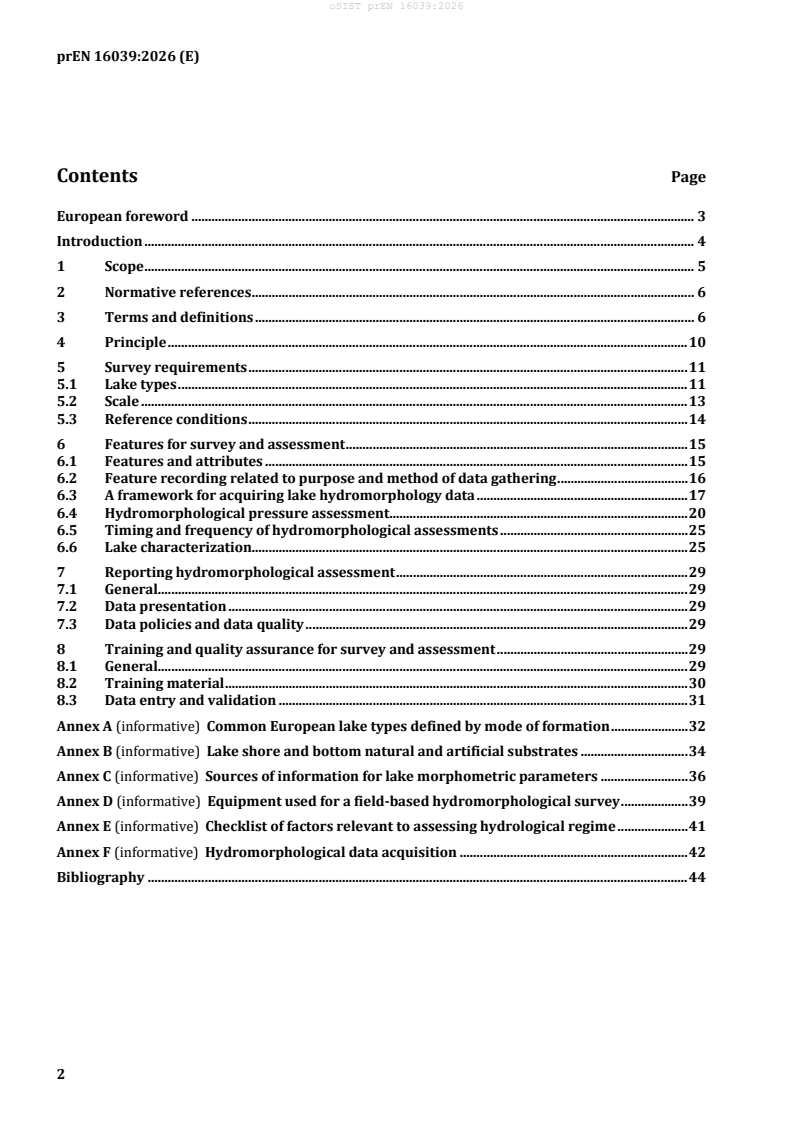
Contents Page
European foreword . 3
Introduction . 4
1 Scope . 5
2 Normative references . 6
3 Terms and definitions . 6
4 Principle . 10
5 Survey requirements . 11
5.1 Lake types . 11
5.2 Scale . 13
5.3 Reference conditions . 14
6 Features for survey and assessment . 15
6.1 Features and attributes . 15
6.2 Feature recording related to purpose and method of data gathering . 16
6.3 A framework for acquiring lake hydromorphology data . 17
6.4 Hydromorphological pressure assessment . 20
6.5 Timing and frequency of hydromorphological assessments . 25
6.6 Lake characterization. 25
7 Reporting hydromorphological assessment . 29
7.1 General. 29
7.2 Data presentation . 29
7.3 Data policies and data quality . 29
8 Training and quality assurance for survey and assessment . 29
8.1 General. 29
8.2 Training material . 30
8.3 Data entry and validation . 31
Annex A (informative) Common European lake types defined by mode of formation . 32
Annex B (informative) Lake shore and bottom natural and artificial substrates . 34
Annex C (informative) Sources of information for lake morphometric parameters . 36
Annex D (informative) Equipment used for a field-based hydromorphological survey . 39
Annex E (informative) Checklist of factors relevant to assessing hydrological regime . 41
Annex F (informative) Hydromorphological data acquisition . 42
Bibliography . 44
European foreword
This document (prEN 16039:2026) has been prepared by Technical Committee CEN/TC 230 “Water
analysis”, the secretariat of which is held by DIN.
This document is currently submitted to the CEN Enquiry.
This document will supersede EN 16039:2011.
The main changes in prEN 16039:2026 compared to EN 16039:2011 are:
— technological advances in the use of remote sensing methods have been added to monitoring lake
hydromorphology procedures and the methodologies have been updated according to the
experiences collected during application of the methods since the first publication of the document.
Introduction
This document contains lists of lake features and guidance on how to record, analyse and interpret the
data obtained from desk-top, remote sensing and field surveys. In this document the word ‘lake’ is used
as a generic term for standing waters, including natural and modified lakes, reservoirs and excavated pits.
The physical character of a lake is defined by its morphometry (size and shape), by its hydrological and
sediment supply regimes, and by the nature of its riparian and aquatic vegetation, all of which are
contingent on the landscape setting of the lake–catchment system and its environmental history.
Ensuring that the key physical characteristics and associated physical processes operating within lakes
are accurately and consistently assessed across different lake types is essential in understanding a lake’s
resilience to the effects of human pressures in helping to understand the extent to which its biodiversity
could have diminished. The assessment of physical characteristics and processes is required for a range
of purposes, including the EC Water Framework Directive (WFD) [1], the EC Habitats Directive [2], the
EC Floods Directive, the EC Biodiversity Strategy for 2030, for Environmental Impact Assessment, and
for lake management and restoration, all of which are vehicles for addressing the climate and nature
emergencies.
The WFD requires physical features of surface waters to be considered when assessing ’ecological status’
and refers to these features as hydromorphological. Annex V of the WFD lists two categories of
hydromorphological ‘quality elements’ for assessing lakes – ‘hydrological regime’ and ‘morphological
conditions’ – each sub-divided into several specified characteristics. Those in the hydrological category
comprise the quantity and dynamics of flow, level, residence time and connection to groundwaters,
whereas those in the morphological category are lake depth variation, quantity and structure of the
substrate and the structure and condition of the lake shore zone.
The Habitats Directive applies to a wide range of terrestrial, freshwater and marine habitats and species.
The Directive requires Member States to maintain or restore these to ‘favourable conservation status’,
partly by designating Special Areas of Conservation (SACs). The EU Biodiversity Strategy for 2030 is
closely related to the Habitats Directive in that it seeks to expand the area of SACs. For lakes, the process
of selection and monitoring SACs involves recording and regularly assessing a suite of physical, chemical
and biological features. A standard approach to hydromorphological assessment, although not
specifically required by the Directive, thus enables the contribution of physical structure and hydrology
to favourable conservation status to be assessed, and allows comparisons to be made between Member
States.
The Floods Directive requires Member States to develop flood risk assessments, maps, and management
plans for both current and future flood risk. As with the Habitats Directive, a standard approach to
hydromorphological assessment is not specifically required, but it can nevertheless provide an enhanced
understanding of how lakes and their catchments can contribute to flood risk management.
NOTE In this document, ‘assessment’ is used as a broad term referring to the general description and
characterization of lake features and the pressures that impinge upon them. It is not used to imply particular levels
of ‘quality’ or ‘value’, whether related to ecological status under the WFD or more generally.
1 Scope
This document is applicable to lakes, which are water bodies occupying one or more basins with surface
areas typically greater than 1 ha (0,01 km ) and maximum depths (at mean water level) greater than 1 m.
All types of permanent and temporary lakes, including natural, modified and artificial, freshwater and
brackish, except for those systems which regularly connect to the sea, are included in this document.
Based on these criteria, it can be estimated that there are at least 500 000 natural lakes across Europe,
most of which are located in the glaciated landscapes in northern and western provinces and in
Scandinavia. Lakeland districts also occur locally in areas such as large river catchments (e.g. the
Danubian plain) and around the Alps. Elsewhere, naturally occurring lakes are relatively sparse and in
such areas reservoirs or pits are more common.
This document is designed to:
a) support environmental and conservation agencies in meeting the monitoring requirements of the
WFD (Article 8, Annex II and Annex V);
b) generate data sets appropriate for monitoring and reporting of Natura 2000 sites designated under
the Habitats Directive and the Birds Directive;
c) provide information supporting other environmental reporting requirements (e.g. in relation to
biodiversity or environmental impact assessment);
d) support lake management and restoration initiatives.
This document:
e) defines the key term of ‘hydromorphology’ and other terms relating to the morphological
characteristics of lakes and their hydrological regimes;
f) details essential features and processes of lakes that should be characterized as part of a
hydromorphological survey and for determining the hydromorphological condition of a lake;
g) identifies and defines the key pressures affecting European lakes;
h) provides guidance on strategies for collecting hydromorphological data depending on resources
available and the anticipated use of the assessment; a hierarchy of approaches is recognized from the
‘overview method’ utilizing existing databases, maps and remote sensing data through to recognized
field-based survey techniques such as Lake Habitat Survey (LHS) [3];
i) offers guidance on data presentation;
j) establishes guidance on data quality assurance issues.
This document does not deal with biological assessments in lakes such as the presence or absence of
individual species or community composition, nor does it attempt to link specific hydromorphological
features with their associated biological communities or to create a classification based on such links.
However, it is relevant where plants or other organisms form significant structural elements of the
habitat (e.g. a gradation from riparian to littoral vegetation).
With respect to the WFD, the hydromorphological condition of a lake only contributes to its status
classification at high ecological status (HES). Hydromorphological conditions are not defined for good
and moderate status but shall be sufficient to support the biological elements. However, some countries
are now beginning to classify lakes according to their hydromorphology. The information gathered by
using this standard can provide a basis for classification, but this classification is the subject of EN 16870
and not EN 16039.
2 Normative references
There are no normative references in this document.
3 Terms and definitions
For the purposes of this document, the following terms and definitions apply.
ISO and IEC maintain terminology databases for use in standardization at the following addresses:
— ISO Online browsing platform: available at https://www.iso.org/obp/
— IEC Electropedia: available at https://www.electropedia.org/
3.1
aquatic macrophyte
larger plant of fresh water that is easily seen with the naked eye, including all aquatic vascular plants,
bryophytes, stoneworts (Characeae) and macro-algal growths
Note 1 to entry: This definition includes plants associated with open water or wetlands with shallow water.
3.2
attribute
specific recorded elements of a hydromorphological feature
Note 1 to entry: Example – ‘silt’ and ‘boulders’ are natural substrate texture attributes, ‘sheet piling’ and ‘gabions’
are attributes of engineered banks.
3.3
bank
physical edge of the lake shore, or of the island(s) within
Note 1 to entry: Generally defined by a wave-cut break in slope at or near the water’s edge of the lake, but can also
be defined as the line along which riparian (terrestrial or land) conditions change to littoral in-lake conditions.
3.4
bathymetry
systematic survey of size, shape and water depth distribution in a lake
Note 1 to entry: Bathymetry is the basis of deriving morphometric parameters and to predict thermal stratification,
residence time and sediment redistribution processes.
3.5
bay
indent of the lake shore which can span from metres to many kilometres in size
Note 1 to entry: Bays are normally protected by a promontory (or headland) projecting from the shore which
reduces exposure. Bays often contain beach deposits.
3.6
bedform patterns
topography of the lake bed may be simple or complex depending on the size and shape of the system and
the nature of local sediment transport processes
Note 1 to entry: Deposition produces bedforms such as sand and gravel bars, whereas erosion results in scour
features such as troughs.
3.7
beach
sub-zone of the exposed shore above the water line of a lake defined by the accumulation of sediment
(texturally will range in grain size from clays and silts through to boulders) depending on the energetics
of the wave environment and the geomorphological history of the site
3.8
bedrock
in situ naturally consolidated rock either underlying drift deposits such as glacial till or exposed by past
or current erosion processes
3.9
catchment
drainage basin contributing water and sediment into a lake
Note 1 to entry: Also recognized as drainage area.
3.10
connectivity
degree of coupling (natural or impeded) between the lake basin and surrounding/underlying
groundwater and surface water bodies
3.11
continuity
uninterrupted movement of water, sediment and organisms into, out of and within a lake system
3.12
deflation basin
shallow depression formed by wind erosion
3.13
ecological status
expression of the quality of the structure and functioning of aquatic ecosystems associated with surface
waters, classified in accordance with Annex V
[SOURCE: European Water Framework Directive: Article 2.21]
3.14
eulittoral zone
area of the lake shore spanning the mean annual high and mean annual low water level
3.15
exposure
measure of the energetics of a shoreline segment obtained from various fetch calculations
3.16
fetch
distance of open water over which the wind can blow and generate wind-driven waves
3.17
headland
promontory of land projecting into water
3.18
hydromorphology
physical and hydrological characteristics of lakes including the underlying physical processes from which
they result
3.19
hypsographic curve
depth–area curve describing the form of the basin
3.20
island
landform protruding from the surface of the lake
Note 1 to entry: A useful size-based classification for island features is as follows:
Outcrop: < 0,001 km
2 2
Islet: 0,001 km to < 0,01 km
2 2
Island: 0,01 km to 1 km
Large island: > 1 km
3.21
lake altitude
elevation of a reference height such as lake mean annual water surface level above reference sea level
datum
3.22
lake basin
defined hollow which is permanently or temporarily filled with water
Note 1 to entry: Basin size and shape (morphometry) strongly control the fluxes of substances in lakes and the
structure and function of lake food webs.
3.23
lake perimeter
equivalent to the shoreline length measured at a reference level such as the mean annual water level
3.24
lake surface area
planimetric surface area of the lake water body
3.25
lake type
group of lakes that can be broadly differentiated from other groups on the basis of their physical and
chemical characteristics
3.26
littoral zone
habitat extending from the water’s edge to the lakeward limit of rooted macrophytes or algae on the lake
bed
3.27
longshore drift
process of sediment transport along the lake shore (coast) driven by shore-wise currents and wave action
3.28
morphometry
basin shape, or form, which expresses how water depth varies with surface area (hypsographic curve)
and includes both mean and maximum water depth
Note 1 to entry: Basis for deriving indices used for morphometric analysis of important lake functions.
3.29
pelagic zone
open water zone extending from the littoral zone to the centre of a lake
Note 1 to entry: In the deeper parts of the pelagic zone (known as the profundal zone) light does not penetrate and
there is no photosynthetic activity.
3.30
planform
view of lake shape from above
Example: Elongate, circular, etc., and also relevant in relation to the shoreline development index which
expresses the degree of irregularity of a lake compared with a circular form of the same area.
3.31
reference conditions
conditions that are totally, or nearly totally undisturbed by human activity
3.32
remote sensing image analysis unsupervised classification
use of computational classification algorithms using spectral data trained on sample data with known
characteristics (e.g. land cover, vegetation types, harbours)
3.33
remote sensing image data analysis supervised classification
interpretation of image features (e.g. land cover, specific object identification) by experienced human
interpreters of digital images or photographs
3.34
riparian zone
area of land adjoining the lake capable of directly influencing the condition of the aquatic ecosystem (e.g.
by shading and leaf litter input)
3.35
shoreline length
length of the lake perimeter at mean annual water level
Note 1 to entry: In practice, lake perimeter is derived from a relevant scaled topographic map.
3.36
shore reinforcement
work undertaken to prevent or mitigate erosion on the banks and shore of a lake
Note 1 to entry: Hard engineering uses materials such as concrete walls, gabion baskets and sheet piling, whereas
soft engineering uses natural materials such as basket-work and planted vegetation such as willow saplings to
stabilize banks.
3.37
shore zone
comprises riparian, eulittoral and littoral zones around the perimeter of a lake
3.38
stratification
variations in water column structure with respect to temperature and density
3.39
substrate (substratum)
natural sediment or engineered surface comprising the shore and bed of a lake
Note 1 to entry: Natural sediments are generally characterized by texture and organic matter content, whereas
artificial substrates are described by their construction materials (see Annex B).
3.40
vegetation structure
physical character of the vegetation that creates habitat
3.41
water level regime
range, frequency and timing of water level fluctuations
3.42
wave base
water depth to which wind-driven waves penetrate, thus separating areas of the lake bottom where wave
action erodes and transports sediments from the zone below where sedimentation is continuous without
resuspension
3.43
wetland
transitional zone between permanently inundated, and generally dry, environments, e.g. marshes (wet
ground without peat), fens (groundwater fed peats) and bogs (rain-fed peat systems)
4 Principle
This document describes a protocol for recording the physical features of lake systems, including both
their gross morphometry (size and shape of the lake basin and its upstream catchment relationships) as
well as characterizing morphological and hydrological attributes that control the behaviour and
functioning of the system. It also describes the physical pressures that have impacts on lake systems. The
document provides a common assessment framework recognizing the strengths and limitations of
different assessment methods, and provides guidance on selecting the most appropriate approaches
depending on lake size, lake type or site-specific characteristics, and on the purpose of the assessment
exercise. Guidance is given on the hydromorphological features that should be used for characterizing
lake types and for subsequent assessment of morphological integrity through comparison with reference
conditions.
5 Survey requirements
5.1 Lake types
Every lake is unique, each with a particular genesis, morphometry, catchment/landscape relationship,
biogeography and environmental history. Lakes exist within a continuum of size, depth, form, altitude,
geology, climate, hydrological regime and catchment characteristics, so in some cases defining site-
specific reference conditions is appropriate. However, describing and identifying lake ’types’ enables the
results of hydromorphological surveys from different types to be compared. In addition, defining ’high
status’, type- (or site-) specific, reference conditions in lakes is a requirement of the WFD, with the aim of
comparing the quality of lakes in an equitable and ecologically meaningful way. Some
hydromorphological assessment methods are not linked to lake types but can still provide useful
information for better lake management; this document therefore includes consideration of such
methods. Information required to define lake types can often be derived from topographical and
geological maps, remote sensing images, or catchment-wide databases. Types may be refined by using
information gathered during field surveys, or through input from expert opinion. It is recommended that
the following factors should be considered in the definition of lake types (see Table 1 together with
Annex A, modes of formation):
Size: Surface area of the lake, catchment area;
Depth: Maximum and mean depth, with the latter expressed as three categories - very shallow, shallow
and deep;
Lake basin form: Shape of lake basin (hypsographic form) represented by three categories – convex,
concave or linear;
Geology: A minimum of four lithological categories, preferably more – e.g. siliceous, calcareous, organic,
sodic/saline (or mixed); this principally applies to the catchment because rock type strongly influences
hydrological pathways e.g. contrasts surface water supplied versus groundwater-fed systems, but also
provides a surrogate for alkalinity;
Geographical location: Latitude and longitude;
Altitude: Altitude of lake, altitude of source within the catchment;
Hydrological regime: Quantity and dynamics of the flow expressed especially through water level
variability (daily, seasonally and annually) and residence time dynamics.
Table 1 lists the physical and chemical features used to derive lake types in the legislative context of the
WFD. In this example, lakes are typed either according to geographic location (ecoregions) together with
a set of obligatory ‘descriptors’ (System A), or using an equivalent approach based on ’obligatory and
optional factors’ (System B).
Table 1 — The two systems for determining lake type provided in the Water Framework
Directive
KEY FACTORS DESCRIPTORS
System A
Ecoregion Ecoregions shown on Map A in Annex XI
Altitude typology high: > 800 m
mid-altitude: 200 m to 800 m
lowland: < 200 m
Depth typology based on mean depth < 3 m
3 m to 15 m
> 15 m
2 2
Size typology based on surface area 0,5 km to 1 km
2 2
1 km to 10 km
2 2
10 km to 100 km
> 100 km
Geology calcareous siliceous
organic
System B
Alternative characterization Physical and chemical factors that determine the
characteristics of the lake and hence the biological
population
structure and composition
Obligatory factors altitude
latitude
longitude
depth
geology
size
Optional factors mean water
depth lake shape
residence time
mean air
temperature air
temperature range
mixing characteristics (e.g. monomictic, dimictic,
polymictic) acid neutralizing capacity
background nutrient status
mean substratum composition
water level fluctuation
5.2 Scale
5.2.1 General
Scale is important in lake hydromorphological assessment owing to the large numbers of lakes involved
and their size range, e.g. from the smallest (approximately 1 ha) to the largest in Western Europe – Lake
Vänern in Sweden at 5 670 km . Different applications also require different levels of detail, e.g. SAC
condition monitoring for Natura 2000 sites can require analysis of the entire lake– catchment system,
whereas analysis of the linkages between hydromorphological alteration and ecological response can be
most appropriate at the scale of habitat patches. Together with lake size, other factors determining the
appropriate scale of survey include the goal of the assessment, access to the lake, and availability of data,
e.g. on human pressures, maps, aerial photos or satellite images. To illustrate this point further, it can be
shown that a lake shoreline measurement (by map measurer or digitizing) varies significantly as a
function of map scale.
The consideration of scale in assessing the severity of impacts is also important; i.e. a small-scale pressure
can be insignificant on a large lake but have significant impacts on a small lake. Different survey
techniques are scale-dependent. For example, catchment and riparian zone pressures can be best
analysed using geospatial databases and remote sensing techniques, whereas characterizing the quantity
and structure of the substrate can generally only be tackled using field survey techniques, or by use of
emerging, new technologies such as hydroacoustics or Green LiDAR (Light Detection and Ranging).
5.2.2 Dividing the lake system into zones for hydromorphological assessment
Small to medium lakes are generally considered as single units. In large and morphologically complex
lakes with discrete and only partially interconnected sub-basins, different reference conditions may
apply. In exceptional situations several very small co-located bodies of water may be grouped and treated
as a composite lake basin. Although many schemes exist to classify lakes into functional zones, the key
for the present purposes is simplicity and general applicability across Europe. Within large, natural, deep
lakes the most useful distinction is between the shore zone and the open water sub-systems found off-
shore. The latter include circulatory lake basins and major embayments extending to either the silt–sand
sediment boundary or the attached plant boundary. Seasonal stratification is likely where water depth is
sufficient, which in turn influences mixing, dissolved oxygen profiles and hydraulic residence times.
Below the wave base the lake bed is typically composed of fine sediment with a low diversity of habitat
types and the profundal zone is free of any rooted macrophytes. The shore zone extends from the
lakeward limit of rooted vegetation through the littoral, exposed shore and riparian zone beyond. It is
typically more diverse in morphometry, energy regime and substrate characteristics with assorted
macrophyte and macroinvertebrate assemblages, and provides important spawning and nursery habitats
for fish.
To a large extent these key principles can also be applied to artificial reservoirs. However, in these
modified ecosystems, littoral vegetation is often limited or absent as a result of extensive water level
fluctuations or steep bank slopes. The shore zone generally has a lower diversity of habitats; its interface
with the deep-water zone can be more difficult to determine, and its importance and nature can fluctuate
considerably in response to the water level of the reservoir. Sediment distribution is strongly influenced
by the upstream/downstream flow gradient. In addition, the stratification regime and residence times
are highly dependent on hydraulic management; information on this is essential for using this Standard
to assess artificial reservoirs. In very shallow lakes the entire lake bed is likely to be colonized by
macrophytes. In such cases, the term ‘near-shore’ still usefully draws attention to pressures most strongly
associated with shore and land-based activities.
5.2.3 Lake–catchment relations
The catchment area (topographically defined) is the area draining into a lake. It is considered a relevant
zone because of the coupling of lake systems to water, mineral sediment and organic matter inputs from
the catchment. The relationship between the lake and its catchment can be strong or weak depending on
lake type, catchment size, landscape setting, groundwater connectivity and degree of catchment
alteration and so should be explicitly addressed in the hydromorphological assessment process. Human
pressures in the catchment cause a range of responses including water quality changes (e.g. increased
phosphorus loading which can indirectly lead to enhanced organic sediment accumulation on the lake
bed). However, hydrological regime alteration and land use/land management pressures leading to
increased soil erosion and accelerated sedimentation are particularly important from a
hydromorphological perspective. It is also increasingly important to recognize the indirect pressures
associated with climate change such as warming conditions, more frequent and larger hydrological
extremes of flooding and drought conditions. These will alter catchment water balance, sediment and
nutrient fluxes accompanying changing land management and adaptation practices.
5.3 Reference conditions
5.3.1 General
The identification of hydromorphological reference conditions is an essential pre-requisite for assessing
the condition, or degree of hydromorphological modification present in a lake that has been affected by
human activity (pressures). It is also a specific requirement of the WFD as part of the water body
classification process. Reference conditions should be identified within each lake type reflecting totally,
or near totally, undisturbed conditions.
The hydromorphological quality elements listed in Annex V of the WFD distinguish between hydrological
regime represented by the quantity and dynamics of flow, level, residence time and connection to
groundwaters, and morphology represented by lake depth variation, quantity and structure of the
substrate and the structure and condition of the lake shore zone, together with dynamic sedimentary
processes including rates and patterns of erosion or sedimentation. The criteria for reference conditions
given below are intended to give a general indication, not a detailed description. Within any given
national typology of lake types, each type should have its distinctive features characterized; thus,
hydromorphological modification is assessed as the degree of departure from reference conditions that
a site exhibits.
At their simplest, reference conditions refer to a complete lack of human interventions and pressures, but
they also need to be linked to the lake hydromorphological type under consideration. For the assessment
of near-natural reference conditions and processes of a lake, information is assembled on processes,
forms and human interventions across different spatial units (catchment, lake shore, lake bed) and how
these have changed through time. This information can be used to identify lakes with near-natural
properties.
When considering substantially altered natural lakes, reservoirs and artificial water bodies, which qualify
under the WFD as either heavily modified water bodies (HMWBs) or artificial water bodies (AWBs), the
concept of reference condition as defined above will only be applicable in some cases. If an HMWB or
AWB is operated or managed in such a way that its hydromorphological processes and forms mimic those
in naturally occurring lake types, then it is possible to identify a near-natural reference condition. For
example, the processes and forms in an ornamental lake with a passive water level regime could
approximate those in a naturally occurring lake once sufficient time has elapsed since its creation. If an
HMWB or AWB is operated or managed in such a way that its hydromorphological processes and forms
are far removed from any that occur in nature in a comparable physiographical zone, the concept of
reference condition will need to be defined on a site-specific basis and with reference to a comparable
natural analogue. The hydromorphological conditions should be consistent with the only impacts on the
surface water body being those resulting from the artificial or heavily modified characteristics of the
water body once all mitigation measures have been taken to ensure the best approximation to an
ecological continuum, in particular with respect to the migration of fauna and appropriate spawning and
breeding grounds.
5.3.2 Lake water balance and hydrological regime
Inflow and outflow volumes and dynamics are minimally altered and no or minimal obvious catchment
or lake structures exist to affect the natural water balance, lake level, stratification and mixing processes
or the hydraulic residence time of the system. Water level fluctuations must therefore be within the
envelope of natural variability (either observed or modelled).
5.3.3 Lake morphometry
Size and shape of the basin is effectively unaltered from the natural condition, with no or minimal
engineering pressures such as land claim or aggregate extraction affecting natural lake depth variation.
The rate and location of erosion and sedimentation processes is also consistent with natural rates within
the lake basin and associated catchment.
5.3.4 Shore and lake bed character
Corresponds to the condition where the shore and lake bed are composed of natural materials. No or
minimal artificial or in-lake or lake shore structures disrupt natural hydromorphological processes such
as longshore sediment transport or wave generation which govern the quantity and structure of the
substrate. Free from human disturbance to sediment supply from the catchment, lake shore or
autochthonous sediment production.
5.3.5 Hydromorphological connectivity and biological continuity
There are no or minimal structural impediments or significant abstraction pressures that prevent the
natural sediment transfers and exchange with groundwater or surface water. Similarly, there should be
no or minimal physical impediments to the movements of biota, such as impassable dams or grilles, which
prevent the passage of migratory species such as salmonids.
5.3.6 Terrestrial and aquatic vegetation
Riparian vegetation and aquatic macrophytes appropriate to the type and geographical location of the
lake. By implication, urban development, intensive agricultural activities or plantation coniferous
forestry are absent or negligible within the riparian zone. In suitable conditions, hydroseres can be
expected to occur.
6 Features for survey and assessment
6.1 Features and attributes
Table 2 provides a standard check-list of hydromorphological features for survey and assessment. These
are grouped within 11 categories and cover the two main zones of lake environments (see Figure 1):
a) the open water system;
b) the shore zone.
Key
1 riparian zone with vegetation/land use
2 shore zone
3 bank sediments
4 substrate
5 eulittoral zone
6 littoral zone
7 mean annual low water level
8 mean annual water level
9 mean annual high water level
10 beach
11 bank face
12 bank top (with bank top vegetation)
Figure 1 — Lake profile showing the main characteristics
6.2 Feature recording related to purpose and method of data gathering
Assessment categories and groups of features (as defined in Table 2) may be selected for survey
according to purpose. For example, for a comprehensive characterization of lake hydromorphological
processes, it is recommended that all categories and features should be assessed. On the other hand,
where a hydromorphological survey is required to assist in lake management and restoration, only those
features should be selected that are likely to be the most sensitive to the prevailing pressures on
hydromorphology (e.g. shore-based marina developments or off-shore aggregate harvesting). Pressure
assessments are described in 6.4.
Other combinations of features may be selected for purposes such as assessing the degree of resilience
to the effects of engineering interventions or climate change, supporting biodiversity assessment,
defining high ecological status (where the degree of hydromorphological alteration should be minimal
relative to the type-specific or site-specific reference condition), or for assessments of lakes important
for conservation. It is important also that the approach adopted is tailored to the scale of the system under
investigation. Other combinations of features may be selected for purposes such as assessing the degree
of resilience to the effects of engineering interventions or climate change, supporting biodiversity
assessment, defining high ecological status (where the degree of hydromorphological alteration should
be minimal relative to the type-specific or site-specific reference condition), or for assessments of lakes
important for conservation. It is important also that the approach adopted is tailored to the scale of the
system under investigation.
6.3 A framework for acquiring lake hydromorphology data
European standards should be both robust and parsimonious and produce consistent outcomes with a
known level of confidence. Where available, existing reliable data should be used before deciding to start
a new data collection campaign. Similarly, because of the large number of lakes that require
hydromorphological assessment, geospatial databases, geographical information systems and remote
sensing data capture systems should be used where possible. However, remote sensing methods cannot
directly quantify the full range of hydromorphological impacts (such as aggregate harvesting,
macrophyte clearance, tourism and amenity impacts) and in such cases a systematic field survey protocol
should be used.
Table 2 — Categories, features and attributes comprising a standard hydromorphological
assessment for lakes
OPEN WATER PELAGIC/ PROFUNDAL ZONE
No Assessment categories Generic features Examples of attributes assessed
1 HYDROLOGY AND Catchment hydrology Quantity and dynamics of inflows and
HYDRAULICS outflows
Describes the quantity and
Stratification/mixing The seasonality and stability of
dynamics of flow, mixing
thermal stratification as well as
behaviour and residence time
salinity-driven mixing within brackish
waters
Water column characteristics at the
Index Site (transparency, temperature
and oxygen profiles) should also be
considered against type-specific
reference conditions
Residence time Hydraulic retention equates to time
for water in a lake to be replaced,
variously calculated. Lake and
catchment water balances are likely to
be subject to alteration through the
effects of climate change
2 MORPHOMETRY Planform Spatial pattern (size and shape) of lake
surface ar
...
Questions, Comments and Discussion
Ask us and Technical Secretary will try to provide an answer. You can facilitate discussion about the standard in here.
Loading comments...