

EN 1246:1998
(Main)Adhesives - Determination of ash and sulphated ash
- Abstract
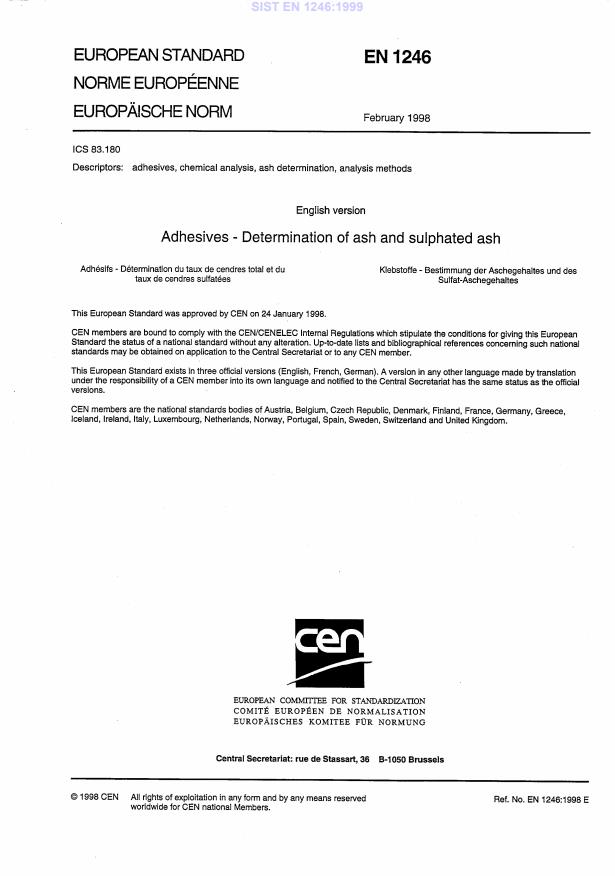
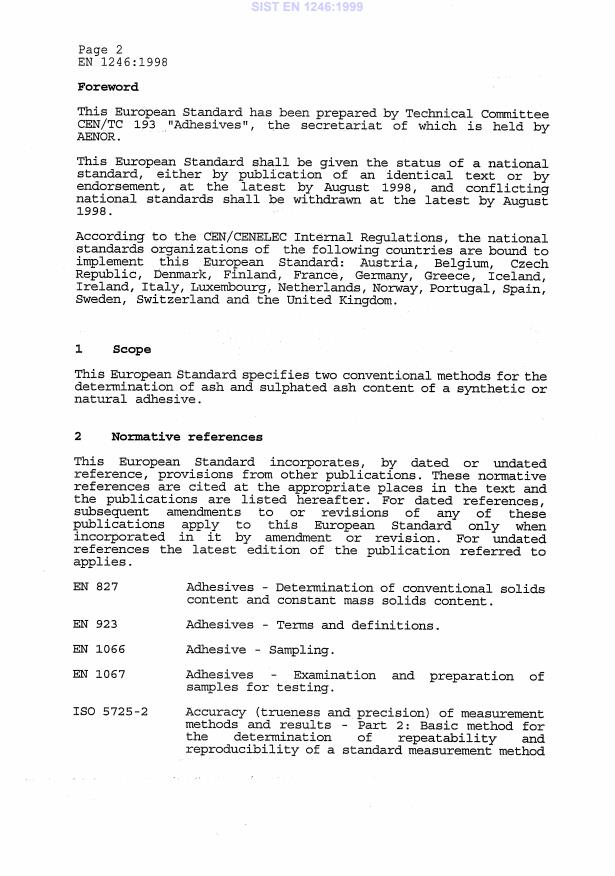
This European Standard specifies two conventional methods for the determination of ash and sulphated ash content of a synthetic or natural adhesive.
- Status
- Published
- Publication Date
- 17-Feb-1998
- Withdrawal Date
- 30-Aug-1998
- Technical Committee
- CEN/TC 193 - Adhesives
- Current Stage
- 9060 - Closure of 2 Year Review Enquiry - Review Enquiry
- Start Date
- 04-Jun-2026
- Completion Date
- 04-Jun-2026

Overview
EN 1246:1998 is a European standard developed by CEN that defines methods for determining the ash and sulphated ash content in adhesives. This standard applies to both synthetic and natural adhesives, providing a reliable and conventional approach to assess inorganic residues after the combustion of adhesive samples. The accurate measurement of ash content is essential for quality control, formulation verification, and ensuring compliance with product specifications.
Key Topics
Ash Content Determination
The standard outlines a conventional method for measuring the total ash content resulting from the combustion of adhesive materials. This helps identify the inorganic residue remaining after organic components have been burned off.Sulphated Ash Determination
EN 1246:1998 specifies a method that includes treatment with sulfuric acid before ignition to determine the sulphated ash content, which is vital for understanding the sulphur-related inorganic compounds within adhesives.Scope of Adhesives
The methods cover both natural adhesives, typically derived from biological sources, and synthetic adhesives, made from chemically formulated polymers.Standardized Procedures
The document provides step-by-step guidance on sample preparation, ignition conditions, and calculation formulas ensuring repeatability and consistency across laboratories.
Applications
Quality Control
Manufacturers use EN 1246:1998 methods to verify ash content as a quality parameter in adhesive production, ensuring product consistency and performance.Formulation Analysis
Determining ash and sulphated ash helps in the analysis of adhesive composition, especially to detect fillers or additives that impact end-use properties.Regulatory Compliance
Adhering to EN 1246 ensures compliance with European standards for adhesive materials, which can be critical for market acceptance and legal requirements.Research and Development
Adhesive formulators and R&D teams utilize these ash determination techniques to innovate and optimize adhesive formulations for improved performance.
Related Standards
EN 1939 - Adhesives - Testing of mechanical properties
Provides complementary methods for evaluating the physical and mechanical characteristics of adhesives.ISO 3451 - Plastics - Determination of Ash
Though focused on plastics, these methods are related and sometimes referenced for similar ash content analysis in polymer-based adhesives.EN 13173 - Adhesives - Sampling for testing
Describes proper sampling techniques that ensure representative adhesive specimens for testing including ash content.
By following EN 1246:1998, industry professionals can reliably determine the inorganic residue content in adhesives, contributing to product quality assurance and regulatory adherence. This standard plays a crucial role in the adhesive manufacturing and testing process, supporting high standards in adhesive performance and safety.
Relations
- Effective Date
- 10-Jun-2026
- Effective Date
- 28-Jan-2026
- Effective Date
- 28-Jan-2026
- Effective Date
- 28-Jan-2026
- Effective Date
- 28-Jan-2026
- Effective Date
- 28-Jan-2026
Get Certified
Connect with accredited certification bodies for this standard

DIN CERTCO
DIN Group product certification.

Smithers Quality Assessments
US management systems and product certification.
Sponsored listings
Frequently Asked Questions
EN 1246:1998 is a standard published by the European Committee for Standardization (CEN). Its full title is "Adhesives - Determination of ash and sulphated ash". This standard covers: This European Standard specifies two conventional methods for the determination of ash and sulphated ash content of a synthetic or natural adhesive.
This European Standard specifies two conventional methods for the determination of ash and sulphated ash content of a synthetic or natural adhesive.
EN 1246:1998 is classified under the following ICS (International Classification for Standards) categories: 83.180 - Adhesives. The ICS classification helps identify the subject area and facilitates finding related standards.
EN 1246:1998 has the following relationships with other standards: It is inter standard links to ISO 5725-2:1994, EN 923:2015, ENV 14237:2002, EN 1067:2005, EN ISO 15605:2004, EN 827:2005. Understanding these relationships helps ensure you are using the most current and applicable version of the standard.
EN 1246:1998 is available in PDF format for immediate download after purchase. The document can be added to your cart and obtained through the secure checkout process. Digital delivery ensures instant access to the complete standard document.
Standards Content (Sample)
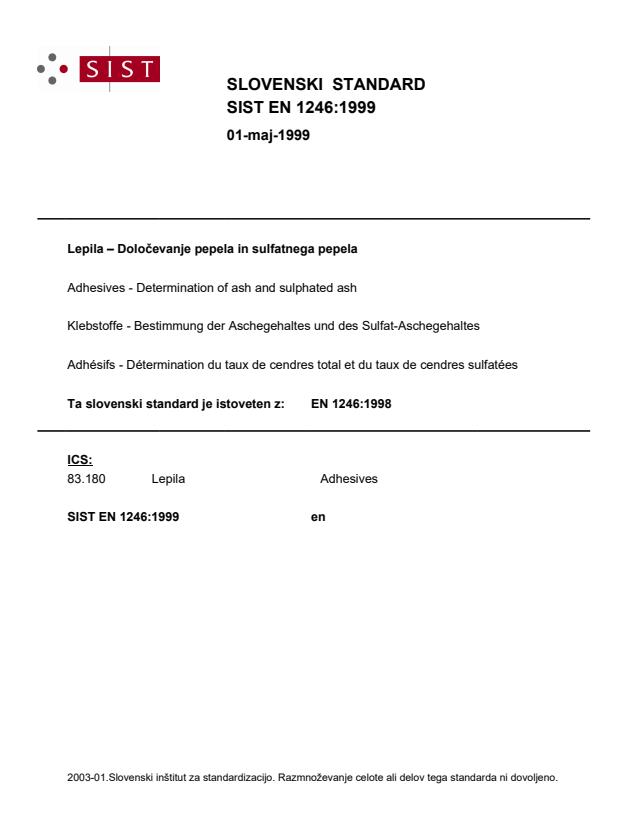
2003-01.Slovenski inštitut za standardizacijo. Razmnoževanje celote ali delov tega standarda ni dovoljeno.Klebstoffe - Bestimmung der Aschegehaltes und des Sulfat-AschegehaltesAdhésifs - Détermination du taux de cendres total et du taux de cendres sulfatéesAdhesives - Determination of ash and s
...