

EN 71-3:2019+A1:2021/prA2
(Amendment)Safety of toys - Part 3: Migration of certain elements
- Abstract
This document specifies requirements and test methods for the migration of aluminium, antimony, arsenic, barium, boron, cadmium, Chromium (III), Chromium (VI), cobalt, copper, lead, manganese, mercury, nickel, selenium, strontium, tin, organic tin and zinc from toy materials and from parts of toys.
Packaging materials are not considered to be part of the toy unless they have intended play value.
NOTE 1 See the European Commission guidance document no. 12 on the application of the Directive on the safety of toys - packaging [2].
The standard contains requirements for the migration of certain elements from the following categories of toy materials:
- Category I: Dry, brittle, powder like or pliable materials;
- Category II: Liquid or sticky materials;
- Category III: Scraped-off materials.
The requirements of this document do not apply to toys or parts of toys which, due to their accessibility, function, volume or mass, clearly exclude any hazard due to sucking, licking or swallowing or prolonged skin contact when the toy or part of toy is used as intended or in a foreseeable way, bearing in mind the behaviour of children.
NOTE 2 For the purposes of this document, for the following toys and parts of toys the likelihood of sucking, licking or swallowing toys is considered significant (see H.2 and H.3):
- All toys intended to be put in the mouth or to the mouth, cosmetics toys and writing instruments categorized as toys can be considered to be sucked, licked or swallowed;
- All the accessible parts and components of toys intended for children up to 6 years of age can be considered to come into contact with the mouth. The likelihood of mouth contact with parts of toys intended for older children is not considered significant in most cases (see H.2).
- Status
- Not Published
- Publication Date
- 03-Mar-2025
- Technical Committee
- CEN/TC 52 - Safety of toys
- Drafting Committee
- CEN/TC 52/WG 5 - Safety of toys - Chemical toys
- Current Stage
- 4097 - End of interruption of work - split/merged
- Start Date
- 10-Oct-2024
- Completion Date
- 07-Oct-2026

Overview
The EN 71-3:2019+A1:2021/prA2 is a critical European standard developed by CEN that governs the safety of toys by regulating the migration of certain hazardous elements from toy materials. This standard focuses on limiting the migration of potentially harmful substances such as aluminium, antimony, arsenic, barium, boron, cadmium, chromium (III and VI), cobalt, copper, lead, manganese, mercury, nickel, selenium, strontium, tin (including organic tin compounds), and zinc. Its main aim is to protect children from exposure to toxic elements through ingestion, sucking, licking, swallowing, or prolonged skin contact when using toys as intended or foreseeably used.
This standard applies to toy materials, excluding packaging materials unless the packaging itself has intended play value. It classifies toy materials into three categories to specify testing and limit requirements based on material types and their likelihood of causing exposure.
Key Topics
Material Categories
- Category I: Dry, brittle, powder-like, or pliable materials
- Category II: Liquid or sticky materials
- Category III: Scraped-off materials from toy surfaces
Element Migration Limits
The standard sets strict limits on the allowable migration of various elements to ensure children's safety. Testing simulates stomach acid exposure using aqueous hydrochloric acid solutions to assess substance migration levels.Testing Methodology
- Sampling and preparation are crucial, focusing on homogeneous test portions without mixing different materials except under strict guidelines (composite testing).
- Migration tests employ specific acid concentrations and temperatures to replicate physiological conditions.
- Special attention is given to stabilizing chromium (VI) during analysis to avoid interconversion with chromium (III).
- The dewaxing procedure previously used to remove wax or oil from test materials has been removed to improve reproducibility and reflect current scientific understanding.
Scope and Exemptions
The standard excludes toys where there is clearly no risk of exposure due to the toy’s design, size, or function. However, it highlights particular concern for toys designed to be mouthed by children under six years and cosmetics or writing instruments categorized as toys.Guidance and Classification
The document references related guidance such as CEN/TS 17973 on slime-type toy materials and provides clarity on categorization for consistent application of the standard across diverse toy types.
Applications
Toy Safety Compliance
Manufacturers and importers use EN 71-3:2019+A1:2021/prA2 to ensure their products meet EU safety legislation, specifically Directive 2009/48/EC on toy safety. Compliance demonstrates that toxic element migration is within safe limits, thereby reducing the risk of chemical exposure to children.Quality Control and Testing Laboratories
Laboratories rely on this standard's detailed test methods and sampling procedures to conduct accurate and reproducible migration testing. This is essential for client certification and regulatory approvals.Regulatory Use
National authorities and market surveillance bodies apply this standard to assess conformity of toys sold within Europe, supporting enforcement of strict safety regulations.Product Development
Toy designers benefit from understanding the toxicological limits and testing protocols, guiding material selection and product design decisions to avoid hazardous substances.
Related Standards
EN 71 Series – This standard is part of the EN 71 suite that addresses various aspects of toy safety including mechanical properties (EN 71-1), flammability (EN 71-2), and chemical properties (EN 71-3 and other parts).
CEN/TS 17973 – Safety of toys – Categorization of slime-type materials, related to classifying materials for testing under EN 71-3.
Directive 2009/48/EC – EU legislation on toy safety, for which compliance with EN 71-3 provides presumption of conformity regarding hazardous element migration.
Additional EN 71 Amendments – Part 15 to 19 relate to the presence of substances like formamide, flame retardants, isothiazolinones, phenol, and bisphenol A in toy materials.
Conclusion
EN 71-3:2019+A1:2021/prA2 is a vital regulatory tool aimed at minimizing children’s exposure to hazardous elements through toy materials. Its comprehensive testing methods, clear material categorizations, and stringent migration limits ensure safer toys in the European market. By following this standard, manufacturers, testing labs, and regulatory authorities collaboratively enhance product safety, uphold compliance, and protect children's health against toxic chemical exposure during play.
Keywords: EN 71-3, toy safety, migration of elements, hazardous substances in toys, toxic elements, migration testing, EU toy safety directive, toy material categories, Chromium (VI) testing, organic tin migration, CEN standards.
Relations
- Effective Date
- 16-Oct-2024
- Effective Date
- 28-Apr-2021
- Effective Date
- 03-Jun-2020
Frequently Asked Questions
EN 71-3:2019+A1:2021/prA2 is a draft published by the European Committee for Standardization (CEN). Its full title is "Safety of toys - Part 3: Migration of certain elements". This standard covers: This document specifies requirements and test methods for the migration of aluminium, antimony, arsenic, barium, boron, cadmium, Chromium (III), Chromium (VI), cobalt, copper, lead, manganese, mercury, nickel, selenium, strontium, tin, organic tin and zinc from toy materials and from parts of toys. Packaging materials are not considered to be part of the toy unless they have intended play value. NOTE 1 See the European Commission guidance document no. 12 on the application of the Directive on the safety of toys - packaging [2]. The standard contains requirements for the migration of certain elements from the following categories of toy materials: - Category I: Dry, brittle, powder like or pliable materials; - Category II: Liquid or sticky materials; - Category III: Scraped-off materials. The requirements of this document do not apply to toys or parts of toys which, due to their accessibility, function, volume or mass, clearly exclude any hazard due to sucking, licking or swallowing or prolonged skin contact when the toy or part of toy is used as intended or in a foreseeable way, bearing in mind the behaviour of children. NOTE 2 For the purposes of this document, for the following toys and parts of toys the likelihood of sucking, licking or swallowing toys is considered significant (see H.2 and H.3): - All toys intended to be put in the mouth or to the mouth, cosmetics toys and writing instruments categorized as toys can be considered to be sucked, licked or swallowed; - All the accessible parts and components of toys intended for children up to 6 years of age can be considered to come into contact with the mouth. The likelihood of mouth contact with parts of toys intended for older children is not considered significant in most cases (see H.2).
This document specifies requirements and test methods for the migration of aluminium, antimony, arsenic, barium, boron, cadmium, Chromium (III), Chromium (VI), cobalt, copper, lead, manganese, mercury, nickel, selenium, strontium, tin, organic tin and zinc from toy materials and from parts of toys. Packaging materials are not considered to be part of the toy unless they have intended play value. NOTE 1 See the European Commission guidance document no. 12 on the application of the Directive on the safety of toys - packaging [2]. The standard contains requirements for the migration of certain elements from the following categories of toy materials: - Category I: Dry, brittle, powder like or pliable materials; - Category II: Liquid or sticky materials; - Category III: Scraped-off materials. The requirements of this document do not apply to toys or parts of toys which, due to their accessibility, function, volume or mass, clearly exclude any hazard due to sucking, licking or swallowing or prolonged skin contact when the toy or part of toy is used as intended or in a foreseeable way, bearing in mind the behaviour of children. NOTE 2 For the purposes of this document, for the following toys and parts of toys the likelihood of sucking, licking or swallowing toys is considered significant (see H.2 and H.3): - All toys intended to be put in the mouth or to the mouth, cosmetics toys and writing instruments categorized as toys can be considered to be sucked, licked or swallowed; - All the accessible parts and components of toys intended for children up to 6 years of age can be considered to come into contact with the mouth. The likelihood of mouth contact with parts of toys intended for older children is not considered significant in most cases (see H.2).
EN 71-3:2019+A1:2021/prA2 is classified under the following ICS (International Classification for Standards) categories: 97.200.50 - Toys. The ICS classification helps identify the subject area and facilitates finding related standards.
EN 71-3:2019+A1:2021/prA2 has the following relationships with other standards: It is inter standard links to EN 71-3:2019+A2:2024, EN 71-3:2019+A1:2021, EN 71-3:2019. Understanding these relationships helps ensure you are using the most current and applicable version of the standard.
EN 71-3:2019+A1:2021/prA2 is associated with the following European legislation: EU Directives/Regulations: 2009/48/EC; Standardization Mandates: M/445, M/589. When a standard is cited in the Official Journal of the European Union, products manufactured in conformity with it benefit from a presumption of conformity with the essential requirements of the corresponding EU directive or regulation.
EN 71-3:2019+A1:2021/prA2 is available in PDF format for immediate download after purchase. The document can be added to your cart and obtained through the secure checkout process. Digital delivery ensures instant access to the complete standard document.
Standards Content (Sample)
SLOVENSKI STANDARD
01-maj-2024
Varnost igrač - 3. del: Migracija določenih elementov - Dopolnilo A2
Safety of toys - Part 3: Migration of certain elements
Sicherheit von Spielzeug - Teil 3: Migration bestimmter Elemente
Sécurité des jouets - Partie 3 : Migration de certains éléments
Ta slovenski standard je istoveten z: EN 71-3:2019+A1:2021/prA2
ICS:
97.200.50 Igrače Toys
2003-01.Slovenski inštitut za standardizacijo. Razmnoževanje celote ali delov tega standarda ni dovoljeno.
DRAFT
EUROPEAN STANDARD
EN 71-3:2019+A1:2021
NORME EUROPÉENNE
EUROPÄISCHE NORM
prA2
March 2024
ICS 97.200.50
English Version
Safety of toys - Part 3: Migration of certain elements
Sécurité des jouets - Partie 3 : Migration de certains Sicherheit von Spielzeug - Teil 3: Migration bestimmter
éléments Elemente
This draft amendment is submitted to CEN members for enquiry. It has been drawn up by the Technical Committee CEN/TC 52.
This draft amendment A2, if approved, will modify the European Standard EN 71-3:2019+A1:2021. If this draft becomes an
amendment, CEN members are bound to comply with the CEN/CENELEC Internal Regulations which stipulate the conditions for
inclusion of this amendment into the relevant national standard without any alteration.
This draft amendment was established by CEN in three official versions (English, French, German). A version in any other
language made by translation under the responsibility of a CEN member into its own language and notified to the CEN-CENELEC
Management Centre has the same status as the official versions.
CEN members are the national standards bodies of Austria, Belgium, Bulgaria, Croatia, Cyprus, Czech Republic, Denmark, Estonia,
Finland, France, Germany, Greece, Hungary, Iceland, Ireland, Italy, Latvia, Lithuania, Luxembourg, Malta, Netherlands, Norway,
Poland, Portugal, Republic of North Macedonia, Romania, Serbia, Slovakia, Slovenia, Spain, Sweden, Switzerland, Türkiye and
United Kingdom.
Recipients of this draft are invited to submit, with their comments, notification of any relevant patent rights of which they are
aware and to provide supporting documentation.
Warning : This document is not a European Standard. It is distributed for review and comments. It is subject to change without
notice and shall not be referred to as a European Standard.
EUROPEAN COMMITTEE FOR STANDARDIZATION
COMITÉ EUROPÉEN DE NORMALISATION
EUROPÄISCHES KOMITEE FÜR NORMUNG
CEN-CENELEC Management Centre: Rue de la Science 23, B-1040 Brussels
© 2024 CEN All rights of exploitation in any form and by any means reserved Ref. No. EN 71-3:2019+A1:2021/prA2:2024 E
worldwide for CEN national Members.
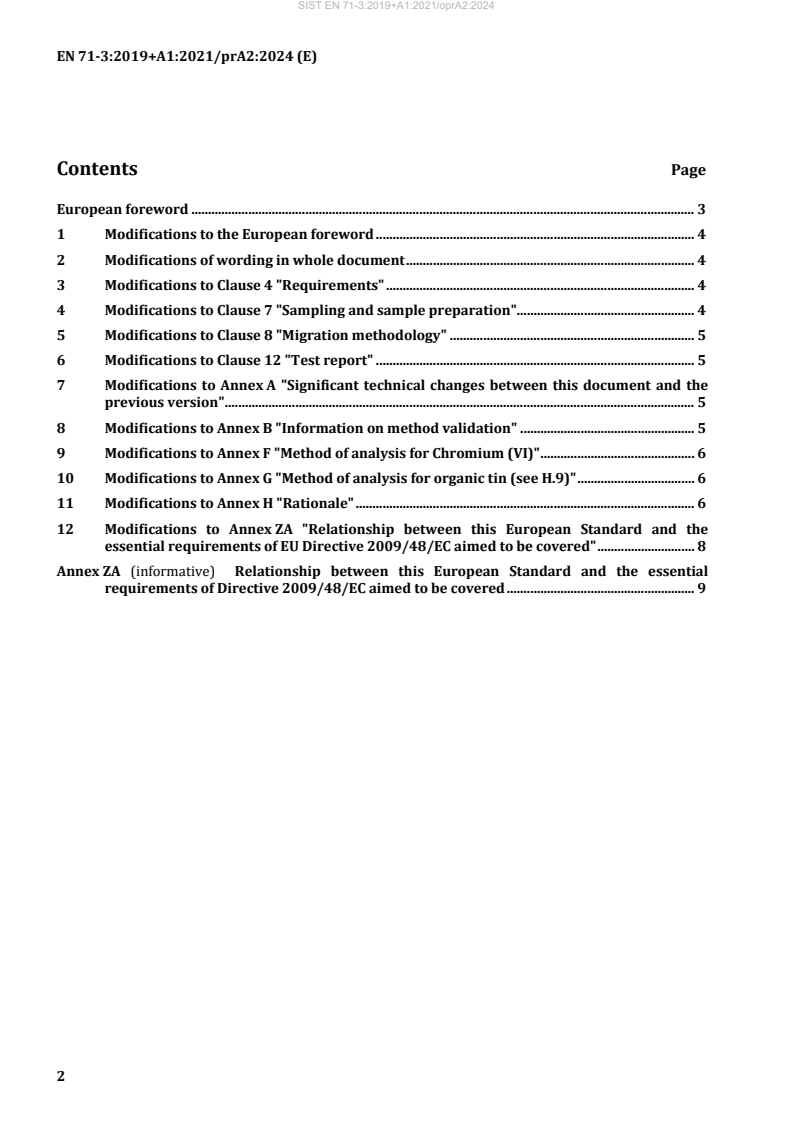
Contents Page
European foreword . 3
1 Modifications to the European foreword . 4
2 Modifications of wording in whole document . 4
3 Modifications to Clause 4 "Requirements" . 4
4 Modifications to Clause 7 "Sampling and sample preparation" . 4
5 Modifications to Clause 8 "Migration methodology" . 5
6 Modifications to Clause 12 "Test report" . 5
7 Modifications to Annex A "Significant technical changes between this document and the
previous version" . 5
8 Modifications to Annex B "Information on method validation" . 5
9 Modifications to Annex F "Method of analysis for Chromium (VI)" . 6
10 Modifications to Annex G "Method of analysis for organic tin (see H.9)" . 6
11 Modifications to Annex H "Rationale" . 6
12 Modifications to Annex ZA "Relationship between this European Standard and the
essential requirements of EU Directive 2009/48/EC aimed to be covered" . 8
Annex ZA (informative) Relationship between this European Standard and the essential
requirements of Directive 2009/48/EC aimed to be covered . 9
European foreword
This document (EN 71-3:2019+A1:2021/prA2:2024) has been prepared by Technical Committee
CEN/TC 52 “Safety of toys”, the secretariat of which is held by DS.
This document is currently submitted to the CEN Enquiry.
This document will amend EN 71-3:2019+A1:2021.
This document has been prepared under a standardization request addressed to CEN by the European
Commission. The Standing Committee of the EFTA States subsequently approves these requests for its
Member States.
For the relationship with EU Legislation, see informative Annex ZA, which is an integral part of this
document.
1 Modifications to the European foreword
Remove the reference to Part 9 from the list of parts.
Add the following references in the list of parts: “
— Part 15: Formamide in foam toy materials
— Part 16: Certain flame retardants in toy materials
— Part 17: Isothiazolinones in aqueous toy materials
— Part 18: Phenol in aqueous and polymeric toy materials
— Part 19: Migration of bisphenol A from toy materials”.
Add the following references to the list of guidance documents: “
— CEN/TS 17973: Safety of toys — Categorization of slime type materials;
— CEN/TR 17695: Safety of toys — Mechanical and physical properties — Guidance on categorisation of
projectile toys within EN 71-1”.
2 Modifications of wording in whole document
Align the wording of "hydrochloric acid solution" in the whole document with subclause 6.1 by replacing
"hydrochloric acid" by "hydrochloric acid solution", whenever relevant.
3 Modifications to Clause 4 "Requirements"
Add the following note after the first paragraph in 4.1 "Toy material categories (see H.4)":
NOTE CEN/TS 17973:2023, Safety of toys — Categorization of slime type materials, specifies a method for
categorization of slime-type products to support users of EN 71-3 in the categorization of products with slime-like
behaviour into material categories 1 (dry, brittle, powder-like or pliable toy material) or 2 (liquid or sticky toy
material).".
4 Modifications to Clause 7 "Sampling and sample preparation"
th th
Replace the 5 and 6 sentences of 7.1 "Selection of test portions" with the following:
"Test portions shall not be composed of more than one toy material unless discrete specimens cannot be
separated physically, e. g. dot printing, patterned textiles, multi-coloured printed surfaces etc. Such test
portions made of more than one toy material shall be representative of the whole material.
NOTE Although this document requires test portions are made up of one material, test portions made up of
multiple materials can be a useful means of verification testing, provided care is taken with sample selection and
analysis. See H.5. for further information.".
Delete subclause 7.2.3, “Dewaxing (see H.11)” in its entirety including its subclauses 7.2.3.1 and 7.2.3.2 until
Clause 8.
5 Modifications to Clause 8 "Migration methodology"
Replace subclause 8.1.2 "Category I: Dry, brittle, powder like or pliable materials and Category II: Liquid or
sticky materials" including its subclauses 8.1.2.1 and 8.1.2.2 until 8.1.3 with the following:
"8.1.2 Category I: Dry, brittle, powder like or pliable materials and Category II: Liquid or sticky
materials
Weigh the test portion to the nearest 0,001 g (Wtp) into the appropriately sized container (see 6.2.4).
Add 50 × Wtp (to the nearest 0,05 g) of an aqueous solution of 0,07 mol/l HCl (see 6.1.1) at (22 ± 3) °C.
For test portions of mass between 0,010 g and 0,100 g, add 5,0 ml of 0,07 mol/l HCl (see 6.1.1) at
(22 ± 3) °C.
Proceed without any delay with the appropriate pH adjustment procedure specified in 8.2 (pH
adjustment).".
nd
Replace the 2 paragraph of 8.1.3.2 "Paper and paper board" with the following:
"Add 25 × Wtp (to the nearest 0,05 g) of water at (22 ± 3) °C.".
th
Replace the 4 paragraph of 8.1.3.2 "Paper and paper board" with the following:
“Add to 25 × Wtp (to the nearest 0,05 g) of 0,14 mol/l hydrochloric acid solution (see 6.1.2) at (22 ± 3) °C
and mix.”.
nd
Replace the 2 paragraph of 8.1.3.3 "Other materials" with the following:
“Add 50 × Wtp (to the nearest 0,05 g) of an aqueous solution of 0,07 mol/l HCl (see 6.1.1) at (22 ± 3) °C.”.
Replace 8.2.2.1 with the following:
“8.2.2.1 Following the addition of diluted hydrochloric acid solution as specified in the relevant
subclause of 8.1 (preparation of test portions before migration testing), shake the mixture gently for
approximately 1 min to mix the contents.”.
6 Modifications to Clause 12 "Test report"
Delete indent i) and renumber the following indents in the list in Clause 12 "Te
...