

EN 71-4:2020+A1:2025
(Main + Amendment)Safety of toys - Part 4: Experimental sets for chemistry and related activities
- Abstract
This document specifies requirements for the maximum amount, and in some cases, the maximum concentration of certain substances and mixtures used in experimental sets for chemistry and related activities.
These substances and mixtures are:
- those classified as hazardous by the EC-legislation applying to hazardous substances and hazardous mixtures [1];
- substances and mixtures which in excessive amounts could harm the health of the children using them and which are not classified as hazardous by the above-mentioned legislation; and
- any other chemical substance(s) and mixture(s) delivered with the experimental set.
This document applies to experimental sets for chemistry and related activities including crystal growing sets, carbon dioxide generating experimental sets and supplementary sets. It also covers sets for chemical experiments within the fields of mineralogy, biology, physics, microscopy and environmental science whenever they contain one or more chemical substances and/or mixtures which are classified as hazardous according to Regulation (EC) No. 1272/2008 [1].
This document also specifies requirements for marking, a contents list, instructions for use, eye protection and for the equipment intended for carrying out the experiments.
This document does not apply to combined sets, e.g. a combination of a chemistry set and a crystal growing set. It also does not apply to toys that are covered by EN 71-13 (e.g. cosmetic kits). Requirements for certain other chemical toys are given in EN 71-5.
NOTE The terms "substance" and "preparation", are used in the "REACH Regulation", Regulation (EC) No. 1907/2006 [2]. According to the Globally Harmonized System (GHS) of classification and labelling of chemicals, which in the European Union has been enacted by Regulation (EC) No. 1272/2008 (classification, labelling and packaging of substances and mixtures) [1], the timetable for the introduction of GHS is followed. The words "preparation" and "mixture" are considered synonymous; both are a mixture or solution of substances that do not react with each other. The old term "preparation" will be replaced by the new term "mixture" in due course. In this document, only the term "mixture" is used.
- Status
- Published
- Publication Date
- 01-Apr-2025
- Technical Committee
- CEN/TC 52 - Safety of toys
- Drafting Committee
- CEN/TC 52/WG 5 - Safety of toys - Chemical toys
- Current Stage
- 9060 - Closure of 2 Year Review Enquiry - Review Enquiry
- Start Date
- 02-Sep-2026
- Completion Date
- 02-Sep-2026
- Directive
- 2009/48/EC - DIRECTIVE 2009/48/EC OF THE EUROPEAN PARLIAMENT AND OF THE COUNCIL of 18 June 2009 on the Safety of ToysOJ Ref: 2026/2032 OJ Date: 14-Sep-2026

Overview
EN 71-4:2020+A1:2025 - Safety of toys: Part 4 - Experimental sets for chemistry and related activities is a CEN European standard that specifies safety requirements for chemical experimental toy sets. The standard sets limits on the maximum amounts (and, where applicable, maximum concentrations) of hazardous substances and mixtures supplied with chemistry sets, crystal growing kits, CO₂‑generating sets and similar educational kits. It also requires specific marking, contents lists, instructions for use, eye protection and appropriate equipment and packaging to reduce health risks to children.
Key topics and technical requirements
- Scope of covered products: chemistry sets, crystal growing sets, carbon dioxide generating experimental sets, supplementary sets, and sets in mineralogy, biology, physics, microscopy and environmental science when hazardous chemicals are included. Exclusions include certain combined sets and products covered by EN 71‑13 and EN 71‑5.
- Chemical limits: requirements for substances/mixtures that are (a) classified as hazardous under CLP (Regulation (EC) No. 1272/2008), (b) non‑classified substances that could be harmful in excessive amounts, and (c) any other chemicals provided with the set.
- Packaging and containers: rules for reagent containers, closures and child‑resistant packaging (referenced standards include EN ISO 28862 and EN ISO 8317 for packaging tests).
- Equipment and glassware: requirements for supplied equipment (test tubes, holders, transfer devices) to ensure safe handling.
- Marking and documentation: mandatory marking on primary packaging and individual containers, a detailed contents list with warnings and first‑aid information, and full, age‑appropriate instructions for use and adult supervision guidance.
- Personal protection: specification for eye protection supplied with sets and guidance on its use.
- Compliance and test methods: normative references and annexes provide test methods (e.g., closures), rationale, and environmental considerations.
Practical applications and users
EN 71‑4 is essential for:
- Toy and educational kit manufacturers designing chemistry/experiment sets for children
- Product safety engineers and compliance teams preparing CE documentation
- Testing laboratories and notified bodies assessing conformity with EU toy safety rules
- Importers, distributors and retailers seeking to ensure product compliance before market placement
- Educational suppliers and curriculum planners who select age‑appropriate experimental kits
Using EN 71‑4 helps reduce chemical exposure risks, ensures clear labelling and instructions, and supports compliance with EU chemical and toy safety legislation (CLP, REACH and Directive 2009/48/EC).
Related standards
- EN 71‑1 (Mechanical and physical properties)
- EN 71‑5 (Chemical toys other than experimental sets)
- EN 71‑13 (Olfactory/cosmetic kits - where applicable)
- EN ISO 28862, EN ISO 8317 (child‑resistant packaging)
Keywords: EN 71‑4:2020+A1:2025, safety of toys, experimental sets for chemistry, toy safety standard, hazardous substances, marking, instructions for use, eye protection, chemical toy compliance.
Relations
- Merged From
EN 71-4:2020 - Safety of toys - Part 4: Experimental sets for chemistry and related activities - Effective Date
- 22-Jan-2025
- Merged From
EN 71-4:2020/prA1 - Safety of toys - Part 4: Experimental sets for chemistry and related activities - Effective Date
- 22-Jan-2025
- Effective Date
- 28-Jan-2026
- Effective Date
- 28-Jan-2026
- Effective Date
- 28-Jan-2026
- Effective Date
- 28-Jan-2026
- Effective Date
- 10-Feb-2026
Frequently Asked Questions
EN 71-4:2020+A1:2025 is a standard published by the European Committee for Standardization (CEN). Its full title is "Safety of toys - Part 4: Experimental sets for chemistry and related activities". This standard covers: This document specifies requirements for the maximum amount, and in some cases, the maximum concentration of certain substances and mixtures used in experimental sets for chemistry and related activities. These substances and mixtures are: - those classified as hazardous by the EC-legislation applying to hazardous substances and hazardous mixtures [1]; - substances and mixtures which in excessive amounts could harm the health of the children using them and which are not classified as hazardous by the above-mentioned legislation; and - any other chemical substance(s) and mixture(s) delivered with the experimental set. This document applies to experimental sets for chemistry and related activities including crystal growing sets, carbon dioxide generating experimental sets and supplementary sets. It also covers sets for chemical experiments within the fields of mineralogy, biology, physics, microscopy and environmental science whenever they contain one or more chemical substances and/or mixtures which are classified as hazardous according to Regulation (EC) No. 1272/2008 [1]. This document also specifies requirements for marking, a contents list, instructions for use, eye protection and for the equipment intended for carrying out the experiments. This document does not apply to combined sets, e.g. a combination of a chemistry set and a crystal growing set. It also does not apply to toys that are covered by EN 71-13 (e.g. cosmetic kits). Requirements for certain other chemical toys are given in EN 71-5. NOTE The terms "substance" and "preparation", are used in the "REACH Regulation", Regulation (EC) No. 1907/2006 [2]. According to the Globally Harmonized System (GHS) of classification and labelling of chemicals, which in the European Union has been enacted by Regulation (EC) No. 1272/2008 (classification, labelling and packaging of substances and mixtures) [1], the timetable for the introduction of GHS is followed. The words "preparation" and "mixture" are considered synonymous; both are a mixture or solution of substances that do not react with each other. The old term "preparation" will be replaced by the new term "mixture" in due course. In this document, only the term "mixture" is used.
This document specifies requirements for the maximum amount, and in some cases, the maximum concentration of certain substances and mixtures used in experimental sets for chemistry and related activities. These substances and mixtures are: - those classified as hazardous by the EC-legislation applying to hazardous substances and hazardous mixtures [1]; - substances and mixtures which in excessive amounts could harm the health of the children using them and which are not classified as hazardous by the above-mentioned legislation; and - any other chemical substance(s) and mixture(s) delivered with the experimental set. This document applies to experimental sets for chemistry and related activities including crystal growing sets, carbon dioxide generating experimental sets and supplementary sets. It also covers sets for chemical experiments within the fields of mineralogy, biology, physics, microscopy and environmental science whenever they contain one or more chemical substances and/or mixtures which are classified as hazardous according to Regulation (EC) No. 1272/2008 [1]. This document also specifies requirements for marking, a contents list, instructions for use, eye protection and for the equipment intended for carrying out the experiments. This document does not apply to combined sets, e.g. a combination of a chemistry set and a crystal growing set. It also does not apply to toys that are covered by EN 71-13 (e.g. cosmetic kits). Requirements for certain other chemical toys are given in EN 71-5. NOTE The terms "substance" and "preparation", are used in the "REACH Regulation", Regulation (EC) No. 1907/2006 [2]. According to the Globally Harmonized System (GHS) of classification and labelling of chemicals, which in the European Union has been enacted by Regulation (EC) No. 1272/2008 (classification, labelling and packaging of substances and mixtures) [1], the timetable for the introduction of GHS is followed. The words "preparation" and "mixture" are considered synonymous; both are a mixture or solution of substances that do not react with each other. The old term "preparation" will be replaced by the new term "mixture" in due course. In this document, only the term "mixture" is used.
EN 71-4:2020+A1:2025 is classified under the following ICS (International Classification for Standards) categories: 97.200.50 - Toys. The ICS classification helps identify the subject area and facilitates finding related standards.
EN 71-4:2020+A1:2025 has the following relationships with other standards: It is inter standard links to EN 71-4:2020, EN 71-4:2020/prA1, EN ISO 28862:2023, EN 71-5:2015, EN ISO 8317:2015, EN 71-1:2014+A1:2018, CEN/CLC Guide 14:2009. Understanding these relationships helps ensure you are using the most current and applicable version of the standard.
EN 71-4:2020+A1:2025 is associated with the following European legislation: EU Directives/Regulations: 2009/48/EC; Standardization Mandates: M/589. When a standard is cited in the Official Journal of the European Union, products manufactured in conformity with it benefit from a presumption of conformity with the essential requirements of the corresponding EU directive or regulation.
EN 71-4:2020+A1:2025 is available in PDF format for immediate download after purchase. The document can be added to your cart and obtained through the secure checkout process. Digital delivery ensures instant access to the complete standard document.
Standards Content (Sample)
SLOVENSKI STANDARD
01-julij-2025
Nadomešča:
SIST EN 71-4:2021
Varnost igrač - 4. del: Kompleti za kemijske poskuse in druge poskuse, pri katerih
se uporabljajo kemikalije (vključno z dopolnilom A1)
Safety of toys - Part 4: Experimental sets for chemistry and related activities
Sicherheit von Spielzeug - Teil 4: Experimentierkästen für chemische und ähnliche
Versuche
Sécurité des jouets - Partie 4 : Coffrets d'expériences chimiques et d'activités connexes
Ta slovenski standard je istoveten z: EN 71-4:2020+A1:2025
ICS:
97.200.50 Igrače Toys
2003-01.Slovenski inštitut za standardizacijo. Razmnoževanje celote ali delov tega standarda ni dovoljeno.
EN 71-4:2020+A1
EUROPEAN STANDARD
NORME EUROPÉENNE
April 2025
EUROPÄISCHE NORM
ICS 97.200.50 Supersedes EN 71-4:2020
English Version
Safety of toys - Part 4: Experimental sets for chemistry and
related activities
Sécurité des jouets - Partie 4 : Coffrets d'expériences Sicherheit von Spielzeug - Teil 4: Experimentierkästen
chimiques et d'activités connexes für chemische und ähnliche Versuche
This European Standard was approved by CEN on 11 October 2020 and includes Amendment 1 approved by CEN on 4 February
2025.
CEN members are bound to comply with the CEN/CENELEC Internal Regulations which stipulate the conditions for giving this
European Standard the status of a national standard without any alteration. Up-to-date lists and bibliographical references
concerning such national standards may be obtained on application to the CEN-CENELEC Management Centre or to any CEN
member.
This European Standard exists in three official versions (English, French, German). A version in any other language made by
translation under the responsibility of a CEN member into its own language and notified to the CEN-CENELEC Management
Centre has the same status as the official versions.
CEN members are the national standards bodies of Austria, Belgium, Bulgaria, Croatia, Cyprus, Czech Republic, Denmark, Estonia,
Finland, France, Germany, Greece, Hungary, Iceland, Ireland, Italy, Latvia, Lithuania, Luxembourg, Malta, Netherlands, Norway,
Poland, Portugal, Republic of North Macedonia, Romania, Serbia, Slovakia, Slovenia, Spain, Sweden, Switzerland, Türkiye and
United Kingdom.
EUROPEAN COMMITTEE FOR STANDARDIZATION
COMITÉ EUROPÉEN DE NORMALISATION
EUROPÄISCHES KOMITEE FÜR NORMUNG
CEN-CENELEC Management Centre: Rue de la Science 23, B-1040 Brussels
© 2025 CEN All rights of exploitation in any form and by any means reserved Ref. No. EN 71-4:2020+A1:2025 E
worldwide for CEN national Members.
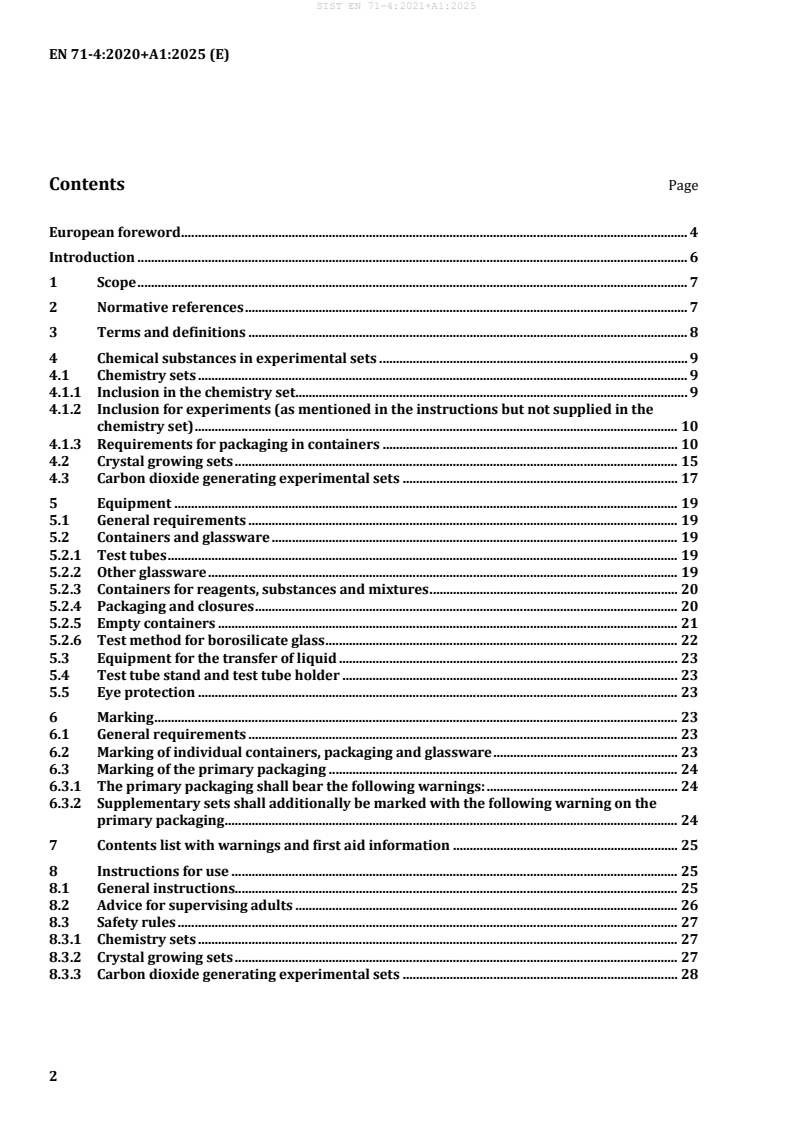
Contents Page
European foreword . 4
Introduction . 6
1 Scope . 7
2 Normative references . 7
3 Terms and definitions . 8
4 Chemical substances in experimental sets . 9
4.1 Chemistry sets . 9
4.1.1 Inclusion in the chemistry set. 9
4.1.2 Inclusion for experiments (as mentioned in the instructions but not supplied in the
chemistry set) . 10
4.1.3 Requirements for packaging in containers . 10
4.2 Crystal growing sets . 15
4.3 Carbon dioxide generating experimental sets . 17
5 Equipment . 19
5.1 General requirements . 19
5.2 Containers and glassware . 19
5.2.1 Test tubes . 19
5.2.2 Other glassware . 19
5.2.3 Containers for reagents, substances and mixtures . 20
5.2.4 Packaging and closures . 20
5.2.5 Empty containers . 21
5.2.6 Test method for borosilicate glass . 22
5.3 Equipment for the transfer of liquid . 23
5.4 Test tube stand and test tube holder . 23
5.5 Eye protection . 23
6 Marking . 23
6.1 General requirements . 23
6.2 Marking of individual containers, packaging and glassware . 23
6.3 Marking of the primary packaging . 24
6.3.1 The primary packaging shall bear the following warnings: . 24
6.3.2 Supplementary sets shall additionally be marked with the following warning on the
primary packaging . 24
7 Contents list with warnings and first aid information . 25
8 Instructions for use . 25
8.1 General instructions. 25
8.2 Advice for supervising adults . 26
8.3 Safety rules . 27
8.3.1 Chemistry sets . 27
8.3.2 Crystal growing sets . 27
8.3.3 Carbon dioxide generating experimental sets . 28
Annex A (informative) Rationale . 29
Annex B (informative) Environmental considerations . 31
Annex C (informative) Significant technical changes between this document and the
previous version . 32
Annex D (normative) Test methods for closures of containers . 33
Annex ZA (informative) !Relationship between this European Standard and the essential
requirements of Directive 2009/48/EC aimed to be covered . 34
Bibliography . 35
European foreword
This document (EN 71-4:2020+A1:2025) has been prepared by Technical Committee CEN/TC 52
“Safety of toys”, the secretariat of which is held by DS.
This European Standard shall be given the status of a national standard, either by publication of an
identical text or by endorsement, at the latest by October 2025, and conflicting national standards shall
be withdrawn at the latest by October 2025.
Attention is drawn to the possibility that some of the elements of this document may be the subject of
patent rights. CEN shall not be held responsible for identifying any or all such patent rights.
This document includes Amendment 1 approved by CEN on 4 February 2025.
This document supersedes !EN 71-4:2020".
The start and finish of text introduced or altered by amendment is indicated in the text by tags !".
This document has been prepared under a standardization request addressed to CEN by the European
Commission. The Standing Committee of the EFTA States subsequently approves these requests for its
Member States
For the relationship with EU Legislation, see informative Annex ZA, which is an integral part of this
document.
The significant changes from the previous edition of this document are detailed in Annex C.
Additional information on the background and rationale for various requirements are given in Annex A.
This document constitutes the fourth part of the EN 71 series of standards on safety of toys.
EN 71, Safety of toys, consists of the following parts:
— Part 1: Mechanical and physical properties
— Part 2: Flammability
— Part 3: Migration of certain elements
— Part 4: Experimental sets for chemistry and related activities (the present document)
— Part 5: Chemical toys (sets) other than experimental sets
— Part 7: Finger paints — Requirements and test methods
— Part 8: Activity toys for domestic use
!Deleted text"
— Part 10: Organic chemical compounds — Sample preparation and extraction
— Part 11: Organic chemical compounds — Methods of analysis
— Part 12: N-Nitrosamines and N-nitrosatable substances
— Part 13: Olfactory board games, cosmetic kits and gustative games
— Part 14: Trampolines for domestic use
!— Part 15: Formamide in foam toy materials (content).
— Part 16: Certain chlorinated phosphorus flame retardants (TCEP, TCPP, TDCP) in toy materials.
— Part 17: Certain isothiazolinones (MIT, CIT, BIT) in aqueous toy materials.
— Part 18: Phenol in aqueous (content) and polymeric (migration) toy materials.
— Part 19: Migration of bisphenol A from toy materials. (under preparation).
— Part 20: Microbiological safety of toys containing accessible aqueous media. (under preparation)."
NOTE 1 In addition to the above parts of EN 71, the following deliverables have been published:
— CEN/TR 15071, Safety of toys — National translations of warnings and instructions for use in the EN 71
series,
— CEN/TR 15371 (all parts), Safety of toys — Interpretations,
— CEN/TR 16918, Safety of toys — Children's mouthing behaviour in contact with toys,
— CEN ISO/TR 8124-8, Safety of toys — Part 8: Age determination – First age grade for the appropriate
play of toys.
!— CEN/TS 17973: Safety of toys — Categorization of slime type materials, and
— CEN/TR 17695: Safety of toys — Mechanical and physical properties — Guidance on categorisation of
projectile toys within EN 71-1"
NOTE 2 Words in italics (apart from document titles) are defined in Clause 3 (Terms and definitions).
Any feedback and questions on this document should be directed to the users’ national standards body.
A complete listing of these bodies can be found on the CEN website.
According to the CEN-CENELEC Internal Regulations, the national standards organisations of the
following countries are bound to implement this European Standard: Austria, Belgium, Bulgaria,
Croatia, Cyprus, Czech Republic, Denmark, Estonia, Finland, France, Germany, Greece, Hungary, Iceland,
Ireland, Italy, Latvia, Lithuania, Luxembourg, Malta, Netherlands, Norway, Poland, Portugal, Republic of
North Macedonia, Romania, Serbia, Slovakia, Slovenia, Spain, Sweden, Switzerland, Türkiye and the
United Kingdom.
Introduction
This document is intended to reduce the risks and health hazards to a child when experimental sets
involving chemical experiments are used as intended or in a foreseeable way, bearing in mind the
behaviour of children.
During use of these experimental sets, the hazards should be kept to a minimum by the provision of
appropriate information to make the experiments safe and controllable. Therefore, this document
specifies warning phrases and instructions for use for experimental sets.
As a general rule, experimental sets are designed and manufactured for particular ages of children. Their
characteristics are related to the age and stage of development of the children, and their use
presupposes certain aptitudes. Age requirements are therefore given.
The requirements of this document do not release parents or carers from their responsibility of
watching over the child while he or she is carrying out experiments. On the contrary, the use of these
sets requires close supervision by adults.
1 Scope
This document specifies requirements for the maximum amount, and in some cases, the maximum
concentration of certain substances and mixtures used in experimental sets for chemistry and related
activities.
These substances and mixtures are:
— those classified as hazardous by the EC-legislation applying to hazardous substances and hazardous
mixtures [1];
— substances and mixtures which in excessive amounts could harm the health of the children using
them and which are not classified as hazardous by the above-mentioned legislation; and
— any other chemical substance(s) and mixture(s) delivered with the experimental set.
This document applies to experimental sets for chemistry and related activities including crystal
growing sets, carbon dioxide generating experimental sets and supplementary sets. It also covers sets for
chemical experiments within the fields of mineralogy, biology, physics, microscopy and environmental
science whenever they contain one or more chemical substances and/or mixtures which are classified
as hazardous according to Regulation (EC) No. 1272/2008 [1].
This document also specifies requirements for marking, a contents list, instructions for use, eye
protection and for the equipment intended for carrying out the experiments.
This document does not apply to combined sets, e.g. a combination of a chemistry set and a crystal
growing set. It also does not apply to toys that are covered by EN 71-13 (e.g. cosmetic kits).
Requirements for certain other chemical toys are given in EN 71-5.
NOTE The terms “substance” and “preparation”, are used in the “REACH Regulation”, Regulation (EC) No.
1907/2006 [2]. According to the Globally Harmonized System (GHS) of classification and labelling of chemicals,
which in the European Union has been enacted by Regulation (EC) No. 1272/2008 (classification, labelling and
packaging of substances and mixtures) [1], the timetable for the introduction of GHS is followed. The words
“preparation” and “mixture” are considered synonymous; both are a mixture or solution of substances that do not
react with each other. The old term “preparation” will be replaced by the new term “mixture” in due course. In this
document, only the term “mixture” is used.
2 Normative references
The following documents are referred to in the text in such a way that some or all of their content
constitutes requirements of this document. For dated references, only the edition cited applies. For
undated references, the latest edition of the referenced document (including any amendments) applies.
EN 71-1:2014+A1:2018, Safety of toys - Part 1: Mechanical and physical properties
EN 71-5:2015, Safety of toys - Part 5: Chemical toys (sets) other than experimental sets
!EN ISO 28862:2023, Packaging - Child-resistant packaging - Requirements and testing procedures for
"
non-reclosable packages for non-pharmaceutical products (ISO 28862:2018)
EN ISO 8317:2015, Child-resistant packaging - Requirements and testing procedures for reclosable
packages (ISO 8317:2015)
3 Terms and definitions
For the purposes of this document, the following terms and definitions apply.
ISO and IEC maintain terminological databases for use in standardization at the following addresses:
• IEC Electropedia: available at http://www.electropedia.org/
• ISO Online browsing platform: available at https://www.iso.org/obp
3.1
chemical toy
toy intended for the direct handling of chemical substances and mixtures and which is used in a manner
appropriate to a given age-group and under the supervision of an adult
3.2
experimental set
chemical toy where the experimental and explorative character in playing with single chemical
substances and mixtures along strict instructions dominates over the creative ideas of the user
3.3
chemistry set
experimental set consisting of one or more chemical substances and/or mixtures with or without
equipment intended for carrying out chemical experiments
Note 1 to entry: The definition also covers experimental sets for chemical experiments within the fields of
mineralogy, biology, physics, microscopy and environmental sciences whenever they contain one or more
chemical substances and/or mixtures which are classified as hazardous according to Regulation (EC) No.
1272/2008, excluding crystal growing sets and carbon dioxide generating experimental sets.
3.4
crystal growing set
experimental set consisting of one or more chemical substances for growing crystals without any
reaction between the supplied substances
Note 1 to entry: A crystal growing set is used to grow crystals of different substances in aqueous solutions. The
crystals may be grown on different materials (e.g. stones or gypsum) and can be coloured in different ways (e.g.
with food colours): The expanding nature of the growing crystal is not subject to requirements within
EN 71-1:2014+A1:2018 for expanding materials as the expansion is not related to the absorption of water in the
crystal and the expansion usually takes place over a long period of time (several days or weeks).
3.5
carbon dioxide generating experimental set
experimental set consisting mainly of a carbon dioxide-donor substance or mixture and a carbon
dioxide-liberating substance or mixture which after combination generate carbon dioxide in the
presence of water in an open system without any gas-tight restriction or confinement
Note 1 to entry: The set is used to carry out and observe chemical reactions where there is no intention to
generate carbon dioxide in order to demonstrate speed, velocity or noise.
3.6
supplementary set
incomplete experimental set which is intended to be used with a complete experimental set
3.7
cosmetic kit
toy, the purpose of which is to assist a child to learn to make products such as fragrances, soaps, creams,
shampoos, bath foams, glosses, lipsticks, other make-up, toothpaste and conditioners
[SOURCE: !EN 71-13:2021+A2:2024, 3.2"]
4 Chemical substances in experimental sets
4.1 Chemistry sets
4.1.1 Inclusion in the chemistry set
The chemical substances, mixtures and indicators given in Table 1 and Table 2 may be supplied in
chemistry sets or in a supplementary set for a chemistry set up to the amounts and concentrations
specified in those tables.
The quality of the chemicals used should be appropriate for the experiments described. In particular,
the chemicals should not contain impurities or substances that allow undefined and dangerous
reactions to occur.
Furthermore, colorants and colouring materials which are not specified in Table 2 may be supplied in
chemistry sets if they do not react with the substances and mixtures of the set and if they do not fulfil the
criteria of any of the following hazard classes:
— “acute toxicity” (hazard class 3.1),
— “skin corrosion/irritation” (hazard class 3.2),
— “serious eye damage/eye irritation” (hazard class 3.3),
— “respiratory or skin sensitisation” (hazard class 3.4),
— “germ cell mutagenicity” (hazard class 3.5),
— “carcinogenicity” (hazard class 3.6),
— “reproductive toxicity” (hazard class 3.7),
— “specific target organ toxicity — single exposure” (hazard class 3.8),
— “specific target organ toxicity — repeated exposure” (hazard class 3.9),
— “aspiration hazard” (hazard class 3.10).
Colorants which are permitted for use in food or cosmetics may be provided.
NOTE 1 The classification is detailed in Regulation (EC) No. 1272/2008 (Annex I, Part 3: Health Hazards).
Besides the chemical substances, mixtures and indicators given in Table 1 and Table 2 and colorants
and colouring materials, only food additives and their mixtures (see Regulation (EC) 1333/2008 [5])
may be supplied in chemistry sets, if pure food additives are not classified as hazardous substances [1]
or mixtures are not classified as hazardous mixtures [1].
NOTE 2 Samples of rocks, stones, minerals on which to perform experiments in order to distinguish their
composition are sometimes supplied with the set.
4.1.2 Inclusion for experiments (as mentioned in the instructions but not supplied in the
chemistry set)
The use of reagents listed in Table 3 may be suggested in the instructions at concentrations not
exceeding those specified in this table. The substances specified in Table 3 shall not be supplied in a
chemistry set.
Apart from its presence in tincture of iodine, denatured alcohol (ethanol) shall not be supplied in a
chemistry set. However, where experiments contained in the instructions of a chemistry set require it,
the use of denatured alcohol may be suggested in the instructions.
The instructions for use may suggest the use of other substances that are not classified as hazardous
substances [1] or mixtures that are not classified as hazardous mixtures [1] (e.g. sucrose, table sugar,
starch or flour).
4.1.3 Requirements for packaging in containers
The substances and mixtures in Table 1 and 2 in a chemistry set or in a supplementary set of a chemistry
set shall be supplied in containers (see 5.2.3) which are provided with closures (see 5.2.4.1).
!
Table 1 — Maximum amounts of chemical substances and mixtures for chemistry sets and
labelling
Chemical Max. GHS Pictograms Signal CAS EINECS INDEX
substance/mixture amount (see Figure 1) word number number number
per set
Aluminium potassium 10 g − − 10043– 233– −
sulfate 67–1 141–3
Ammonium carbonate 5 g GHS07 Warning 10361– 233– −
29–2 786–0
Ammonium chloride 30 g GHS07 Warning 12125– 235– 017–014–
02–9 186–4 00–8
Ammonium iron (III) 5 g GHS05 Danger 10138– 233– −
sulfate 04–2 382–4
Ammonium sodium 5 g − − 13011– 235– −
hydrogen phosphate 54–6 860–8
Calcium carbonate 100 g − − 471–34–1 207– −
439–9
Calcium chloride 10 g GHS07 Warning 10043– 233– 017–013–
52–4 140–8 00–2
a 20 g GHS05, GHS07 Danger 1305–62– 215– −
Calcium hydroxide
0 137–3
Calcium nitrate 5 g GHS03, GHS05, Danger 10124– 233– −
GHS07 37–5 332–1
a 10 g GHS05, GHS07 Danger 1305–78– 215– −
Calcium oxide
8 138–9
Calcium sulfate 100 g − − 7778–18– 231– −
9 900–3
b 100 g − − 7440–44– 231– −
Charcoal
0 153–3
Chemical Max. GHS Pictograms Signal CAS EINECS INDEX
substance/mixture amount (see Figure 1) word number number number
per set
Citric acid 20 g GHS07 Warning 77–92–9 201– −
069–1
Copper sheet 100 g − − 7440–50– 231– −
8 159–6
Copper (II) oxide 10 g GHS07, GHS09 Warning 1317–38– 215– 029–016–
0 269–1 00–6
Copper (II) sulfate 15 g GHS05, GHS07, Danger 7758–98– 231– 029–004–
GHS09 7 847–6 00–0
Disodium disulfite 10 g GHS05, GHS07 Danger 7681–57– 231– 016–063–
4 673–0 00–2
Glycerol (containing at 25 g − − 56–81–5 200– −
least 15 % (volume 289–5
concentration) water)
Hexamethylene- 10 g GHS02, GHS07 Warning 100–97–0 202– 612–101–
b 905–8 00–2
tetramine (solid fuel)
b 100 g GHS02 Warning 7439–89– 231– −
Iron fillings
6 096–4
b 100 g GHS02 Danger 7439–89– 231– −
Iron powder
6 096–4
Iron (III) chloride 10 g GHS05, GHS07 Danger 7705–08– 231– −
0 729–4
Iron (II) sulfate 10 g GHS07 Warning 7720–78– 231– 026–003–
7 753–5 00–7
Lactose 100 g − − 63–42–3 200– −
559–2
Lead-free solder 100 g − − − − −
Magnesium strip 3 g GHS02 Warning 7439–95– 231– 012–001–
4 104–6 00–3
Magnesium sulfate 25 g − − 7487–88– 231– −
9 298–2
Manganese (IV) 5 g GHS07, GHS08 Danger 1313–13– 215– 025–001–
dioxide 9 202–6 00–3
Manganese (II) sulfate 15 g GHS05, GHS08, Danger 7785–87– 232– 025–003–
GHS09 7 089–9 00–4
Ninhydrin 1 g GHS07 Warning 485–47–2 207– −
618–1
Pepsin A 10 g GHS07, GHS08 Danger 9001–75– 232– 647–008–
6 629–3 00–6
Potassium bromide 15 g GHS07 Warning 7758–02– 231– −
3 830–3
Chemical Max. GHS Pictograms Signal CAS EINECS INDEX
substance/mixture amount (see Figure 1) word number number number
per set
Potassium 10 g GHS07 Warning 13746– 237– −
hexacyanoferrate 66–2 323–3
b
(III)
Potassium 10 g − − 13943– 237– −
b 58–3 722–2
hexacyanoferrate (II)
Potassium iodide 10 g GHS08 Danger 7681–11– 231– −
0 659–4
Potassium 15 g GHS07, GHS09 Warning − − −
permanganate in
sodium sulfate
mixture (2,5 %
to < 3 %) (mass
fraction)
Silver nitrate 10 ml GHS05, GHS07, Warning 7761–88– 231– 047–001–
(0,01 g/ml mass GHS09 8 853–9 00–2
concentration aqueous
solution)
Sodium acetate 20 g − − 127–09–3 204– −
823–8
Sodium carbonate 50 g GHS07 Warning 497–19–8 207– 011–005–
838–8 00–2
Sodium chloride 100 g − − 7647–14– 231– −
5 598–3
Sodium hydrogen 50 g − − 144–55–8 205– −
carbonate 633–8
Sodium hydrogen 30 g GHS05 Danger 7681–38– 231– 016–046–
sulfate 1 665–7 00-X
Sodium silicate 100 ml GHS05 Danger 1344–09– 215– −
solution 8 687–4
(SiO :Na O > 2)
2 2
Sodium sulfate 100 g − − 7757–82– 231– −
6 820–9
Sodium thiosulfate 50 g − − 7772–98– 231– −
7 867–5
7704–34– 231– 016–094–
Sulfur 15 g GHS07 Warning
9 722–6 00–1
Tannin 15 g − − 1401–55– 215– −
4 753–2
Tartaric acid 20 g GHS05 Danger 87–69–4 201– −
766–0
Tin (II) chloride 15 g GHS05, GHS07, Danger 7772–99– 231– −
GHS08, GHS09 8 868–0
Chemical Max. GHS Pictograms Signal CAS EINECS INDEX
substance/mixture amount (see Figure 1) word number number number
per set
b 10 ml GHS02, GHS07, Danger 7553–56– 231– 053–001–
Tincture of iodine
GHS08 2 442–4 003
(0,025 g/ml mass
concentration
c
ethanolic solution)
b 10 g − − 57–13–6 200– −
Urea
315–5
Zinc powder 20 g GHS09 Warning 7440–66– 231– 030–001–
(stabilized)/zinc 6 175–3 01–9
pellets
Zinc sulfate 20 g GHS05, GHS07, Danger 7446–20– 231– 030–006–
(heptahydrate) GHS09 0 793–3 00–9
a
Only one of these substances shall be provided in each set.
b
Generally, IUPAC chemical nomenclature is used with the exceptions of these substances.
c
Denatured alcohol (ethanol).
"
If indicators are supplied in solution, their solid contents shall not exceed the amounts and
concentrations specified in Table 2.
Non-bleeding indicators in books, pads or rolls are not of toxicological concern and are sometimes
supplied without any quantity limitations for the relevant indicator(s).
Table 2 — Maximum amounts and concentrations of indicators for chemistry sets and labelling
Chemical Max. GHS Signal CAS EINECS INDEX
substance/mixture amount Pictograms word number number number
per set (see Figure 1)
Eosin 1 g GHS07 Warning 17372–87– 241–409–6 −
Iodine (0,025 g/ml 10 ml GHS08 Warning 7553–56–2 231–442–4 053–001–00–
mass concentration in 3
an aqueous solution
(0,025 g/ml mass
concentration) of
potassium iodide)
Litmus blue 1 g − − 1393–92–6 215–739–6 −
Litmus red 1 g − − 1393–92–6 215–739–6 −
Luminol (5 % (mass 3 g − − 521–31–3 208–309–4 −
fraction) mixture with
sodium sulfate)
Methyl orange 3 g GHS07 Warning 547–58–0 208–925–3 −
(15 % (mass fraction)
mixture with sodium
sulfate)
Chemical Max. GHS Signal CAS EINECS INDEX
substance/mixture amount Pictograms word number number number
per set (see Figure 1)
Methylene blue 1 g GHS07 Warning 61–73–4 200–515–2 −
Phenol red 1 g GHS07 Warning 143–74–8 205–609–7 −
Thymol blue 1 g − − 76–61–9 200–973–3 −
Bleeding universal 1 pad − − − − −
indicator paper
If not mentioned otherwise, the maximum amounts of the solid substances in Table 1 and Table 2 refer
to the anhydrous chemicals. Equivalent amounts of the hydrated chemicals may replace the anhydrous
substances.
Table 3 — Maximum concentration of reagents not supplied with the chemistry set and labelling
Reagent Maximum GHS Signal CAS EINECS INDEX
concentration Pictograms word number number number
mol/l (see Figure 1)
Ammonia solution 2 GHS05 Danger 1336–21– 215–647– 007–001–01–
6 6 2
Hydrochloric acid 2 GHS05 Warning 7647–01– 231–595– 017–002–01-
0 7 X
Hydrogen 1 - - 7722–84– 231–765– 008–003–00–
a 1 0 9
peroxide
Sodium hydroxide 1 GHS05 Danger 1310–73– 215–185– 011–002–00–
solution 2 5 6
Additional units (e.g. percentage) may also be used on the packaging, instructions for use, etc.
a
The concentration of hydrogen peroxide is equivalent to a 3 % (volume fraction) solution.
a) GHS02 b) GHS03 c) GHS05
d) GHS07 e) GHS08 f) GHS09
These pictograms are taken from Regulation (EC) No. 1272/2008 of the European Parliament and the
Council of 16 December 2008 (also named GHS or CLP) on the classification, labelling and packaging of
substances and mixtures. The use of these pictograms should comply with the requirements of Annex I
to this regulation [1].
Figure 1 — GHS pictograms
4.2 Crystal growing sets
The chemical substances given in Table 4 may be supplied in crystal growing sets or in a supplementary
set for a crystal growing set up to the amounts specified in that table.
A crystal growing set shall only contain substances which cannot react between each other.
The quality of the chemicals used in crystal growing sets should be appropriate for the experiments
described; in particular, the chemicals should not contain impurities or substances which allow
undefined and dangerous reactions to occur.
Besides the chemical substances given in Table 4 only colourants and colouring materials which do not
fulfil the criteria of any of the following hazard classes:
— “acute toxicity” (hazard class 3.1),
— “skin corrosion/irritation” (hazard class 3.2),
— “serious eye damage/eye irritation” (hazard class 3.3),
— “respiratory or skin sensitisation” (hazard class 3.4),
— “germ cell mutagenicity” (hazard class 3.5),
— “carcinogenicity” (hazard class 3.6),
— “reproductive toxicity” (hazard class 3.7),
— “specific target organ toxicity — single exposure” (hazard class 3.8),
— “specific target organ toxicity — repeated exposure” (hazard class 3.9),
— “aspiration hazard” (hazard class 3.10),
shall be supplied in crystal growing sets. Colourants which are permitted for use in food or cosmetics
may be provided.
NOTE The classification is detailed in Regulation (EC) No. 1272/2008 (Annex I, Part 3: Health Hazards).
If substances are supplied as mixtures or if substances/mixtures are supplied in solution, their solid
contents shall not exceed the amounts specified in Table 4.
Samples of materials on which to grow the crystals may be supplied with the set (e.g. plaster of Paris
(gypsum), different stones, different minerals) without limits to their quantities. For gypsum, applicable
requirements are specified in EN 71-5:2015 (i.e. labelling, etc.).
The substances and mixtures in Table 4 in a crystal growing set or in a supplementary set for a crystal
growing set shall be supplied in child-resistant packaging (see 5.2.4.2).
Table 4 — Maximum amounts of chemical substances for crystal growing sets and labelling
Chemical substance Max. GHS Signal CAS EINECS INDEX
amount Pictograms word number number number
per set (see
Figure 1)
g
a 30 GHS07 Warning 12125– 235–186– 017–014–
Ammonium chloride
02–9 4 00–8
Ammonium dihydrogen 600 - - 7722–76– 231–764– −
orthophosphate (Ammonium
1 5
biphosphate)
Aluminium potassium sulfate 600 - - 7784–24– 233–141– −
9 3
b 50 GHS07 Warning 77–92–9 201–069– −
Citric acid
Copper (II) sulfate 50 GHS05, Danger 7758–98– 231–847– 029–004–
GHS07, 7 6 00–0
GHS09
Iron (II) sulfate 50 GHS07 Warning 7782–63– 231–753– 026–003–
0 5 00–7
Magnesium sulfate 100 - - 10034– 231–298– −
99–8 2
Potassium dihydrogen phosphate 600 - - 7778–77– 231–913– −
0 4
Potassium hexacyanoferrate (III) 100 GHS07 Warning 13746– 237–323– −
66–2 3
Potassium sodium tartrate 600 - - 6381–59– 205–698– −
5 2
Sodium acetate 100 - - 127–09–3 204–823– −
Sodium hydrogen carbonate 600 - - 144–55–8 205–633– −
b 50 GHS05, Danger 1344–09– 215–687– −
Sodium silicate
GHS07 8 4
(SiO : Na O > 2)
2 2
Chemical substance Max. GHS Signal CAS EINECS INDEX
amount Pictograms word number number number
per set (see
Figure 1)
g
Sodium sulfate 100 - - 7757–82– 231–820– −
6 9
Sodium thiosulfate 600 - - 7772–98– 231–867– −
7 5
Strontium aluminate 5 GHS 07 Warning e.g. e.g. 234– −
12004– d
455–3
d
37–4
b 50 GHS05 Danger 87–69–4 201–766– −
Tartaric acid
Trisodium citrate 600 - - 6132–04– 200–675– −
3 3
c 5 - - e.g. 1314– e.g. 215– −
Zinc sulfide
d d
98–3 251–3
The maximum amounts specified in Table 4 refer to anhydrous chemicals. Equivalent amounts of the hydrated
chemicals may replace the anhydrous substances.
a
Shall be supplied as an aqueous solution.
b
Shall not be supplied in a set with sodium hydrogen carbonate.
c
Shall not be supplied in a set with any acid, e.g. citric acid.
d
If different to the given number, the CAS or EINECS number of the chemical supplier should be given.
4.3 Carbon dioxide generating experimental sets
The chemical substances given in Table 5 may be supplied in carbon dioxide generating experimental
sets whose function relies on the generation of carbon dioxide. The amounts supplied in a single set
shall not exceed those specified in Table 5. If mixtures of these substances are supplied in solid form,
the single mixture shall consist of stoichiometric equivalent amounts of acidic and CO -generating
substances.
The quality of the chemicals used in carbon dioxide generating experimental sets should be appropriate
for the experiments described; in particular, the chemicals should not contain impurities or substances
which allow undefined and dangerous reactions to occur.
Besides the chemical substances given in Table 5 carbon dioxide generating experimental sets may only
contain gypsum or colourants. For gypsum, applicable requirements are specified in EN 71-5:2015 (i.e.
labelling, etc.). Only colourants and colouring materials which do not fulfil the criteria of any of the
following hazard classes:
— “acute toxicity” (hazard class 3.1),
— “skin corrosion/irritation” (hazard class 3.2),
— “serious eye damage/eye irritation” (hazard class 3.3),
— “respiratory or skin sensitisation” (hazard class 3.4),
— “germ cell mutagenicity” (hazard class 3.5),
— “carcinogenicity” (hazard class 3.6),
— “reproductive toxicity” (hazard class 3.7),
— “specific target organ toxicity — single exposure” (hazard class 3.8),
— “specific target organ toxicity — repeated exposure” (hazard class 3.9),
— “aspiration hazard” (hazard class 3.10),
shall be supplied in carbon dioxide generating experimental sets. Colourants that are permitted for use in
food or cosmetics may be provided.
NOTE The classification is detailed in Regulation (EC) No. 1272/2008 (Annex I, Part 3: Health Hazards).
If substances are supplied as mixtures or if substances/mixtures are supplied in solution, their solid
contents shall not exceed the amounts specified in Table 5.
The substances in Table 5 in a carbon dioxide generating experimental set shall be supplied in child-
resistant packaging (see 5.2.4.3).
Table 5 — Maximum amounts of chemical substances for carbon dioxide generating
experimental sets and labelling
Chemical substance Max. GHS Signal CAS EINECS INDEX
amount Pictograms word number number number
per set (see Figure 1)
g
a −
100 GHS07 Warning 77–92–9 201–069–1
Citric acid
Disodium hydrogen −
20 − − 7558–79–4 231–448–7
phosphate
a −
60 GHS07 Warning 6915–15–7 230–022–8
Malic acid
Potassium hydrogen −
50 − − 298–14–6 206–059–0
carbonate
Potassium dihydrogen −
100 − − 7778–77–0 231–913–4
phosphate
Sodium dihydrogen −
70 − − 7558–80–7 231–449–2
phosphate
Sodium hydrogen −
100 − − 144–55–8 205–633–8
carbonate
a −
60 GHS05 Danger 87–69–4 201–766–0
Tartaric acid
The maximum amounts specified in Table 5 refer to anhydrous chemicals. Equivalent amounts of the hydrated
chemicals may replace the anhydrous substances.
a
Only one of these substances shall be provided in each set.
5 Equipment
5.1 General requirements
Experimental sets, excluding supplementary sets, shall be supplied with instructions for use (see
Clause 8); a contents list with warnings and first aid information (see Clause 7); the equipment
necessary for carrying out the experiments described in the instructions for use; and, if required, eye
protection (see 5.5) and/or a test tube stand (see 5.4).
Supplementary sets shall be supplied with instructions for use (see Clause 8) and a contents list with
warnings and first aid information, as specified in Clause 7.
!All the experiments described in the instructions for use shall be evaluated". In particular, it shall
not be possible for substances to be formed in amounts that are injurious to health.
Any known hazards arising from the use of the set, especially during the experiments, should be
detailed (e.g. handling of chemicals, handling of glassware, retarded boiling point, back flow of barrier
water into overheated glassware, evolution of gases and handling of burners and other heating
sources).
5.2 Containers and glassware
5.2.1 Test tubes
5.2.1.1 Sets in which test tubes are heated
In experimental sets where the instructions for use include chemical experiments in which test tubes are
heated, all test tubes shall be made of borosilicate glass in order to be heat resistant.
Glass test tubes which are intended to be heated shall have dimensions greater than 110 mm in length
and greater than 15 mm in internal diameter.
Glass test tubes which are not intended to be heated, for example, those used as containers, shall have
dimensions not greater than 90 mm in length and not greater than 12 mm in internal diameter unless
they are made of borosilicate glass.
When necessary, borosilicate glass shall be identified by the test method described in 5.2.6.
5.2.1.2 Sets in which test tubes are not heated
In experimental sets where the instructions for use do not include chemical experiments in which glass
test tubes are heated, any glass tubes not made of borosilicate glass shall be labelled in accordance with
6.2.
5.2.2 Other glassware
In experimental sets where the instructions for use include experiments in which laboratory glassware
is heated, all glassware intended to be heated shall be made of borosilicate glass in order to be heat
resistant. This requirement does not apply to glass tubing intended to be heated for the purpose of
bending.
Unless made of borosilicate glass, glassware which is not intended to be heated but which by its
appearance or shape could be construed as being suitable for heating shall be labelled in accordance
with 6.2.
When necessary, borosilicate glass shall be identified by the test method described in 5.2.6.
5.2.3 Containers for reagents, substances and mixtures
Containers for reagents shall differ in size and shape from laboratory glassware to avoid them being
mistaken as glassware for use in experiments.
All containers for reagents, substances and mixtures shall be shock resistant. They shall not break or
crack when subjected to the drop test specified in EN 71-1:2014+A1:2018.
5.2.4 Packaging and closures
5.2.4.1 Chemistry sets
! All substances and mixtures in Table 1 and 2 shall be supplied in child-resistant containers.
Closures for child-resistant containers shall comply with one of the following requirements
a) they shall comply with EN ISO 8317:2015; or
b) they shall require two independent movements to be opened: a vertical force downwards and a
torque in the clockwise or anticlockwise direction (e.g. bayonet joint). When tested in accordance
with Annex D.1 (closure test A), the closure shall not open; or
c) they shall consist of a snap-in stopper and shall require an external tool to be opened. The closure
shall only be opened by a specifically designed tool (i.e. a tool deviating from usual household tools
such as screw drivers, wrenches, or coins). When tested in accordance with Annex D.2 (closure test
B), the clos
...