

EN 15625:2008
(Main)Railway applications - Braking - Automatic variable load sensing devices
- Abstract
This European Standard applies to automatic variable load sensing devices designed to continuously sense the load of a railway vehicle and provide a signal that can be used by a relay valve for the automatic variation of the air pressure used for brake application, thereby adjusting the brake force accordingly to achieve the required brake performance.
This European Standard specifies the requirements for the design, dimensions, manufacture and testing of automatic variable load sensing devices.
- Status
- Withdrawn
- Publication Date
- 28-Oct-2008
- Withdrawal Date
- 05-Oct-2010
- Technical Committee
- CEN/TC 256 - Railway applications
- Drafting Committee
- CEN/TC 256/SC 3/WG 24 - Components
- Current Stage
- 9960 - Withdrawal effective - Withdrawal
- Start Date
- 06-Oct-2010
- Completion Date
- 06-Oct-2010
- Directive
- 2001/16/EC - Directive 2001/16/EC of the European Parliament and of the Council of 19 March 2001 on the interoperability of the trans-European conventional rail systemOJ Ref: C, C 97 OJ Date: 16-Apr-2010
96/48/EC - Interoperability of the trans-European high-speed rail systemOJ Ref: C, C 97 OJ Date: 16-Apr-2010

Relations
- Merged Into
EN 15625:2008+A1:2010 - Railway applications - Braking - Automatic variable load sensing devices - Effective Date
- 14-Aug-2010
- Amended By
EN 15625:2008/FprA1 - Railway applications - Braking - Automatic variable load sensing devices - Effective Date
- 12-Dec-2009
Get Certified
Connect with accredited certification bodies for this standard

IRIS Certification (UNIFE)
International Railway Industry Standard certification.

TÜV SÜD Rail GmbH
TÜV SÜD railway certification services.

Bureau Veritas Railway Certification
Railway and transportation certification.
Sponsored listings
Frequently Asked Questions
EN 15625:2008 is a standard published by the European Committee for Standardization (CEN). Its full title is "Railway applications - Braking - Automatic variable load sensing devices". This standard covers: This European Standard applies to automatic variable load sensing devices designed to continuously sense the load of a railway vehicle and provide a signal that can be used by a relay valve for the automatic variation of the air pressure used for brake application, thereby adjusting the brake force accordingly to achieve the required brake performance. This European Standard specifies the requirements for the design, dimensions, manufacture and testing of automatic variable load sensing devices.
This European Standard applies to automatic variable load sensing devices designed to continuously sense the load of a railway vehicle and provide a signal that can be used by a relay valve for the automatic variation of the air pressure used for brake application, thereby adjusting the brake force accordingly to achieve the required brake performance. This European Standard specifies the requirements for the design, dimensions, manufacture and testing of automatic variable load sensing devices.
EN 15625:2008 is classified under the following ICS (International Classification for Standards) categories: 45.060.01 - Railway rolling stock in general. The ICS classification helps identify the subject area and facilitates finding related standards.
EN 15625:2008 has the following relationships with other standards: It is inter standard links to EN 15625:2008+A1:2010, EN 15625:2008/FprA1. Understanding these relationships helps ensure you are using the most current and applicable version of the standard.
EN 15625:2008 is associated with the following European legislation: EU Directives/Regulations: 2001/16/EC, 2008/57/EC, 96/48/EC; Standardization Mandates: M/275, M/334. When a standard is cited in the Official Journal of the European Union, products manufactured in conformity with it benefit from a presumption of conformity with the essential requirements of the corresponding EU directive or regulation.
EN 15625:2008 is available in PDF format for immediate download after purchase. The document can be added to your cart and obtained through the secure checkout process. Digital delivery ensures instant access to the complete standard document.
Standards Content (Sample)
2003-01.Slovenski inštitut za standardizacijo. Razmnoževanje celote ali delov tega standarda ni dovoljeno.Železniške naprave - Zavore - Naprave za samodejno zaznavanje spremembe obtežbeBahnanwendungen - Bremse - Automatisch kontinuierlich wirkende LasterfassungseinrichtungenApplications ferroviaires - Freinage - Dispositifs de pesée variable automatiquesRailway applications - Braking - Automatic variable load sensing devices45.040Materiali in deli za železniško tehnikoMaterials and components for railway engineeringICS:Ta slovenski standard je istoveten z:EN 15625:2008SIST EN 15625:2009en,fr01-april-2009SIST EN 15625:2009SLOVENSKI
STANDARD
EUROPEAN STANDARDNORME EUROPÉENNEEUROPÄISCHE NORMEN 15625October 2008ICS 45.060.01 English VersionRailway applications - Braking - Automatic variable load sensingdevicesApplications ferroviaires - Freinage - Dispositifs de peséevariable automatiquesBahnanwendungen - Bremse - Automatisch kontinuierlichwirkende LasterfassungseinrichtungenThis European Standard was approved by CEN on 13 September 2008.CEN members are bound to comply with the CEN/CENELEC Internal Regulations which stipulate the conditions for giving this EuropeanStandard the status of a national standard without any alteration. Up-to-date lists and bibliographical references concerning such nationalstandards may be obtained on application to the CEN Management Centre or to any CEN member.This European Standard exists in three official versions (English, French, German). A version in any other language made by translationunder the responsibility of a CEN member into its own language and notified to the CEN Management Centre has the same status as theofficial versions.CEN members are the national standards bodies of Austria, Belgium, Bulgaria, Cyprus, Czech Republic, Denmark, Estonia, Finland,France, Germany, Greece, Hungary, Iceland, Ireland, Italy, Latvia, Lithuania, Luxembourg, Malta, Netherlands, Norway, Poland, Portugal,Romania, Slovakia, Slovenia, Spain, Sweden, Switzerland and United Kingdom.EUROPEAN COMMITTEE FOR STANDARDIZATIONCOMITÉ EUROPÉEN DE NORMALISATIONEUROPÄISCHES KOMITEE FÜR NORMUNGManagement Centre: rue de Stassart, 36
B-1050 Brussels© 2008 CENAll rights of exploitation in any form and by any means reservedworldwide for CEN national Members.Ref. No. EN 15625:2008: ESIST EN 15625:2009
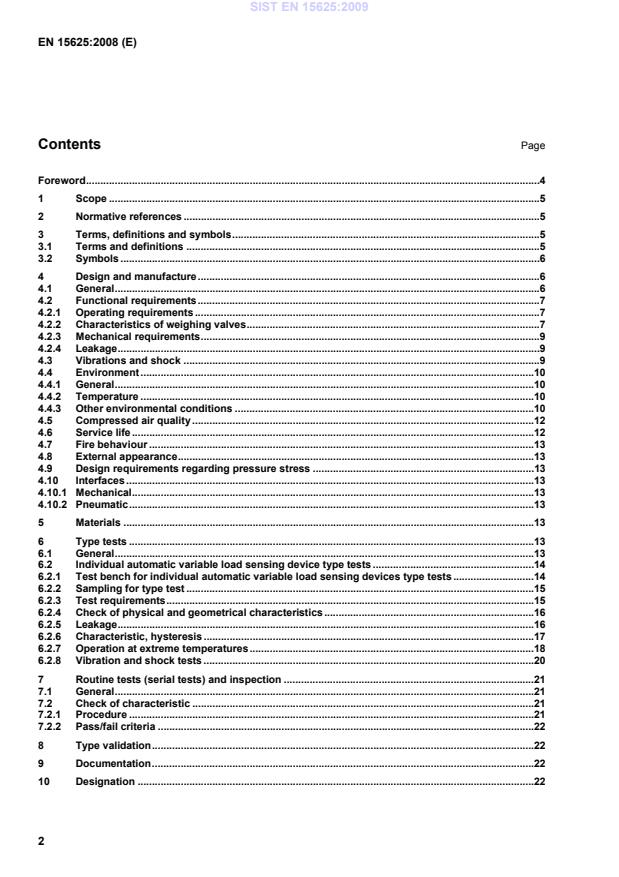
Assessment of an automatic variable load sensing device when fitted to a vehicle.24 A.1 Vehicle assessment – Testing set up.24 A.2 Design acceptance testing set up.24 A.3 Running tests.24 A.3.1 General.24 A.3.2 Pneumatic automatic variable load sensing device – Air consumption.24 A.3.3 Automatic variable load sensing device – Output signal variation.25 Annex ZA (informative)
Relationship between this European Standard and the Essential Requirements of EU Directive 96/48/EC, as amended by Directive 2004/50/EC.26 Annex ZB (informative)
Relationship between this European Standard and the Essential Requirements of EU Directive 2001/16/EC, as amended by EU Directive 2004/50/EC.27 Bibliography.28
Key 1 automatic variable load sensing device 2 F, mechanical force, generated by a share of the vehicle weight 3 supply pressure, typically taken from the distributor auxiliary reservoir 4 Lcp, output signal pressure Figure 1 — Principles of operation of the automatic variable load sensing device 4.2.2 Characteristics of weighing valves Two characteristics of weighing valves are defined: type 1: (0,8 ± 0,1) bar/10 kN (see Figure 2); type 3: (1,0 ± 0,1) bar/10 kN (see Figure 3). The characteristics for type 1 and type 3 shall be tested in accordance with 6.2.6. NOTE These types are recommended for new interoperable freight wagons. For applications other than interoperable freight wagons other characteristics may be used by agreement between the manufacturer and the customer.
Key 1 characteristic (nominal value) 2 upper limit of tolerance 3 lower limit of tolerance Figure 2 — Characteristic of the automatic variable load sensing device type 1
Key 1 characteristic (nominal value) 2 upper limit of tolerance 3 lower limit of tolerance Figure 3 — Characteristic of the automatic variable load sensing device type 3 4.2.3 Mechanical requirements The automatic variable load sensing device shall be designed to operate with at least a static force F of 60 kN without any damage or change of its characteristic. This shall be tested in accordance with 6.2.6. 4.2.4 Leakage The sealing arrangement within the automatic variable load sensing device shall prevent any unacceptable loss of air. At of (20 ± 5) °C the automatic variable load sensing device shall not have a leakage rate greater than 0,005 Nl/min at the normal working pressure. This requirement shall be tested in accordance with 6.2.5.2, 6.2.5.3 and 6.2.5.4. At an environmental temperature of – 25 °C, also at + 70 °C, the automatic variable load sensing device shall not have a leakage rate greater than 0,01 Nl/min at the normal working pressure. This requirement shall be tested in accordance with 6.2.7.2, 6.2.7.3 and 6.2.7.4. At – 40 °C ≤ environmental temperature < – 25 °C the automatic variable load sensing device shall not have a leakage rate greater than 0,1 Nl/min at the normal working pressure. This requirement shall be tested in accordance with 6.2.7.2, 6.2.7.3 and 6.2.7.4. 4.3 Vibrations and shock The automatic variable load sensing device shall be able to operate without restriction under vibration and shock conditions as specified by EN 61373:1999, Category 2. This requirement shall be tested in accordance with 6.2.8. SIST EN 15625:2009
70 °C without any deviation from the technical requirements specified in Clause 4; at – 40 °C ≤ environmental temperature < – 25 °C with allowed deviation from the technical requirements specified in this European Standard but without affecting the function of the automatic variable load sensing device. Deviations from the technical requirement when testing at extremes are defined in 6.2.7. The purchaser can specify higher or lower extreme temperature limit values if operational constraints demand it. In this case the temperature limit values used in the extreme temperature tests of 6.2.7 shall be changed accordingly. 4.4.3 Other environmental conditions 4.4.3.1 General The following environmental conditions shall be considered in the design of the automatic variable load sensing device. SIST EN 15625:2009
4.5 Compressed air quality It shall be possible to operate the automatic variable load sensing device without restrictions with at least the compressed air quality according to the following classes defined by ISO 8573-1:2001: class 4 – for the maximum particle size and the maximum concentration of solid contaminants; class 4 – for the water dew point; class 4 – for the maximum total (droplets, aerosols and vapours) oil concentration. The automatic variable load sensing device shall be capable of operating in an air supply system that is not fitted with an air dryer, or when the air dryer is out of order. The air system should therefore include some means of preventing water collecting within the automatic variable load sensing device and hence freezing of the water in conditions below 0 °C. 4.6 Service life No specific requirements for the automatic variable load sensing device to attain a particular service life are contained in this European Standard. Any testing to establish the service life of an automatic variable load sensing device shall be conducted as part of the product development. NOTE The service life of the automatic variable load sensing device is a function of the environment/operating conditions in which the automatic variable load sensing device will function, and the requirements for the automatic variable load sensing device to achieve a serviceable life in accordance with the maintenance requirements of the vehicle to which it is fitted. SIST EN 15625:2009
...