

EN 12207:2016
(Main)Windows and doors - Air permeability - Classification
- Abstract
This European Standard defines the classification of test results for completely assembled windows and external and internal pedestrian doorsets of any materials after testing in accordance with EN 1026.
- Status
- Published
- Publication Date
- 13-Dec-2016
- Withdrawal Date
- 29-Jun-2017
- Technical Committee
- CEN/TC 33 - Doors, windows, shutters and building hardware
- Drafting Committee
- CEN/TC 33/WG 1/2 - Windows and doors
- Current Stage
- 9093 - Decision to confirm - Review Enquiry
- Start Date
- 14-Jun-2022
- Completion Date
- 30-Sep-2026
Overview
EN 12207:2016 is a European Standard developed by CEN that specifies the classification method for air permeability of windows and doors. This standard applies to fully assembled windows and external and internal pedestrian doorsets made from any materials after being tested according to EN 1026. The classification is based on quantifiable air permeability test results, providing a reliable metric to assess how airtight these building components are.
This standard replaces EN 12207:1999, offering clarified procedures without changing existing classification evidence. It is mandatory for CEN member countries to adopt this standard as their national norm, ensuring harmonized air permeability classification across Europe.
Key Topics
- Scope: Classification of air permeability for windows, external and internal pedestrian doorsets after testing per EN 1026.
- Test Basis: Air permeability is measured under defined pressure differences, primarily at 100 Pa, with calculations adjusted by pressure.
- Classification Criteria:
- Based on overall specimen area (m³/h·m²)
- Based on length of opening joints (m³/h·m)
- Classes Defined:
- For windows and external doors: Classes 1 to 4, with class 4 being the most airtight.
- For internal doors: Classes A to D with D being the highest airtightness.
- Evaluation Method:
- Average classification derived from both overall area and joint length measurements.
- Specimens must meet minimum class requirements (class 1 or A).
- No separate classification for positive or negative air pressure; both must be evaluated.
- Classification Report: Must include classifications based on overall area, joint length, and final combined classification.
Applications
EN 12207:2016 is essential in the building and construction industry for:
- Quality Assurance: Assessing air permeability performance of windows and doors to ensure energy efficiency and ventilation control.
- Product Certification: Helping manufacturers demonstrate compliance with European air leakage standards.
- Building Regulations Compliance: Supporting the fulfillment of local or national energy codes requiring airtight building envelope components.
- Specification and Procurement: Assisting architects, engineers, and builders in selecting windows and doors with certified air permeability performance.
- Research and Development: Guiding the design improvements of windows and pedestrian doorsets to achieve better airtightness classifications.
By standardizing air permeability classification, EN 12207:2016 helps reduce energy loss and improve indoor comfort by minimizing uncontrolled air leakage through building openings.
Related Standards
- EN 1026: Windows and doors - Air permeability - Test method - This is the core test procedure referenced by EN 12207 for measuring air permeability.
- EN 12208: Windows and doors - Water tightness - Test method - Often used alongside EN 12207 to evaluate overall performance.
- EN 12210: Windows and doors - Resistance to wind load - Important for a complete performance assessment of windows and doors.
- EN 14351-1: Windows and external pedestrian doorsets - Product standard including performance characteristics.
- CEN/TC 33: Technical committee responsible for standards relating to doors, windows, shutters and related products.
Keywords
Air permeability classification, EU window standards, door air leakage, EN 12207, CEN EN standards, testing windows airtightness, pedestrian doorsets, air infiltration, building envelope performance, energy efficient windows, airtight doors classification.
Relations
- Effective Date
- 21-Dec-2016
- Effective Date
- 28-Jan-2026
- Referred By
EN 12152:2002 - Curtain walling - Air permeability - Performance requirements and classification - Effective Date
- 28-Jan-2026
- Effective Date
- 28-Jan-2026
- Effective Date
- 28-Jan-2026
- Referred By
EN 12152:2023 - Curtain walling - Air permeability - Performance requirements and classification - Effective Date
- 28-Jan-2026
- Effective Date
- 28-Jan-2026
Get Certified
Connect with accredited certification bodies for this standard

DIBt (Deutsches Institut für Bautechnik)
German Institute for Building Technology.
DIN CERTCO
DIN Group product certification.

Aboma Certification B.V.
Specialized in construction, metal, and transport sectors.
Sponsored listings
Frequently Asked Questions
EN 12207:2016 is a standard published by the European Committee for Standardization (CEN). Its full title is "Windows and doors - Air permeability - Classification". This standard covers: This European Standard defines the classification of test results for completely assembled windows and external and internal pedestrian doorsets of any materials after testing in accordance with EN 1026.
This European Standard defines the classification of test results for completely assembled windows and external and internal pedestrian doorsets of any materials after testing in accordance with EN 1026.
EN 12207:2016 is classified under the following ICS (International Classification for Standards) categories: 91.060.50 - Doors and windows. The ICS classification helps identify the subject area and facilitates finding related standards.
EN 12207:2016 has the following relationships with other standards: It is inter standard links to EN 12207:1999, EN 1026:2016, EN 12152:2002, EN 14351-2:2018, EN 12210:2016, EN 12152:2023, EN 13420:2011. Understanding these relationships helps ensure you are using the most current and applicable version of the standard.
EN 12207:2016 is available in PDF format for immediate download after purchase. The document can be added to your cart and obtained through the secure checkout process. Digital delivery ensures instant access to the complete standard document.
Standards Content (Sample)
2003-01.Slovenski inštitut za standardizacijo. Razmnoževanje celote ali delov tega standarda ni dovoljeno.Okna in vrata - Prepustnost zraka na pripirah - KlasifikacijaFenster und Türen - Lutfdurchlässigkeit - KlassifizierungFenêtres et portes - Perméabilité à l'air - ClassificationWindows and doors - Air permeability - Classification91.060.50Vrata in oknaDoors and windowsICS:Ta slovenski standard je istoveten z:EN 12207:2016SIST EN 12207:2017en,fr,de01-februar-2017SIST EN 12207:2017SLOVENSKI
STANDARDSIST EN 12207:20001DGRPHãþD
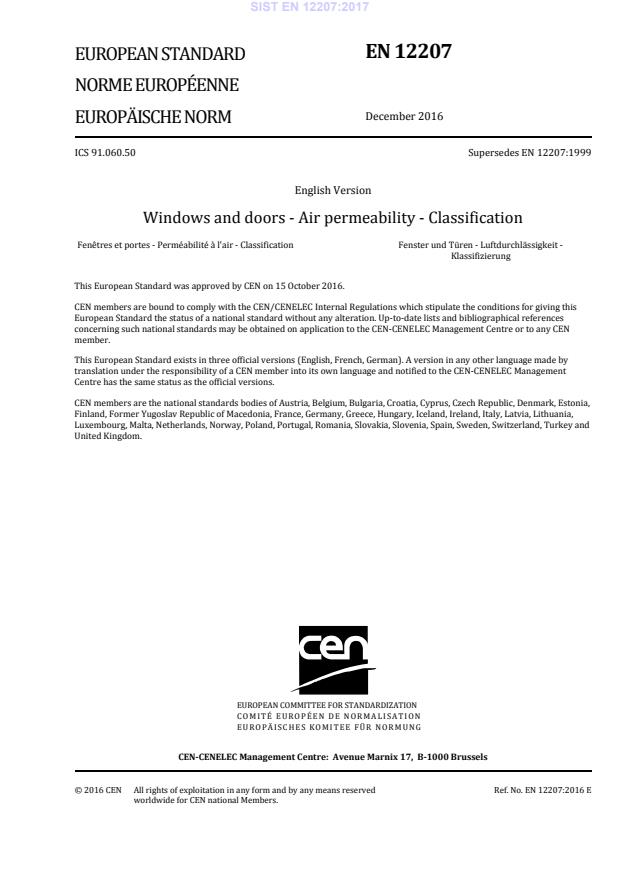
EUROPEAN STANDARD NORME EUROPÉENNE EUROPÄISCHE NORM
EN 12207
December
t r s x ICS
{ sä r x rä w r Supersedes EN
s t t r yã s { { {English Version
Windows and doors æ Air permeability æ Classification Fenêtres et portes æ Perméabilité à l 5air æ Classification Fenster und Türen æ Luftdurchlässigkeit æ Klassifizierung This European Standard was approved by CEN on
s w October
t r s xä
egulations which stipulate the conditions for giving this European Standard the status of a national standard without any alterationä Upætoædate lists and bibliographical references concerning such national standards may be obtained on application to the CENæCENELEC Management Centre or to any CEN memberä
translation under the responsibility of a CEN member into its own language and notified to the CENæCENELEC Management Centre has the same status as the official versionsä
CEN members are the national standards bodies of Austriaá Belgiumá Bulgariaá Croatiaá Cyprusá Czech Republicá Denmarká Estoniaá Finlandá Former Yugoslav Republic of Macedoniaá Franceá Germanyá Greeceá Hungaryá Icelandá Irelandá Italyá Latviaá Lithuaniaá Luxembourgá Maltaá Netherlandsá Norwayá Polandá Portugalá Romaniaá Slovakiaá Sloveniaá Spainá Swedená Switzerlandá Turkey andUnited Kingdomä
EUROPEAN COMMITTEE FOR STANDARDIZATION COMITÉ EUROPÉEN DE NORMALISATION EUROPÄISCHES KOMITEE FÜR NORMUNG
CEN-CENELEC Management Centre:
Avenue Marnix 17,
B-1000 Brussels
t r s x CEN All rights of exploitation in any form and by any means reserved worldwide for CEN national Membersä Refä Noä EN
s t t r yã t r s x ESIST EN 12207:2017
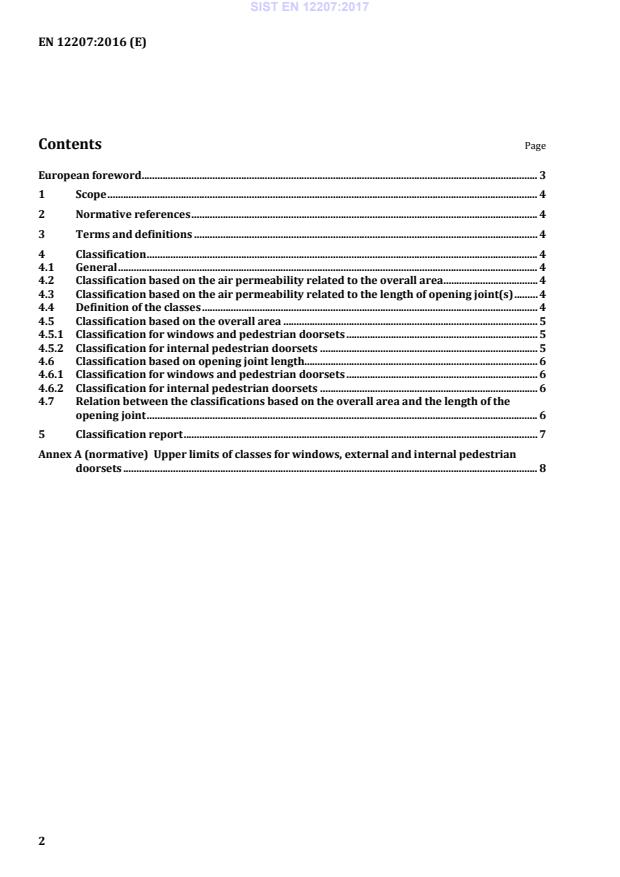
Upper limits of classes for windows, external and internal pedestrian doorsets . 8
complet
...