

EN 13438:2005
(Main)Paints and varnishes - Powder organic coatings for galvanized or sherardised steel products for construction purposes
- Abstract
This European Standard specifies performance requirements for powder coatings applied to galvanized or sherardised steel products, for architectural (internal and external application), fencing and construction purposes. Galvanized steel products can be articles batch hot dip galvanized (galvanized after fabrication) or articles consisting of continuous hot dip galvanized sheet which is then subsequently fabricated. This standard does not apply to articles with zinc-aluminium coatings (EN 10214) or aluminium-zinc coatings (EN 10215), or to continuously hot dip galvanized wire. Requirements for cleaning and pre-treatment of the galvanized or sherardised steel products prior to powder coating are also specified.
- Status
- Withdrawn
- Publication Date
- 01-Nov-2005
- Withdrawal Date
- 03-Sep-2013
- Technical Committee
- CEN/TC 139 - Paints and varnishes
- Current Stage
- 9960 - Withdrawal effective - Withdrawal
- Start Date
- 04-Sep-2013
- Completion Date
- 04-Sep-2013

Relations
- Effective Date
- 11-Sep-2013
- Effective Date
- 25-Aug-2026
- Refers
ISO 7724-3:1984 - Paints and varnishes — Colorimetry — Part 3: Calculation of colour differences - Effective Date
- 25-Aug-2026
- Effective Date
- 09-Feb-2026
- Effective Date
- 28-Jan-2026
- Refers
EN 3094:2017 - Aerospace series - Sealants - Test method - Determination of the application time - Effective Date
- 28-Jan-2026
- Refers
EN ISO 9227:2022 - Corrosion tests in artificial atmospheres - Salt spray tests (ISO 9227:2022) - Effective Date
- 28-Jan-2026
- Effective Date
- 28-Jan-2026
- Effective Date
- 28-Jan-2026
- Effective Date
- 28-Jan-2026
- Effective Date
- 28-Jan-2026
- Effective Date
- 28-Jan-2026
- Effective Date
- 28-Jan-2026
- Effective Date
- 28-Jan-2026
- Effective Date
- 28-Jan-2026
Get Certified
Connect with accredited certification bodies for this standard

DVS-ZERT GmbH
German welding certification society.
CARES (UK Certification Authority for Reinforcing Steels)
UK certification for reinforcing steels and construction.
EWF/IIW (European/International Welding Federation)
International welding personnel certification.
Sponsored listings
Frequently Asked Questions
EN 13438:2005 is a standard published by the European Committee for Standardization (CEN). Its full title is "Paints and varnishes - Powder organic coatings for galvanized or sherardised steel products for construction purposes". This standard covers: This European Standard specifies performance requirements for powder coatings applied to galvanized or sherardised steel products, for architectural (internal and external application), fencing and construction purposes. Galvanized steel products can be articles batch hot dip galvanized (galvanized after fabrication) or articles consisting of continuous hot dip galvanized sheet which is then subsequently fabricated. This standard does not apply to articles with zinc-aluminium coatings (EN 10214) or aluminium-zinc coatings (EN 10215), or to continuously hot dip galvanized wire. Requirements for cleaning and pre-treatment of the galvanized or sherardised steel products prior to powder coating are also specified.
This European Standard specifies performance requirements for powder coatings applied to galvanized or sherardised steel products, for architectural (internal and external application), fencing and construction purposes. Galvanized steel products can be articles batch hot dip galvanized (galvanized after fabrication) or articles consisting of continuous hot dip galvanized sheet which is then subsequently fabricated. This standard does not apply to articles with zinc-aluminium coatings (EN 10214) or aluminium-zinc coatings (EN 10215), or to continuously hot dip galvanized wire. Requirements for cleaning and pre-treatment of the galvanized or sherardised steel products prior to powder coating are also specified.
EN 13438:2005 is classified under the following ICS (International Classification for Standards) categories: 25.220.60 - Organic coatings. The ICS classification helps identify the subject area and facilitates finding related standards.
EN 13438:2005 has the following relationships with other standards: It is inter standard links to EN 13438:2013, ISO 9227:1990, ISO 7724-3:1984, ISO 10474:1991, EN ISO 8495:2013, EN 3094:2017, EN ISO 9227:2022, EN ISO 17668:2016, EN ISO 1519:2011, EN ISO 11341:2004, EN ISO 1518-1:2023, EN ISO 2409:2020, EN 14433:2006, EN ISO 6270-1:2018, EN ISO 1461:2022. Understanding these relationships helps ensure you are using the most current and applicable version of the standard.
EN 13438:2005 is available in PDF format for immediate download after purchase. The document can be added to your cart and obtained through the secure checkout process. Digital delivery ensures instant access to the complete standard document.
Standards Content (Sample)
SLOVENSKI STANDARD
01-april-2006
Barve in laki – Praškasti organski premazi za izdelke iz galvaniziranega ali
difuzijsko pocinkanega jekla v gradbeništvu
Paints and varnishes - Powder organic coatings for galvanized or sherardised steel
products for construction purposes
Beschichtungsstoffe - Pulverbeschichtungen für verzinkte oder sherardisierte
Stahlerzeugnisse für Bauzwecke
Peintures et vernis - Revetements de poudre organique pour produits en acier galvanisé
ou shérardisé utilisés dans la construction
Ta slovenski standard je istoveten z: EN 13438:2005
ICS:
25.220.60 Organske prevleke Organic coatings
87.040 Barve in laki Paints and varnishes
2003-01.Slovenski inštitut za standardizacijo. Razmnoževanje celote ali delov tega standarda ni dovoljeno.
EUROPEAN STANDARD
EN 13438
NORME EUROPÉENNE
EUROPÄISCHE NORM
November 2005
ICS 25.220.60
English Version
Paints and varnishes - Powder organic coatings for galvanized
or sherardised steel products for construction purposes
Peintures et vernis - Revêtements de poudre organique Beschichtungsstoffe - Pulverbeschichtungen für
pour produits en acier galvanisé ou shérardisé utilisés dans feuerverzinkte oder sherardisierte Stahlerzeugnisse für
la construction Bauzwecke
This European Standard was approved by CEN on 8 September 2005.
CEN members are bound to comply with the CEN/CENELEC Internal Regulations which stipulate the conditions for giving this European
Standard the status of a national standard without any alteration. Up-to-date lists and bibliographical references concerning such national
standards may be obtained on application to the Central Secretariat or to any CEN member.
This European Standard exists in three official versions (English, French, German). A version in any other language made by translation
under the responsibility of a CEN member into its own language and notified to the Central Secretariat has the same status as the official
versions.
CEN members are the national standards bodies of Austria, Belgium, Cyprus, Czech Republic, Denmark, Estonia, Finland, France,
Germany, Greece, Hungary, Iceland, Ireland, Italy, Latvia, Lithuania, Luxembourg, Malta, Netherlands, Norway, Poland, Portugal, Slovakia,
Slovenia, Spain, Sweden, Switzerland and United Kingdom.
EUROPEAN COMMITTEE FOR STANDARDIZATION
COMITÉ EUROPÉEN DE NORMALISATION
EUROPÄISCHES KOMITEE FÜR NORMUNG
Management Centre: rue de Stassart, 36 B-1050 Brussels
© 2005 CEN All rights of exploitation in any form and by any means reserved Ref. No. EN 13438:2005: E
worldwide for CEN national Members.
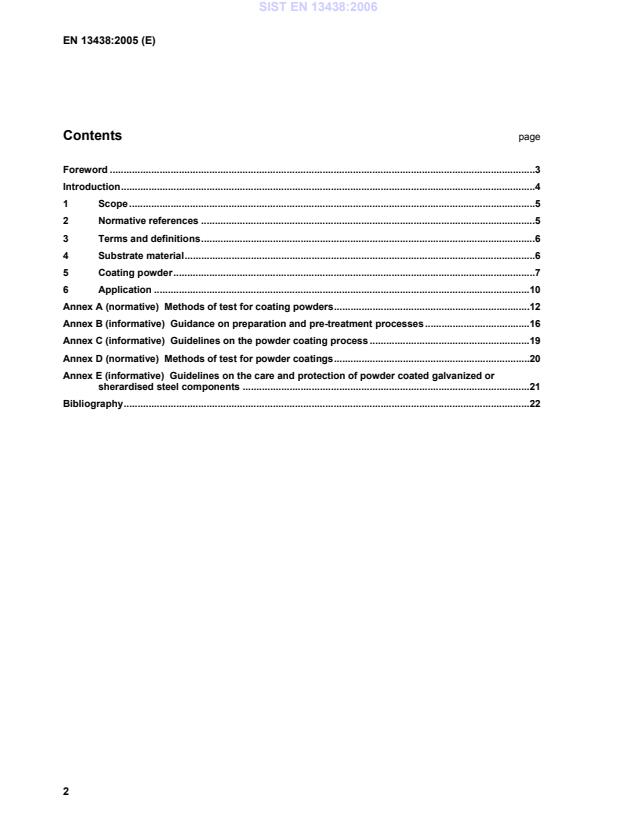
Contents page
Foreword .3
Introduction.4
1 Scope .5
2 Normative references .5
3 Terms and definitions.6
4 Substrate material.6
5 Coating powder.7
6 Application .10
Annex A (normative) Methods of test for coating powders.12
Annex B (informative) Guidance on preparation and pre-treatment processes .16
Annex C (informative) Guidelines on the powder coating process .19
Annex D (normative) Methods of test for powder coatings.20
Annex E (informative) Guidelines on the care and protection of powder coated galvanized or
sherardised steel components .21
Bibliography.22
Foreword
This European Standard (EN 13438:2005) has been prepared by Technical Committee CEN/TC 139 “Paints
and varnishes”, the secretariat of which is held by DIN.
This European Standard shall be given the status of a national standard, either by publication of an identical
text or by endorsement, at the latest by May 2006, and conflicting national standards shall be withdrawn at the
latest by May 2006.
According to the CEN/CENELEC Internal Regulations, the national standards organizations of the following
countries are bound to implement this European Standard: Austria, Belgium, Cyprus, Czech Republic,
Denmark, Estonia, Finland, France, Germany, Greece, Hungary, Iceland, Ireland, Italy, Latvia, Lithuania,
Luxembourg, Malta, Netherlands, Norway, Poland, Portugal, Slovakia, Slovenia, Spain, Sweden, Switzerland
and United Kingdom.
Introduction
This European Standard has been produced as a result of the growing demand for products made of powder
coated hot-dip galvanized or sherardised steel. These products offer a combination of corrosion resistance
and decorative appearance.
It is assumed in the drafting of this standard that the specified test methods will be applied by those who are
suitably trained and supervised.
This European Standard has been written from a coating performance perspective and does not seek to set
out one method of powder coating galvanized or sherardised steel products. In order to facilitate production of
the best quality powder coated hot dip galvanized or sherardised articles however, experience has shown that
it is important that sufficient dialogue between the client, specifier, designer, fabricator, galvanizer or
sherardiser and powder coating applicator takes place at the earliest stages of the project and that where
possible timescales set out for processing of the work are practical and adhered to. A guidance document
dealing with these and other aspects of supply is currently under development.
1 Scope
This European Standard specifies performance requirements for powder coatings applied to galvanized or
sherardised steel products, for architectural (internal and external application), fencing and construction
purposes. Galvanized steel products can be articles batch hot dip galvanized (galvanized after fabrication) or
articles consisting of continuously hot-dip galvanized sheet which is then subsequently fabricated. This
standard does not apply to articles with zinc-aluminium coatings or aluminium-zinc coatings, or to continuously
hot dip galvanized wire. Requirements for cleaning and pre-treatment of the galvanized or sherardised steel
products prior to powder coating are also specified.
2 Normative references
The following referenced documents are indispensable for the application of this document. For dated
references, only the edition cited applies. For undated references, the latest edition of the referenced
document (including any amendments) applies.
EN 10326, Continuously hot-dip coated strip and sheet of structural steels — Technical delivery conditions
EN 10327, Continuously hot-dip coated strip and sheet of low carbon steels for cold forming — Technical
delivery conditions
EN 13811, Sherardising — Zinc diffusion coatings on ferrous products — Specification
EN ISO 1461, Hot dip galvanized coatings on fabricated iron and steel articles — Specifications and test
methods (ISO 1461:1999)
EN ISO 1518, Paints and varnishes — Scratch test (ISO 1518:1992)
EN ISO 1519, Paints and varnishes — Bend test (cylindrical mandrel) (ISO 1519:2002)
EN ISO 2178, Non-magnetic coatings on magnetic substrates — Measurement of coating thickness —
Magnetic method (ISO 2178:1982)
EN ISO 2409, Paints and varnishes — Cross-cut test (ISO 2409:1992)
EN ISO 2808, Paints and varnishes — Determination of film thickness (ISO 2808:1997)
EN ISO 2810, Paints and varnishes - Natural weathering of coatings - Exposure and assessment (ISO
2810:2004)
EN ISO 2813, Paints and varnishes - Determination of specular gloss of non-metallic paint films at 20°, 60°
and 85° (ISO 2813:1994, including Technical Corrigendum 1:1997)
EN ISO 3231, Paints and varnishes — Determination of resistance to humid atmospheres containing sulfur
dioxide (ISO 3231:1993)
EN ISO 3668, Paints and varnishes — Visual comparison of the colour of paints (ISO 3668:1998)
EN ISO 6270-1, Paints and varnishes — Determination of resistance to humidity — Part 1: Continuous
condensation (ISO 6270-1:1998)
EN ISO 7253, Paints and varnishes — Determination of resistance to neutral salt spray (fog) (ISO 7253:1996)
EN ISO 8130-9, Coating powders — Part 9: Sampling (ISO 8130-9:1992)
EN ISO 11341:2004, Paints and varnishes - Artificial weathering and exposure to artificial radiation - Exposure
to filtered xenon-arc radiation (ISO 11341:2004)
ISO 7724-3, Paints and varnishes — Colorimetry — Part 3: Calculation of colour differences
ISO 9227, Corrosion tests in artificial atmospheres - Salt spray tests
ISO 10474, Steel and steel products — Inspection documents
3 Terms and definitions
For the purposes of this European Standard, the following terms and definitions apply.
3.1
finishing coat
final coat of a coating system
[EN 971-1:1996]
3.2
conversion coating
layer produced on a galvanized or sherardised steel surface by a chemical treatment
3.3
powder coating
dry film obtained by application and fusing of a coating powder
3.4
coating powder
solvent-free coating material in powder form which, after fusing and possible curing, gives a continuous film
3.5
test piece
single item, representative of the work being processed
3.6
test sample
group of test pieces
3.7
significant surface
that part of the coated article on which the coating is essential for serviceability of the article
3.8
specifier
person specifying the performance requirements for the coating and significant surfaces of the article
3.9
coating applicator
company responsible for applying the coating powder onto a substrate
4 Substrate material
The substrate shall be hot dip galvanized steel in accordance with EN ISO 1461, EN 10326, EN 10327 or
sherardised steel in accordance with EN 13811. If required, steel sections shall be free from surface
imperfections such as die lines and laminations. Unless otherwise agreed, the preparation of the surface of
the galvanized article, such that the surface is suitable for pre-treatment and application of powder to the
surface, shall be the responsibility of the coating applicator (see 3.9).
NOTE 1 The galvanizer or the sherardiser and coating applicator should be consulted about the design of the steel
products intended for galvanizing or sherardising after construction, prior to the fabrication stage, in order to optimise
galvanizing and powder coating quality. EN ISO 12944-4 provides some guidance on surface conditions that might be
encountered on post fabrication hot dip galvanized or sherardised articles.
NOTE 2 To achieve optimum quality of finished product sharp edges on the fabrication should be avoided.
5 Coating powder
5.1 Identification
The following information shall be made available by the supplier for each consignment of coating powder:
a) manufacturer;
b) trade name;
c) colour;
d) gloss level;
e) type of resin;
f) batch number;
g) box number;
h) product reference code;
i) date of manufacture;
j) date of despatch.
5.2 Storage
The coating powder, after storage in unopened containers for a maximum period indicated by the
manufacturer, calculated from the date of dispatch by the manufacturer, shall still conform to 5.3. If no
maximum permissible storage period is indicated by the manufacturer, the coating powder shall, after storage
in unopened containers for up to 12 months from the date of despatch by the manufacturer, conform to 5.3.
The storage temperature shall not exceed 25 °C unless otherwise specified by the coating powder
manufacturer.
Coating powder that has been stored for longer than the maximum permissible period indicated by the
manufacturer (or if no maximum permissible storage period has been indicated and the coating powder has
been stored for longer then 12 months) shall only be used upon agreement between the manufacturer and the
coating applicator.
5.3 Performance requirements
5.3.1 General
The following tests (5.3.2. to 5.3.12) shall be carried out in accordance with Annex A by the manufacturer of
the coating powder.
The coating powder, when applied to a prepared test panel in accordance with Annex A shall show no
scratches through to the substrate. When a coated test panel is examined in accordance with A.4.1, no
blisters, craters, pinholes or scratches shall be first visible from a distance of 1 m.
The manufacturer of the coating powder shall identify, with reference to Class 1 or Class 2, the performance
capability of powder supplied, dependent upon the results of testing set out in 5.3.12.
5.3.2 Colour
When a coated test panel is examined in accordance with A.4.2, the colour of the coating shall match the
reference colour or fall within the tolerance previously indicated by the specifier.
5.3.3 Gloss
When a coated test panel is examined in accordance with A.4.3, the gloss level of the coating shall be within
the tolerance limits indicated by the manufacturer. If no tolerance limits have been indicated by the
manufacturer the gloss level of the coating shall be in accordance with Table 1.
Table 1 — Gloss requirements
Acceptable variation from
Specified gloss level
specified gloss level
> 50
± 10
≤ 50
± 7
5.3.4 Adhesion
When a coated test panel is tested in accordance with A.4.4, the result shall be in accordance with the
classification 0 of EN ISO 2409.
5.3.5 Resistance to scratching
When a coated test panel is tested in accordance A.4.5, there shall be no penetration through the coating to
the substrate.
5.3.6 Resistance to deformation
When a coated test panel is tested in accordance with A.4.6, there shall be no cracking or delamination of the
coating from the substrate.
5.3.7 Resistance to mortar
When a coated test panel is tested in accordance with A.4.7, the mortar shall be readily dislodged without the
use of an implement. There shall be no detachment of the coating and no change in its appearance.
5.3.8 Resistance to weathering
A coated test panel shall conform to one of the following weathering tests, dependent on the product and
following the agreement between the coating applicator and the specifier.
a) resistance to artificial weathering: After testing in accordance with A.4.8.1, there shall be no signs of
cracking or blistering. The residual gloss level shall be more than 40 % of the original gloss level. Colour
changes shall be within the limits agreed by the coating applicator and the specifier (e.g. as ∆E and/or ∆C
and/or ∆L).
b) resistance to natural weathering: After testing in accordance with A.4.8.2, there shall be no signs of
cracking, blistering or unacceptable colour change.
NOTE Natural weathering tests are generally considered to be more informative than artificial weathering procedures
in assessing coating durability, but necessarily take longer.
5.3.9 Resistance to humidity
When a coated test panel is tested in accordance with A.4.9.1 there shall be no blistering, softening or
detachment of the coating, nor signs of corrosion of the substrate.
When the coating is tested by the method described in A.4.9.2 the result shall be in accordance with the
classification of EN ISO 2409.
5.3.10 Resistance to sulfur dioxide
When a coated test panel is tested in accordance with A.4.10, there shall be no colour change in comparison
with an unexposed coated test panel, no blistering of the coating and no signs of corrosion of the substrate.
5.3.11 Permeability
When a coated test panel is tested in accordance with A.4.11, there shall be no blistering or detachment of the
coating. Any blistering within 3 mm of any panel edge shall be ignored.
5.3.12 Resistance to salt spray
5.3.12.1 General
Coating powders shall be subject to the following tests. Coated test panels shall be subjected to one of the
two tests, as referred to in 5.3.12.2 or 5.3.12.3, and powders which pass shall be designated by the
appropriate “class” by the powder supplier.
5.3.12.2 Neutral salt spray
When tested in accordance with A.4.12.1, there shall be no underfilm corrosion or loss of adhesion extending
in a perpendicular direction beyond 5 mm from the scribed lines and there shall be no signs of blistering or
cracking on any other part of the panel. Powders which pass this test shall be designated 'Class 1' by the
powder supplier.
5.3.12.3 Acetic acid salt spray
When tested in accordance with A.4.12.2, there shall be no underfilm corrosion or loss of adhesion extending
in a perpendicular direction beyond 5 mm from the scribed lines and there shall be no signs of blistering or
cracking on any other part of the panel. Powders which pass this test shall be designated 'Class 2' by the
powder supplier.
5.4 Health and safety information
Relevant information on the chemical and physical characteristics, storage and use of the organic powders
shall be provided by the coating powder supplier to the coating applicator.
6 Application
6.1 Coating powder
Coating powders used shall conform to Clause 5.
6.2 Preparation of the galvanized or sherardised substrate
Guidance on preparation is given in Annex B.
6.3 Pre-treatment
Guidance on pre-treatment is given in Annex B.
6.4 Application of coating powder
The coating powder manufacturer shall provide information to the coating applicator regarding the
recommended conditions of application of the powder coating. Guidance on the application of the powder
coating is given in Annex C.
6.5 Significant surfaces and environment for use of coated article
Significant surfaces shall be indicated by the specifier.
6.6 Performance requirements of the powder coated article
6.6.1 General
The tests in 6.6.2. to 6.6.5 shall be carried out by the coating applicator.
NOTE 1 The surface finish and surface chemistry of the steel can influence the structure and surface finish of the
galvanized coatings formed. Variations in surface smoothness of the hot dip galvanized coatings allowed for in the supply
standard (e.g. EN ISO 1461) should be taken into account when assessing the surface smoothness of finished article.
NOTE 2 The electrostatic deposition of a coating powder can cause thicker coatings near edges and thinner coatings
in recesses.
6.6.2 Surface appearance
When tested in accordance with D.3.1, the coating on significant surfaces shall show no scratches through to
the substrate. No blisters, craters or scratches shall be first visible from a distance of not less than 3 m.
NOTE A slight degree of orange peel can sometimes occur. Before any work is conducted the maximum extent of
orange peel allowable should be obtained from the specifier, using suitable reference samples where agreed. Pinholing
and variations in characteristics (such as colour and gloss) can be reduced by avoiding large changes in the section
thickness of materials in the same fabrication, as these materials will exhibit significant differences in heat capacity.
6.6.3 Colour
When tested in accordance with D.3.2, the coating on significant surfaces shall match the reference colour
previously nominated by the specifier.
6.6.4 Thickness
When tested in accordance with D.3.3, the thickness of the coating on significant surfaces shall be within the
range specified by the coating powder manufacturer, at or above the minimum thickness specifiedin A.3.3 and
the substrate shall not be visible at any edge.
6.6.5 Gloss
When tested in accordance with D.3.4, the gloss level on significant surfaces shall be within the range
specified by the coating powder manufacturer or where no tolerance has been specified, in accordance with
the requirements of Table 1.
6.6.6 Adhesion
When tested in accordance with EN ISO 2409, the coating shall meet classification 0 of that standard.
6.6.7 Certificate of conformity
The coating applicator shall, on request, issue a certificate of conformity in accordance with ISO 10474.
Annex A
(normative)
Methods of test for coating powders
A.1 General
Unless otherwise specified carry out the tests in duplicate (see A.3.1).
A.2 Sampling
Take a representative sample of the coating powder in accordance with EN ISO 8130-9.
A.3 Coated test panels
A.3.1 Material and dimensions
Galvanized test panels (for tests not related to mechanical properties) shall be rectangular, 150 mm 100 mm
×
in area, of steel thickness 0,75 mm to 1,6 mm and meet the requirements of grade Z275-N-A of EN 10327.
Galvanized test panels for mechanical properties shall have a steel thick
...