

EN 13785:2005
(Main)Regulators with a capacity of up to and including 100 kg/h, having a maximum nominal outlet pressure of up to and including 4 bar, other than those covered by EN 12864 and their associated safety devices for butane, propane or their mixtures
General Information
- Abstract
This document defines the constructional and operational characteristics, the safety requirements, test methods and the marking of regulators having a capacity of less than or equal to 100 kg/h, other than the regulators covered by EN 12864, for butane, propane or their mixtures, in the gaseous phase.
Regulators for caravans up to 1,5 kg/h are covered by EN 12864.
NOTE 1 bar = 105 Pa
This document also applies to the safety devices which are included within regulators covered by this document. The characteristics of these devices are given in annexes A and B.
The requirements apply generally to regulators used in locations where the temperature likely to be reached during use is between -20 °C and +50 °C. When the regulators are used at temperatures below -20 °C it is essential that they comply with special requirements which are defined in annex C.
This document does not include the installation rules for regulators. Reference should be made to national regulations in force in the member countries.
This document only covers type testing.
WARNING NOTICE: The figures in annexes G and H show the types of connections used according to the country of use of the regulators.
The top part of these figures (above the horizontal line) applies to the regulator and is normative.
The bottom part of these figures (below the horizontal line) applies to the part to be connected to the regulator. This is given as a guide for the tests and is not normative.
- Status
- Withdrawn
- Publication Date
- 08-Mar-2005
- Withdrawal Date
- 04-Nov-2008
- Technical Committee
- CEN/TC 181 - Dedicated liquified petroleum gas appliances
- Drafting Committee
- CEN/TC 181/WG 8 - Pressure regulators and changeover devices
- Current Stage
- 9960 - Withdrawal effective - Withdrawal
- Start Date
- 05-Nov-2008
- Completion Date
- 05-Nov-2008

Relations
- Effective Date
- 22-Dec-2008
- Effective Date
- 28-Jan-2026
- Effective Date
- 22-Dec-2008
- Effective Date
- 22-Dec-2008
- Effective Date
- 22-Dec-2008
Get Certified
Connect with accredited certification bodies for this standard

Institut za varilstvo d.o.o. (Welding Institute)
Slovenia's leading welding institute since 1952. ISO 3834, EN 1090, pressure equipment certification, NDT personnel, welder qualification. Only IIW Au
Sponsored listings
Frequently Asked Questions
EN 13785:2005 is a standard published by the European Committee for Standardization (CEN). Its full title is "Regulators with a capacity of up to and including 100 kg/h, having a maximum nominal outlet pressure of up to and including 4 bar, other than those covered by EN 12864 and their associated safety devices for butane, propane or their mixtures". This standard covers: This document defines the constructional and operational characteristics, the safety requirements, test methods and the marking of regulators having a capacity of less than or equal to 100 kg/h, other than the regulators covered by EN 12864, for butane, propane or their mixtures, in the gaseous phase. Regulators for caravans up to 1,5 kg/h are covered by EN 12864. NOTE 1 bar = 105 Pa This document also applies to the safety devices which are included within regulators covered by this document. The characteristics of these devices are given in annexes A and B. The requirements apply generally to regulators used in locations where the temperature likely to be reached during use is between -20 °C and +50 °C. When the regulators are used at temperatures below -20 °C it is essential that they comply with special requirements which are defined in annex C. This document does not include the installation rules for regulators. Reference should be made to national regulations in force in the member countries. This document only covers type testing. WARNING NOTICE: The figures in annexes G and H show the types of connections used according to the country of use of the regulators. The top part of these figures (above the horizontal line) applies to the regulator and is normative. The bottom part of these figures (below the horizontal line) applies to the part to be connected to the regulator. This is given as a guide for the tests and is not normative.
This document defines the constructional and operational characteristics, the safety requirements, test methods and the marking of regulators having a capacity of less than or equal to 100 kg/h, other than the regulators covered by EN 12864, for butane, propane or their mixtures, in the gaseous phase. Regulators for caravans up to 1,5 kg/h are covered by EN 12864. NOTE 1 bar = 105 Pa This document also applies to the safety devices which are included within regulators covered by this document. The characteristics of these devices are given in annexes A and B. The requirements apply generally to regulators used in locations where the temperature likely to be reached during use is between -20 °C and +50 °C. When the regulators are used at temperatures below -20 °C it is essential that they comply with special requirements which are defined in annex C. This document does not include the installation rules for regulators. Reference should be made to national regulations in force in the member countries. This document only covers type testing. WARNING NOTICE: The figures in annexes G and H show the types of connections used according to the country of use of the regulators. The top part of these figures (above the horizontal line) applies to the regulator and is normative. The bottom part of these figures (below the horizontal line) applies to the part to be connected to the regulator. This is given as a guide for the tests and is not normative.
EN 13785:2005 is classified under the following ICS (International Classification for Standards) categories: 23.060.40 - Pressure regulators. The ICS classification helps identify the subject area and facilitates finding related standards.
EN 13785:2005 has the following relationships with other standards: It is inter standard links to EN 13785:2005+A1:2008, EN 15001-1:2009, EN 13785:2005/prA1, EN 13785:2005/AC:2007, EN 16129:2013. Understanding these relationships helps ensure you are using the most current and applicable version of the standard.
EN 13785:2005 is associated with the following European legislation: EU Directives/Regulations: 2009/142/EC, 90/396/EEC; Standardization Mandates: M/BC/CEN/89/6. When a standard is cited in the Official Journal of the European Union, products manufactured in conformity with it benefit from a presumption of conformity with the essential requirements of the corresponding EU directive or regulation.
EN 13785:2005 is available in PDF format for immediate download after purchase. The document can be added to your cart and obtained through the secure checkout process. Digital delivery ensures instant access to the complete standard document.
Standards Content (Sample)
2003-01.Slovenski inštitut za standardizacijo. Razmnoževanje celote ali delov tega standarda ni dovoljeno.Regulators with a capacity of up to and including 100 kg/h, having a maximum nominal outlet pressure of up to and including 4 bar, other than those covered by EN 12864 and their associated safety devices for butane, propane or their mixturesL]KRGQLPDétendeurs de débit inférieur ou égal a 100 kg/h, a pression de détente nominale maximale inférieure ou égale a 4 bar, autres que les détendeurs relevant de l'EN 12864, et leurs dispositifs de sécurité associés pour butane, propane ou leurs mélangesDruckregelgeräte mit einem höchsten Ausgangsdruck bis einschließlich 4 bar und einem Durchfluss bis einschließlich 100 kg/h, die nicht in EN 12864 behandelt sind, für Butan, Propan oder deren Gemische sowie die dazugehörigen SicherheitseinrichtungenTa slovenski standard je istoveten z:EN 13785:2005SIST EN 13785:2005en,fr,de23.060.40ICS:SLOVENSKI
STANDARDSIST EN 13785:200501-junij-2005
EUROPEAN STANDARDNORME EUROPÉENNEEUROPÄISCHE NORMEN 13785March 2005ICS 23.060.40English versionRegulators with a capacity of up to and including 100 kg/h,having a maximum nominal outlet pressure of up to andincluding 4 bar, other than those covered by EN 12864 and theirassociated safety devices for butane, propane or their mixturesDétendeurs de débit inférieur ou égal à 100 kg/h, àpression de détente nominale maximale inférieure ou égaleà 4 bar, autres que les détendeurs relevant de l'EN 12864,et leurs dispositifs de sécurité associés pour butane,propane ou leurs mélangesDruckregelgeräte mit einem höchsten Ausgansdruck von <4 bar und einem Durchfluss < 100 kg/h, die nicht in EN12864 geregelt sind, für Butan, Propan oder derenGemische sowie die dazugehörigenSicherheitseinrichtungenThis European Standard was approved by CEN on 1 July 2004.CEN members are bound to comply with the CEN/CENELEC Internal Regulations which stipulate the conditions for giving this EuropeanStandard the status of a national standard without any alteration. Up-to-date lists and bibliographical references concerning such nationalstandards may be obtained on application to the Central Secretariat or to any CEN member.This European Standard exists in three official versions (English, French, German). A version in any other language made by translationunder the responsibility of a CEN member into its own language and notified to the Central Secretariat has the same status as the officialversions.CEN members are the national standards bodies of Austria, Belgium, Cyprus, Czech Republic, Denmark, Estonia, Finland, France,Germany, Greece, Hungary, Iceland, Ireland, Italy, Latvia, Lithuania, Luxembourg, Malta, Netherlands, Norway, Poland, Portugal, Slovakia,Slovenia, Spain, Sweden, Switzerland and United Kingdom.EUROPEAN COMMITTEE FOR STANDARDIZATIONCOMITÉ EUROPÉEN DE NORMALISATIONEUROPÄISCHES KOMITEE FÜR NORMUNGManagement Centre: rue de Stassart, 36
B-1050 Brussels© 2005 CENAll rights of exploitation in any form and by any means reservedworldwide for CEN national Members.Ref. No. EN 13785:2005: E
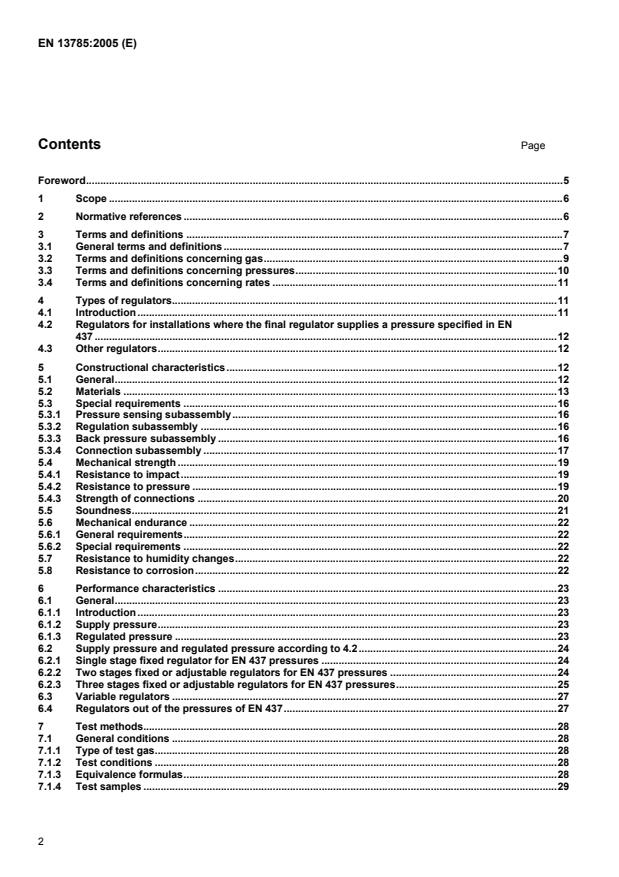
Special requirements for regulators fitted with pressure or rate operated
safety devices.42 A.1 Regulators fitted with an over-pressure relief.42 A.1.1 Definition.42 A.1.2 Constructional characteristics.42 A.1.3 Performance characteristics.42 A.1.4 Test methods.43 A.1.5 Regulator marking.43 A.2 Regulators fitted with an over-pressure shut off safety valve.43 A.2.1 Definition.43 A.2.2 Constructional characteristics.43 A.2.3 Performance characteristics.44 A.2.4 Test methods.44 A.3 Regulators fitted with an under-pressure shut off safety device.45 A.3.1 Definition.45 A.3.2 Constructional and performance characteristics.45 A.3.3 Test methods.46 A.4 Regulators fitted with an excess flow valve.46 A.4.1 Definition.46 A.4.2 Performance characteristics.46 A.4.3 Test methods.46 A.4.4 User and maintenance instructions.47 A.5 Regulators fitted with a regulated pressure limiter.47 A.5.1 Definition.47 A.5.2 Constructional and performance characteristics.48 A.5.3 Test methods.48 A.5.4 User and maintenance instructions.48 Annex B (normative)
Special requirements for regulators fitted with a thermal cut out.49 B.1 Definition.49 B.2 Constructional characteristics.49 B.3 Performance characteristics.49 B.4 Test methods.49 Annex C (normative)
Special requirements for low pressure regulators under extreme temperature conditions (temperatures below -20 °C).51 Annex D (normative)
Method for measuring leaks at test pressures less than or equal to 16 bar.52 D.1 Scope.52 D.2 Diagram of the test bench.52 D.3 Coefficient K.53 D.3.1 Method.53 D.3.2 Calculations.53
Complementary test requirements for non metallic thermoplastic or thermal setting materials used in the construction of regulators.55 E.1 Scope.55 E.2 Materials.55 E.3 Special conditions for carrying out the tests mentioned in the body of the document.55 E.3.1 Resistance to impact (see 5.4.1 and 7.2.1).55 E.3.2 Mechanical resistance of connections (see 5.4.3 and 7.2.3).55 E.3.3 Soundness (see 5.5 and 7.2.5).56 E.4 Special requirements.56 E.4.1 Resistance to hydrocarbons.56 E.4.2 Resistance to cracking under stress and when chemical agents are present.56 E.4.3 Characteristics relating to fire resistance.56 E.4.4 Accelerated ageing.57 E.5 Sampling and order of tests.57 Annex F (normative)
Requirements for elastomeric reinforced diaphragms.58 Annex G (normative)
Inlet connections.59 Annex H (normative)
Outlet connections.103 Annex I (informative)
Test method for resistance to corrosion.131 I.1 Principle.131 I.2 Reagents.131 I.2.1 Saline solution.131 I.2.2 Compressed air.131 I.2.3 Salt mist.132 I.3 Apparatus.132 I.3.1 Spraying chamber.132 I.3.2 Sprayers.132 I.3.3 Heating device.133 I.3.4 Salt solution supply device.133 I.3.5 Compressed air supply device.133 I.3.6 Mist collectors.133 I.4 Test method.134 I.4.1 Method of exposure of regulators.134 I.4.2 Duration of tests.134 I.4.3 Checks.134 I.4.4 Cleaning of regulators.134 I.5 Results.134 Annex ZA (informative)
Relationship between this European Standard and the Essential Requirements of EU Directive 90/396/EEC.137 Bibliography.139
EN 437:2003, Test gases - Test pressures - Appliances categories. EN 549, Rubber materials for seals and diaphragms for gas appliances and gas equipment. EN 12164, Copper and copper alloys - Rod for free machining purposes. EN 12165, Copper and copper alloys - Wrought and unwrought forging stock. EN 60695-11-10, Fire hazard testing - Part 11-10: Test flames - 50 W horizontal and vertical flame test methods (IEC 60695-11-10:1999). EN ISO 75, Plastics - Determination of temperature of deflection under load. EN ISO 178, Plastics - Determination of flexural properties (ISO 178:2001). EN ISO 180, Plastics - Determination of Izod impact strength (ISO 180:2000). EN ISO 228-1, Pipe threads where pressure-tight joints are not made on the threads - Part 1: dimensions, tolerances and designation (ISO 228-1:2000)
EN ISO 4892-3, Plastics - Methods of exposure to laboratory light sources - Part 3: Fluorescent UV lamps (ISO 4892-3:1994). EN ISO 8434-1; Metallic tube connections for fluid power and general use - Part 1: 24° compression fittings (ISO 8434-1:1994). ISO 7-1, Pipe threads where pressure-tight joints are made on the threads - Part 1: Dimensions, tolerances and designation. ISO 301, Zinc alloy ingots intended for casting. ISO 565, Test sieves - Metal wire cloth, perforated metal plate and electroformed sheet - Nominal sizes of openings. ISO 7005-2, Metallic flanges - Part 2: Cast iron flanges. ISO 9227, Corrosion tests in artificial atmospheres - Salt spray tests. 3 Terms and definitions For the purposes of this document, the following terms and definitions apply. 3.1 General terms and definitions 3.1.1 regulator device which maintains a regulated pressure within preset limits, whatever the upstream pressure, rate and temperature. The regulator can have fixed, variable or adjustable regulated pressure. The terminology given is that shown in Figure 1. The diagram is given as information; no other method is excluded
Key 1 Pressure sensing subassembly
2 Regulation subassembly
3 Back pressure subassembly
4 Mechanical connection subassembly
5 Connection subassembly
Figure 1 - Principal parts of a regulator
• the supply pressure of the regulator is equal to the pressure of the LPG supply container(s); • the regulator supplies a gas appliance. 2 – Two stages
• the supply pressure of the first regulator is equal to the pressure of the LPG supply container(s); • the supply pressure of the second regulator depends on the regulated pressure of the first regulator and on the pressure losses in the intermediate line; • the second regulator supplies a gas appliance.
• the supply pressure of the first regulator is equal to the pressure of the LPG supply container(s); • the supply pressure of the second and the third regulator depends on the regulated pressure of the upstream regulator and on the pressure losses in the intermediate upstream line; • the third regulator supplies a gas appliance. 4.2 Regulators for installations where the final regulator supplies a pressure specified in EN 437 The last regulator, which supplies a gas appliance for pressures specified by EN 437 shall be a fixed regulator (see 3.1.2). It is recommended that all the other regulators of the installation are fixed regulators. For interchangeability the recommended nominal value of intermediate regulated pressures (pd) are the following: 3 – 1,5 – 1 – 0,75 – 0,5 – 0,4 – 0,3 – 0,15 bar These settings accommodate pressure losses in the interstage pipe work. In general systems are designed with a pressure loss of up to 15 %. However in some cases where additional equipment (i.e limiter) is fitted, pressure losses of 50 % are found. 4.3 Other regulators To supply appliances with pressures which are different from those specified by EN 437 fixed, variable or adjustable regulators are used. 5 Constructional characteristics 5.1 General Regulators shall be designed, manufactured and assembled in such a way that their operation is satisfactory under the installation and service conditions specified by the manufacturer. The safety devices, if incorporated in or onto the regulators covered by this document shall be designed and constructed in accordance with the provisions of annexes A and B. All the parts of a regulator shall be free from sharp corners or edges capable of causing damage, deterioration, injury or faulty operation.
Parts shall be clean internally and externally. Holes for screws, pins, etc., intended for the assembly of the regulators components and for their fixing shall not open into the gas ways. The thickness of the wall between these holes and the gas ways shall be at least 1 mm. Holes necessary for machining which join gas ways to the atmosphere, but which have no influence on the operation of the regulator, shall be permanently closed metallically. Appropriate additional sealing compounds may be used.
Key 1 Cover 2 Body 3 Connections Figure 2 - Regulator diagram showing the metallic parts
...