

EN 16465:2015
(Main)Plastics - Methods for the calibration of black-standard and white-standard thermometers and black-panel and white-panel thermometers for use in natural and artificial weathering
- Abstract
This European Standard specifies traceable calibration methods of black-standard thermometers (BST), white-standard thermometers (WST), black-panel thermometers (BPT) and white-panel thermometers (WPT) for use in natural and artificial weathering:
- method A, a contact method, uses a traceable calibrated resistance standard thermometer;
- method B, a contactless method, uses a traceable calibrated pyrometer.
A basic design of types of the thermometers is described in EN ISO 4892 1.
NOTE 1 Historically method A has been used for weathering applications for many years: Method B has been developed recently. Both methods are qualified for weathering applications. They may provide different calibration results that are not interchangeable.
NOTE 2 Annex A gives information on the characteristics of BST/WST and BPT/WPT.
- Status
- Published
- Publication Date
- 29-Sep-2015
- Technical Committee
- CEN/TC 249 - Plastics
- Drafting Committee
- CEN/TC 249/WG 19 - Light exposure
- Current Stage
- 9060 - Closure of 2 Year Review Enquiry - Review Enquiry
- Start Date
- 02-Sep-2026
- Completion Date
- 02-Sep-2026

Overview - EN 16465:2015 (CEN)
EN 16465:2015 provides traceable calibration procedures for thermometers used to measure surface temperatures in natural and artificial weathering tests. It covers four instrument types defined in EN ISO 4892‑1:
- Black-standard thermometer (BST) and black-panel thermometer (BPT) (upper temperature limit),
- White-standard thermometer (WST) and white-panel thermometer (WPT) (lower temperature limit).
Two qualified calibration methods are specified:
- Method A (contact) - uses a traceable calibrated resistance (RTD) master reference thermometer (MRT).
- Method B (contactless) - uses a traceable calibrated pyrometer.
The standard emphasizes traceability to a national metrological institute (NMI), measurement uncertainty, and consistent calibration reporting. It notes that Methods A and B can produce different, non‑interchangeable results and provides informative annexes on thermometer characteristics and example equipment.
Key topics and technical requirements
- Traceable master reference: MRT calibrated to an NMI; recommended recalibration interval (annual) and stated performance (e.g., MRT range 0 °C to 140 °C, uncertainty k=2 ±0.2 °C).
- Two calibration principles:
- Contact method (A) - immersion or thermal contact using an insulated vessel or liquid bath and a reference RTD.
- Contactless method (B) - radiometric calibration with a calibrated pyrometer; includes emissivity considerations and controlled radiation sources.
- Test environment and apparatus: requirements for thermally insulated devices, test chambers, radiation sources, holders, controlled air flow, and ambient conditions to minimize gradients and ensure repeatability.
- Calibration procedure & reporting: procedures to align field thermometers to reference values and record uncertainty, traceability path, and any deviations; annexes provide characteristic descriptions and equipment examples.
- Patent notice: CEN draws attention to a declared patent related to Method B (EP1500920) and that licensing is asserted by the patent holder.
Applications - who should use EN 16465
- Materials testing laboratories performing outdoor or accelerated weathering (xenon-arc, metal‑halide, fluorescent UV) tests.
- Calibration and metrology labs offering traceable calibration services for weathering thermometers.
- Manufacturers of weathering devices and thermometers validating instrument performance.
- R&D, quality control and regulatory teams in plastics, coatings, automotive, and construction industries that rely on accurate specimen surface temperature measurement to assess UV/heat ageing.
- Third‑party test labs and accreditation bodies assessing conformity and measurement uncertainty.
Related standards
- EN ISO 4892‑1 - Basic designs and definitions for panels/standards used in weathering tests.
- EN ISO 291 - Standard atmospheres for conditioning and testing (reference for ambient conditions).
Using EN 16465 ensures consistent, traceable calibration of black/white panel and standard thermometers for reliable temperature characterization in weathering studies.
Relations
- Effective Date
- 28-Jan-2026
- Effective Date
- 28-Jan-2026
Get Certified
Connect with accredited certification bodies for this standard

DIN CERTCO
DIN Group product certification.

Smithers Quality Assessments
US management systems and product certification.
Sponsored listings
Frequently Asked Questions
EN 16465:2015 is a standard published by the European Committee for Standardization (CEN). Its full title is "Plastics - Methods for the calibration of black-standard and white-standard thermometers and black-panel and white-panel thermometers for use in natural and artificial weathering". This standard covers: This European Standard specifies traceable calibration methods of black-standard thermometers (BST), white-standard thermometers (WST), black-panel thermometers (BPT) and white-panel thermometers (WPT) for use in natural and artificial weathering: - method A, a contact method, uses a traceable calibrated resistance standard thermometer; - method B, a contactless method, uses a traceable calibrated pyrometer. A basic design of types of the thermometers is described in EN ISO 4892 1. NOTE 1 Historically method A has been used for weathering applications for many years: Method B has been developed recently. Both methods are qualified for weathering applications. They may provide different calibration results that are not interchangeable. NOTE 2 Annex A gives information on the characteristics of BST/WST and BPT/WPT.
This European Standard specifies traceable calibration methods of black-standard thermometers (BST), white-standard thermometers (WST), black-panel thermometers (BPT) and white-panel thermometers (WPT) for use in natural and artificial weathering: - method A, a contact method, uses a traceable calibrated resistance standard thermometer; - method B, a contactless method, uses a traceable calibrated pyrometer. A basic design of types of the thermometers is described in EN ISO 4892 1. NOTE 1 Historically method A has been used for weathering applications for many years: Method B has been developed recently. Both methods are qualified for weathering applications. They may provide different calibration results that are not interchangeable. NOTE 2 Annex A gives information on the characteristics of BST/WST and BPT/WPT.
EN 16465:2015 is classified under the following ICS (International Classification for Standards) categories: 83.080.01 - Plastics in general. The ICS classification helps identify the subject area and facilitates finding related standards.
EN 16465:2015 has the following relationships with other standards: It is inter standard links to EN ISO 291:2008, EN ISO 4892-1:2024. Understanding these relationships helps ensure you are using the most current and applicable version of the standard.
EN 16465:2015 is available in PDF format for immediate download after purchase. The document can be added to your cart and obtained through the secure checkout process. Digital delivery ensures instant access to the complete standard document.
Standards Content (Sample)
2003-01.Slovenski inštitut za standardizacijo. Razmnoževanje celote ali delov tega standarda ni dovoljeno.UD]PHUDKKunststoffe - Kalibrierverfahren für Schwarz- und Weißstandard-Thermometer und Schwarz- und Weißtafel-Thermometer für die Verwendung bei natürlicher und künstlicher BewitterungPlastiques - Méthode d’étalonnage des thermomètres à étalon noir et à étalon blanc et des thermomètres à panneau noir et à panneau blanc pour utilisation en vieillissement naturel et artificielPlastics - Calibration method of black-standard and white-standard thermometers and black-panel and white-panel thermometers for use in natural and artificial weathering83.080.01Polimerni materiali na splošnoPlastics in generalICS:Ta slovenski standard je istoveten z:EN 16465:2015SIST EN 16465:2015en,fr,de01-december-2015SIST EN 16465:2015SLOVENSKI
STANDARD
EUROPEAN STANDARD NORME EUROPÉENNE EUROPÄISCHE NORM
EN 16465
September
t r s w ICS
z uä r z rä r s English Version
Plastics æ Methods for the calibration of blackæstandard and whiteæstandard thermometers and blackæpanel and whiteæpanel thermometers for use in natural and artificial weathering Plastiques æ Méthodes d 5étalonnage des thermomètres à étalon noir et à étalon blanc et des thermomètres à panneau noir et à panneau blanc pour utilisation en vieillissement naturel et artificiel
Kunststoffe æ Kalibrierverfahren für Schwarzæ und WeißstandardæThermometer und Schwarzæ und Weißtafelæ Thermometer für die Verwendung bei natürlicher und künstlicher Bewitterung This European Standard was approved by CEN on
s w August
t r s wä
egulations which stipulate the conditions for giving this European Standard the status of a national standard without any alterationä Upætoædate lists and bibliographical references concerning such national standards may be obtained on application to the CENæCENELEC Management Centre or to any CEN memberä
translation under the responsibility of a CEN member into its own language and notified to the CENæCENELEC Management Centre has the same status as the official versionsä
CEN members are the national standards bodies of Austriaá Belgiumá Bulgariaá Croatiaá Cyprusá Czech Republicá Denmarká Estoniaá Finlandá Former Yugoslav Republic of Macedoniaá Franceá Germanyá Greeceá Hungaryá Icelandá Irelandá Italyá Latviaá Lithuaniaá Luxembourgá Maltaá Netherlandsá Norwayá Polandá Portugalá Romaniaá Slovakiaá Sloveniaá Spainá Swedená Switzerlandá Turkey andUnited Kingdomä
EUROPEAN COMMITTEE FOR STANDARDIZATION COMITÉ EUROPÉEN DE NORMALISATION EUROPÄISCHES KOMITEE FÜR NORMUNG
CEN-CENELEC Management Centre:
Avenue Marnix 17,
B-1000 Brussels
t r s w CEN All rights of exploitation in any form and by any means reserved worldwide for CEN national Membersä Refä Noä EN
s x v x wã t r s w ESIST EN 16465:2015
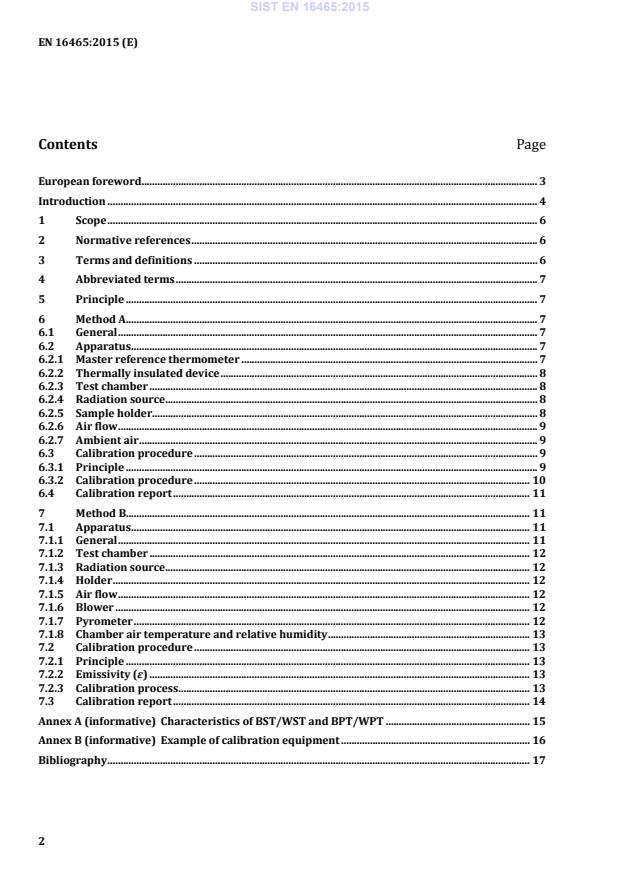
Characteristics of BST/WST and BPT/WPT . 15 Annex B (informative)
Example of calibration equipment . 16 Bibliography . 17
of more than 40 K above ambient air. The possible surface temperature is characterized by a white panel or white standard temperature as its lower limit, and a black panel or standard temperature as its upper limit. It is then assumed that the actual sample temperature lies between the two cited limits. Surface temperatures of specific specimens can be higher or lower (e.g. massive black polymers and transparent polymers). The white panel/standard and black panel/standard temperatures can be easily determined using conventional measuring techniques. In one category of exposure devices, only the short UV range of the natural solar radiation is simulated with fluorescent UV radiation source radiation. In these devices, there is no significant increase in surface temperature of a specimen, because these radiation sources have no significant visible and infrared radiation. An additional category of exposure devices uses a mercury medium pressure radiation source to induce critical photo-degradation reactions that are typical of natural solar exposures. Even this specific radiation source does not provide significant visible and infrared radiation. For this reason, as in the previous category, these exposures do not increase significantly the specimen surface temperature above ambient. NOTE For fluorescent UV and mercury medium pressure radiation sources, the ambient air temperature surrounding the specimen is the main variable influencing the specimen temperature. The relative humidity may have a small effect on the specimen temperature as well. Black/white standard thermometers and black/white panel thermometers are defined in EN ISO 4892-1. They are used in weathering applications to characterize the temperature level (maximum and minimum temperature) under given weathering exposure conditions. The accuracy of these thermometers depends on their design and especially on a well-defined and traceable calibration method. Such methods are the content of this standard. Two methods are defined in this standard. Each method requires calibration of a black panel/standard or white panel/standard to a traceable reference from a national metrological institute (NMI). Historically, the contact calibration method (e.g. calibration in a water bath) has been used for weathering applications: recently a contactless calibration method has been developed. Any requirement to use one method versus the other method is not justified, and both calibration methods are suitable for most weathering applications. However, because of a lack of data comparing the two methods as of the time of publication of this standard, preference or equivalency of results for these two methods is unknown. Both methods may provide different calibration results that are not interchangeable. SIST EN 16465:2015
...