


EN 15885:2010
(Main)Classification and characteristics of techniques for renovation and repair of drains and sewers
Classification and characteristics of techniques for renovation and repair of drains and sewers
This European Standard specifies a system for the classification of techniques for renovation and repair of drains and sewers outside buildings, operated under gravity or pressure, including pipes, connections and manholes. It defines and describes families of techniques and their different generic methods and materials used.
This European Standard does not describe specific products.
For each technique family it lists relevant existing standards, materials and applications and outlines characteristics including installation aspects, structural and hydraulic capabilities and site impact.
Necessary work on the existing pipe prior to renovation and repair is outside the scope of this European Standard.
This European Standard provides information needed to determine viable options for identification of the optimal technique with regard to a given set of renovation and repair objectives.
NOTE It is the responsibility of the designer to choose and design the renovation and repair systems.
It does not specify the calculation methods to determine, for each viable technique, the required amount of lining material needed to secure the desired performance of the renovated pipeline.
Klassifizierung und Eigenschaften von Techniken für die Renovierung und Reparatur von Abwasserkanälen und -leitungen
Diese Europäische Norm legt ein System zur Klassifizierung von Techniken für die Renovierung und Reparatur von Abwasserkanälen und -leitungen außerhalb von Gebäuden fest, die unter Schwerkraft oder Druck betrieben werden, und Rohre, Verbindungen und Schächte beinhalten. Sie definiert und beschreibt Technik-Gruppen und verschiedene allgemeine Verfahren und Werkstoffe.
Diese Europäische Norm beschreibt keine bestimmten Produkte.
Für jede Technik-Gruppe sind die zutreffenden bestehenden Normen, Werkstoffe und Anwendungen aufgeführt und die Eigenschaften, einschließlich Einbauaspekte, baustatischer und hydraulischer Leistungsmerkmale sowie Standorteinflüsse dargestellt.
Die vor der Renovierung und Reparatur erforderlichen Arbeiten am vorhandenen Rohr gehören nicht zum Anwendungsbereich dieser Europäischen Norm.
Diese Europäische Norm enthält Angaben, die für die Auswahl der optimalen Technik im Hinblick auf eine vorgegebene Reihe von Renovierungs- und Reparaturzielen erforderlich sind.
ANMERKUNG Es liegt in der Verantwortung des Entwurfsplaners, das Renovierungs- und Reparatursystem auszuwählen und zu entwerfen.
Sie legt keine Berechnungsverfahren fest, mit denen für jede praktikable Technik der erforderliche Typ des Liners ermittelt werden kann, der zur Sicherstellung der gewünschten Leistung der renovierten Rohrleitung benötigt wird.
Classification et caractéristiques des techniques de rénovation et de réparation des réseaux d'évacuation et d'assainissement
La présente Norme européenne spécifie un système de classification pour les techniques de rénovation et de
réparation des réseaux d'évacuation et d'assainissement situés à l'extérieur des bâtiments, fonctionnant par
gravité ou sous pression, incluant les canalisations, les branchements et les regards de visite. Elle définit et
décrit les familles de techniques ainsi que leurs différentes méthodes génériques et les matériaux utilisés.
La présente Norme européenne ne décrit pas de produits spécifiques.
Pour chaque famille de techniques, elle dresse la liste des normes pertinentes existantes, des matériaux et
applications, et expose les principales caractéristiques incluant les différents aspects de l'installation, les
capacités structurelle et hydraulique et l'impact sur le site.
Les travaux requis sur la canalisation existante avant la rénovation ou réparation n'entrent pas dans le
domaine d'application de la présente Norme européenne.
La présente Norme européenne fournit les informations requises pour déterminer des options viables qui
permettront d'identifier la technique optimale pour un ensemble donné d'objectifs de rénovation et de
réparation.
NOTE Il est de la responsabilité du concepteur de choisir et de concevoir les systèmes de rénovation et de
réparation.
La présente Norme européenne ne spécifie pas les méthodes de calcul qui permettent de déterminer, pour
chaque technique viable, la quantité de matériau de tubage ou chemisage nécessaire pour garantir les
performances désirées pour la canalisation rénovée.
Klasifikacija in tehnične lastnosti za obnovo in popravilo vodov in kanalov
Ta standard je dokument z navodili, ki opredeljuje družine tehnik za obnovo in popravilo vodov in kanalov.
Podaja vodilo o načelih, a ne podrobnih metodologij, za načrtovanje in kriterije izbora za vsako družino tehnik.
Še zlasti podaja vodilo o naslednjih tematikah:
- delovanje cevi po obnovi ali popravilu;
- stanje obstoječih cevovodov in mesta;
- vidiki, povezani s tehniko;
- strukturni vidiki;
- hidravlični vidiki;
- fizikalni in kemijski vidiki.
General Information
- Status
- Withdrawn
- Publication Date
- 30-Nov-2010
- Withdrawal Date
- 08-Feb-2026
- Technical Committee
- CEN/TC 165 - Waste water engineering
- Drafting Committee
- CEN/TC 165/WG 13 - Renovation and repair of drains and sewers
- Current Stage
- 9960 - Withdrawal effective - Withdrawal
- Start Date
- 07-Nov-2018
- Completion Date
- 09-Feb-2026
Relations
- Effective Date
- 08-Jun-2022
- Effective Date
- 28-Jan-2026

Get Certified
Connect with accredited certification bodies for this standard

Zavod za gradbeništvo Slovenije (ZAG) - Inšpekcija
ZAG inspection body for construction products, structures, and materials.
Sponsored listings
Frequently Asked Questions
EN 15885:2010 is a standard published by the European Committee for Standardization (CEN). Its full title is "Classification and characteristics of techniques for renovation and repair of drains and sewers". This standard covers: This European Standard specifies a system for the classification of techniques for renovation and repair of drains and sewers outside buildings, operated under gravity or pressure, including pipes, connections and manholes. It defines and describes families of techniques and their different generic methods and materials used. This European Standard does not describe specific products. For each technique family it lists relevant existing standards, materials and applications and outlines characteristics including installation aspects, structural and hydraulic capabilities and site impact. Necessary work on the existing pipe prior to renovation and repair is outside the scope of this European Standard. This European Standard provides information needed to determine viable options for identification of the optimal technique with regard to a given set of renovation and repair objectives. NOTE It is the responsibility of the designer to choose and design the renovation and repair systems. It does not specify the calculation methods to determine, for each viable technique, the required amount of lining material needed to secure the desired performance of the renovated pipeline.
This European Standard specifies a system for the classification of techniques for renovation and repair of drains and sewers outside buildings, operated under gravity or pressure, including pipes, connections and manholes. It defines and describes families of techniques and their different generic methods and materials used. This European Standard does not describe specific products. For each technique family it lists relevant existing standards, materials and applications and outlines characteristics including installation aspects, structural and hydraulic capabilities and site impact. Necessary work on the existing pipe prior to renovation and repair is outside the scope of this European Standard. This European Standard provides information needed to determine viable options for identification of the optimal technique with regard to a given set of renovation and repair objectives. NOTE It is the responsibility of the designer to choose and design the renovation and repair systems. It does not specify the calculation methods to determine, for each viable technique, the required amount of lining material needed to secure the desired performance of the renovated pipeline.
EN 15885:2010 is classified under the following ICS (International Classification for Standards) categories: 93.030 - External sewage systems. The ICS classification helps identify the subject area and facilitates finding related standards.
EN 15885:2010 has the following relationships with other standards: It is inter standard links to EN 15885:2018, EN 752:2008. Understanding these relationships helps ensure you are using the most current and applicable version of the standard.
EN 15885:2010 is available in PDF format for immediate download after purchase. The document can be added to your cart and obtained through the secure checkout process. Digital delivery ensures instant access to the complete standard document.
Standards Content (Sample)
2003-01.Slovenski inštitut za standardizacijo. Razmnoževanje celote ali delov tega standarda ni dovoljeno.Klassifizierung und Eigenschaften von Techniken für die Renovierung und Reparatur von Abwasserkanälen und -leitungenClassification et caractéristiques des techniques de rénovation et de réparation des réseaux d'évacuation et d'assainissementClassification and characteristics of techniques for renovation and repair of drains and sewers93.030Zunanji sistemi za odpadno vodoExternal sewage systemsICS:Ta slovenski standard je istoveten z:EN 15885:2010SIST EN 15885:2011en,fr,de01-november-2011SIST EN 15885:2011SLOVENSKI
STANDARD
EUROPEAN STANDARD NORME EUROPÉENNE EUROPÄISCHE NORM
EN 15885
December 2010 ICS 93.030 English Version
Classification and characteristics of techniques for renovation and repair of drains and sewers
Classification et caractéristiques des techniques de rénovation et de réparation des réseaux d'évacuation et d'assainissement
Klassifizierung und Eigenschaften von Techniken für die Renovierung und Reparatur von Abwasserkanälen und -leitungen This European Standard was approved by CEN on 30 October 2010.
CEN members are bound to comply with the CEN/CENELEC Internal Regulations which stipulate the conditions for giving this European Standard the status of a national standard without any alteration. Up-to-date lists and bibliographical references concerning such national standards may be obtained on application to the CEN-CENELEC Management Centre or to any CEN member.
This European Standard exists in three official versions (English, French, German). A version in any other language made by translation under the responsibility of a CEN member into its own language and notified to the CEN-CENELEC Management Centre has the same status as the official versions.
CEN members are the national standards bodies of Austria, Belgium, Bulgaria, Croatia, Cyprus, Czech Republic, Denmark, Estonia, Finland, France, Germany, Greece, Hungary, Iceland, Ireland, Italy, Latvia, Lithuania, Luxembourg, Malta, Netherlands, Norway, Poland, Portugal, Romania, Slovakia, Slovenia, Spain, Sweden, Switzerland and United Kingdom.
EUROPEAN COMMITTEE FOR STANDARDIZATION
COMITÉ EUROPÉEN DE NORMALISATION EUROPÄISCHES KOMITEE FÜR NORMUNG
Management Centre:
Avenue Marnix 17,
B-1000 Brussels © 2010 CEN All rights of exploitation in any form and by any means reserved worldwide for CEN national Members. Ref. No. EN 15885:2010: ESIST EN 15885:2011
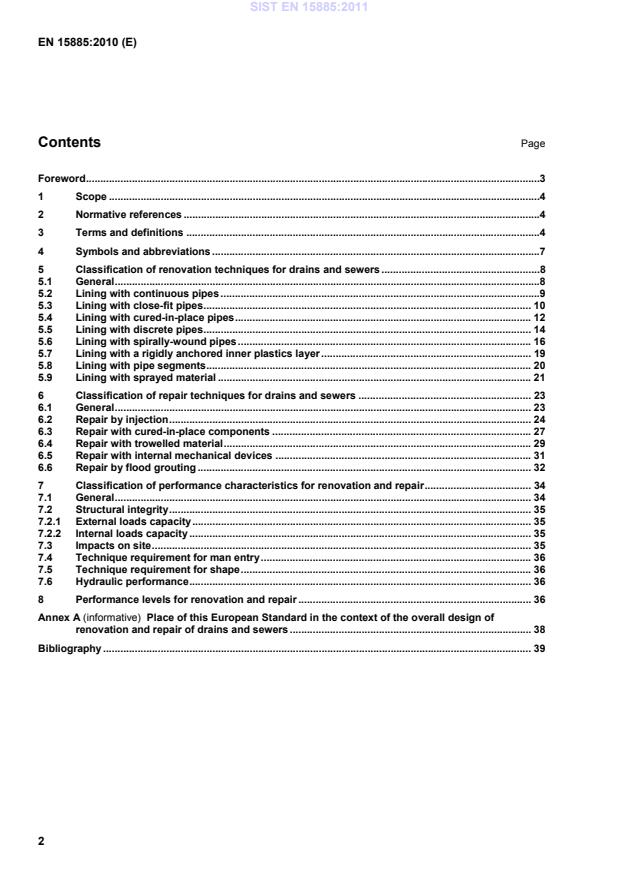
Place of this European Standard in the context of the overall design of renovation and repair of drains and sewers . 38Bibliography . 39 SIST EN 15885:2011
[EN 752:2008, 3.53] SIST EN 15885:2011
[ISO 11296-1:2009, 3.2.2] 3.11 lining with cured-in-place pipes lining with a flexible tube impregnated with a thermosetting resin, which produces a pipe after resin cure
[ISO 11296-1:2009, 3.2.3] 3.12 lining with discrete pipes lining with short lengths of pipe which are jointed to form a continuous pipe one by one during insertion 3.13 lining with spirally-wound pipes lining with a profiled strip, spirally wound to form a continuous pipe after installation [ISO 11296-1:2009, 3.2.5] SIST EN 15885:2011
b) cover only part of circumference 3.16 lining with sprayed or cast-in-place material lining by applying cementitious or polymeric material, with or without reinforcement, directly onto the inside surface of the host pipe and/or manhole, by manual or mechanical (including robotic) means 3.17 non-stabilising repair repair where the materials applied have a sealing effect but do not enhance structural stability 3.18 stabilising repair repair where the materials applied have a sealing effect and can enhance structural stability
3.19 repair by grout injection filling of voids in existing pipe and/or surrounding ground by injection of grout over all or part of the perimeter of the sewer NOTE Two different methods can be distinguished: a) injection directly into a brickwork or masonry pipe structure; b) injection of the soil around the pipe. 3.20 repair by injection sealing repair of leakage at a crack, joint or lateral connection by resin or grout injection, with or without the aid of a packer 3.21 repair with cured-in-place patch repair by local lining with a flexible tube impregnated with a thermosetting resin which produces a short length of pipe after resin cure 3.22 repair with lateral connection collar repair of a connection between lateral and main pipe by installing a cured in place collar 3.23 repair with trowelled material repair of local structural defects effecting part of the drain or sewer cross-section by trowelling material directly onto the wall or into the defect of the existing pipeline by manual or mechanical means 3.24 repair with internal mechanical devices repair with internal mechanical seals or re-rounding clips SIST EN 15885:2011
structural integrity based on external loads capacity G
gravity pipeline applications P
pressurized pipeline applications SIL
structural integrity based on internal loads capacity
EW
excavation works NM
non man entry ME
man entry CS
circular shape NC
non circular and circular shapes possible CCTV
closed circuit television UP
unsaturated polyester EP
epoxy
VE
vinylester
PE
polyethylene PVC-U
unplasticized poly(vinyl chloride) PP
polypropylene EPDM
ethylene-propylene-diene monomer GRP
glass reinforced plastics GRC
glass reinforced cement SIST EN 15885:2011
polyurethane PCC
polymer concrete 5 Classification of renovation techniques for drains and sewers 5.1 General Renovation technique families within the scope of this European Standard are shown in Figure 1. This clause establishes a classification of renovation techniques into families, where renovation is applied to continuous lengths of drain or sewer usually between two or more access points. Individual techniques shall be classified into families according to 5.2 to 5.9 where the different renovation technique families are defined and their respective features, including materials, applications, as well as geometric, performance and installation characteristics, are described.
a Outside the scope of this European Standard. b Other renovation techniques, which do not fit into the above families, are outside the scope of this European Standard which covers only technique families commonly available at the time of drafting. Figure 1 — Renovation technique families SIST EN 15885:2011
Key 1
pulling head 2
lining pipe
prior jointing of lining pipe
pulling force
existing pipe a) Schematic representation of lining with continuous pipes without re-rounding of existing pipeline (Method A)
Key 1
pulling and re-rounding head (only for Method B)
lining pipe
prior jointing of lining pipe 4
pulling force
re-rounded defect
defects
existing pipe b) Schematic representation of lining with continuous pipes with re-rounding of existing pipeline (Method B) Figure 2 — Lining with continuous pipes SIST EN 15885:2011
100 mm for Method A, 150 mm for Method B; − typical maximum size:
1 200 mm for Method A, 600 mm for Method B; − typical maximum length:
300 m for Method A, 100 m for Method B; − some Method A techniques capable of accommodating bends Performance: − significant reduction in hydraulic (volumetric and flow) capacity for Method A; minimal reduction of volumetric capacity with increase in flow due to reduced friction possible for Method B; − uniform gradient cannot be restored; − structural rehabilitation is possible; − abrasion resistance depends on material; − chemical resistance depends on material Installation characteristics: a) pipes manufactured or prior assembled into the continuous length required; for Method B pipes of non standard outside diameter required (max. 10 mm less than host pipe inside diameter); b) insertion possible by pushing and/or pulling for Method A; for Method B only by pulling with use of re-rounding head; c) surface working space: storage of the whole insertion length required on surface: 1) small diameters (typically ≤ 180 mm) can be supplied on coils, small space; 2) larger diameters: supplied in straight lengths requiring greater storage and working space; d) access to the existing pipeline: generally requires local excavation; e) technique does not rely on adhesion to host pipe; f) flow diversion is typically required for installation; g) the annular space is typically grouted for Method A but not applicable to Method B; h) reconnection of laterals: generally requires excavation for Method A except in man entry sizes; for Method B reconnection from inside possible
5.3 Lining with close-fit pipes Lining with a continuous pipe for which the cross section is reduced to facilitate installation and reverted after installation to provide a close fit to the existing pipe. Two possible methods of lining with close fit pipes are shown in Figure 3 and Table 2: − Method A: reduction in the pipe manufacturing plant; the pipe is usually supplied coiled on a reel from which it is directly inserted; − Method B: reduction on site (typically applied to pressure pipelines only); the pipe is fed through diameter reduction or folding equipment and simultaneously inserted.
Key 1 pulling head
2 lining pipe (folded) 3 drum trailer
4 pulling line
NOTE Pipe reverted (unfolded) after insertion by application of heat and/or pressure. a) Schematic representation of installation of a pipe reduced in cross section in the pipe manufacturing plant (Method A)
Key 1 pulling head 2a initial lining pipe 2b reduced lining
pipe 3
cross section
reducing device
NOTE Pipe reverted (expanded) after insertion by release of pulling force and application of pressure. b) Schematic representation of installation of a pipe reduced in cross section on site (Method B) Figure 3 — Lining with close-fit pipes SIST EN 15885:2011
2) in pressure applications: generally requires excavation, except in man entry sizes
5.4 Lining with cured-in-place pipes Lining with a flexible tube impregnated with a thermosetting resin which produces a pipe after resin cure (see Figure 4 and Table 3). SIST EN 15885:2011
water pressure
for inversion 2 lining pipe 3 inversion face 4 water or air for
inversion
a) Schematic representation of lining with cured-in-place pipes installed by inversion (Method A) Key 1 lining pipe 2 winch 3 end packer 4 curing equipment 5 compressor
b) Schematic representation of lining with cured-in-place pipes installed by winching and subsequent inflation (Method B) Figure 4 — Lining with cured-in-place pipes SIST EN 15885:2011
100 mm; − typical maximum size: 2 800 mm; − typical maximum length: Method A: 600 m, Method B: 250 m; − bends can be accommodated Performance: − minimal reduction in volumetric capacity; increase in flow due to reduced friction possible; − restoring of invert is not possible; − structural rehabilitation is possible; − abrasion resistance depends on wall structure; − chemical resistance mainly depends on resin type Installation characteristics: a) insertion of the impregnated tube, prior to curing, can be achieved by:
1) inverting into position with fluid pressure only (water or air) or 2) winching into place and then inflating; 3) combinations of Methods a) and b) are also possible;
b) the curing process can be initiated or accelerated by either:
1) heat (hot water, steam or electrical heating elements); UV radiation or 2) ambient temperature; c) surface working space: generally minimal, varies with technique; d) access: entry via existing manhole or small excavation possible; e) structural effect does not rely on adhesion to host pipe; f) flow diversion required; g) grouting of annular space not necessary; h) re-opening of laterals from inside is possible; i) reconnection of laterals: 1) gravity pipelines: possible from inside (re-opening and tight connection); 2) in pressure applications: generally requires excavation, except in man entry sizes
5.5 Lining with discrete pipes Lining with short lengths of pipe which are jointed to form a continuous pipe one by one during insertion (see Figure 5 and Table 4). Discrete pipes can be installed by pushing (Method A), by pulling (Method B) or by individual pipe placement (Method C). NOTE Use of a re-rounding head with as described in 5.2 is also possible for discrete pipes Method B. SIST EN 15885:2011
Key 1 pushing device 2 pushing guide 3
jointed lining pipe 4 thrust plate
NOTE The diameter of discrete pipes for insertion is slightly reduced against the existing pipe. a) Schematic representation of installation by pushing (Method A)
Key 1 winch 2 pulling
head 3
jointed
lining pipe 4 stock of
discrete
pipes 5
existing
pipe 6 re-rounding
and pulling
head
b) Schematic representation of installation by pulling (Method B)
Key 1 existing pipe 2 individual discrete
pipe being pulled or
pushed into place 3 manhole
c) Schematic representation of installation by individual pipe placement (Method C) Figure 5 — Lining with discrete pipes SIST EN 15885:2011
100 mm; Method C:
800 mm; − typical maximum size: Method A and B:
600 mm; Method C:
4 000 mm; − typical maximum length:
150 m; − Bends: bends can generally not be accommodated for Method A and B; bends with large radii can be accommodated for Method C Performance: − significant reduction in hydraulic (volumetric and flow) capacity for Method A; minimal reduction of volumetric capacity for Method B where re-rounding head is used, with increase in flow due to reduced friction possible; for Method C, reduction in capacity dependent on annular space and diameter/thickness ratio; − uniform gradient can be restored using Method C in man-entry pipes; − structural rehabilitation is possible; − abrasion resistance depends on material; − chemical resistance depends on material Installation characteristics: − the type of joint is a significant feature of each technique; − pipe joints can be locked (end load bearing) or unlocked; − surface working space: no particular constraint; − short pipe lengths may allow insertion from existing manholes (Methods A and B); − access to the existing pipeline:
generally through manholes but requires local excavation for man entry sizes; − technique does not rely on adhesion on host pipe; − flow diversion is typically required for installation and grouting; − the annular space is typically grouted, except for Method B when re-rounding and non standard lining pipe outside diameter is used (see 5.2); − reconnection of laterals: generally requires excavation; except in man entry sizes; for Method B, when a re-rounding head is used, reconnection from inside possible
5.6 Lining with spirally-wound pipes Lining with a profiled strip, spirally wound to form a continuous pipe after installation (see Figure 6 and Table 5). This technique family does not rely on any contribution from grout for its structural performance. NOTE For this technique the continuous pipe after installation is the structural element, with minimum ring stiffness conforming to EN 13566-1. SIST EN 15885:2011
Key 1 plastics strip to be
spirally wound 2 winding machine in the
manhole 3 guidance head (where
applicable) 4 spirally-wound lining pipe
a) Schematic representation of fixed diameter winding from the manhole (Method A1)
Key 1 plastic strip to be spirally
wound 2 winding machine in the
manhole 3 spirally-wound lining pipe
temporarily locked at
reduced diameter for
insertion
b) Schematic representation of expanded liner winding from the manhole (Method A2)
Key 1 plastics strip to be
spirally wound 2 winding machine in the
pipe 3 spirally-wound liner c) Schematic representation of winding of liner from pipe-traversing winding machine (Method B) Figure 6 — Lining with spirally-wound pipes Table 5 — Features of lining with spirally-wound pipes Feature Description Relevant standards: EN 13566-1 and EN 13566-7 Materials: plastics (PVC-U, PE), optional steel reinforcement Applications: − non pressure; − applicable for manholes Geometric capabilities − circular cross section; − typical minimum size: 200 mm for Method A1 and Method A2; 800 mm for Method B; − typical maximum size (without steel reinforcement): 1 200 mm for Method A1, 700 mm for Method A2, 1 800 mm for Method B; a − typical maximum length: 100 m; − bends can be accommodated Performance: − reduction in capacity dependent on annular space and ratio of diameter to overall profile height; − uniform gradient can generally not be restored; − structural renovation is possible; − abrasion resistance depends on material; − chemical resistance depends on material; Installation characteristics: − lining pipe formed on site by spirally winding a strip, which is jointed and sealed by solvent welding or mechanical means; − individual winding machines can produce a range of diameters; − no pipe storage on site; − access via manholes possible; − technique does not rely on adhesion to host pipe; − flow diversion during installation is typically required for grouting and installation; − grouting of annular space is required for fixed diameter; − for (re)connection of laterals in non man entry pipes local excavation is generally required; reconnection from the inside is also possible a Larger sizes are possible with steel reinforcement. SIST EN 15885:2011
integral profiles or studs for
anchorage 2 grout with optional reinforcement 3 external layer if applicable 4 existing pipe (host pipe) 5 anchors a detail of wall construction Figure 7 — Typical wall construction
...
Questions, Comments and Discussion
Ask us and Technical Secretary will try to provide an answer. You can facilitate discussion about the standard in here.
Loading comments...