


EN 1796:2006
(Main)Plastics piping systems for water supply with or without pressure - Glass-reinforced thermosetting plastics (GRP) based on unsaturated polyester resin (UP)
Plastics piping systems for water supply with or without pressure - Glass-reinforced thermosetting plastics (GRP) based on unsaturated polyester resin (UP)
This European Standard specifies the required properties of the piping system and its components made from glass-reinforced thermosetting plastics (GRP) based on unsaturated polyester resin (UP) intended to be used for water supply (drinking or raw) with or without pressure. In a pipework system, pipes and fittings of different nominal pressure and stiffness ratings may be used together.
NOTE 1 It is the responsibility of the purchaser or specifier to make the appropriate selections from these aspects, taking into account their particular requirements and any relevant national regulations and installation practices or codes.
This standard is applicable to GRP-UP, with flexible or rigid joints (see 3.37 and 3.38), primarily intended for use in buried installations.
NOTE 2 Piping systems conforming to this standard can also be used for non-buried applications provided that the influence of the environment and the supports are considered in the design of the pipes, fittings and joints.
It is applicable to pipes, fittings and their joints of nominal sizes from DN 100 to DN 3000, which are intended to be used for the conveyance of water at temperatures up to 50 °C, with or without pressure.
This standard covers a range of nominal sizes, nominal stiffnesses and nominal pressures.
Clause 4 specifies the general aspects of GRP-UP piping system intended to be used in the field of water supply with or without pressure.
NOTE 3 Attention is drawn to the national requirements, in the country of installation, for the effects on water quality applicable to pipes intended for use in possible contact with drinking water.
Clause 5 specifies the characteristics of pipes made from GRP-UP with or without aggregates and/or fillers. The pipes can have a thermosetting or thermoplastics liner. Clause 5 also specifies the test parameters for the test methods referred to in this standard.
Clause 6 specifies the characteristics of fittings made from GRP-UP with either a thermosett
Kunststoff-Rohrleitungssysteme für die Wasserversorgung mit oder ohne Druck - Glasfaserverstärkte duroplastische Kunststoffe (GFK) auf der Basis von ungesättigtem Polyesterharz (UP)
1 Anwendungsbereich
Diese Europäische Norm legt die Anforderungen an ein Rohrleitungssystem und seine Rohrleitungsteile fest, die aus glasfaserverstärkten duroplastischen Kunststoffen (GFK) auf der Basis von ungesättigtem Polyesterharz (UP) hergestellt und für den Einsatz in der Wasserversorgung (Trinkwasser oder Rohwasser) mit oder ohne Druck vorgesehen sind. In einem Rohrleitungssystem werden Rohre und Formstücke mit verschiedenen Nenndruckstufen und Steifigkeitsklassen zusammen verwendet.
ANMERKUNG 1 Der Anwender bzw. Auftraggeber ist unter Berücksichtigung der eigenen Anforderungen sowie der geltenden nationalen Festlegungen und Verlegepraktiken für die entsprechende Auswahl dieser Kriterien verantwortlich.
Diese Norm ist anwendbar auf Kunststoff-Rohrleitungssyssteme aus glasfaserverstärkten duroplastischen Kunststoffen (GFK) auf der Basis von ungesättigtem Polyesterharz (UP) mit flexiblen oder starren Verbindungen (siehe 3.36 and 3.37), die in erster Linie für die Erdverlegung vorgesehen sind.
ANMERKUNG 2 Rohrleitungssysteme nach dieser Norm können auch für oberirdische Anwendungen eingesetzt werden, vorausgesetzt, dass der Einfluss der Umgebung und der Auflager bei der Dimensionierung von Rohren, Formstücken und Verbindungen berücksichtigt wurde.
Diese Norm gilt für Rohre, Formstücke und deren Verbindungen mit Nennweiten von DN 100 bis
DN 3000, die für die Fortleitung von Wasser bis zu Temperaturen von 50 °C mit oder ohne Druck vorgesehen sind.
Diese Norm enthält Festlegungen für Nennweiten, Nennsteifigkeiten und Nenndrücke.
Abschnitt 4 legt die allgemeinen Anforderungen an glasfaserverstärkte duroplastische Kunststoffe (GFK) auf der Basis von ungesättigtem Polyesterharz (UP) im Bereich der Wasserversorgung mit oder ohne Druck fest.
Systèmes de canalisations en plastiques pour l'alimentation en eau avec ou sans pression - Plastiques thermodurcissables renforcés de verre (PRV) à base de résine polyester non saturé (UP)
La présente Norme européenne spécifie les propriétés requises d'un système de canalisation et de ses composants, fabriqués en plastiques thermodurcissables renforcés de verre (PRV) à base de résine de polyester non saturé (UP) et destinés à l'alimentation en eau (potable ou brute) avec ou sans pression. Dans un système de canalisation, des tubes et raccords de pression nominale et de rigidité différentes peuvent être utilisés ensemble.
NOTE 1 Il est de la responsabilité du client ou du prescripteur de procéder aux choix appropriés de ces aspects, en tenant compte de leurs exigences particulières et de toute réglementation nationale, règles ou codes de pose appropriés.
La présente norme s'applique aux PRV-UP, avec assemblages flexibles ou rigides (voir 3.37 et 3.38), destinés à être utilisés principalement dans des installations enterrées.
NOTE 2 Les systèmes de canalisations conformes à la présente norme peuvent aussi être utilisés pour des canalisations aériennes, sous réserve que l'influence de l'environnement et que les supports soit pris en compte dans le dimensionnement des tubes, raccords et assemblages.
La présente norme s'applique aux tubes, aux raccords et à leurs assemblages de dimensions nominales comprises entre DN 100 et DN 3000, destinés à être utilisés pour le transport de l'eau à des températures allant jusqu'à 50 °C, avec ou sans pression.
Cette norme couvre une série de dimensions nominales, rigidités nominales et pressions nominales.
L'Article 4 spécifie les aspects généraux d'un système de canalisation en PRV-UP destiné à être utilisé dans le domaine de l'alimentation en eau avec ou sans pression.
NOTE 3 L'attention est attirée sur les exigences nationales, dans le pays d'installation, relatives aux effets sur la qualité de l'eau, applicables aux tuyauteries destinées à être utilisées en contact possible avec l'eau potable.
Cevni sistemi iz polimernih materialov za oskrbo z vodo, s tlakom ali brez njega – S steklenimi vlakni ojačeni duromerni materiali (GRP), ki temeljijo na nenasičeni poliestrski smoli (UP)
General Information
- Status
- Withdrawn
- Publication Date
- 07-Feb-2006
- Withdrawal Date
- 04-Nov-2008
- Technical Committee
- CEN/TC 155 - Plastics piping systems and ducting systems
- Drafting Committee
- CEN/TC 155 - Plastics piping systems and ducting systems
- Current Stage
- 9960 - Withdrawal effective - Withdrawal
- Start Date
- 05-Nov-2008
- Completion Date
- 05-Nov-2008
- Directive
- 89/106/EEC - Construction products
Relations
- Effective Date
- 18-Jan-2023

Get Certified
Connect with accredited certification bodies for this standard

Institut za varilstvo d.o.o. (Welding Institute)
Slovenia's leading welding institute since 1952. ISO 3834, EN 1090, pressure equipment certification, NDT personnel, welder qualification. Only IIW Au
Sponsored listings
Frequently Asked Questions
EN 1796:2006 is a standard published by the European Committee for Standardization (CEN). Its full title is "Plastics piping systems for water supply with or without pressure - Glass-reinforced thermosetting plastics (GRP) based on unsaturated polyester resin (UP)". This standard covers: This European Standard specifies the required properties of the piping system and its components made from glass-reinforced thermosetting plastics (GRP) based on unsaturated polyester resin (UP) intended to be used for water supply (drinking or raw) with or without pressure. In a pipework system, pipes and fittings of different nominal pressure and stiffness ratings may be used together. NOTE 1 It is the responsibility of the purchaser or specifier to make the appropriate selections from these aspects, taking into account their particular requirements and any relevant national regulations and installation practices or codes. This standard is applicable to GRP-UP, with flexible or rigid joints (see 3.37 and 3.38), primarily intended for use in buried installations. NOTE 2 Piping systems conforming to this standard can also be used for non-buried applications provided that the influence of the environment and the supports are considered in the design of the pipes, fittings and joints. It is applicable to pipes, fittings and their joints of nominal sizes from DN 100 to DN 3000, which are intended to be used for the conveyance of water at temperatures up to 50 °C, with or without pressure. This standard covers a range of nominal sizes, nominal stiffnesses and nominal pressures. Clause 4 specifies the general aspects of GRP-UP piping system intended to be used in the field of water supply with or without pressure. NOTE 3 Attention is drawn to the national requirements, in the country of installation, for the effects on water quality applicable to pipes intended for use in possible contact with drinking water. Clause 5 specifies the characteristics of pipes made from GRP-UP with or without aggregates and/or fillers. The pipes can have a thermosetting or thermoplastics liner. Clause 5 also specifies the test parameters for the test methods referred to in this standard. Clause 6 specifies the characteristics of fittings made from GRP-UP with either a thermosett
This European Standard specifies the required properties of the piping system and its components made from glass-reinforced thermosetting plastics (GRP) based on unsaturated polyester resin (UP) intended to be used for water supply (drinking or raw) with or without pressure. In a pipework system, pipes and fittings of different nominal pressure and stiffness ratings may be used together. NOTE 1 It is the responsibility of the purchaser or specifier to make the appropriate selections from these aspects, taking into account their particular requirements and any relevant national regulations and installation practices or codes. This standard is applicable to GRP-UP, with flexible or rigid joints (see 3.37 and 3.38), primarily intended for use in buried installations. NOTE 2 Piping systems conforming to this standard can also be used for non-buried applications provided that the influence of the environment and the supports are considered in the design of the pipes, fittings and joints. It is applicable to pipes, fittings and their joints of nominal sizes from DN 100 to DN 3000, which are intended to be used for the conveyance of water at temperatures up to 50 °C, with or without pressure. This standard covers a range of nominal sizes, nominal stiffnesses and nominal pressures. Clause 4 specifies the general aspects of GRP-UP piping system intended to be used in the field of water supply with or without pressure. NOTE 3 Attention is drawn to the national requirements, in the country of installation, for the effects on water quality applicable to pipes intended for use in possible contact with drinking water. Clause 5 specifies the characteristics of pipes made from GRP-UP with or without aggregates and/or fillers. The pipes can have a thermosetting or thermoplastics liner. Clause 5 also specifies the test parameters for the test methods referred to in this standard. Clause 6 specifies the characteristics of fittings made from GRP-UP with either a thermosett
EN 1796:2006 is classified under the following ICS (International Classification for Standards) categories: 23.040.03 - Pipeline and its parts for external water conveyance systems; 23.040.20 - Plastics pipes; 23.040.45 - Plastics fittings. The ICS classification helps identify the subject area and facilitates finding related standards.
EN 1796:2006 has the following relationships with other standards: It is inter standard links to EN 1796:2006+A1:2008. Understanding these relationships helps ensure you are using the most current and applicable version of the standard.
EN 1796:2006 is associated with the following European legislation: EU Directives/Regulations: 305/2011, 89/106/EEC; Standardization Mandates: M/131. When a standard is cited in the Official Journal of the European Union, products manufactured in conformity with it benefit from a presumption of conformity with the essential requirements of the corresponding EU directive or regulation.
EN 1796:2006 is available in PDF format for immediate download after purchase. The document can be added to your cart and obtained through the secure checkout process. Digital delivery ensures instant access to the complete standard document.
Standards Content (Sample)
2003-01.Slovenski inštitut za standardizacijo. Razmnoževanje celote ali delov tega standarda ni dovoljeno.Kunststoff-Rohrleitungssysteme für die Wasserversorgung mit oder ohne Druck - Glasfaserverstärkte duroplastische Kunststoffe (GFK) auf der Basis von ungesättigtem Polyesterharz (UP)Systemes de canalisations en plastiques pour l'alimentation en eau avec ou sans pression - Plastiques thermodurcissables renforcés de verre (PRV) a base de résine polyester non saturé (UP)Plastics piping systems for water supply with or without pressure - Glass-reinforced thermosetting plastics (GRP) based on unsaturated polyester resin (UP)91.140.60Sistemi za oskrbo z vodoWater supply systems83.120Reinforced plastics23.040.20Cevi iz polimernih materialovPlastics pipesICS:Ta slovenski standard je istoveten z:EN 1796:2006SIST EN 1796:2006en01-april-2006SIST EN 1796:2006SLOVENSKI
STANDARD
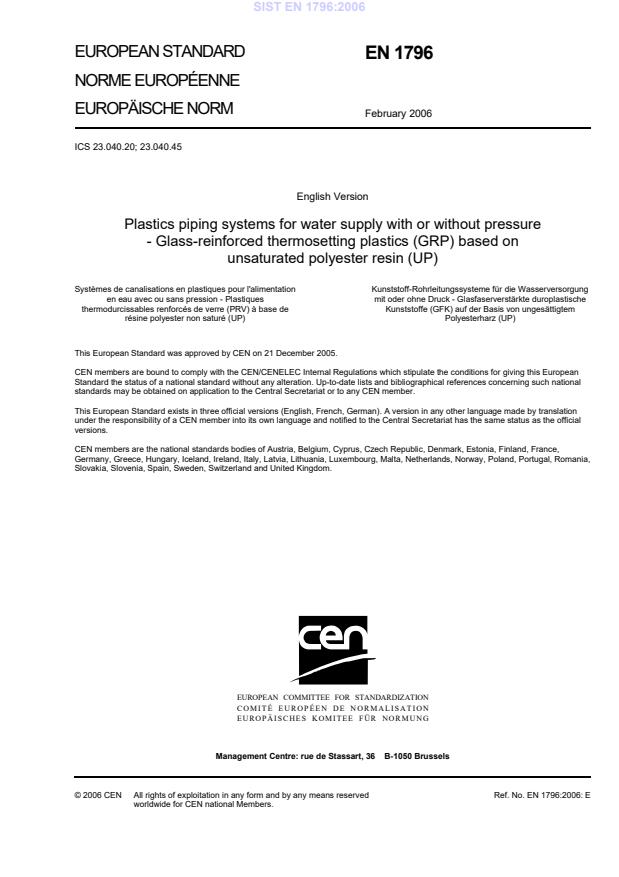
EUROPEAN STANDARDNORME EUROPÉENNEEUROPÄISCHE NORMEN 1796February 2006ICS 23.040.20; 23.040.45 English VersionPlastics piping systems for water supply with or without pressure- Glass-reinforced thermosetting plastics (GRP) based onunsaturated polyester resin (UP)Systèmes de canalisations en plastiques pour l'alimentationen eau avec ou sans pression - Plastiquesthermodurcissables renforcés de verre (PRV) à base derésine polyester non saturé (UP)Kunststoff-Rohrleitungssysteme für die Wasserversorgungmit oder ohne Druck - Glasfaserverstärkte duroplastischeKunststoffe (GFK) auf der Basis von ungesättigtemPolyesterharz (UP)This European Standard was approved by CEN on 21 December 2005.CEN members are bound to comply with the CEN/CENELEC Internal Regulations which stipulate the conditions for giving this EuropeanStandard the status of a national standard without any alteration. Up-to-date lists and bibliographical references concerning such nationalstandards may be obtained on application to the Central Secretariat or to any CEN member.This European Standard exists in three official versions (English, French, German). A version in any other language made by translationunder the responsibility of a CEN member into its own language and notified to the Central Secretariat has the same status as the officialversions.CEN members are the national standards bodies of Austria, Belgium, Cyprus, Czech Republic, Denmark, Estonia, Finland, France,Germany, Greece, Hungary, Iceland, Ireland, Italy, Latvia, Lithuania, Luxembourg, Malta, Netherlands, Norway, Poland, Portugal, Romania,Slovakia, Slovenia, Spain, Sweden, Switzerland and United Kingdom.EUROPEAN COMMITTEE FOR STANDARDIZATIONCOMITÉ EUROPÉEN DE NORMALISATIONEUROPÄISCHES KOMITEE FÜR NORMUNGManagement Centre: rue de Stassart, 36
B-1050 Brussels© 2006 CENAll rights of exploitation in any form and by any means reservedworldwide for CEN national Members.Ref. No. EN 1796:2006: ESIST EN 1796:2006
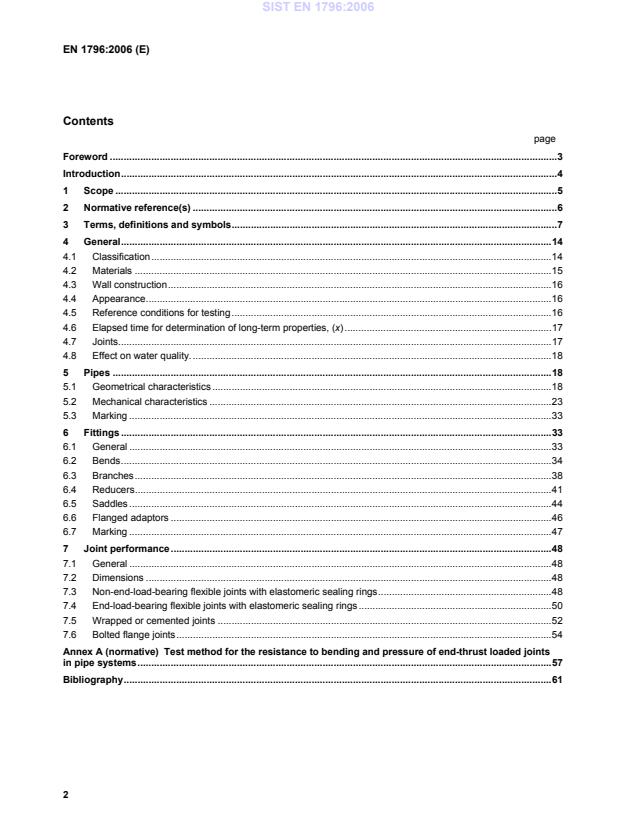
Test method for the resistance to bending and pressure of end-thrust loaded joints in pipe systems.57 Bibliography.61
This European Standard (EN 1796:2006) has been prepared by CEN /TC 155, "Plastics piping systems and ducting systems", the secretariat of which is held by NEN. This European Standard shall be given the status of a national standard, either by publication of an identical text or by endorsement, at the latest by August 2006, and conflicting national standards shall be withdrawn at the latest by February 2008. This standard is a System Standard for plastics piping systems using glass-reinforced thermosetting plastics based on polyester resin (GRP-UP), for water supply with or without pressure.
System Standards are based on the results of the work being undertaken in ISO/TC 138 "Plastics pipes, fittings and valves for the transport of fluids", which is a Technical Committee of the International Organization for Standardization (ISO). They are supported by separate standards on test methods, to which references are made throughout the System Standard. System Standards are consistent with standards on general functional requirements. This European Standard results from merging and revising (by 155 resolution 537/1997) of the following CEN enquiry drafts:
prEN 1796-1:1995, prEN 1796-2:1995, prEN 1796-3:1995 and prEN 1796-5:1995. EN 1796 consists of the following main clauses: Clause 1: Scope Clause 2: Normative references Clause 3: Definitions and symbols Clause 4: General
Clause 5: Pipes Clause 6: Fittings
Clause 7: Joint performance NOTE
Separate CEN/Technical Specifications are published covering practices for installation CEN/TS 14578 [1], and assessment of conformity CEN/TS 14632 [2]. According to the CEN/CENELEC Internal Regulations, the national standards organizations of the following countries are bound to implement this European Standard: Austria, Belgium, Cyprus, Czech Republic, Denmark, Estonia, Finland, France, Germany, Greece, Hungary, Iceland, Ireland, Italy, Latvia, Lithuania, Luxembourg, Malta, Netherlands, Norway, Poland, Portugal, Romania, Slovakia, Slovenia, Spain, Sweden, Switzerland and United Kingdom.
The working group responsible for this standard is currently working on a test method and requirements for assessing resistance to impact damage. When this work is completed it may result in additional requirements being incorporated into this standard.
It is the responsibility of the purchaser or specifier to make the appropriate selections from these aspects, taking into account their particular requirements and any relevant national regulations and installation practices or codes. This standard is applicable to GRP-UP, with flexible or rigid joints (see 3.37 and 3.38), primarily intended for use in buried installations. NOTE 2
Piping systems conforming to this standard can also be used for non-buried applications provided that the influence of the environment and the supports are considered in the design of the pipes, fittings and joints.
It is applicable to pipes, fittings and their joints of nominal sizes from DN 100 to DN 3000, which are intended to be used for the conveyance of water at temperatures up to 50 °C, with or without pressure. This standard covers a range of nominal sizes, nominal stiffnesses and nominal pressures. Clause 4 specifies the general aspects of GRP-UP piping system intended to be used in the field of water supply with or without pressure. NOTE 3
Attention is drawn to the national requirements, in the country of installation, for the effects on water quality applicable to pipes intended for use in possible contact with drinking water. Clause 5 specifies the characteristics of pipes made from GRP-UP with or without aggregates and/or fillers. The pipes can have a thermosetting or thermoplastics liner. Clause 5 also specifies the test parameters for the test methods referred to in this standard. Clause 6 specifies the characteristics of fittings made from GRP-UP with either a thermosetting or thermoplastics liner intended to be used in the field of water supply. Clause 6 specifies the dimensional and performance requirements for bends, branches, reducers, saddles and flanged adaptors and it also specifies the test parameters for the test methods referred to in this standard. Clause 6 is applicable to fittings made using any of the following techniques: a) fabricated from straight pipe; b) moulded by
1) filament winding; 2) tape winding;
3) contact moulding; 4) hot or cold press moulding. Clause 7 is applicable to the joints to be used in GRP-UP piping systems to be used for the conveyance of water, both buried and non-buried. This specification is applicable to joints, which are or are not intended to be resistant to axial loading. It covers requirements to prove the design of the joint. Clause 7 specifies type test performance requirements for the following joints as a function of the declared nominal pressure rating of the pipeline or system: c) socket-and-spigot or mechanical joint; d) locked socket-and-spigot joint; e) cemented or wrapped joint; f) bolted flange joint.
Elastomeric seals — Materials requirements for pipe joint seals used in water and drainage applications — Part 1: Vulcanised rubber EN 705:1994,
Plastics piping systems — Glass-reinforced thermosetting plastics (GRP) pipes and fittings — Methods for regression analysis and their use ENV 1046,
Plastics piping and ducting systems — Systems outside building structures for the conveyance of water or sewage — Practices for installation above and below ground EN 1119,
Plastics piping systems — Joints for glass-reinforced thermosetting plastics (GRP) pipes and fittings — Test methods for leaktightness and resistance to damage of flexible and reduced-articulation joints EN 1226,
Plastics piping systems — Glass-reinforced thermosetting plastics (GRP) pipes — Test method to prove the resistance to initial ring deflection EN 1228,
Plastics piping systems — Glass-reinforced thermosetting plastics (GRP) pipes — Determination of initial specific ring stiffness EN 1393:1996,
Plastics piping systems — Glass-reinforced thermosetting plastics (GRP) pipes — Determination of initial longitudinal tensile properties EN 1394:1996,
Plastics piping systems — Glass-reinforced thermosetting plastics (GRP) pipes — Determination of the apparent initial circumferential tensile strength EN 1447,
Plastics piping systems — Glass-reinforced thermosetting plastics (GRP) pipes — Determination of long-term resistance to internal pressure EN 1452-3, Plastics piping systems for water supply - Unplasticized poly (vinyl chloride) (PVC-U) - Part 3: Fittings EN ISO 75-2:2004,
Plastics - Determination of temperature of deflection under load - Part 2: Plastics, ebonite and long-fibre-reinforced composites (ISO 75-2:2004) EN ISO 527-4, Plastics - Determination of tensile properties - Part 4: Test conditions for isotropic and orthotropic fibre-reinforced plastic composites (ISO 527-4:1997) EN ISO 527-5, Plastics - Determination of tensile properties - Part 5: Test conditions for unidirectional fibre-reinforced plastic composites (ISO 527-5:1997) EN ISO 3126,
Plastics piping systems — Plastics components — Determination of dimensions (ISO 3126:2005) ISO 2531, Ductile iron pipes, fittings, accessories and their joints for water or gas applications ISO 4200, Plain end steel tubes, welded and seamless - General tables of dimensions and masses per unit length ISO 7432,
Glass-reinforced thermosetting plastics (GRP) pipes and fittings - Test methods to prove the design of locked socket-and-spigot joints, including double-socket joints, with elastomeric seals ISO 8483,
Glass-reinforced thermosetting plastics (GRP) pipes and fittings — Test methods to prove the design of bolted flange joints ISO 8533,
Glass-reinforced thermosetting plastics (GRP) pipes and fittings — Test methods to prove the design of cemented or wrapped joints SIST EN 1796:2006
Glass-reinforced thermosetting plastics (GRP) pipes -- Determination of the long-term specific ring creep stiffness under wet conditions and calculation of the wet creep factor ISO 10471,
Glass-reinforced thermosetting plastics (GRP) pipes - Determination of the long-term ultimate bending strain and the long-term ultimate relative ring deflection under wet conditions ISO 11922-1, Thermoplastics pipes for the conveyance of fluids - Dimensions and tolerances - Part 1: Metric series ISO 14828,
Glass-reinforced thermosetting plastics (GRP) pipes - Determination of the long-term specific ring relaxation stiffness under wet conditions and calculation of the wet relaxation factor 3 Terms, definitions and symbols For the purposes of this European Standard, the following terms, definitions and symbols apply. 3.1 nominal size DN alphanumerical designation of size, which is common to all components in a piping system. It is a convenient round number for reference purposes and is related to the internal diameter when expressed in millimetres NOTE The designation for reference or marking purposes consists of the letters DN plus a number. 3.2
declared diameter diameter which a manufacturer states to be the mean internal or external diameter produced in respect of a particular nominal size DN 3.3 nominal stiffness SN alphanumerical designation for stiffness classification purposes, which has the same numerical value as the minimum initial specific ring stiffness value required, when expressed in newtons per square metre (N/m2) (see 4.1.3) NOTE The designation for reference or marking purposes consists of the letters SN plus a number. 3.4 specific ring stiffness S physical characteristic of the pipe, expressed in newtons per square metre (N/m2). It is a measure of the resistance to ring deflection per metre length under external load and is defined by Equation (1):
3mdIES×= …(1) where: E
is the apparent modulus of elasticity, which can be derived from the result of the ring stiffness test, i.e. EN 1228, expressed in newtons per square metre (N/m2); dm
is the mean diameter of the pipe, in metres (m) (see 3.5); I
is the second moment of area in the longitudinal direction per metre length, in metres to the fourth power per metre, (m4/m) [see Equation (2)] SIST EN 1796:2006
is the wall thickness, in metres (m). 3.5 mean diameter dm diameter of the circle corresponding with the middle of the pipe wall cross section. It is given, in metres (m), by either Equation (3) or (4) edd+=im …(3) edd−=em …(4) where: di is the internal diameter, in metres (m); de
is the external diameter, in metres (m); e
is the wall thickness of the pipe, in metres (m). 3.6 initial specific ring stiffness S0 value of S obtained when tested in accordance with EN 1228, in newtons per square metre (N/m2) 3.7 wet creep factor ααααx,creep,wet ratio of the long-term specific ring stiffness, Sx,wet at x years (see 4.6), determined under sustained loading in wet conditions when tested in accordance with ISO 10468, to the initial specific ring stiffness, S0. It is given by Equation (5) 0wet,wetcreep,,SSxx=α …(5) 3.8 wet relaxation factor ααααx,relax,wet ratio of the long-term specific ring stiffness, Sx,wet at x years (see 4.6), determined under sustained deflection in wet conditions when tested in accordance with ISO 14828, to the initial specific ring stiffness, S0. It is given by Equation (6) 0wet,wetrelax,,SSxx=α …(6) SIST EN 1796:2006
Sx,wet
calculated value of S at x years (see 4.6), obtained by Equation (7) wet,0wet,xxSSα×= …(7) where: x is the elapsed time in years specified in this standard (see 4.6); αx,wet is either the wet creep factor (see 3.7) or the wet relaxation factor (see 3.8); S0
is the initial specific ring stiffness, in newtons per square metre (N/m2) (see 3.6). 3.10 rerating factor RRF multiplication factor that quantifies the relation between a mechanical, physical or chemical property at the service condition compared to the respective value at 23 °C and 50 % relative humidity (R.H.) 3.11 nominal pressure
PN alphanumeric designation for pressure classification purposes, which has a numerical value equal to the resistance of a component of a piping system to internal pressure, when expressed in bars1. NOTE The designation for reference or marking purposes consists of the letters PN plus a number. 3.12 type tests tests carried out to prove that a material, component, joint or assembly is capable of conforming to the relevant requirement 3.13 quality control tests tests carried out for the purpose of process control and/or release of product 3.14 nominal length numerical designation of a pipe length which is equal to the pipe's laying length (see 3.16), expressed in metres (m), rounded to the nearest whole number 3.15 total length distance between two planes normal to the pipe axis and passing through the extreme end points of the pipe including, where applicable, the affixed sockets; expressed in metres (m) 3.16 laying length total length of a pipe minus, where applicable, the manufacturer's recommended insertion depth of the spigot(s) in the socket; expressed in metres (m)
1 1 bar = 105 N/m2 = 0,1 MPa. SIST EN 1796:2006
P0,d least value for mean short term burst test failure pressure, which is evaluated in accordance with the procedures described in EN 705 and used to design the pipe. It is expressed in bars. 3.19 minimum initial failure pressure P0,min least value for short term burst test failure pressure, which is evaluated in accordance with the procedures described in EN 705, expressed in bars. 3.20 minimum long-term design pressure Px,d least value for mean long-term burst failure pressure, expressed in bars, which is evaluated in accordance with the procedures described in EN 705 and includes a design factor of safety, Fs,d. It is one of the parameters used to determine the minimum initial design pressure.
3.21 minimum long-term failure pressure Px,min least value for long-term burst failure pressure, expressed in bars, which is evaluated in accordance with the procedures described in EN 705 and includes a factor of safety, Fs,min. It is one parameter used to determine the minimum initial design pressure
3.22 pressure regression ratio RRP
relationship between the extrapolated mean failure pressure at 50 years to the extrapolated mean failure pressure at 6 min derived using Equation (8) as follows: meanmin,6mean,PR,PPRx= …(8) where: Px,mean is the extrapolated long-term (50 year) mean failure pressure; P6 min,mean is the extrapolated short-term (6 min) mean failure pressure. 3.23 break condition where a test piece can no longer carry load 3.24 non-pressure pipe or fitting
pipe or fitting, subject at its top to an internal pressure not greater than 1 bar SIST EN 1796:2006
pipe or fitting having a nominal pressure classification which is greater than 1 bar and which is intended to be used with the internal pressure equal to or less than its nominal pressure when expressed in bars 3.26 buried pipeline
pipeline which is subjected to the external pressure transmitted from soil loading, including traffic and superimposed loads and, possibly, the pressure of a head of water 3.27 non-buried pipeline pipeline subject only to forces resulting from its supports and environmental conditions, including, where applicable, internal negative and positive pressures, snow and wind 3.28 sub-aqueous pipeline pipeline which is subjected to an external pressure arising from a head of water and may be subject to conditions such as drag and lift caused by current and wave action 3.29 design service temperature maximum sustained temperature at which the system is expected to operate, expressed in degrees Celsius (°C) 3.30 relative ring deflection y/dm ratio of the change in diameter of a pipe, y, in metres, to its mean diameter, dm (see 3.5)
It is derived as a percentage, %, when using Equation (9). 100deflectionringrelativem×=dy …(9) 3.31 projected initial relative ultimate ring deflection y2/dm
projected value, at 2 min, expressed as a percentage, derived from the ultimate relative ring deflection regression line obtained from long-term ultimate relative ring deflection tests performed in accordance with ISO 10471
3.32 minimum initial relative specific ring deflection before bore cracking occurs (y2,bore/dm)min initial relative specific ring deflection, expressed as a percentage (%), at 2 min, which a test piece is required to pass without bore cracking when tested in accordance with EN 1226 3.33 minimum initial relative specific ring deflection before structural failure occurs (y2,struct/dm)min initial relative specific ring deflection, expressed as a percentage (%), at 2 min, which a test piece is required to pass without structural failure when tested in accordance with EN 1226 SIST EN 1796:2006
yu,wet,x/dm value, expressed as a percentage (%), at x years (see 4.6), derived from the ultimate relative ring deflection regression line, obtained from long-term deflection tests performed under wet conditions in accordance with ISO 10471 3.35 minimum long-term ultimate relative ring deflection
(yu,wet,x/dm)min required minimum extrapolated value, expressed as a percentage (%), at x years (see 4.6), derived from the ultimate relative ring deflection regression line obtained from long-term ultimate ring deflection tests performed under wet conditions in accordance with ISO 10471 3.36 ultimate deflection regression ratio RR,dv ratio of the extrapolated long-term ultimate relative ring deflection, at x years (see 4.6), yu,wet,x/dm (see 3.34), to the projected initial ultimate relative ring deflection, y2/dm (see 3.31), (see Equation (10) m2mwet,u,dvR,dydyRx//= …(10) 3.37 flexible joint joint which allows relative movement between the pipes being joined Examples of this type of joint are: a) socket-and-spigot joint with an elastomeric sealing element (including double socket designs); b) locked socket-and-spigot joint with an elastomeric sealing element (including double socket designs); c) mechanical clamped joint, e.g. bolted coupling including joints made from materials other than GRP. End-load-bearing flexible joints have resistance to axial loading. 3.38 rigid joint joint which does not allow relative movement between the pipes being joined Examples of this type of joint are: a) flanged joint, including integral and loose flanges; b) wrapped or cemented joint; Non-end-load-bearing rigid joints do not have resistance to axial loading. 3.39 angular deflection δδδδ angle between the axis of two adjacent pipes (see Figure 1), expressed in degrees (°) 3.40 draw D longitudinal movement of a joint (see Figure 1), is expressed in millimetres (mm) SIST EN 1796:2006
Key D
Draw J
Longitudinal movement arising from angular deflection /
Angular deflection T
Total draw M
Misalignment Figure 1 — Joint movements SIST EN 1796:2006
Nominal stiffnesses a b c (SN) Nominal stiffnesses a b c (SN) 500 2500 630 4000 1000 5000 1250 8000 2000 10000 a These nominal stiffnesses correspond to the values specified in Clause 5 for the minimum initial specific ring stiffness, in newtons per square metre (N/m2). b Pipes of nominal stiffness less than SN 1000 are not intended for laying directly in the ground. c The selection of pipe stiffness shall be in accordance with the recommendations given in ENV 1046 based on loading, backfill materials and native soils.
4.1.4 Nominal pressure The nominal pressure (PN) shall conform to one of those given in Table 2. Where pressure ratings other than the nominal values in Table 2 are to be supplied, by agreement between the manufacturer and the purchaser, the pressure marking PN on the component shall be replaced by PN v where v is the number equal to the components nominal pressure.
Components marked PN1 are non-pressure (gravity) components.
4.2 Materials 4.2.1 General The pipe or fitting shall be constructed using chopped and/or continuous glass filaments, strands or rovings, mats or fabric synthetic veils, and polyester resin with or without fillers and if applicable additives necessary to impart specific properties to the resin. The pipe or fitting may also incorporate aggregates, and if required, a thermoplastics liner. 4.2.2 Reinforcement The glass used for the manufacture of the reinforcement shall be one of the following types: a) a type 'E' glass, comprising primarily either oxides of Silicon, Aluminium and Calcium (alumino–calcosilicate glass) or Silicon, Aluminium and Boron (alumino-borosilicate glass); b) a type 'C' glass, comprising primarily oxides of Silicon, Sodium, Potassium, Calcium and Boron (alkali calcium glass with an enhanced boron trioxide content) which is intended for applications requiring enhanced chemical resistance. In either of these types of glass small amounts of oxides of other metals will be present. NOTE
These descriptions for 'C' glass and 'E' glass are consistent with, but more specific than those given in EN ISO 2078:1994 [3]. The reinforcement shall be made from continuously drawn filaments of a glass conforming to type E or type C, and shall have a surface treatment compatible with the resin to be used. It may be used in any form, e.g. as continuous or chopped filaments, strands or rovings, mat or fabric. 4.2.3 Resin The resin used in the structural layer (see 4.3.2) shall have a temperature of deflection of at least 70 °C when tested in accordance with Method A of EN ISO 75-2:2004. 4.2.4 Aggregates and fillers The size of particles in aggregates and fillers shall not exceed 1/5 of the total wall thickness of the pipe or fitting or 2,5 mm, whichever is the lesser. 4.2.5 Thermoplastic liners The thermoplastic liner may require a bonding material compatible with all other materials used in the pipe construction. SIST EN 1796:2006
4.3.3 Outer layer The design of the outer layer of the pipe shall take into account the environment in which the pipe is to be used. This layer shall be formed of a thermosetting resin with or without aggregates or fillers and with or without a reinforcement of glass or synthetic filaments. The use of special constructions is permitted when the pipe is expected to be exposed to extreme climatic, environmental or ground conditions, for example provision for the inclusion of pigments or inhibitors for extreme climatic conditions or fire retardation. The resin used in this outer layer need not conform to the temperature of deflection requirements in 4.2.3. 4.4 Appearance Both internal and external surfaces shall be free from irregularities, which would impair the ability of the component to conform to the requirements of this standard.
4.5 Reference conditions for testing 4.5.1 Temperature The mechanical, physical and chemical properties specified in all clauses of this standard shall, unless otherwise specified, be determined at (23 ± 5)°C.
For service temperatures over 35 °C and up to and including 50 °C type tests shall, unless otherwise specified, be carried out at least at the design service temperature (see 3.29)
50+°C, to establish re-rating factors for all long-term properties to be used in design. 4.5.2 Properties of water for testing The water used for the tests referred to in this standard shall be tap water having a pH of (7 ± 2). SIST EN 1796:2006
Routine measurements shall be determined at the prevailing temperature or if the manufacturer prefers at the temperature specified in 4.5.1. 4.6 Elapsed time for determination of long-term properties, (x) The subscript x, in for example Sx,wet (see 3.8), denotes the elapsed time for which the long-term property is to be determined. Unless otherwise specified, the long-term properties shall be determined at 50 years (438 000 h). 4.7 Joints 4.7.1 General If requested, the manufacturer shall declare the length and the maximum external diameter of the assembled joint. 4.7.2 Types of joint A joint shall be classified as either flexible (see 3.37) or rigid (see 3.38) and in each case whether or not it is capable of resisting end-loads. 4.7.3 Flexibility of the jointing system 4.7.3.1 Allowable maximum angular deflection The manufacturer shall declare the allowable maximum angular deflection for which each joint is designed. Except for locked joints, flexible joints shall have an allowable maximum angular deflection that is not less than the following applicable value: a) 3° for pipes and/or fittings with a nominal size equal to or less than DN 500; b) 2° for pipes and/or fittings with a nominal size greater than DN 500 and equal to or less than DN 900; c) 1° for pipes and/or fittings with a nominal size greater than DN 900 and equal to or less than DN 1800; d) 0,5° for pipes and/or fittings with a nominal size greater than DN 1800. The manufacturer of locked joints, shall declare for each joint its allowable maximum angular deflection. Flexible joints intended to be used at pressures greater than 16 bar may have lower allowable maximum angular deflections than those given in this clause, by declaration and agreement between the manufacturer and the purchaser. 4.7.3.2 Maximum draw The manufacturer shall declare the maximum draw (see 3.40) for which each joint is designed. SIST EN 1796:2006
5 Pipes 5.1 Geometrical characteristics 5.1.1 Diameter 5.1.1.1 Diameter series GRP-UP pipes shall be designated by nominal size in accordance with one of the following two series: Series A - which specifies the internal diameters in millimetres (mm); Series B - which specifies external diameters in millimetres (mm). NOTE
In standardising the diameters of (GRP-UP) pipes, difficulties are encountered because of the varying methods of manufacture (e.g. filament winding, centrifugal casting or contact moulding). GRP-UP pipes are typically produced by controlling either the internal diameter, or the external diameter to a fixed value. 5.1.1.2 Nominal size The nominal size, DN, shall be chosen from those given in Table 3 SIST EN 1796:2006
Figures in parenthesis are non-preferred nominal sizes
5.1.1.3 Specified diameters 5.1.1.3.1 General Pipes shall be supplied conforming to either 5.1.1.3.2 (Series A) or 5.1.1.3.3 (Series B). It is permitted to supply pipes having other diameters by agreement between the manufacturer and the purchaser. 5.1.1.3.2 Series A (Internal diameter specified) The internal diameter, in millimetres, shall conform to the applicable values relative to the nominal size given in Table 4. 5.1.1.3.3 Series B (External diameter specified) The external diameter, in millimetres, shall conform to the applicable value relative to the nominal size given in Table 5 or Table 6. Pipes with nominal sizes between DN 300 and DN 3000 intended to be used with GRP-UP fittings conforming to Clause 6 shall conform to the dimensions of Series B1. Pipes with nominal sizes between DN 100 and DN 600 intended to be used with either
a) GRP fittings conforming to Clause 6; or
b) ductile iron fittings conforming to ISO 2531, shall conform to the dimensions of series B2. NOTE
When specifying the use of ductile iron fittings with GRP-UP pipes care should be taken to ensure their dimensional compatibility with the GRP-UP pipe.
a) GRP-UP fittings conforming to Clause 6, or
b) PVC fittings conforming to EN 1452-3 and to the tolerances to ISO 11922-1,
shall conform to the dimensions of series B3. Pipes with nominal sizes between DN 100 and DN 300 intended to be used with either
a) GRP-UP fittings conforming to Clause 6; or
b) steel pipes conforming to ISO 4200
shall conform to the dimensions of Series B4. SIST EN 1796:2006
DN Minimum Maximum Permissible deviations from the declared internal diameter 100 110 125 150 200
225 250 300 350 400
450 500 600 700 800 900
1000 1200 1400 1600 1800 2000
2200 2400 2600 2800 3000 97 107 122 147 196
221 246 296 346 396
446 496 595 695 795 895
995 1195 1395 1595 1795 1995
2195 2395 2595 2795 2995 103 113 128 153 204
229 255 306 357 408
459 510 612 714 816 918
1020 1220 1420 1620 1820 2020
2220 2420 2620 2820 3020 ± 1,5 ± 1,5 ± 1,5 ± 1,5 ± 1,5
± 1,5 ± 1,5 ± 1,8 ± 2,1 ± 2,4
± 2,7 ± 3,0 ± 3,6 ± 4,2 ± 4,2 ± 4,2
± 5,0 ± 5,0 ± 5,0 ± 5,0 ± 5,0 ± 5,0
± 5,0 ± 6,0 ± 6,0 ± 6,0 ± 6,0 a
When a non-preferred size is selected from Table 3, the range of diameters and the permissible deviations shall be interpolated between the preferred size immediately above and below the non-preferred size. b
Where a manufacturer supplies pipes with a definable change in diameter from one end to the other he shall declare the diameters at each end and these declared values shall be subject to the tolerances given in column 4.
5.1.1.4 Minimum internal diameters for pipes with a prefabricated thermoplastics liner The internal diameter of the thermoplastics liner shall be not less than 96,5 % of the nominal size of the GRP-UP pipe. 5.1.1.5 Tolerances NOTE
Where interchangeability is required see Clause 7 for further information. SIST EN 1796:2006
...
Questions, Comments and Discussion
Ask us and Technical Secretary will try to provide an answer. You can facilitate discussion about the standard in here.
Loading comments...