

EN 12671:2009
(Main)Chemicals used for treatment of water intended for human consumption - Chlorine dioxide generated in situ
General Information
- Abstract
This document is applicable to chlorine dioxide generated on site for treatment of water intended for human consumption. It describes the characteristics for chlorine dioxide and specifies the composition and the corresponding test methods for chlorine dioxide. It gives information on its use in water treatment. It also determines the rules relating to safe handling and use of chlorine dioxide generated on site (see Annex B).
- Status
- Withdrawn
- Publication Date
- 13-Jan-2009
- Withdrawal Date
- 29-Sep-2026
- Technical Committee
- CEN/TC 164 - Water supply
- Drafting Committee
- CEN/TC 164/WG 9 - Drinking water treatment
- Current Stage
- 9960 - Withdrawal effective - Withdrawal
- Start Date
- 25-May-2016
- Completion Date
- 30-Sep-2026

Relations
- Effective Date
- 21-Jan-2009
- Effective Date
- 01-Jun-2016
- Effective Date
- 25-Aug-2026
- Effective Date
- 25-Aug-2026
- Effective Date
- 28-Jan-2026
- Effective Date
- 28-Jan-2026
- Effective Date
- 28-Jan-2026
Get Certified
Connect with accredited certification bodies for this standard

ECOCERT
Organic and sustainability certification.

Eurofins Food Testing Global
Global leader in food, environment, and pharmaceutical product testing.

Intertek Bangladesh
Intertek certification and testing services in Bangladesh.
Sponsored listings
Frequently Asked Questions
EN 12671:2009 is a standard published by the European Committee for Standardization (CEN). Its full title is "Chemicals used for treatment of water intended for human consumption - Chlorine dioxide generated in situ". This standard covers: This document is applicable to chlorine dioxide generated on site for treatment of water intended for human consumption. It describes the characteristics for chlorine dioxide and specifies the composition and the corresponding test methods for chlorine dioxide. It gives information on its use in water treatment. It also determines the rules relating to safe handling and use of chlorine dioxide generated on site (see Annex B).
This document is applicable to chlorine dioxide generated on site for treatment of water intended for human consumption. It describes the characteristics for chlorine dioxide and specifies the composition and the corresponding test methods for chlorine dioxide. It gives information on its use in water treatment. It also determines the rules relating to safe handling and use of chlorine dioxide generated on site (see Annex B).
EN 12671:2009 is classified under the following ICS (International Classification for Standards) categories: 71.100.80 - Chemicals for purification of water. The ICS classification helps identify the subject area and facilitates finding related standards.
EN 12671:2009 has the following relationships with other standards: It is inter standard links to EN 12671:2000, EN 12671:2016, ISO 3165:1976, ISO 6206:1979, EN ISO 3696:1995, EN ISO 8751:1997, EN 1998-6:2005. Understanding these relationships helps ensure you are using the most current and applicable version of the standard.
EN 12671:2009 is available in PDF format for immediate download after purchase. The document can be added to your cart and obtained through the secure checkout process. Digital delivery ensures instant access to the complete standard document.
Standards Content (Sample)
2003-01.Slovenski inštitut za standardizacijo. Razmnoževanje celote ali delov tega standarda ni dovoljeno.Kemikalije, ki se uporabljajo za pripravo pitne vode - Klorov dioksid, proizveden na kraju samemProdukte zur Aufbereitung von Wasser für den menschlichen Gebrauch - Vor Ort erzeugtes ChlordioxidProduits chimiques utilisés pour le traitement de l'eau destinée à la consommation humaine - Dioxyde de chlore obtenu sur siteChemicals used for treatment of water intended for human consumption - Chlorine dioxide generated in situ71.100.80Chemicals for purification of water13.060.20Pitna vodaDrinking waterICS:Ta slovenski standard je istoveten z:EN 12671:2009SIST EN 12671:2009en,fr,de01-maj-2009SIST EN 12671:2009SLOVENSKI
STANDARDSIST EN 12671:20001DGRPHãþD
EUROPEAN STANDARDNORME EUROPÉENNEEUROPÄISCHE NORMEN 12671January 2009ICS 71.100.80Supersedes EN 12671:2000
English VersionChemicals used for treatment of water intended for humanconsumption - Chlorine dioxide generated in situProduits chimiques utilisés pour le traitement de l'eaudestinée à la consommation humaine - Dioxyde de chloreproduit sur siteProdukte zur Aufbereitung von Wasser für denmenschlichen Gebrauch - Vor Ort erzeugtes ChlordioxidThis European Standard was approved by CEN on 29 November 2008.CEN members are bound to comply with the CEN/CENELEC Internal Regulations which stipulate the conditions for giving this EuropeanStandard the status of a national standard without any alteration. Up-to-date lists and bibliographical references concerning such nationalstandards may be obtained on application to the CEN Management Centre or to any CEN member.This European Standard exists in three official versions (English, French, German). A version in any other language made by translationunder the responsibility of a CEN member into its own language and notified to the CEN Management Centre has the same status as theofficial versions.CEN members are the national standards bodies of Austria, Belgium, Bulgaria, Cyprus, Czech Republic, Denmark, Estonia, Finland,France, Germany, Greece, Hungary, Iceland, Ireland, Italy, Latvia, Lithuania, Luxembourg, Malta, Netherlands, Norway, Poland, Portugal,Romania, Slovakia, Slovenia, Spain, Sweden, Switzerland and United Kingdom.EUROPEAN COMMITTEE FOR STANDARDIZATIONCOMITÉ EUROPÉEN DE NORMALISATIONEUROPÄISCHES KOMITEE FÜR NORMUNGManagement Centre:
Avenue Marnix 17,
B-1000 Brussels© 2009 CENAll rights of exploitation in any form and by any means reservedworldwide for CEN national Members.Ref. No. EN 12671:2009: ESIST EN 12671:2009
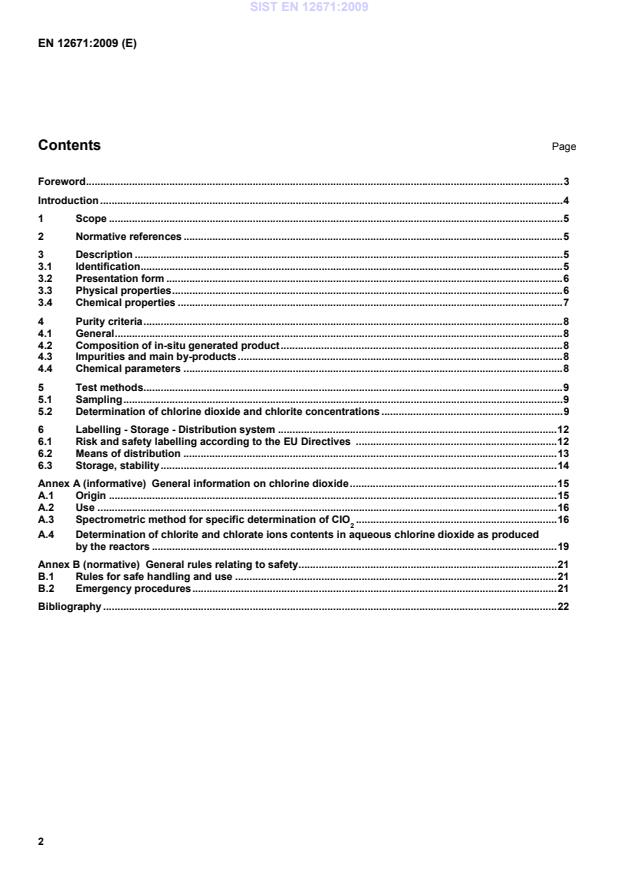
...................................................................... 126.2Means of distribution .................................................................................................................................. 136.3Storage, stability .......................................................................................................................................... 14Annex A (informative)
General information on chlorine dioxide . 15A.1Origin . 15A.2Use . 16A.3Spectrometric method for specific determination of CIO2 . 16A.4Determination of chlorite and chlorate ions contents in aqueous chlorine dioxide as produced by the reactors . 19Annex B (normative)
General rules relating to safety. . 21B.1Rules for safe handling and use . 21B.2Emergency procedures . 21Bibliography . 22 SIST EN 12671:2009
1) Chemical Abstracts Service Registry Number. SIST EN 12671:2009
3.1.7 EINECS reference 2) 233 – 162 - 8 3.2 Presentation form For water treatment, chlorine dioxide is generated in situ as an aqueous solution on or near the site of use and transferred to the site of use. 3.3 Physical properties 3.3.1 Appearance The pure product is an orange gas or liquid, which forms a yellow solution in water. NOTE If the solution becomes red-brown, it is sign of decomposition. 3.3.2 Density Gas: 3,09 g/l, (2,4 g/l relative, air = 1) at 273 K and 101,3 kPa 3). Liquid: 1,64 g/ml at 20 °C. 3.3.3 Solubility in water In Table 1 the solubility values (S) for chlorine dioxide are given in grams per m³ water at a pressure of 101,3 kPa for different temperatures 1: Table 1 –Solubility values Temperature of water °C S value : gasg/mOHg/m323 0 70 ± 0,7 5 (60,3) 10 (53,7) 15 45 20 (42,7) 25 (33) 30 (30,1) 35 26,5 ± 0,8 NOTE 1 S is a ratio, not an absolute value of concentration. NOTE 2 The S values are directly measured values except those in brackets which are extrapolated data. 3.3.4 Vapour pressure The vapour pressure of pure chlorine dioxide as a function of temperature is given in Table 2.
2) European Inventory of Existing Commercial Chemical Substances. 3 ) 100 kPa = 1 bar SIST EN 12671:2009
0 82,3
5 90,4
10 98,8
11 100,5
20 116,5 (extrapolated) 25 125,8 (extrapolated) 30 135,3 (extrapolated) 35 145,1 (extrapolated) 40 155,0 (extrapolated) 3.3.5 Boiling point at 101,3 kPa 4) 11 °C (for pure chlorine dioxide). 3.3.6 Crystallisation point - 59 °C (for pure chlorine dioxide). 3.3.7 Specific heat The specific heat of solutions of chlorine dioxide is very similar to that of pure water. 3.3.8 Viscosity (dynamic) The dynamic viscosity of solutions of chlorine dioxide is very similar to that of pure water. 3.3.9 Critical temperature 153 °C (for pure chlorine dioxide). 3.3.10 Critical pressure Not applicable. 3.3.11 Physical hardness Not applicable. 3.3.12 Dissolution heat The heat of the dissolution in water is – 26,8 kJ/mol (exothermic). 3.4 Chemical properties Chlorine dioxide is a molecule containing an unpaired electron and has the characteristics of a "molecule-free-radical". Relevant Redox potentials of chlorine dioxide and related molecules are (Eo values at 25 °C in volts):
4) 100 kPa = 1 bar SIST EN 12671:2009
The concentration of the aqueous ClO2 solution with intermediate storage in a storage tank (i.e. with headspace) should not exceed a concentration of 3 g/l, to ensure an adequate distance to the explosion limit (see B.1). 4.3 Impurities and main by-products Impurities and main by-products of the starting products used for the generation (indicated in A.1.1) can be found in the in situ generated product in respective proportional concentrations.
Inadequate design, operation and maintenance of reactors can give rise to the formation of chlorine and traces of chlorate ion and, eventually, the presence of unreacted chlorite, chlorate and/or chlorine (see [5]); for analysis see 5.2 and A.4. 4.4 Chemical parameters Limits of chemical parameters being potentially present in chlorine dioxide solution have been specified in the corresponding EN standards of the starting products (indicated in A.1.1). SIST EN 12671:2009
NOTE Other oxidizing agents could interfere with the determination. 5.2.2 Principle 5.2.2.1 General Phosphate-buffered iodide is first reacted with the chlorine dioxide sample and titrated at pH 7,2 and subsequently acidified to pH 2 and titration is continued. 5.2.2.2 With iodometry at pH 7,2 ClO2 + l- ⇒ ClO2- +1/2 l2 (1) SIST EN 12671:2009
Dissolve in 1l of water, 28,2 g of sodium dihydrogen phosphate (NaH2PO4 . 2H2O) and 100 g monohydrogen phosphate (Na2HPO4 . 12H2O). NOTE If necessary, precise adjustment of the pH value can be done with aliquots of sodium hydroxide (NaOH) or phosphoric acid (H3PO4). 5.2.3.3 Sulfuric acid c(H2SO4) = 6 mol/l. 5.2.3.4 Potassium iodate (KlO3) powdered. 5.2.3.5 Hydrochloric acid standard volumetric solution c(HCl) = 0,1 mol/l or sulfuric acid c(H2SO4) = 0,5 mol/l. 5.2.3.6 Potassium iodide, (Kl) crystalline. 5.2.3.7 Zinc iodide (ZnI2)-starch indicator. Disperse 4 g starch into a small quantity of water. Add the dispersion to a solution of 20 g zinc chloride (ZnCl2) in 100 ml of water. The solution is boiled until the volume has been reduced to 100 ml and finally diluted to 1 l while adding 2 g of ZnI2. NOTE An alternative starch indicator is soluble starch 5 g + ZnCl2 4 g + salicylic acid 1,25 g; disperse the starch in a small volume of water. Dissolve ZnCl2 and salicylic acid in 500 ml water, boil and, while boiling, add the starch dispersion. Continue boiling for 5 min and finally dilute to 1 l. 5.2.3.8 Standardization of sodium thiosulfate solution 5.2.3.8.1 Reactions 5KI + 5H+ ⇒ 5Hl + 5K+
(4) SIST EN 12671:2009
Add 0,5 ml of starch indicator (5.2.3.7) and titrate to the end point, i.e. the disappearance of the blue-black colour. Record the volume Vt of the sodium thiosulfate solution added. 5.2.3.8.3 Calculation The concentration, ct, expressed in moles per litre, of the sodium thiosulfate solution is given by the following equation: tatVVcc×= (8) where ca is the concentration, in moles per litre, of the acid (5.2.3.5); V is the volume, in millilitres, of the acid (5.2.3.5); Vt is the volume, in millilitres, of the sodium thiosulfate solution used. 5.2.4 Apparatus Ordinary laboratory apparatus: all glassware shall be dark brown to protect against photodecomposition; wash all glassware with a dilute solution (approximately 1 g/l) of chlorine dioxide and rinse with water; the glassware used for the determinations of chlorine dioxide and related oxidants shall be reserved for this specific use and kept maintained separately. 5.2.5 Procedure Prepare sets of three conical flasks of 250 ml immediately before the sampling: take 80 ml of water, followed by 20 ml buffer solution (5.2.3.2) and approximately 1 g of potassium iodide (5.2.3.6). Use immediately or keep in the dark if immediate use is not possible. Introduce a volume (Vs) of chlorine dioxide solution which (presumably) contains between 3 mg and 10 mg of ClO2. Titration of sample under conditions of 5.2.2.2 gives a volume V1 of the sodium thiosulfate standard volumetric solution (5.2.3.1). After this first titration add 5 ml of the sulfuric acid (5.2.3.3) and after shaking the titration is continued to give an additional volume V2 of the sodium thiosulfate standard volumetric solution (5.2.3.1).
,
c) V(V Cs
××××+=5000156721 (9) where V1 is the volume in millilitres, of the sodium thiosulfate standard volumetric solution (5.2.3.1) used for the titration at pH 7,2; V2 is the volume in millilitres, of the sodium thiosulfate standard volumetric solution (5.2.3.1) used for the titration at pH 2; Vs is the volume in millilitres, of the test portion of chlorine dioxide; c is the actual concentratio
...