

EN 15028:2012
(Main)Chemicals used for treatment of water intended for human consumption - Sodium chlorate
- Abstract
This European Standard is applicable to sodium chlorate used for treatment of water intended for human consumption. It describes the characteristics of sodium chlorate and specifies the requirements and the corresponding test methods for sodium chlorate. It gives information on its use in water treatment. It also determines the rules relating to safe handling and use of sodium chlorate (see Annex B) and gives the environmental, health and safety precautions within chemical laboratory (see Annex C).
- Status
- Published
- Publication Date
- 13-Nov-2012
- Withdrawal Date
- 30-May-2013
- Technical Committee
- CEN/TC 164 - Water supply
- Drafting Committee
- CEN/TC 164/WG 9 - Drinking water treatment
- Current Stage
- 9092 - Decision on results of review/2YR ENQ - revise - Review Enquiry
- Start Date
- 14-Jun-2019
- Completion Date
- 07-Oct-2026

Overview
EN 15028:2012 - published by CEN - is the European standard that specifies requirements for sodium chlorate used in the treatment of water intended for human consumption (drinking water). The standard describes the chemical identity, physical properties, purity criteria, sampling and test methods, and gives guidance on labelling, transport, storage, handling and laboratory environmental, health and safety precautions (Annex B and Annex C). It supersedes EN 15028:2006 and clarifies the requirements for sodium chlorate as an oxidising agent in water treatment.
Key identifying details in the standard:
- Chemical formula: NaClO3, relative molecular mass 106.45
- CAS: 7775-09-9, EINECS: 231-887-4
- Commercial forms: crystalline, powdered, or aqueous solution
- Melting point: 248 °C; thermal decomposition at ≥ 400 °C
Key Topics and Requirements
- Purity criteria: Commercial sodium chlorate solids are normally required to have a minimum dry mass fraction of 99% NaClO3; solutions must be certified against that basis. No added colourants are permitted.
- Impurity limits (typical values in Table 5): arsenic, cadmium, mercury, nickel, lead, antimony and selenium generally limited to 1 mg/kg; chromium up to 5 mg/kg (values as specified in the standard).
- Physical & chemical properties: solubility, density of solutions, crystallisation and boiling point data provided to support safe handling and formulation.
- Test methods: normatively references analytical procedures and includes a titrimetric method for determination of chlorate (reduction by Fe(II) and titration with dichromate), plus requirements for sample preparation.
- Sampling protocols: sampling from solids, drums, tanks and tankers is defined with reference to ISO sampling standards.
- Safety & lab practices: Annex B (normative) gives rules for safe handling; Annex C (informative) addresses environmental, health and safety precautions in the chemical laboratory.
Practical Applications
- Use case: specification and quality control of sodium chlorate used as an oxidant or precursor in municipal and industrial drinking water treatment processes.
- Practical value: ensures consistent product quality, defines acceptable impurity levels, and provides validated methods for analysis, sampling, labelling, storage and transport, reducing operational and regulatory risk.
- Users: water utilities, chemical manufacturers and suppliers, analytical laboratories, regulatory bodies and consultants involved in drinking water treatment and chemical supply chains.
Related Standards
Normative and referenced standards include:
- EN ISO 3696 (water for analytical lab use)
- EN ISO 11885 (ICP‑OES elemental analysis)
- EN ISO 12846 (mercury analysis)
- ISO 3165, ISO 6206, ISO 8213 (sampling of chemical products)
Conformity with EN 15028:2012 supports quality control and regulatory compliance for sodium chlorate in potable water applications; however, national regulations and approvals for use remain applicable.
Relations
- Effective Date
- 21-Nov-2012
- Effective Date
- 25-Aug-2026
- Effective Date
- 25-Aug-2026
- Effective Date
- 09-Feb-2026
- Effective Date
- 28-Jan-2026
- Effective Date
- 28-Jan-2026
- Effective Date
- 28-Jan-2026
- Effective Date
- 28-Jan-2026
- Effective Date
- 28-Jan-2026
- Revised
prEN 15028 - Chemicals used for treatment of water intended for human consumption - Sodium chlorate - Effective Date
- 19-Jan-2023
Get Certified
Connect with accredited certification bodies for this standard

ECOCERT
Organic and sustainability certification.

Eurofins Food Testing Global
Global leader in food, environment, and pharmaceutical product testing.

Intertek Bangladesh
Intertek certification and testing services in Bangladesh.
Sponsored listings
Frequently Asked Questions
EN 15028:2012 is a standard published by the European Committee for Standardization (CEN). Its full title is "Chemicals used for treatment of water intended for human consumption - Sodium chlorate". This standard covers: This European Standard is applicable to sodium chlorate used for treatment of water intended for human consumption. It describes the characteristics of sodium chlorate and specifies the requirements and the corresponding test methods for sodium chlorate. It gives information on its use in water treatment. It also determines the rules relating to safe handling and use of sodium chlorate (see Annex B) and gives the environmental, health and safety precautions within chemical laboratory (see Annex C).
This European Standard is applicable to sodium chlorate used for treatment of water intended for human consumption. It describes the characteristics of sodium chlorate and specifies the requirements and the corresponding test methods for sodium chlorate. It gives information on its use in water treatment. It also determines the rules relating to safe handling and use of sodium chlorate (see Annex B) and gives the environmental, health and safety precautions within chemical laboratory (see Annex C).
EN 15028:2012 is classified under the following ICS (International Classification for Standards) categories: 71.100.80 - Chemicals for purification of water. The ICS classification helps identify the subject area and facilitates finding related standards.
EN 15028:2012 has the following relationships with other standards: It is inter standard links to EN 15028:2006, ISO 6206:1979, ISO 3165:1976, ISO 8213:1986, EN 1998-6:2005, EN ISO 12846:2012, EN ISO 3696:1995, EN ISO 11885:2009, EN ISO 8751:1997, prEN 15028. Understanding these relationships helps ensure you are using the most current and applicable version of the standard.
EN 15028:2012 is available in PDF format for immediate download after purchase. The document can be added to your cart and obtained through the secure checkout process. Digital delivery ensures instant access to the complete standard document.
Standards Content (Sample)
2003-01.Slovenski inštitut za standardizacijo. Razmnoževanje celote ali delov tega standarda ni dovoljeno.Kemikalije, ki se uporabljajo za pripravo pitne vode - Natrijev kloratProdukte zur Aufbereitung von Wasser für den menschlichen Gebrauch - NatriumchloratProduits chimiques utilisés pour le traitement de l'eau destinée à la consommation humaine - Chlorate de sodiumChemicals used for treatment of water intended for human consumption - Sodium chlorate71.100.80Chemicals for purification of water13.060.20Pitna vodaDrinking waterICS:Ta slovenski standard je istoveten z:EN 15028:2012SIST EN 15028:2013en,fr,de01-maj-2013SIST EN 15028:2013SLOVENSKI
STANDARDSIST EN 15028:20061DGRPHãþD
EUROPEAN STANDARD NORME EUROPÉENNE EUROPÄISCHE NORM
EN 15028
November 2012 ICS 71.100.80 Supersedes EN 15028:2006English Version
Chemicals used for treatment of water intended for human consumption - Sodium chlorate
Produits chimiques utilisés pour le traitement de l'eau destinée à la consommation humaine - Chlorate de sodium Produkte zur Aufbereitung von Wasser für den menschlichen Gebrauch - Natriumchlorat This European Standard was approved by CEN on 16 September 2012.
CEN members are bound to comply with the CEN/CENELEC Internal Regulations which stipulate the conditions for giving this European Standard the status of a national standard without any alteration. Up-to-date lists and bibliographical references concerning such national standards may be obtained on application to the CEN-CENELEC Management Centre or to any CEN member.
This European Standard exists in three official versions (English, French, German). A version in any other language made by translation under the responsibility of a CEN member into its own language and notified to the CEN-CENELEC Management Centre has the same status as the official versions.
CEN members are the national standards bodies of Austria, Belgium, Bulgaria, Croatia, Cyprus, Czech Republic, Denmark, Estonia, Finland, Former Yugoslav Republic of Macedonia, France, Germany, Greece, Hungary, Iceland, Ireland, Italy, Latvia, Lithuania, Luxembourg, Malta, Netherlands, Norway, Poland, Portugal, Romania, Slovakia, Slovenia, Spain, Sweden, Switzerland, Turkey and United Kingdom.
EUROPEAN COMMITTEE FOR STANDARDIZATION
COMITÉ EUROPÉEN DE NORMALISATION EUROPÄISCHES KOMITEE FÜR NORMUNG
Management Centre:
Avenue Marnix 17,
B-1000 Brussels © 2012 CEN All rights of exploitation in any form and by any means reserved worldwide for CEN national Members. Ref. No. EN 15028:2012: ESIST EN 15028:2013
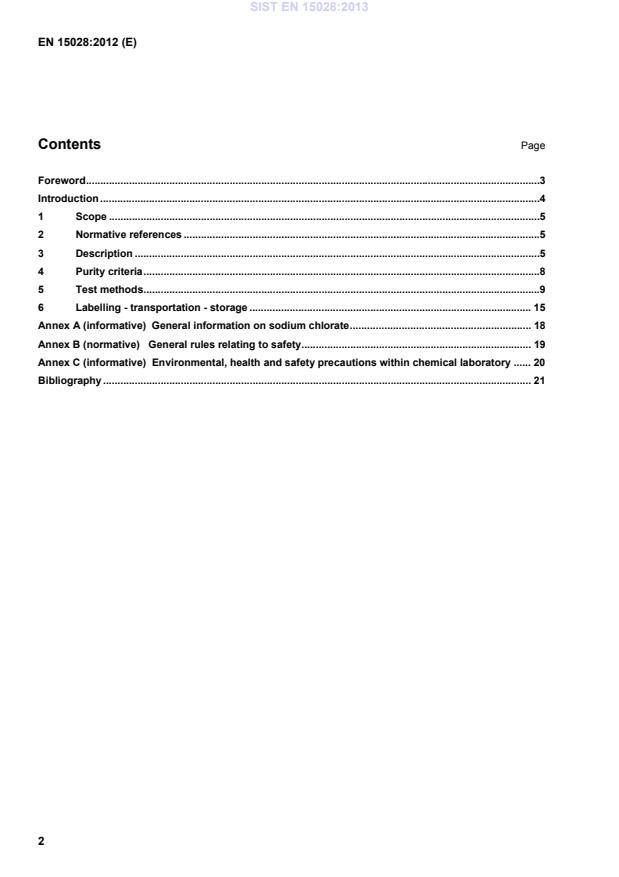
General information on sodium chlorate . 18Annex B (normative)
General rules relating to safety . 19Annex C (informative)
Environmental, health and safety precautions within chemical laboratory . 20Bibliography . 21 SIST EN 15028:2013
Table 1 — Density of sodium chlorate solution Concentration of aqueous solution of sodium chlorate solution (Mass fraction in %) Density (g/ml at 20 °C) 30 1,24 40 1,33 50 1,44 3.3.3 Solubility in water The solubility of sodium chlorate in water is given in Table 2. Table 2 — Solubility of sodium chlorate Temperature (°C) Solubility (g/l) 10 650 20 700 40 780 60 880
1) Chemical Abstracts Service Registry Number. 2) European Inventory of Existing Commercial Chemical Substances. SIST EN 15028:2013
(mass fraction in %) Crystallisation point (°C) 40 -20 45 0 50 20 55 32 60 55 3.3.7 Melting point The melting point (of the solid) is 248 °C; and the thermal decomposition is at ≥ 400 °C. 3.3.8 Viscosity (dynamic) The relative viscosity of aqueous solutions of mass fraction of 40 % of sodium chlorate compared with water at the same temperature between 25 °C and 35 °C is 2,07. 3.3.9 Critical temperature in aqueous solution Not applicable. 3.3.10 Critical pressure Not applicable.
3) 100 kPa = 1 bar. SIST EN 15028:2013
NOTE 1 When an acidic sodium chlorate solution is treated with a reducing agent (e.g. hydrogen peroxide (EN 902) or oxalic acid), chlorine dioxide can be formed. NOTE 2 The formation of chlorine dioxide can also be obtained by acidification if the acid applied is capable of acting as a reducing agent in the current environment. For the purpose of drinking water treatment one should use acids of quality in accordance with existing standards for the purpose: hydrochloric acid (EN 939); sulfuric acid (EN 899); phosphoric acid (EN 974). 4 Purity criteria 4.1 General This European Standard specifies the minimum purity requirements for sodium chlorate used for the treatment of water intended for human consumption. Limits are given for impurities commonly present in the product. Depending on the raw material and the manufacturing process other impurities may be present and, if so, this shall be notified to be user and when necessary to relevant authorities. NOTE Users of this product should check the national regulations in order to clarify whether it is of appropriate purity for treatment of water intended for human consumption, taking into account raw water quality, required dosage, contents of other impurities and additives used in the product not stated in this product standard. Limits have been given for impurities and chemical parameters where these are likely to be present in significant quantities from the current production process and raw materials. If the production process or raw materials lead to significant quantities of impurities, by-products or additives being present, this shall be notified to the user. 4.2 Composition of commercial product The sodium chlorate is commercially available as solid forms usually with a minimum dry mass fraction of 99 % of NaClO3. Commercial solutions if used for water treatment shall be certified to be made-up on the basis of the product with a dry mass fraction of 99 %. No additional substances like colorants shall be added to the basic product or to the solutions. The content of sodium chlorate in commercially available solutions shall be within 3 % of the manufacturer's declared value. 4.3 Impurities and main by-products NOTE Sodium chlorate in crystalline form contains normally a maximum mass fraction of 0,1 % of sodium chloride (as NaCl). 4.4 Chemical parameters The product shall conform to the requirements specified in Table 5. SIST EN 15028:2013
Limit in
sodium chlorate (mass fraction 100 %)
(mg/kg) Arsenic (As) max.
Cadmium (Cd) max.
Chromium (Cr) max.5
Mercury (Hg) max.1
Nickel (Ni) max.1
Lead (Pb) max.1
Antimony (Sb) max.1
Selenium (Se) max.1
NOTE Cyanide which does not exist in a strong oxidising medium such as sodium chlorate is not a relevant chemical parameter. Pesticides and polycyclic aromatic hydrocarbons are not by-products of the manufacturing process. For parametric values of sodium chlorate on trace metal content in drinking water, see [1].
5 Test methods 5.1 Sampling 5.1.1 General Observe the recommendations of ISO 3165 and take account of ISO 6206. 5.1.2 Solid Prepare the laboratory sample(s) required by the relevant procedure described in ISO 8213. 5.1.3 Liquid 5.1.3.1 Sampling from drums and bottles 5.1.3.1.1 General 5.1.3.1.1.1 Mix the contents of each container to be sampled by shaking the container, by rolling it or by rocking it from side to side, taking care not to damage the container or spill any of the liquid. 5.1.3.1.1.2 If the design of the container is such (for example, a narrow-necked bottle) that it is impracticable to use a sampling implement, take a sample by pouring after the contents have been thoroughly mixed. Otherwise, proceed as described in 5.1.3.1.1.3. 5.1.3.1.1.3 Examine the surface of the liquid. If there are signs of surface contamination, take samples from the surface as described in 5.1.3.1.2. Otherwise, take samples as described in 5.1.3.1.3. 5.1.3.1.2 Surface sampling Take a sample using a suitable ladle. Lower the ladle into the liquid until the rim is just below the surface, so that the surface layer runs into it. Withdraw the ladle just before it fills completely and allow any liquid adhering to the ladle to drain off. If necessary, repeat this operation so that, when the other selected containers have been sampled in a similar manner, the total volume of sample required for subsequent analysis is obtained. SIST EN 15028:2013
...