

CEN/TS 18036:2024
(Main)Light and lighting - Commissioning of lighting systems in buildings
- Abstract
This document specifies requirements for the commissioning of lighting systems in buildings to meet defined design specifications. This document presents details of the commissioning of lighting systems without focusing on the technical characteristics of specific components.
This document can be applied to new installations or renovations of non-residential buildings and public spaces of multi-occupancy residential buildings.
This document does not cover electrical power connection aspects of lighting system components, which are deemed to be in compliance with relevant legislation or standards.
This document is not applicable to the commissioning of emergency lighting.
- Status
- Published
- Publication Date
- 30-Apr-2024
- Technical Committee
- CEN/TC 169 - Lighting applications
- Drafting Committee
- CEN/TC 169/WG 2 - Lighting of work places
- Current Stage
- 6060 - Definitive text made available (DAV) - Publishing
- Start Date
- 01-May-2024
- Due Date
- 30-Jul-2023
- Completion Date
- 01-May-2024

Overview
CEN/TS 18036:2024 - Light and lighting: Commissioning of lighting systems in buildings defines minimum requirements and a structured process to commission lighting systems so they meet defined design specifications. Applicable to new installations and renovations in non‑residential buildings and public spaces of multi‑occupancy residential buildings, the Technical Specification focuses on the commissioning process (planning, verification, documentation and handover) rather than the detailed technical characteristics of individual components. Emergency lighting and electrical power connection aspects are excluded.
Key SEO keywords: commissioning of lighting systems, lighting system commissioning, CEN/TS 18036:2024, building lighting, lighting controls.
Key Topics and Requirements
- Scope and exclusions: Applies to commissioning of general lighting systems (not emergency lighting); assumes electrical connections comply with legislation/standards.
- Commissioning objectives: Confirm and document that installed systems meet the design specification; identify and correct deficiencies.
- Benefits: Reduced energy use and operating costs, improved occupant satisfaction, better asset marketability, accountability for project participants.
- Commissioning methods:
- Method 1 - Basic: activities between installation and operation to ensure correct installation, calibration and configuration.
- Method 2 - Full life‑cycle: commissioning team engaged from design through post‑occupancy for a complete, commissionable solution.
- Phases covered: Pre‑commissioning, installation, field commissioning, and post‑occupancy verification.
- Roles and responsibilities: Owner/tenant, design team, contractors/subcontractors/suppliers, and the commissioning team - each with defined deliverables and acceptance steps.
- Verification checks: Component operation, luminaire positioning/aiming, sensor positioning, local and system‑wide controls, interaction with daylighting and other building systems where applicable.
- Documentation requirements: Commissioning plan, commissioning specification, inspection/calibration reports, issues log, training plan, and final commissioning report.
Applications and Users
- Building owners, facility managers and tenants seeking verified lighting performance and energy savings
- Lighting designers and design teams aiming to specify commissionable systems
- Contractors, sub‑contractors and suppliers responsible for installation and handover
- Commissioning providers and consultants executing Method 1 or Method 2
- Project managers and clients who require formal deliverables and acceptance processes
Related Standards
- ISO/TS 21274 - original ISO technical specification on which this CEN/TS is based
- CEN/TS 17165 - referenced for the lighting design process
- CIE S 017 - terminology and definitions related to lighting systems
CEN/TS 18036:2024 is provisional (initially valid for three years) and provides a practical, document‑driven framework to ensure lighting systems operate as intended and deliver intended energy and comfort benefits.
Get Certified
Connect with accredited certification bodies for this standard

DIBt (Deutsches Institut für Bautechnik)
German Institute for Building Technology.
DIN CERTCO
DIN Group product certification.

Aboma Certification B.V.
Specialized in construction, metal, and transport sectors.
Sponsored listings
Frequently Asked Questions
CEN/TS 18036:2024 is a technical specification published by the European Committee for Standardization (CEN). Its full title is "Light and lighting - Commissioning of lighting systems in buildings". This standard covers: This document specifies requirements for the commissioning of lighting systems in buildings to meet defined design specifications. This document presents details of the commissioning of lighting systems without focusing on the technical characteristics of specific components. This document can be applied to new installations or renovations of non-residential buildings and public spaces of multi-occupancy residential buildings. This document does not cover electrical power connection aspects of lighting system components, which are deemed to be in compliance with relevant legislation or standards. This document is not applicable to the commissioning of emergency lighting.
This document specifies requirements for the commissioning of lighting systems in buildings to meet defined design specifications. This document presents details of the commissioning of lighting systems without focusing on the technical characteristics of specific components. This document can be applied to new installations or renovations of non-residential buildings and public spaces of multi-occupancy residential buildings. This document does not cover electrical power connection aspects of lighting system components, which are deemed to be in compliance with relevant legislation or standards. This document is not applicable to the commissioning of emergency lighting.
CEN/TS 18036:2024 is classified under the following ICS (International Classification for Standards) categories: 91.160.10 - Interior lighting. The ICS classification helps identify the subject area and facilitates finding related standards.
CEN/TS 18036:2024 is available in PDF format for immediate download after purchase. The document can be added to your cart and obtained through the secure checkout process. Digital delivery ensures instant access to the complete standard document.
Standards Content (Sample)
SLOVENSKI STANDARD
01-november-2024
Svetloba in razsvetljava - Zagon sistemov razsvetljave v stavbah
Light and lighting - Commissioning of lighting systems in buildings
Licht und Beleuchtung - Inbetriebnahme von Beleuchtungsanlagen in Gebäuden
Lumière et éclairage Mise en service des systèmes d'éclairage dans les bâtiments
Ta slovenski standard je istoveten z: CEN/TS 18036:2024
ICS:
91.160.10 Notranja razsvetljava Interior lighting
2003-01.Slovenski inštitut za standardizacijo. Razmnoževanje celote ali delov tega standarda ni dovoljeno.
CEN/TS 18036
TECHNICAL SPECIFICATION
SPÉCIFICATION TECHNIQUE
May 2024
TECHNISCHE SPEZIFIKATION
ICS 91.160.10
English Version
Light and lighting - Commissioning of lighting systems in
buildings
Lumière et éclairage - Mise en service des systèmes Licht und Beleuchtung - Inbetriebnahme von
d'éclairage dans les bâtiments Beleuchtungsanlagen in Gebäuden
This Technical Specification (CEN/TS) was approved by CEN on 15 March 2024 for provisional application.
The period of validity of this CEN/TS is limited initially to three years. After two years the members of CEN will be requested to
submit their comments, particularly on the question whether the CEN/TS can be converted into a European Standard.
CEN members are required to announce the existence of this CEN/TS in the same way as for an EN and to make the CEN/TS
available promptly at national level in an appropriate form. It is permissible to keep conflicting national standards in force (in
parallel to the CEN/TS) until the final decision about the possible conversion of the CEN/TS into an EN is reached.
CEN members are the national standards bodies of Austria, Belgium, Bulgaria, Croatia, Cyprus, Czech Republic, Denmark, Estonia,
Finland, France, Germany, Greece, Hungary, Iceland, Ireland, Italy, Latvia, Lithuania, Luxembourg, Malta, Netherlands, Norway,
Poland, Portugal, Republic of North Macedonia, Romania, Serbia, Slovakia, Slovenia, Spain, Sweden, Switzerland, Türkiye and
United Kingdom.
EUROPEAN COMMITTEE FOR STANDARDIZATION
COMITÉ EUROPÉEN DE NORMALISATION
EUROPÄISCHES KOMITEE FÜR NORMUNG
CEN-CENELEC Management Centre: Rue de la Science 23, B-1040 Brussels
© 2024 CEN All rights of exploitation in any form and by any means reserved Ref. No. CEN/TS 18036:2024 E
worldwide for CEN national Members.
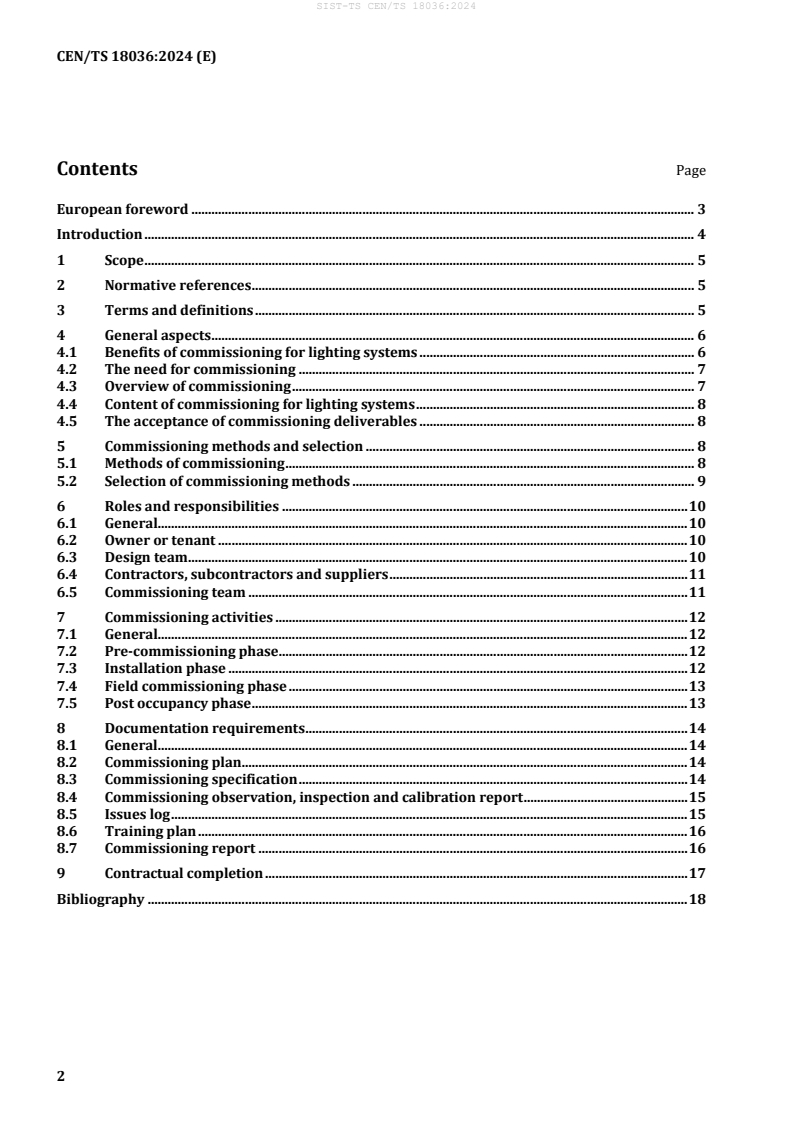
Contents Page
European foreword . 3
Introduction . 4
1 Scope . 5
2 Normative references . 5
3 Terms and definitions . 5
4 General aspects . 6
4.1 Benefits of commissioning for lighting systems . 6
4.2 The need for commissioning . 7
4.3 Overview of commissioning . 7
4.4 Content of commissioning for lighting systems . 8
4.5 The acceptance of commissioning deliverables . 8
5 Commissioning methods and selection . 8
5.1 Methods of commissioning . 8
5.2 Selection of commissioning methods . 9
6 Roles and responsibilities . 10
6.1 General. 10
6.2 Owner or tenant . 10
6.3 Design team . 10
6.4 Contractors, subcontractors and suppliers . 11
6.5 Commissioning team . 11
7 Commissioning activities . 12
7.1 General. 12
7.2 Pre-commissioning phase . 12
7.3 Installation phase . 12
7.4 Field commissioning phase . 13
7.5 Post occupancy phase . 13
8 Documentation requirements . 14
8.1 General. 14
8.2 Commissioning plan. 14
8.3 Commissioning specification . 14
8.4 Commissioning observation, inspection and calibration report . 15
8.5 Issues log . 15
8.6 Training plan . 16
8.7 Commissioning report . 16
9 Contractual completion . 17
Bibliography . 18
European foreword
This document (CEN/TS 18036:2024) has been prepared by Technical Committee CEN/TC 169 “Light
and lighting”, the secretariat of which is held by DIN.
Attention is drawn to the possibility that some of the elements of this document may be the subject of
patent rights. CEN shall not be held responsible for identifying any or all such patent rights.
This document is based on ISO/TS 21274 “Light and lighting — Commissioning of lighting systems in
buildings”, which was prepared by ISO/TC 274 “Light and lighting”. CEN/TC 169 decided to adapt
ISO/TS 21274 integrating modifications.
Any feedback and questions on this document should be directed to the users’ national standards body.
A complete listing of these bodies can be found on the CEN website.
According to the CEN/CENELEC Internal Regulations, the national standards organisations of the
following countries are bound to announce this Technical Specification: Austria, Belgium, Bulgaria,
Croatia, Cyprus, Czech Republic, Denmark, Estonia, Finland, France, Germany, Greece, Hungary, Iceland,
Ireland, Italy, Latvia, Lithuania, Luxembourg, Malta, Netherlands, Norway, Poland, Portugal, Republic of
North Macedonia, Romania, Serbia, Slovakia, Slovenia, Spain, Sweden, Switzerland, Türkiye and the
United Kingdom.
Introduction
Building users are expecting a better quality of visual environment while there is also a need to reduce
the impact on natural resources and minimize energy use from lighting. The use of a control system can
help to deliver the correct quantity and quality of light where it is needed and when it is needed. The
use of a well-designed, installed and commissioned control system can provide a high level of energy
efficiency, support flexibility of use within a space and increase occupant satisfaction.
Commissioning is a quality-oriented process for achieving, verifying and documenting whether the
performance of lighting systems and its associated components meets defined objectives and criteria.
Potential benefits of commissioning include:
— reduced energy consumption and operating costs;
— higher user acceptance and satisfaction;
— enhanced marketability and value of commercial property;
— full accountability by project participants for the quality of their work;
— verification that a lighting system performs as intended.
The purpose of this document is to identify the minimum requirements for the commissioning of
lighting systems, including roles and responsibilities, commissioning activities, documentation
requirements and system handover procedure.
1 Scope
This document specifies requirements for the commissioning of lighting systems in buildings to meet
defined design specifications. This document presents details of the commissioning of lighting systems
without focusing on the technical characteristics of specific components.
This document can be applied to new installations or renovations of non-residential buildings and
public spaces of multi-occupancy residential buildings.
This document does not cover electrical power connection aspects of lighting system components,
which are deemed to be in compliance with relevant legislation or standards.
This document is not applicable to the commissioning of emergency lighting.
2 Normative references
There are no normative references in this document.
3 Terms and definitions
For the purposes of this document, the following terms and definitions apply.
ISO and IEC maintain terminology databases for use in standardization at the following addresses:
— ISO Online browsing platform: available at https://www.iso.org/obp/
— IEC Electropedia: available at https://www.electropedia.org/
3.1
lighting system
system designed to provide lighting
Note 1 to entry: A lighting system can be dedicated to
a) the support of one or more specified visual tasks under specified conditions considering other requirements
such as human comfort, safety, the appearance of the surrounding environment and energy consumption;
b) the support of other than human tasks.
Note 2 to entry: A lighting system can include a set of light sources, other physical components, communication
protocols, user interfaces, software and networks to provide control and monitoring functions.
Note 3 to entry: The light source(s) and the related equipment can be integrated in a single item, e.g. an LED
module, a lamp or a luminaire.
Note 4 to entry: A lighting system can be networked to provide central or remote control and monitoring
functions.
Note 5 to entry: A lighting system can be connected to or integrated with other systems or devices.
[SOURCE: CIE S 017:2020, 17-27-010]
3.2
commissioning
quality-oriented process for confirming and documenting whether the performance
of a building’s systems and assemblies meets the defined design specification
Note 1 to entry: Typically, a lighting system is classed as a technical building system.
Note 2 to entry: Adjustment can be made if applicable, e.g. the aiming angle of luminaires or sensors, or
programming in order to meet the design specifications.
[SOURCE: ISO/TS 21274:2020, 3.2, modified: abbreviation omitted]
3.3
calibration
adjustment of control devices to meet the performance requirements of the lighting system
specification
[SOURCE: CIBSE Commissioning Code M: Commissioning Management, 2003, modified; used with
permission.]
3.4
commissioning team
individuals or entities who, through coordinated actions, are responsible for planning and
implementing the commissioning
[SOURCE: ISO/TS 21274:2020, 3.4, modified: abbreviation omitted]
3.5
lighting installation
that part of a lighting system that comprises the luminaires and their supporting structures, installed at
the location or property concerned
[SOURCE: CIE S 017:2020, 17-29-034]
3.6
verification
quality-oriented process for measuring and documenting the performance of a
building’s systems and assemblies
3.7
user interface
device intended to provide a direct means of communication between the user and the lighting system,
which enables the user to control and monitor the operation of the lighting system
[SOURCE: ISO/TS 21274:2020, 3.5]
4 General aspects
4.1 Benefits of commissioning for lighting systems
As lighting systems are becoming increasingly interconnected and interactive, a deficiency in one or
more components can prevent the correct operation of the lighting system. Commissioning is a process
for ensuring the correct operation of a lighting system according to the design specifications, including
identifying and remedying any deficiencies in operation.
4.2 The need for commissioning
The design process for a lighting system is described in CEN/TS 17165. Commissioning and verification
are key stages in the provision of a lighting system within a building, as shown in Figure 1 below.
Commissioning and verification ensure that the client brief has been successfully interpreted by the
lighting designer, correctly installed according to the design, and may be operated and maintained to
ensure continued correct functioning.
Without commissioning and verification of the lighting system, the full benefits in energy efficiency and
comfort are unlikely to be achieved.
Figure 1 — Life cycle of a lighting system
4.3 Overview of commissioning
The process of commissioning for lighting systems consists of commissioning activities (see Clause 7)
carried out and supported by teams and parties with defined roles and responsibilities (see Clause 6)
using selected commissioning methods (see Clause 5) to develop interim documentation and final
deliverables (see Clause 8) until the contract is completed (see Clause 9). This process is schematically
presented in Figure 2.
Key
parties related to commissioning
professional teams involved in commissioning
commissioning activities
groundwork and interim documents
handover documentation
Cx commissioning
Figure 2 — Overview of commissioning for lighting systems
4.4 Content of commissioning for lighting systems
Commissioning shall be conducted to ensure that the lighting system functions as close to the design
specification as possible after installation. The following points shall be checked and verified:
— It shall be verified that all components of a lighting system have been properly installed and
connected and are operating.
— The positioning of luminaires shall be verified and in the case of adjustable luminaires or
asymmetric luminaires also their aiming and orientation.
— The positioning and aiming of sensors shall be verified.
— In the case of local control of the lighting system or any part of it, the correct operation of the local
control shall be verified.
— The system-wide functioning of the lighting system shall be tested and verified according to the
design specification.
— It should be verified that daylighting systems such as solar shading systems or daylight redirecting
systems, if present and intended to be connected, have been properly installed and connected and
are operating.
— Where applicable, interactions with other systems in the building shall be tested to ensure the
correct response to system inputs from and the correct communication of system outputs to the
external system(s).
4.5 The acceptance of commissioning deliverables
The process for each activity and deliverable shall include an acceptance step as defined in the
commissioning plan. This step shall formalize the acceptance of the commissioning deliverable by the
owner or tenant.
5 Commissioning methods and selection
5.1 Methods of commissioning
This document covers two methods for the commissioning of lighting systems:
1) Method 1 is a basic method that requires the commissioning activities listed in 7.4 to be
conducted between the installation and operation stages to ensure that the lighting system has
been installed, calibrated and configured according to the design documents.
2) Method 2 is a full life cycle commissioning method, requiring that the commissioning activities
listed in Clause 7 are conducted, and that the commissioning team is involved throughout the
whole process from the design stage to the post occupation stage, ensuring the design of
commissionable lighting systems and that the lighting system meets the requirements in the
design specification.
Minor changes may be made to the design specification depending upon the agreed contract and clients’
written confirmation of the change required.
5.2 Selection of commissioning methods
The increasing use of solid-state lighting technology, the need for more sustainable practices, and the
growing understanding of the physiological and psychological impact of light upon an individual, brings
a significant incentive for the application of lighting controls. However, the resu
...