

FprEN 12094-8
(Main)Fixed firefighting systems - Components for gas extinguishing systems - Part 8: Characteristics for connectors
- Abstract
This document specifies product characteristics and describes test methods for flexible connectors intended to be used in CO2, inert-gas or halocarbon gas-fire extinguishing systems.
This document covers connectors of the following types: Type 1 to Types 4 (see 3.8 to 3.11).
This document specifies procedures for assessment and verification of constancy (AVCP) of performance for characteristics of flexible connectors.
This document does not cover the following:
- installation techniques for flexible connectors;
- details on service life time and maintenance.
- Status
- Not Published
- Publication Date
- 06-Mar-2022
- Withdrawal Date
- 20-Sep-2022
- Technical Committee
- CEN/TC 191 - Fixed firefighting systems
- Drafting Committee
- CEN/TC 191/WG 6 - Gas extinguishing Systems and components
- Current Stage
- 5060 - Closure of Vote - Formal Approval
- Start Date
- 22-Jun-2023
- Due Date
- 28-Apr-2021
- Completion Date
- 22-Jun-2023



Overview
The FprEN 12094-8 standard, developed by the European Committee for Standardization (CEN), defines essential product characteristics and test methods for connectors used in fixed firefighting gas extinguishing systems. This standard addresses flexible and rigid connectors intended for CO₂, inert gas, or halocarbon gas fire suppression systems. It is crucial in ensuring reliability, safety, and compliance within fire protection infrastructure installed across buildings.
By focusing specifically on connectors, FprEN 12094-8 ensures these components meet stringent requirements for operational reliability, durability under fire conditions, pressure resistance, and material integrity. It complements other parts of the EN 12094 series that cover various components in gas extinguishing systems.
Key Topics
Types of Connectors Covered
- Type 1 & Type 5: Connectors between container valves and manifolds; Type 1 being flexible and Type 5 rigid.
- Type 2: Flexible connectors for distribution pipework downstream of manifolds, connecting moving parts.
- Type 3: Flexible connectors used in pneumatic pilot lines.
- Type 4: Flexible connectors used downstream in distribution pipework, for non-moving parts allowing dimensional adjustments.
Product Characteristics
- Operational Reliability and Fire Performance: Connectors must withstand pressurization at 1.5 times the working pressure without leakage or damage.
- Material Requirements: Metals such as stainless steel, copper, copper alloys, or corrosion-protected steel are mandated for durability.
- Resistance Testing: Includes bursting pressure resistance (up to 3 times working pressure), heat and pressure endurance, cold and heat shock resistance, and flexing tests (Type 2).
- Working Pressure Ratings: Vary depending on connector type and gas system, for example:
- Type 1 and 5 connectors: 140 bar for CO₂ high-pressure installations.
- Type 2 and 4 connectors: 25–60 bar depending on specific gas and installation conditions.
Testing & Verification
- Testing procedures require samples subject to multiple test steps including pressure testing, temperature shock, and material durability.
- Assessment and verification of constancy of performance (AVCP) ensure ongoing compliance with performance requirements.
- Factory production controls are detailed for manufacturers to maintain consistent quality.
Applications
The FprEN 12094-8 standard is applied in the design, manufacturing, and quality assurance of connectors used in fixed firefighting gas suppression systems. Its practical implementations include:
- Fire protection installations in commercial, industrial, and public buildings using gas extinguishing agents such as CO₂, inert gas mixtures, and halocarbon gases.
- Ensuring connectors reliably link critical components such as storage containers, manifolds, pilot lines, and distribution piping.
- Helping manufacturers demonstrate product safety and performance to comply with European regulatory frameworks like Regulation (EU) 305/2011.
- Guiding installation engineers and system designers in selecting certified connectors that can withstand challenging environmental and operational fire scenarios.
By harmonizing product characteristics and test methods, this standard improves system integrity and operational safety, minimizing risks of connector failure during fire events.
Related Standards
FprEN 12094-8 forms part of the broader EN 12094 series for fixed firefighting gas extinguishing systems, which includes:
- Part 1: Electrical automatic control and delay devices.
- Part 2: Non-electrical automatic control and delay devices.
- Part 3: Manual triggering and stop devices.
- Part 4: Container valve assemblies and actuators.
- Part 5: High and low-pressure selector valves and actuators.
- Part 7: Nozzles.
- Part 9: Special fire detectors.
- Part 10: Pressure gauges and pressure switches.
This interconnected suite of standards ensures comprehensive regulation of gas extinguishing system components. Compliance with FprEN 12094-8 supports alignment with these standards to deliver robust, safe, and effective firefighting system components.
Keywords: FprEN 12094-8, fixed firefighting systems, gas extinguishing systems, flexible connectors, CO2 fire suppression, inert gas fire system, halocarbon gas connectors, fire safety standards, connector testing, European fire protection standards, AVCP compliance, pressure resistance testing, fire extinguisher components.
Relations
- Effective Date
- 28-Jan-2026
- Effective Date
- 28-Jan-2026
- Effective Date
- 28-Jan-2026
- Effective Date
- 28-Jan-2026
- Effective Date
- 13-Feb-2019
Get Certified
Connect with accredited certification bodies for this standard

CIS Institut d.o.o.
Personal Protective Equipment (PPE) certification body. Notified Body NB-2890 for EU Regulation 2016/425 PPE.

Kiwa BDA Testing
Building and construction product certification.
Kmetijski inštitut Slovenije
Agricultural Institute of Slovenia. Soil testing, plant health, agricultural product analysis.
Sponsored listings
Frequently Asked Questions
FprEN 12094-8 is a draft published by the European Committee for Standardization (CEN). Its full title is "Fixed firefighting systems - Components for gas extinguishing systems - Part 8: Characteristics for connectors". This standard covers: This document specifies product characteristics and describes test methods for flexible connectors intended to be used in CO2, inert-gas or halocarbon gas-fire extinguishing systems. This document covers connectors of the following types: Type 1 to Types 4 (see 3.8 to 3.11). This document specifies procedures for assessment and verification of constancy (AVCP) of performance for characteristics of flexible connectors. This document does not cover the following: - installation techniques for flexible connectors; - details on service life time and maintenance.
This document specifies product characteristics and describes test methods for flexible connectors intended to be used in CO2, inert-gas or halocarbon gas-fire extinguishing systems. This document covers connectors of the following types: Type 1 to Types 4 (see 3.8 to 3.11). This document specifies procedures for assessment and verification of constancy (AVCP) of performance for characteristics of flexible connectors. This document does not cover the following: - installation techniques for flexible connectors; - details on service life time and maintenance.
FprEN 12094-8 is classified under the following ICS (International Classification for Standards) categories: 13.220.20 - Fire protection. The ICS classification helps identify the subject area and facilitates finding related standards.
FprEN 12094-8 has the following relationships with other standards: It is inter standard links to EN ISO 18497:2018, EN ISO 25119-4:2018, EN ISO 25119-1:2018, EN ISO 25119-3:2018, EN 12094-8:2006. Understanding these relationships helps ensure you are using the most current and applicable version of the standard.
FprEN 12094-8 is associated with the following European legislation: EU Directives/Regulations: 305/2011; Standardization Mandates: M/109. When a standard is cited in the Official Journal of the European Union, products manufactured in conformity with it benefit from a presumption of conformity with the essential requirements of the corresponding EU directive or regulation.
FprEN 12094-8 is available in PDF format for immediate download after purchase. The document can be added to your cart and obtained through the secure checkout process. Digital delivery ensures instant access to the complete standard document.
Standards Content (Sample)
SLOVENSKI STANDARD
oSIST prEN 12094-8:2016
01-julij-2016
Vgrajeni gasilni sistemi - Sestavni deli sistemov za gašenje s plinom - 8. del:
Zahteve in preskusne metode za spoje
Fixed firefighting systems - Components for gas extinguishing systems - Part 8:
Requirements and test methods for connectors
Ortsfeste Brandbekämpfungsanlagen - Bauteile für Löschanlagen mit gasförmigen
Löschmitteln - Teil 8: Anforderungen und Prüfverfahren für Verbindungen
Installations fixes de lutte contre l'incendie - Élements constitutifs des installations
d'extinction à gaz - Partie 8 : Exigences et méthodes d'essai pour raccords
Ta slovenski standard je istoveten z: prEN 12094-8
ICS:
13.220.10 Gašenje požara Fire-fighting
oSIST prEN 12094-8:2016 en,fr,de
2003-01.Slovenski inštitut za standardizacijo. Razmnoževanje celote ali delov tega standarda ni dovoljeno.
oSIST prEN 12094-8:2016
oSIST prEN 12094-8:2016
DRAFT
EUROPEAN STANDARD
prEN 12094-8
NORME EUROPÉENNE
EUROPÄISCHE NORM
May 2016
ICS 13.220.20 Will supersede EN 12094-8:2006
English Version
Fixed firefighting systems - Components for gas
extinguishing systems - Part 8: Requirements and test
methods for connectors
Installations fixes de lutte contre l'incendie - Élements Ortsfeste Brandbekämpfungsanlagen - Bauteile für
constitutifs des installations d'extinction à gaz - Partie Löschanlagen mit gasförmigen Löschmitteln - Teil 8:
8 : Exigences et méthodes d'essai pour raccords Anforderungen und Prüfverfahren für Verbindungen
This draft European Standard is submitted to CEN members for enquiry. It has been drawn up by the Technical Committee
CEN/TC 191.
If this draft becomes a European Standard, CEN members are bound to comply with the CEN/CENELEC Internal Regulations
which stipulate the conditions for giving this European Standard the status of a national standard without any alteration.
This draft European Standard was established by CEN in three official versions (English, French, German). A version in any other
language made by translation under the responsibility of a CEN member into its own language and notified to the CEN-CENELEC
Management Centre has the same status as the official versions.
CEN members are the national standards bodies of Austria, Belgium, Bulgaria, Croatia, Cyprus, Czech Republic, Denmark, Estonia,
Finland, Former Yugoslav Republic of Macedonia, France, Germany, Greece, Hungary, Iceland, Ireland, Italy, Latvia, Lithuania,
Luxembourg, Malta, Netherlands, Norway, Poland, Portugal, Romania, Slovakia, Slovenia, Spain, Sweden, Switzerland, Turkey and
United Kingdom.
Recipients of this draft are invited to submit, with their comments, notification of any relevant patent rights of which they are
aware and to provide supporting documentation.
Warning : This document is not a European Standard. It is distributed for review and comments. It is subject to change without
notice and shall not be referred to as a European Standard.
EUROPEAN COMMITTEE FOR STANDARDIZATION
COMITÉ EUROPÉEN DE NORMALISATION
EUROPÄISCHES KOMITEE FÜR NORMUNG
CEN-CENELEC Management Centre: Avenue Marnix 17, B-1000 Brussels
© 2016 CEN All rights of exploitation in any form and by any means reserved Ref. No. prEN 12094-8:2016 E
worldwide for CEN national Members.
oSIST prEN 12094-8:2016
prEN 12094-8:2016 (E)
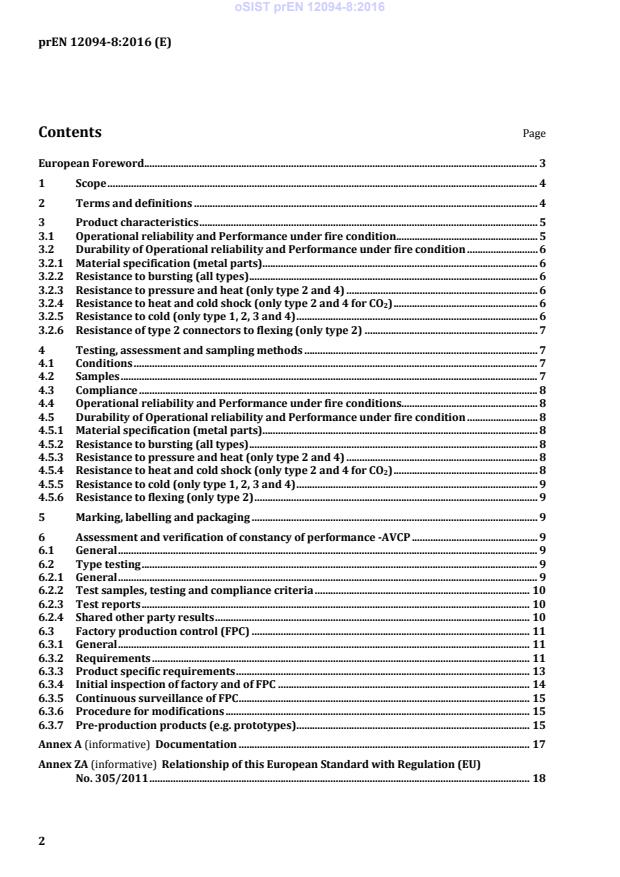
Contents Page
European Foreword . 3
1 Scope . 4
2 Terms and definitions . 4
3 Product characteristics . 5
3.1 Operational reliability and Performance under fire condition. 5
3.2 Durability of Operational reliability and Performance under fire condition . 6
3.2.1 Material specification (metal parts). 6
3.2.2 Resistance to bursting (all types) . 6
3.2.3 Resistance to pressure and heat (only type 2 and 4) . 6
3.2.4 Resistance to heat and cold shock (only type 2 and 4 for CO ) . 6
3.2.5 Resistance to cold (only type 1, 2, 3 and 4) . 6
3.2.6 Resistance of type 2 connectors to flexing (only type 2) . 7
4 Testing, assessment and sampling methods . 7
4.1 Conditions . 7
4.2 Samples . 7
4.3 Compliance . 8
4.4 Operational reliability and Performance under fire conditions. 8
4.5 Durability of Operational reliability and Performance under fire condition . 8
4.5.1 Material specification (metal parts). 8
4.5.2 Resistance to bursting (all types) . 8
4.5.3 Resistance to pressure and heat (only type 2 and 4) . 8
4.5.4 Resistance to heat and cold shock (only type 2 and 4 for CO ) . 8
4.5.5 Resistance to cold (only type 1, 2, 3 and 4) . 9
4.5.6 Resistance to flexing (only type 2) . 9
5 Marking, labelling and packaging . 9
6 Assessment and verification of constancy of performance -AVCP . 9
6.1 General . 9
6.2 Type testing . 9
6.2.1 General . 9
6.2.2 Test samples, testing and compliance criteria . 10
6.2.3 Test reports . 10
6.2.4 Shared other party results . 10
6.3 Factory production control (FPC) . 11
6.3.1 General . 11
6.3.2 Requirements . 11
6.3.3 Product specific requirements . 13
6.3.4 Initial inspection of factory and of FPC . 14
6.3.5 Continuous surveillance of FPC . 15
6.3.6 Procedure for modifications . 15
6.3.7 Pre-production products (e.g. prototypes) . 15
Annex A (informative) Documentation . 17
Annex ZA (informative) Relationship of this European Standard with Regulation (EU)
No. 305/2011 . 18
oSIST prEN 12094-8:2016
prEN 12094-8:2016 (E)
European foreword
This document (prEN 12094-8:2016) has been prepared by Technical Committee CEN/TC 191 “Fixed
firefighting systems”, the secretariat of which is held by BSI.
This document is currently submitted to the CEN Enquiry.
This document will supersede EN 12094-8:2006.
This document has been prepared under a mandate given to CEN by the European Commission and the
European Free Trade Association, and supports essential requirements of Regulation (EU) 305/2011.
For relationship with Regulation (EU) 305/2011, see informative Annex ZA, which is an integral part of
this document.
EN 12094, Fixed firefighting systems - Components for gas extinguishing systems consists of the following
parts:
— Part 1: Requirements and test methods for electrical automatic control and delay devices
— Part 2: Requirements and test methods for non-electrical automatic control and delay devices
— Part 3: Requirements and test methods for manual triggering and stop devices
— Part 4: Requirements and test methods for container valve assemblies and their actuators
— Part 5: Requirements and test methods for high and low pressure selector valves and their actuators
— Part 6: Requirements and test methods for non-electrical disable devices
— Part 7: Requirements and test methods for nozzles
— Part 8: Requirements and test methods for connectors
— Part 9: Requirements and test methods for special fire detectors
— Part 10: Requirements and test methods for pressure gauges and pressure switches
— Part 11: Requirements and test methods for mechanical weighing devices
— Part 12: Requirements and test methods for pneumatic alarm devices
— Part 13: Requirements and test methods for check valves and non-return valves
— Part 16: Requirements and test methods for odorizing devices for CO low pressure systems
NOTE This list includes standards that are in preparation and other standards may be added. For current
status of published standards, refer to www.cen.eu.
oSIST prEN 12094-8:2016
prEN 12094-8:2016 (E)
1 Scope
This European Standard specifies product characteristics and describes test methods for flexible and
rigid connectors intended to be used in gas extinguishing systems (i.e. CO , inert gas or halocarbon gas)
installed in buildings as a part of a complete operating system.
This European Standard is applicable to the following connectors:
— Type 1 and Type 5: used between container valves and the manifold;
— Type 3: used in pneumatic pilot lines;
— Type 2 and Type 4: used in distribution pipework of fire extinguishing installations downstream of
the manifold/selector valve.
2 Terms and definitions
For the purposes of this document, the following terms and definitions apply.
2.1
CO -high-pressure installation
fire extinguishing installation in which the CO is stored at ambient temperature
EXAMPLE The pressure of the CO in storage is p = 58,6 bar at 21 °C.
2 abs
2.2
CO -low-pressure installation
fire extinguishing installation in which the CO is stored at low temperature
Note 1 to entry: Normally −19 °C to −21 °C.
2.3
fill ratio
the mass of extinguishing medium related to the net capacity of a container
Note 1 to entry: Expressed as kilogram per litre (kg/l).
2.4
flexible connector
link between two parts which are subject to relative movement or subject to tolerances
2.5
halocarbon gas
extinguishing agent that contains as primary components one or more organic compounds containing
one or more of the elements fluorine, chlorine, bromine or iodine
2.6
halocarbon gas installation
fire extinguishing installation in which the halocarbon gas is stored at ambient temperature
2.7
inert gas
non liquefied gas or mixture of gases which extinguish the fire mainly by reducing the oxygen-
concentration in the protected zone
EXAMPLE Argon, nitrogen or mixtures of these gases with CO .
oSIST prEN 12094-8:2016
prEN 12094-8:2016 (E)
2.8
inert gas installation
fire extinguishing installation in which the inert gas is stored at ambient temperature
2.9
type 1 connector
flexible connector for connecting containers to a manifold
2.10
type 2 connector
flexible connector for use in distribution pipework downstream the manifold or selector valve for the
connection of moving parts
2.11
type 3 connector
flexible connector for use in pneumatic pilot lines
2.12
type 4 connector
flexible connector for use in distribution pipework downstream the manifold or selector valve for the
connection of non-moving parts which allow for dimensional adjustments
2.13
type 5 connector
rigid connector for connecting containers to a manifold
2.14
working pressure
pressure at which the component is used in the system
3 Product characteristics
3.1 Operational reliability and performance under fire condition
The manufacturer shall specify the type of the connector and the working pressure at least in
accordance with Table 1.
Table 1 — Working pressure
Type Working pressure
in bar
CO -high-pressure CO -low-pressure Inert gas Halocarbon gas
2 2
component component component component
Type 1 connector 140 not applicable see NOTE 1 see NOTE 1
Type 2 connector 60 25 as specified by the see NOTE 2
manufacturer
Type 3 connector As specified by the manufacturer
Type 4 connector 60 25 As specified by the see NOTE 2
manufacturer
Type 5 connector 140 not applicable see NOTE 1 see NOTE 1
NOTE 1 This value is given as the developed pressure in the container at 50 °C with the highest fill
ratio/ superpressurization, where applicable, or – for components specified for use in systems with reduced and controlled
pressure only – as specified by the manufacturer.
NOTE 2 This value is given as the developed pressure in the container at 20 °C with the highest fill
ratio/superpressurization, where applicable, or – for components specified for use in systems with reduced and controlled
pressure only – as specified by the manufacturer.
oSIST prEN 12094-8:2016
prEN 12094-8:2016 (E)
Connectors shall not leak, and shall show no sign of damage which could impair proper function when
pressurized up to 1,5 times the working pressure according to Table 1 when tested in accordance with
4.1.
The performance shall be declared as working pressure in bar.
3.2 Durability of Operational reliability and Performance under fire condition
3.2.1 Material specification (metal parts)
Metal parts of connectors shall be made of stainless steel, copper, copper alloy or corrosion-protected
steel (e.g. galvanized) or other metal which has been proved to be equally suitable (regarding e.g.
corrosion resistance, ductile strength).
The performance shall be declared as description of the metal.
3.2.2 Resistance to bursting (all types)
Connectors shall not burst when pressurized up to 3 times the working pressure according to Table 1
when tested in accordance with 4.5.2.
The performance shall be declared as “no bursting”.
3.2.3 Resistance to pressure and heat (only type 2 and 4)
Type 2 and type 4 connectors shall show no sign of damage which could impair proper function when
tested in accordance with 4.5.3 at the pressure and temperature conditions given in Table 2 and shall
not leak when subsequently tested in accordance with 4.1.
Table 2 — Test pressure and temperature conditions for resistance of type 2 and type 4
connectors to pressure and heat
Test condition Test pressure Test temperature
in bar in °C
CO -low pressure component 25 600
CO -high pressure component 60 600
Inert gas component working pressure 600
(see Table 1)
Halocarbon gas component working pressure 600
(see Table 1)
The performance shall be declared as “no damage and no leakage”.
3.2.4 Resistance to heat and cold shock (only type 2 and 4 for CO )
Type 2 and type 4 connectors shall show no sign of damage which could impair proper function when
tested in accordance with 4.5.4 and shall not leak when subsequently tested in accordance with 4.1.
The performance shall be declared as “no damage and no leakage”.
3.2.5 Resistance to cold (only type 1, 2, 3 and 4)
Flexible connectors shall show no visible sign of damage when tested in accordance with 4.5.5.
The performance shall be declared as “no damage”.
oSIST prEN 12094-8:2016
prEN 12094-8:2016 (E)
3.2.6 Resistance of type 2 connectors to flexing (only type 2)
Type 2 connectors shall not leak when tested in accordance with 4.1 after being tested in accordance
with 4.5.6.
The performance shall be declared as “no leakage”.
4 Testing, assessment and sampling methods
4.1 Conditions
The components shall be assembled for test according to the manufacturer instructions. The tests shall
be carried out at a temperature of (25 ± 10) °C, except when otherwise specified for a particular test.
The tolerance for all test parameters is ± 5 %, unless otherwise stated.
4.2 Samples
Test samples shall be submit for tests as follows: three samples for type 1, type 3 and type 5 connectors,
six samples for type 2 and five samples for type 4 connectors. One of these samples is needed for
reference.
If for type 2 or type 4 connectors the same materials and parts are used to provide a range of
connectors, use six samples of 350 mm to 1 000 mm long. The sequence of tests is shown in Table 3 and
is given by the numbers 1, 2, 3, etc. in the Table. A, B, etc. are the different samples.
Table 3 — Order of tests
Tests Order of tests for
type 1, type 3 and
type 2 and type 4
type 5
a b
Sample A Sample B Sample A Sample B Sample C Sample D Sample E
c
4.1 Working pressure - 2 and 4 - 2 and 4 3 3 3
4.5.2 Resistance to bursting
2 - 2 - - - -
(all types)
4.5.3 Resistance to pressure
- - - - 2 - -
and heat (only type 2 and 4)
4.5.4 Resistance to heat and
a
cold shock (only type 2 and - - - - - 2 -
4 for CO )
4.5.5 Resistance to cold
c
- 3 - 3 - -
(only type 1, 2, 3 and 4)
4.5.6 Resistance to flexing
b
- - - - - - 2
(only type 2)
Prior to the tests, all samples are checked according to 5.3.
In addition, the documentation is checked according to 5.5.1, Material specification (metal parts).
a Only for CO -components.
b Only for type 2 connectors.
c Not for type 5 connectors.
oSIST prEN 12094-8:2016
prEN 12094-8:2016 (E)
4.3 Compliance
A visual and measurement check shall be made to determine whether the test samples correspond to
the manufacturer documentation (see Annex A).
4.4 Operational reliability and performance under fire conditions
Connect the inlet of the sample to a hydraulic pressure supply and block the outlet. Vent the system and
+5
increase the pressure by (2 ± 1) bar/s up to the test pressure ( ) %.
+1
Maintain this pressure for a period of (10 ) min. At the end of this period release the hydraulic
pressure and examine the sample for damage.
4.5 Durability of Operational reliability and Performance under fire condition
4.5.1 Material specification (metal parts)
The documentation shall be checked to verify compliance with 3.2.1.
4.5.2 Resistance to bursting (all types)
Connect the inlet of the sample to a hydraulic pressure supply and block the outlet. Vent the system and
+5
increase the pressure at (5 ± 1) bar/s up to the test pressure ( ) %.
+1
Maintain this pressure for a period of (10 ) min. At the end of this period release the hydraulic
pressure and examine the sample.
4.5.3 Resistance to pressure and heat (only type 2 and 4)
Connect the sample to a vessel delivering an absolute pressure in accordance with Table 2. Block the
outlet. Subject the sample to a temperature of (600 ± 30) °C in a furnace for a period of 10 min. Then
pressurize the heated sample for (30 ± 5) s with gaseous CO , nitrogen or air at test pressure. Remove
the sample from the furnace and allow it to cool at normal temperature.
Then examine the sample for visible evidence of damage. Subsequently test the sample in accordance
with 4.4.
4.5.4 Resistance to heat and cold shock (only type 2 and 4 for CO )
Connect the sample to a CO vessel which incorporates a diptube and is capable of delivering liquid CO
2 2
at an absolute pressure of (20 ± 1) bar. A 2 position, 3 port ball valve (by-pass-valve) shall be installed
in the pipework between the vessel and the sample which allows to control the CO -flow from the
vessel. The nominal diameter of the pipework between the vessel and the by-pass-valve shall be at least
25 mm. The nominal diameter of the by-pass-valve and the connected pipe to the sample shall be
25 mm. The length of the connected pipe shall not exceed 1,1 m.
In one position, the test position, the by-pass-valve allows the CO to pass through the sample. In the
other position, the by-pass position, the outlet to the sample is closed and the CO -flow is diverted via
an appropriate pipework, which is dimensioned to reach a stable flow of liquid CO at the by-pass-valve
within 30 s. At the outlet of the sample connect a nozzle with a 10 mm orifice.
+2
Subject the sample to a temperature of (600 ± 30) °C in a furnace for a period of (10 ) min. Just before
completion of the heating period commence CO flow through the by-pass. Upon stabilization of liquid
+10
CO flow and completion of heating period divert flow through the sample for a period of ( ) s.
Remove the sample from the furnace and allow it to cool at normal temperature.
Then examine the sample for visible evidence of damage. Subsequently test the sample in accordance
with 4.4.
oSIST prEN 12094-8:2016
prEN 12094-8:2016 (E)
4.5.5 Resistance to cold (only type 1, 2, 3 and 4)
Condition the sample for (4 ± 1) h at (− 20 ) °C. With the sample at – 20 °C bend to the minimum
−2
radius and maximum angle of deflection as specified by the manufacturer. If the maximum angle of
deflection is not specified, then bend the flexible connector along the whole length to the specified
minimum radius.
Then examine the sample for visible evidence of deterioration or damage.
4.5.6 Resistance to flexing (only type 2)
Use a bending rig to bend the sample around the minimum radius specified by the manufacturer. One
bending cycle consists of bending the sample from straight to the maximum angle of deflection specified
by the manufacturer (or, if not specified, to the maximum possible angle of deflection), and back to
straight. Carry out 3 000 bending cycles.
Subsequently test the sample in accordance with 4.4.
5 Marking, labelling and packaging
Connectors shall be marked with the following:
a) manufacturer's name or trademark;
b) model designation;
c) working pressure;
d) some mark(s) or code(s) (e.g. serial number or batch code), by which, at least, the date or batch and
place of manufacture (if several places of manufacture) can be identified by the manufacturer.
The markings should be non-detachable, non-flammable (with exception of a) and c) when marked on the
flammable hose material), permanent, and legible.
Where regulatory marking provisions require information on some or all items listed in this clause, the
provisions of this clause concerning those common items are deemed to be met.
6 Assessment and verification of constancy of performance -AVCP
6.1 General
The compliance of connectors with the requirements of this standard and with the performances
declared by the manufacturer in the DoP shall be demonstrated by:
— determination of the product type;
— factory production control by the manufacturer, including product assessment.
The manufacturer shall always retain the overall control and shall have the necessary means to take
responsibility for the conformity of the product wit
...