

EN 12845-2:2024
(Main)Fixed firefighting systems - Automatic sprinkler systems - Part 2: Design and installation of ESFR and CMSA sprinkler systems
- Abstract
This document specifies requirements for the design and installation of early suppression fast response (ESFR) and control mode specific application (CMSA) sprinklers in automatic sprinkler systems, in accordance with this standard and additionally the EN 12845 series of standards.
This document does not cover all legislative requirements.
NOTE In certain countries, specific national regulations can apply. Attention is drawn to the applicability or non-applicability for this document as specified by national responsible authorities.
- Status
- Published
- Publication Date
- 17-Dec-2024
- Technical Committee
- CEN/TC 191 - Fixed firefighting systems
- Drafting Committee
- CEN/TC 191/WG 5 - Sprinkler systems
- Current Stage
- 6060 - Definitive text made available (DAV) - Publishing
- Start Date
- 18-Dec-2024
- Due Date
- 16-Feb-2024
- Completion Date
- 18-Dec-2024



Overview
EN 12845-2:2024 - published by CEN - is the European standard that specifies requirements for the design and installation of ESFR (Early Suppression Fast Response) and CMSA (Control Mode Specific Application) sprinklers used in automatic sprinkler systems. It is part of the EN 12845 series for fixed firefighting systems and focuses on storage fire protection strategies, installation rules, and design considerations. The document clarifies scope, terms, installation limits and emphasizes that national regulations may also apply.
Key topics and technical requirements
- Sprinkler types and standards:
- ESFR sprinklers in accordance with EN 12259-13 (suppression mode).
- CMSA sprinklers per prEN 12259-15 (control mode).
- Operating modes: ESFR operates in suppression mode to rapidly reduce heat release; CMSA operates in control mode to limit fire growth. Designs are typically specified by k‑factors, number of heads operating, and required head pressures.
- Installation constraints:
- ESFR: wet installations only; CMSA: wet or dry (dry CMSA limited to dry pendent/upright heads).
- Restrictions on open-top containers in protected storage and specific rules for roll paper arrays (closed/standard/open arrays).
- Spacing, positioning and obstruction: Requirements cover ceiling/roof clearance, spacing measured along ceiling slope, and management of obstructions to sprinkler discharge patterns.
- Design process and hydraulics: Guidance on hazard classification (Annex A), hydraulic design criteria, pipe sizing, layout and calculation methods.
- System components and commissioning: Requirements for valves, pipework/supports, alarms, water supplies and pumps, commissioning, inspection and maintenance.
- Limitations and compliance risk: ESFR/CMSA installations are less tolerant of deviations; full compliance with the standard is essential to avoid system failure.
Applications and who uses this standard
- Typical applications: high-hazard storage environments - warehouses, pallet racking, roll paper storage, plastics storage and other storage occupancies where rapid suppression/control is required. ESFR is frequently used for ceiling‑only protection (and sometimes in‑rack), while CMSA is used for specific storage challenges.
- Primary users: fire protection engineers, sprinkler system designers, installation contractors, building owners/operators, insurance assessors, and authorities having jurisdiction (AHJs). Fire and Rescue Services rely on compliant systems but typically perform final extinguishment.
Related standards and references
- EN 12845:2015+A1:2019 (main automatic sprinkler standard)
- EN 12259-1 (sprinkler components)
- EN 12259-13 (ESFR sprinklers) and prEN 12259-15 (CMSA and special application sprinklers)
- Other related CEN documents covering pumps, components, water spray systems and maintenance
Note: EN 12845-2:2024 does not replace national legislative requirements. Check local regulations and national annexes for applicability.
Relations
- Effective Date
- 28-Jan-2026
- Effective Date
- 28-Jan-2026
- Effective Date
- 28-Jan-2026
- Effective Date
- 28-Jan-2026
- Effective Date
- 19-Jan-2023
- Effective Date
- 28-Jan-2026
- Effective Date
- 11-Jun-2025
- Effective Date
- 19-Jan-2023
Get Certified
Connect with accredited certification bodies for this standard

CIS Institut d.o.o.
Personal Protective Equipment (PPE) certification body. Notified Body NB-2890 for EU Regulation 2016/425 PPE.

Kiwa BDA Testing
Building and construction product certification.
Kmetijski inštitut Slovenije
Agricultural Institute of Slovenia. Soil testing, plant health, agricultural product analysis.
Sponsored listings
Frequently Asked Questions
EN 12845-2:2024 is a standard published by the European Committee for Standardization (CEN). Its full title is "Fixed firefighting systems - Automatic sprinkler systems - Part 2: Design and installation of ESFR and CMSA sprinkler systems". This standard covers: This document specifies requirements for the design and installation of early suppression fast response (ESFR) and control mode specific application (CMSA) sprinklers in automatic sprinkler systems, in accordance with this standard and additionally the EN 12845 series of standards. This document does not cover all legislative requirements. NOTE In certain countries, specific national regulations can apply. Attention is drawn to the applicability or non-applicability for this document as specified by national responsible authorities.
This document specifies requirements for the design and installation of early suppression fast response (ESFR) and control mode specific application (CMSA) sprinklers in automatic sprinkler systems, in accordance with this standard and additionally the EN 12845 series of standards. This document does not cover all legislative requirements. NOTE In certain countries, specific national regulations can apply. Attention is drawn to the applicability or non-applicability for this document as specified by national responsible authorities.
EN 12845-2:2024 is classified under the following ICS (International Classification for Standards) categories: 13.220.20 - Fire protection. The ICS classification helps identify the subject area and facilitates finding related standards.
EN 12845-2:2024 has the following relationships with other standards: It is inter standard links to EN 12259-1:1999 + A1:2001, EN 12259-13:2022, EN 12845-3:2024, EN 12259-15:2025, EN 12845:2015+A1:2019, EN 17451:2024, EN 12845-2:2024/FprA1, EN 12845:2015/AC:2016. Understanding these relationships helps ensure you are using the most current and applicable version of the standard.
EN 12845-2:2024 is available in PDF format for immediate download after purchase. The document can be added to your cart and obtained through the secure checkout process. Digital delivery ensures instant access to the complete standard document.
Standards Content (Sample)
SLOVENSKI STANDARD
01-februar-2025
Vgrajene naprave za gašenje - Avtomatski sprinklerski sistemi - 2. del:
Projektiranje in vgradnja sprinklerskih sistemov ESFR in CMSA
Fixed firefighting systems - Automatic sprinkler systems - Part 2: Design and installation
of ESFR and CMSA sprinkler systems
Ortsfeste Feuerlöschanlagen– Automatische Sprinkleranlagen– Teil2: Auslegung und
Installation von Sprinklern zur frühzeitigen Unterdrückung und schnellen Reaktion
Installations fixes de lutte contre l'incendie - Systèmes d'extinction automatique du type
sprinkleur - Partie 2 : Conception et installation de système de sprinkleurs ESFR et
CMSA
Ta slovenski standard je istoveten z: EN 12845-2:2024
ICS:
13.220.10 Gašenje požara Fire-fighting
2003-01.Slovenski inštitut za standardizacijo. Razmnoževanje celote ali delov tega standarda ni dovoljeno.
EN 12845-2
EUROPEAN STANDARD
NORME EUROPÉENNE
December 2024
EUROPÄISCHE NORM
ICS 13.220.20
English Version
Fixed firefighting systems - Automatic sprinkler systems -
Part 2: Design and installation of ESFR and CMSA sprinkler
systems
Installations fixes de lutte contre l'incendie - Systèmes Ortsfeste Feuerlöschanlagen - Automatische
d'extinction automatique du type sprinkleur - Partie 2 : Sprinkleranlagen - Teil 2: Auslegung und Installation
Conception et installation de système de sprinkleurs von Sprinklern zur frühzeitigen Unterdrückung und
ESFR et CMSA schnellen Reaktion
This European Standard was approved by CEN on 11 November 2024.
CEN members are bound to comply with the CEN/CENELEC Internal Regulations which stipulate the conditions for giving this
European Standard the status of a national standard without any alteration. Up-to-date lists and bibliographical references
concerning such national standards may be obtained on application to the CEN-CENELEC Management Centre or to any CEN
member.
This European Standard exists in three official versions (English, French, German). A version in any other language made by
translation under the responsibility of a CEN member into its own language and notified to the CEN-CENELEC Management
Centre has the same status as the official versions.
CEN members are the national standards bodies of Austria, Belgium, Bulgaria, Croatia, Cyprus, Czech Republic, Denmark, Estonia,
Finland, France, Germany, Greece, Hungary, Iceland, Ireland, Italy, Latvia, Lithuania, Luxembourg, Malta, Netherlands, Norway,
Poland, Portugal, Republic of North Macedonia, Romania, Serbia, Slovakia, Slovenia, Spain, Sweden, Switzerland, Türkiye and
United Kingdom.
EUROPEAN COMMITTEE FOR STANDARDIZATION
COMITÉ EUROPÉEN DE NORMALISATION
EUROPÄISCHES KOMITEE FÜR NORMUNG
CEN-CENELEC Management Centre: Rue de la Science 23, B-1040 Brussels
© 2024 CEN All rights of exploitation in any form and by any means reserved Ref. No. EN 12845-2:2024 E
worldwide for CEN national Members.
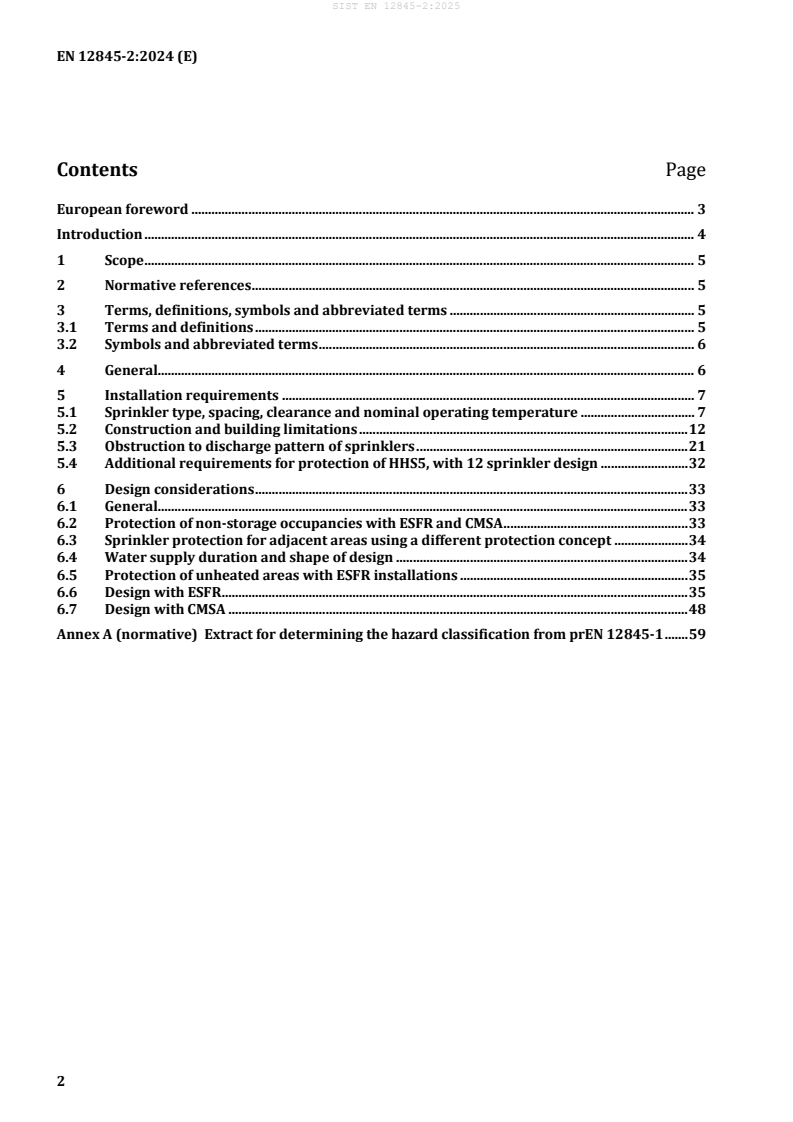
Contents Page
European foreword . 3
Introduction . 4
1 Scope . 5
2 Normative references . 5
3 Terms, definitions, symbols and abbreviated terms . 5
3.1 Terms and definitions . 5
3.2 Symbols and abbreviated terms . 6
4 General. 6
5 Installation requirements . 7
5.1 Sprinkler type, spacing, clearance and nominal operating temperature . 7
5.2 Construction and building limitations . 12
5.3 Obstruction to discharge pattern of sprinklers . 21
5.4 Additional requirements for protection of HHS5, with 12 sprinkler design . 32
6 Design considerations . 33
6.1 General. 33
6.2 Protection of non-storage occupancies with ESFR and CMSA . 33
6.3 Sprinkler protection for adjacent areas using a different protection concept . 34
6.4 Water supply duration and shape of design . 34
6.5 Protection of unheated areas with ESFR installations . 35
6.6 Design with ESFR . 35
6.7 Design with CMSA . 48
Annex A (normative) Extract for determining the hazard classification from prEN 12845-1 . 59
European foreword
This document (EN 12845-2:2024) has been prepared by Technical Committee CEN/TC 191 “Fixed
firefighting systems”, the secretariat of which is held by BSI.
This European Standard shall be given the status of a national standard, either by publication of an
identical text or by endorsement, at the latest by June 2025, and conflicting national standards shall be
withdrawn at the latest by June 2025.
Attention is drawn to the possibility that some of the elements of this document may be the subject of
patent rights. CEN shall not be held responsible for identifying any or all such patent rights.
This document is included in a series of European standards:
— CEN/TS 14816, Fixed firefighting systems - Water spray systems - Design, installation and
maintenance;
— CEN/TS 17551, Fixed firefighting systems - Automatic sprinkler systems - Guidance for earthquake
bracing;
— EN 671 (all parts), Fixed firefighting systems - Hose systems;
— EN 12094 (all parts), Fixed firefighting systems - Components for gas extinguishing systems;
— EN 12101 (all parts), Smoke and heat control systems;
— EN 12259 (all parts), Fixed firefighting systems - Components for sprinkler and water spray systems;
— EN 12416 (all parts), Fixed firefighting systems - Powder systems;
— EN 12845, Fixed firefighting systems - Automatic sprinkler systems - Design, installation and
maintenance;
— EN 13565 (all parts), Fixed firefighting systems - Foam systems;
— EN 14972 (all parts), Fixed firefighting systems - Water mist systems;
— EN 17451, Fixed firefighting systems - Automatic sprinkler systems - Design, assembly, installation and
commissioning of pump sets.
Any feedback and questions on this document should be directed to the users’ national standards body.
A complete listing of these bodies can be found on the CEN website.
According to the CEN-CENELEC Internal Regulations, the national standards organisations of the
following countries are bound to implement this European Standard: Austria, Belgium, Bulgaria, Croatia,
Cyprus, Czech Republic, Denmark, Estonia, Finland, France, Germany, Greece, Hungary, Iceland, Ireland,
Italy, Latvia, Lithuania, Luxembourg, Malta, Netherlands, Norway, Poland, Portugal, Republic of North
Macedonia, Romania, Serbia, Slovakia, Slovenia, Spain, Sweden, Switzerland, Türkiye and the United
Kingdom.
Introduction
ESFR (early suppression fast response) sprinkler protection to this standard utilizes sprinklers in
accordance with EN 12259-13 operating in suppression mode, i.e. which have the capability of markedly
suppressing (reducing the heat release rate of) fires typically within storage risks. ESFR sprinkler
protection tends to be used in high hazard storage scenarios to provide effective ceiling-only sprinkler
protection (although ESFR protection schemes utilizing in-rack sprinkler heads do also exist). Designs
are typically specified in terms of k-factors, numbers of heads operating and required head pressures.
CMSA (Control Mode Specific Application) sprinkler protection to this standard utilizes sprinklers
operating in control mode, i.e. which have the capability of controlling (limiting the heat release rate)
fires within storage risks. CMSA sprinkler protection tends to be used in a variety of specific challenges
of high hazard storage scenarios, where alternative approaches are not considered suitable. Designs are
typically specified in terms of numbers of heads operating and required head pressures.
CMDA (control mode density area) sprinkler protection to EN 12845-1 typically utilizes sprinklers in
accordance with EN 12259-1 operating in control mode, i.e. which have the capability of controlling
(limiting the heat release rate) fires in residential, commercial, industrial or storage applications. CMDA
sprinkler protection tends to be used to good effect in a wide variety of built environment scenarios.
Designs are typically specified in terms of a minimum application rate of water “density” (mm/min) to
be applied over a specified area of operation “area”.
All three approaches are designed to provide rapid and effective control of a fire. The selection of the
most appropriate option is best entrusted to competent personnel. In all cases, it is expected that final
extinguishment to be performed by the Fire and Rescue Service will be necessary.
Both sprinkler types ESFR and CMSA were developed for storage fires. The ESFR sprinkler concept is a
technical innovation developed from CMSA sprinklers. ESFR and CMSA sprinkler designs are less able to
cope with adverse design features and non-compliances (e.g. those caused by incorrect design or change
in practice in the protected premises over time). The risk that design and installation deviations from this
standard are likely to result in a total system failure is highlighted, as is the particular importance of
complying with all the requirements of this standard, without exception.
It is planned to publish an Amendment for EN 12845:2015+A1:2019 to align it with this document and
update the references for ESFR and CMSA requirements. Annex A in this document was added to support
this transition.
1 Scope
This document specifies requirements for the design and installation of early suppression fast response
(ESFR) and control mode specific application (CMSA) sprinklers in automatic sprinkler systems, in
accordance with this standard and additionally the EN 12845 series of standards.
This document does not cover all legislative requirements.
NOTE In certain countries, specific national regulations can apply. Attention is drawn to the applicability or
non-applicability for this document as specified by national responsible authorities.
2 Normative references
The following documents are referred to in the text in such a way that some or all of their content
constitutes requirements of this document. For dated references, only the edition cited applies. For
undated references, the latest edition of the referenced document (including any amendments) applies.
EN 12845:2015+A1:2019, Fixed firefighting systems — Automatic sprinkler systems —Design, installation
and maintenance
EN 12845 (series), Fixed firefighting systems — Automatic sprinkler systems
EN 12259-1, Fixed firefighting systems — Components for sprinkler and water spray systems — Part 1:
Sprinklers
EN 12259-13, Fixed firefighting systems — Components for sprinkler and water spray systems — Part 13:
ESFR sprinklers
prEN 12259-15, Fixed firefighting systems — Components for sprinkler and water spray systems — Part
15: Spray pattern sprinklers with a k-factor of at least K160, extended coverage sprinklers of at least K80
and control mode special application sprinklers
3 Terms, definitions, symbols and abbreviated terms
3.1 Terms and definitions
For the purposes of this document, the terms and definitions given in the EN 12845 series of standards,
EN 12259-1, EN 12259-13, prEN 12259-15 and the following apply.
ISO and IEC maintain terminological databases for use in standardization at the following addresses:
— IEC Electropedia: available at https://www.electropedia.org/
— ISO Online browsing platform: available at https://www.iso.org/obp
3.1.1
open-top containers
boxes having an open top and which can retain water
Note 1 to entry: Containers that have five sides will collect and hold up water that has been discharged from
operating sprinklers thus delaying the water delivery down through the flue spaces where it is needed to either
suppress or control the fire.
Note 2 to entry: Containers with less than five full-height sides redirect the discharged water from operating
sprinklers so that the water delivery down through the flues is not uniform. Five-sided, open-top containers made
of wood, cardboard, plastic, or other combustible material promote faster horizontal fire spread compared to
closed-top combustible containers.
Note 3 to entry: Non-combustible open-top containers help promote faster horizontal fire spread if combustible
containers are located below them within a storage rack. See Clause 4 when open-top containers are present within
a storage rack arrangement.
3.1.2
closed array
roll paper storage arrangement with flues no more than 50 mm in one direction and no more than 25 mm
in the other direction
3.1.3
standard array
roll paper storage arrangement with flues no more than 25 mm in one direction but more than 50 mm in
the other direction
3.1.4
open array
roll paper storage arrangement where air movement through the pile is enhanced because of vertical
flues larger than those in standard or closed array
3.1.5
banded roll paper storage
rolls provided with a circumferential steel strap of 10 mm or wider at each end of the roll
3.2 Symbols and abbreviated terms
For the purposes of this document, the following symbols and abbreviated terms apply.
ESFR early suppression fast response
CMSA control mode specific application
IRAS in-rack automatic sprinkler
EP expanded plastics
UP/EP uncartoned or exposed plastics
CUP/CNP cartoned unexpanded plastic or cartoned nonexpanded plastics
CEP cartoned expanded plastics
UUP/ENP uncartoned unexpanded plastic or exposed nonexpanded plastics
UEP/EEP uncartoned expanded plastic or exposed expanded plastics
4 General
ESFR sprinklers shall be used in wet installations only. CMSA sprinklers may be used in wet and dry
installations. Open top containers shall not be used in storage hazards protected by ESFR or CMSA
sprinklers, unless otherwise specifically stated in a clause in this standard. Open-top non-combustible
containers can be treated as closed-top non-combustible containers when:
• all of the storage located below the open-top non-combustible containers is either non-combustible
or in non-combustible containers, or
• all of the open-top non-combustible containers are located on the bottom tier of the storage rack.
For an overview of the sequence of tasks and their corresponding clauses see Table 1. Annex A shall be
applied for FH and HHS determination.
Table 1 — Overview of the sequence of tasks and their corresponding clauses
Clauses
Tasks
EN 12845:2015+A1:2019 EN 12845-2:2024
Contract planning and Clause 4
documentation
Extent of protection Clause 5
Hazard review, identification and Clauses 6, Annex A, B and C Annex A
classification
Hydraulic design criteria Clause 6
Pipe sizing, layout and hydraulic Clause 13
calculations
Sprinkler system components Clause 14
Installation type and size Clause 11
Spacing and location of sprinklers 5.1.3, 5.2 and 5.3
Obstruction to discharge pattern of 5.3
sprinklers
Valves Clause 15
Pipework and pipe support Clause 17
Alarms and alarm devices Clause 16
Signs, notices, and information Clause 18
Alarm generation, monitoring and Clause 16
transmission to remote manned
station
Water supplies Clause 8 6.4
Type of water supply Clause 9
Pumps Clause 10
Commissioning and first inspection Clause 19
Replacement sprinklers Clause 20.1.4
Maintenance and inspection Clause 20
5 Installation requirements
5.1 Sprinkler type, spacing, clearance and nominal operating temperature
5.1.1 Sprinkler type
ESFR pendent, dry pendent or upright sprinklers in accordance with EN 12259-13 shall be used.
CMSA pendent, dry pendent or upright sprinklers in accordance with prEN 12259-15 shall be used. In
dry CMSA systems only dry pendent and upright sprinkler shall be used.
The design criteria provided in 6.6 and 6.7 are applicable under the condition that the sprinkler has been
successfully tested for the ceiling height, storage height, goods and storage type that are intended.
NOTE 1 The design criteria specified in 6.6 and 6.7 reflects the test results of full-scale fire tests conducted at
various fire test laboratories in line with their test requirements to support various design guidelines. 6.6 therefore
contains information which can seem to overlap or contradict but actually reflects the specific data available.
Sprinkler nominal operating temperature and response characteristic are specified in the design tables
in Clause 6.
NOTE 2 Typically ESFR has a nominal operating temperature of 68 °C to 74 °C and is fast response. CMSA
typically has a nominal operating temperature of 68 °C to 74 °C except for dry systems where it has usually a
nominal operating temperature of 141 °C.
5.1.2 Sprinkler installation type
All requirements for wet or dry installations given in EN 12845 shall be followed unless required
differently in this document.
5.1.3 Sprinkler spacing, location and positioning relative to roof and ceilings
5.1.3.1 General
The linear distance between sprinklers shall be measured along the slope of the ceiling, not on the
viewpoint from floor level.
5.1.3.2 ESFR sprinkler spacing and location
The minimum distance between two sprinklers shall be 2,4 m. The maximum spacing between two
adjacent sprinklers shall be 3,7 m in ceiling height not exceeding 9,1 m and 3,1 m for ceiling height
exceeding 9,1 m. The maximum area per sprinkler shall be 9,3 m . The minimum area per sprinkler shall
be 6 m . The distance to wall shall be no more than 50 % of the maximum allowed distance between
sprinklers.
5.1.3.3 CMSA sprinkler spacing and location
The minimum distance between two sprinklers shall be 2,4 m. The maximum spacing between two
adjacent sprinklers shall be 3,7 m except for combustible obstructed construction where it shall be 3,1 m.
The distance to wall shall be no more than 50 % of the maximum allowed distance between sprinklers.
The maximum area per sprinkler shall be 12 m for STC1 where the ceiling corresponds the following:
• unobstructed and non-combustible;
• obstructed and non-combustible;
• unobstructed and combustible.
2 2
For all other cases it shall be 9,3 m . The minimum area per sprinkler shall be 7,5 m .
5.1.3.4 Exception for spacing and area per sprinkler due to obstruction
The maximum linear spacing of a sprinkler in each direction may be extended by maximum 0,3 m as
demonstrated in Figure 1, only for the purpose to avoid unacceptable obstruction to its discharge by
installed objects. This allows the maximum area to be extended up to 10,2 m .
This may be applied multiple times, but each time the adjacent spacing shall be in accordance with 5.1.3.2
or 5.1.3.3. This is an exception and shall not be applied as a normal standard design.
See Figure 1 for a diagram of this arrangement.
a) Extended spacing between branch lines b) Extended spacing among branch lines
Key
1 standard spacing
2 extended spacing
Figure 1 — Maximum increase in linear and area of coverage to avoid obstructing sprinkler
discharge
5.1.3.5 Vertical distance from the ceiling to sprinkler
5.1.3.5.1 General
Vertical distance shall be measured perpendicularly to the floor, between the sprinkler’s thermal element
to the uppermost portion of the ceiling.
Exceptionally, for corrugated metal deck roofs up to 75 mm in depth, the distance to the deflector shall
be measured from the bottom of the flange. In other cases, the measurement shall be made from the top
of the flange.
5.1.3.5.2 Distance from ceiling to sprinkler deflector
Sprinklers under unobstructed or obstructed construction shall be installed so that the deflector is at
least 100 mm below ceiling. The maximum vertical distance of the deflector below a ceiling shall be in
accordance with Table 2 unless specified differently in Clause 6.
Table 2 — Maximum allowable vertical distance of sprinkler thermal element below the ceiling
Dimensions in millimetres
ESFR obstructed or CMSA CMSA
k-
unobstructed obstructed unobstructed
factor
construction construction construction
160 - 325 225
200 325 - -
240 325 325 225
280 - 325 325
320 425 - -
360 425 325 325
400 325 - -
480 425 - -
5.1.3.5.3 Unobstructed ceiling
For ESFR and CMSA installation, the following shall be considered an unobstructed ceiling:
— smooth ceiling like a suspending ceiling;
— if all solid structural members are equal or less than 100 mm deep;
— if all solid ceiling structural members are equal to or more than 4,3 m apart;
— if solid structural members are deeper than 100 mm and the minimum distance between solid ceiling
structural members for ceiling heights up to 9,0 m is 3,7 m;
— if solid structural members are deeper than 100 mm and the minimum distance between solid ceiling
structural members for ceiling heights greater than 9,0 m is 3,0 m.
In all other cases the ceiling shall be considered to be obstructed.
A solid ceiling structural member is one where its cross-sectional area in a vertical plane is less than 70 %
open.
5.1.3.5.4 Obstructed ceiling – Location of sprinkler in channels
ESFR sprinklers shall be installed in every channel bay formed by obstructed construction except when
the following criteria are met:
• solid structural members extend up to a maximum 300 mm below the ceiling; and
• sprinklers are located below the bottom of the structural members.
Sprinklers shall be installed in every channel in accordance with the minimum and maximum linear
spacing within the channel (see 5.1.3.2). The minimum linear spacing between range pipes shall not apply
to the sprinklers located in adjacent channel bays. See Figure 2.
a) Elevation view
b) Plan view
Key
1 Sprinkler spacing less than required minimum
2 Sprinkler spacing per required linear spacing
Figure 2 — Spacing of sprinklers when installed in every bay channel formed by solid structural
members
CMSA sprinklers with a standard response element shall be installed in every channel bay formed by
obstructed construction except when the following criteria are fulfilled:
• solid structural members extend up to a maximum 600 mm below the ceiling; and
• the deflector shall be installed in a vertical distance of 25 mm to 150 mm below a non-combustible
solid structural member. If a solid structural member extends more than 300 mm below the ceiling,
formed channel bays shall not exceed 28 m in area and shall not be horizontally wider than 0,9 m;
or
• the deflector shall be installed in a vertical distance of 25 mm to 100 mm below a solid structural
member if combustible and if it extends 300 mm to 525 mm below the ceiling and formed channel
bays shall not exceed 28 m in area; or
• the deflector shall be installed up to 550 mm below the ceiling and in a vertical distance of 25 mm to
150 mm below the solid structural member if it is non-combustible and extends in a vertical distance
of 300 mm to 525 mm below the ceiling to form channel bays which shall not exceed 28 m in area.
The same installation criteria as above shall be applied if a non-combustible solid structural member
forms channel bays that exceed 28 m in area with a horizontal separation of 0,9 m to 2,3 m.
5.1.3.6 Sprinkler orientation relative to the floor or pipework
Sprinklers shall be preferably installed with the deflector parallel to the floor; they may also be installed
parallel to the ceiling where the slope is no more than 10°.
5.1.3.7 Vertical clearance below sprinklers
At least 1 m of clear space between ceiling sprinkler deflectors and the top of storage shall be maintained.
5.1.3.8 Positioning of sprinklers relative to draft curtains
Draft curtains should preferably not be installed within sprinkler arrays. Where required, the sprinklers
on either side of the draft curtain should be generally equally spaced from the draft curtain. The
obstruction criteria shall be fulfilled.
NOTE 1 The distance of sprinklers from the draft curtain can vary along the length of the draft curtain if there
are changes in sprinkler spacing.
NOTE 2 Draft curtains have been shown to have a negative effect on sprinkler effectiveness. If they are required,
special consideration needs to be applied in order to make any negative impact minimal.
5.2 Construction and building limitations
5.2.1 Roof or ceiling slope
The maximum ceiling slope shall not be higher than 10° (17,6 %). For ceiling slopes that exceed the
maximum 10°, the following options shall be used:
• a flat, continuous horizontal false ceiling shall be installed over the affected area and for two lines of
sprinkler beyond in all directions. The false ceiling shall be designed in accordance with 5.2.2. The
area above the false ceiling shall be sprinkler protected. Sprinkler protection beneath the false ceiling
according to the relevant occupancy hazard shall be provided; or
• for areas with only rack storage, provide in-rack sprinklers in accordance with 6.6.2.1 plus an
additional level of in-rack sprinklers installed at the top of storage including face sprinklers at the
same spacing as the longitudinal sprinklers; or
• sprinkler system design shall be in accordance with EN 12845.
5.2.2 Strength of ceilings, sub-ceilings and suspended ceilings
Ceilings, sub-ceilings and suspended ceilings including solid barriers shall be firmly secured and shall be
capable of withstanding a vertical upward thrust of 140 N/m .
EXAMPLE Ceiling materials considered suitable are 10 mm gypsum board, corrugated and sheet steel and mineral
tiles.
5.2.3 Skylights
Skylights shall be capable of withstanding a temperature of 300 °C for a period of at least 5 min. Skylights
with a volume greater than 1 m measured above the normal ceiling level shall be sprinkler protected
unless the distance from the normal ceiling level to the top of the skylight does not exceed 0,3 m, or there
is a tightly fitting frame and glass level with the roof or ceiling. Any additional sprinklers in a skylight
should be of the same type as the sprinklers around the skylight.
If sprinkler design is based on building height including skylight dome normal spacing can be applied. If
distance between the top of skylight exceeds 0,3 m and the design exceeds the maximum building height
use option 1 in Figure 3 or option 2 in Figure 4. If these options are applied, design for 0,3 m higher than
ceiling.
a) Elevation view
b) Plan view
Key
1 Upright or pendent ceiling level sprinklers 5 ≤ 50 % max. allowable linear spacing
2 Ceiling 6 Ceiling level sprinklers
3 Plastic skylight 7 Quick-response sprinklers under plastic skylights
4 Supplemental sprinklers
The supplemental sprinklers shall be quick response and pendent (when available) sprinklers. The
maximum ceiling height of the plastic skylight shall be used for design purposes. The supplemental
sprinklers shall not be included in the ceiling level sprinkler design.
Figure 3 — Protection of plastic skylights using quick-response sprinklers, Option 1
a) Elevation view
b) Plan view
Key
1 Plastic skylight 5 Installed at the same elevation level
2 Upright or pendent ceiling level sprinkler 6 Supplemental sprinklers
3 Ceiling 7 Ceiling level sprinklers
4 ≤ 50 % max. allowable linear spacing 8 Quick response sprinklers under plastic
skylights at the same elevation as ceiling
sprinklers
Supplemental sprinkler shall be the same as ceiling sprinklers except as follows: quick-response and
pendent sprinklers (when available) shall be used. The maximum ceiling height of the main building shall
be used for design purposes. The supplemental sprinklers shall not be included in the ceiling level
sprinkler design.
Figure 4 — Protection of plastic skylights using quick-response sprinklers, Option 2
5.2.4 Heat and smoke vents or other ceiling vents
In ESFR or CMSA installations only manual smoke or heat vents shall be used. Drop-out-type heat vents
shall not be installed.
If national regulations require the installation of automatic smoke and heat vents, the operation and
performance of the sprinkler system shall not be impaired by the venting system. To achieve this, the
following solutions shall be applied:
• Where the installation is an ESFR or CMSA installation corresponding sprinklers, directly under the
vent opening, evenly distributed on a maximum 1,2 m linear spacing with a maximum distance of
0,6 m to the edge of the vent shall be installed. When installing the sprinkler inside a skylight the
requirements for minimum and maximum vertical distances (see 5.1.3.5.2) to the ceiling shall not be
applied between the deflector and the closed skylight. Ensure these sprinklers have, at a minimum,
the same k-factor and orientation as the adjacent ceiling-level sprinklers and are fed by sprinkler
piping no smaller than the ceiling level range pipes. Sprinklers located under the ceiling vent and
installed as outlined above don’t need to be added to the hydraulic design of the ceiling sprinkler
system. See Figure 5 for a diagram of this arrangement; or
• Vents equipped with a standard-response 141 °C or higher nominal thermal activating device shall
be installed; or
• Automatic smoke vents shall be individually activated.
Dimensions in metres
a) Elevation view
b) Plan view
Key
1 automatic heat, smoke or ceiling vent and skylights
2 ceiling level sprinkler
Figure 5 — ESFR or CMSA sprinklers installed under automatic smoke, heat vents and skylights
5.2.5 Natural exhaust openings at the ceiling
Where the installation is an ESFR or CMSA installation corresponding sprinklers shall be installed directly
under the natural exhaust opening, evenly distributed on a maximum 1,2 m linear spacing with a
maximum distance of 0,6 m to the edge of the exhaust. When installing the sprinkler inside an exhaust
the requirements for minimum and maximum vertical distances (see 5.1.3.5.2) to the ceiling shall be
applied between the deflector and the apex of the vent. These sprinklers shall have the same k-factor and
orientation as the adjacent ceiling-level sprinklers and are fed by sprinkler piping no smaller than the
ceiling level range pipes. Sprinklers located under the ceiling vent and installed as outlined above do not
have to be included in the hydraulic design of the ceiling sprinkler system. See Figure 6 for a diagram of
this typical arrangement.
a) Elevation view
b) Plan view
Key
1 Ridge vent
2 Ceiling level sprinkler
3 Ceiling level branchline piping
Figure 6 — Additional sprinklers installed under ceiling-level exhaust devices
5.2.6 Exhaust openings with or without fans and airflow velocities at ceiling-level
5.2.6.1 Horizontal airflow
Air-ventilation equipment shall be arranged in such a way that the airflow velocity at any ceiling-level
sprinkler shall not exceed 1,5 m/s or to stop automatically upon early fire detection.
If it is not possible to avoid airflow velocities in excess of 1,5 m/s at ceiling-level sprinklers, one of the
following options shall be applied (see Figure 7):
• flame detection shall be installed at ceiling level; or
• linear heat detection within the storage racks.
Either type of detection system shall be arranged to automatically shut down the flow of air upon detector
actuation.
For flame detection, the detectors shall be arranged to monitor the area located within a 3,0 m radius
from all affected sprinklers.
For linear heat detection, the detection shall be installed at the top of the storage rack structure, within
all transverse flue spaces that are within a 3,0 m radius of any sprinkler affected by the higher velocity.
The nominal temperature rating of the linear heat detection should be as low as permissible based on
ambient temperature conditions.
Directly underneath the openings no storage is permitted, the horizontal distance between stored goods
and the perimeter of the extraction openings shall be not less than L (in m) given by the equation:
L = 1/2S + d
where
S is the sprinkler spacing (in m);
L is the horizontal distance between stored goods (in m);
d is the ventilation duct diameter (in m).
A horizontal sub-ceiling shall be installed below the openings, sprinklers shall be located below the sub-
ceiling in accordance with the normal spacing requirements. The sub-ceiling shall have a minimum
diameter or cross-sectional dimension W in m given by either of the equations below:
• if the ventilation airflow rate is known:
W = Q / (283 min/m x h)
• if the ventilation airflow rate is unknown:
W = 2,6 A* / h
where
Q
is the ventilation air flow rate (in m /min);
A*
is the ventilation opening area (in m );
h is the vertical distance between ceiling and top of the sub-ceiling (in m).
Ceiling sprinklers shall be a horizontal distance of at least 0,7 times the sprinkler spacing from the
perimeter of the sub-ceiling.
Extraction fans and fire dampers shall be closed before the first sprinkler operates. Fire detection and
fire alarm systems shall be either:
• aspirating smoke detectors shall be installed in all ventilation ducts extracting from the ESFR or CMSA
protected risk; or
• a fire detection and fire alarm system with detection performance equivalent to an aspirating smoke
detection system.
If the air flow rate through the fan is not known then the duct velocity should be measured using a suitable
device, such as pitot tube and micromanometer.
The air flow rate Q (in m /min) through a circular cross-sectional duct can be calculated using the
equation:
Q = (49 / 60) × A × V
where
A
is the cross-sectional area of a circular duct (in m );
V is the maximum velocity through the duct (in m/min).
Key
1 sub-ceiling dimension – W (in m) 6 diameter D in m
2 sub-ceiling sprinkler 7 ceiling
3 roof or ceiling sprinkler 8 vertical distance between sub-ceiling and vent opening – h (in m)
4 sub-ceiling 9
ventilator air flow rate – Q (in m /min)
5 fan/vent 10 0,7 × spacing
Figure 7 — Sprinklered sub-ceiling below a ceiling vent or fan
5.2.6.2 Vertical airflow
For storage types of occupancies, any airflow shall be arranged taking place between the top of storage
and a horizontal plane located at the ceiling-level sprinklers so that the airflow velocity does not exceed
1,5 m/s. See Figure 8.
Key
1 Ceiling
2 Ceiling level sprinkler
3 Air handling system (e.g. fan)
Figure 8 — Demonstration of airflow velocities that exceed 1,5 m/s perpendicular to the floor
The following options can be used:
— Option 1: Automatic shutdown of airflow upon activation of sprinkler system waterflow alarm.
— Option 2: Flame detection shall be installed at ceiling level to monitor the area located within a 3,0 m
radius of any affected ceiling sprinklers and arrange the detection to automatically shut down the
flow of air upon activation.
— Option 3: For a wet sprinkler system, the design shall be increased area by 30 %.
— Option 4: A flat, continuous false ceiling shall be installed over the affected area and install ceiling-
level sprinklers below it, using the same branch line pipe and sprinkler spacing installed at ceiling
level.
— Option 5: Line-type detection shall be installed at the top of the storage rack structure, within all
transverse flue spaces that are within a 3,0 m radius of any affected ceiling sprinklers. Arrange the
detection to automatically shut down the flow of air upon activation.
— Option 6: Ceiling-level sprinklers shall be installed as in-rack sprinklers at all flue space intersections
where the airflow velocities above the flue space intersections 1,5 m/s.
5.2.7 Solid mezzanines
Quick-response or ESFR sprinklers shall be installed under solid mezzanines that have combustible
construction and/or a combustible occupancy located below them. With the exception of standard-
response sprinklers which can be installed under a solid mezzanine when:
• a line of sprinkler is located no more than 0,6 m from the edge of the mezzanine and all storage or
combustible goods under the mezzanine are located within the boundary created by these perimeter
sprinklers, or
• a smoke curtain is provided around the perimeter of the mezzanine.
For the use of CMDA sprinklers see EN 12845.
The design of the mezzanine-level sprinkler protection shall be based on the height of the mezzanine and
the occupancy located underneath it.
5.3 Obstruction to discharge pattern of sprinklers
5.3.1 General
For ceiling protection, the obstruction requirements as well as the requirements to compensate for
obstructions are the same for ESFR and CMSA system designs.
5.3.2 Obstruction located at or near ceiling
In addition to the limits of obstructed and unobstructed ceilings, pendent and upright sprinklers shall be
installed on standard spacing in accordance with Figures 9 and 11 and Table 3 to avoid obstructing the
umbrella discharge pattern of the sprinklers. Interpolation between values given in Table 3 is permitted
as shown in Figures 9 and 10. No objects shall be located less than 300 mm horizontally from the
sprinkler unless minimum 50 mm above the horizontal plane of the sprinkler deflector.
Key
H horizontal distance to edge of obstruction 2 service pipe or similar
V vertical distance to edge of obstruction 3 centreline
1 duct, beam or similar
NOTE Objects are not considered obstructions when located entirely within the checkerboard area.
Figure 9 — Objects at or near ceiling level not considered obstruction to ESFR and CMSA
sprinkler
Key
H horizontal distance to edge of obstruction 1 beam
V vertical distance to edge of obstruction 3 centreline
NOTE Objects less than 70 % open in their vertical profile.
Figure 10 — Example of objects at ceiling level considered to obstruct ESFR and CMSA sprinkler
Dimensions in millimetres
Key
H horizontal distance to edge of obstruction 3 upright or pendent sprinkler
W width of the obstruction
1 obstruction (e.g. beam, curtain or girder) 4 distance between bottom of 1 and top of 5
2 ceiling 5 storage occupancy
NOTE 1 H ≤ 50 % max. allowable linear spacing.
NOTE 2 If W is > 300 mm and ≤ 600 mm then 4 is ≥ 900 mm above the top of storage, if W is ≤ 300 mm then 4 is
≥ 450 mm above the top of storage. If W is more than 600 mm then additional sprinklers are required.
Figure 11 — Positioning at or near ceiling level sprinklers when structural members obstruct
sprinkler discharge of ESFR and CMSA sprinkler
Table 3 — Minimum horizontal distance of ceiling objects to avoid obstructing umbrella
patterns of sprinklers
Maximum vertical distance of
Minimum horizontal distance
ceiling object located below
from sprinkler
sprinkler deflector
mm mm
50 300
100 500
150 700
200 800
300 1 000
500 1 300
900 1 800
An object located at or near ceiling level that is entirely within the gridded pattern shown in Figures 9 to
11 shall not be considered an obstruction to the sprinkler discharge pattern. Any object located at or near
ceiling level that extends downward into the area below the gridded pattern in Figures 9 to 11 shall be
considered an obstruction to the sprinkler discharge pattern.
An exception to this is when the object that is located at or near ceiling level is a structural member or
similar that is at least 70 % open (see Note in Figure 10). If not, the obstructions shall be accounted for
by using either of the two following methods:
• obstructed sprinkler shall be relocated so it is in accordance with the horizontal and vertical distances
in Figures 9 to 11;
• sprinklers on both sides of the obstruction shall be installed as follows:
• at equal horizontal distances from the obstruction; and
• a minimum of 300 mm horizontally from the edge of the obstruction.
5.3.3 Obstruction entirely below sprinkler deflector level
5.3.3.1 Grouped obstructions
Two or more adjacent objects shall be collectively considered one object (grouped obstruction) for
obstruction evaluation purposes when the horizontal distance between them is less than 3 times the
width of the smallest object but never less than 150 mm. Under these conditions the width of the grouped
obstruction shall be considered the width of both objects’ least dimensions plus the horizontal distance
between them (see Figure 12). If an object is separated from adjacent objects by a distance that is equal
or greater than 3 times the object’s least dimension or a minimum of 150 mm, it is considered as an
individual object for obstruction evaluation purposes.
----
...